


 |
市場調查報告書
商品編碼
2122308
軟性混合電子元件(FHE):市場佔有率分析、產業趨勢與統計及成長預測(2026-2031 年)Flexible Hybrid Electronics (FHE) - Market Share Analysis, Industry Trends & Statistics, Growth Forecasts (2026 - 2031) |
||||||

※ 本網頁內容可能與最新版本有所差異。詳細情況請與我們聯繫。
據 Mordor Intelligence 稱,軟性混合電子市場預計到 2026 年價值 2.5439 億美元,高於 2025 年的 2.1476 億美元,預計到 2031 年將達到 5.9342 億美元。
預計從 2026 年到 2031 年,其複合年成長率將達到 18.46%。
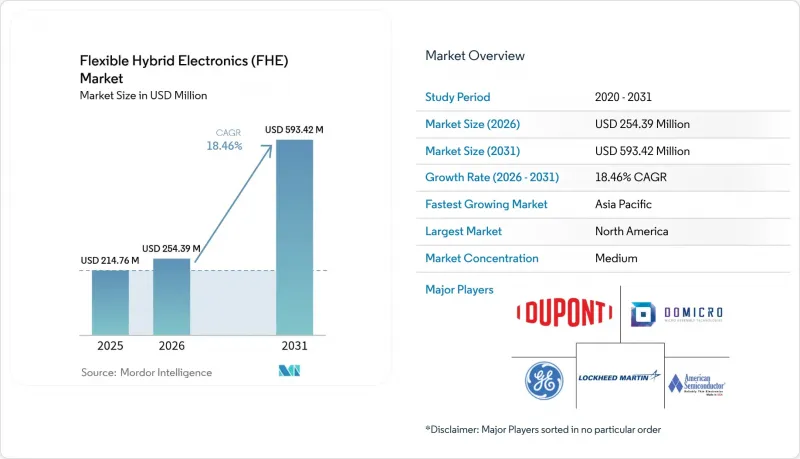
本報告按組件(軟性感測器、軟性顯示器及其他)、基板(聚醯亞胺、PET、PEN及其他)、終端應用產業(醫療保健/醫藥、消費性電子、工業製造及其他)、製造流程(片對片、卷對卷、轉印及其他)和地區進行細分。市場預測以美元計價。
全球軟性混合電子(FHE)市場趨勢與洞察
對輕量、機械柔軟性、經濟實惠的產品有需求。
目前,消費品牌之間的競爭不再侷限於性能的漸進式提升,而是在外形規格的自由度上展開。三星顯示器推出的18.1吋折疊式OLED面板,能夠承受超過50萬次的折疊循環,證明了高階設備的可靠性標準是可以達到的。同時,在對成本高度敏感的市場中,紙本和纖維素基板正被用於生產一次性電子產品,應用於物流、智慧標籤和一次性醫療檢測等領域。 VARTA AG公司利用回收材料開發的多層印刷電池,展示了永續設計目標與軟性電源需求如何兼顧。這些進步共同拓展了軟性混合電子產品市場的潛在基本客群,並推動了價值鏈各環節的創新設計。
政府資助的商業化計劃
自2015年以來,NextFlex已投資1.65億美元,用於將試點階段的概念轉化為量產,並計劃在2024年和2025年分別投入530萬美元和500萬美元,用於卷對卷(R2R)規模化生產和套模電子技術。獲得津貼的企業正透過技術工作小組合作,以規範材料、測量技術和人力資源開發,從而縮短中小企業的學習曲線。在歐洲,IMEC投資1,400萬歐元的PI-SCALE生產線實現了軟性薄膜微處理器在多個獨立晶圓廠生產的代工模式。這些措施透過消除高成本設備帶來的障礙並縮短產品上市時間,將軟性混合電子市場的預期複合年成長率提高2.8個百分點。
需要大量的研發費用和資本投資。
卷對卷 (R2R) 光子燒結、超薄晶片處理以及精密印刷夾具等都需要數百萬美元的投入,這使得中小企業 (SME) 難以獲得資金籌措。雖然部分成本可以透過政府津貼來抵消,但多個製程階段仍需要客製化夾具。與軟體相比,資本密集硬體的創業融資仍然有限,這阻礙了新進業者進入軟性混合電子市場,並延長了現有投資者的投資回報期。
細分市場分析
到2025年,軟性顯示器將佔據軟性混合電子產品市場41.02%的佔有率,這印證了早期對折疊式和可捲曲等外形規格的投資是合理的。成熟的量產晶圓廠和願意為新穎用戶體驗支付溢價的消費者為此細分市場提供了支撐。隨著超薄、可貼合形狀的感測層在醫療保健、工業IoT和智慧包裝等領域得到應用,感測器領域正以18.96%的複合年成長率成長。可拉伸鋰離子電池等儲能元件呈現兩位數成長,確保了行動裝置和一次性裝置的自主運作。軟性積體電路晶片仍面臨技術挑戰,但對板載處理至關重要;而軟性天線則透過實現強大的無線連接,解決了性能方面的難題。
產品多元化加劇了競爭,但也加速了生態系統的成熟。顯示器供應商正在將現有的OLED平台擴展到透明和多折疊式設計領域,由此產生的技術溢出效應正被感測器和電池供應商用於升級其捲對捲製造流程。薄膜電晶體穩定性的突破性進展正在縮小與剛性驅動IC的性能差距,從而提高軟性混合電子市場的整體系統可靠性。
預計到2025年,聚醯亞胺將在軟性混合電子市場佔據45.78%的佔有率,這主要得益於其在回流焊接中優異的耐高溫性能以及在航太環境中良好的化學穩定性。然而,纖維素基板正迅速崛起(年複合成長率19.02%),這主要得益於生態設計法規的推動以及品牌對永續性的承諾。此外,PET薄膜由於能夠利用光子燒結技術進行低溫金屬化,再次受到關注,並逐漸成為大面積電路的經濟高效的替代材料。
目前,材料的選擇取決於每種應用的熱性能、機械性能和環境性能。聚醯亞胺在對可靠性要求高的市場(例如國防領域)仍然是首選材料,而與現有印刷基礎設施相容的紙捲材則在亞太地區的包裝生產線中佔據主導地位。彈性體基板可用於製造可拉伸的穿戴式設備,但其耐洗滌性方面仍存在技術挑戰。每種基板都在推動製程創新,並擴大軟性混合電子市場的潛在基本客群。
區域分析
預計到2025年,北美將佔總收入的38.10%,這得益於NextFlex的資金籌措儲備以及在國防、航太和醫療設備領域強大的生態系統。聯邦津貼降低了研發風險,而契約製造網路則加速了從試生產到大規模生產的過渡。加拿大憑藉其在先進材料和航太認證電路方面的特色優勢,進一步增強了該地區廣泛的競爭優勢。
預計到2031年,亞太地區將以18.97%的複合年成長率(CAGR)實現全球最高成長。這反映了中國在顯示器和智慧型手機製造領域的領先地位,以及日本在材料技術方面的專長和韓國在OLED技術領域的領先地位。地方政府為卷對卷(R2R)生產線提供補貼以實現大規模生產,電動車的普及也刺激了對套模電子儀錶板的需求。因此,亞太地區軟性混合電子市場預計將快速擴張,跨國供應商正紛紛成立合資企業以掌握該地區的成長機會。
在歐洲,汽車和工業領域的機會持續推動成長動能。 IMEC 的 PI-SCALE 試點生產線證明了代工模式在降低新創企業准入門檻方面的有效性,而強調永續性的監管趨勢正在推動纖維素基板的應用,尤其是在德國和法國。在中東和非洲,人們正在探索將軟性太陽能電池用於偏遠地區的離網供電;而在以巴西為首的南美洲,軟性電路正被應用於消費性電子產品和包裝領域。整體而言,儘管不同地區的應用速度有所差異,但跨境最佳實踐正透過全球合作不斷傳播。
其他好處
- Excel格式的市場預測(ME)表
- 3個月的分析師支持
目錄
第1章:引言
- 研究假設和市場定義
- 調查範圍
第2章:調查方法
第3章執行摘要
第4章 市場狀況
- 市場概覽
- 彈性混合電子生態系分析
- 市場促進因素
- 對輕量、機械柔軟性、經濟實惠的產品有需求。
- 政府資助的商業化計劃
- 穿戴式健康監測設備的普及
- 大規模生產包裝中向低成本PET和紙質基材過渡
- 光子燒結和低溫焊接技術使得PET的應用成為可能。
- 汽車內裝中的套模結構電子元件
- 市場限制因素
- 需要大量的研發費用和資本投資。
- 供應鏈標準和複雜性的差異
- 薄壁模具在反覆彎曲載重下的可靠性
- 缺乏快速且低成本的線上檢測方法
- 產業價值鏈分析
- 監理情勢
- 技術展望與家庭教育藍圖
- 宏觀經濟因素的影響
- 波特五力分析
- 宏觀經濟因素的影響
- 專利分析
- 政府資助的研究中心
- NextFlex
- 霍斯特中心
- IMEC
- 芬蘭VTT技術研究中心有限公司
- CPI
- CEA-Liten
- 韓國機械與材料實驗室
第5章 市場規模與成長預測
- 按組件
- 軟性感測器
- 軟性顯示器
- 軟性電池和儲能
- 軟性積體電路晶片
- 軟性天線和射頻組件
- 軟性記憶體
- 軟性太陽能電池
- 按基板
- 聚醯亞胺(PI)
- PET
- PEN
- TPU/彈性體
- 紙張和纖維素
- 織物和紡織品
- 按最終用途行業分類
- 醫療保健
- 家用電子產品
- 工業製造
- 包裝/物流
- 車
- 航太/國防
- 能源與公共產業
- 農業
- 透過製造程序
- 座位對座位 (S2S)
- 卷對卷(R2R)
- 轉印
- 套模電子裝置(IME)
- 拾取放置混合組裝
- 3D/積層製造
- 按地區
- 北美洲
- 美國
- 加拿大
- 南美洲
- 巴西
- 阿根廷
- 其他南美國家
- 歐洲
- 德國
- 英國
- 法國
- 義大利
- 西班牙
- 俄羅斯
- 其他歐洲國家
- 亞太地區
- 中國
- 日本
- 韓國
- 印度
- 澳洲和紐西蘭
- 其他亞太國家
- 中東
- GCC
- 土耳其
- 其他中東國家
- 非洲
- 南非
- 奈及利亞
- 其他非洲地區
- 北美洲
第6章 競爭情勢
- 市場集中度
- 策略趨勢
- 市佔率分析
- 公司簡介
- DuPont de Nemours, Inc.
- DuPont Teijin Films US Limited Partnership
- DoMicro BV
- General Electric Company
- Lockheed Martin Corporation
- American Semiconductor, Inc.
- Flex Ltd.
- Brewer Science, Inc.
- Integrity Industrial Inkjet Integration, Inc.
- Antenna Research Associates, Inc.
- Epicore Biosystems, Inc.
- TactoTek Oy
- PragmatIC Semiconductor Ltd.
- Samsung Electronics Co., Ltd.
- LG Display Co., Ltd.
- Molex, LLC
- 3M Company
- TE Connectivity Ltd.
- FlexEnable Limited
- Interlink Electronics, Inc.
- Blue Spark Technologies, Inc.
- Enfucell Oy
第7章 市場機會與未來展望
According to Mordor Intelligence, flexible hybrid electronics market size in 2026 is estimated at USD 254.39 million, growing from 2025 value of USD 214.76 million with 2031 projections showing USD 593.42 million, growing at 18.46% CAGR over 2026-2031.
This report is Segmented by Component (Flexible Sensors, Flexible Displays, and More), Substrate Material (Polyimide, PET, PEN, and More), End-Use Industry (Healthcare and Medical, Consumer Electronics, Industrial Manufacturing, and More), Manufacturing Process (Sheet-To-Sheet, Roll-To-Roll, Transfer Printing, and More), and Geography. The Market Forecasts are Provided in Terms of Value (USD).
Global Flexible Hybrid Electronics (FHE) Market Trends and Insights
Lightweight, mechanically-flexible and cost-effective product demand
Consumer-facing brands now compete on form-factor freedom rather than incremental performance gains. Samsung Display's 18.1-inch foldable OLED panel with more than 500,000 fold cycles demonstrated that reliability thresholds for premium devices are achievable. Simultaneously, cost-sensitive markets are embracing paper and cellulose substrates that support disposable electronics for logistics, smart labels, and one-time medical tests. VARTA AG's multilayer printed battery based on recycled inputs shows how sustainable design goals can coexist with the need for flexible power sources. Collectively, these advances widen the accessible customer base for the flexible hybrid electronics market and stimulate fresh design activity across multiple tiers of the value chain.
Government-funded commercialization programs
NextFlex has deployed USD 165 million since 2015 to move pilot concepts toward volume production, allocating USD 5.3 million in 2024 and USD 5.0 million in 2025 to R2R scale-up and in-mold electronics. Grant recipients coordinate through technical working groups that standardize materials sets, metrology, and workforce training, shortening learning curves for smaller firms. In Europe, IMEC's EUR 14 million PI-SCALE line delivered a foundry model that produced flexible thin-film microprocessors across several independent fabs. Such initiatives address costly equipment barriers and accelerate time-to-market, adding 2.8 percentage points to forecast CAGR for the flexible hybrid electronics market.
High R&D and capex requirements
Tooling for R2R photonic sintering, ultra-thin die handling, and precision printing incurs multimillion-dollar outlays that smaller enterprises struggle to finance. Although public grants offset some cost, multiple process steps still require bespoke fixtures. Venture financing for capital-heavy hardware remains limited compared with software, curbing entry of new players into the flexible hybrid electronics market and prolonging payback periods for existing investors.
Other drivers and restraints analyzed in the detailed report include:
- Wearable health monitoring proliferation
- Shift to low-cost PET/paper substrates for high-volume packaging
- Fragmented standards and supply-chain complexity
For complete list of drivers and restraints, kindly check the Table Of Contents.
Segment Analysis
Flexible displays contributed 41.02% of the flexible hybrid electronics market share in 2025, validating early investments in foldable and rollable form factors. The segment benefits from established mass-production fabs and premium consumer willingness to pay for novel user experiences. Sensors are advancing at a 18.96% CAGR as healthcare, industrial IoT, and smart packaging adopt thin, conformal sensing layers. Energy storage elements such as stretchable lithium-ion batteries are witnessing double-digit growth, ensuring autonomous operation for mobile or disposable devices. Flexible IC dies remain technically challenging yet strategically critical for on-board processing, while flexible antennas close the performance loop by enabling robust wireless links.
Product diversification has intensified competition yet accelerated ecosystem maturation. Display vendors extend existing OLED platforms toward transparent and multi-fold designs, creating technology spill-overs that sensor and battery suppliers exploit for their own roll-to-roll upgrades. Breakthroughs in thin-film transistor stability are narrowing performance gaps with rigid driver ICs, improving overall system reliability in the flexible hybrid electronics market.
Polyimide held 45.78% share of the flexible hybrid electronics market size in 2025 due to its high-temperature resilience during solder reflow and chemical robustness in aerospace settings. Yet cellulose substrates are rising quickly (19.02% CAGR) on the back of eco-design regulations and brand sustainability pledges. PET films have reclaimed attention as photonic sintering unlocked low-temperature metallization, positioning PET as a cost-efficient alternative for large-area circuits.
Material choice now hinges on an application's thermal, mechanical, and environmental profile. High-reliability markets such as defense continue to favor polyimide, whereas packaging lines in APAC gravitate toward paper webs that match existing printing infrastructure. Elastomeric substrates enable stretchable wearables, though washing durability poses engineering hurdles. Each substrate advances process innovation, expanding the addressable customer base for the flexible hybrid electronics market.
Complete Report Scope:
- By Component
- Flexible Sensors
- Flexible Displays
- Flexible Batteries and Energy Storage
- Flexible IC Dies
- Flexible Antennas and RF Components
- Flexible Memory
- Flexible Photovoltaics
- By Substrate Material
- Polyimide (PI)
- PET
- PEN
- TPU/Elastomeric
- Paper and Cellulose
- Fabric/Textile
- By End-use Industry
- Healthcare and Medical
- Consumer Electronics
- Industrial Manufacturing
- Packaging and Logistics
- Automotive
- Aerospace and Defense
- Energy and Utilities
- Agriculture
- By Manufacturing Process
- Sheet-to-Sheet (S2S)
- Roll-to-Roll (R2R)
- Transfer Printing
- In-Mold Electronics (IME)
- Pick-and-Place Hybrid Assembly
- 3D / Additive Printing
- By Geography
- North America
- United States
- Canada
- South America
- Brazil
- Argentina
- Rest of South America
- Europe
- Germany
- United Kingdom
- France
- Italy
- Spain
- Russia
- Rest of Europe
- Asia Pacific
- China
- Japan
- South Korea
- India
- Australia and New Zealand
- Rest of Asia Pacific
- Middle East
- GCC
- Turkey
- Rest of Middle East
- Africa
- South Africa
- Nigeria
- Rest of Africa
- North America
Geography Analysis
North America commanded 38.10% of total revenue in 2025, supported by NextFlex's funding pipeline and strong defense, aerospace, and medical device ecosystems. Federal grants de-risk R&D, while a network of contract manufacturers accelerates pilot-to-production transitions. Canada contributes niche strengths in advanced materials and space-qualified circuitry, complementing the region's broader competitive edge.
Asia-Pacific records the highest regional CAGR at 18.97% through 2031, reflecting China's dominance in display and smartphone manufacturing coupled with Japan's materials expertise and South Korea's leadership in OLED technology. Local governments offer subsidies for high-volume R2R lines, and electric vehicle adoption stimulates demand for in-mold electronics dashboards. The flexible hybrid electronics market size in Asia-Pacific is therefore poised for rapid scaling, with multinational suppliers forming joint ventures to tap regional growth.
Europe maintains momentum through automotive and industrial opportunities. IMEC's PI-SCALE pilot line validates a foundry model that reduces entry barriers for startups, while regulatory emphasis on sustainability encourages cellulose substrate adoption, particularly in Germany and France. The Middle East and Africa explore flexible photovoltaics for off-grid power in remote areas, whereas South America, led by Brazil, integrates flexible circuits into consumer appliances and packaging. Overall, geography dictates adoption speed but global collaboration continues to spread best practices across borders.
- DuPont de Nemours, Inc.
- DuPont Teijin Films U.S. Limited Partnership
- DoMicro BV
- General Electric Company
- Lockheed Martin Corporation
- American Semiconductor, Inc.
- Flex Ltd.
- Brewer Science, Inc.
- Integrity Industrial Inkjet Integration, Inc.
- Antenna Research Associates, Inc.
- Epicore Biosystems, Inc.
- TactoTek Oy
- PragmatIC Semiconductor Ltd.
- Samsung Electronics Co., Ltd.
- LG Display Co., Ltd.
- Molex, LLC
- 3M Company
- TE Connectivity Ltd.
- FlexEnable Limited
- Interlink Electronics, Inc.
- Blue Spark Technologies, Inc.
- Enfucell Oy
Additional Benefits:
- The market estimate (ME) sheet in Excel format
- 3 months of analyst support
TABLE OF CONTENTS
1 INTRODUCTION
- 1.1 Study Assumptions and Market Definition
- 1.2 Scope of the Study
2 RESEARCH METHODOLOGY
3 EXECUTIVE SUMMARY
4 MARKET LANDSCAPE
- 4.1 Market Overview
- 4.2 Flexible Hybrid Electronics Ecosystem Analysis
- 4.3 Market Drivers
- 4.3.1 Lightweight, mechanically-flexible and cost-effective product demand
- 4.3.2 Government-funded commercialization programs
- 4.3.3 Wearable-health monitoring proliferation
- 4.3.4 Shift to low-cost PET/paper substrates for high-volume packaging
- 4.3.5 Photonic sintering and low-temp solders enabling PET adoption
- 4.3.6 In-mold structural electronics in vehicle interiors
- 4.4 Market Restraints
- 4.4.1 High R&D and capex requirements
- 4.4.2 Fragmented standards and supply-chain complexity
- 4.4.3 Reliability of thinned dies under cyclic bending
- 4.4.4 Absence of fast, low-cost inline test/inspection
- 4.5 Industry Value Chain Analysis
- 4.6 Regulatory Landscape
- 4.7 Technological Outlook and FHE Roadmap
- 4.8 Impact of Macroeconomic Factors
- 4.9 Porter's Five Forces Analysis
- 4.9.1 Threat of New Entrants
- 4.9.2 Bargaining Power of Buyers
- 4.9.3 Bargaining Power of Suppliers
- 4.9.4 Threat of Substitutes
- 4.9.5 Intensity of Competitive Rivalry
- 4.10 Impact of Macroeconomic Factors
- 4.11 Patent Analysis
- 4.12 Government-Supported Research Centres
- 4.12.1 NextFlex
- 4.12.2 Holst Centre
- 4.12.3 IMEC
- 4.12.4 VTT Technical Research Centre of Finland Ltd.
- 4.12.5 CPI
- 4.12.6 CEA-Liten
- 4.12.7 Korea Institute of Machinery and Materials
5 MARKET SIZE AND GROWTH FORECASTS (VALUE)
- 5.1 By Component
- 5.1.1 Flexible Sensors
- 5.1.2 Flexible Displays
- 5.1.3 Flexible Batteries and Energy Storage
- 5.1.4 Flexible IC Dies
- 5.1.5 Flexible Antennas and RF Components
- 5.1.6 Flexible Memory
- 5.1.7 Flexible Photovoltaics
- 5.2 By Substrate Material
- 5.2.1 Polyimide (PI)
- 5.2.2 PET
- 5.2.3 PEN
- 5.2.4 TPU/Elastomeric
- 5.2.5 Paper and Cellulose
- 5.2.6 Fabric/Textile
- 5.3 By End-use Industry
- 5.3.1 Healthcare and Medical
- 5.3.2 Consumer Electronics
- 5.3.3 Industrial Manufacturing
- 5.3.4 Packaging and Logistics
- 5.3.5 Automotive
- 5.3.6 Aerospace and Defense
- 5.3.7 Energy and Utilities
- 5.3.8 Agriculture
- 5.4 By Manufacturing Process
- 5.4.1 Sheet-to-Sheet (S2S)
- 5.4.2 Roll-to-Roll (R2R)
- 5.4.3 Transfer Printing
- 5.4.4 In-Mold Electronics (IME)
- 5.4.5 Pick-and-Place Hybrid Assembly
- 5.4.6 3D / Additive Printing
- 5.5 By Geography
- 5.5.1 North America
- 5.5.1.1 United States
- 5.5.1.2 Canada
- 5.5.2 South America
- 5.5.2.1 Brazil
- 5.5.2.2 Argentina
- 5.5.2.3 Rest of South America
- 5.5.3 Europe
- 5.5.3.1 Germany
- 5.5.3.2 United Kingdom
- 5.5.3.3 France
- 5.5.3.4 Italy
- 5.5.3.5 Spain
- 5.5.3.6 Russia
- 5.5.3.7 Rest of Europe
- 5.5.4 Asia Pacific
- 5.5.4.1 China
- 5.5.4.2 Japan
- 5.5.4.3 South Korea
- 5.5.4.4 India
- 5.5.4.5 Australia and New Zealand
- 5.5.4.6 Rest of Asia Pacific
- 5.5.5 Middle East
- 5.5.5.1 GCC
- 5.5.5.2 Turkey
- 5.5.5.3 Rest of Middle East
- 5.5.6 Africa
- 5.5.6.1 South Africa
- 5.5.6.2 Nigeria
- 5.5.6.3 Rest of Africa
- 5.5.1 North America
6 COMPETITIVE LANDSCAPE
- 6.1 Market Concentration
- 6.2 Strategic Moves
- 6.3 Market Share Analysis
- 6.4 Company Profiles {(includes Global-level Overview ... Recent Developments)}
- 6.4.1 DuPont de Nemours, Inc.
- 6.4.2 DuPont Teijin Films U.S. Limited Partnership
- 6.4.3 DoMicro BV
- 6.4.4 General Electric Company
- 6.4.5 Lockheed Martin Corporation
- 6.4.6 American Semiconductor, Inc.
- 6.4.7 Flex Ltd.
- 6.4.8 Brewer Science, Inc.
- 6.4.9 Integrity Industrial Inkjet Integration, Inc.
- 6.4.10 Antenna Research Associates, Inc.
- 6.4.11 Epicore Biosystems, Inc.
- 6.4.12 TactoTek Oy
- 6.4.13 PragmatIC Semiconductor Ltd.
- 6.4.14 Samsung Electronics Co., Ltd.
- 6.4.15 LG Display Co., Ltd.
- 6.4.16 Molex, LLC
- 6.4.17 3M Company
- 6.4.18 TE Connectivity Ltd.
- 6.4.19 FlexEnable Limited
- 6.4.20 Interlink Electronics, Inc.
- 6.4.21 Blue Spark Technologies, Inc.
- 6.4.22 Enfucell Oy
7 MARKET OPPORTUNITIES AND FUTURE OUTLOOK
- 7.1 White-space and Unmet-Need Assessment

 金屬化隔離層市場:全球市場預測(2026-2032年)
 軟性PCB市場:預測至2034年-按類型、材料、厚度、製造流程、元件類型、應用、最終用戶、銷售管道和地區分類的全球分析
 軟性電子產品:市場佔有率分析、產業趨勢與統計、成長預測(2026-2031)軟性電子產品與電路市場-2026-2032年全球市場預測
 軟性PCB市場規模、佔有率和成長分析:按類型、材料類型、應用、元件類型、最終用戶、製造流程和地區分類-2026-2033年產業預測
 軟性電子產品市場分析與預測(至2035年):按類型、產品、技術、組件、應用、材料類型、裝置、製程、最終用戶和功能分類
 軟性電子產品市場報告:按應用、電路結構類型、產業和地區分類(2026-2034 年)
 軟性電子產品市場:按組件、應用和地區分類軟性導體市場預測至2034年:按材料類型、形狀、性能特徵、應用、最終用戶和地區分類的全球分析
 全球軟性印刷電路板(PCB)市場