


 |
市場調查報告書
商品編碼
2122893
自行車:市場佔有率分析、行業趨勢和統計數據、成長預測(2026-2031)Bicycle - Market Share Analysis, Industry Trends & Statistics, Growth Forecasts (2026 - 2031) |
||||||

※ 本網頁內容可能與最新版本有所差異。詳細情況請與我們聯繫。
根據 Mordor Intelligence 預測,自行車市場規模將從 2025 年的 835 億美元和 2026 年的 921 億美元成長到 2031 年的 1,508 億美元,2026 年至 2031 年的年複合成長率(CAGR)為 10.35%。
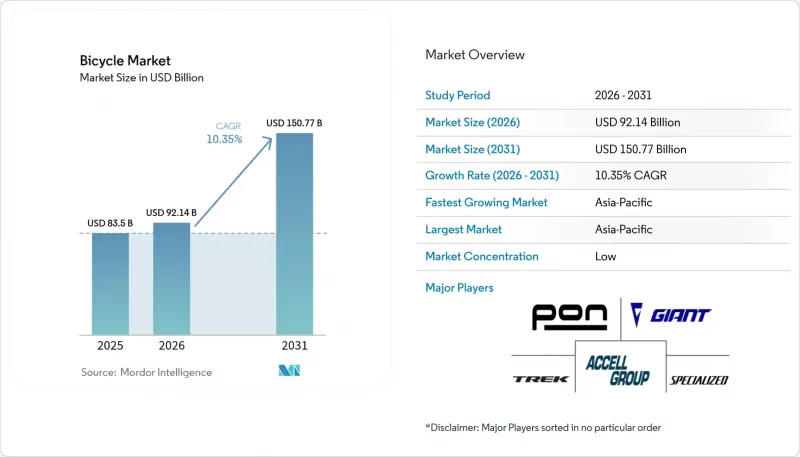
本報告按自行車類型(電動自行車、傳統自行車)、設計(標準型、折疊式)、用途(公路/城市自行車、山地自行車、混合動力自行車、其他)、價格範圍(大眾市場預算型、高階豪華型)、最終用戶(成人、嬰幼兒)、配銷通路(線上管道、線下管道)和地區(北美、歐洲、亞太、南美、中東和非洲)進行分類。預測值以美元計價。
全球自行車市場趨勢與洞察
都市區交通堵塞與積極出行政策的結合正在重塑需求性質。
都市區交通堵塞正推動自行車在全球自行車市場中日益成為日常通勤的重要交通工具。英國自行車協會(Cycling UK)委託進行的一項2026年3月調查顯示,28%的英國駕駛員已經減少了汽車使用,增加了步行和騎行,另有15%的人正在考慮做出改變。愛爾蘭已撥款3.6億歐元(約3.9億美元)用於其「積極出行」和「綠色通道」計劃,支持1000個自行車和行人用項目。這些措施可望改善路線和安全連通性,使騎乘更加便利。電動式自行車有望取代長途汽車出行,從而惠及大多數通勤者,因為電動輔助可以減輕人們對續航里程和騎乘強度的擔憂。這種交通方式的轉變可能會導致電動式自行車的平均售價上漲,而傳統自行車仍將繼續用於短途都市區出行。
健康與健身科學將促進自行車的長期需求。
人們對健康和健身的關注正在推動騎乘運動的發展,無論是通勤還是休閒。文中引用的研究引用了2026年發表在《運動與積極生活前沿》(Frontiers in Sports and Active Living)期刊上的一篇綜述,該綜述檢驗了19個國家的87項研究,並報告了騎行對情緒、認知功能、注意力和社交聯繫的顯著影響。此外,文中還引用了2025年的一項Meta分析表明,每週騎行三次,每次30分鐘,可使全因死亡風險降低24%。根據英國的CWIS3研究,增加積極出行方式的使用每年可減少170萬次全科醫生就診。這些證據支持雇主的健康計劃和學校的出勤計劃。同時,這些證據也可能拓展騎乘在休閒以外的作用,並鼓勵那些既重視健康又注重出行的家庭購買自行車。
細分市場分析
預計到2025年,電動自行車將佔全球自行車市場50.74%的佔有率,屆時電動車款預計將成為市場佔有率最大的來源。這一品類透過整合電池系統和電子元件,提高了平均購買價格,從而改變全球自行車產業格局。消費者接受度的提高、產品種類的豐富以及分銷管道的拓展,都在推動已開發國家和新興市場的成長。同時,傳統自行車仍滿足著廣大消費者的需求,尤其是在價格敏感市場,價格實惠、易於購買和維護仍然是關鍵的購買因素。
預計2026年至2031年間,電動自行車市場將以12.52%的複合年成長率成長,超過全球自行車市場的整體成長速度。這一成長主要得益於人們對便捷交通工具的需求不斷成長、通勤距離延長以及對更高品質騎行體驗的追求。儘管一些成熟市場可能會出現短期庫存調整和價格壓力,但價格區間的下降有望提高電動自行車的普及率,並進一步促進消費者接受度。隨著市場環境趨於穩定,在城市出行趨勢、永續性措施以及電動自行車技術持續創新等因素的推動下,製造商和零售商有望受益於需求的復甦。
預計到2025年,標準車架自行車將佔據全球自行車市場佔有率的85.12%。其強勁的市場地位反映了其在休閒、公路騎行、山地自行車、健身和日常通勤等廣泛用途中的受歡迎程度。標準車架車型在儲存空間有限的地區尤其受歡迎,因為這些地區的用戶更注重性能、舒適性和耐用性而非便攜性。儘管對這類自行車的需求持續支撐著成熟的自行車市場,但消費者在高階騎行裝備上的支出不斷增加,使得高性能公路自行車和山地自行車市場更具吸引力。
預計2026年至2031年間,折疊式自行車市場將以11.22%的複合年成長率成長。這一成長主要得益於都市區通勤者對靈活出行方式的需求不斷成長,他們希望將騎行與公共運輸相結合。折疊自行車的緊湊設計使其成為家庭和辦公室等儲存空間有限環境的理想選擇。此外,折疊式電動自行車的日益普及也提升了這一品類的吸引力,因為它創造了兼具便攜性和電動助力的高階產品,從而提升了產品附加價值,並獲得了更廣泛的消費者認可。
區域分析
預計到2025年,亞太地區將成為最大的區域市場,佔全球自行車市場佔有率的47.68%。該地區受益於大規模的製造業基礎和不斷成長的國內需求。儘管中國電動自行車產量的增加和更換計劃預計將推動市場成長,但印度的需求潛力巨大,交通堵塞和燃油價格上漲促進了自行車的使用。然而,來自未經認證進口產品的價格競爭可能仍將對當地製造商構成挑戰。
此外,亞太地區預計將在2026年至2031年間以13.08%的複合年成長率實現最高成長。日本和韓國市場依然成熟,成年人的健身和旅行趨勢推動了單價上漲。包括印尼、泰國和越南在內的東南亞國家,對自行車的消費觀念正從必需品轉變為更廣泛的消費選擇。這種轉變預計將有利於電動自行車和混合動力自行車的發展。該地區的製造能力確保了供應,而其都市區基數則持續推動需求。生產規模和不斷變化的消費者行為相結合,使亞太地區成為全球自行車市場的中心。
歐洲仍然是第二大市場,其特點是政策支持力度大、定價較高且自行車基礎設施成熟。英國和愛爾蘭對積極出行方式的投資預計將加強自行車基礎設施建設,並促進電動自行車的普及。在德國電動自行車市場,消費者興趣依然濃厚,但庫存緊張可能會影響短期銷售表現。北美擁有龐大的需求基礎,但其自行車基礎設施與歐洲相比發展落後。在美國,電動自行車進口和潛在的聯邦措施可能會降低零件成本,並促進其在通勤領域的應用。南美、中東和非洲仍處於起步階段,都市化、燃料成本、基礎設施限制和收入水準預計將影響未來的普及程度。
其他好處
- Excel格式的市場預測(ME)表
- 3個月的分析師支持
目錄
第1章:引言
- 研究假設和市場定義
- 調查範圍
第2章:調查方法
第3章執行摘要
第4章 市場狀況
- 市場概覽
- 市場促進因素
- 都市區的交通堵塞導致騎自行車通勤的人數增加。
- 受健身潮流的影響,騎自行車越來越受歡迎。
- 在政府的支持下,環保型交通方式正在推廣。
- 環保意識和永續性正在推動消費者接受自行車。
- 職場健康計畫鼓勵員工騎自行車。
- 隨著燃油價格飆升,自行車已成為一種經濟實惠的替代交通工具。
- 市場限制因素
- 摩托車和其他更快捷的交通工具的出現,可能會阻礙自行車的使用。
- 假冒自行車的存在阻礙了市場成長。
- 電動自行車的高昂價格阻礙了其在全球的普及。
- 鄉村地區道路狀況差,阻礙了人們享受騎行的樂趣。
- 消費行為分析
- 監理展望
- 技術展望
- 波特五力分析
第5章 市場規模與成長預測(價值)
- 按自行車類型
- 電動自行車
- 傳統自行車
- 有意為之
- 普通型
- 折疊式
- 按活動
- 領主城
- MTB
- 混合
- 其他
- 按價格範圍
- 大眾市場預算
- 頂級奢華
- 最終用戶
- 成人
- 嬰兒
- 透過分銷管道
- 線上管道
- 離線頻道
- 按地區
- 北美洲
- 美國
- 加拿大
- 墨西哥
- 其他北美國家
- 歐洲
- 德國
- 英國
- 義大利
- 法國
- 西班牙
- 荷蘭
- 波蘭
- 比利時
- 瑞典
- 其他歐洲國家
- 亞太地區
- 中國
- 印度
- 日本
- 澳洲
- 印尼
- 韓國
- 泰國
- 新加坡
- 其他亞太國家
- 南美洲
- 巴西
- 阿根廷
- 哥倫比亞
- 智利
- 秘魯
- 其他南美國家
- 中東和非洲
- 南非
- 沙烏地阿拉伯
- 阿拉伯聯合大公國
- 奈及利亞
- 埃及
- 摩洛哥
- 土耳其
- 其他中東和非洲國家
- 北美洲
第6章 競爭情勢
- 市場集中度
- 策略趨勢
- 市佔率分析
- 公司簡介
- Accell Group NV
- Trek Bicycle Corporation
- Pon Holdings BV
- Giant Manufacturing Co. Ltd
- Specialized Bicycle Components Inc.
- Shimano Inc.
- Scott Sports SA
- Merida Industry Co. Ltd
- Stryder Cycle Private Limited
- Cycles Devinci inc.
- Pending System GmbH & Co. KG
- Brompton Bicycle Ltd
- Decathlon SA
- Rad Power Bikes Inc.
- Riese and Muller GmbH
- Bulls Bikes GmbH
- Yadea Group Holdings Ltd
- Canyon Bicycles GmbH
- Hero Cycles Limited
- Ribble Cycles
第7章 市場機會與未來展望
According to Mordor Intelligence, the bicycle market size is projected to expand from USD 83.5 billion in 2025 and USD 92.1 billion in 2026 to USD 150.8 billion by 2031, registering a CAGR of 10.35% between 2026 and 2031.
This report is Segmented by Bicycle Type (E-Bikes, Conventional Bicycles), Design (Regular, Foldable), Activity (Road/City, MTB, Hybrid, Others), Price Range (Mass/Budget, Premium/Luxury), End User (Adults, Kids), Distribution Channel (Online, Offline), and Geography (North America, Europe, Asia-Pacific, South America, Middle East and Africa). Forecasts are in Value (USD).
Global Bicycle Market Trends and Insights
Urban Congestion and Active Mobility Policy Converge to Reshape Demand
Urban congestion is increasing the relevance of bicycles for regular commuting in the global bicycle market. A March 2026 survey commissioned by Cycling UK indicated that 28% of UK drivers were already walking or cycling more instead of driving, while another 15% were considering the shift. Ireland allocated EUR 360 million, equivalent to USD 390 million, to Active Travel and Greenways capital funding for 2026 to support 1,000 cycling and walking projects. These commitments can make cycling more practical by improving routes and safer connections. E-bikes may benefit the most when commuters replace longer car trips, as electric assistance can reduce concerns about range and effort. This mix shift can increase average selling prices, even as conventional bicycles continue to serve shorter urban journeys.
Health and Fitness Science Reinforces Long-Term Cycling Demand
Health and fitness considerations support cycling participation across commuter and recreational uses. The supplied research cites a 2026 review in Frontiers in Sports and Active Living that reviewed 87 studies across 19 countries and reported consistent benefits for mood, cognitive function, attention, and social connection. It also cites a 2025 meta-analysis that associated cycling for 30 minutes three times a week with a 24% lower risk of all-cause mortality. The United Kingdom's CWIS3 stated that increased active travel could free up 1.7 million general practitioner appointments each year. This evidence can support employer wellness plans and school transport programs. It also expands the role of bicycles beyond discretionary recreation and may support purchases among households that value both health and mobility.
Other drivers and restraints analyzed in the detailed report include:
- Government Infrastructure and Subsidy Programs Structurally Lift Demand
- Rising Fuel Prices Accelerate the Cost-Parity Calculation for Cycling
- Competing Mobility Modes and Subpar Infrastructure Create Structural Demand Ceiling
- Counterfeit Products and E-Bike Cost Constrain Market Scalability
For complete list of drivers and restraints, kindly check the Table Of Contents.
Segment Analysis
E-bikes are projected to account for 50.74% of the global bicycle market size in 2025, marking the point at which electrified models become the largest source of market value. The category is reshaping the global bicycle industry by increasing average purchase value through the integration of battery systems and electronic components. Growing consumer adoption, expanding product availability, and wider distribution channels are supporting market expansion across developed and emerging regions. Meanwhile, conventional bicycles continue to address broad consumer demand, particularly in price-sensitive markets where affordability, accessibility, and ease of maintenance remain key purchasing considerations.
E-bikes are forecast to register a CAGR of 12.52% during 2026-2031, outpacing the overall global bicycle market. Rising demand for convenient mobility solutions, longer commuting distances, and premium cycling experiences is driving growth. Although some mature markets are experiencing short-term inventory adjustments and pricing pressures, lower price points may improve accessibility and support broader consumer adoption. As market conditions stabilize, manufacturers and retailers are expected to benefit from renewed demand, supported by ongoing urban mobility trends, sustainability initiatives, and continued innovation in e-bike technology.
Regular-frame bicycles are expected to account for 85.12% of the global bicycle market share in 2025. Their strong position reflects widespread adoption across recreation, road cycling, mountain biking, fitness, and daily commuting applications. Regular-frame models remain particularly popular in regions with fewer storage constraints, where riders prioritize performance, comfort, and durability over portability. Mature cycling markets continue to support demand for these bicycles, while rising consumer spending on premium cycling equipment strengthens the appeal of high-performance road and mountain bike segments.
Foldable bicycles are projected to expand at a CAGR of 11.22% during 2026-2031. Increasing demand from urban commuters who combine cycling with public transportation and require flexible mobility solutions is driving growth. Their compact design makes them well-suited for homes, offices, and other environments with limited storage space. In addition, the growing popularity of foldable electric bicycles is enhancing the category's attractiveness by combining portability with motorized assistance, creating premium offerings that support higher value generation and broader consumer adoption.
Complete Report Scope:
- By Bicycle Type
- E-Bikes
- Conventional/Traditional Bicycles
- By Design
- Regular
- Foldable
- By Activity
- Road/ City
- Mountain Terrain (MTB)
- Hybrid
- Others
- By Price Range
- Mass/Budget
- Premium/Luxury
- By End User
- Adults
- Kids
- By Distribution Channel
- Online Channels
- Offline Channels
- By Geography
- North America
- United States
- Canada
- Mexico
- Rest of North America
- Europe
- Germany
- United Kingdom
- Italy
- France
- Spain
- Netherlands
- Poland
- Belgium
- Sweden
- Rest of Europe
- Asia-Pacific
- China
- India
- Japan
- Australia
- Indonesia
- South Korea
- Thailand
- Singapore
- Rest of Asia-Pacific
- South America
- Brazil
- Argentina
- Colombia
- Chile
- Peru
- Rest of South America
- Middle East and Africa
- South Africa
- Saudi Arabia
- United Arab Emirates
- Nigeria
- Egypt
- Morocco
- Turkey
- Rest of Middle East and Africa
- North America
Geography Analysis
Asia-Pacific accounted for 47.68% of the global bicycle market share in 2025, making it the largest regional market. The region benefits from large-scale manufacturing and rising domestic demand. China's expanding electric bicycle production and replacement programs are expected to support market growth, while India presents strong demand potential as congestion and fuel prices encourage bicycle use. However, price competition from non-certified imports may continue to challenge local producers.
Asia-Pacific is also projected to grow at the fastest CAGR of 13.08% during 2026-2031. Japan and South Korea remain mature markets, with adult fitness and touring trends supporting higher spending per unit. Southeast Asian countries, including Indonesia, Thailand, and Vietnam, are shifting from necessity-based bicycle ownership toward broader consumer choice. This transition is expected to favor e-bikes and hybrid products. The region's manufacturing strength supports supply availability, while its urban population base continues to drive demand. Together, production scale and changing consumer behavior position Asia-Pacific at the center of the global bicycles market.
Europe remains the second-largest region and is defined by policy support, premium pricing, and mature cycling infrastructure. Active-travel investments in the United Kingdom and Ireland are expected to strengthen cycling infrastructure and support adoption. Germany's e-bike market continues to reflect strong consumer interest, although inventory pressures may affect near-term sales performance. North America has a large demand base but less developed cycling infrastructure than Europe. In the United States, e-bike imports and potential federal measures may reduce component costs and support commuting adoption. South America and the Middle East and Africa remain earlier-stage markets, where urbanization, fuel costs, infrastructure limitations, and income levels are expected to shape adoption.
- Accell Group NV
- Trek Bicycle Corporation
- Pon Holdings BV
- Giant Manufacturing Co. Ltd
- Specialized Bicycle Components Inc.
- Shimano Inc.
- Scott Sports SA
- Merida Industry Co. Ltd
- Stryder Cycle Private Limited
- Cycles Devinci inc.
- Pending System GmbH & Co. KG
- Brompton Bicycle Ltd
- Decathlon SA
- Rad Power Bikes Inc.
- Riese and Muller GmbH
- Bulls Bikes GmbH
- Yadea Group Holdings Ltd
- Canyon Bicycles GmbH
- Hero Cycles Limited
- Ribble Cycles
Additional Benefits:
- The market estimate (ME) sheet in Excel format
- 3 months of analyst support
TABLE OF CONTENTS
1 INTRODUCTION
- 1.1 Study Assumptions and Market Definition
- 1.2 Scope of the Study
2 RESEARCH METHODOLOGY
3 EXECUTIVE SUMMARY
4 MARKET LANDSCAPE
- 4.1 Market Overview
- 4.2 Market Drivers
- 4.2.1 Urban congestion boosts bicycle usage for daily commute
- 4.2.2 Fitness trends increase popularity of cycling activities
- 4.2.3 Government support encourages eco-friendly transportation methods
- 4.2.4 Environmental awareness and sustainability drives bicycle usage among consumers
- 4.2.5 Workplace wellness programs encourage employee bicycle usage
- 4.2.6 Rising fuel prices make bicycles cost-effective alternatives
- 4.3 Market Restraints
- 4.3.1 Availability of substitute like bikes, and other faster transport modes discourages the use of bicycle
- 4.3.2 Presence of counterfeit bicycles hinders market growth
- 4.3.3 High e-bike cost restricts wider adoption globally
- 4.3.4 Poor road conditions in rural areas hinder smooth bicycle experience
- 4.4 Consumer Behavior Analysis
- 4.5 Regulatory Outlook
- 4.6 Technological Outlook
- 4.7 Porter's Five Forces Analysis
- 4.7.1 Threat of New Entrants
- 4.7.2 Bargaining Power of Buyers
- 4.7.3 Bargaining Power of Suppliers
- 4.7.4 Threat of Substitutes
- 4.7.5 Competitive Rivalry
5 MARKET SIZE AND GROWTH FORECASTS (VALUE )
- 5.1 By Bicycle Type
- 5.1.1 E-Bikes
- 5.1.2 Conventional/Traditional Bicycles
- 5.2 By Design
- 5.2.1 Regular
- 5.2.2 Foldable
- 5.3 By Activity
- 5.3.1 Road/ City
- 5.3.2 Mountain Terrain (MTB)
- 5.3.3 Hybrid
- 5.3.4 Others
- 5.4 By Price Range
- 5.4.1 Mass/Budget
- 5.4.2 Premium/Luxury
- 5.5 By End User
- 5.5.1 Adults
- 5.5.2 Kids
- 5.6 By Distribution Channel
- 5.6.1 Online Channels
- 5.6.2 Offline Channels
- 5.7 By Geography
- 5.7.1 North America
- 5.7.1.1 United States
- 5.7.1.2 Canada
- 5.7.1.3 Mexico
- 5.7.1.4 Rest of North America
- 5.7.2 Europe
- 5.7.2.1 Germany
- 5.7.2.2 United Kingdom
- 5.7.2.3 Italy
- 5.7.2.4 France
- 5.7.2.5 Spain
- 5.7.2.6 Netherlands
- 5.7.2.7 Poland
- 5.7.2.8 Belgium
- 5.7.2.9 Sweden
- 5.7.2.10 Rest of Europe
- 5.7.3 Asia-Pacific
- 5.7.3.1 China
- 5.7.3.2 India
- 5.7.3.3 Japan
- 5.7.3.4 Australia
- 5.7.3.5 Indonesia
- 5.7.3.6 South Korea
- 5.7.3.7 Thailand
- 5.7.3.8 Singapore
- 5.7.3.9 Rest of Asia-Pacific
- 5.7.4 South America
- 5.7.4.1 Brazil
- 5.7.4.2 Argentina
- 5.7.4.3 Colombia
- 5.7.4.4 Chile
- 5.7.4.5 Peru
- 5.7.4.6 Rest of South America
- 5.7.5 Middle East and Africa
- 5.7.5.1 South Africa
- 5.7.5.2 Saudi Arabia
- 5.7.5.3 United Arab Emirates
- 5.7.5.4 Nigeria
- 5.7.5.5 Egypt
- 5.7.5.6 Morocco
- 5.7.5.7 Turkey
- 5.7.5.8 Rest of Middle East and Africa
- 5.7.1 North America
6 COMPETITIVE LANDSCAPE
- 6.1 Market Concentration
- 6.2 Strategic Moves
- 6.3 Market Share Analysis
- 6.4 Company Profiles {(includes Global level Overview, Market level overview, Core Segments, Financials as available, Strategic Information, Market Rank/Share for key companies, Products and Services, and Recent Developments)}
- 6.4.1 Accell Group NV
- 6.4.2 Trek Bicycle Corporation
- 6.4.3 Pon Holdings BV
- 6.4.4 Giant Manufacturing Co. Ltd
- 6.4.5 Specialized Bicycle Components Inc.
- 6.4.6 Shimano Inc.
- 6.4.7 Scott Sports SA
- 6.4.8 Merida Industry Co. Ltd
- 6.4.9 Stryder Cycle Private Limited
- 6.4.10 Cycles Devinci inc.
- 6.4.11 Pending System GmbH & Co. KG
- 6.4.12 Brompton Bicycle Ltd
- 6.4.13 Decathlon SA
- 6.4.14 Rad Power Bikes Inc.
- 6.4.15 Riese and Muller GmbH
- 6.4.16 Bulls Bikes GmbH
- 6.4.17 Yadea Group Holdings Ltd
- 6.4.18 Canyon Bicycles GmbH
- 6.4.19 Hero Cycles Limited
- 6.4.20 Ribble Cycles
7 MARKET OPPORTUNITIES AND FUTURE OUTLOOK

 北美自行車市場:市佔率分析、產業趨勢與統計及成長預測(2026-2031 年)歐洲自行車:市場佔有率分析、行業趨勢和統計數據、成長預測(2026-2031)
 自行車市場-2026-2032年全球市場預測自行車及騎乘裝備市場:2026-2032年全球市場預測(產品類型、自行車類型、車架材料、煞車類型、應用、最終用戶、客戶類型、分銷管道和安裝方式分類)
 2026年全球自行車市場報告
 2026-2030年全球自行車市場
 自行車市場規模、佔有率、趨勢和預測:按類型、技術、價格、銷售管道、最終用戶和地區分類,2026-2034 年
 自行車裝備市場規模、佔有率、成長、全球產業分析、區域洞察及2026-2034年預測。
 自行車市場報告:趨勢、預測和競爭分析(至2035年)
 自行車市場機會、成長要素促進因素、產業趨勢分析及2026-2035年預測。