

 |
市場調查報告書
商品編碼
2122700
農業機器人:市場佔有率分析、產業趨勢與統計、成長預測(2026-2031)Agricultural Robots - Market Share Analysis, Industry Trends & Statistics, Growth Forecasts (2026 - 2031) |
||||||

※ 本網頁內容可能與最新版本有所差異。詳細情況請與我們聯繫。
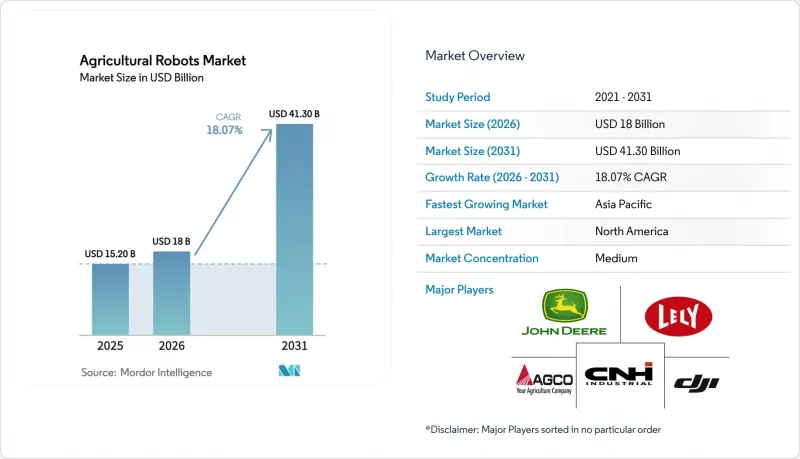
根據 Mordor Intelligence 預測,農業機器人市場規模將從 2025 年的 152 億美元和 2026 年的 180 億美元成長到 2031 年的 413 億美元,2026 年至 2031 年的年複合成長率(CAGR)為 18.07%。
本報告按產品類型(無人駕駛曳引機、無人駕駛飛行器和無人機、擠乳機器人等)、應用領域(作物種植、畜牧管理、酪農養殖、水產養殖等)、組件(硬體、軟體、服務)和地區(北美、南美、歐洲、亞太等)進行細分。市場預測以美元計價。
全球農業機器人市場趨勢與洞察
已開發農業國家勞動力短缺問題日益加劇
農業勞動力短缺正在重塑美國、歐洲和日本的資本配置重點。在美國,儘管2023年透過臨時工作簽證計畫發放了310,676份簽證,但到2025年4月,從事農作物種植的工人數量僅為637,000人,這表明僅靠引進外籍勞工無法完全彌補國內勞動力的流失。在日本,預計到2030年,農業工人數將降至100萬以下,平均年齡超過68歲。德國、法國和荷蘭也面臨類似的人口壓力。草莓和蘋果等仍依賴人工採摘的特色作物面臨最大的風險,因為計劃失誤或突然的勞動力短缺都可能導致整個產季的利潤損失。當人事費用超過每小時18美元時,能夠模擬重複性人工動作的自動收割機才能帶來利潤。在加州和西歐,由於生產者重新設計果園和行距以適應機械化作業,這一閾值已被突破。減少人事費用帶來的成本節約將在幾個種植季內累積。由於建立一種新方法需要經歷一個完整的作物種植週期,因此對市場成長的影響將集中在中期。
機器視覺相機和LiDAR價格下調
感測器成本的快速下降降低了設備製造商和生產商的進入門檻。 2020 年售價 1 萬美元的固態雷射雷達單元預計到 2024 年底將降至 1,000 美元以下。這主要得益於汽車產業規模經濟效應帶來的 90% 的價格降幅。內建推理晶片的相機模組價格在 2022 年至 2025 年間從每台 500 美元降至 150 美元以下。迪爾公司在其「See and Spray Ultimate」平台中整合了一塊英偉達 Jetson 邊緣人工智慧板,該平台每秒可處理 20 張圖像,並在 50 毫秒內激活噴嘴,從而將除草劑用量減少高達 80%。感測器成本的降低縮短了產品開發週期,並促進了模組化設計的普及,為以前無法負擔高昂研發成本的區域製造商打開了市場大門。這些成本節約在產品出貨後即可立即顯現,顯著促進了短期成長。
多供應商農業平台互通性面臨的挑戰
大多數設備製造商採用專有資料格式,這阻礙了不同製造商混合設備環境下的無縫整合。例如,約翰迪爾營運中心 (Deere Operations Center)、凱斯紐荷蘭工業集團 (CNH Industrial) 的 Raven Autonomy 系統以及愛科集團 (AGCO) 的 Fuse 系統均使用各自的訊息協議,迫使農民要麼選擇特定供應商的標準,要麼投資中間件整合。農業電子產業基金會 (Agricultural Industry Electronics Foundation) 已發布了 ISO 11783 標準。然而,供應商通常會添加自己的擴展以維護其競爭優勢。嘗試跨品牌自動化的農民面臨資料孤島、不相容的地圖圖層和重複訂閱等問題。整合諮詢可能會增加整體擁有成本並延緩專案部署。由於標準的採用通常需要 5 到 7 年時間,因此此限制對市場成長的影響被歸類為中期影響。
細分市場分析
到2025年,農民已積極採用無人機(UAV)和無人機,這些設備集田間勘測和厘米級精準噴灑農藥功能於一體,使其佔據農業機器人市場36.0%的佔有率。大疆創新(DJI)的Agras T50無人機有效載荷達40公斤,每小時可覆蓋20公頃,與地面噴藥機相比,噴灑時間縮短了60%。中國和東南亞水稻和小麥田大規模部署空中機器人,凸顯了它們能夠輕鬆融入現有工作流程。尤其值得注意的是,無人機採集的數據正被用於變數施肥模型,使資本投資直接轉化為產量成長。硬體製造商不僅提供一次性無人機銷售,還提供基於訂閱的分析服務,將飛行數據轉化為持續的收入來源。即使衛星影像品質不斷提高,無人機在空間解析度和靈活的作業時間方面仍然保持優勢,從而在各個作物領域保持領先地位。
預計從2026年到2031年,採摘機器人將以18.9%的複合年成長率成長,成為農業機器人市場中成長最快的領域。曾經運送工人的果園平台如今配備了機械臂,用於採摘蘋果、桃子和漿果。軟抓取末端執行器和機器視覺攝影機能夠追蹤水果的成熟度,而雷射瞄準技術則能減少水果損傷並提高包裝效率。 Carbon Robotics公司的雷射除草系統已在實際應用中證明了其耐用性,每分鐘可清除5000株雜草。創業投資資金正在加速加州、華盛頓州和新南威爾斯州的商業試點項目,服務供應商承諾在三個種植季內將每英畝的成本與季節性勞動力成本相匹配。隨著可控環境農業的擴展,專門用於溫室種植番茄、黃瓜和綠葉蔬菜的機器人將進一步豐富收入來源,並推動該類別的成長高於市場平均水平。
到2025年,作物種植將佔農業機器人市場的44.0%,玉米、大豆和小麥的種植者將利用自動曳引機和噴灑無人機,以厘米級的精度管理大片農田。這些作物行的規模和均勻性將使機器人運作,產生高品質的資料集,從而最佳化不同季節的施肥量。到2025年,畜牧管理也將佔據相當大的市場佔有率,這主要得益於機器人擠乳、健康監測項圈和自動化飼餵系統的應用,這些技術將使酪農的工作時間減少一半,同時提高產量的穩定性。像「Lely Astronaut A5」這樣的酪農專用解決方案每天最多可處理60牛,使工人能夠專注於更高價值的牛健康管理工作,並在不到四年的時間內實現投資回報。
預計到2031年,溫室農業將以17.4%的複合年成長率成長,成為成長最快的應用領域。這主要歸功於視覺引導機器人能夠在環境可控的環境中快速投入生產。北美和西歐的垂直農場營運商目前正在使用機器人播種機和收割機,在人事費用飆升、營運風險迅速增加的農場中實現全天候作業。一些最初在露天除草領域得到驗證的技術,例如Naio Technologies的「Oz」平台,現在也被應用於溫室種植的番茄和黃瓜,實現刀片的精準控制,避免損傷脆弱的莖稈。隨著都市農業的擴張,來自持續生產週期的穩定數據流被輸送到人工智慧(AI)引擎,這使得機器人的戰略價值超越了簡單的勞動力替代,並推動了農業機器人市場的整體擴張。
區域分析
預計到2025年,北美將佔據33.0%的市場。這主要得益於中西部地區的大規模農作物種植以及加州的高價值特色作物種植,加州農業工人的平均時薪為19.52美元。迪爾公司8R型自動駕駛曳引機於2024年實現量產,為玉米和大豆種植者實現全年無人化作業開闢了商業性道路。在加拿大草原省份,一項省級補貼計畫為升級到自動駕駛曳引機提供高達30%的成本補貼,推動了小麥和菜籽種植者採用自動駕駛曳引機。儘管經銷商網路強大,但主要品牌之間的互通性障礙阻礙了市場成長。這是因為農民不願意被單一供應商的生態系統所束縛。
預計到2031年,亞太地區將以每年14.8%的速度成長,成為各地區中成長速度最快的地區。日本正面臨人口快速下降的問題,農民的平均年齡已超過68歲。為了應對這個問題,日本農林水產省正在補貼每天可插秧10公頃的自動插秧機。中國正致力於2025年實現30%的智慧農業普及率,並投資於像FJDynamics這樣的國內製造商。該公司已交付了第5000台自動割草機,其交付速度相當於亞太地區表現最佳地區的平均時薪,從而提高了整體自主性。在澳大利亞,機器人除草機正被用於對抗抗除草劑黑麥草,Carbon Robotics公司計劃於2024年在昆士蘭州和新南威爾斯州部署20台「雷射除草機」。
在歐洲,德國、荷蘭和法國計劃在2024年部署超過1萬台來自利樂(Lely)、德拉瓦爾(DeLaval)和GEA的擠奶機器人,這將使人工時間縮短一半,並提高產量穩定性。在中東和非洲,儘管規模較小,但由於缺水和高溫等因素導致人力有限,機器人也正在水耕溫室中進行測試。
其他好處:
- Excel格式的市場預測(ME)表
- 3個月的分析師支持
目錄
第1章:引言
- 研究假設和市場定義
- 調查範圍
第2章:調查方法
第3章執行摘要
第4章 市場狀況
- 市場概覽
- 市場促進因素
- 已開發農業國家勞動力短缺問題日益加劇
- 機器視覺相機和LiDAR降價。
- 促進永續和精準農業的政策獎勵
- 創業投資流入自主收割新創公司
- 農業機器人與排碳權平台的協同利用
- 農業機器人的訂閱模式有助於降低中小企業的初始投資成本。
- 市場限制因素
- 多廠商農業平台之間的互通性差距
- 物聯網在農村地區的普及率較低
- 老舊工作設備的初始改造成本很高。
- 農業機器人利用GNSS欺騙技術引發的網路安全問題
- 監理情勢
- 技術展望
- 波特五力分析
第5章 市場規模與成長預測
- 依產品類型
- 無人駕駛曳引機
- 無人駕駛飛行器和無人機
- 擠乳機器人
- 收割和採摘機器人
- 除草機器人
- 其他
- 透過使用
- 作物種植
- 畜牧管理
- 酪農管理
- 水產養殖
- 溫室農業
- 按組件
- 硬體
- 軟體
- 服務
- 按地區
- 北美洲
- 美國
- 加拿大
- 墨西哥
- 其他北美國家
- 南美洲
- 巴西
- 阿根廷
- 其他南美國家
- 歐洲
- 德國
- 英國
- 法國
- 義大利
- 西班牙
- 俄羅斯
- 其他歐洲國家
- 亞太地區
- 中國
- 日本
- 印度
- 澳洲
- 其他亞太國家
- 中東
- 沙烏地阿拉伯
- 阿拉伯聯合大公國
- 其他中東國家
- 非洲
- 南非
- 埃及
- 其他非洲國家
- 北美洲
第6章 競爭情勢
- 市場集中度
- 策略趨勢
- 市佔率分析
- 公司簡介
- Deere & Company
- CNH Industrial BV
- AGCO Corporation
- DJI
- Lely
- YANMAR HOLDINGS CO., LTD.
- KUBOTA Corporation
- Naio Technologies Inc.
- Harvest Automation Solutions.
- EagleNXT
- BouMatic
- GEA Group Aktiengesellschaft
- EcoRobotix
- FJDYNAMICS PTE.LTD.
- FarmWise Labs
第7章 市場機會與未來展望
According to Mordor Intelligence, the agricultural robots market is projected to expand from USD 15.2 billion in 2025 and USD 18.0 billion in 2026 to USD 41.3 billion by 2031, registering a CAGR of 18.07% between 2026 to 2031.
This report is Segmented by Product Type (Driverless Tractors, Unmanned Aerial Vehicles and Drones, Milking Robots, and More), by Application (Crop Farming, Livestock Management, Dairy Management, Aquaculture, and More), by Component (Hardware, Software, and Services), and by Geography (North America, South America, Europe, Asia-Pacific, and More). The Market Forecasts are Provided in Terms of Value (USD).
Global Agricultural Robots Market Trends and Insights
Accelerating Labor Shortages in Industrialized Farming Nations
Farm labor scarcity is reshaping capital-allocation priorities across the United States, Europe, and Japan. In the United States, only 637,000 hired crop workers were counted in April 2025, despite the temporary worker visa program issuing 310,676 visas in 2023, indicating that guest-worker inflows cannot fully offset domestic labor exits. Japan projects that its farmer population will plunge below one million by 2030, with an average age surpassing 68 years, and similar demographic pressures are also haunting Germany, France, and the Netherlands. Specialty crops such as strawberries and apples, which still depend on hand-picking, face the greatest risk because scheduling errors or sudden worker shortages can wipe out full-season profits. Autonomous harvesters that replicate repetitive human motions offer an economic breakeven once hourly labor costs exceed USD 18, a threshold already surpassed in California and Western Europe, as growers redesign orchards and row spacing to accommodate machines. Labor savings compound over multiple seasons. Because a full crop cycle is needed to embed new practices, the impact on market growth is concentrated in the medium term.
Declining Price of Machine-Vision Cameras and LiDAR
Rapid cost deflation in sensors is lowering entry barriers for both equipment makers and growers. Solid-state LiDAR units, which cost USD 10,000 in 2020, dropped below USD 1,000 by late 2024, a 90% reduction driven by economies of scale in the automotive sector. Camera modules with onboard inference chips decreased in price from USD 500 to under USD 150 per unit between 2022 and 2025. Deere integrated Nvidia Jetson edge-AI boards into its See and Spray Ultimate platform to process 20 images per second and trigger nozzles within 50 milliseconds, slashing herbicide volumes by up to 80%. Lower sensor bills shorten product development cycles, encourage modular designs, and open doors for regional manufacturers that could not previously afford expensive research and development. The affordability gains materialize immediately upon shipment, resulting in a significant short-term growth contribution.
Inter-Operability Gaps Among Multi-Vendor Farm Platforms
Most equipment brands maintain proprietary data formats that prevent seamless coordination across mixed fleets. Deere Operations Center, CNH Industrial Raven Autonomy, and AGCO Fuse each apply unique message protocols, forcing growers either to standardize on one supplier or invest in middleware integration. The Agricultural Industry Electronics Foundation has published ISO 11783 standards. However, vendors often add private extensions to protect their competitive moats. Farmers who attempt cross-brand automation confront data silos, incompatible map layers, and duplicative subscriptions. Integration consulting can inflate the total cost of ownership and slow project rollouts. Because standards adoption historically stretches over five to seven years, the restraint's drag on market growth is classified as medium-term.
Other drivers and restraints analyzed in the detailed report include:
- Venture-Capital Influx into Autonomous Harvesting Start-Ups
- Synergistic use of Agricultural Robots with Carbon-Credit Platforms
- Low Internet of Things Coverage in Rural Zones
For complete list of drivers and restraints, kindly check the Table Of Contents.
Segment Analysis
Unmanned aerial vehicles and drones captured 36.0% of the agricultural robots market share in 2025 as growers embraced their dual ability to scout fields and spray inputs with centimeter-accurate targeting. The DJI Agras T50 drone carries a 40-kilogram payload and covers 20 hectares per hour, trimming application time by 60% compared to ground sprayers. The large-scale adoption of aerial robots in rice and wheat paddies across China and Southeast Asia highlights the ease of integrating them into existing workflows. Notably, data gathered by drones feeds into variable-rate fertilizer models, linking equipment spending to tangible yield gains. Hardware manufacturers are layering subscription-based analytics on top of one-time drone sales, turning flight data into recurring revenue streams. As satellite imagery improves, drones continue to hold an edge in spatial resolution and flexible deployment windows, thereby preserving their leadership across various crop types.
Harvesting and picking robots are projected to grow at a CAGR of 18.9% between 2026 and 2031, the fastest trajectory in the agricultural robots market. Orchard platforms that once moved workers now carry robotic arms to pick apples, peaches, and berries. Soft-grip end-effectors and machine-vision cameras track fruit ripeness, while laser targeting reduces bruising and boosts pack-out rates. Laser weeding systems from Carbon Robotics already demonstrate field-ready durability, removing 5,000 weeds per minute. Venture funding is accelerating commercial pilots across California, Washington, and New South Wales, with service providers guaranteeing per-acre cost parity with seasonal labor by the third season. As controlled-environment agriculture expands, robots tailored to greenhouse tomatoes, cucumbers, and leafy greens will further diversify revenue, driving the category's out-performances.
Crop farming commanded a 44.0% market share of agricultural robots in 2025, as growers of corn, soybeans, and wheat leveraged autonomous tractors and spray drones to cover broad acreages with centimeter-level precision. The scale and uniformity of these row-crop fields enable robots to log long duty cycles and generate high-quality data sets that refine variable-rate prescriptions season after season. Livestock management accounted for a significant share in 2025, driven by robotic milking, health-monitoring collars, and automated feeding systems that enable dairy operators to reduce labor hours by half while enhancing yield consistency. Dairy-specific solutions, such as the Lely Astronaut A5, can handle up to 60 cows a day, freeing workers for higher-value herd-health tasks and validating payback timelines of fewer than four years.
Greenhouse farming is forecast to expand at a 17.4% compound annual growth rate through 2031, the fastest trajectory within the application mix, because controlled-environment layouts make vision-guided robots immediately productive. Vertical-farm operators in North America and Western Europe now rely on robotic transplanters and harvesters to operate around the clock in facilities where human labor costs exceed and ergonomic risks rise quickly. Technologies first proven in open-field weeding, such as Naio Technologies Oz platform, are now adapted for greenhouse tomatoes and cucumbers, enabling precise blade control that avoids delicate stems. As urban agriculture scales, continuous production cycles feed a steady data stream into artificial-intelligence engines, raising the strategic worth of robots beyond labor substitution and helping boost the overall agricultural robots market size.
Complete Report Scope:
- By Product Type
- Driverless Tractors
- Unmanned Aerial Vehicles and Drones
- Milking Robots
- Harvesting and Picking Robots
- Weeding Robots
- Others
- By Application
- Crop Farming
- Livestock Management
- Dairy Management
- Aquaculture
- Greenhouse Farming
- By Component
- Hardware
- Software
- Services
- By Geography
- North America
- United States
- Canada
- Mexico
- Rest of North America
- South America
- Brazil
- Argentina
- Rest of South America
- Europe
- Germany
- United Kingdom
- France
- Italy
- Spain
- Russia
- Rest of Europe
- Asia-Pacific
- China
- Japan
- India
- Australia
- Rest of Asia-Pacific
- Middle East
- Saudi Arabia
- United Arab Emirates
- Rest of Middle East
- Africa
- South Africa
- Egypt
- Rest of Africa
- North America
Geography Analysis
North America held a 33.0% share in 2025, bolstered by large row-crop farms in the Midwest and high-value specialty crop operations in California, where the average hourly wage for hired labor was USD 19.52. The serial production of the Deere autonomous 8R tractor in 2024 provided corn and soybean growers with a commercial path to full-season driverless operation. Canada's Prairie provinces introduced provincial rebate programs covering up to 30% of autonomous upgrades, increasing adoption in the wheat and canola sectors. Despite robust dealer networks, interoperability barriers among major brands temper growth because growers hesitate to lock into single-vendor ecosystems.
The Asia-Pacific region is projected to grow at a rate of 14.8% per year through 2031, the fastest regional pace. Japan faces a rapid demographic contraction, with the average age of farmers exceeding 68 years. To address this, the Ministry of Agriculture, Forestry, and Fisheries subsidizes autonomous rice transplanters capable of planting 10 hectares daily. China's plan to achieve 30% smart-farming coverage by 2025 channels funds into domestic manufacturers such as FJDynamics, which shipped its five-thousandth autonomous mower, at a rate equivalent to the average hourly wage for the fastest-performing region in the Asia-Pacific region, enhancing collective autonomy. Australia leverages robotic weeders to counter herbicide-resistant ryegrass, and Carbon Robotics deployed 20 LaserWeeder units across Queensland and New South Wales in 2024.
In Europe, Germany, the Netherlands, and France together installed more than 10,000 Lely, DeLaval, and GEA milking robots in 2024, cutting labor hours by half and improving yield consistency. The Middle East and Africa, though comparatively smaller, are piloting robots in hydroponic greenhouses where water scarcity and heat stress limit human labor.
- Deere & Company
- CNH Industrial B.V.
- AGCO Corporation
- DJI
- Lely
- YANMAR HOLDINGS CO., LTD.
- KUBOTA Corporation
- Naio Technologies Inc.
- Harvest Automation Solutions.
- EagleNXT
- BouMatic
- GEA Group Aktiengesellschaft
- EcoRobotix
- FJDYNAMICS PTE.LTD.
- FarmWise Labs
Additional Benefits:
- The market estimate (ME) sheet in Excel format
- 3 months of analyst support
TABLE OF CONTENTS
1 Introduction
- 1.1 Study Assumptions & Market Definition
- 1.2 Scope of the Study
2 Research Methodology
3 Executive Summary
4 Market Landscape
- 4.1 Market Overview
- 4.2 Market Drivers
- 4.2.1 Accelerating labor shortages in industrialized farming nations
- 4.2.2 Declining price of machine-vision cameras and LiDAR
- 4.2.3 Policy incentives for sustainable and precision farming
- 4.2.4 Venture-capital influx into autonomous harvesting start-ups
- 4.2.5 Synergistic use of agricultural robots with carbon-credit platforms
- 4.2.6 Ag-robot subscription models boosting SME affordability
- 4.3 Market Restraints
- 4.3.1 Inter-operability gaps among multi-vendor farm platforms
- 4.3.2 Low internet-of-things (IoT) coverage in rural zones
- 4.3.3 High up-front retro-fitting cost for legacy implements
- 4.3.4 Cyber-security concerns around GNSS spoofing of ag-robots
- 4.4 Regulatory Landscape
- 4.5 Technological Outlook
- 4.6 Porter's Five Forces Analysis
- 4.6.1 Threat of New Entrants
- 4.6.2 Bargaining Power of Suppliers
- 4.6.3 Bargaining Power of Buyers
- 4.6.4 Threat of Substitutes
- 4.6.5 Competitive Rivalry
5 Market Size and Growth Forecasts (Value)
- 5.1 By Product Type
- 5.1.1 Driverless Tractors
- 5.1.2 Unmanned Aerial Vehicles and Drones
- 5.1.3 Milking Robots
- 5.1.4 Harvesting and Picking Robots
- 5.1.5 Weeding Robots
- 5.1.6 Others
- 5.2 By Application
- 5.2.1 Crop Farming
- 5.2.2 Livestock Management
- 5.2.3 Dairy Management
- 5.2.4 Aquaculture
- 5.2.5 Greenhouse Farming
- 5.3 By Component
- 5.3.1 Hardware
- 5.3.2 Software
- 5.3.3 Services
- 5.4 By Geography
- 5.4.1 North America
- 5.4.1.1 United States
- 5.4.1.2 Canada
- 5.4.1.3 Mexico
- 5.4.1.4 Rest of North America
- 5.4.2 South America
- 5.4.2.1 Brazil
- 5.4.2.2 Argentina
- 5.4.2.3 Rest of South America
- 5.4.3 Europe
- 5.4.3.1 Germany
- 5.4.3.2 United Kingdom
- 5.4.3.3 France
- 5.4.3.4 Italy
- 5.4.3.5 Spain
- 5.4.3.6 Russia
- 5.4.3.7 Rest of Europe
- 5.4.4 Asia-Pacific
- 5.4.4.1 China
- 5.4.4.2 Japan
- 5.4.4.3 India
- 5.4.4.4 Australia
- 5.4.4.5 Rest of Asia-Pacific
- 5.4.5 Middle East
- 5.4.5.1 Saudi Arabia
- 5.4.5.2 United Arab Emirates
- 5.4.5.3 Rest of Middle East
- 5.4.6 Africa
- 5.4.6.1 South Africa
- 5.4.6.2 Egypt
- 5.4.6.3 Rest of Africa
- 5.4.1 North America
6 Competitive Landscape
- 6.1 Market Concentration
- 6.2 Strategic Moves
- 6.3 Market Share Analysis
- 6.4 Company Profiles (includes Global Level Overview, Market Level Overview, Core Segments, Financials as Available, Strategic Information, Market Rank/Share for Key Companies, Products and Services, and Recent Developments)
- 6.4.1 Deere & Company
- 6.4.2 CNH Industrial B.V.
- 6.4.3 AGCO Corporation
- 6.4.4 DJI
- 6.4.5 Lely
- 6.4.6 YANMAR HOLDINGS CO., LTD.
- 6.4.7 KUBOTA Corporation
- 6.4.8 Naio Technologies Inc.
- 6.4.9 Harvest Automation Solutions.
- 6.4.10 EagleNXT
- 6.4.11 BouMatic
- 6.4.12 GEA Group Aktiengesellschaft
- 6.4.13 EcoRobotix
- 6.4.14 FJDYNAMICS PTE.LTD.
- 6.4.15 FarmWise Labs
7 Market Opportunities and Future Outlook

 全球農業機器人市場規模、佔有率、趨勢和成長分析報告(2026-2034)
 農業機器人軟體市場預測至2034年-全球分析(按機器人類型、軟體功能、農場類型、技術、應用、最終用戶和地區分類)
 全球農業機器人市場:按產品、服務、農業類型、應用、最終用戶和地區分類-市場規模、產業動態、機會分析和預測(2026-2035 年)
 農業機器人與機電整合:市場佔有率分析、產業趨勢與統計、成長預測(2026-2031)亞太地區農業機器人:市場佔有率分析、產業趨勢與統計及成長預測(2026-2031)
 農業機器人市場:2026-2032年全球市場預測(依產品類型、農場類型、農場規模、最終用戶和銷售管道分類)農業機器人市場預測至2034年—按產品、組件、技術、應用、最終用戶和地區分類的全球分析
 農業機器人市場規模、佔有率、趨勢和預測:按產品類型、應用、可用性和地區分類,2026-2034年全球農業機器人市場規模、佔有率、趨勢和成長分析報告(2026-2034年)
 農業機器人市場:依類型(無人機、自主拖拉機和農田機器人、收割機器人、擠乳機器人、除草和噴灑機器人、分類和包裝機器人)、應用和農場類型劃分-全球預測至2036年