


 |
市場調查報告書
商品編碼
2113381
農業機器人與機電整合:市場佔有率分析、產業趨勢與統計、成長預測(2026-2031)Agricultural Robots And Mechatronics - Market Share Analysis, Industry Trends & Statistics, Growth Forecasts (2026 - 2031) |
||||||

※ 本網頁內容可能與最新版本有所差異。詳細情況請與我們聯繫。
據 Mordor Intelligence 稱,2025 年農業機器人和機電一體化市場價值 43 億美元,預計到 2031 年將達到 104.5 億美元,而 2026 年為 49.9 億美元,預測期(2026-2031 年)的複合年成長率為 15.95%。
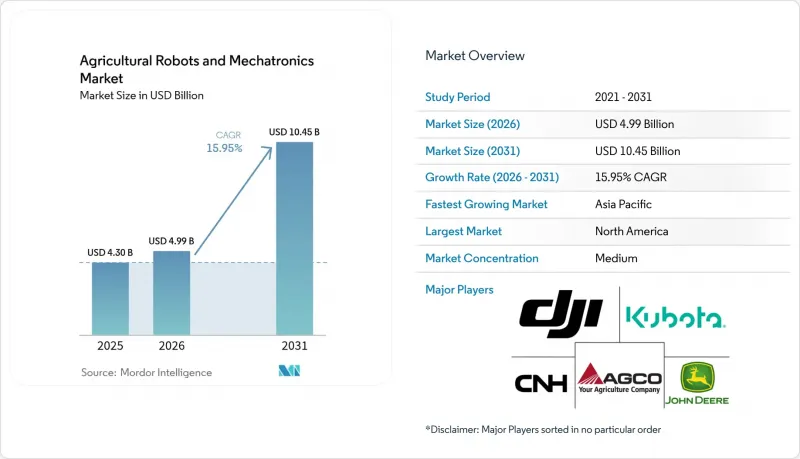
本報告按類型(自動曳引機、無人機、擠乳機器人等)、應用(作物生產、畜牧養殖、森林管理等)和地區(北美、歐洲、亞太、南美、中東等)進行細分。市場預測以貨幣價值(美元)表示。
全球農業機器人與機電一體化市場趨勢及洞察
先進的視覺技術和人工智慧(AI)能夠以小於1公分的精度清除雜草。
目前,機器視覺技術可在50毫秒內以98%的準確率區分雜草和作物,使雷射和微噴系統能夠以每小時8公里的速度精準噴灑單一植物。 Carbon Robotics公司在2024年部署了100多台雷射除草機,減少了80%的除草劑用量,並降低了每英畝200美元的人事費用。迪爾公司(Deere & Company)的See and Spray Ultimate系統結合了36個相機和Nvidia Orin處理器,可即時產生雜草地圖,實現亞厘米級的噴灑精度。 EcoRobotix公司的太陽能空中機器人手臂(ARA)無需柴油燃料,因此擁有更長的運作時間。發表在《田間機器人學雜誌》(Journal of Field Robotics)上的一篇同行評審論文證實,高光譜影像技術可以在雜草發芽前(肉眼可見前7天)檢測到它們,這表明到2027年,預防性雜草控制可能成為現實。
LiDAR(光探測和測距)和頻譜感測器的成本不斷下降,這將降低機器人的價格。
2020年售價8000美元的固態雷射雷達模組,如今價格已降至1200美元以下;頻譜相機的價格也從15,000美元降至3500美元,使得機器人組件成本降低了約30%。 Trimble公司的低成本GNSS-RTK(全球導航衛星系統即時動態定位)接收器無需昂貴的基地台即可實現小於2公分的定位誤差。這些成本的降低使得像AGCO公司和久保田公司這樣的中型供應商能夠將自動駕駛系統不僅銷售給5000英畝的大型農場,也銷售給500英畝的小型農場。Yamaha Motor Co, Ltd.的RMAX(最大放鬆)無人直升機比用於稻田作業的高階無人機便宜40%。根據發表在《MDPI Sensors》期刊的研究,即使是低成本相機,現在也能在歸一化植被指數(NDVI)測繪方面達到研究級性能的92%。
高昂的初始投資成本
全自動曳引機的售價在35萬至45萬美元之間,是傳統曳引機價格的三到四倍,超過了巴西和印度許多500英畝農場的年銷售額。即使是價值15萬美元的改裝套件,也占到中型農場設備預算的40%。根據聯準會的一項研究,由於負債權益比過高,到2024年,38%的自動農業機械貸款申請將被拒絕。酪農擁有100乳牛的乳牛場需要升級設備近40萬美元,才能安裝一台單價18萬美元(19.5萬美元)的DeLaval擠乳機器人。農業金融評論顯示,面積小於1000英畝的農場需要12年才能收回投資,而面積超過3000英畝的農場只需4年即可。
細分市場分析
預計到2025年,自動駕駛曳引機將佔銷售額的37.40%,成為農業機器人和機電一體化市場的支柱。無人機(UAV)預計將以21.90%的複合年成長率成長,是所有設備類別中成長最快的。約翰迪爾公司在2024年交付了1,200台改良型8R曳引機,並預計隨著零件成本的下降,2025年的交付量將翻倍。大疆創新(DJI)的Agras T50無人機每小時可噴灑40英畝的土地,目前已佔據中國無人機噴灑器市場35%的佔有率。
地面和空中平台之間的協同作業日益增多。例如,AGCO公司的「Xaver」集群作業系統已被證明能減少60%的土壤壓實。久保田公司的「Agri Robo MR1000A」水稻插秧機在日本新潟縣的普及率已達15%,目前正在進行改造,用於澳洲的小麥播種。這表明,專業化的設計可以跨區域應用。Yamaha Motor Co, Ltd.的「RMAX」應用直升機也證明,其特殊設計的機身運作成本比通用無人機低40%。精密農業的研究證實,與單一平台策略相比,混合型飛機集群可將淨利率提高22%。這些趨勢凸顯了農業機器人和機電一體化市場持續成長的需求。
區域分析
預計到2025年,北美將佔據農業機器人和機電一體化市場39.30%的佔有率。由於農場規模龐大、4G LTE網路覆蓋率高達92%以及美國農業部(USDA)的補貼,該技術的應用正在加速發展。自動曳引機主要集中在愛荷華州、伊利諾伊州和內布拉斯加州,這些地區的平均農場面積超過1200英畝。在加拿大草原地區,為了應對勞動力短缺,自動糧食運輸車正在部署中。聯邦政府的農業創新津貼)將在2024年為420個農場支付30%的設備成本。在墨西哥的溫室種植業,由於勞動力短缺超過22%,機器人收割機的應用也不斷推進。
亞太地區成長速度最快,預計年複合成長率將達19.60%。中國對無人機和曳引機的成本補貼高達40%,以推動其在2025年實現70%機械化的目標。印度新的超視距(BVLOS)作業法規使得印尼鷹航公司得以在230萬英畝農地部署1,800架噴灑無人機。日本久保田農業機器人公司的插秧機佔新潟縣水稻種植面積的15%,而澳洲SwarmFarm Robotics公司的糧食運輸機則緩解了高達19%的勞動力短缺問題。
歐洲在2024年的預期銷售額中佔據相當大的佔有率,並有望實現顯著成長。通用農業政策(CAP)將一定比例的直接補貼分配給環境保護項目,這促使西班牙草莓種植者採用Naio公司的除草機器人,預計這些機器人將在兩年內收回投資。在德國,相當一部分乳牛現在使用擠乳機器人,減少了三分之一的勞動力需求。在法國的葡萄園,為了達到減少農藥使用的目標,Monarch Tractor和Fendt公司的自動駕駛曳引機的使用越來越普遍。南美洲、中東和非洲共同貢獻了市場價值,預計成長強勁,這主要得益於巴西甘蔗種植園和南非葡萄園的蓬勃發展。
其他好處:
- Excel格式的市場預測(ME)表
- 3個月的分析師支持
目錄
第1章:引言
- 研究假設和市場定義
- 調查範圍
第2章:調查方法
第3章執行摘要
第4章 市場狀況
- 市場概覽
- 市場促進因素
- 先進的視覺技術和人工智慧(AI)能夠以小於1公分的精度清除雜草。
- LiDAR(LIDAR)和頻譜感測器的成本不斷下降,導致機器人價格下降。
- 勞動短缺和成本
- 為「機器人即服務」提供資金籌措將加速中小農戶採用這項技術。
- 政府對智慧農業和排碳權計畫的激勵措施
- 農業OEM廠商的自動駕駛藍圖
- 市場限制因素
- 大筆初始投資
- 農村地區通訊基礎設施的差距
- 多供應商系統整合的複雜性
- 自動駕駛領域責任與安全法規的發展趨勢
- 監理情勢
- 技術展望
- 波特五力分析
第5章 市場規模與成長預測
- 按類型
- 自動駕駛曳引機
- 無人駕駛飛行器(UAV)
- 擠乳機器人
- 其他類型
- 透過使用
- 農作物生產
- 家畜
- 森林管理
- 其他用途
- 按地區
- 北美洲
- 美國
- 加拿大
- 墨西哥
- 其他北美國家
- 歐洲
- 西班牙
- 英國
- 法國
- 德國
- 俄羅斯
- 義大利
- 其他歐洲國家
- 亞太地區
- 中國
- 印度
- 日本
- 澳洲
- 其他亞太國家
- 南美洲
- 巴西
- 阿根廷
- 其他南美國家
- 中東
- 沙烏地阿拉伯
- 阿拉伯聯合大公國
- 其他中東國家
- 非洲
- 南非
- 奈及利亞
- 其他非洲國家
- 北美洲
第6章 競爭情勢
- 市場集中度
- 策略趨勢
- 市佔率分析
- 公司簡介
- Deere & Company
- DJI
- AGCO Corporation
- CNH Industrial NV
- Kubota Corporation
- DeLaval
- GEA Group Aktiengesellschaft
- Yamaha Motor Co., Ltd.
- Trimble Inc.
- XAG Co., Ltd.
- Naio Technologies Inc.
- Autonomous Solutions, Inc.
- EagleNXT
- Monarch Tractor
- EcoRobotix SA
第7章 市場機會與未來展望
According to Mordor Intelligence, the agricultural robots and mechatronics market size was valued at USD 4.30 billion in 2025 and estimated to grow from USD 4.99 billion in 2026 to reach USD 10.45 billion by 2031, at a CAGR of 15.95% during the forecast period (2026-2031).
This report is Segmented by Type (Autonomous Tractors, Unmanned Aerial Vehicles, Milking Robots, and More), by Application (Crop Production, Animal Husbandry, Forest Control, and More), and by Geography (North America, Europe, Asia-Pacific, South America, Middle East, and More). The Market Forecasts are Provided in Terms of Value (USD).
Global Agricultural Robots And Mechatronics Market Trends and Insights
Advanced Vision-Artificial intelligence (AI) Enables Sub-Centimeter Weeding Accuracy
Machine vision now distinguishes weeds from crops with 98% accuracy in 50 milliseconds, allowing laser or micro-spray systems to target individual plants while traveling 8 kilometers per hour. Carbon Robotics deployed over 100 LaserWeeder units in 2024, cutting herbicide use by 80% and labor costs by USD 200 per acre. Deere & Company's See and Spray Ultimate pairs 36 cameras with Nvidia Orin processors, creating real-time weed maps to guide sub-centimeter spraying. EcoRobotix's sun-powered Aerial Robot Arms (ARA) robot extends operating hours by eliminating diesel refueling. Peer-reviewed work in the Journal of Field Robotics confirms that hyperspectral imaging detects pre-emergent weeds seven days before they become visible, hinting at prophylactic weeding routines by 2027.
Declining Light Detection and Ranging (LIDAR) and Multispectral Sensor Costs Cut Robot Prices
Solid-state Light Detection and Ranging (LIDAR) modules that retailed at USD 8,000 in 2020 now cost under USD 1,200, while multispectral cameras fell from USD 15,000 to USD 3,500, lowering robot bills of material by roughly 30%. Trimble's low-cost Global Navigation Satellite System-Real-Time Kinematic (GNSS-RTK) receivers reduce positioning error to under 2 centimeters without expensive base stations. Cost compression lets mid-tier vendors such as AGCO Corporation and Kubota Corporation sell autonomy packages to 500-acre growers rather than only 5,000-acre operations. Yamaha Motor's Maximum Relaxation (RMAX) unmanned helicopter undercuts premium drones by 40% in rice farms. Studies in MDPI Sensors show low-cost cameras now achieve 92% of research-grade performance for normalized difference vegetation index mapping.
High Initial Capital Outlay
Fully autonomous tractors sell for USD 350,000-450,000, three to four times a conventional model and above annual revenue for many 500-acre farms in Brazil and India. Retrofit kits that cost USD 150,000 still consume 40% of a medium farm's equipment budget. The Federal Reserve found that 38% of autonomous-equipment loan applications were rejected in 2024 due to high debt-to-asset ratios . DeLaval milking robots priced at EUR 180,000 (USD 195,000) per unit push a 100-cow dairy's upgrade cost near USD 400,000. Agricultural Finance Review shows payback stretches to 12 years for farms under 1,000 acres, compared with four years for operations above 3,000 acres.
Other drivers and restraints analyzed in the detailed report include:
- Shortage and Cost of Labor
- Robot-as-a-Service Financing Unlocks Small and Medium Farm Adoption
- Connectivity Gaps in Rural Areas
For complete list of drivers and restraints, kindly check the Table Of Contents.
Segment Analysis
Autonomous tractors generated 37.40% of 2025 revenue, anchoring the agricultural robots and mechatronics market. Unmanned aerial vehicles are set to grow at a 21.90% CAGR, the fastest of any equipment class. Deere shipped 1,200 retrofit 8R tractors in 2024 and expects to double that in 2025 as component costs shrink. DJI's Agras T50 drone sprays 40 acres per hour and already owns 35% of China's drone-sprayer segment.
Ground and aerial platforms increasingly work together. Swarm approaches such as AGCO's Xaver have shown a 60% soil-compaction reduction. Kubota's Agri Robo MR1000A rice transplanter, which achieved 15% penetration in Japan's Niigata Prefecture, is being adapted for wheat seeding in Australia, illustrating how task-specific designs can cross geographies. Yamaha Motor's task-specific RMAX helicopter proves that specialized designs can undercut general-purpose drones by 40%. Precision Agriculture research confirms hybrid fleets lift net margins 22% over single-platform strategies. These developments reinforce sustained demand across the agricultural robots and mechatronics market.
Complete Report Scope:
- By Type
- Autonomous Tractors
- Unmanned Aerial Vehicles (UAVs)
- Milking Robots
- Other Types
- By Application
- Crop Production
- Animal Husbandry
- Forest Control
- Other Applications
- By Geography
- North America
- United States
- Canada
- Mexico
- Rest of North America
- Europe
- Spain
- United Kingdom
- France
- Germany
- Russia
- Italy
- Rest of Europe
- Asia-Pacific
- China
- India
- Japan
- Australia
- Rest of Asia-Pacific
- South America
- Brazil
- Argentina
- Rest of South America
- Middle East
- Saudi Arabia
- United Arab Emirates
- Rest of Middle East
- Africa
- South Africa
- Nigeria
- Rest of Africa
- North America
Geography Analysis
North America generated 39.30% of the 2025 revenue share in the agricultural robots and mechatronics market. Wide farm sizes, 92% fourth-generation Long Term Evolution coverage, and the United States Department of Agriculture (USDA) subsidies speed adoption. Autonomous tractors cluster in Iowa, Illinois, and Nebraska, where average holdings exceed 1,200 acres. Canada's Prairie farms use autonomous grain carts to offset labor gaps, and federal AgriInnovate grants funded 30% of equipment bills for 420 operations in 2024. Mexico's greenhouse sector is turning to robotic harvesters as labor deficits surpass 22%.
Asia-Pacific is the fastest mover, projected at 19.60% CAGR. China subsidizes up to 40% of drone and tractor costs, pushing mechanization toward a 70% target by 2025 . India's new beyond-visual-line-of-sight rules let Garuda Aerospace deploy 1,800 spraying drones across 2.3 million acres. Japan's Kubota Agri Robo transplanter controls 15% of the planted rice area in Niigata Prefecture, while Australia's SwarmFarm Robotics grain carts combat a 19% labor shortage.
Europe accounted for a significant share of the projected 2024 revenue and is projected to grow at a notable rate. The Common Agricultural Policy allocates a portion of direct payments to eco-schemes, encouraging Spanish strawberry growers to adopt Naio weeders, which offer a two-year payback period. In Germany, a substantial percentage of dairy herds are now equipped with milking robots, reducing labor requirements by one-third. French vineyards are increasingly utilizing autonomous tractors from Monarch Tractor and Fendt to comply with pesticide-reduction targets. South America, the Middle East, and Africa collectively contribute to the market value and are projected to grow at strong rates, driven by Brazil's sugarcane farms and South African vineyards.
- Deere & Company
- DJI
- AGCO Corporation
- CNH Industrial N.V.
- Kubota Corporation
- DeLaval
- GEA Group Aktiengesellschaft
- Yamaha Motor Co., Ltd.
- Trimble Inc.
- XAG Co., Ltd.
- Naio Technologies Inc.
- Autonomous Solutions, Inc.
- EagleNXT
- Monarch Tractor
- EcoRobotix SA
Additional Benefits:
- The market estimate (ME) sheet in Excel format
- 3 months of analyst support
TABLE OF CONTENTS
1 Introduction
- 1.1 Study Assumptions and Market Definition
- 1.2 Scope of the Study
2 Research Methodology
3 Executive Summary
4 Market Landscape
- 4.1 Market Overview
- 4.2 Market Drivers
- 4.2.1 Advanced Vision-Artificial intelligence (AI) Enables Sub-Centimeter Weeding Accuracy
- 4.2.2 Declining Light Detection and Ranging (LIDAR) and Multispectral Sensor Costs Cut Robot Prices
- 4.2.3 Shortage and Cost of Labor
- 4.2.4 Robot-as-a-Service Financing Unlocks Small and Medium Farm Adoption
- 4.2.5 Government Smart-Farming Incentives and Carbon-Credit Schemes
- 4.2.6 Agricultural Original Equipment Manufacturers (OEMs) Autonomy Roadmaps
- 4.3 Market Restraints
- 4.3.1 High Initial Capital Outlay
- 4.3.2 Connectivity Gaps in Rural Areas
- 4.3.3 Complexity of Multi-Vendor System Integration
- 4.3.4 Evolving Liability and Safety Regulations for Field Autonomy
- 4.4 Regulatory Landscape
- 4.5 Technological Outlook
- 4.6 Porter's Five Forces Analysis
- 4.6.1 Bargaining Power of Suppliers
- 4.6.2 Bargaining Power of Buyers
- 4.6.3 Threat of New Entrants
- 4.6.4 Threat of Substitutes
- 4.6.5 Intensity of Competitive Rivalry
5 Market Size and Growth Forecasts (Value)
- 5.1 By Type
- 5.1.1 Autonomous Tractors
- 5.1.2 Unmanned Aerial Vehicles (UAVs)
- 5.1.3 Milking Robots
- 5.1.4 Other Types
- 5.2 By Application
- 5.2.1 Crop Production
- 5.2.2 Animal Husbandry
- 5.2.3 Forest Control
- 5.2.4 Other Applications
- 5.3 By Geography
- 5.3.1 North America
- 5.3.1.1 United States
- 5.3.1.2 Canada
- 5.3.1.3 Mexico
- 5.3.1.4 Rest of North America
- 5.3.2 Europe
- 5.3.2.1 Spain
- 5.3.2.2 United Kingdom
- 5.3.2.3 France
- 5.3.2.4 Germany
- 5.3.2.5 Russia
- 5.3.2.6 Italy
- 5.3.2.7 Rest of Europe
- 5.3.3 Asia-Pacific
- 5.3.3.1 China
- 5.3.3.2 India
- 5.3.3.3 Japan
- 5.3.3.4 Australia
- 5.3.3.5 Rest of Asia-Pacific
- 5.3.4 South America
- 5.3.4.1 Brazil
- 5.3.4.2 Argentina
- 5.3.4.3 Rest of South America
- 5.3.5 Middle East
- 5.3.5.1 Saudi Arabia
- 5.3.5.2 United Arab Emirates
- 5.3.5.3 Rest of Middle East
- 5.3.6 Africa
- 5.3.6.1 South Africa
- 5.3.6.2 Nigeria
- 5.3.6.3 Rest of Africa
- 5.3.1 North America
6 Competitive Landscape
- 6.1 Market Concentration
- 6.2 Strategic Moves
- 6.3 Market Share Analysis
- 6.4 Company Profiles (Includes Global Level Overview, Market Level Overview, Core Segments, Financials as Available, Strategic Information, Market Rank/Share for Key Companies, Products and Services, and Recent Developments)
- 6.4.1 Deere & Company
- 6.4.2 DJI
- 6.4.3 AGCO Corporation
- 6.4.4 CNH Industrial N.V.
- 6.4.5 Kubota Corporation
- 6.4.6 DeLaval
- 6.4.7 GEA Group Aktiengesellschaft
- 6.4.8 Yamaha Motor Co., Ltd.
- 6.4.9 Trimble Inc.
- 6.4.10 XAG Co., Ltd.
- 6.4.11 Naio Technologies Inc.
- 6.4.12 Autonomous Solutions, Inc.
- 6.4.13 EagleNXT
- 6.4.14 Monarch Tractor
- 6.4.15 EcoRobotix SA
7 Market Opportunities and Future Outlook

 全球農業機器人市場規模、佔有率、趨勢和成長分析報告(2026-2034)
 農業機器人軟體市場預測至2034年-全球分析(按機器人類型、軟體功能、農場類型、技術、應用、最終用戶和地區分類)
 農業機器人:市場佔有率分析、產業趨勢與統計、成長預測(2026-2031)
 全球農業機器人市場:按產品、服務、農業類型、應用、最終用戶和地區分類-市場規模、產業動態、機會分析和預測(2026-2035 年)亞太地區農業機器人:市場佔有率分析、產業趨勢與統計及成長預測(2026-2031)
 農業機器人市場:2026-2032年全球市場預測(依產品類型、農場類型、農場規模、最終用戶和銷售管道分類)農業機器人市場預測至2034年—按產品、組件、技術、應用、最終用戶和地區分類的全球分析
 農業機器人市場規模、佔有率、趨勢和預測:按產品類型、應用、可用性和地區分類,2026-2034年全球農業機器人市場規模、佔有率、趨勢和成長分析報告(2026-2034年)
 農業機器人市場:依類型(無人機、自主拖拉機和農田機器人、收割機器人、擠乳機器人、除草和噴灑機器人、分類和包裝機器人)、應用和農場類型劃分-全球預測至2036年