


 |
市場調查報告書
商品編碼
2117553
亞太地區農業機器人:市場佔有率分析、產業趨勢與統計及成長預測(2026-2031)Asia-Pacific Agricultural Robots - Market Share Analysis, Industry Trends & Statistics, Growth Forecasts (2026 - 2031) |
||||||

※ 本網頁內容可能與最新版本有所差異。詳細情況請與我們聯繫。
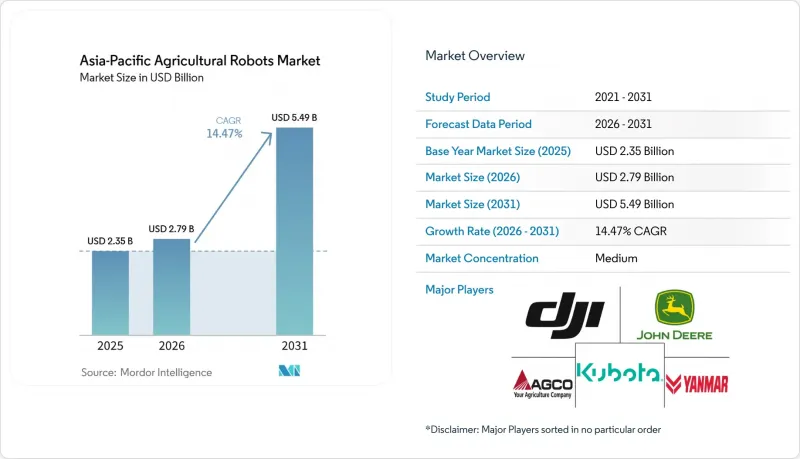
根據 Mordor Intelligence 預測,亞太地區的農業機器人市場規模預計將在 2025 年達到 23.5 億美元,在 2026 年成長至 27.9 億美元,並在 2031 年達到 54.9 億美元,預測期內的複合年成長率為 14.47%。
本報告按產品類型(無人曳引機、無人駕駛飛行器等)、組件(硬體、軟體、服務)、應用領域(作物種植、牲畜管理、酪農管理等)和地區(中國、日本、印度、澳洲、韓國、印尼等)進行細分。市場預測以美元計價。
亞太地區農業機器人市場趨勢及洞察
東亞和大洋洲的農業勞動力短缺問題日益嚴重。
隨著生產者擴大採用自動化方式處理勞動密集型農業作業,勞動力短缺正成為亞太地區農業機器人市場的主要驅動力。根據日本農林水產省(MAFF)預測,到2024年,日本農業主要勞動力預計將達到111萬人,平均年齡為69.2歲,其中60.9%的人年齡超過70歲,凸顯了勞動力結構嚴重失衡的問題。為了維持生產力、提高營運效率並確保全部區域農業工作的及時發展,老齡化勞動力正在加速推動對自動曳引機、收割機器人、無人機和其他精密農業技術的投資。
政府對智慧農業和自動化發展的支持措施
政府的支持正在加速全部區域農業機器人的普及,具體措施包括降低投資門檻和加強智慧農業生態系統建設。據韓國農林畜產食品部(MAFRA)稱,政府將於2025年根據《智慧農業發展與支持法》設立兩個智慧農業支援中心,以促進技術發展、人才培養、產業成長和智慧農業解決方案的推廣。這些政策舉措正在刺激對自主農業機械、機器人和數位農業技術的投資,從而支持全部區域技術的快速商業化和長期市場成長。
前期投資成本高,且維修複雜。
高昂的初始投資成本和複雜的改造流程仍然是亞太地區農業機器人市場發展的主要限制因素,尤其是在以小規模農戶為主的農業系統中。根據印度國家轉型委員會(NITI Aayog)發布的《前沿技術中心報告》(2025年),超過86%的印度農民平均耕種面積僅0.74公頃。這些小規模分散的農場往往缺乏投資昂貴自主農業機械的資金。此外,將機器人技術整合到現有曳引機和設備中還需要額外的改造、安裝和維護成本。這些成本障礙持續阻礙農業機器人在亞太地區發展中市場的大規模應用。
細分市場分析
預計到2025年,無人機和無人駕駛飛行器(UAV)將在亞太地區農業機器人市場佔據36.0%的最大佔有率。這一主導地位反映了無人機在廣袤農田上的廣泛應用,例如作物噴灑、田間監測和精準測繪,透過快速空中勘測提高作業效率。無人機尤其適用於亞太地區許多國家常見的農田分散和作物種植系統多樣化的現狀,使生產者能夠以更少的勞動力最佳化田間作業。無人機的多功能性、相對簡單的部署以及不斷擴展的服務型運作模式,進一步鞏固了其作為該地區應用最廣泛的農業機器人平台的地位。
預計採摘機器人將呈現最高的成長率,2026年至2031年的複合年成長率將達到18.9%。水果、蔬菜、果園和溫室種植業勞動力短缺問題日益嚴重,促使生產商尋求自動化採摘作業,以滿足對速度、一致性和精準度的要求。機器人視覺、人工智慧和末端執行器技術的進步正在拓展嬌嫩作物的商業性應用,提高採摘精度並減少作物損傷。隨著製造商不斷開發能夠處理多種作物的靈活採摘系統,預計採摘機器人將成為亞太地區農業機器人市場成長最快的產品類型之一。
其他好處:
- Excel格式的市場預測(ME)表
- 3個月的分析師支持
目錄
第1章:引言
- 研究假設和市場定義
- 調查範圍
第2章:調查方法
第3章執行摘要
第4章 市場狀況
- 市場概覽
- 市場促進因素
- 東亞和大洋洲的農業勞動力短缺問題日益嚴重。
- 高附加價值農場對精準作物管理的需求日益成長。
- 政府對智慧農業和自動化的激勵措施
- 降低感測器、視覺系統和邊緣人工智慧硬體的成本。
- 中小農場的機器人即服務(RaaS)擴展
- 在受控環境農業中引入自主機器人
- 市場限制因素
- 前期投資成本高,且維修複雜。
- 農業數位化中的碎片化和互通性差距
- 遍遠地區雲端連線自動駕駛的連線限制
- 關於自主農業機械的安全、責任與網路安全問題
- 監理情勢
- 技術展望
- 價值和供應鏈分析
- 波特五力分析
第5章 市場規模與成長預測
- 依產品類型
- 無人駕駛曳引機
- 無人駕駛飛行器和無人機
- 擠乳機器人
- 收割和採摘機器人
- 除草機器人
- 其他產品類型
- 透過使用
- 作物種植
- 畜牧管理
- 酪農管理
- 水產養殖
- 溫室農業
- 按組件
- 硬體
- 軟體
- 服務
- 按地區
- 中國
- 日本
- 印度
- 澳洲
- 韓國
- 印尼
- 泰國
- 其他亞太國家
第6章 競爭情勢
- 策略趨勢
- 市佔率分析
- 公司簡介
- Deere and Company
- SZ DJI Technology Co., Ltd.
- Kubota Corporation
- Yanmar Holdings Co., Ltd.
- AGCO Corporation
- CNH Industrial NV
- FJ Dynamics International Limited
- Daedong Corporation
- Trimble Inc.
- Autonomous Solutions, Inc.
- AgXeed BV
- Naio Technologies SAS
- Ecorobotix SA
- Carbon Robotics, Inc.
- Harvest Automation, Inc.
第7章 市場機會與未來展望
According to Mordor Intelligence, the Asia-Pacific agricultural robots market was valued at USD 2.35 billion in 2025 and is projected to grow from USD 2.79 billion in 2026 to USD 5.49 billion by 2031, registering a CAGR of 14.47% over the forecast period.
This report is Segmented by Product Type (Driverless Tractors, Unmanned Aerial Vehicles, and More), by Component (Hardware, Software, and Services), by Application (Crop Farming, Livestock Management, Dairy Management, and More), and by Geography (China, Japan, India, Australia, South Korea, Indonesia, and More). The Market Forecasts are Provided in Terms of Value (USD).
Asia-Pacific Agricultural Robots Market Trends and Insights
Accelerating Agricultural Labor Shortages in East Asia and Oceania
Labor shortages are emerging as a primary driver of the Asia-Pacific agricultural robots market, as producers increasingly automate labor-intensive farm operations. According to Japan's Ministry of Agriculture, Forestry and Fisheries (MAFF), the country had 1.11 million core agricultural workers in 2024, with an average age of 69.2 years and 60.9% aged 70 years or older, highlighting a growing workforce imbalance. This aging labor force is accelerating investments in autonomous tractors, robotic harvesters, drones, and other precision farming technologies to maintain productivity, improve operational efficiency, and ensure timely field operations across the region.
Government Incentives for Smart Farming and Automation
Government support is accelerating the adoption of agricultural robots across the Asia-Pacific region by reducing investment barriers and strengthening the smart farming ecosystem. According to the Ministry of Agriculture, Food and Rural Affairs (MAFRA) of South Korea, in 2025, the government designated two Smart Farming Support Centers to promote technology development, workforce training, industry growth, and wider adoption of smart farming solutions under the Act on Fostering and Supporting Smart Farming. These policy initiatives encourage investments in autonomous agricultural machinery, robotics, and digital farming technologies, supporting faster commercialization and long-term market growth across the region.
High Upfront Capital Cost and Retrofit Complexity
High upfront capital costs and retrofit complexity remain significant restraints on the Asia-Pacific agricultural robots market, particularly in smallholder-dominated farming systems. According to NITI Aayog's Frontier Tech Hub report (2025), more than 86% of India's farmers cultivate an average landholding of just 0.74 hectares. Such small and fragmented farms often lack the financial capacity to invest in expensive autonomous machinery. Additionally, integrating robotic technologies with existing tractors and equipment requires additional retrofit, installation, and maintenance expenditures. These cost barriers continue to limit large-scale adoption of agricultural robots across developing markets in the Asia-Pacific region.
Other drivers and restraints analyzed in the detailed report include:
- Declining Economics of Sensors, Vision Systems, and Edge AI Hardware
- Autonomous Robotics Adoption in Controlled-Environment Agriculture
- Safety, Liability, and Cybersecurity Concerns for Autonomous Farm Machines
For complete list of drivers and restraints, kindly check the Table Of Contents.
Segment Analysis
Unmanned aerial vehicles and drones accounted for the largest share of 36.0% in the Asia-Pacific agricultural robots market in 2025. Their dominant position reflects strong adoption across broad-acre farming for crop spraying, field monitoring, and precision mapping, where rapid aerial coverage improves operational efficiency. Drones are particularly suited to fragmented farmland and diverse cropping systems common across several Asia-Pacific countries, enabling growers to optimize field operations with lower labor requirements. Their versatility, relatively simple deployment, and expanding service-based operating models continue to strengthen their position as the most widely adopted agricultural robotic platform in the region.
Harvesting and picking robots are forecast to grow at the fastest CAGR of 18.9% from 2026 to 2031. Rising labor shortages in fruit, vegetable, orchard, and greenhouse production are encouraging growers to automate harvesting activities that require speed, consistency, and precision. Improvements in robotic vision, artificial intelligence, and end-effector technologies are expanding commercial applications for delicate crops, improving picking accuracy and reducing crop damage. As manufacturers continue developing flexible harvesting systems capable of handling multiple crop varieties, harvesting robots are projected to become one of the fastest-growing product categories in the Asia-Pacific agricultural robots market.
Complete Report Scope:
- By Product Type
- Driverless Tractors
- Unmanned Aerial Vehicles and Drones
- Milking Robots
- Harvesting and Picking Robots
- Weeding Robots
- Other Product Types
- By Application
- Crop Farming
- Livestock Management
- Dairy Management
- Aquaculture
- Greenhouse Farming
- By Component
- Hardware
- Software
- Services
- By Geography
- China
- Japan
- India
- Australia
- South Korea
- Indonesia
- Thailand
- Rest of Asia-Pacific
List of Companies Covered in this Report:
- Deere and Company
- SZ DJI Technology Co., Ltd.
- Kubota Corporation
- Yanmar Holdings Co., Ltd.
- AGCO Corporation
- CNH Industrial N.V.
- FJ Dynamics International Limited
- Daedong Corporation
- Trimble Inc.
- Autonomous Solutions, Inc.
- AgXeed B.V.
- Naio Technologies SAS
- Ecorobotix SA
- Carbon Robotics, Inc.
- Harvest Automation, Inc.
Additional Benefits:
- The market estimate (ME) sheet in Excel format
- 3 months of analyst support
TABLE OF CONTENTS
1 Introduction
- 1.1 Study Assumptions and Market Definition
- 1.2 Scope of the Study
2 Research Methodology
3 Executive Summary
4 Market Landscape
- 4.1 Market Overview
- 4.2 Market Drivers
- 4.2.1 Accelerating agricultural labor shortages in East Asia and Oceania
- 4.2.2 Rising need for precision crop intervention in high-value farms
- 4.2.3 Government incentives for smart farming and automation
- 4.2.4 Declining economics of sensors, vision systems, and edge AI hardware
- 4.2.5 Expansion of robotics-as-a-service for small and mid-sized farms
- 4.2.6 Autonomous robotics adoption in controlled-environment agriculture
- 4.3 Market Restraints
- 4.3.1 High upfront capital cost and retrofit complexity
- 4.3.2 Fragmented farm digitization and interoperability gaps
- 4.3.3 Rural connectivity limits for cloud-connected autonomy
- 4.3.4 Safety, liability, and cybersecurity concerns for autonomous farm machines
- 4.4 Regulatory Landscape
- 4.5 Technological Outlook
- 4.6 Value and Supply-Chain Analysis
- 4.7 Porter's Five Forces Analysis
- 4.7.1 Threat of New Entrants
- 4.7.2 Bargaining Power of Suppliers
- 4.7.3 Bargaining Power of Buyers
- 4.7.4 Threat of Substitutes
- 4.7.5 Intensity of Competitive Rivalry
5 Market Size and Growth Forecasts (Value)
- 5.1 By Product Type
- 5.1.1 Driverless Tractors
- 5.1.2 Unmanned Aerial Vehicles and Drones
- 5.1.3 Milking Robots
- 5.1.4 Harvesting and Picking Robots
- 5.1.5 Weeding Robots
- 5.1.6 Other Product Types
- 5.2 By Application
- 5.2.1 Crop Farming
- 5.2.2 Livestock Management
- 5.2.3 Dairy Management
- 5.2.4 Aquaculture
- 5.2.5 Greenhouse Farming
- 5.3 By Component
- 5.3.1 Hardware
- 5.3.2 Software
- 5.3.3 Services
- 5.4 By Geography
- 5.4.1 China
- 5.4.2 Japan
- 5.4.3 India
- 5.4.4 Australia
- 5.4.5 South Korea
- 5.4.6 Indonesia
- 5.4.7 Thailand
- 5.4.8 Rest of Asia-Pacific
6 Competitive Landscape
- 6.1 Strategic Moves
- 6.2 Market Share Analysis
- 6.3 Company Profiles (Includes Global Level Overview, Market Level Overview, Core Segments, Financials as Available, Strategic Information, Market Rank/Share for Key Companies, Products and Services, and Recent Developments)
- 6.3.1 Deere and Company
- 6.3.2 SZ DJI Technology Co., Ltd.
- 6.3.3 Kubota Corporation
- 6.3.4 Yanmar Holdings Co., Ltd.
- 6.3.5 AGCO Corporation
- 6.3.6 CNH Industrial N.V.
- 6.3.7 FJ Dynamics International Limited
- 6.3.8 Daedong Corporation
- 6.3.9 Trimble Inc.
- 6.3.10 Autonomous Solutions, Inc.
- 6.3.11 AgXeed B.V.
- 6.3.12 Naio Technologies SAS
- 6.3.13 Ecorobotix SA
- 6.3.14 Carbon Robotics, Inc.
- 6.3.15 Harvest Automation, Inc.
7 Market Opportunities and Future Outlook

 全球農業機器人市場規模、佔有率、趨勢和成長分析報告(2026-2034)
 農業機器人軟體市場預測至2034年-全球分析(按機器人類型、軟體功能、農場類型、技術、應用、最終用戶和地區分類)
 農業機器人:市場佔有率分析、產業趨勢與統計、成長預測(2026-2031)
 全球農業機器人市場:按產品、服務、農業類型、應用、最終用戶和地區分類-市場規模、產業動態、機會分析和預測(2026-2035 年)農業機器人與機電整合:市場佔有率分析、產業趨勢與統計、成長預測(2026-2031)
 農業機器人市場:2026-2032年全球市場預測(依產品類型、農場類型、農場規模、最終用戶和銷售管道分類)農業機器人市場預測至2034年—按產品、組件、技術、應用、最終用戶和地區分類的全球分析
 農業機器人市場規模、佔有率、趨勢和預測:按產品類型、應用、可用性和地區分類,2026-2034年全球農業機器人市場規模、佔有率、趨勢和成長分析報告(2026-2034年)
 農業機器人市場:依類型(無人機、自主拖拉機和農田機器人、收割機器人、擠乳機器人、除草和噴灑機器人、分類和包裝機器人)、應用和農場類型劃分-全球預測至2036年