


 |
市場調查報告書
商品編碼
2122686
越南水產飼料:市場佔有率分析、產業趨勢與統計及成長預測(2026-2031)Vietnam Aquaculture Feed - Market Share Analysis, Industry Trends & Statistics, Growth Forecasts (2026 - 2031) |
||||||

※ 本網頁內容可能與最新版本有所差異。詳細情況請與我們聯繫。
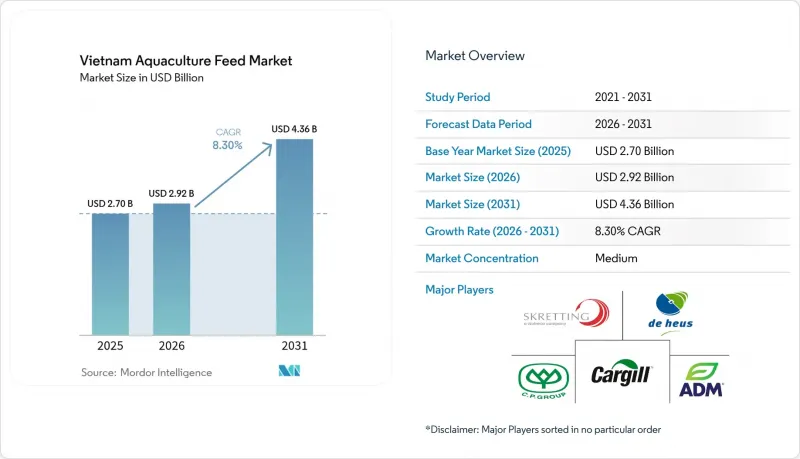
據 Mordor Intelligence 稱,越南水產養殖飼料市場在 2025 年的價值為 27 億美元,預計到 2031 年將達到 43.6 億美元,而 2026 年為 29.2 億美元,預測期(2026-2031 年)的複合年成長率為 8.30%。
本報告按飼料種類(膨化飼料、顆粒飼料、濕飼料、飼料)、原料來源(魚粉/魚油、植物蛋白、動物副產品、藻類/替代蛋白)和目標魚類(白蝦、大虎蝦、巴沙魚、鯉魚、鯰魚、吳郭魚及其他魚類)進行分類。市場預測以美元計價。
越南水產養殖飼料市場趨勢及洞察。
國內循環水產養殖系統(RAS)的強勁擴張
越南循環水產養殖系統(RAS)的快速發展顯著提高了高價值水產養殖的生產效率和生物安全性。 RAS有助於水質管理,抑制疾病爆發,並允許更高的養殖密度,特別是在蝦類和巴沙魚養殖中。例如,湄公河三角洲地區的集約化蝦場正擴大採用RAS技術,以最大限度地減少換水次數,降低早衰症(EMS)等疾病的風險。這種技術主導的模式有助於提高單位面積產量,並實現全年穩定生產,從而直接促進整個水產養殖業的發展。
功能性飼料的推廣
含有益生菌、酵素和免疫促效劑的功能性飼料的日益普及,正在提高蝦類和魚類養殖的飼料轉換率和存活率。隨著疾病管理的重要性日益凸顯,水產養殖戶正從傳統飼料轉向能夠增強腸道健康和免疫力的專用飼料飼料。例如,朔莊省和北陸省的蝦場正在使用添加益生菌的飼料,以減少對抗生素的依賴,同時維持出口標準的品質。這種轉變提高了每噸飼料的價值,提升了養殖場的生產力,並最終推動了整個產業的成長。 2025年10月,GreenFeed的益生菌強化蝦飼料獲得了水產養殖管理委員會(ASC)的認證,這將有助於水產養殖戶提高飼料轉換率並降低成本。
魚粉和魚油價格波動
越南水產養殖飼料生產嚴重依賴進口魚粉和魚油,使得該產業極易受到全球價格波動的影響。全球魚粉價格上漲(通常受秘魯供應緊張的影響)直接推高了飼料生產成本,進而影響蝦農的利潤率,導致一些小規模養殖戶被迫降低養殖密度或放慢生產週期。過去兩年,越南魚油出口價格波動劇烈。 2024年,價格區間為每公斤0.83美元至2.96美元。 2025年,價格持續波動,區間為每公斤0.97美元至2.48美元。
細分市場分析
膨化飼料是越南水產養殖飼料市場中最大的細分市場,預計到2025年將佔越南水產養殖飼料市場的42.0%。這反映了其諸多優勢,例如減少廢棄物和提高飼料轉換率。顆粒飼料也曾佔較大佔有率,但隨著集約化蝦農追求更高效率,膨化飼料正逐漸超越顆粒飼料。顆粒飼料生產商正在引入蒸汽調節技術來提高顆粒的耐久性,但由於顆粒密度與蝦的攝食習性不匹配這一根本問題,這種方法的應用受到限制。
飼料是成長最快的細分市場,預計到2031年將以11.5%的複合年成長率成長。這主要歸功於孵化場投資緩釋技術以提高幼苗存活率。濕飼料目前仍主要面向鰻魚和觀賞魚等小眾市場,因為其保存期限較短,增加了人事費用,限制了其在越南水產養殖飼料市場的商業性潛力。 2024年5月,升龍集團在海陽省開設了一家新的飼料廠,使其年產能擴大至70萬噸。該工廠專注於生產膨化蝦飼料,旨在開拓高階市場並提高利潤率。
其他好處
- Excel格式的市場預測(ME)表
- 3個月的分析師支持
目錄
第1章:引言
- 研究假設和市場定義
- 調查範圍
第2章:調查方法
第3章執行摘要
第4章 市場狀況
- 市場概覽
- 市場促進因素
- 國內循環水產養殖系統(RAS)的強勁擴張
- 功能性飼料的廣泛應用
- 消費者對不含抗生素魚貝類的需求日益成長
- 整合人工智慧驅動的精準送料平台
- 利用沼氣處理水擴大單細胞蛋白生產規模
- 湄公河三角洲蝦飼料補貼
- 市場限制因素
- 魚粉和魚油價格波動
- 自然資源與環境部製定了嚴格的廢水處理規定
- 特種添加劑供應鏈中的瓶頸
- 農業工人對基因改造蛋白質材料的負面態度
- 監理情勢
- 技術展望
- 波特五力分析
第5章 市場規模與成長預測
- 按飼料類型
- 擠壓飼料
- 顆粒飼料
- 濕飼料
- 飼料
- 按原料來源
- 魚粉/魚油
- 植物蛋白
- 動物副產品
- 藻類和替代蛋白
- 目標魚種
- 凡納濱對蝦(Litopenaeus vannamei)
- 斑節對蝦(Penaeus monodon)
- 巴沙魚
- 鯉魚
- 鯰魚
- 吳郭魚
- 其他魚類
第6章 競爭情勢
- 市場集中度
- 策略趨勢
- 市佔率分析
- 公司簡介
- Cargill Inc.
- De Heus Animal Nutrition BV
- Skretting(Nutreco NV)
- Archer-Daniels-Midland Company
- Charoen Pokphand Group
- Skretting Vietnam(Nutreco NV)
- Grobest Industrial Co. Ltd.(Grobest Group)
- Tongwei Co. Ltd.
- Alltech Inc.
- Lallemand Inc.
- INVE Aquaculture Inc.(Benchmark Holdings Plc)
- Aller Aqua Vietnam(Aller Aqua A/S)
- GreenFeed Vietnam Corp.
- Uni-President Vietnam Co. Ltd.
第7章 市場機會與未來展望
According to Mordor Intelligence, the Vietnam aquaculture feed market size was valued at USD 2.70 billion in 2025 and estimated to grow from USD 2.92 billion in 2026 to reach USD 4.36 billion by 2031, at a CAGR of 8.30% during the forecast period (2026-2031).
This report is Segmented by Feed Type (Extruded Feed, Pelleted Feed, Moist Feed, and Micro Feed), by Ingredient Source (Fish Meal and Fish Oil, Plant Protein, Animal By-Products, and Algal and Alternative Proteins), and by Species (White-Leg Shrimp, Giant Tiger Prawn, Pangasius, Carp, Catfish, Tilapia, and Other Species). The Market Forecasts are Provided in Terms of Value (USD).
Vietnam Aquaculture Feed Market Trends and Insights
Robust Expansion of Domestic Recirculating Aquaculture Systems Facilities
The rapid expansion of Recirculating Aquaculture Systems (RAS) in Vietnam is significantly improving production efficiency and biosecurity in high-value species farming. RAS facilitates controlled water quality, reduces disease outbreaks, and enhances stocking density, particularly in shrimp and pangasius farming. For instance, intensive shrimp farms in the Mekong Delta are increasingly adopting RAS technology to minimize water exchange and mitigate disease risks such as Early Mortality Syndrome (EMS). This technology-driven approach supports higher output per hectare and stabilizes year-round production, directly contributing to overall aquaculture growth.
Mainstream Growth of Functional Feeds
The growing adoption of functional feeds fortified with probiotics, enzymes, and immunostimulants is improving feed conversion ratios and survival rates in shrimp and fish farming. As disease management becomes increasingly critical, farmers are transitioning from traditional feed to specialized formulations that enhance gut health and immunity. For instance, shrimp farms in Soc Trang and Bac Lieu provinces are using probiotic-enhanced feeds to reduce reliance on antibiotics while maintaining export-grade quality. This shift increases feed value per metric ton and enhances farm productivity, thereby driving sectoral growth. GreenFeed secured Aquaculture Stewardship Council certification in October 2025 for its probiotic shrimp diet, delivering improved feed conversion and cost savings for farmers.
Volatile Fish-Meal and Fish-Oil Prices
Vietnam relies heavily on imported fishmeal and fish oil for aquafeed production, making the industry susceptible to global price fluctuations. Increases in global fishmeal prices, often driven by supply constraints in Peru, directly raise feed production costs. This impacts shrimp farmers, leading to margin compression. As a result, some small-scale operators are compelled to reduce stocking densities or delay production cycles. The export price of fish oil from Vietnam has fluctuated significantly over the past two years. In 2024, prices ranged from 0.83 USD per kg to 2.96 USD per kg. In 2025, prices continued to vary, ranging from 0.97 USD per kg to 2.48 USD per kg.
Other drivers and restraints analyzed in the detailed report include:
- Rising Consumer Demand for Antibiotic-Free Seafood
- Integration of AI-Driven Precision-Feeding Platforms
- Stringent Effluent-Discharge Rules
For complete list of drivers and restraints, kindly check the Table Of Contents.
Segment Analysis
Extruded diets were the largest segment, accounting for 42.0% of the Vietnam aquaculture feed market share in 2025, reflecting their buoyancy advantage, which reduces waste and improves feed conversion. Pelleted diets held a significant share yet are losing ground to extruded formats as intensive shrimp farmers shift toward higher efficiency. Pelleted manufacturers are retrofitting steam conditioners to raise pellet durability, but their inherent density mismatch with shrimp feeding habits restricts uptake.
Micro feeds are the fastest-growing segment, advancing at a 11.5% CAGR through 2031, as hatcheries invest in controlled-release technology to drive gains in larval survival. Moist feeds remain a niche for eel and ornamental species because their short shelf life increases labor costs and limits their commercial potential in the Vietnamese aquaculture feed market. Thang Long Group inaugurated a new feed mill in Hai Duong province in May 2024, increasing its annual capacity to 700,000 metric tons. The facility focuses on producing extruded shrimp diets to target the premium segment and enhance profit margins.
Complete Report Scope:
- By Feed Type
- Extruded Feed
- Pelleted Feed
- Moist Feed
- Micro Feed
- By Ingredient Source
- Fish Meal and Fish Oil
- Plant Protein
- Animal By-products
- Algal and Alternative Proteins
- By Species
- White-leg Shrimp (Litopenaeus vannamei)
- Giant Tiger Prawn (Penaeus monodon)
- Pangasius
- Carp
- Catfish
- Tilapia
- Other Species
List of Companies Covered in this Report:
- Cargill Inc.
- De Heus Animal Nutrition B.V.
- Skretting (Nutreco NV)
- Archer-Daniels-Midland Company
- Charoen Pokphand Group
- Skretting Vietnam (Nutreco N.V.)
- Grobest Industrial Co. Ltd. (Grobest Group)
- Tongwei Co. Ltd.
- Alltech Inc.
- Lallemand Inc.
- INVE Aquaculture Inc. (Benchmark Holdings Plc)
- Aller Aqua Vietnam (Aller Aqua A/S)
- GreenFeed Vietnam Corp.
- Uni-President Vietnam Co. Ltd.
Additional Benefits:
- The market estimate (ME) sheet in Excel format
- 3 months of analyst support
TABLE OF CONTENTS
1 Introduction
- 1.1 Study Assumptions and Market Definition
- 1.2 Scope of the Study
2 Research Methodology
3 Executive Summary
4 Market Landscape
- 4.1 Market Overview
- 4.2 Market Drivers
- 4.2.1 Robust expansion of domestic Recirculating Aquaculture Systems facilities
- 4.2.2 Mainstream growth of functional feeds
- 4.2.3 Rising consumer demand for antibiotic-free seafood
- 4.2.4 Integration of AI-driven precision-feeding platforms
- 4.2.5 Scale-up of single-cell protein production from biogas effluent
- 4.2.6 Shrimp-specific feed subsidies in Mekong Delta
- 4.3 Market Restraints
- 4.3.1 Volatile fish-meal and fish-oil prices
- 4.3.2 Stringent effluent-discharge rules from Ministry of Natural Resources and Environment
- 4.3.3 Supply-chain bottlenecks for specialty additives
- 4.3.4 Farmer hesitancy toward genetically engineered protein inputs
- 4.4 Regulatory Landscape
- 4.5 Technological Outlook
- 4.6 Porter's Five Forces Analysis
- 4.6.1 Bargaining Power of Suppliers
- 4.6.2 Bargaining Power of Buyers
- 4.6.3 Threat of New Entrants
- 4.6.4 Threat of Substitutes
- 4.6.5 Intensity of Competitive Rivalry
5 Market Size and Growth Forecasts (Value)
- 5.1 By Feed Type
- 5.1.1 Extruded Feed
- 5.1.2 Pelleted Feed
- 5.1.3 Moist Feed
- 5.1.4 Micro Feed
- 5.2 By Ingredient Source
- 5.2.1 Fish Meal and Fish Oil
- 5.2.2 Plant Protein
- 5.2.3 Animal By-products
- 5.2.4 Algal and Alternative Proteins
- 5.3 By Species
- 5.3.1 White-leg Shrimp (Litopenaeus vannamei)
- 5.3.2 Giant Tiger Prawn (Penaeus monodon)
- 5.3.3 Pangasius
- 5.3.4 Carp
- 5.3.5 Catfish
- 5.3.6 Tilapia
- 5.3.7 Other Species
6 Competitive Landscape
- 6.1 Market Concentration
- 6.2 Strategic Moves
- 6.3 Market Share Analysis
- 6.4 Company Profiles (Includes Global Level Overview, Market Level Overview, Core Segments, Financials as Available, Strategic Information, Market Rank/Share for Key Companies, Products and Services, Recent Developments)
- 6.4.1 Cargill Inc.
- 6.4.2 De Heus Animal Nutrition B.V.
- 6.4.3 Skretting (Nutreco NV)
- 6.4.4 Archer-Daniels-Midland Company
- 6.4.5 Charoen Pokphand Group
- 6.4.6 Skretting Vietnam (Nutreco N.V.)
- 6.4.7 Grobest Industrial Co. Ltd. (Grobest Group)
- 6.4.8 Tongwei Co. Ltd.
- 6.4.9 Alltech Inc.
- 6.4.10 Lallemand Inc.
- 6.4.11 INVE Aquaculture Inc. (Benchmark Holdings Plc)
- 6.4.12 Aller Aqua Vietnam (Aller Aqua A/S)
- 6.4.13 GreenFeed Vietnam Corp.
- 6.4.14 Uni-President Vietnam Co. Ltd.
7 Market Opportunities and Future Outlook

 2026-2030年全球水產飼料市場
 擠壓成型水產飼料市場規模、佔有率和成長分析:按擠壓機類型、飼料類型、目標水產養殖品種、最終用戶和地區分類-2026-2033年產業預測
 印度水產飼料:市場佔有率分析、產業趨勢與統計及成長預測(2026-2031)
 水產養殖飼料市場分析及預測(至2035年):依類型、產品、服務、技術、成分、應用、形式、材料類型及最終使用者分類
 水產養殖飼料中蛋白質水解物的市場機會、成長促進因素、產業趨勢分析及預測(2025-2034年)
 2030 年溫水水產養殖飼料市場預測:按物種、原料類型、飼料類型、形式、添加劑和地區進行全球分析