


 |
市場調查報告書
商品編碼
2114150
印度水產飼料:市場佔有率分析、產業趨勢與統計及成長預測(2026-2031)India Aquaculture Feed - Market Share Analysis, Industry Trends & Statistics, Growth Forecasts (2026 - 2031) |
||||||

※ 本網頁內容可能與最新版本有所差異。詳細情況請與我們聯繫。
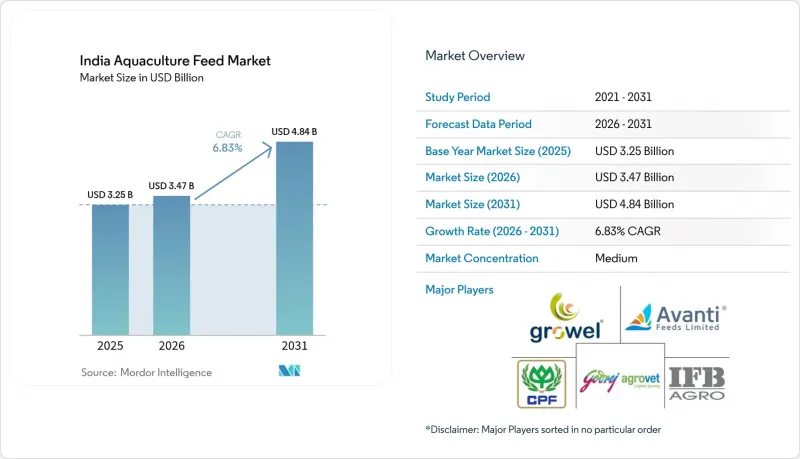
據 Mordor Intelligence 稱,2025 年印度水產養殖飼料市值為 32.5 億美元,預計到 2031 年將從 2026 年的 34.7 億美元成長至 48.4 億美元,預測期(2026-2031 年)複合年成長率為 6.83%。
本報告按類型(魚飼料、貝類飼料等)、原料(大豆粕等)、生長階段(幼畜飼料、育成雞飼料、育肥雞飼料)和形態(顆粒飼料、膨化(漂浮)飼料等)分類。市場預測以價值(美元)和數量(公噸)表示。
印度水產養殖飼料市場趨勢及洞察。
國內魚貝類消費量增加
受都市區消費者轉向低脂蛋白質來源的推動,預計2025年,人均魚貝類消費量將達到5.7公斤。大型零售連鎖店報告魚貝類銷量顯著成長,促使水產養殖戶更加重視提高飼料質量,以確保全年穩定生產。對高品質魚貝類產品日益成長的需求正在推動水產養殖飼料市場的發展,因為水產養殖戶優先考慮飼料轉換率以維持穩定的供應。消費者對新鮮安全魚貝類產品的偏好推動了養殖吳郭魚和巴沙魚需求的成長,從而促進了印度水產養殖飼料市場的發展。在魚類歷來是日常膳食主食的南印度家庭,養殖魚類的消費量正在擴大,導致市售飼料的使用量增加。
擴大出口型水產養殖
2024年,印度水產品出口額達80.9億美元,其中蝦類佔75%。為符合國際品質標準,出口型水產養殖場採高密度養殖及集約化養殖方式,導致每公頃飼料消耗量高於國內養殖場。美國仍是印度水產品出口的主要目的地,佔總出口額的35%。近期關稅調整促使市場更加多元化,歐洲和中東市場也隨之成長。對出口的重視推動了對營養成分更優、飼料轉換率更高的特種飼料的需求。
魚粉和原物料價格波動
2024年,魚粉價格在每噸1,200美元至1,500美元之間波動,季度波動幅度達15%至20%。大豆粕也出現類似波動,由於原料成本佔生產成本的75%,影響了飼料生產的盈利。印度飼料生產商所需魚粉的60%從秘魯和智利進口,因此極易受到外匯波動和供應鏈中斷的影響。由於原料成本在總生產成本中佔比很高,價格穩定對於維持出口競爭力至關重要。
細分市場分析
至2025年,魚飼料將佔印度水產養殖飼料市場的53.78%。這主要得益於鯉魚、吳郭魚和鯰魚的國內消費需求。由於西孟加拉邦和奧裡薩邦的大規模鯉魚養殖,市場需求保持穩定;而吳郭魚生長週期短,也促進了飼料消耗的成長。甲殼類飼料雖然產量較小,但由於其營養需求高且出口品質標準嚴格,因此利潤率較高。
受養殖面積擴大和出口導向水產養殖密度提高的推動,預計到2031年,蝦飼料市場將以9.86%的複合年成長率成長。專為蝦子設計的高蛋白飼料提升了產品價值,而強調高效飼料轉換率和可追溯性的國際認證進一步增強了其價值。領先製造商持續研發功能性飼料添加劑,改善了蝦子的腸道健康,提高了蝦子的存活率,使該細分市場成為印度水產養殖飼料市場的主要收入來源。
預計到2025年,大豆粕將佔印度水產養殖飼料市場規模的34.92%,主要得益於國內產量和均衡的胺基酸組成。雖然魚粉在海水魚類飼料中仍佔有重要地位,但其高成本和環境問題正促使生產者探索替代蛋白質來源。玉米蛋白粉產業預計到2031年將以9.08%的複合年成長率成長,這主要得益於玉米濕磨產能的擴大和成本效益的提高。
在這個市場中,包括酵素製劑和益生菌在內的飼料添加劑的使用正在不斷擴大,以提高飼料轉換率。昆蟲粉和單細胞蛋白仍處於早期發展階段,但作為極具潛力的原料,正引起廣泛關注。為了維持印度水產養殖飼料市場穩定的營養供應,該產業正在積極尋求應對價格波動、減少對海洋來源原料的依賴以及提高飼料消化率等策略。
其他好處:
- Excel格式的市場預測(ME)表
- 3個月的分析師支持
目錄
第1章:引言
- 研究假設和市場定義
- 調查範圍
第2章:調查方法
第3章執行摘要
第4章 市場狀況
- 市場概覽
- 市場促進因素
- 國內魚貝類消費量增加
- 擴大出口型水產養殖
- 政府對水產養殖材料的補貼和扶持措施。
- 高蛋白飼料飼料技術介紹
- 大型零售連鎖店對自有品牌魚貝類的需求
- 人工智慧輔助的魚池監測可提高飼料轉換率。
- 市場限制因素
- 魚粉和原物料價格波動
- 水產養殖場疾病爆發
- 對飼料廠廢水製定更嚴格的環境標準
- 與低成本自製飼料的競爭
- 監理情勢
- 技術展望
- 波特五力分析
第5章 市場規模與成長預測
- 按類型
- 魚飼料
- 鯉魚飼料
- 鮭魚飼料
- 吳郭魚飼料
- 鯰魚飼料
- 其他魚飼料(鱒魚飼料、絲瓜飼料等)
- 軟體動物飼料
- 甲殼類動物飼料
- 蝦飼料
- 其他甲殼類飼料(蟹飼料、蝦飼料、龍蝦飼料飼料)
- 其他水生動物飼料(烏龜、海膽、青蛙等)
- 魚飼料
- 按成分
- 大豆粕
- 魚粉
- 玉米蛋白粉
- 添加劑(維生素、礦物質、酵素)
- 其他材料(血粉、肉骨粉、花生粉等)
- 依生命週期階段
- 起始飼料
- 生長飼料
- 精加工飼料
- 按形式
- 顆粒
- 擠出成型(浮動)
- 粉末
- 濃縮液液
第6章 競爭情勢
- 市場集中度
- 策略趨勢
- 市佔率分析
- 公司簡介
- Avanti Feeds Limited
- Charoen Pokphand Foods PCL
- Growel Feeds Private Limited
- IFB Agro Industries Ltd
- Godrej Agrovet Limited
- Alltech Inc.
- Nutreco NV(SHV Holdings NV)
- ADM(Archer Daniels Midland Company)
- BASF SE
- Waterbase Ltd.(KCT Group)
- UNO Feeds Private Limited
- De Heus Animal Nutrition BV
- Grobest Group Limited(Permira Advisers LLP)
- Zeus Biotech Pvt. Ltd.
- Kemin Industries, Inc.
第7章 市場機會與未來展望
According to Mordor Intelligence, the India aquaculture feed market size was valued at USD 3.25 billion in 2025 and estimated to grow from USD 3.47 billion in 2026 to reach USD 4.84 billion by 2031, at a CAGR of 6.83% during the forecast period (2026-2031).
This report is Segmented by Type (Fish Feed, Mollusk Feed, and More), by Ingredient (Soybean Meal, and More), by Lifecycle Stage (Starter Feed, Grower Feed, and Finisher Feed), and by Form (Pellets, Extruded (Floating), and More). The Market Forecasts are Provided in Terms of Value (USD) and Volume (Metric Tons).
India Aquaculture Feed Market Trends and Insights
Rising Domestic Seafood Consumption
Per capita fish consumption reached 5.7 kg in 2025, driven by urban consumers shifting toward lean protein sources. Organized retail chains reported significant growth in seafood sales, leading farmers to improve feed quality for consistent year-round production. The increasing demand for quality fish products has strengthened the aquafeed market, as farmers prioritize feed conversion efficiency to maintain a reliable supply. Consumer preferences for fresh and safe fish products have increased demand for farmed tilapia and pangasius, supporting the growth of India aquaculture feed market. South Indian households, traditionally incorporating fish in their daily diet, have expanded their consumption to include farmed species, increasing the adoption of commercial feed.
Expansion of Export-Oriented Aquaculture
India's seafood exports reached USD 8.09 billion in 2024, with shrimp contributing 75% of the total value. Export-oriented farms consume more feed per hectare compared to domestic-focused operations, due to higher stocking densities and intensive farming practices required to meet international quality standards. The United States remains India's primary seafood export destination, accounting for 35% of total shipments. Recent tariff adjustments have led to market diversification toward Europe and the Middle East. The export focus has increased demand for specialized feeds with enhanced nutritional profiles and improved feed conversion ratios.
Volatility in Fishmeal and Raw Material Prices
Fishmeal prices fluctuated between USD 1,200-1,500 per metric ton in 2024, with quarterly variations of 15-20%. Soybean meal experienced comparable price volatility, affecting feed production profitability, as raw materials constitute 75% of production costs. Indian feed manufacturers import 60% of their fishmeal requirements from Peru and Chile, making them vulnerable to currency fluctuations and supply chain disruptions. The high proportion of raw material costs in total production expenses makes price stability essential for maintaining export competitiveness.
Other drivers and restraints analyzed in the detailed report include:
- Government Subsidies and Schemes for Aquaculture Inputs
- Technical Adoption of High-Protein Formulated Feeds
- Disease Outbreaks in Aquaculture Farming
For complete list of drivers and restraints, kindly check the Table Of Contents.
Segment Analysis
Fish feed constituted 53.78% of the India aquaculture feed market share in 2025, driven by the production of carp, tilapia, and catfish for domestic consumption. The extensive carp farming operations in West Bengal and Odisha maintain consistent demand, while tilapia's rapid growth cycle contributes to increased feed consumption. Crustacean feed, despite lower volume, generates higher margins due to its enhanced nutrient requirements and strict export quality standards.
The shrimp feed segment is anticipated to grow at a 9.86% CAGR through 2031, driven by expanding farm areas and increased stocking densities in export-oriented operations. High-protein formulations specifically designed for vannamei shrimp support value growth, complemented by international certifications that emphasize efficient feed conversion and traceability. Major manufacturers' ongoing research and development in functional feed additives improve shrimp gut health and survival rates, establishing this segment as the key revenue generator in the India aquaculture feed market.
Soybean meal accounts for 34.92% of the India aquaculture feed market size in 2025, supported by domestic production and its balanced amino-acid profile. While fishmeal maintains importance in marine species feeds, its high costs and environmental concerns drive manufacturers to seek protein alternatives. The corn gluten meal segment is projected to grow at a 9.08% CAGR through 2031, driven by increased corn wet-milling capacity and improved cost efficiency.
The market shows increasing adoption of feed additives, including enzymes and probiotics, to improve feed efficiency. While insect meals and single-cell proteins remain in early development stages, they represent potential future ingredients. The industry prioritizes strategies to manage price volatility, reduce dependency on marine ingredients, and improve feed digestibility to maintain a consistent nutrition supply in the India aquaculture feed market.
Complete Report Scope:
- By Type
- Fish Feed
- Carp Feed
- Salmon Feed
- Tilapia Feed
- Catfish Feed
- Other Fish Feed (Trout Feed, Rohu Feed, etc.)
- Mollusk Feed
- Crustacean Feed
- Shrimp Feed
- Other Crustacean Feed (Crab Feed, Prawn Feed, Lobstar Feed, etc.)
- Other Aquafeed (Turtles, Sea Urchins, Frogs, etc.)
- Fish Feed
- By Ingredient
- Soybean Meal
- Fish Meal
- Corn Gluten Meal
- Additives (Vitamins, Minerals, Enzymes)
- Others (Blood meal, Meat and Bone Meal, Groundnut Cake, etc.)
- By Lifecycle Stage
- Starter Feed
- Grower Feed
- Finisher Feed
- By Form
- Pellets
- Extruded (Floating)
- Powder
- Liquid Concentrates
List of Companies Covered in this Report:
- Avanti Feeds Limited
- Charoen Pokphand Foods PCL
- Growel Feeds Private Limited
- IFB Agro Industries Ltd
- Godrej Agrovet Limited
- Alltech Inc.
- Nutreco N.V. (SHV Holdings N.V.)
- ADM (Archer Daniels Midland Company)
- BASF SE
- Waterbase Ltd. (KCT Group)
- UNO Feeds Private Limited
- De Heus Animal Nutrition B.V.
- Grobest Group Limited (Permira Advisers LLP)
- Zeus Biotech Pvt. Ltd.
- Kemin Industries, Inc.
Additional Benefits:
- The market estimate (ME) sheet in Excel format
- 3 months of analyst support
TABLE OF CONTENTS
1 Introduction
- 1.1 Study Assumptions and Market Definition
- 1.2 Scope of the Study
2 Research Methodology
3 Executive Summary
4 Market Landscape
- 4.1 Market Overview
- 4.2 Market Drivers
- 4.2.1 Rising Domestic Seafood Consumption
- 4.2.2 Expansion of Export-Oriented Aquaculture
- 4.2.3 Government Subsidies and Schemes for Aquaculture Inputs
- 4.2.4 Technical Adoption of High-Protein Formulated Feeds
- 4.2.5 Corporate Retail Chains' Private-Label Fish Demand
- 4.2.6 AI-Driven Pond Monitoring Improving Feed Conversion Ratios
- 4.3 Market Restraints
- 4.3.1 Volatility in Fishmeal and Raw Material Prices
- 4.3.2 Disease Outbreaks in Aquaculture Farming
- 4.3.3 Tighter Environmental Norms on Feed-Mill Effluent
- 4.3.4 Competition from Low-Cost Homemade Feeds
- 4.4 Regulatory Landscape
- 4.5 Technological Outlook
- 4.6 Porter's Five Forces Analysis
- 4.6.1 Bargaining Power of Suppliers
- 4.6.2 Bargaining Power of Buyers
- 4.6.3 Threat of New Entrants
- 4.6.4 Threat of Substitute Products
- 4.6.5 Intensity of Competitive Rivalry
5 Market Size and Growth Forecasts (Value and Volume)
- 5.1 By Type
- 5.1.1 Fish Feed
- 5.1.1.1 Carp Feed
- 5.1.1.2 Salmon Feed
- 5.1.1.3 Tilapia Feed
- 5.1.1.4 Catfish Feed
- 5.1.1.5 Other Fish Feed (Trout Feed, Rohu Feed, etc.)
- 5.1.2 Mollusk Feed
- 5.1.3 Crustacean Feed
- 5.1.3.1 Shrimp Feed
- 5.1.3.2 Other Crustacean Feed (Crab Feed, Prawn Feed, Lobstar Feed, etc.)
- 5.1.4 Other Aquafeed (Turtles, Sea Urchins, Frogs, etc.)
- 5.1.1 Fish Feed
- 5.2 By Ingredient
- 5.2.1 Soybean Meal
- 5.2.2 Fish Meal
- 5.2.3 Corn Gluten Meal
- 5.2.4 Additives (Vitamins, Minerals, Enzymes)
- 5.2.5 Others (Blood meal, Meat and Bone Meal, Groundnut Cake, etc.)
- 5.3 By Lifecycle Stage
- 5.3.1 Starter Feed
- 5.3.2 Grower Feed
- 5.3.3 Finisher Feed
- 5.4 By Form
- 5.4.1 Pellets
- 5.4.2 Extruded (Floating)
- 5.4.3 Powder
- 5.4.4 Liquid Concentrates
6 Competitive Landscape
- 6.1 Market Concentration
- 6.2 Strategic Moves
- 6.3 Market Share Analysis
- 6.4 Company Profiles (Includes Global Level Overview, Market Level Overview, Core Segments, Financials, Strategic Information, Market Rank/Share, Products and Services, Recent Developments)
- 6.4.1 Avanti Feeds Limited
- 6.4.2 Charoen Pokphand Foods PCL
- 6.4.3 Growel Feeds Private Limited
- 6.4.4 IFB Agro Industries Ltd
- 6.4.5 Godrej Agrovet Limited
- 6.4.6 Alltech Inc.
- 6.4.7 Nutreco N.V. (SHV Holdings N.V.)
- 6.4.8 ADM (Archer Daniels Midland Company)
- 6.4.9 BASF SE
- 6.4.10 Waterbase Ltd. (KCT Group)
- 6.4.11 UNO Feeds Private Limited
- 6.4.12 De Heus Animal Nutrition B.V.
- 6.4.13 Grobest Group Limited (Permira Advisers LLP)
- 6.4.14 Zeus Biotech Pvt. Ltd.
- 6.4.15 Kemin Industries, Inc.
7 Market Opportunities and Future Outlook

 2026-2030年全球水產飼料市場
 擠壓成型水產飼料市場規模、佔有率和成長分析:按擠壓機類型、飼料類型、目標水產養殖品種、最終用戶和地區分類-2026-2033年產業預測
 越南水產飼料:市場佔有率分析、產業趨勢與統計及成長預測(2026-2031)
 水產養殖飼料市場分析及預測(至2035年):依類型、產品、服務、技術、成分、應用、形式、材料類型及最終使用者分類
 水產養殖飼料中蛋白質水解物的市場機會、成長促進因素、產業趨勢分析及預測(2025-2034年)
 2030 年溫水水產養殖飼料市場預測:按物種、原料類型、飼料類型、形式、添加劑和地區進行全球分析