


 |
市場調查報告書
商品編碼
2122669
現場服務管理(FSM):市場佔有率分析、行業趨勢和統計數據、成長預測(2026-2031 年)Field Service Management (FSM) - Market Share Analysis, Industry Trends & Statistics, Growth Forecasts (2026 - 2031) |
||||||

※ 本網頁內容可能與最新版本有所差異。詳細情況請與我們聯繫。
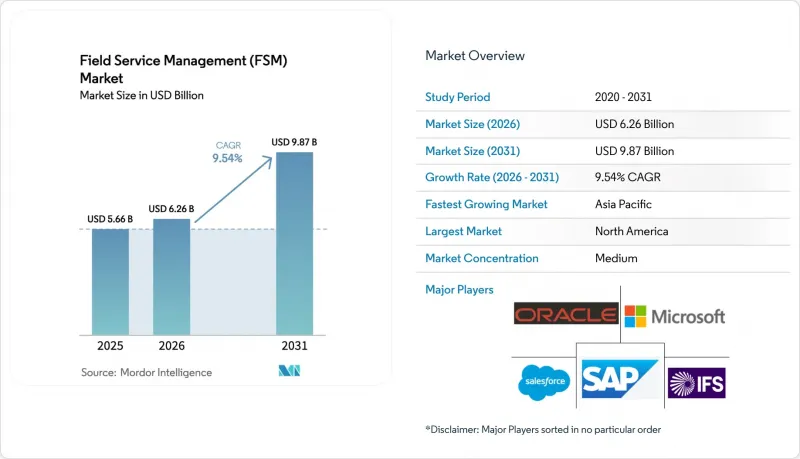
根據 Mordor Intelligence 預測,現場服務管理 (FSM) 市場將從 2025 年的 56.6 億美元成長到 2026 年的 62.6 億美元,然後在 2031 年達到 98.7 億美元,2026 年至 2031 年的複合年成長率為 9.5%。
本報告按部署類型(本地部署、雲端部署)、組織規模(大型企業、中小企業)、FSM解決方案/服務類型(調度、派單、路線最佳化、服務合約管理、工單管理等)、最終用戶行業(IT和電信等)以及地區進行細分。市場預測以美元(USD)為單位。
全球現場服務管理 (FSM) 市場趨勢與洞察
公共產業和電信業工程師的即時視覺化需求
公共產業和電信公司正在將GPS感測器、行動應用程式和地理圍欄技術整合到日常營運中,以即時追蹤位置、到達時間和工作狀態,從而加快恢復速度並提高服務等級協定 (SLA) 的合規性。投資智慧電網可以將異常警報直接轉化為工作單,從而縮短停電時間並降低罰款成本。將安裝在變壓器和基地台上的物聯網設備與現場服務平台整合,可自動產生工單,消除電話調度造成的延遲。雲端儀表板整合了資產狀態數據和員工可用性信息,即使在風暴災害加劇的情況下,主管也能在輪班期間重新安排工作團隊的路線。歐洲監管機構對長時間停電處以罰款,進一步推動了預測性調度工具的普及。因此,公共產業正在用整合式雲端平台取代紙本公告欄,這些平台可以同步資產遙測資料、員工排班表和客戶聯絡資訊。
大規模5G部署導致地面狀況日益複雜
隨著5G在全球範圍內的擴展,小型基地台基地台和邊緣節點數量迅速成長,每個站點都需要精確定位和頻繁維護。與宏基站不同,這些資產分散在電線杆和屋頂上,給傳統的調度模式帶來了巨大壓力。目前,現場服務頻道確定演算法會將鄰近站點分組,使一名技術人員能夠在一次出勤中完成多項任務,從而減少高達20%的出勤次數。工廠內部的專用5G網路需要運作保障,因此預測性調度對於維持低於一小時的平均修復時間(MTTR)至關重要。對於與5G設備位於同一設施的邊緣資料中心而言,這一點更為關鍵,因為冷卻系統故障或斷電可能會同時影響多個租戶。因此,營運商正在採用人工智慧驅動的調度和擴增實境(AR)驅動的維修指南,以滿足更嚴格的服務回應時限並控制維護成本。
公共部門資料主權面臨的網路安全障礙
政府採購負責人實施嚴格的資料居住規則和零信任義務,這延長了採購週期。供應商必須提供符合 NIST CSF 等框架的加密、身分管理和事件回應程序,這可能會將銷售週期延長至長達九個月。在歐盟,「資料法」強制要求雲端服務供應商將營運資料在地化,這推高了基礎設施成本並限制了多邊部署。沒有經過認證的主權雲端區域的中小型供應商可能被排除在競標之外,導致市場佔有率集中在少數幾家超大規模公司手中。這些障礙尤其阻礙了公共產業和交通運輸行業的採用,因為這些行業處理關鍵的基礎設施數據。
細分市場分析
預計到2025年,雲端解決方案將佔總營收的64.29%,複合年成長率(CAGR)為10.58%,超過本地部署解決方案。這一優勢使雲端在預計的現場服務管理市場規模中佔據核心地位。公共產業可以受益於彈性許可,在應對風暴引發的需求激增期間避免伺服器採購延遲。季度功能發布能夠比傳統升級週期更快地提供人工智慧驅動的路線最佳化、說明影片指南和行動用戶介面升級。整合的API簡化了與CRM和ERP套件的整合,將客戶、財務和資產資料整合到單一工作流程中。本地部署在國防領域和高度監管的公共部門仍然普遍存在,因為在這些領域,主權網路至關重要。混合模式正在興起,它將敏感邏輯託管在防火牆後,同時利用雲端分析進行模式識別,這是一種折衷方案。提供精細化部署選項的供應商正在提高訂單率,尤其是在需要跨司法管轄區柔軟性的跨國公司中。隨著資料主權法規日益嚴格,區域特定的雲端節點正逐漸成為必要條件,而不是差異化因素。
雲端技術的擴展為供應商創造了更多提升銷售機會,他們可以提供預測性維護分析和擴增實境(AR) 指導等增值模組。圍繞主要平台的市場生態系統目前擁有數百個認證連接器,涵蓋從備件目錄到天氣預警資訊等各種內容。這種開放性降低了客製化整合的成本,並縮短了中型企業實現價值所需的時間。此外,將現金支出與已實現價值掛鉤的訂閱定價模式,對專注於最佳化資本支出 (CAPEX) 的財務長 (CFO) 來說極具吸引力。這些因素共同作用,將使雲端技術在預測期內繼續保持其在現場服務管理市場中的市場佔有率和成長率的領先地位。
到2025年,大型企業將佔據57.55%的收入佔有率,這主要得益於其複雜的多站點部署,以及與ERP和供應鏈系統深度整合。這種規模正在擴大現場服務管理市場的高階領域,相關專案涉及數千名技術人員,並支援多種語言。同時,中小企業(SME)正以10.12%的複合年成長率成長,縮小了市場滲透率的差距。入門級方案的成本約為每位技術人員每月50美元,降低了初始投資門檻,並包含直覺的行動應用程式,無需長期變更管理計劃即可實施。暖通空調、管道和設施管理服務的區域承包商正在採用這些方案,以取代紙本剪貼簿和電子表格,從而立即提高調度效率。供應商正擴大將其產品線細分為“企業版”和“成長版”,前者捆綁了人工智慧分析和沙盒環境,後者則提供模板化的工作流程和自助設定。通路合作夥伴(例如 MSP 和會計軟體經銷商)在向中小企業部署的過程中發揮著至關重要的作用,將現場服務能力整合到更廣泛的數位轉型方案中。
從創新角度來看,中小企業 (SME) 領域通常是低程式碼工作流程建構器和語音輸入工單所創建的試驗場,因為敏捷性比繁瑣的流程更為重要。這種敏捷的採用方式催生了成功的案例研究,供應商可以利用這些案例拓展本地市場,加速成長。隨著中小企業採用率的提高,資料量不斷增加,人工智慧模型得到訓練,而這些洞察的共用將惠及所有基本客群。因此,中小企業的成長動能對整個現場服務管理市場而言都是一股結構性利好。
區域分析
預計到2025年,北美將佔全球銷售額的37.89%。這主要得益於其優越的地理位置,這裡擁有先進的通訊基礎設施、廣泛的智慧電網部署以及成熟的ERP部署基礎,並整合了現場模組。投資者所有的公共產業在2025年投資284億美元用於升級輸配電設備,推動了對停電管理調度工具的穩定需求(eia.gov)。在航太和製造業領域,基於擴增實境(AR)的遠端協助技術正在加速應用,使專家能夠在無需親臨現場的情況下指導現場技術人員。加拿大公共產業正在測試和實施FSM(現場服務管理)與電動車充電網路的整合,以提高充電樁的運轉率;而在墨西哥,離線行動應用程式正被用於擴展服務欠缺地區的光纖網路。
受中國智慧製造雄心、印度「數位印度」計畫和日本「社會5.0」計畫的推動,亞太地區預計到2031年將以9.93%的複合年成長率成長。中國智慧電錶的大規模部署催生了安裝和維護需求,這與現場服務管理(FSM)平台直接相關。印度政府對雲端軟體應用的津貼降低了微企業的進入門檻,並促進了冷暖氣空調(HVAC)和電氣承包商的基層數位轉型。日本正透過人工智慧驅動的調度和機器人整合來解決人手不足,協調人工和無人機對其所有基礎設施資產的巡檢工作。澳洲和紐西蘭正在利用低地球軌道衛星通訊來維護偏遠礦場和公共產業網路。
現場服務管理市場的剩餘佔有率由歐洲、南美洲以及中東和非洲佔據。在歐洲,嚴格的「清潔能源包裝」可靠性標準迫使公共產業採用預測性調度和邊緣分析技術。德國的現有電廠正在對其設備進行改造,加裝邊緣閘道器,以檢測振動異常並發出現場故障單,從而減少停機時間。南美的電信業者正在部署現場服務管理(FSM)系統,以協調巴西和阿根廷的大規模光纖鋪設工作;而中東的石油生產商則正在使用衛星平台來維護海上鑽井鑽機。南非的礦場正在以巡檢為基礎,實施自動駕駛運輸卡車的預測性維護,這表明該地區的技術正在不斷進步。
其他好處
- Excel格式的市場預測(ME)表
- 3個月的分析師支持
目錄
第1章:引言
- 研究假設和市場定義
- 調查範圍
第2章:調查方法
第3章執行摘要
第4章 市場狀況
- 市場概覽
- 市場促進因素
- 公共產業和電信業工程師的即時視覺化需求
- 大規模5G部署導致地面狀況日益複雜
- 促進脫碳將鼓勵安裝智慧電錶和電動車充電樁。
- 由於勞動力老化,加速採用人工智慧進行排班正在成為必然趨勢。
- 能夠產生持續收入的OEM服務模式
- 透過遠距工作安全法規,為利用擴增實境技術進行遠端支援提供支援
- 市場限制因素
- 公共部門資料主權面臨的網路安全障礙
- 在棕地工廠整合傳統ERP和OT系統的複雜性。
- 中小企業的初始實施成本與變更管理成本
- 跨境監管法規不一致阻礙了人工智慧驅動的叫車服務的發展。
- 監理展望
- 波特五力分析
- 宏觀經濟衝擊(包括新冠疫情和供應鏈)的影響
- 現場應用案例的演進(AR/VR、預測性維護、自動化)
- 買方優先分析
第5章 市場規模與成長預測
- 依部署類型
- 現場
- 雲
- 按組織規模
- 大公司
- 小型企業
- 按服務類型分類的 FSM 解決方案
- 解決方案
- 調度、車輛派送、路線最佳化
- 服務合約管理
- 工單管理
- 客戶管理
- 庫存管理
- 其他軟體(收費、發票、保固)
- 服務(整合、實施、支援)
- 解決方案
- 按最終用戶行業分類
- 設施管理(硬體維修/軟性設施管理)
- 資訊科技/通訊
- 醫療保健和生命科學
- 能源與公共產業
- 石油和天然氣
- 製造業
- 運輸/物流
- 房地產及其他
- 按地區
- 北美洲
- 美國
- 加拿大
- 墨西哥
- 南美洲
- 巴西
- 阿根廷
- 智利
- 秘魯
- 其他南美國家
- 歐洲
- 德國
- 英國
- 法國
- 義大利
- 西班牙
- 其他歐洲國家
- 亞太地區
- 中國
- 日本
- 韓國
- 印度
- 澳洲
- 紐西蘭
- 其他亞太國家
- 中東和非洲
- 阿拉伯聯合大公國
- 沙烏地阿拉伯
- 土耳其
- 南非
- 其他中東和非洲國家
- 北美洲
第6章 競爭情勢
- Strategic Developments
- 供應商定位分析
- 公司簡介
- Oracle Corp.(Oracle Field Service)
- Salesforce Inc.(Field Service)
- Microsoft Corp.(Dynamics 365 Field Service)
- SAP SE(Coresystems)
- IFS AB
- ServiceMax Inc.(PTC)
- ServicePower PLC
- Trimble Inc.
- FieldAware US Inc.
- Accruent LLC(Fortive)
- Zinier Inc.
- simPRO Group Pty Ltd.
- OverIT SpA
- Praxedo SA
- KloudGin Inc.
- Jobber
- FieldEZ Technologies
- ProntoForms Corp.
- Zuper Inc.
- KloudGin Inc.
第7章 市場機會與未來展望
According to Mordor Intelligence, the field service management market size is expected to grow from USD 5.66 billion in 2025 to USD 6.26 billion in 2026 and is forecast to reach USD 9.87 billion by 2031 at 9.54% CAGR over 2026-2031.
This report is Segmented by Deployment Type (On-Premise, and Cloud), Organization Size (Large Enterprises, and Small and Medium Enterprises), FSM Solution and Service Type (Scheduling, Dispatch and Route Optimization, Service Contract Management, Work-Order Management, and More), End-User Vertical (IT and Telecom, and More), Geography. The Market Forecasts are Provided in Terms of Value (USD).
Global Field Service Management (FSM) Market Trends and Insights
Real-time Technician Visibility Needs across Utilities And Telecom
Utilities and telecom carriers are embedding GPS sensors, mobile apps, and geofencing into daily workflows to track location, arrival times, and job status in real time, enabling faster restoration and higher SLA compliance. Smart-grid investments translate anomaly alerts directly into work orders, shortening outage duration and trimming penalty costs. Integration between IoT devices on transformers or cell sites and field service platforms auto-generates tickets, eliminating phone dispatch delays. Cloud dashboards now merge asset-health data with workforce availability so supervisors can reroute crews mid-shift when storm damage escalates. European regulators that levy fines for prolonged outages further motivate the adoption of predictive dispatch tools. As a result, utilities are replacing paper boards with unified cloud platforms that synchronize asset telemetry, workforce calendars, and customer messaging.
Large-scale 5G Roll-outs Raising Field Complexity
Global 5G expansion is multiplying small-cell sites and edge nodes, each requiring precision alignment and frequent maintenance. Unlike macro towers, these assets are dispersed on poles and rooftops, stressing legacy dispatch models. Field service routing algorithms now cluster proximate sites so a single technician can complete multiple jobs per trip, cutting truck rolls up to 20%. Private 5G networks in factories add round-the-clock uptime guarantees, making predictive scheduling indispensable for maintaining sub-hour MTTR benchmarks. Edge data centers co-located with 5G equipment raise the stakes further, as cooling or power failures jeopardize multiple tenants simultaneously. Consequently, operators adopt AI-driven scheduling and AR-assisted repair guides to meet tighter service windows and control maintenance costs.
Cyber-security and Data-sovereignty Barriers in the Public Sector
Government buyers impose strict data-residency rules and zero-trust mandates that lengthen procurement cycles. Vendors must demonstrate encryption, identity management, and incident-response playbooks compliant with frameworks such as NIST CSF, extending sales cycles up to nine months. In the European Union, the Data Act obliges cloud providers to localize operational data, inflating infrastructure costs and limiting multi-country rollouts. Smaller vendors lacking certified sovereign-cloud regions face exclusion from tenders, concentrating share among a few hyperscale players. These barriers particularly slow adoption in utilities and transit agencies that handle critical infrastructure data.
Other drivers and restraints analyzed in the detailed report include:
- OEM Servitization Models Creating Recurring Revenue Streams
- Ageing Workforce Accelerating AI-assisted Scheduling
- Legacy ERP and OT Integration Complexity in Brownfield Plants
For complete list of drivers and restraints, kindly check the Table Of Contents.
Segment Analysis
Cloud solutions generated 64.29% of 2025 revenue and are projected to grow at a 10.58% CAGR, outpacing on-premise alternatives. This dominance positions cloud at the heart of the field service management market size forecast. Utilities benefit from elastic licensing during storm-response surges, avoiding server procurement delays. Quarterly feature releases deliver AI route optimization, walk-through video guides, and mobile UI upgrades faster than traditional upgrade cycles. Integration APIs streamline linking with CRM and ERP suites, unifying customer, financial, and asset data in a single workflow. On-premise deployments persist in defense and highly regulated public-sector contexts where sovereign networks are mandatory. Hybrid models are emerging as a compromise, hosting sensitive logic behind the firewall while leveraging cloud analytics for pattern recognition. Vendors that offer granular deployment options enhance win rates, particularly in multi-national groups needing flexibility across jurisdictions. As data-sovereignty laws tighten, region-specific cloud nodes are becoming table stakes rather than a differentiation.
Cloud expansion reinforces vendor opportunities to upsell value-added modules such as predictive-maintenance analytics and augmented-reality guidance. Marketplace ecosystems around leading platforms now list hundreds of certified connectors, ranging from spare-parts catalogs to weather-alert feeds. This openness lowers custom-integration costs for mid-market adopters, accelerating time to value. Additionally, subscription pricing aligns cash outflows with value realized, appealing to CFOs focused on capex optimization. In aggregate, these factors sustain the cloud segment's lead in both field service management market share and growth velocity through the forecast horizon.
Large enterprises accounted for 57.55% of 2025 revenue on the strength of complex, multi-site deployments deeply integrated with ERP and supply-chain systems. Their scale amplifies the field service management market size at the top end, with projects spanning thousands of technicians in multiple languages. Conversely, small and medium enterprises are expanding at a 10.12% CAGR, narrowing the penetration gap. Entry-level plans priced near USD 50 per technician per month remove capital hurdles and include mobile apps intuitive enough to deploy without lengthy change-management programs. Regional contractors in HVAC, plumbing, and facilities services adopt these tiers to eliminate clipboards and spreadsheets, realizing immediate wins in dispatch efficiency. Vendors increasingly segment product lines into "enterprise" and "growth" editions, bundling AI analytics and sandbox environments for the former, while offering templatized workflows and self-service setup for the latter. Channel partners such as MSPs and accounting-software resellers play a pivotal role in SME outreach, embedding field service features into broader digital-transformation bundles.
From an innovation standpoint, the SME cohort often serves as a proving ground for low-code workflow builders and voice-to-text work-order entry, as agility trumps bureaucracy. These agile deployments create reference logos that vendors use to penetrate adjacent regional markets, compounding growth. As SME usage scales, data volumes train AI models, benefiting the entire customer base via pooled learning. Consequently, SME momentum constitutes a structural tailwind for the overall field service management market.
Complete Report Scope:
- By Deployment Type
- On-premise
- Cloud
- By Organization Size
- Large Enterprises
- Small and Medium Enterprises
- By FSM Solution and Service Type
- Solutions
- Scheduling, Dispatch and Route Optimization
- Service Contract Management
- Work-order Management
- Customer Management
- Inventory Management
- Other Software (Billing, Invoicing, Warranty)
- Services (Integration, Implementation, Support)
- Solutions
- By End-User Vertical
- Facilities Management (Hard-FM and Soft-FM)
- IT and Telecom
- Healthcare and Life Sciences
- Energy and Utilities
- Oil and Gas
- Manufacturing
- Transportation and Logistics
- Real Estate and Others
- By Geography
- North America
- United States
- Canada
- Mexico
- South America
- Brazil
- Argentina
- Chile
- Peru
- Rest of South America
- Europe
- Germany
- United Kingdom
- France
- Italy
- Spain
- Rest of Europe
- Asia-Pacific
- China
- Japan
- South Korea
- India
- Australia
- New Zealand
- Rest of Asia-Pacific
- Middle East and Africa
- United Arab Emirates
- Saudi Arabia
- Turkey
- South Africa
- Rest of Middle East and Africa
- North America
Geography Analysis
North America generated 37.89% of global revenue in 2025, positioned at the intersection of advanced telecom infrastructure, widespread smart-grid roll-outs, and a mature ERP installed base that bundles field modules. Investor-owned utilities invested USD 28.4 billion in transmission and distribution upgrades during 2025, feeding steady demand for outage-management dispatch tools (eia.gov). Augmented-reality remote-assistance adoption is accelerating in aerospace and manufacturing, allowing experts to guide on-site technicians without travel. Canada's utilities pilot FSM integrations with electric-vehicle charging networks to boost charger uptime, while Mexico's fiber expansion in underserved regions relies on mobile apps capable of offline operation.
Asia-Pacific is projected to grow at a 9.93% CAGR through 2031, buoyed by China's smart-manufacturing ambitions, India's Digital India initiative, and Japan's Society 5.0 framework. Massive smart-meter roll-outs in China generate installation and maintenance volumes that feed directly into FSM platforms. India's government grants for cloud software adoption lower barriers for micro-enterprises, fostering grassroots digitization among HVAC and electrical contractors. Japan combats labor shortages with AI scheduling and robotics integration, coordinating human and drone inspections across infrastructure assets. Australia and New Zealand leverage low-Earth-orbit satellite connectivity to manage maintenance in remote mining and utility networks.
Europe, South America, and the Middle East and Africa account for the remaining share of the field service management market. Europe's stringent reliability standards under the Clean Energy Package prompt utilities to adopt predictive dispatch and edge analytics. Germany's brownfield plants retrofit equipment with edge gateways that trigger field tickets on vibration anomalies, cutting downtime. South American telecom operators deploy FSM to coordinate large-scale fiber builds in Brazil and Argentina, while Middle Eastern oil producers use satellite-enabled platforms to service offshore rigs. South Africa's mines experiment with predictive maintenance for autonomous haul trucks, indicating rising regional sophistication.
- Oracle Corp. (Oracle Field Service)
- Salesforce Inc. (Field Service)
- Microsoft Corp. (Dynamics 365 Field Service)
- SAP SE (Coresystems)
- IFS AB
- ServiceMax Inc. (PTC)
- ServicePower PLC
- Trimble Inc.
- FieldAware US Inc.
- Accruent LLC (Fortive)
- Zinier Inc.
- simPRO Group Pty Ltd.
- OverIT S.p.A.
- Praxedo SA
- KloudGin Inc.
- Jobber
- FieldEZ Technologies
- ProntoForms Corp.
- Zuper Inc.
- KloudGin Inc.
Additional Benefits:
- The market estimate (ME) sheet in Excel format
- 3 months of analyst support
TABLE OF CONTENTS
1 INTRODUCTION
- 1.1 Study Assumptions and Market Definition
- 1.2 Scope of the Study
2 RESEARCH METHODOLOGY
3 EXECUTIVE SUMMARY
4 MARKET LANDSCAPE
- 4.1 Market Overview
- 4.2 Market Drivers
- 4.2.1 Real-time Technician Visibility Needs across Utilities and Telecom
- 4.2.2 Large-scale 5G Roll-outs Raising Field Complexity
- 4.2.3 Decarbonization Push Driving Smart-Meter and EV-Charger Installs
- 4.2.4 Ageing Workforce Accelerating AI-assisted Scheduling
- 4.2.5 OEM Servitization Models Creating Recurring Revenue Streams
- 4.2.6 Remote-work Safety Rules Fueling AR-based Remote Assistance
- 4.3 Market Restraints
- 4.3.1 Cyber-security and Data-sovereignty Barriers in Public Sector
- 4.3.2 Legacy ERP/OT Integration Complexity in Brownfield Plants
- 4.3.3 Up-front Subscription and Change-management Costs for SMEs
- 4.3.4 Cross-border Regulatory Fragmentation Hindering AI Dispatch
- 4.4 Regulatory Outlook
- 4.5 Porter's Five Forces Analysis
- 4.5.1 Bargaining Power of Suppliers
- 4.5.2 Bargaining Power of Buyers
- 4.5.3 Threat of New Entrants
- 4.5.4 Threat of Substitutes
- 4.5.5 Intensity of Competitive Rivalry
- 4.6 Impact of Macroeconomic Shocks (incl. COVID-19 and Supply Chain)
- 4.7 Field Use-Case Evolution (AR/VR, Predictive Maintenance, Automation)
- 4.8 Buyer Imperatives Analysis
5 MARKET SIZE AND GROWTH FORECASTS (VALUE)
- 5.1 By Deployment Type
- 5.1.1 On-premise
- 5.1.2 Cloud
- 5.2 By Organization Size
- 5.2.1 Large Enterprises
- 5.2.2 Small and Medium Enterprises
- 5.3 By FSM Solution and Service Type
- 5.3.1 Solutions
- 5.3.1.1 Scheduling, Dispatch and Route Optimization
- 5.3.1.2 Service Contract Management
- 5.3.1.3 Work-order Management
- 5.3.1.4 Customer Management
- 5.3.1.5 Inventory Management
- 5.3.1.6 Other Software (Billing, Invoicing, Warranty)
- 5.3.2 Services (Integration, Implementation, Support)
- 5.3.1 Solutions
- 5.4 By End-User Vertical
- 5.4.1 Facilities Management (Hard-FM and Soft-FM)
- 5.4.2 IT and Telecom
- 5.4.3 Healthcare and Life Sciences
- 5.4.4 Energy and Utilities
- 5.4.5 Oil and Gas
- 5.4.6 Manufacturing
- 5.4.7 Transportation and Logistics
- 5.4.8 Real Estate and Others
- 5.5 By Geography
- 5.5.1 North America
- 5.5.1.1 United States
- 5.5.1.2 Canada
- 5.5.1.3 Mexico
- 5.5.2 South America
- 5.5.2.1 Brazil
- 5.5.2.2 Argentina
- 5.5.2.3 Chile
- 5.5.2.4 Peru
- 5.5.2.5 Rest of South America
- 5.5.3 Europe
- 5.5.3.1 Germany
- 5.5.3.2 United Kingdom
- 5.5.3.3 France
- 5.5.3.4 Italy
- 5.5.3.5 Spain
- 5.5.3.6 Rest of Europe
- 5.5.4 Asia-Pacific
- 5.5.4.1 China
- 5.5.4.2 Japan
- 5.5.4.3 South Korea
- 5.5.4.4 India
- 5.5.4.5 Australia
- 5.5.4.6 New Zealand
- 5.5.4.7 Rest of Asia-Pacific
- 5.5.5 Middle East and Africa
- 5.5.5.1 United Arab Emirates
- 5.5.5.2 Saudi Arabia
- 5.5.5.3 Turkey
- 5.5.5.4 South Africa
- 5.5.5.5 Rest of Middle East and Africa
- 5.5.1 North America
6 COMPETITIVE LANDSCAPE
- 6.1 Strategic Developments
- 6.2 Vendor Positioning Analysis
- 6.3 Company Profiles (includes Global level Overview, Market level overview, Core Segments, Financials as available, Strategic Information, Products and Services, and Recent Developments)
- 6.3.1 Oracle Corp. (Oracle Field Service)
- 6.3.2 Salesforce Inc. (Field Service)
- 6.3.3 Microsoft Corp. (Dynamics 365 Field Service)
- 6.3.4 SAP SE (Coresystems)
- 6.3.5 IFS AB
- 6.3.6 ServiceMax Inc. (PTC)
- 6.3.7 ServicePower PLC
- 6.3.8 Trimble Inc.
- 6.3.9 FieldAware US Inc.
- 6.3.10 Accruent LLC (Fortive)
- 6.3.11 Zinier Inc.
- 6.3.12 simPRO Group Pty Ltd.
- 6.3.13 OverIT S.p.A.
- 6.3.14 Praxedo SA
- 6.3.15 KloudGin Inc.
- 6.3.16 Jobber
- 6.3.17 FieldEZ Technologies
- 6.3.18 ProntoForms Corp.
- 6.3.19 Zuper Inc.
- 6.3.20 KloudGin Inc.
7 MARKET OPPORTUNITIES AND FUTURE OUTLOOK
- 7.1 White-space and Unmet-need Assessment

 現場行銷服務:市場佔有率分析、產業趨勢與統計、成長預測(2026-2031 年)
 現場服務管理市場-2026-2032年全球市場預測
 現場服務管理市場報告:按解決方案、服務、部署類型、組織規模、最終用戶產業和地區分類(2026-2034 年)
 現場服務管理市場規模、佔有率和趨勢分析報告:按組件、部署類型、企業規模、最終用途、地區和細分市場預測(2026-2033 年)
 2026年全球現場服務管理解決方案市場報告
 2026-2030年全球現場服務管理(FSM)軟體市場2026年全球現場服務管理市場報告
 現場服務管理市場分析及預測(至2035年):依類型、產品類型、服務、技術、組件、應用、部署類型、最終用戶、模組及功能分類
 全球現場服務管理市場規模、佔有率、趨勢和成長分析報告(2026-2034年)
 現場服務管理市場 - 全球產業規模、佔有率、趨勢、機會及預測(按組件、部署模式、公司規模、產業垂直領域、地區和競爭格局分類,2021-2031 年)