


 |
市場調查報告書
商品編碼
2122629
定位服務:市場佔有率分析、行業趨勢和統計數據、成長預測(2026-2031 年)Location Based Services - Market Share Analysis, Industry Trends & Statistics, Growth Forecasts (2026 - 2031) |
||||||

※ 本網頁內容可能與最新版本有所差異。詳細情況請與我們聯繫。
據 Mordor Intelligence 稱,2025 年定位服務市值為 562.3 億美元,預計到 2031 年將達到 2105.4 億美元,而 2026 年為 700.8 億美元,預測期(2026-2031 年)的複合成長率為 24.62%。
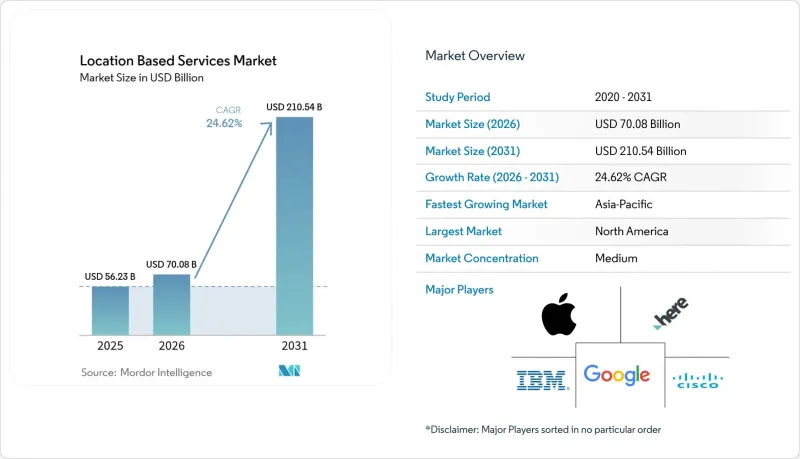
本報告按組件(硬體、軟體、服務)、位置類型(室內、室外)、核心技術(GPS/A-GPS、Wi-Fi 和 WLAN 三角定位等)、應用(導航和地圖繪製等)、終端用戶行業(零售和快速消費品、運輸和物流等)以及地區進行細分。市場預測以價值(美元)表示。
全球定位服務市場趨勢與洞察
在地化廣告預算正在激增。
鑑於地理圍籬技術在提升客流量方面的顯著成效,行銷人員計畫在2025年將超過20%的預算分配給本地宣傳活動,高於2024年的46%。谷歌地圖的廣告年收入已達111億美元。已實施基於位置的推播通知的零售商報告稱,店內轉換率大幅提升,進一步印證了收入成長的預期。定位精度的提升也支援動態創新最佳化,使品牌能夠針對不同的細分市場最佳化訊息。因此,廣告科技平台、出版商和品牌對定位服務市場的需求持續旺盛,他們都渴望將線上購買意願與線下購買路徑連結起來。
經合組織市場中關於e-911和AML緊急位置資訊準確性的規定
歐洲電子通訊法典強制要求所有智慧型手機配備反貨幣政策(AML)功能,在87%的緊急情況下,呼叫者座標的精度可達50公尺以內。英國數據顯示,與基地台定位相比,AML的精度提高了4000倍,縮短了反應時間,並有望在十年內挽救7500人的生命。雖然已有超過30個國家採用AML,但美國正在收緊對E-911垂直定位精度的監管。這迫使營運商升級其定位核心系統和切換API,從而推動了對混合GNSS、Wi-Fi和感測器輔助解決方案的投資。隨著營運商將先進的定位中間件整合到其網路核心和終端用戶應用程式中,合規相關的預算也直接促進了定位服務市場的擴張。
消費者對位置資料隱私的抵抗情緒日益高漲
研究表明,71%的用戶只有在明確同意的情況下才會共用位置數據。隨著GDPR強制要求資料最小化,CCPA要求提供退出機制,持續追蹤的覆蓋範圍已減少高達30%。印度的DPDP法案引入了額外的同意程序,迫使服務提供者投資於差分隱私和聯邦學習模型,這增加了工程成本。這些變化正在減緩資料收集的速度,並抑制定位服務市場中某些廣告收入來源。
細分市場分析
隨著企業將設計、實施和支援外包給託管服務專家,服務收入在2025年佔比將達到47.02%。同時,軟體預計將以26.05%的複合年成長率成長,凸顯了人工智慧分析在將原始數據轉化為業務行動方面的重要性。一家領先的第三方物流(3PL)公司整合數位孿生指揮中心的案例清晰地展示了承包套件為何能吸引高級訂閱用戶。隨著超寬頻(UWB)錨點和藍牙低功耗(BLE)閘道器在醫療機構中日益普及,硬體業務也穩步成長。
定位服務軟體訂閱市場正穩步擴張,這主要得益於Mapbox的MapGPT和TomTom的Azure整合等技術的進步,這些技術使汽車製造商無需更新車載設備即可進行無線升級。服務整合商正在將硬體、雲端儀表板和分析功能捆綁在一起,以降低客戶的整體擁有成本(TCO)並增強其經常性收入前景。
隨著全球導航衛星系統(GNSS)生態系統的日益成熟,室外定位仍佔據主導地位,但室內定位的應用正在迅速擴展。預計到2025年,室外定位將佔定位服務市場佔有率的67.94%,而室內定位預計到2031年將以27.45%的複合年成長率成長,這表明未來這兩個市場將逐漸融合。隨著藍牙低功耗(BLE)和超寬頻(UWB)標籤在醫院、購物中心和機場等場所的部署,用於縮短資產搜尋時間和引導訪客,預計在預測期內,室內定位市場佔有率將逐步趕上室外定位市場佔有率。
此混合解決方案可在 GPS、5G、Wi-Fi 和藍牙之間無縫切換,從而保持一致的使用者體驗。標準化聯盟正在不斷改進精度基準,預計將降低校準成本並刺激潛在需求,進而擴大定位服務市場的整體規模。
區域分析
北美地區憑藉著廣泛普及的具備反洗錢功能的智慧型手機和強大的雲端基礎設施,預計到2025年將佔據36.35%的最大市場佔有率。 HERE Technologies與AWS達成的價值10億美元的合作協議等高價值契約,清楚展現了該地區的市場規模。聯邦政府設定的E-911部署期限確保了電信業者的持續投資,而汽車製造商正在試行用於L3級自動駕駛的車道級高清地圖。
亞太地區正經歷最快的成長,年複合成長率高達25.17%,預計到2030年,該地區行動用戶將達到21億,並為GDP貢獻8,800億美元。中國、韓國和日本部署的獨立組網5G正在推動基於網路的定位API的發展。此外,諸如GAGAN之類的SBAS衛星系統在精密農業中發揮與GNSS互補的作用。世界各國政府都在積極推動資料管治框架,以平衡創新與隱私,促進國內生態系統的形成,並擴大整個全部區域的定位服務市場規模。
在歐洲,嚴格的隱私保護措施引領產業發展,增強了消費者信任,從而維持了穩定成長的勢頭。自2022年起,所有智慧型手機都必須具備匿名化(AML)功能,加速了電信業者和公共安全應答中心(PSAP)的後端升級。專注於隱私保護的新興新創公司正在採用差分隱私技術,以符合GDPR的要求並提升服務多樣性。隨著需要可靠無人機定位的U-Space走廊在南歐和東歐城市進行試點,新的鄰近區域也隨之擴展。南美、中東和非洲仍在發展中,但潛力巨大。 SBAS技術正在巴西的航空領域得到應用,而沿岸地區的智慧城市專案正在大型購物中心部署低功耗藍牙(BLE)信標,用於行動商務。非洲的區域航空機構正在合作開展「SatNav-Africa SBAS」項目,為未來的精密農業和交通運輸服務建立基礎設施。這些努力共同擴大了定位服務市場的地理覆蓋範圍。
其他好處:
- Excel格式的市場預測(ME)表
- 3個月的分析師支持
目錄
第1章:引言
- 市場定義與研究假設
- 調查範圍
第2章:調查方法
第3章執行摘要
第4章 市場狀況
- 市場概覽
- 市場促進因素
- 在地化廣告預算正在激增。
- 經合組織市場中關於電子911緊急程序和反洗錢的規定
- 利用藍牙低功耗(BLE)、超寬頻(UWB)和感測器融合的室內定位技術的興起。
- 定位服務(LBS) 透過 5G 網路切片實現低於 1 公尺的延遲。
- 需要即時定位系統(RTLS)的「數位孿生」型物流樞紐的普及。
- 可達到公分級精度的衛星增強系統(SBAS、多GNSS)
- 市場限制因素
- 消費者對位置資料隱私的抵抗情緒日益高漲。
- 監管碎片化(GDPR、CCPA、印度的DPDP法案)
- 室內地圖標準化進程的延遲增加了整合成本。
- 高密度城區射頻訊號的多路徑效應與干擾
- 價值鏈分析
- 重要法規結構的評估
- 對關鍵相關人員的影響評估
- 技術展望
- 波特五力分析
- 宏觀經濟因素的影響
第5章 市場規模與成長預測
- 按組件
- 硬體
- 軟體
- 服務
- 按位置類型
- 室內的
- 戶外的
- 核心技術
- GPS/A-GPS
- 利用Wi-Fi和WLAN進行三角定位
- Bluetooth Low Energy(BLE)
- 超寬頻(UWB)
- RFID和NFC
- 透過使用
- 導航與地圖繪製
- 基於位置的廣告和促銷
- 資產和車輛追蹤
- 緊急服務和公共安全
- 遊戲和擴增實境(AR)
- 社群媒體與互動
- 按最終用戶行業分類
- 零售/快速消費品
- 運輸/物流
- 醫療保健和生命科學
- 通訊和資訊科技服務
- 石油、天然氣和能源
- 政府/公共部門
- 製造業和工業
- 按地區
- 北美洲
- 美國
- 加拿大
- 墨西哥
- 南美洲
- 巴西
- 阿根廷
- 其他南美國家
- 歐洲
- 德國
- 英國
- 法國
- 義大利
- 西班牙
- 俄羅斯
- 其他歐洲國家
- 亞太地區
- 中國
- 日本
- 印度
- 韓國
- 澳洲和紐西蘭
- 其他亞太國家
- 中東和非洲
- 中東
- 沙烏地阿拉伯
- 阿拉伯聯合大公國
- 土耳其
- 其他中東國家
- 非洲
- 南非
- 奈及利亞
- 埃及
- 其他非洲國家
- 中東
- 北美洲
第6章 競爭情勢
- 市場集中度
- 策略趨勢
- 市佔率分析
- 公司簡介
- Google LLC(Alphabet Inc.)
- Apple Inc.
- Cisco Systems, Inc.
- IBM Corporation
- HERE Global BV(Nokia Corporation)
- Microsoft Corporation
- Ericsson AB
- Alcatel-Lucent Enterprise International Limited(ALE International)
- Hewlett Packard Enterprise Company(Aruba Networks)
- Zebra Technologies Corporation
- Maxar Technologies Inc.
- Esri Global Inc.
- Qualcomm Technologies Inc.
- Garmin Ltd.
- TomTom NV
- Baidu Inc.
- IndoorAtlas Ltd.
- Sewio Networks sro
- Ubiquicom Srl
- HID Global Corporation(ASSA ABLOY AB)
- Teldio Corporation
- Creativity Software Ltd.
- GL Communications Inc.
第7章 市場機會與未來趨勢
- 評估未開發的領域和未滿足的需求
According to Mordor Intelligence, the location-based services market size was valued at USD 56.23 billion in 2025 and estimated to grow from USD 70.08 billion in 2026 to reach USD 210.54 billion by 2031, at a CAGR of 24.62% during the forecast period (2026-2031).
This report is Segmented by Component (Hardware, Software, Services), Location Type (Indoor, Outdoor), Core Technology (GPS/A-GPS, Wi-Fi and WLAN Triangulation, and More), Application (Navigation and Mapping, and More), End-User Industry (Retail and FMCG, Transportation and Logistics, and More), and Geography. The Market Forecasts are Provided in Terms of Value (USD).
Global Location Based Services Market Trends and Insights
Explosion of hyper-local advertising budgets
Marketers plan to allocate 20%-plus of budgets to local campaigns in 2025, up from 46% in 2024, as geofencing proves effective for foot-traffic uplift. Google Maps already monetizes USD 11.1 billion annually through ad placements. Retailers adopting location-triggered push notifications report sharp increases in in-store conversions, validating the revenue-expansion thesis. Greater location granularity also supports dynamic creative optimization, letting brands tailor messages to micro-markets. As a result, the location-based services market gains sustained demand from advertising technology platforms, publishers, and brands eager to link online intent with offline purchase paths.
Mandates for e-911 and AML emergency accuracy in OECD markets
The European Electronic Communications Code requires AML on all smartphones, delivering caller coordinates within 50 m for 87% of emergencies . The UK experience shows a 4,000-fold accuracy boost versus Cell-ID, cutting response times and potentially saving 7,500 lives over 10 years. More than 30 nations have adopted AML, while the US is tightening E-911 vertical-accuracy rules. Telcos must therefore upgrade positioning cores and hand-off APIs, fueling spending on hybrid GNSS, Wi-Fi, and sensor-assisted solutions. Compliance budgets directly expand the location-based services market as operators embed advanced location middleware within network cores and end-user apps.
Heightened consumer push-back on location privacy
Surveys show 71% of users will only share location after explicit consent. GDPR mandates data-minimization, while CCPA imposes opt-out mechanics, reducing always-on tracking coverage by up to 30%. India's DPDP Act introduces extra consent layers, compelling providers to invest in differential-privacy and federated-learning models that add engineering cost. These shifts slow data-collection velocity, tempering certain advertising revenue streams inside the location-based services market.
Other drivers and restraints analyzed in the detailed report include:
- Rise of Indoor Positioning via BLE, UWB and Sensor Fusion
- 5G Network Slicing Enabling Sub-meter Latency LBS
- Regulatory fragmentation (GDPR, CCPA, India DPDP Act)
For complete list of drivers and restraints, kindly check the Table Of Contents.
Segment Analysis
Services represented 47.02% of 2025 revenue as enterprises outsourced design, deployment, and support to managed-service experts. Software, however, is forecast to log a 26.05% CAGR, underscoring how AI analytics convert raw pings into business actions. Large 3PLs integrating digital-twin command centers illustrate why turnkey suites attract premium subscriptions. Meanwhile, hardware growth stays positive as UWB anchors and BLE gateways proliferate in healthcare campuses.
The location-based services market size for software subscriptions climbs steadily as Mapbox's MapGPT and TomTom's Azure integrations let automakers push over-the-air upgrades without refreshing on-board units. Service integrators bundle hardware, cloud dashboards, and analytics, ensuring lower total cost of ownership for clients and reinforcing recurring-revenue visibility.
Outdoor positioning still dominates owing to mature GNSS ecosystems, yet indoor deployments are scaling fast. The location-based services market share for outdoor stood at 67.94% in 2025; indoor positioning is tracking a 27.45% CAGR through 2031, suggesting convergence down the line. Hospitals, malls, and airports deploy BLE and UWB tags to cut asset-search cycles and guide visitors, inching the indoor slice toward parity with outdoor during the forecast horizon.
Hybrid solutions hand-off seamlessly between GPS, 5G, Wi-Fi, and Bluetooth, preserving user experience. Standardisation consortia continue refining accuracy benchmarks, which should trim calibration costs and unlock pent-up demand, expanding the overall location-based services market.
Complete Report Scope:
- By Component
- Hardware
- Software
- Services
- By Location Type
- Indoor
- Outdoor
- By Core Technology
- GPS / A-GPS
- Wi-Fi and WLAN Triangulation
- Bluetooth Low Energy (BLE)
- Ultra-Wideband (UWB)
- RFID and NFC
- By Application
- Navigation and Mapping
- Location-Based Advertising and Promotion
- Asset and Fleet Tracking
- Emergency Services and Public Safety
- Gaming and Augmented Reality
- Social Media and Engagement
- By End-user Industry
- Retail and FMCG
- Transportation and Logistics
- Healthcare and Life Sciences
- Telecom and IT Services
- Oil, Gas and Energy
- Government and Public Sector
- Manufacturing and Industrial
- By Geography
- North America
- United States
- Canada
- Mexico
- South America
- Brazil
- Argentina
- Rest of South America
- Europe
- Germany
- United Kingdom
- France
- Italy
- Spain
- Russia
- Rest of Europe
- Asia-Pacific
- China
- Japan
- India
- South Korea
- Australia and New Zealand
- Rest of Asia-Pacific
- Middle East and Africa
- Middle East
- Saudi Arabia
- United Arab Emirates
- Turkey
- Rest of Middle East
- Africa
- South Africa
- Nigeria
- Egypt
- Rest of Africa
- Middle East
- North America
Geography Analysis
North America generated the largest slice at 36.35% in 2025 on the back of AML-ready smartphone penetration and robust cloud infrastructure. High-value contracts such as HERE Technologies' USD 1 billion AWS alliance illustrate the region's scale. Federal E-911 deadlines ensure continuous operator investment, while automotive OEMs trial lane-level HD maps for Level-3 autonomy.
Asia-Pacific is the fastest-growing at 25.17% CAGR, with unique mobile subscribers on track to hit 2.1 billion by 2030 and contribute USD 880 billion to GDP . Standalone 5G rollouts in China, Korea, and Japan foster network-based positioning APIs; SBAS constellations such as GAGAN complement GNSS for precision farming. Governments champion data-governance frameworks that balance innovation with privacy, encouraging domestic ecosystem formation and enlarging the location-based services market size across the region.
Europe maintains steady momentum through stringent privacy leadership that nurtures consumer trust. AML has been mandatory on all smartphones since 2022, catalyzing backend upgrades among carriers and PSAPs. An emerging crop of privacy-focused startups employs differential-privacy to meet GDPR, enriching service diversity. Southern and Eastern European cities trial U-Space corridors requiring reliable drone positioning, adding a new adjacency.South America and Middle East and Africa remain nascent but promising. Brazil adopts SBAS for aviation, while Gulf smart-city programs deploy BLE m-commerce beacons in mega-malls. African regional aviation bodies collaborate on SatNav-Africa SBAS, sowing foundational infrastructure for future precision-agriculture and transport services. Collectively these initiatives broaden the geographic footprint of the location-based services market.
- Google LLC (Alphabet Inc.)
- Apple Inc.
- Cisco Systems, Inc.
- IBM Corporation
- HERE Global B.V. (Nokia Corporation)
- Microsoft Corporation
- Ericsson AB
- Alcatel-Lucent Enterprise International Limited (ALE International)
- Hewlett Packard Enterprise Company (Aruba Networks)
- Zebra Technologies Corporation
- Maxar Technologies Inc.
- Esri Global Inc.
- Qualcomm Technologies Inc.
- Garmin Ltd.
- TomTom N.V.
- Baidu Inc.
- IndoorAtlas Ltd.
- Sewio Networks s.r.o.
- Ubiquicom S.r.l.
- HID Global Corporation (ASSA ABLOY AB)
- Teldio Corporation
- Creativity Software Ltd.
- GL Communications Inc.
Additional Benefits:
- The market estimate (ME) sheet in Excel format
- 3 months of analyst support
TABLE OF CONTENTS
1 INTRODUCTION
- 1.1 Market Definition and Study Assumptions
- 1.2 Scope of the Study
2 RESEARCH METHODOLOGY
3 EXECUTIVE SUMMARY
4 MARKET LANDSCAPE
- 4.1 Market Overview
- 4.2 Market Drivers
- 4.2.1 Explosion of hyper-local advertising budgets
- 4.2.2 Mandates for e-911 and AML emergency accuracy in OECD markets
- 4.2.3 Rise of indoor positioning via BLE, UWB and sensor fusion
- 4.2.4 5G network slicing enabling sub-meter latency LBS
- 4.2.5 Proliferation of 'digital twin' logistics hubs needing RTLS
- 4.2.6 Satellite-based augmentation (SBAS, multi-GNSS) for cm-grade precision
- 4.3 Market Restraints
- 4.3.1 Heightened consumer push-back on location privacy
- 4.3.2 Regulatory fragmentation (GDPR, CCPA, India DPDP Act)
- 4.3.3 Indoor mapping standardisation lag increases integration cost
- 4.3.4 RF-signal multipath and interference in dense urban cores
- 4.4 Value Chain Analysis
- 4.5 Evaluation of Critical Regulatory Framework
- 4.6 Impact Assessment of Key Stakeholders
- 4.7 Technological Outlook
- 4.8 Porter's Five Forces Analysis
- 4.8.1 Bargaining Power of Suppliers
- 4.8.2 Bargaining Power of Consumers
- 4.8.3 Threat of New Entrants
- 4.8.4 Threat of Substitutes
- 4.8.5 Intensity of Competitive Rivalry
- 4.9 Impact of Macro-economic Factors
5 MARKET SIZE AND GROWTH FORECASTS (VALUE)
- 5.1 By Component
- 5.1.1 Hardware
- 5.1.2 Software
- 5.1.3 Services
- 5.2 By Location Type
- 5.2.1 Indoor
- 5.2.2 Outdoor
- 5.3 By Core Technology
- 5.3.1 GPS / A-GPS
- 5.3.2 Wi-Fi and WLAN Triangulation
- 5.3.3 Bluetooth Low Energy (BLE)
- 5.3.4 Ultra-Wideband (UWB)
- 5.3.5 RFID and NFC
- 5.4 By Application
- 5.4.1 Navigation and Mapping
- 5.4.2 Location-Based Advertising and Promotion
- 5.4.3 Asset and Fleet Tracking
- 5.4.4 Emergency Services and Public Safety
- 5.4.5 Gaming and Augmented Reality
- 5.4.6 Social Media and Engagement
- 5.5 By End-user Industry
- 5.5.1 Retail and FMCG
- 5.5.2 Transportation and Logistics
- 5.5.3 Healthcare and Life Sciences
- 5.5.4 Telecom and IT Services
- 5.5.5 Oil, Gas and Energy
- 5.5.6 Government and Public Sector
- 5.5.7 Manufacturing and Industrial
- 5.6 By Geography
- 5.6.1 North America
- 5.6.1.1 United States
- 5.6.1.2 Canada
- 5.6.1.3 Mexico
- 5.6.2 South America
- 5.6.2.1 Brazil
- 5.6.2.2 Argentina
- 5.6.2.3 Rest of South America
- 5.6.3 Europe
- 5.6.3.1 Germany
- 5.6.3.2 United Kingdom
- 5.6.3.3 France
- 5.6.3.4 Italy
- 5.6.3.5 Spain
- 5.6.3.6 Russia
- 5.6.3.7 Rest of Europe
- 5.6.4 Asia-Pacific
- 5.6.4.1 China
- 5.6.4.2 Japan
- 5.6.4.3 India
- 5.6.4.4 South Korea
- 5.6.4.5 Australia and New Zealand
- 5.6.4.6 Rest of Asia-Pacific
- 5.6.5 Middle East and Africa
- 5.6.5.1 Middle East
- 5.6.5.1.1 Saudi Arabia
- 5.6.5.1.2 United Arab Emirates
- 5.6.5.1.3 Turkey
- 5.6.5.1.4 Rest of Middle East
- 5.6.5.2 Africa
- 5.6.5.2.1 South Africa
- 5.6.5.2.2 Nigeria
- 5.6.5.2.3 Egypt
- 5.6.5.2.4 Rest of Africa
- 5.6.5.1 Middle East
- 5.6.1 North America
6 COMPETITIVE LANDSCAPE
- 6.1 Market Concentration
- 6.2 Strategic Moves
- 6.3 Market Share Analysis
- 6.4 Company Profiles (includes Global level Overview, Market level overview, Core Segments, Financials as available, Strategic Information, Market Rank/Share for key companies, Products and Services, and Recent Developments)
- 6.4.1 Google LLC (Alphabet Inc.)
- 6.4.2 Apple Inc.
- 6.4.3 Cisco Systems, Inc.
- 6.4.4 IBM Corporation
- 6.4.5 HERE Global B.V. (Nokia Corporation)
- 6.4.6 Microsoft Corporation
- 6.4.7 Ericsson AB
- 6.4.8 Alcatel-Lucent Enterprise International Limited (ALE International)
- 6.4.9 Hewlett Packard Enterprise Company (Aruba Networks)
- 6.4.10 Zebra Technologies Corporation
- 6.4.11 Maxar Technologies Inc.
- 6.4.12 Esri Global Inc.
- 6.4.13 Qualcomm Technologies Inc.
- 6.4.14 Garmin Ltd.
- 6.4.15 TomTom N.V.
- 6.4.16 Baidu Inc.
- 6.4.17 IndoorAtlas Ltd.
- 6.4.18 Sewio Networks s.r.o.
- 6.4.19 Ubiquicom S.r.l.
- 6.4.20 HID Global Corporation (ASSA ABLOY AB)
- 6.4.21 Teldio Corporation
- 6.4.22 Creativity Software Ltd.
- 6.4.23 GL Communications Inc.
7 MARKET OPPORTUNITIES AND FUTURE TRENDS
- 7.1 White-space and Unmet-need Assessment

 澳新定位服務:市場佔有率分析、行業趨勢和統計數據、成長預測(2026-2031 年)美國定位服務:市場佔有率分析、行業趨勢和統計數據以及成長預測(2026-2031 年)義大利定位服務:市場佔有率分析、行業趨勢和統計數據以及成長預測(2026-2031 年)
 定位服務市場商機、成長要素、產業趨勢分析及 2026-2035 年預測。
 定位服務市場:全球市場預測(2026-2032年)
 全球微定位技術市場
 定位服務市場規模、佔有率和趨勢分析報告:按組件、位置類型、技術、應用、最終用途、地區和細分市場預測(2026-2033 年)
 定位服務市場報告:按組件、技術、位置類型、應用、最終用戶和地區分類(2026-2034 年)
 全球定位服務市場規模、佔有率、趨勢和成長分析報告(2026-2034年)
 定位服務市場:按位置、最終用戶行業和地區分類。