


 |
市場調查報告書
商品編碼
2119786
義大利定位服務:市場佔有率分析、行業趨勢和統計數據以及成長預測(2026-2031 年)Italy Location-Based Services - Market Share Analysis, Industry Trends & Statistics, Growth Forecasts (2026 - 2031) |
||||||

※ 本網頁內容可能與最新版本有所差異。詳細情況請與我們聯繫。
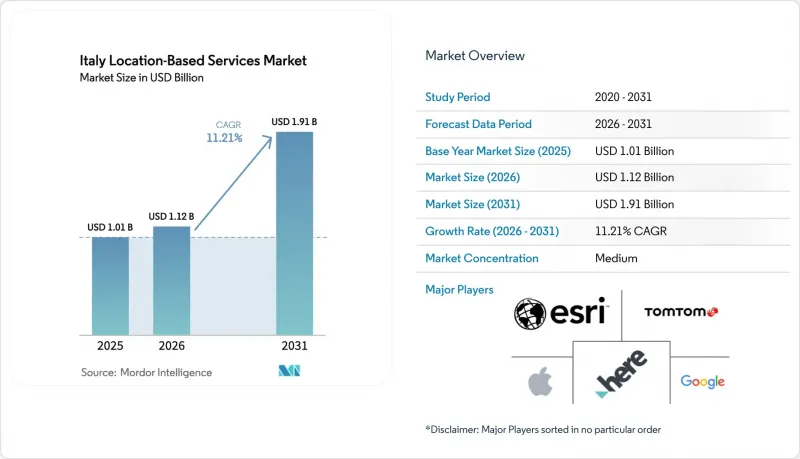
根據 Mordor Intelligence 估計,義大利定位服務市場在 2026 年的價值將達到 11.2 億美元,高於 2025 年的 10.1 億美元,預計到 2031 年將達到 19.1 億美元。
預計2026年至2031年複合年成長率將達到11.21%。
本報告按組件(硬體、軟體、服務)、技術(GPS/GNSS、Wi-Fi、其他)、位置類型(室內、室外)、部署模式(本地部署、雲端部署、邊緣/霧部署)、應用程式(地圖/導航、商業智慧/分析、基於位置的廣告、其他)、最終用戶產業(運輸/物流、IT/電信、其他)和地區進行分類。
義大利定位服務市場趨勢與洞察
5G和NB-IoT的部署將提高亞米級精度。
義大利電信業者正在城市中部署高密度小型基地台網路和NB-IoT疊加網路,從而在現場巡檢中實現亞米級精度的高精度定位服務。 TIM已在5000個市鎮部署了NB-IoT網路,而WindTre的5G網路則提供高達1.6 Gbps的峰值速度,以支援高精度定位處理。僅耗資9770萬歐元的「#Roma5G」計畫就在羅馬市部署了2200個小型基地台和1800個物聯網感測器,充分展現了公私合作聯盟如何加速網路覆蓋的擴展。都靈理工大學的研究證實,當超寬頻系統與5G邊緣節點協同工作時,定位精度可達3.2厘米,從而減少了對獨立組網信標的需求。 EOLO的毫米波獨立組網進一步降低了需要確定性定位的工業應用場景的延遲。
歐盟數位市場法案促進應用層面的基於位置的服務互通性
該法律強制要求開放API和資料可攜性,從而消除多年來阻礙義大利市政當局發展的供應商鎖定問題。像TIM Urban Genius這樣的平台正在整合蜂窩遙測、物聯網數據和第三方應用程式,以建立統一的智慧城市基礎架構。室內定位專家Nextome正在利用新規,將其SDK與外部分析引擎無縫整合,從而將其目標市場擴展到醫院和工廠之外。博爾扎諾一項耗資230萬歐元的出行即服務(MaaS)試點計畫表明,標準化介面使出行業者能夠將公車、自行車和停車位整合到一個對應位置情報的單一服務中。因此,平台間互通性的增強加劇了競爭,降低了企業的切換成本,並鼓勵供應商提供差異化的分析功能,而不是各自獨立的資料孤島。
根據《一般資料保護規範》(GDPR),針對位置追蹤的隱私權制裁措施將受到製裁。
義大利監管機構對不當處理位置資料的公司處以巨額罰款,Foodinho 因在追蹤送貨司機方面缺乏透明度而被罰款 260 萬歐元。此外,當局禁止使用 Google Analytics 進行跨大西洋資料傳輸,加劇了全球服務供應商的合規擔憂。同時,當地法律要求所有位置追蹤都必須獲得明確且可撤銷的同意,這增加了應用程式開發人員的行政負擔。由此產生的成本壓力促使企業轉向能夠確保本地資料居住的歐洲供應商,儘管一些中小企業正在推遲實施基於位置的服務 (LBS),直到法律更加明確為止。
細分市場分析
硬體投資是義大利目前定位服務市場的基礎,預計到2025年將佔銷售額的46.20%,這主要得益於工廠和交通系統中高密度信標網路的建設。在FCA Cento工廠部署350個信標,每分鐘可減少500美元的停機成本,這表明硬體主導的專案仍能帶來顯著的投資回報。在羅馬地鐵,為保全人員部署位置追蹤感測器,使緊急應變時間縮短了一半,凸顯了在公共基礎設施中以安全為中心的部署的重要性。然而,隨著人工智慧分析將決策邏輯轉移到邊緣,在不犧牲洞察力的前提下降低延遲和頻寬成本,軟體平台正以13.77%的複合年成長率快速成長。
SECO 的邊緣原生堆疊將低功耗模組與雲端協作層結合,從而在同一台主機中實現即時三角定位和歷史模式分析。儘管服務業的市場佔有率最小,但它支援整合式射頻勘測、GDPR 審計和應用程式配置的複雜項目。因此,供應商正在打包託管服務,以降低資源受限的中小企業的部署風險。總體而言,硬體基礎設施正朝著能源採集標籤和多頻段天線的方向發展,隨著義大利定位服務市場軟體技術的不斷進步,這為現有系統的可擴展改造奠定了基礎。
GPS/GNSS 仍然是戶外導航領域的主導力量,預計到 2025 年,其在叫車、車用通訊系統和消費者應用領域的市場佔有率將達到 39.65%。然而,在義大利定位服務市場中,蜂巢定位的市場規模成長最為迅猛,年複合成長率高達 14.04%,主要得益於電信業者大力推動獨立組網 5G 和 NB-IoT 技術。 TIM 的全國性 NB-IoT 網路將智慧電錶標籤的電池壽命延長至 10 年,而 LTE-M 解決方案則滿足了資產監控中對頻寬要求適中的應用場景。在倉庫中,UWB 和 BLE 的組合應用日益普及,相關研究證實,在運作中工業環境中,其平均誤差僅 3.2 公分。
一種能夠動態選擇射頻頻道的混合引擎目前已開始在先導計畫中部署。錫耶納醫院的空間智慧套件結合了磁性指紋辨識、Wi-Fi嗅探器和低功耗藍牙(BLE)錨點,以滿足臨床精確度標準。這種多模態架構顯示如何針對每項資產平衡精度、功耗和成本之間的權衡。因此,供應商正在將軟體定義無線電(SDR)整合到其標籤中,以適應未來的頻段分配,預計這一趨勢將繼續推動義大利定位服務市場的技術變革。
其他好處
- Excel格式的市場預測(ME)表
- 3個月的分析師支持
目錄
第1章:引言
- 研究假設和市場定義
- 調查範圍
第2章:調查方法
第3章執行摘要
第4章 市場狀況
- 市場概覽
- 市場促進因素
- 5G和NB-IoT的部署將提高亞米級精度。
- 歐盟的《數位市場法案》促進了應用程式層級定位服務(LBS) 的互通性。
- 國家PNRR對智慧運輸與智慧交通系統計畫的資助
- 零售商們正經歷著基於位置的廣告支出激增。
- 工業4.0推動了工廠和醫院對室內定位的需求。
- 開放資料生態系統(OpenStreetMap、歐盟資料空間)降低了進入門檻。
- 市場限制因素
- 根據GDPR,針對位置追蹤的隱私相關制裁措施適用GDPR。
- 室內定位技術標準的碎片化
- 中小企業引進UWB/BLE信標需要大量資金投入。
- 歷史名城人口密集中心區域的多路徑訊號失真
- 產業價值鏈分析
- 監管狀態(GDPR、ePrivacy、AGCOM)
- 技術趨勢(超寬頻、5G-SA、邊緣運算)
- 產業吸引力—五力分析
- 買方的議價能力
- 供應商的議價能力
- 新進入者的威脅
- 替代品的威脅
- 競爭公司之間的競爭
- 宏觀經濟因素對市場的影響
第5章 市場規模與成長預測
- 按組件
- 硬體
- 軟體
- 服務
- 透過技術
- GPS/GNSS
- Wi-Fi
- 藍牙低功耗/超寬頻
- 蜂窩網路(5G、LTE、NB-IoT)
- 混合型及其他
- 按位置類型
- 室內的
- 戶外的
- 部署模式
- 現場
- 雲
- 邊緣霧
- 透過使用
- 地圖導航
- 商業智慧與分析
- 基於位置的廣告
- 社群網路娛樂
- 緊急情況/公共安全
- 資產追蹤和車輛管理
- 其他
- 按最終用戶行業分類
- 運輸/物流
- 資訊科技/通訊
- 醫療保健和生命科學
- 政府/公共部門
- BFSI
- 飯店和旅遊業
- 製造業和工業
- 零售與電子商務
- 其他終端用戶產業
- 按地區
- 義大利北部
- 義大利中部
- 義大利南部和島嶼
第6章 競爭情勢
- 市場集中度
- 策略趨勢
- 市佔率分析
- 公司簡介
- Google LLC
- Apple Inc.
- HERE Technologies
- TomTom NV
- Esri Inc.
- Cisco Systems Inc.(Meraki)
- Ericsson AB
- Nokia Corp.(ALE-Alcatel Lucent Enterprise)
- Huawei Technologies Co. Ltd.
- Samsung Electronics Co. Ltd.
- Qualcomm Technologies Inc.
- Aruba Networks(HPE)
- IBM Corp.
- Juniper Networks Inc.
- Zebra Technologies Corp.
- Mapbox Inc.
- Foursquare Labs Inc.
- Hexagon AB(Hexagon Geospatial)
- Garmin Ltd.
- Vodafone Group Plc
- Telecom Italia(TIM SpA)
- WindTre SpA
- Fastweb SpA
- Iliad Italia SpA
- Telespazio SpA
- SITAONAIR(SITA)
- Telefonica SA
第7章 市場機會與未來趨勢
- 評估閒置頻段和未滿足的需求
According to Mordor Intelligence, the Italy location-Based services market size in 2026 is estimated at USD 1.12 billion, growing from 2025 value of USD 1.01 billion with 2031 projections showing USD 1.91 billion, growing at 11.21% CAGR over 2026-2031.
This report is Segmented by Component (Hardware, Software, and Services), Technology (GPS/GNSS, Wi-Fi, and More), Location Type (Indoor and Outdoor), Deployment Mode (On-Premise, Cloud, and Edge/Fog), Application (Mapping and Navigation, Business Intelligence and Analytics, Location-Based Advertising, and More), End-User Vertical (Transportation and Logistics, IT and Telecom, and More), and Region.
Italy Location-Based Services Market Trends and Insights
5G and NB-IoT Rollout Boosts Sub-Meter Accuracy
Italian operators blanket cities with dense small-cell grids and NB-IoT overlays, enabling precision location services that now reach sub-meter performance in live trials. TIM covers 5,000 municipalities with NB-IoT, while WindTre's 5G network delivers 1.6 Gbps peak speeds that support high-definition positioning flows. The EUR 97.7 million #Roma5G project alone installed 2,200 small cells and 1,800 IoT sensors across the capital, illustrating how public-private consortiums accelerate coverage. Research at Politecnico di Torino confirms 3.2 cm accuracy when ultra-wideband systems interwork with 5G edge nodes, reducing the need for stand-alone beacons. EOLO's mmWave stand-alone network further trims latency for industrial use cases that demand deterministic positioning.
EU Digital Markets Act Catalyzes App-Level LBS Interoperability
The Act enforces open APIs and data portability, dismantling vendor lock-in that long hampered Italian municipalities. Platforms such as TIM Urban Genius now merge cellular telemetry, IoT feeds, and third-party apps into a cohesive smart-city canvas. Indoor-positioning specialist Nextome leverages the new rules to link its SDK seamlessly with external analytics engines, broadening addressable markets beyond hospitals and factories. Bolzano's MaaS pilot, funded with EUR 2.3 million, shows how standardised interfaces let mobility operators stitch together buses, bikes, and parking into a single location-aware service. In turn, rising platform interoperability intensifies competition, lowering switching costs for enterprises and pushing suppliers toward differentiated analytics rather than proprietary data silos.
GDPR-Driven Privacy Sanctions on Geo-Tracking
Italy's regulator imposes hefty fines on companies mishandling location data, exemplified by a EUR 2.6 million penalty levied on Foodinho for non-transparent rider tracking. The authority's ban on Google Analytics over trans-Atlantic transfers magnifies compliance anxiety for global providers. Local law further compels explicit, revocable consent for all geo-tracking, elevating administrative overhead for app developers. Resulting cost pressure nudges enterprises toward Europe-based vendors able to guarantee regional data residency, though smaller firms sometimes delay LBS roll-outs until legal clarity improves.
Other drivers and restraints analyzed in the detailed report include:
- National PNRR Funds for Smart Mobility and ITS Projects
- Retailers' Surge in Location-Based Advertising Spend
- Fragmented Indoor-Positioning Technology Standards
For complete list of drivers and restraints, kindly check the Table Of Contents.
Segment Analysis
Hardware investments anchor today's Italy location-based services market, accounting for 46.20% revenue in 2025 on the back of dense beacon networks within factories and transit systems. The FCA Cento plant's 350-beacon roll-out trimmed downtime costs by USD 500 per minute, illustrating the clear payback that hardware-led projects still deliver. Rome's metro deployed guard-tracking sensors that halve emergency response time, underscoring safety-driven adoption in public infrastructure. Nevertheless, software platforms are growing faster at 13.77% CAGR as AI analytics migrate decision logic to the edge, lowering latency and bandwidth outlays without sacrificing insight depth.
Edge-native stacks from SECO couple low-power modules with a cloud orchestration layer, allowing real-time triangulation and historical pattern mining inside the same console. Services, while the smallest slice, underpin complex projects that blend RF surveys, GDPR audits, and application configuration. Vendors, therefore, bundle managed services to de-risk deployments for resource-constrained SMEs. Collectively, the hardware base is shifting toward energy-harvesting tags and multi-band antennas, laying the foundation for scalable retrofits once software sophistication matures further within the Italy location-based services market.
GPS/GNSS remains the workhorse of outdoor navigation, securing 39.65% market share in 2025 across ride-hailing, automotive telematics, and consumer apps. Yet the Italy location-based services market size attached to cellular positioning grows quickest at 14.04% CAGR, catalysed by operator commitments to stand-alone 5G and NB-IoT. TIM's nationwide NB-IoT layer facilitates decade-long battery life for smart-meter tags, whereas LTE-M options satisfy mid-tier bandwidth use cases in asset monitoring. UWB and BLE overlap grows within warehouses, with research confirming a 3.2 cm mean error in live industrial environments.
Hybrid engines that dynamically select RF paths now surface in pilot projects. Siena's hospital spatial-intelligence suite fused magnetic fingerprinting with Wi-Fi sniffers and BLE anchors to meet clinical precision thresholds. Such multi-modal architectures exemplify how accuracy, power, and cost trade-offs can be balanced per asset. Consequently, vendors embed software-defined radios inside tags to future-proof against emerging spectrum allocations, a trend likely to sustain technology churn within the Italy location-based services market.
Complete Report Scope:
- By Component
- Hardware
- Software
- Services
- By Technology
- GPS/GNSS
- Wi-Fi
- Bluetooth LE and UWB
- Cellular (5G, LTE, NB-IoT)
- Hybrid and Others
- By Location Type
- Indoor
- Outdoor
- By Deployment Mode
- On-premise
- Cloud
- Edge/Fog
- By Application
- Mapping and Navigation
- Business Intelligence and Analytics
- Location-based Advertising
- Social Networking and Entertainment
- Emergency and Public Safety
- Asset Tracking and Fleet Management
- Other Applications
- By End-user Vertical
- Transportation and Logistics
- IT and Telecom
- Healthcare and Life Sciences
- Government and Public Sector
- BFSI
- Hospitality and Tourism
- Manufacturing and Industrial
- Retail and E-commerce
- Other End-user Verticals
- By Region
- Northern Italy
- Central Italy
- Southern Italy and Islands
List of Companies Covered in this Report:
- Google LLC
- Apple Inc.
- HERE Technologies
- TomTom N.V.
- Esri Inc.
- Cisco Systems Inc. (Meraki)
- Ericsson AB
- Nokia Corp. (ALE-Alcatel Lucent Enterprise)
- Huawei Technologies Co. Ltd.
- Samsung Electronics Co. Ltd.
- Qualcomm Technologies Inc.
- Aruba Networks (HPE)
- IBM Corp.
- Juniper Networks Inc.
- Zebra Technologies Corp.
- Mapbox Inc.
- Foursquare Labs Inc.
- Hexagon AB (Hexagon Geospatial)
- Garmin Ltd.
- Vodafone Group Plc
- Telecom Italia (TIM S.p.A.)
- WindTre S.p.A.
- Fastweb S.p.A.
- Iliad Italia S.p.A.
- Telespazio S.p.A.
- SITAONAIR (SITA)
- Telefonica S.A.
Additional Benefits:
- The market estimate (ME) sheet in Excel format
- 3 months of analyst support
TABLE OF CONTENTS
1 INTRODUCTION
- 1.1 Study Assumptions and Market Definition
- 1.2 Scope of the Study
2 RESEARCH METHODOLOGY
3 EXECUTIVE SUMMARY
4 MARKET LANDSCAPE
- 4.1 Market Overview
- 4.2 Market Drivers
- 4.2.1 5G and NB-IoT rollout boosts sub-meter accuracy
- 4.2.2 EU Digital Markets Act catalyzes app-level LBS interoperability
- 4.2.3 National PNRR funds for smart mobility and ITS projects
- 4.2.4 Retailers' surge in location-based advertising spend
- 4.2.5 Industry 4.0 demand for indoor positioning in factories and hospitals
- 4.2.6 Open-data ecosystems (OpenStreetMap, EU Data Spaces) lower entry barriers
- 4.3 Market Restraints
- 4.3.1 GDPR-driven privacy sanctions on geo-tracking
- 4.3.2 Fragmented indoor-positioning technology standards
- 4.3.3 High capex of UWB/BLE beacon roll-outs for SMEs
- 4.3.4 Multipath signal distortion in dense historical city cores
- 4.4 Industry Value Chain Analysis
- 4.5 Regulatory Landscape (GDPR, ePrivacy, AGCOM)
- 4.6 Technological Outlook (UWB, 5G-SA, edge computing)
- 4.7 Industry Attractiveness - Porter's Five Forces Analysis
- 4.7.1 Bargaining Power of Buyers
- 4.7.2 Bargaining Power of Suppliers
- 4.7.3 Threat of New Entrants
- 4.7.4 Threat of Substitutes
- 4.7.5 Intensity of Competitive Rivalry
- 4.8 Impact of Macroeconomic Factors on the Market
5 MARKET SIZE AND GROWTH FORECASTS (VALUES)
- 5.1 By Component
- 5.1.1 Hardware
- 5.1.2 Software
- 5.1.3 Services
- 5.2 By Technology
- 5.2.1 GPS/GNSS
- 5.2.2 Wi-Fi
- 5.2.3 Bluetooth LE and UWB
- 5.2.4 Cellular (5G, LTE, NB-IoT)
- 5.2.5 Hybrid and Others
- 5.3 By Location Type
- 5.3.1 Indoor
- 5.3.2 Outdoor
- 5.4 By Deployment Mode
- 5.4.1 On-premise
- 5.4.2 Cloud
- 5.4.3 Edge/Fog
- 5.5 By Application
- 5.5.1 Mapping and Navigation
- 5.5.2 Business Intelligence and Analytics
- 5.5.3 Location-based Advertising
- 5.5.4 Social Networking and Entertainment
- 5.5.5 Emergency and Public Safety
- 5.5.6 Asset Tracking and Fleet Management
- 5.5.7 Other Applications
- 5.6 By End-user Vertical
- 5.6.1 Transportation and Logistics
- 5.6.2 IT and Telecom
- 5.6.3 Healthcare and Life Sciences
- 5.6.4 Government and Public Sector
- 5.6.5 BFSI
- 5.6.6 Hospitality and Tourism
- 5.6.7 Manufacturing and Industrial
- 5.6.8 Retail and E-commerce
- 5.6.9 Other End-user Verticals
- 5.7 By Region
- 5.7.1 Northern Italy
- 5.7.2 Central Italy
- 5.7.3 Southern Italy and Islands
6 COMPETITIVE LANDSCAPE
- 6.1 Market Concentration
- 6.2 Strategic Moves
- 6.3 Market Share Analysis
- 6.4 Company Profiles (includes Global level Overview, Market level overview, Core Segments, Financials as available, Strategic Information, Market Rank/Share for key companies, Products and Services, and Recent Developments)
- 6.4.1 Google LLC
- 6.4.2 Apple Inc.
- 6.4.3 HERE Technologies
- 6.4.4 TomTom N.V.
- 6.4.5 Esri Inc.
- 6.4.6 Cisco Systems Inc. (Meraki)
- 6.4.7 Ericsson AB
- 6.4.8 Nokia Corp. (ALE-Alcatel Lucent Enterprise)
- 6.4.9 Huawei Technologies Co. Ltd.
- 6.4.10 Samsung Electronics Co. Ltd.
- 6.4.11 Qualcomm Technologies Inc.
- 6.4.12 Aruba Networks (HPE)
- 6.4.13 IBM Corp.
- 6.4.14 Juniper Networks Inc.
- 6.4.15 Zebra Technologies Corp.
- 6.4.16 Mapbox Inc.
- 6.4.17 Foursquare Labs Inc.
- 6.4.18 Hexagon AB (Hexagon Geospatial)
- 6.4.19 Garmin Ltd.
- 6.4.20 Vodafone Group Plc
- 6.4.21 Telecom Italia (TIM S.p.A.)
- 6.4.22 WindTre S.p.A.
- 6.4.23 Fastweb S.p.A.
- 6.4.24 Iliad Italia S.p.A.
- 6.4.25 Telespazio S.p.A.
- 6.4.26 SITAONAIR (SITA)
- 6.4.27 Telefonica S.A.
7 MARKET OPPORTUNITIES AND FUTURE TRENDS
- 7.1 White-Space and Unmet-Need Assessment

 澳新定位服務:市場佔有率分析、行業趨勢和統計數據、成長預測(2026-2031 年)美國定位服務:市場佔有率分析、行業趨勢和統計數據以及成長預測(2026-2031 年)
 定位服務市場商機、成長要素、產業趨勢分析及 2026-2035 年預測。定位服務:市場佔有率分析、行業趨勢和統計數據、成長預測(2026-2031 年)
 定位服務市場:全球市場預測(2026-2032年)
 全球微定位技術市場
 定位服務市場規模、佔有率和趨勢分析報告:按組件、位置類型、技術、應用、最終用途、地區和細分市場預測(2026-2033 年)
 定位服務市場報告:按組件、技術、位置類型、應用、最終用戶和地區分類(2026-2034 年)
 全球定位服務市場規模、佔有率、趨勢和成長分析報告(2026-2034年)
 定位服務市場:按位置、最終用戶行業和地區分類。