


 |
市場調查報告書
商品編碼
2122624
MicroLED:市場佔有率分析、行業趨勢和統計數據、成長預測(2026-2031)Micro LED - Market Share Analysis, Industry Trends & Statistics, Growth Forecasts (2026 - 2031) |
||||||

※ 本網頁內容可能與最新版本有所差異。詳細情況請與我們聯繫。
據 Mordor Intelligence 稱,微型 LED 市場預計在 2026 年價值 5.6 億美元,預計在預測期(2026-2031 年)內將以 31.12% 的複合年成長率成長,到 2031 年達到 21.7 億美元。
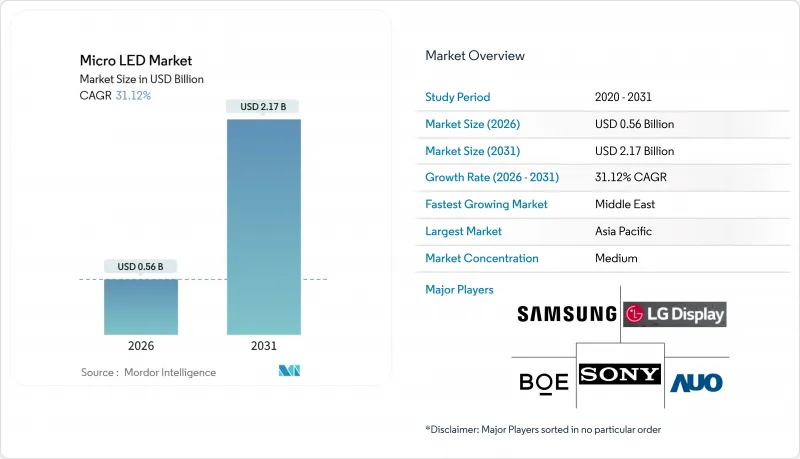
本報告按應用領域(例如智慧型手錶)、終端用戶行業(例如汽車)、面板尺寸(例如 50 英寸及以上)、像素間距(例如超過 2.5 毫米的大尺寸)、技術(例如單色)、組件(例如背板)、製造程序(例如大尺寸轉印)、產品形式(例如顯示模組)和地區進行細分。市場預測以美元計價。
全球MicroLED市場趨勢與洞察
蘋果和三星針對配備微型LED的穿戴式裝置所製定的藍圖,正在加速對小型顯示器的需求。
三星在2025年國際消費電子展(CES)上發表的概念智慧型手錶,峰值亮度約為4000尼特,是目前OLED穿戴裝置亮度的四倍,這印證了其對戶外可視性的重視。蘋果已停止其智慧手錶項目,並將其位於聖克拉拉園區的microLED研發重心轉移到近眼AR眼鏡上。 Meta公司已預定了Plessey公司2025年下半年用於智慧眼鏡的全部GaN-on-Si產能,而JBD公司正在為一級頭戴式設備OEM廠商量產單色和RGB面板。從這些藍圖來看,市場需求正從腕戴式顯示器轉向尺寸小於一吋的微型顯示器,後者需要3000 PPI的像素密度,而OLED難以在保證有效良率的情況下達到如此高的密度。這些趨勢表明,未來四年內,microLED市場將多元化發展,涵蓋多種穿戴式裝置形式。
透明靈活的零售指示牌在海灣合作理事會國家和東亞地區的普及
在沙烏地阿拉伯、阿拉伯聯合大公國、東京和上海的商店和機場,正在部署像素關閉時透明度可達70-85%的微型LED顯示螢幕,確保在播放影像內容的同時也能保證視野清晰。 LG Display和京東方(BOE)發布了厚度不到5毫米的原型產品,可包覆曲面玻璃,滿足新型智慧城市區域玻璃幕牆的建築要求。在這些區域,超過10萬勒克斯的極端環境光照使得透明OLED解決方案在戶外難以辨認,而微型LED則展現出固有的性能優勢。優先考慮可視性的法規和區域分類進一步加速了微型LED的普及,零售指示牌是推動微型LED市場早期採用小間距面板的主要動力。
對於尺寸小於 10µm、晶圓尺寸大於 4 英吋的 LED,其質量轉移效率低於 60%。
2025年9月《自然》雜誌的一篇綜述證實,由於側壁複合和俄歇效應,像素間距小於10µm時,良率會下降。 AR微顯示器所需的尺寸小於5µm的LED在拾取放置和雷射剝離轉移過程中會遭受災難性的晶片損失,從而限制了其商業性可行性。儘管PlayNitride公司2025年3月發布的關於晶片載體上封裝(chip-on-loader)的研究表明良率有所提高,但工業規模的挑戰仍然存在。因此,高PPI微顯示器在北美和歐洲仍將價格昂貴,消費者接受度較低,這將導致微型LED市場發展勢頭放緩,直到混合鍵合和其他晶圓級製程成熟為止。
細分市場分析
預計到2031年,近眼設備市場將以32.61%的複合年成長率成長,超過所有其他應用領域。蘋果、Meta以及國防系統整合商都在調整藍圖,將產品線轉向尺寸小於1吋、像素密度為3000 PPI的微型顯示器。隨著AR頭顯從單色原型發展到全彩、陽光下可見的光學元件,近眼設備的microLED市場也預計將成長。智慧型手錶顯示器在2025年佔總銷售量的28.43%,仍將是出貨量最大的市場,但其成長率將低於AR眼鏡產品。由於晶片數量成本問題,電視領域的microLED應用較為滯後;一塊100吋的面板仍需要約2500萬個晶片。顯示器和筆記型電腦的應用則介於兩者之間,它們在醫療影像和HDR內容調色等領域使用microLED,因為在這些領域,OLED的燒屏風險是不可接受的。
應用領域的這種分化催生了兩條平行的供應鏈。穿戴式裝置供應商傾向於採用混合鍵合技術來實現小於10µm的對準精度,而大型指示牌則繼續使用間距為50µm的彈性體印模進行品質轉移。醫療產業構成了第三個細分市場,其診斷顯示器的採購價格超過1萬美元。這些應用不僅證明了microLED高昂價格的合理性,也充分利用了其在機器人手術中不會產生運動模糊的特性。這種細分市場的多樣性降低了收入波動,並支持了整個microLED市場的多方面創新。
到2025年,消費性電子產品將佔總銷售額的40.12%,主要成長動力來自高階電視、遊戲顯示器和智慧型手錶。然而,醫療產業預計將以33.37%的複合年成長率(CAGR)實現最高成長,這主要得益於手術室對亮度高達10,000尼特且需在數小時手術過程中最大限度減少熱量產生的需求。診斷放射工作站也受惠於微型LED高達1,000,000:1的對比度,這增強了明亮環境下的灰階辨識度。在聯合國歐洲經濟委員會(UNECE)陽光下可視性標準的推動下,汽車原始設備製造商(OEM)正在加速採用抬頭顯示器(HUD),一旦認證障礙消除,他們就會立即投入使用。同時,由於美國和歐盟對耐環境微型顯示器的需求,航太和國防領域的供應鏈也不斷擴大。
家用電子電器市場成長緩慢,OLED 在智慧型手機市場保持主導地位,而 mini-LED 在中型顯示器市場則展現出成本優勢。同時,在醫療領域,多年的折舊免稅額計畫使得每台設備 1 萬美元的單價能夠被納入預算,從而獲得足以彌補 micro-LED 良率降低造成的損失的利潤。汽車產業的專案也展現出類似的強勁勢頭,預計一旦檢驗完成,每台設備的收入將達到 500 至 1000 美元,而一旦認證協議標準化,永續的收入來源將得到保障。國防項目甚至可以承受更高的價格,這為 micro-LED 市場創造了多層次的商業機會。
預計到2025年,10英寸以下面板將佔總銷量的46.78%,並保持32.83%的複合年成長率,因為智慧型手錶、AR眼鏡和抬頭顯示器等產品優先考慮的是緊湊性和電池續航時間。因此,在傳統技術無法實現的像素密度驅動下,10吋以下產品的microLED市場規模將會成長最快。中型面板(10-50吋)在高亮度顯示器和筆記型電腦工作站領域有需求,但不得不與成熟的mini-LED背光技術競爭。 50英寸以上的面板仍然是售價超過10萬美元的高階產品,其應用僅限於旗艦商業指示牌。
微型發光架構在對重量和電流(低至克或毫安級)要求極高的設備中特別強大。 JBD 的亞 5 微米像素間距實現了 3000 PPI,即使在明亮的日光下也能呈現流暢的 AR 疊加效果。相較之下,尺寸較大的裝置仍面臨著晶片數量龐大、良率低於 60% 等挑戰,這使得其在電視市場的普及應用推遲到 2028 年或 2030 年。由此產生的尺寸分層進一步強化了整個微型 LED 市場雙模策略的必要性。
區域分析
至2025年,亞太地區將佔全球銷售額的66.42%,並繼續維持其作為外延晶圓、TFT背板和量產工具製造地的地位。中國的京東方和天馬正在利用政府激勵措施擴大其遊戲顯示器和汽車叢集的生產規模,而台灣的輝光電子和晶元光電則在擴建其6英寸外延晶圓生產線。韓國的三星和LG Display則專注於模組化電視和透明玻璃原型產品,這些產品已在2025年國際消費電子展(CES 2025)上亮相。該地區垂直整合的供應鏈確保了更快的產品改進週期和成本降低,從而增強了該地區在microLED市場的經濟影響力。
預計中東地區將以32.21%的複合年成長率實現最高成長,這主要得益於透明微型LED帷幕牆的引進。即使在沙漠高達10萬勒克斯的陽光下,這些幕牆依然清晰可見,例如沙烏地阿拉伯的NEOM計畫和杜拜的零售區就採用了這種幕牆。政府支持的資金正在消除資本投資的障礙,並加速大規模試點部署。監管標準推薦「玻璃優先」的建築設計,對OLED無法滿足的透明指示牌產生了可預見的需求。
北美地區的成長主要集中在國防領域和擴增實境(AR)穿戴式裝置。與美國陸軍和國防高級研究計劃局(DARPA)的合約確立了性能指標,這些指標將成為商用眼鏡的事實標準。蘋果位於聖克拉拉的實驗室即使在停止其Apple Watch專案後,仍在繼續開發小於1英寸的微型顯示器,不僅支持了國內的研發投入,還促進了專注於微型LED技術叢集的形成。在歐洲,汽車原始設備製造商(OEM)對陽光下可視的抬頭顯示器(HUD)的需求推動了發展,並利用聯合國歐洲經濟委員會(UNECE)的合規標準作為轉型催化劑。南美和非洲的發展則相對滯後,原因是晶圓廠建設成本高達6億美元,且缺乏本地外延晶圓資源,迫使它們依賴進口模組,從而限制了它們在全球微型LED市場的貢獻。
其他好處:
- Excel格式的市場預測(ME)表
- 3個月的分析師支持
目錄
第1章:引言
- 研究假設和市場定義
- 調查範圍
第2章:調查方法
第3章執行摘要
第4章 市場狀況
- 市場概覽
- 市場促進因素
- 蘋果和三星的microLED穿戴裝置藍圖正在加速對小型顯示器的需求。
- 透明靈活的零售指示牌在波灣合作理事會國家和東亞地區的普及。
- 美國和歐盟政府為國防微型顯示器提供資金
- 台灣地區Mini-LED成本的下降使得推出Micro-LED試生產線成為可能。
- 歐洲汽車日光可視性標準正在推動微型 LED HUD 的普及。
- 量子點顏色轉換效率的突破性進步簡化了製造過程。
- 市場限制因素
- 對於尺寸小於 10µm 且大於 4 吋晶圓的 LED,傳質效率低於 60%。
- 非標準化的汽車認證協議
- 亞洲氮化鎵矽基晶片供應集中
- 需要超過 6 億美元的資本投資,這限制了企業在南美洲和非洲的擴張。
- 產業價值鏈分析
- 宏觀經濟因素對市場的影響
- 技術展望
- 波特五力分析
第5章 市場規模與成長預測
- 透過使用
- 智慧型手錶
- 近眼設備(AR/VR)
- 電視機
- 智慧型手機和平板電腦
- 顯示器和筆記型電腦
- 抬頭顯示器
- 數位電子看板
- 微型投影儀
- 醫療和外科展覽
- 工業檢驗面板
- 按最終用途行業分類
- 家用電子產品
- 車
- 航太/國防
- 衛生保健
- 廣告與零售
- 工業和製造業
- 其他終端用戶產業
- 按面板尺寸
- 小於10吋(小型和微型顯示器)
- 10-50吋(中號)
- 50吋或更大(大號)
- 按像素間距
- 細間距(小於1.5毫米)
- 標準(1.5-2.5 毫米)
- 大號(2.5毫米或以上)
- 按技術(顏色)
- RGB全彩
- 黑白
- 按組件
- 外延晶片
- 背板
- 驅動IC
- 傳輸和黏合設備
- 檢查和維修工具
- 透過製造程序
- 傳質
- 外延晶片晶圓鍵合技術
- 混合鍵合
- 按產品形式
- 顯示模組
- 照明模組
- 按地區
- 北美洲
- 美國
- 加拿大
- 墨西哥
- 南美洲
- 巴西
- 阿根廷
- 其他南美國家
- 歐洲
- 英國
- 德國
- 法國
- 西班牙
- 義大利
- 其他歐洲國家
- 亞太地區
- 中國
- 印度
- 日本
- 澳洲
- 韓國
- 其他亞太國家
- 中東和非洲
- 中東
- 沙烏地阿拉伯
- 阿拉伯聯合大公國
- 土耳其
- 其他中東國家
- 非洲
- 南非
- 肯亞
- 其他非洲國家
- 中東
- 北美洲
第6章 競爭情勢
- 市場集中度
- 策略趨勢
- 市佔率分析
- 公司簡介
- Samsung Electronics Co. Ltd.
- Sony Corporation
- LG Display Co. Ltd.
- BOE Technology Group Co. Ltd.
- AU Optronics Corp.
- Epistar Corporation
- PlayNitride Inc.
- Innolux Corporation
- Apple Inc.(LuxVue Technology)
- Tianma Microelectronics Co. Ltd.
- Nichia Corporation
- Sharp Corporation
- VueReal Inc.
- Plessey Semiconductors Ltd.
- Aledia SA
- Ostendo Technologies Inc.
- JBD(Jade Bird Display)
- Leyard Optoelectronics Co. Ltd.
- Seoul Semiconductor Co. Ltd.
- San'an Optoelectronics Co. Ltd.
- Allos Semiconductors GmbH
- Optovate Ltd.
- Foxconn(Hon Hai Precision)
- Aledia SA
第7章 市場機會與未來展望
According to Mordor Intelligence, the micro LED market size is estimated at USD 0.56 billion in 2026, and is expected to reach USD 2.17 billion by 2031, at a CAGR of 31.12% during the forecast period (2026-2031).
This report is Segmented by Application (Smartwatch, and More), End-Use Industry (Automotive, and More), Panel Size (Above 50-Inch, and More), Pixel Pitch (Large Above 2. 5 Mm, and More), Technology (Monochrome, and More), Component (Backplanes, and More), Manufacturing Process (Mass Transfer, and More), Offering (Display Modules, and More), and Geography. The Market Forecasts are Provided in Terms of Value (USD).
Global Micro LED Market Trends and Insights
Apple and Samsung Roadmaps For Micro-LED Wearables Accelerating Small-Display Demand
Samsung's CES 2025 concept smartwatch features a peak luminance of roughly 4,000 nits, quadrupling the luminance of today's OLED wearables and confirming outdoor readability targets. Apple's canceled watch project shifts micro-LED R&D toward near-eye AR glasses at its Santa Clara campus. Meta has locked in Plessey's full GaN-on-Si capacity for late-2025 smart glasses, while JBD mass-produces monochrome and RGB panels for tier-one headset OEMs. Collectively, these roadmaps pivot demand from wrist-worn to sub-1-inch microdisplays requiring 3,000 PPI, a density OLED struggles to achieve at viable yield. Their trajectories signal that the micro LED market will diversify across multiple wearable form factors over the next four years.
Transparent and Flexible Retail Signage Uptake In Gulf Cooperation Council Countries and East Asia
Storefront and airport installations in Saudi Arabia, the United Arab Emirates, Tokyo, and Shanghai are deploying modules that deliver 70-85% transparency once pixels are off, maintaining sightlines while broadcasting video content. LG Display and BOE publicized prototypes under 5 mm thick that wrap around curved glass, addressing architectural mandates for glass facades in new smart-city districts. The region's extreme ambient light-exceeding 100,000 lux-renders transparent OLED solutions unreadable outdoors, giving micro LED an intrinsic performance moat. Regulatory zoning that favors sightline preservation further accelerates uptake, making retail signage an early-scale driver of fine-pitch panels in the micro LED market.
Mass-Transfer Yield Below 60 % For Sub-10 µm LEDs Beyond 4-Inch Wafers
Nature's September 2025 review confirms sidewall recombination and Auger effects erode yields once pixel pitch falls below 10 µm. Sub-5 µm LEDs demanded by AR microdisplays face catastrophic die loss during pick-and-place or laser lift-off transfer, limiting their commercial viability. PlayNitride's March 2025 chip-on-carrier study improved yields but still documented industrial-scale gaps. High-PPI microdisplays in North America and Europe, therefore, remain expensive, slowing consumer adoption and subtracting momentum from the micro LED market until hybrid bonding or other wafer-level processes mature.
Other drivers and restraints analyzed in the detailed report include:
- Defense-Grade Micro-Displays Funded By United States and EU Governments
- Taiwanese Mini-LED Cost Decline Enabling Pilot Micro-LED Lines
- Non-Standardized Automotive Qualification Protocols
For complete list of drivers and restraints, kindly check the Table Of Contents.
Segment Analysis
Near-to-eye devices expanded at a 32.61% CAGR through 2031, outpacing all other uses as Apple, Meta, and defense integrators align roadmaps to sub-1-inch microdisplays with 3,000 PPI densities. The micro LED market size for near-to-eye devices is projected to compound as AR headsets transition from monochrome prototypes to full-color, sunlight-readable optics. Smartwatch displays, which commanded 28.43% of 2025 revenue, remain the largest shipped volume, yet will concede growth ranking to AR eyewear. Television adoption lags due to die-count economics; a 100-inch panel still requires about 25 million dies. Monitors and laptops carve a middle path, tapping micro LED for medical imaging and HDR content grading where OLED burn-in risks are unacceptable.
The application bifurcation gives rise to two parallel supply chains. Wearable vendors favor hybrid bonding for sub-10 µm alignment accuracy, whereas large-format signage continues to use elastomer-stamp mass transfer at a 50 µm pitch. Medical theaters form a third niche, purchasing USD 10,000-plus diagnostic displays that justify micro-LED premiums and leverage zero-motion-blur characteristics for robotic surgery. This segmentation diversity cushions revenue volatility and sustains multi-node innovation across the micro LED market.
Consumer electronics accounted for 40.12% of 2025 revenue, driven by premium televisions, gaming monitors, and smartwatches. Yet, healthcare will post the fastest 33.37% CAGR, propelled by surgical suites that demand 10,000-nit luminance with minimal heat rise over multi-hour procedures. Diagnostic radiology workstations also benefit from micro-LED's 1,000,000:1 contrast ratio, which enhances grayscale discernment in bright rooms. Automotive OEMs, driven by UNECE sun-readability thresholds, accelerate the integration of head-up displays once qualification hurdles are cleared, while the aerospace and defense supply streams grow on U.S. and EU contracts for ruggedized micro-displays.
Consumer electronics growth moderates as OLED retains smartphone dominance and mini-LED undercuts cost in mid-size monitors. Conversely, healthcare budgets can absorb USD 10,000 unit pricing due to multi-year depreciation schedules, yielding margins that offset the micro-LED yield penalty. Automotive programs offer similar resilience-the segment commands USD 500-1,000 per vehicle once validated, ensuring durable revenue once qualification protocols converge. Defense projects tolerate even higher pricing, creating a layered opportunity ladder within the micro LED market.
Sub-10-inch panels captured 46.78% of 2025 revenue and are expected to maintain a 32.83% CAGR, as smartwatches, AR glasses, and head-up displays prioritize compactness and battery life. The micro LED market size for sub-10-inch products will therefore expand the fastest, driven by pixel densities that are impossible for legacy technologies. Medium panels (10-50 inches) appeal to high-brightness monitors and laptop workstations, yet must compete with mature mini-LED backlights. Panels beyond 50 inches remain luxury items priced above USD 100,000, confining adoption to flagship commercial signage.
Micro-scale emissive architecture, especially when it comes to devices, favors those where every gram and milliamp counts. JBD's sub-5 µm pixel pitch achieves 3,000 PPI, enabling uninterrupted AR overlays in daylight. Large-format units, by contrast, still face prohibitive die-counts and sub-60% yields, delaying mainstream television adoption until 2028-2030. The resulting size stratification reinforces dual tooling strategies across the micro LED market.
Complete Report Scope:
- By Application
- Smartwatch
- Near-to-Eye Devices (AR/VR)
- Television
- Smartphone and Tablet
- Monitor and Laptop
- Head-up Display
- Digital Signage
- Micro-Projector
- Medical and Surgical Displays
- Industrial Inspection Panels
- By End Use Industry
- Consumer Electronics
- Automotive
- Aerospace and Defense
- Healthcare
- Advertising and Retail
- Industrial and Manufacturing
- Others End Use Industries
- By Panel Size
- Less than 10-inch (Small and Micro-Displays)
- 10- to 50-inch (Medium)
- Above 50-inch (Large)
- By Pixel Pitch
- Fine Pitch (Less than 1.5 mm)
- Standard (1.5 - 2.5 mm)
- Large (Above 2.5 mm)
- By Technology (Color)
- RGB Full-Color
- Monochrome
- By Component
- Epitaxial Wafers
- Backplanes
- Driver ICs
- Transfer and Bonding Equipment
- Inspection and Repair Tools
- By Manufacturing Process
- Mass Transfer
- Epitaxial Wafer Bonding
- Hybrid Bonding
- By Offering
- Display Modules
- Lighting Modules
- By Geography
- North America
- United States
- Canada
- Mexico
- South America
- Brazil
- Argentina
- Rest of South America
- Europe
- United Kingdom
- Germany
- France
- Spain
- Italy
- Rest of Europe
- Asia Pacific
- China
- India
- Japan
- Australia
- South Korea
- Rest of Asia-Pacific
- Middle East and Africa
- Middle East
- Saudi Arabia
- United Arab Emirates
- Turkey
- Rest of Middle East
- Africa
- South Africa
- Kenya
- Rest of Africa
- Middle East
- North America
Geography Analysis
Asia Pacific generated 66.42% of 2025 revenue and remains the manufacturing backbone for epitaxial wafers, TFT backplanes, and mass-transfer tooling. China's BOE and Tianma leverage government incentives to scale gaming monitors and automotive clusters, while Taiwan's PlayNitride and Epistar extend six-inch epi-wafer lines. South Korea's Samsung and LG Display concentrate on modular televisions and transparent glass prototypes showcased at CES 2025. The region's vertically integrated supply chain ensures faster iteration cycles and cost degression, reinforcing its economic gravity inside the micro LED market.
The Middle East is projected to chart the fastest 32.21% CAGR, as Saudi Arabia's NEOM project and Dubai's retail corridors install transparent micro-LED facades readable under 100,000 lux of desert daylight. Sovereign wealth funding offsets capex hurdles and accelerates full-scale pilot deployments. Regulatory codes favor glass-first architecture, creating a predictable pull for transparency-enabled signage that OLED cannot satisfy.
North America's growth centers on defense and AR wearables. U.S. Army and DARPA contracts finance performance matrices that serve as de facto standards for commercial glasses. Apple's Santa Clara lab continues developing sub-1-inch microdisplays after ending its watch program, anchoring domestic R&D spending and seeding a specialized micro-LED competency cluster. Europe advances through automotive OEM demand for sun-readable HUDs, leveraging UNECE conformity as a conversion catalyst. South America and Africa trail due to USD 600 million fab cost thresholds and absent local epi-wafer sources, confining them to imported modules and tempering their contribution to the global micro LED market.
- Samsung Electronics Co. Ltd.
- Sony Corporation
- LG Display Co. Ltd.
- BOE Technology Group Co. Ltd.
- AU Optronics Corp.
- Epistar Corporation
- PlayNitride Inc.
- Innolux Corporation
- Apple Inc. (LuxVue Technology)
- Tianma Microelectronics Co. Ltd.
- Nichia Corporation
- Sharp Corporation
- VueReal Inc.
- Plessey Semiconductors Ltd.
- Aledia SA
- Ostendo Technologies Inc.
- JBD (Jade Bird Display)
- Leyard Optoelectronics Co. Ltd.
- Seoul Semiconductor Co. Ltd.
- San'an Optoelectronics Co. Ltd.
- Allos Semiconductors GmbH
- Optovate Ltd.
- Foxconn (Hon Hai Precision)
- Aledia SA
Additional Benefits:
- The market estimate (ME) sheet in Excel format
- 3 months of analyst support
TABLE OF CONTENTS
1 INTRODUCTION
- 1.1 Study Assumptions and Market Definition
- 1.2 Scope of the Study
2 RESEARCH METHODOLOGY
3 EXECUTIVE SUMMARY
4 MARKET LANDSCAPE
- 4.1 Market Overview
- 4.2 Market Drivers
- 4.2.1 Apple and Samsung Road-maps for Micro-LED Wearables Accelerating Small-Display Demand
- 4.2.2 Transparent and Flexible Retail Signage Uptake in Gulf Cooperation Council Countries and East Asia
- 4.2.3 Defense-grade Micro-Displays Funded by United States and EU Governments
- 4.2.4 Taiwanese Mini-LED Cost Decline Enabling Pilot Micro-LED Lines
- 4.2.5 European Automotive Sun-Readability Norms Boosting Micro-LED HUD Integration
- 4.2.6 Quantum-Dot Color-Conversion Efficiency Breakthroughs Reducing Manufacturing Steps
- 4.3 Market Restraints
- 4.3.1 Mass-Transfer Yield Below 60% for Sub-10 µm LEDs Beyond 4-inch Wafers
- 4.3.2 Non-standardised Automotive Qualification Protocols
- 4.3.3 GaN-on-Si Wafer Supply Concentration in Asia
- 4.3.4 More than USD 600 Million Capex Requirement Limiting Expansion in South America and Africa
- 4.4 Industry Value Chain Analysis
- 4.5 Impact of Macroeconomic Factors on the Market
- 4.6 Technological Outlook
- 4.7 Porter's Five Forces Analysis
- 4.7.1 Bargaining Power of Suppliers
- 4.7.2 Bargaining Power of Buyers
- 4.7.3 Threat of New Entrants
- 4.7.4 Threat of Substitutes
- 4.7.5 Intensity of Competitive Rivalry
5 MARKET SIZE AND GROWTH FORECASTS (VALUES)
- 5.1 By Application
- 5.1.1 Smartwatch
- 5.1.2 Near-to-Eye Devices (AR/VR)
- 5.1.3 Television
- 5.1.4 Smartphone and Tablet
- 5.1.5 Monitor and Laptop
- 5.1.6 Head-up Display
- 5.1.7 Digital Signage
- 5.1.8 Micro-Projector
- 5.1.9 Medical and Surgical Displays
- 5.1.10 Industrial Inspection Panels
- 5.2 By End Use Industry
- 5.2.1 Consumer Electronics
- 5.2.2 Automotive
- 5.2.3 Aerospace and Defense
- 5.2.4 Healthcare
- 5.2.5 Advertising and Retail
- 5.2.6 Industrial and Manufacturing
- 5.2.7 Others End Use Industries
- 5.3 By Panel Size
- 5.3.1 Less than 10-inch (Small and Micro-Displays)
- 5.3.2 10- to 50-inch (Medium)
- 5.3.3 Above 50-inch (Large)
- 5.4 By Pixel Pitch
- 5.4.1 Fine Pitch (Less than 1.5 mm)
- 5.4.2 Standard (1.5 - 2.5 mm)
- 5.4.3 Large (Above 2.5 mm)
- 5.5 By Technology (Color)
- 5.5.1 RGB Full-Color
- 5.5.2 Monochrome
- 5.6 By Component
- 5.6.1 Epitaxial Wafers
- 5.6.2 Backplanes
- 5.6.3 Driver ICs
- 5.6.4 Transfer and Bonding Equipment
- 5.6.5 Inspection and Repair Tools
- 5.7 By Manufacturing Process
- 5.7.1 Mass Transfer
- 5.7.2 Epitaxial Wafer Bonding
- 5.7.3 Hybrid Bonding
- 5.8 By Offering
- 5.8.1 Display Modules
- 5.8.2 Lighting Modules
- 5.9 By Geography
- 5.9.1 North America
- 5.9.1.1 United States
- 5.9.1.2 Canada
- 5.9.1.3 Mexico
- 5.9.2 South America
- 5.9.2.1 Brazil
- 5.9.2.2 Argentina
- 5.9.2.3 Rest of South America
- 5.9.3 Europe
- 5.9.3.1 United Kingdom
- 5.9.3.2 Germany
- 5.9.3.3 France
- 5.9.3.4 Spain
- 5.9.3.5 Italy
- 5.9.3.6 Rest of Europe
- 5.9.4 Asia Pacific
- 5.9.4.1 China
- 5.9.4.2 India
- 5.9.4.3 Japan
- 5.9.4.4 Australia
- 5.9.4.5 South Korea
- 5.9.4.6 Rest of Asia-Pacific
- 5.9.5 Middle East and Africa
- 5.9.5.1 Middle East
- 5.9.5.1.1 Saudi Arabia
- 5.9.5.1.2 United Arab Emirates
- 5.9.5.1.3 Turkey
- 5.9.5.1.4 Rest of Middle East
- 5.9.5.2 Africa
- 5.9.5.2.1 South Africa
- 5.9.5.2.2 Kenya
- 5.9.5.2.3 Rest of Africa
- 5.9.5.1 Middle East
- 5.9.1 North America
6 COMPETITIVE LANDSCAPE
- 6.1 Market Concentration
- 6.2 Strategic Moves
- 6.3 Market Share Analysis
- 6.4 Company Profiles
- 6.4.1 Samsung Electronics Co. Ltd.
- 6.4.2 Sony Corporation
- 6.4.3 LG Display Co. Ltd.
- 6.4.4 BOE Technology Group Co. Ltd.
- 6.4.5 AU Optronics Corp.
- 6.4.6 Epistar Corporation
- 6.4.7 PlayNitride Inc.
- 6.4.8 Innolux Corporation
- 6.4.9 Apple Inc. (LuxVue Technology)
- 6.4.10 Tianma Microelectronics Co. Ltd.
- 6.4.11 Nichia Corporation
- 6.4.12 Sharp Corporation
- 6.4.13 VueReal Inc.
- 6.4.14 Plessey Semiconductors Ltd.
- 6.4.15 Aledia SA
- 6.4.16 Ostendo Technologies Inc.
- 6.4.17 JBD (Jade Bird Display)
- 6.4.18 Leyard Optoelectronics Co. Ltd.
- 6.4.19 Seoul Semiconductor Co. Ltd.
- 6.4.20 San'an Optoelectronics Co. Ltd.
- 6.4.21 Allos Semiconductors GmbH
- 6.4.22 Optovate Ltd.
- 6.4.23 Foxconn (Hon Hai Precision)
- 6.4.24 Aledia SA
7 MARKET OPPORTUNITIES AND FUTURE OUTLOOK
- 7.1 White-space and Unmet-Need Assessment

 MicroLED市場報告:趨勢、預測和競爭分析(至2035年)
 2026年全球微型發光二極體(LED)顯示器市場報告微型發光二極體(LED)晶片市場報告:趨勢、預測與競爭分析(至2035年)
 微型LED晶片及傳質材料市場機會、成長促進因素、產業趨勢分析及2026-2035年預測
 MicroLED晶片:市佔率分析、產業趨勢與統計、成長預測(2026-2031年)
 微型LED光學引擎市場:按組件、技術、材料、應用和終端用戶產業分類的全球預測(2026-2032年)微型LED晶圓質傳設備市場:2026-2032年全球預測(依設備類型、傳輸技術、晶圓尺寸、自動化程度及最終用途產業分類)
 MicroLED市場規模、佔有率和成長分析:按應用、顯示像素密度、最終用途和地區分類-產業預測(2026-2033年)
 MicroLED市場分析及預測(至2035年):按類型、產品、技術、組件、應用、材料類型、裝置、最終用戶和製程分類AR微光學引擎市場按技術、引擎類型、顯示類型、解析度和應用分類-2026-2032年全球預測