


 |
市場調查報告書
商品編碼
2122491
塑合板:市場佔有率分析、產業趨勢與統計、成長預測(2026-2031)Particle Board - Market Share Analysis, Industry Trends & Statistics, Growth Forecasts (2026 - 2031) |
||||||

※ 本網頁內容可能與最新版本有所差異。詳細情況請與我們聯繫。
根據 Mordor Intelligence 預測,塑合板市場規模將從 2025 年的 1.2021 億立方米成長到 2026 年的 1.2348 億立方米,到 2031 年達到 1.4121 億立方米,2026 年至 2031 年的複合年成長率為 2.72%。
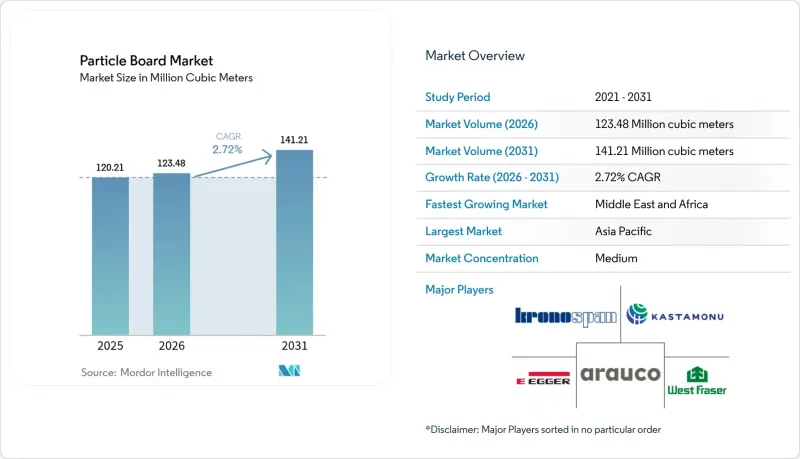
本報告按原料(木屑、甘蔗渣及其他原料)、應用領域(家具、建築、基礎設施及其他應用)和地區(亞太地區、北美地區、歐洲地區、南美地區以及中東和非洲地區)進行細分。市場預測以體積(立方米)為單位。
全球塑合板市場趨勢與洞察
亞洲二、三線城市的快速都市化正在推高對價格適中的住宅用品的需求。
印度、中國和東南亞的二、三線城市人口激增,推動了對經濟適用型公寓室內板材的需求。印度的「總理住房計畫」(Pradhan Mantri Awas Yojana)專注於推廣塑合板櫥櫃和衣櫃,旨在促進經濟適用住宅的普及。預計中國的都市化將進一步提高,但省會城市的家具普及率仍落後於沿海地區。越南的家具出口量年增率顯著,這主要得益於製造商從中國遷至越南以及歐盟-越南自由貿易協定(FTA)提供的關稅優惠。地理位置的接近性不僅顯著降低了與中密度纖維板(MDF)相比的運輸成本,而且還形成了一個良性循環,便於本地安裝,從而加速了家具在附近都市區的普及。
在非承重應用中,與中密度纖維板和膠合板相比,具有成本優勢。
與中密度纖維板(MDF)和膠合板相比,塑合板具有成本優勢,尤其是在櫥櫃主體、層架和不顯眼表面等應用領域。 MDF的生產耗電量大,而塑合板的能耗更低,顯著降低了成本。在越南,薪資逐年快速上漲,改變了抽屜底板和背板的材料選擇。膠合板在重型家具領域仍然佔據主導地位,但隨著大直徑螺絲、金屬嵌件和黏合劑加固接頭的引入,其優勢正在逐漸減弱。這種變化在匯率波動較大的市場尤為明顯,進口合板的價格波動幅度可能遠超過國產板材。
樹脂和甲醇價格的波動給生產商的利潤率帶來了壓力。
2024年中,歐洲現貨甲醇價格先是飆漲後回落。這一價格波動推高了脲醛樹脂的價格,為木材生產商的息稅折舊攤提前EBITDA獲利率)帶來了壓力。然而,像喬治亞太平洋公司這樣的綜合性企業,透過利用自身生產的化學產品供應,成功抵禦了這項衝擊。鑑於原料來源集中在中國、中東和美國墨西哥灣沿岸地區,地緣政治風險是一個主要隱患,這意味著樹脂市場的經濟狀況本身就存在不穩定性。
細分市場分析
到2025年,木材殘渣將佔原料的76.25%,凸顯其在物流和生產流程方面的強大優勢。雖然以木材殘渣為原料的塑合板市場預計將隨著板材總產量的成長而擴張,但其市場佔有率可能會逐漸被甘蔗渣蠶食,預計到2031年,甘蔗渣的複合年成長率將達到3.42%。儘管如此,甘蔗渣在全球市場的供應預計仍將受到限制。這種限制源於季節性供應挑戰,迫使工廠投資建造室內倉儲設施並改變其樹脂的化學成分。
在印度和巴西,甘蔗渣的廣泛應用主要受成本降低的驅動,其乾以重量為準交付價格遠低於木材殘渣。在德國和荷蘭,由於強制性的廢棄物掩埋減量措施,再生木材在塑合板市場佔了相當大的佔有率。
區域分析
預計到2025年,亞太地區的消費量將佔全球的45.44%。中國擁有龐大的生產能力,但由於房地產市場低迷,國內需求成長正在放緩。同時,印度在2024年充分利用自身資源,以滿足國內家具需求和出口合約。東協在貿易協定的推動下,正吸引中國的生產轉移,而日本則因人口老化而面臨需求下降的局面。
中東和非洲是成長最快的地區,預計到2031年複合年成長率將達到3.71%。這項成長主要得益於「沙烏地阿拉伯2030願景」下對經濟適用住宅內部裝潢的投資。此外,南非住宅市場在2024年的成長也為該地區的擴張提供了支持。
2025年,北美在全球櫥櫃產量中佔據了相當大的佔有率。儘管美國住宅量提振了櫥櫃需求,但由於加州空氣資源委員會(CARB)和美國環保署(EPA)的嚴格監管,人們擔心會出現嚴重的供不應求。同時,歐洲憑藉著德國、波蘭和羅馬尼亞的生產設施,在全球市場佔了相當大的佔有率。然而,2024年初,這些地區的產量受到抑制,主要原因是天然氣價格波動。南美洲在全球市場中所佔佔有率相對較小,巴西鋸木廠正積極尋求關稅保護,以應對來自中國的價格競爭性進口產品。
其他好處
- Excel格式的市場預測(ME)表
- 3個月的分析師支持
目錄
第1章:引言
- 研究假設和市場定義
- 調查範圍
第2章:調查方法
第3章執行摘要
第4章 市場狀況
- 市場概覽
- 市場促進因素
- 亞洲二、三線城市的快速都市化正在推高對價格適中的住宅用品的需求。
- 在非承重應用中,與中密度纖維板和膠合板相比,具有成本優勢。
- 歐盟和北美嚴格的低甲醛法規正在提振進口需求。
- 透過製糖業脫碳擴大甘蔗渣原料供應
- 利用人工智慧進行連續壓機最佳化,提高產量和切割精度。
- 市場限制因素
- 樹脂和甲醇價格的波動給生產商的利潤率帶來了壓力。
- 歐盟森林砍伐法規導致亞洲工廠合規成本增加。
- 由於潮濕引起的膨脹,限制戶外使用。
- 價值鏈分析
- 波特五力模型
第5章 市場規模與成長預測
- 按原料
- 木材殘渣
- 渣
- 其他成分
- 透過使用
- 家具
- 建造
- 基礎設施
- 其他用途
- 按地區
- 亞太地區
- 中國
- 印度
- 日本
- 韓國
- ASEAN
- 其他亞太國家
- 北美洲
- 美國
- 加拿大
- 墨西哥
- 歐洲
- 德國
- 英國
- 法國
- 義大利
- 俄羅斯
- 北歐國家
- 其他歐洲國家
- 南美洲
- 巴西
- 阿根廷
- 其他南美國家
- 中東和非洲
- 沙烏地阿拉伯
- 南非
- 其他中東和非洲國家
- 亞太地區
第6章 競爭情勢
- 市場集中度
- 策略趨勢
- 市佔率和排名分析
- 公司簡介
- ARAUCO
- Associate Decor
- Boise Cascade Company
- Century Prowud
- Century Plyboards (India) Ltd
- EGGER
- Georgia-Pacific
- Kastamonu Entegre
- Krifour Industries Pvt. Ltd.
- Kronoplus Limited
- Roseburg Forest Products
- Siam Riso Wood Products Co., Ltd.
- Sonae Arauco
- SWISS KRONO Group
- Timber Products Company
- West Fraser Timber Co.
第7章 市場機會與未來展望
According to Mordor Intelligence, the particle board market size is expected to increase from 120.21 million cubic meters in 2025 to 123.48 million cubic meters in 2026 and reach 141.21 million cubic meters by 2031, growing at a CAGR of 2.72% over 2026-2031.
This report is Segmented by Raw Material (Wood Residue, Bagasse, and Other Raw Materials), Application (Furniture, Construction, Infrastructure, and Other Applications), and Geography (Asia-Pacific, North America, Europe, South America, and Middle-East and Africa). The Market Forecasts are Provided in Terms of Volume (Cubic Meters).
Global Particle Board Market Trends and Insights
Rapid Urbanization in Tier-2/3 Asian Cities Spurring Affordable Housing Interiors
As second- and third-tier cities in India, China, and Southeast Asia witness a surge in migration, the demand for budget-friendly interior panels, tailored for apartments, is on the rise. India's Pradhan Mantri Awas Yojana is steering the affordable housing narrative, emphasizing particle board cabinetry and wardrobes. China's urbanization rate is expected to grow further, and provincial capitals are trailing coastal areas in furniture penetration. Vietnamese furniture exports, bolstered by manufacturers shifting from China and capitalizing on EU-Vietnam FTA tariff benefits, saw a significant year-on-year surge. This proximity not only slashes delivered costs compared to MDF but also fuels a cycle of local installations, hastening adoption in nearby urban areas.
Cost Advantage vs. MDF and Plywood in Non-Load-Bearing Uses
Particle board boasts a cost advantage over MDF and plywood, particularly in applications like carcass, shelving, and concealed surfaces. While MDF consumes more electricity for production, particle board's lower energy consumption translates to significant savings. In Vietnam, wage inflation has surged annually, prompting a shift in material choices for drawer bottoms and backs. Although plywood continues to dominate in high-load furniture applications, the introduction of larger-diameter screws, metal inserts, and adhesive-reinforced joints is gradually diminishing plywood's stronghold. This shift is particularly pronounced in markets with volatile currencies, where the price of imported plywood can fluctuate more rapidly than domestic panel costs.
Volatile Resin and Methanol Prices Squeezing Producer Margins
In mid-2024, Europe witnessed a surge in methanol spot quotes before retracting. This volatility pushed urea-formaldehyde prices higher and squeezed EBITDA margins at merchant mills. However, integrated firms like Georgia-Pacific managed to absorb the impact, thanks to their captive chemistry streams. With feedstock concentrated in China, the Middle East, and the U.S. Gulf, geopolitical risks loom large, hinting at an inherently unstable resin economic landscape.
Other drivers and restraints analyzed in the detailed report include:
- Stringent Low-Formaldehyde Rules Boosting EU/NA Import Demand
- Sugar-Industry Decarbonization Freeing Up Bagasse Feedstock
- EU Deforestation Regulation Raising Compliance Costs for Asian Mills
For complete list of drivers and restraints, kindly check the Table Of Contents.
Segment Analysis
Wood residue delivered 76.25% of 2025 feedstock, confirming its entrenched logistical and process advantages. While the particle board market size for wood residue-based production is set to grow in tandem with the overall panel output, it will gradually yield a portion of its market share to bagasse, projected to grow at a 3.42% CAGR through 2031. Despite this growth, bagasse's global market penetration is expected to stay limited. This limitation arises as seasonal supply challenges compel mills to invest in covered storage and modify resin chemistry.
In India and Brazil, bagasse's adoption is driven by cost savings, with delivered prices significantly lower than wood residue on a dry-weight basis. In Germany and the Netherlands, recycled wood commands a notable share of the particle board market, bolstered by landfill-diversion mandates.
Complete Report Scope:
- By Raw Material
- Wood Residue
- Bagasse
- Other Raw Materials
- By Application
- Furniture
- Construction
- Infrastructure
- Other Applications
- By Geography
- Asia-Pacific
- China
- India
- Japan
- South Korea
- ASEAN Countries
- Rest of Asia-Pacific
- North America
- United States
- Canada
- Mexico
- Europe
- Germany
- United Kingdom
- France
- Italy
- Russia
- NORDIC Countries
- Rest of Europe
- South America
- Brazil
- Argentina
- Rest of South America
- Middle-East and Africa
- Saudi Arabia
- South Africa
- Rest of Middle-East and Africa
- Asia-Pacific
Geography Analysis
Asia-Pacific represented 45.44% of 2025 consumption. China, boasting substantial installed capacity, faces a slowdown in local uptake due to weaknesses in its property sector. Meanwhile, India utilized resources in 2024, catering to both domestic furniture needs and export contracts. ASEAN nations are attracting production shifts from China, bolstered by trade agreements, whereas Japan grapples with dwindling demand due to its aging demographics.
Middle-East and Africa is the fastest-growing region at 3.71% CAGR to 2031. This growth is fueled by Saudi Vision 2030's investment in affordable housing fit-outs. Additionally, South Africa's residential growth in 2024 lends further credence to the region's expansion.
North America represented a notable portion of global volume in 2025. While U.S. housing starts bolstered cabinet demand, a significant supply gap looms, largely due to stringent CARB and EPA regulations. Europe, on the other hand, contributed a considerable share to the global volume, with production hubs in Germany, Poland, and Romania. However, early 2024 saw output curbed in these regions, primarily due to fluctuations in natural gas prices. South America accounted for a smaller share of the global market, with Brazilian mills actively seeking tariff protections against competitively priced imports from China.
- ARAUCO
- Associate Decor
- Boise Cascade Company
- Century Prowud
- Century Plyboards (India) Ltd
- EGGER
- Georgia-Pacific
- Kastamonu Entegre
- Krifour Industries Pvt. Ltd.
- Kronoplus Limited
- Roseburg Forest Products
- Siam Riso Wood Products Co., Ltd.
- Sonae Arauco
- SWISS KRONO Group
- Timber Products Company
- West Fraser Timber Co.
Additional Benefits:
- The market estimate (ME) sheet in Excel format
- 3 months of analyst support
TABLE OF CONTENTS
1 Introduction
- 1.1 Study Assumptions and Market Definition
- 1.2 Scope of the Study
2 Research Methodology
3 Executive Summary
4 Market Landscape
- 4.1 Market Overview
- 4.2 Market Drivers
- 4.2.1 Rapid urbanisation in tier-2/3 Asian cities spurring affordable housing interiors
- 4.2.2 Cost advantage vs. MDF and plywood in non-load-bearing uses
- 4.2.3 Stringent low-formaldehyde rules boosting EU/NA import demand
- 4.2.4 Sugar-industry decarbonisation freeing up bagasse feedstock
- 4.2.5 AI-driven continuous-press optimisation lifting yields and cut-offs
- 4.3 Market Restraints
- 4.3.1 Volatile resin and methanol prices squeezing producer margins
- 4.3.2 EU Deforestation Regulation raising compliance costs for Asian mills
- 4.3.3 Moisture-related swelling limiting exterior applications
- 4.4 Value Chain Analysis
- 4.5 Porter's Five Forces
- 4.5.1 Bargaining Power of Suppliers
- 4.5.2 Bargaining Power of Buyers
- 4.5.3 Threat of New Entrants
- 4.5.4 Threat of Substitutes
- 4.5.5 Degree of Competition
5 Market Size and Growth Forecasts (Volume)
- 5.1 By Raw Material
- 5.1.1 Wood Residue
- 5.1.2 Bagasse
- 5.1.3 Other Raw Materials
- 5.2 By Application
- 5.2.1 Furniture
- 5.2.2 Construction
- 5.2.3 Infrastructure
- 5.2.4 Other Applications
- 5.3 By Geography
- 5.3.1 Asia-Pacific
- 5.3.1.1 China
- 5.3.1.2 India
- 5.3.1.3 Japan
- 5.3.1.4 South Korea
- 5.3.1.5 ASEAN Countries
- 5.3.1.6 Rest of Asia-Pacific
- 5.3.2 North America
- 5.3.2.1 United States
- 5.3.2.2 Canada
- 5.3.2.3 Mexico
- 5.3.3 Europe
- 5.3.3.1 Germany
- 5.3.3.2 United Kingdom
- 5.3.3.3 France
- 5.3.3.4 Italy
- 5.3.3.5 Russia
- 5.3.3.6 NORDIC Countries
- 5.3.3.7 Rest of Europe
- 5.3.4 South America
- 5.3.4.1 Brazil
- 5.3.4.2 Argentina
- 5.3.4.3 Rest of South America
- 5.3.5 Middle-East and Africa
- 5.3.5.1 Saudi Arabia
- 5.3.5.2 South Africa
- 5.3.5.3 Rest of Middle-East and Africa
- 5.3.1 Asia-Pacific
6 Competitive Landscape
- 6.1 Market Concentration
- 6.2 Strategic Moves
- 6.3 Market Share(%)/Ranking Analysis
- 6.4 Company Profiles (includes Global Overview, Market Overview, Core Segments, Financials, Strategic Information, Products and Services, Recent Developments)
- 6.4.1 ARAUCO
- 6.4.2 Associate Decor
- 6.4.3 Boise Cascade Company
- 6.4.4 Century Prowud
- 6.4.5 Century Plyboards (India) Ltd
- 6.4.6 EGGER
- 6.4.7 Georgia-Pacific
- 6.4.8 Kastamonu Entegre
- 6.4.9 Krifour Industries Pvt. Ltd.
- 6.4.10 Kronoplus Limited
- 6.4.11 Roseburg Forest Products
- 6.4.12 Siam Riso Wood Products Co., Ltd.
- 6.4.13 Sonae Arauco
- 6.4.14 SWISS KRONO Group
- 6.4.15 Timber Products Company
- 6.4.16 West Fraser Timber Co.
7 Market Opportunities and Future Outlook
- 7.1 White-space and Unmet-Need Assessment

 水泥塑合板市場規模、佔有率和成長分析:按產品類型、厚度、應用、最終用戶和地區分類-2026-2033年產業預測
 北美塑合板:市場佔有率分析、產業趨勢與統計及成長預測(2026-2031)
 2026-2030年全球塑合板市場印度塑合板:市場佔有率分析、產業趨勢與統計及成長預測(2026-2031)歐洲塑合板:市場佔有率分析、產業趨勢與統計、成長預測(2026-2031)
 塑合板市場規模、佔有率、趨勢和預測:按應用、行業和地區分類,2026-2034年日本塑合板市場規模、佔有率、趨勢和預測:按應用、行業和地區分類,2026-2034年
 2026年全球塑合板市場報告
 塑合板市場規模、佔有率和成長分析(按原料、產品類型、安裝方式、應用、最終用途產業和地區分類)-2026-2033年產業預測
 塑合板市場-全球產業規模、佔有率、趨勢、機會和預測,按原料(木材、甘蔗渣、其他)、應用(建築、家具、基礎設施、其他)、地區、競爭細分,2020-2030 年預測