


 |
市場調查報告書
商品編碼
2114340
印度塑合板:市場佔有率分析、產業趨勢與統計及成長預測(2026-2031)India Particle Board - Market Share Analysis, Industry Trends & Statistics, Growth Forecasts (2026 - 2031) |
||||||

※ 本網頁內容可能與最新版本有所差異。詳細情況請與我們聯繫。
據 Mordor Intelligence 稱,2025 年印度塑合板市值為 7.2 億美元,預計到 2031 年將從 2026 年的 7.9 億美元成長至 12.7 億美元,預測期(2026-2031 年)的複合年成長率為 9.98%。
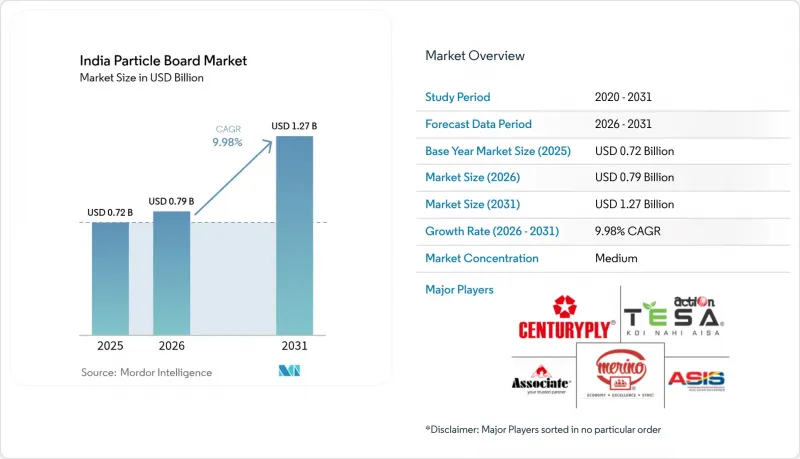
本報告按原料(木材[鋸末、刨花、薄片、木屑]、甘蔗渣等)和應用領域(家具和櫥櫃、建築、基礎設施等)進行分類。市場預測以美元計價。
印度塑合板市場趨勢與洞察
辦公、飯店和零售家具的需求不斷成長。
隨著企業採用基於標準化板材尺寸的模組化工作站,商業設施的維修週期正在縮短,板材供應商的訂單也趨於穩定。飯店連鎖企業以易於更換的塑合板(碎料板)家具取代客製化木設備,並開始下達多年期的大宗訂單以穩定工廠生產。大型零售商正在擴大其組裝包裝家具的供應,由於塑合板在平板包裝物流方面具有重量和成本優勢,因此比膠合板更受歡迎。電商經銷商正在銷售貼合加工材,並配備五金配件,以滿足注重預算的消費者的需求,進一步推動了二線成長地區的消費。企業租戶遷往區域性城市的趨勢,也使得這種需求的驅動力擴展到了傳統大都市以外的地區。
促進城市住宅建設和智慧城市項目
在智慧城市計畫中,公共運輸站點、政府辦公大樓和社區中心的室內裝修工程被納入土木工程預算,從而對認證板材產生了非週期性需求。在「總理經濟適用房計畫」(PMAY)下,低收入住宅計畫採用E1級塑合板打造模組化廚房,將社會政策與產業發展緊密結合。產業走廊樞紐整合了住宅和商業房地產的授權,持續推動了對板材櫥櫃的需求。低排放複合板在綠色建築評估標準中日益受到重視,使得符合條件的生產商能夠以溢價競標。 12個新建產業中心的規劃確保了長期訂單前景,也為引進新的連續壓機生產線提供了依據。
高階櫥櫃市場中MDF的蠶食
中密度纖維板(MDF)更細密的纖維結構使其能夠實現更鋒利的銑削邊緣,而高階廚房製造商對MDF門板的偏好,正在改變櫥櫃市場高階細分領域的市場佔有率模式。如果都市區認為產品品質的提升與其不斷成長的可支配收入相匹配,他們更願意接受15%至20%的價格上漲。塑合板供應商正透過提供高密度等級產品和改進表面處理流程來縮小視覺上的差距,同時將交付成本保持在比MDF低8%至10%的水平。雖然MDF在水槽下方面板等對濕度敏感的區域仍然佔據主導地位,但板材製造商正在加速研發防水添加劑,以重新奪回市場佔有率。因此,這種蠶食效應目前僅限於高階產品,而非大眾市場家具。
細分市場分析
到2025年,木質原料在印度塑合板市場仍佔61.20%的佔有率。這得益於其生產過程的高出材率,以及與鋸木廠數百年來建立的合作關係,這些合作關係保證了木片的品質。然而,由於應對氣候變遷的努力和生質能能的獎勵,甘蔗渣(甘蔗殘渣)正以12.32%的複合年成長率成長,超過了所有其他材料,並逐年縮小了木材的主導地位。一旦規劃中的儲料筒倉和乾燥機投入運作,僅靠甘蔗廢棄物的商業化利用,印度塑合板市場規模就可能進一步擴大。同時,來自建築廢棄物的再生木片也將被添加為原料,從而在進口木材短缺的情況下保障原料供應。
以甘蔗渣為主要原料的工廠正在建立排碳權文件,以實現溫室氣體排放抵消的貨幣化,從而獲得額外的收入來源,以緩解價格波動的影響。大學的檢查表明,當壓制參數最佳化後,甘蔗渣板和桉樹板的斷裂強度和內部黏合強度相當,解決了先前的品質問題。印度西部的幾家鋸木廠決定投資購買專用的剝皮和清潔設備,預計優先從獲得綠色標籤認證的家具出口商處採購。 2025年後,隨著印度標準局(BIS)審核團隊的擴大,那些已將其甘蔗渣採購記錄數位化的鋸木廠有望憑藉原料可追溯性標準獲得優勢。
其他好處
- Excel格式的市場預測(ME)表
- 3個月的分析師支持
目錄
第1章:引言
- 研究假設和市場定義
- 調查範圍
第2章:調查方法
第3章執行摘要
第4章 市場狀況
- 市場概覽
- 市場促進因素
- 辦公、飯店和零售家具的需求不斷成長。
- 促進城市住宅建設和智慧城市項目
- 政府對家具零件的生產關聯獎勵
- 歐盟和美國低排放量產品的出口機會
- 透過人工智慧驅動的面板生產線自動化降低單位成本。
- 市場限制因素
- 高階櫥櫃市場中MDF的蠶食
- 進口原木和樹脂價格波動
- 全球加強甲醛監管
- 價值鏈分析
- 波特五力模型
- 貿易分析
第5章 市場規模與成長預測
- 按原料
- 木頭
- 鋸末
- 刨花
- 薄片
- 洋芋片
- 渣
- 其他
- 木頭
- 透過使用
- 家具和櫥櫃
- 建造
- 基礎設施
- 其他
第6章 競爭情勢
- 市場集中度
- 策略趨勢
- 市佔率和排名分析
- 公司簡介
- Action TESA
- ARCHIDPLY DECOR
- Asian Prelam Industries Pvt. Ltd
- Associate Decor Ltd.
- Bajaj Hindusthan Sugar Ltd
- CenturyPly(Century Prowud)
- DMK Particleboard LLP
- Evergreen Boardlam Pvt. Ltd.
- Krifor Industries Pvt. Ltd.
- Lamikon Woodlam LLP
- Merino Industries
- Niramay Woodlam
- Shirdi Panel Industries Ltd.(ASIS)
第7章 市場機會與未來展望
According to Mordor Intelligence, the India particle board market size was valued at USD 0.72 billion in 2025 and estimated to grow from USD 0.79 billion in 2026 to reach USD 1.27 billion by 2031, at a CAGR of 9.98% during the forecast period (2026-2031).
This report is Segmented by Raw Material (Wood [Sawdust, Shavings, Flakes, and Chips], Bagasse, and Other Raw Materials) and Application (Furniture and Cabinetry, Construction, Infrastructure, and Others). The Market Forecasts are Provided in Terms of Value (USD).
India Particle Board Market Trends and Insights
Rising Office, Hospitality, and Retail Furniture Demand
Commercial refurbishment cycles have shortened as enterprises adopt modular workstations that rely on standardized board dimensions, ensuring steady call-offs from panel suppliers. Hospitality chains replacing custom millwork with easily replaceable particle board (chip board) fixtures now place multi-year blanket orders that stabilize factory throughput. Organized retail is scaling ready-to-assemble furniture lines whose flat-pack logistics favor particle board over plywood because of weight and cost advantages. E-commerce sellers bundle fittings and fasteners with pre-laminated panels to serve budget-conscious consumers, deepening consumption in Tier-2 growth corridors. Corporate occupiers migrating to secondary cities extend this driver beyond traditional metropolitan catchments.
Urban-Housing Push and Smart-City Projects
Smart-city spending packages interior fit-outs for public transit stations, administrative offices, and community centers into the civil works budget, adding a non-cyclical layer of demand for certified boards. Affordable-housing schemes under PMAY integrate modular kitchens that specify E1-grade particle board, linking social policy with industrial growth. Industrial corridor nodes blend residential and commercial real-estate approvals, creating contiguous demand pools for board-based cabinetry. Green-building scorecards increasingly reward low-emission engineered wood, allowing compliant producers to bid at premium prices. The pipeline of 12 new industrial nodes sustains long-range order visibility that justifies new continuous-press lines.
MDF Cannibalisation in Premium Cabinets
MDF's finer fiber matrix yields crisper routed edges that premium kitchen makers prefer for shaker-style doors, leading to a share shift at the cabinetry market's upper end. Urban consumers tolerate a 15-20% price uplift when the perceived quality jump aligns with rising disposable incomes. Particle board suppliers respond with higher-density grades and improved surface sanding to shrink the aesthetic gap, while staying 8-10% below MDF on delivered cost. Moisture-prone zones such as under-sink panels remain MDF strongholds, but board makers accelerate research and development on hydrophobic additives to claw back share. Cannibalisation, therefore, remains contained to premium SKUs rather than mass-market furniture.
Other drivers and restraints analyzed in the detailed report include:
- Government PLI Incentives for Furniture Components
- EU/US Low-Emission Export Opportunity
- Volatile Imported Log and Resin Prices
For complete list of drivers and restraints, kindly check the Table Of Contents.
Segment Analysis
Wood-based feedstocks retained 61.20% of India particle board market share in 2025, anchoring process yields through centuries-old sawmill linkages that guarantee chip consistency. However, climate commitments and biomass incentives propel bagasse to a 12.32% CAGR, outpacing all other materials and narrowing wood's hegemony each successive year. The India particle board market size attributable to bagasse could grow purely on the back of sugar-mill waste monetization once planned storage silos and dryers come online. Simultaneously, recycled wood chips from construction debris enter the mix, providing feedstock hedges against imported log shortages.
Bagasse-centric plants compile carbon-credit dossiers to monetize greenhouse-gas offsets, adding a supplementary revenue stream that cushions price cycles. University trials demonstrate comparable rupture and internal-bond strength modulus between bagasse and eucalyptus boards when press parameters are optimized, nullifying earlier quality concerns. Several western-India mills have committed capex for dedicated depithing and cleaning units, anticipating preferential procurement from green-label furniture exporters. As BIS audit teams expand post-2025, feedstock traceability standards will favor mills with digitized bagasse procurement records.
Complete Report Scope:
- By Raw Material
- Wood
- Sawdust
- Shavings
- Flakes
- Chips
- Bagasse
- Other Raw Materials
- Wood
- By Application
- Furniture and Cabinetry
- Construction
- Infrastructure
- Others
List of Companies Covered in this Report:
- Action TESA
- ARCHIDPLY DECOR
- Asian Prelam Industries Pvt. Ltd
- Associate Decor Ltd.
- Bajaj Hindusthan Sugar Ltd
- CenturyPly (Century Prowud)
- DMK Particleboard LLP
- Evergreen Boardlam Pvt. Ltd.
- Krifor Industries Pvt. Ltd.
- Lamikon Woodlam LLP
- Merino Industries
- Niramay Woodlam
- Shirdi Panel Industries Ltd.(ASIS)
Additional Benefits:
- The market estimate (ME) sheet in Excel format
- 3 months of analyst support
TABLE OF CONTENTS
1 Introduction
- 1.1 Study Assumptions and Market Definition
- 1.2 Scope of the Study
2 Research Methodology
3 Executive Summary
4 Market Landscape
- 4.1 Market Overview
- 4.2 Market Drivers
- 4.2.1 Rising office, hospitality and retail furniture demand
- 4.2.2 Urban-housing push and smart-city projects
- 4.2.3 Government PLI incentives for furniture components
- 4.2.4 EU/US low-emission export opportunity
- 4.2.5 AI-enabled panel-line automation cuts unit cost
- 4.3 Market Restraints
- 4.3.1 MDF cannibalisation in premium cabinets
- 4.3.2 Volatile imported log and resin prices
- 4.3.3 Tightening global formaldehyde limits
- 4.4 Value Chain Analysis
- 4.5 Porter's Five Forces
- 4.5.1 Bargaining Power of Suppliers
- 4.5.2 Bargaining Power of Buyers
- 4.5.3 Threat of New Entrants
- 4.5.4 Threat of Substitutes
- 4.5.5 Degree of Competition
- 4.6 Trade Analysis
5 Market Size and Growth Forecasts (Value)
- 5.1 By Raw Material
- 5.1.1 Wood
- 5.1.1.1 Sawdust
- 5.1.1.2 Shavings
- 5.1.1.3 Flakes
- 5.1.1.4 Chips
- 5.1.2 Bagasse
- 5.1.3 Other Raw Materials
- 5.1.1 Wood
- 5.2 By Application
- 5.2.1 Furniture and Cabinetry
- 5.2.2 Construction
- 5.2.3 Infrastructure
- 5.2.4 Others
6 Competitive Landscape
- 6.1 Market Concentration
- 6.2 Strategic Moves
- 6.3 Market Share(%)/Ranking Analysis
- 6.4 Company Profiles (includes Global level Overview, Market level overview, Core Segments, Financials as available, Strategic Information, Market Rank/Share for key companies, Products and Services, and Recent Developments)
- 6.4.1 Action TESA
- 6.4.2 ARCHIDPLY DECOR
- 6.4.3 Asian Prelam Industries Pvt. Ltd
- 6.4.4 Associate Decor Ltd.
- 6.4.5 Bajaj Hindusthan Sugar Ltd
- 6.4.6 CenturyPly (Century Prowud)
- 6.4.7 DMK Particleboard LLP
- 6.4.8 Evergreen Boardlam Pvt. Ltd.
- 6.4.9 Krifor Industries Pvt. Ltd.
- 6.4.10 Lamikon Woodlam LLP
- 6.4.11 Merino Industries
- 6.4.12 Niramay Woodlam
- 6.4.13 Shirdi Panel Industries Ltd.(ASIS)
7 Market Opportunities and Future Outlook
- 7.1 White-space and Unmet-need Assessment

 2026-2030年全球塑合板市場
 歐洲塑合板:市場佔有率分析、產業趨勢與統計、成長預測(2026-2031)
 塑合板市場規模、佔有率、趨勢和預測:按應用、行業和地區分類,2026-2034年日本塑合板市場規模、佔有率、趨勢和預測:按應用、行業和地區分類,2026-2034年
 2026年全球塑合板市場報告塑合板:市場佔有率分析、產業趨勢與統計、成長預測(2026-2031)
 塑合板市場規模、佔有率和成長分析(按原料、產品類型、安裝方式、應用、最終用途產業和地區分類)-2026-2033年產業預測
 塑合板市場-全球產業規模、佔有率、趨勢、機會和預測,按原料(木材、甘蔗渣、其他)、應用(建築、家具、基礎設施、其他)、地區、競爭細分,2020-2030 年預測
 塑合板市場機會、成長動力、產業趨勢分析與 2024 - 2032 年預測
 全球塑合板市場