


 |
市場調查報告書
商品編碼
2116938
北美塑合板:市場佔有率分析、產業趨勢與統計及成長預測(2026-2031)North America Particle Board - Market Share Analysis, Industry Trends & Statistics, Growth Forecasts (2026 - 2031) |
||||||

※ 本網頁內容可能與最新版本有所差異。詳細情況請與我們聯繫。
據 Mordor Intelligence 稱,北美塑合板市場預計到 2026 年將達到 1541 萬立方米,高於 2025 年的 1467 萬立方米,預計到 2031 年將達到 1969 萬立方米。
預計從 2026 年到 2031 年,其複合年成長率將達到 5.02%。
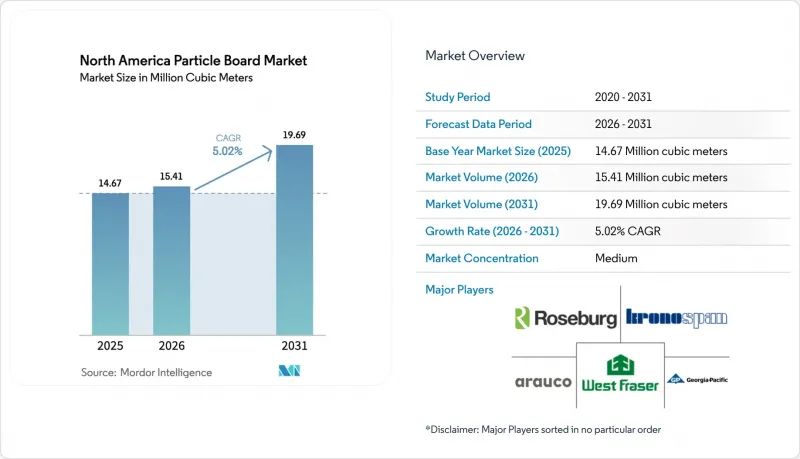
本報告按原料(木材[鋸末、刨花、薄片、木屑]、甘蔗渣及其他原料)、應用領域(家具、建築、基礎設施、包裝及其他)和地區(美國、加拿大和墨西哥)進行細分。市場預測以體積(立方米)為單位。
北美塑合板市場趨勢與洞察
建設產業需求不斷成長
2024年,住宅翻新支出超出預期,帶動了檯面核心材料、樓梯踏板和隔間牆對塑合板的需求。獨棟住宅開工量仍遠高於疫情前基準值,每套新房平均使用約0.8-1.2立方米的板材產品。模組化建築在多用戶住宅項目中日益普及,塑合板因其易於加工且能承受異地組裝過程中的反覆搬運而備受青睞。加拿大也出現了類似的趨勢,尤其是在安大略省和不列顛哥倫比亞省,這兩個省的建築規範現在已允許在非承重牆中使用複合板。基礎設施建設支出雖然在整體消費中佔比不大,但卻推動了對塑合板的需求,尤其是在隔音墊和交通走廊臨時模板方面。
該地區木材殘渣獲取便利
美國能源局的《十億噸報告》指出,伐木殘餘物和未利用的鋸木廠殘餘物是主要的年度廢棄物來源。阿拉巴馬州、喬治亞、密西西比州和南卡羅來納州每年產生大量的鋸木產品,推動了沿著連接森林和墨西哥灣沿岸港口的主要鐵路走廊建設鋸木廠的投資。儘管魁北克省和安大略省氣候較為寒冷,但也出現了類似的趨勢。鋸木廠和板材製造廠的就地選址顯著縮短了運輸距離,並穩定了原料成本。透過美國林務局疏伐合約位置的小徑材也提供了額外的年度供應,儘管其經濟效益很大程度上取決於地形和卡車運輸半徑。
中密度纖維板和膠合板替代品的威脅
中密度纖維板(MDF)價格較高,但其細密的纖維結構無需封邊,因此在預塗裝櫃市場中佔有率較高。膠合板在結構性組裝和底層地板方面仍然保持優勢,而塑合板較低的內部黏合強度則成為其劣勢。交叉層壓木材(CLT)在中高層建築框架中日益普及,對塑合板在非結構性踢腳板應用領域的地位構成威脅。高階消費者往往將MDF和膠合板視為高品質的代名詞,尤其是在廚房和浴室等潮濕區域。製造商正在測試三聚氰胺、脲醛樹脂和甲醛樹脂配方以及蠟添加劑,以提高其防潮性能。然而,這些改進正在縮小與MDF的價格差距,使得塑合板在價格方面吸引力下降。
細分市場分析
2025年,木材殘渣佔北美塑合板市佔率的57.62%。這反映了成熟的鋸木廠基礎設施,該設施利用鋸末、刨花、薄片和木屑作為連續壓制的原料。鋸末用於表層以獲得更光滑的表面,而較粗的薄片則有助於增加芯層的體積,芯層的抗彎強度取決於密度。紙漿生產過程中產生的木屑是第三種原料來源,尤其是在美國南部,低品質原木資源豐富。甘蔗渣是甘蔗榨汁過程中產生的纖維產品,預計到2031年將以5.38%的複合年成長率成長,成為原料中成長最快的。這主要得益於路易斯安那州糖廠與板材製造商之間的合作,將曾經被視為廢料的甘蔗渣貨幣化。實驗室測試證實,用MDI樹脂黏合的甘蔗渣板符合ANSI A208.1內部黏合標準。由於難以保證全年穩定的供應,而這對於管理連續壓榨工藝的進度至關重要,因此像大麻莖稈和棉花莖稈這樣的二次原料仍然是小眾產品。
乾燥控制和樹脂噴塗技術的不斷改進降低了回收拆除木材中水分含量造成的品質下降,使工廠能夠在不超出排放基準值的情況下將回收木片與原生原料混合使用。然而,提高回收率需要更嚴格的雜質篩檢,因為舊的膠合板廢料通常含有酚醛黏合劑,會影響甲醛的測量結果。配備光學分選線的大規模工廠能夠更好地應對這些複雜情況,進一步提升北美塑合板市場的規模經濟效益。
其他好處:
- Excel格式的市場預測(ME)表
- 3個月的分析師支持
目錄
第1章:引言
- 研究假設和市場定義
- 調查範圍
第2章:調查方法
第3章執行摘要
第4章 市場狀況
- 市場概覽
- 市場促進因素
- 建設產業需求不斷成長
- 當地易得木材殘渣。
- RTA家具的激增和DIY家居裝修熱潮
- 各州為減少垃圾掩埋廢棄物而製定的強制性規定,正在擴大可回收材料的供應。
- 採用連續壓制技術的自動化可以降低單位成本。
- 市場限制因素
- 中密度纖維板和膠合板替代品的威脅
- 加強甲醛排放法規
- 生質能源計畫競相爭奪木材殘渣的供應。
- 價值鏈分析
- 波特五力分析
第5章 市場規模與成長預測
- 按成分
- 樹
- 鋸末
- 刨花
- 薄片
- 洋芋片
- 渣
- 其他原料
- 樹
- 透過使用
- 家具
- 建造
- 基礎設施
- 包裝
- 其他
- 按地區
- 美國
- 加拿大
- 墨西哥
第6章 競爭情勢
- 市場集中度分析
- 策略趨勢
- 市佔率(%)/排名分析
- 公司簡介
- Amerhart
- Arauco
- Boise Cascade
- Collins Products
- Cornerstone Specialty Wood Products LLC
- Egger Wood Products LLC
- Forestral Terranova Mexico SA de CV(MASISA)
- Georgia-Pacific.
- GP Wood Products Inc.
- Kronospan LLC
- Maderas Conglomeradas SA de CV(MACOSA)
- Masonite Corporation
- Panolam Industries International Inc.
- Plummer Forest Products
- Roseburg Forest Products
- Tafisa Canada Inc.
- Timber Products Company
- Uniboard
- West Fraser Timber Co.
- Weyerhaeuser Company
第7章 市場機會與未來展望
According to Mordor Intelligence, north america particle board market size in 2026 is estimated at 15.41 million cubic meters, growing from 2025 value of 14.67 million cubic meters with 2031 projections showing 19.69 million cubic meters, growing at 5.02% CAGR over 2026-2031.
This report is Segmented by Raw Material (Wood [Sawdust, Shavings, Flakes, and Chips], Bagasse, and Other Raw Materials), Application (Furniture, Construction, Infrastructure, Packaging, and Others), and Geography (United States, Canada, and Mexico). The Market Forecasts are Provided in Terms of Volume (Cubic Meters).
North America Particle Board Market Trends and Insights
Growing Demand from the Construction Industry
Residential remodeling spending surpassed expectations in 2024, driving demand for particle board in countertop cores, stair treads, and interior partitions. Single-family housing starts remain comfortably above pre-pandemic baselines, and each new unit incorporates roughly 0.8-1.2 m3 of panel products. Modular construction is scaling in multi-family projects, favoring particle board because the material machines easily and withstands repeated handling during off-site assembly. Canada echoes this pattern, particularly in Ontario and British Columbia, where provincial codes now recognize engineered wood for use in non-load-bearing walls. Infrastructure spending, although a smaller slice of consumption, is lifting particle board volumes in acoustic baffles and temporary formwork used in transit corridors.
Easy Availability of Regional Wood Residues
The 2023 U.S. Department of Energy Billion-Ton Report identified logging residue and unused mill residue as sources of annual waste. Alabama, Georgia, Mississippi, and South Carolina collectively account for significant sawmill by-products each year, prompting mill investment along key rail corridors that connect forests to Gulf Coast ports. Quebec and Ontario enjoy a similar, if colder, dynamic: co-located sawmill and panel operations slash haul distances and stabilize furnish costs. Small-diameter trees harvested through U.S. Forest Service thinning contracts represent an additional source each year, although economics are sensitive to terrain and trucking radius.
Threat of MDF and Plywood Substitutes
Medium-density fiberboard commands a price premium but wins market share in painted cabinets because its fine fibers eliminate the need for edge banding. Plywood retains dominance in structural shelving and sub-floor assemblies where particle board's lower internal bond strength is a disadvantage. Cross-laminated timber is emerging in mid-rise frames and threatens particle board's foothold in non-structural skirting applications. Consumers in premium brackets often equate MDF or plywood with higher quality, particularly for moisture-prone areas such as kitchens and bathrooms. Producers are trialing melamine-urea-formaldehyde recipes, along with wax additives, to improve moisture resistance; however, these upgrades narrow the cost delta with MDF and curb particle board's pricing appeal.
Other drivers and restraints analyzed in the detailed report include:
- Surge in RTA Furniture and DIY Renovation Boom
- State-Level Landfill-Diversion Mandates Unlocking Recycled Feedstock
- Tightening Formaldehyde-Emission Regulations
For complete list of drivers and restraints, kindly check the Table Of Contents.
Segment Analysis
Wood residues captured 57.62% of the North America particle board market share in 2025, reflecting entrenched sawmill infrastructure that channels sawdust, shavings, flakes, and chips into continuous-press furnish. Sawdust feeds the surface layer for a smoother finish, while coarser flakes bulk out the core where density drives bending strength. Chips from pulp operations provide a tertiary stream when low-grade roundwood is plentiful, especially in the U.S. South. Bagasse, the fibrous by-product of sugarcane crushing, is forecast to expand at a 5.38% CAGR through 2031, the fastest rate among feedstocks, helped by partnerships between Louisiana sugar mills and panel makers that monetize what was once a disposal cost. Laboratory trials confirm that bagasse boards bonded with MDI resin pass ANSI A208.1 internal-bond benchmarks. Secondary materials such as hemp hurds and cotton stalks remain niche because year-round supply consistency is elusive, a key requirement for continuous-press scheduling.
Continuous refinements in dryer controls and resin sprays are lowering the moisture penalty of recycled demolition lumber, enabling mills to blend reclaimed chips with virgin furnish without exceeding emissions thresholds. Nevertheless, shifting to higher recycled content demands closer contaminant screening because legacy plywood offcuts often carry phenol-based adhesives that skew formaldehyde assays. Large mills with optical sorting lines absorb this complexity more readily, reinforcing the scale advantage that characterizes the North America particle board market.
Complete Report Scope:
- By Raw Material
- Wood
- Sawdust
- Shavings
- Flakes
- Chips
- Bagasse
- Other Raw Materials
- Wood
- By Application
- Furniture
- Construction
- Infrastructure
- Packaging
- Others
- By Geography
- United States
- Canada
- Mexico
List of Companies Covered in this Report:
- Amerhart
- Arauco
- Boise Cascade
- Collins Products
- Cornerstone Specialty Wood Products LLC
- Egger Wood Products LLC
- Forestral Terranova Mexico SA de CV (MASISA)
- Georgia-Pacific.
- GP Wood Products Inc.
- Kronospan LLC
- Maderas Conglomeradas SA de CV (MACOSA)
- Masonite Corporation
- Panolam Industries International Inc.
- Plummer Forest Products
- Roseburg Forest Products
- Tafisa Canada Inc.
- Timber Products Company
- Uniboard
- West Fraser Timber Co.
- Weyerhaeuser Company
Additional Benefits:
- The market estimate (ME) sheet in Excel format
- 3 months of analyst support
TABLE OF CONTENTS
1 Introduction
- 1.1 Study Assumptions and Market Definition
- 1.2 Scope of the Study
2 Research Methodology
3 Executive Summary
4 Market Landscape
- 4.1 Market Overview
- 4.2 Market Drivers
- 4.2.1 Growing demand from the construction industry
- 4.2.2 Easy availability of regional wood residues
- 4.2.3 Surge in RTA furniture and DIY renovation boom
- 4.2.4 State-level landfill-diversion mandates unlocking recycled feedstock
- 4.2.5 Continuous-press automation cutting unit costs
- 4.3 Market Restraints
- 4.3.1 Threat of MDF and plywood substitutes
- 4.3.2 Tightening formaldehyde-emission regulations
- 4.3.3 Bio-energy projects competing for wood residue supply
- 4.4 Value Chain Analysis
- 4.5 Porter's Five Forces Analysis
- 4.5.1 Bargaining Power of Suppliers
- 4.5.2 Bargaining Power of Buyers
- 4.5.3 Threat of New Entrants
- 4.5.4 Threat of Substitutes
- 4.5.5 Degree of Competition
5 Market Size and Growth Forecasts (Volume)
- 5.1 By Raw Material
- 5.1.1 Wood
- 5.1.1.1 Sawdust
- 5.1.1.2 Shavings
- 5.1.1.3 Flakes
- 5.1.1.4 Chips
- 5.1.2 Bagasse
- 5.1.3 Other Raw Materials
- 5.1.1 Wood
- 5.2 By Application
- 5.2.1 Furniture
- 5.2.2 Construction
- 5.2.3 Infrastructure
- 5.2.4 Packaging
- 5.2.5 Others
- 5.3 By Geography
- 5.3.1 United States
- 5.3.2 Canada
- 5.3.3 Mexico
6 Competitive Landscape
- 6.1 Market Concentration Analysis
- 6.2 Strategic Moves
- 6.3 Market Share (%)/ Ranking Analysis
- 6.4 Company Profiles (includes Global-level Overview, Market-level Overview, Core Segments, Financials as available, Strategic Information, Market Rank/Share, Products and Services, Recent Developments)
- 6.4.1 Amerhart
- 6.4.2 Arauco
- 6.4.3 Boise Cascade
- 6.4.4 Collins Products
- 6.4.5 Cornerstone Specialty Wood Products LLC
- 6.4.6 Egger Wood Products LLC
- 6.4.7 Forestral Terranova Mexico SA de CV (MASISA)
- 6.4.8 Georgia-Pacific.
- 6.4.9 GP Wood Products Inc.
- 6.4.10 Kronospan LLC
- 6.4.11 Maderas Conglomeradas SA de CV (MACOSA)
- 6.4.12 Masonite Corporation
- 6.4.13 Panolam Industries International Inc.
- 6.4.14 Plummer Forest Products
- 6.4.15 Roseburg Forest Products
- 6.4.16 Tafisa Canada Inc.
- 6.4.17 Timber Products Company
- 6.4.18 Uniboard
- 6.4.19 West Fraser Timber Co.
- 6.4.20 Weyerhaeuser Company
7 Market Opportunities and Future Outlook
- 7.1 White-space and Unmet-Need Assessment

 水泥塑合板市場規模、佔有率和成長分析:按產品類型、厚度、應用、最終用戶和地區分類-2026-2033年產業預測
 2026-2030年全球塑合板市場
 印度塑合板:市場佔有率分析、產業趨勢與統計及成長預測(2026-2031)塑合板:市場佔有率分析、產業趨勢與統計、成長預測(2026-2031)歐洲塑合板:市場佔有率分析、產業趨勢與統計、成長預測(2026-2031)
 塑合板市場規模、佔有率、趨勢和預測:按應用、行業和地區分類,2026-2034年日本塑合板市場規模、佔有率、趨勢和預測:按應用、行業和地區分類,2026-2034年
 2026年全球塑合板市場報告
 塑合板市場規模、佔有率和成長分析(按原料、產品類型、安裝方式、應用、最終用途產業和地區分類)-2026-2033年產業預測
 塑合板市場-全球產業規模、佔有率、趨勢、機會和預測,按原料(木材、甘蔗渣、其他)、應用(建築、家具、基礎設施、其他)、地區、競爭細分,2020-2030 年預測