


 |
市場調查報告書
商品編碼
2122477
軍事生物識別:市場佔有率分析、產業趨勢與統計及成長預測(2026-2031 年)Military Biometrics - Market Share Analysis, Industry Trends & Statistics, Growth Forecasts (2026 - 2031) |
||||||

※ 本網頁內容可能與最新版本有所差異。詳細情況請與我們聯繫。
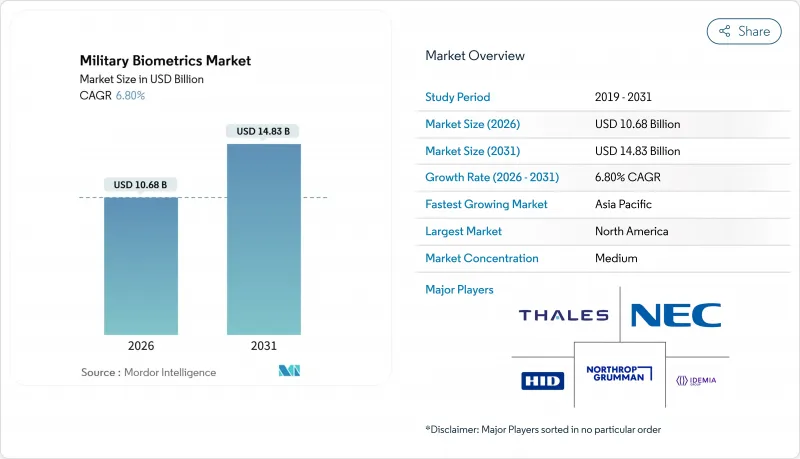
據 Mordor Intelligence 稱,預計到 2026 年,軍事生物識別市場規模將達到 106.8 億美元,到 2031 年將成長至 148.3 億美元,在預測期內複合年成長率將達到 6.80%。
本報告按識別方法(指紋、臉部、虹膜及其他)、解決方案(硬體、軟體)、平台(陸地系統、海軍系統、機載系統)、部署環境(固定、移動/戰術)和地區(北美、南美、歐洲及其他)進行分類。市場預測以美元計價。
全球軍事生物識別市場趨勢及洞察
非對稱戰爭的興起和邊防安全。
非國家行為體、敵對勢力和移民潮如今繞過了固定檢查站,迫使指揮官在巡邏、前哨站和偏遠沙漠地區進行身分核查。作為其「生物識別賦能能力」計畫的一部分,美國陸軍在伊拉克、阿富汗和敘利亞登記了730萬人的身份訊息,展現了野戰工具包的作戰價值。 2025年,印度邊防部隊在與孟加拉和緬甸的邊境部署了1,200台行動生物識別設備,在六個月內將非法跨境減少了34%。沙烏地阿拉伯將89個陸地邊境檢查站的虹膜掃描器與國際刑警組織的監控名單連結起來,在第一年就阻止了2,400起非法入境事件。這些先例解釋了為什麼移動和戰術系統在2025年佔據了近三分之二的收入。在持續不斷的分散衝突中,能夠在基礎基礎設施之外運作的強大手持終端機預計仍將在軍事生物識別市場中發揮關鍵作用。
政府數位身分和國防現代化計劃
各國國防部門正在將士兵和承包商的身份驗證資訊與全國電子識別(e-ID)框架進行同步。美國國防部於2025年簽署了一份價值9,200萬美元的契約,旨在將生物識別驗證整合到約210萬名人員的通用訪問卡(CAC)中。日本在2025財政年度累計1.2億美元,用於在340個設施部署多模態閘門,使安全檢查點的未授權存取事件減少了67%。歐盟的永久結構化合作(PESCO)舉措要求在2027年實現ISO/IEC 19794標準的合規性,從而加快了中間件的採購,以連接國家網路。這些項目正在將身份驗證的範圍從基地訪問擴展到供應鏈檢查站和海軍碼頭,從而拓展了軍事生物識別市場,使其涵蓋不同的資產類別和任務範圍。
生物識別資料庫引發的隱私和公民自由問題
民主國家的監管機構正在限制集中式資料儲存庫。歐洲資料保護委員會強制要求成員國軍隊使用的臉部辨識系統必須在設備本身完成匹配,這項規定使單位成本增加40%,並限制了雲端技術的採用。美國政府責任署 (GAO) 在2025年的審計中發現,國防安全保障部 (DHS) 的 HART 專案存在17個隱私漏洞,導致2.14億美元的支出延遲。在加拿大,如果未提起訴訟,生物識別資料必須在90天內刪除,這降低了現場註冊的調查效用。此類決定導致軍事生物識別市場出現碎片化,一部分司法管轄區追求建立大規模中央資料庫,而另一部分司法管轄區則強制要求嚴格的現場存儲,這使得供應商的產品藍圖變得更加複雜。
細分市場分析
指紋認證系統在2025年佔銷售額的44.67%,這得益於美國各旅部署的14,000台SEEK II手持終端機以及刑事司法領域的大量判例法。臉部辨識緊隨其後,受益於檢查站的被動資料收集,美國海關與邊防安全局(CBP)在2025會計年度處理了9,700萬次配對。虹膜辨識由於需要被辨識者的配合,目前仍屬於小眾技術,但2024年,美國海軍陸戰隊在兩棲艦艇上部署了800台具備虹膜辨識功能的平板電腦用於門禁控制。其他類別——語音、掌紋、步態和行為認證——正以8.89%的複合年成長率成長,因為特種部隊在存在化學和生物威脅的地區更傾向於非接觸式認證方式。美國國防高級研究計劃局(DARPA)在2024年的一項實地測試中,展示了150米外步態識別87%的準確率。掌紋辨識技術目前正在日本120個軍械庫進行測試部署,展現出極強的抗磨損能力,能夠有效克服指紋辨識技術因表面磨損而帶來的限制。語音生物識別則採用泰雷茲AN/PRC-163無線電台,透過安全加密的無線電頻道和經過認證的說話者進行即時辨識。多模態融合是其長期的最終目標。美國國防部即將發布的關於三模手持終端機的提案徵集,凸顯了混合型軍用生物識別市場預計在2031年之前持續成長的趨勢。
預計到2025年,硬體收入將佔總收入的61.13%,這反映了掃描器和加固型平板電腦的資本密集特性。然而,軟體授權收入的成長速度最快,複合年成長率(CAGR)達到9.91%,這主要得益於神經匹配技術的升級,該技術無需更換感測器即可將準確率提升至98%的指令閾值。 Aware公司透過在傳統閱讀器中加裝機器學習(ML)引擎,在2025年實現了軟體授權收入成長34%,誤拒率降低40%。 NeoFace公司擁有亞秒級搜尋能力,可對1000萬個模板進行搜索,從而為德國、西班牙和波蘭的邊境管制提供即時決策支援。加密和稽核模組也正在創造價值。 DERMALOG公司透過整合區塊鏈審計追蹤功能,為聯邦執法機關維護證據鏈,從而獲得了一份價值4900萬美元的合約。硬體供應商現在提供捆綁式訂閱服務,IDEMIA公司的MorphoWave Compact產品包含三年的雲端匹配選項,這反映了這種融合趨勢。由於軟體升級週期至關重要,因此在軍用生物識別市場中,預算的更大比例可能會分配給中間件、演算法和聯合資料庫管理。
區域分析
北美地區佔據領先地位,在2025年佔總銷售額的36.75%,這主要得益於美國海關與邊境保護局(CBP)價值3.86億美元的OBIM合約以及大規模國防現代化預算。加拿大投資1.8億美元,計畫在2029年前將生物識別整合到其人力資源管理系統中。墨西哥在2024年部署了800套設備用於南部邊防安全。
亞太地區正以8.32%的複合年成長率成長。印度計畫在2025年,在實際控制線(LAC)沿線的198個前線地點安裝生物識別閘門,該計畫耗資4.2億美元。中國公共安全將把邊境登記資料增加到12億條,並在312個邊境口岸實施臉部認證出入境管制系統。
日本已投資1.9億美元,用於安裝NEC多模態閘機並維修340個基地。韓國選擇HID Global公司,斥資9,500萬美元在280個設施安裝虹膜掃描器。在歐洲,德國投資1.3億美元將資料庫遷移到符合標準的基礎設施,同時兼顧GDPR隱私限制和北約標準。中東和非洲的成長重點在於邊防安全圍籬和兵役登記。沙烏地阿拉伯目前在89個邊境口岸營運生物識別查核點,使詐欺活動減少了67%。
其他好處
- Excel格式的市場預測(ME)表
- 3個月的分析師支持
目錄
第1章:引言
- 研究假設和市場定義
- 調查範圍
第2章:調查方法
第3章執行摘要
第4章 市場狀況
- 市場概覽
- 市場促進因素
- 非對稱戰爭的興起和邊防安全。
- 政府數位身分和國防現代化計劃
- 降低指紋和臉部認證感應器的成本
- 透過人工智慧/機器學習整合提高準確性和處理速度
- 引入配備生物識別功能的穿戴式設備,用於士兵識別。
- 北約致力於推動建立可互通的多模態生物識別庫。
- 市場限制因素
- 生物識別資料庫引發的隱私和公民自由問題
- 與傳統國防資訊系統整合成本高昂
- 嚴酷戰場環境下反欺騙技術的落後。
- 針對戰術生物識別感測器的網路物理攻擊
- 價值鏈分析
- 監理展望
- 技術展望
- 波特五力分析
第5章 市場規模與成長預測
- 透過識別方法
- 指紋認證
- 臉部辨識
- 虹膜辨識
- 其他識別方法
- 透過解決方案
- 硬體(掃描器、感測器、可攜式套件)
- 軟體(匹配引擎、資料庫、中間件、加密)
- 按平台
- 陸基系統
- 海軍系統
- 機載系統
- 按部署環境
- 固定安裝類型
- 移動/戰術
- 按地區
- 北美洲
- 美國
- 加拿大
- 墨西哥
- 南美洲
- 巴西
- 其他南美國家
- 歐洲
- 英國
- 德國
- 法國
- 俄羅斯
- 其他歐洲國家
- 亞太地區
- 中國
- 印度
- 日本
- 韓國
- 其他亞太國家
- 中東和非洲
- 中東
- 阿拉伯聯合大公國
- 沙烏地阿拉伯
- 其他中東國家
- 非洲
- 埃及
- 其他非洲地區
- 中東
- 北美洲
第6章 競爭情勢
- 市場集中度
- 策略趨勢
- 市佔率分析
- 公司簡介
- IDEMIA
- Thales Group
- HID Global(ASSA ABLOY group)
- NEC Corporation
- Aware, Inc.
- M2SYS
- Fulcrum Biometrics, Inc.
- Northrop Grumman Corporation
- Leidos, Inc.
- DERMALOG Identification Systems GmbH
- Parsons Corporation
- SIC Biometrics Inc.
第7章 市場機會與未來展望
According to Mordor Intelligence, the military biometrics market size is expected to reach USD 10.68 billion in 2026 and is projected to grow to USD 14.83 billion by 2031, registering a 6.80% CAGR over the forecast period.
This report is Segmented by Recognition Type (Fingerprint, Facial, Iris, and Others), Solution (Hardware and Software), Platform (Land-Based, Naval, and Airborne Systems), Deployment Environment (Fixed Installations and Mobile and Tactical), and Geography (North America, South America, Europe, and More). The Market Forecasts are Provided in Terms of Value (USD).
Global Military Biometrics Market Trends and Insights
Rising Asymmetric Warfare And Border Security Needs
Non-state adversaries and migration flows now bypass fixed checkpoints, forcing commanders to verify identities during patrols, at forward posts, and along remote deserts. The US Army enrolled 7.3 million individuals across Iraq, Afghanistan, and Syria under its Biometrics Enabling Capability, demonstrating the operational value of field kits. India's Border Security Force installed 1,200 mobile biometric devices along the Bangladesh and Myanmar frontiers in 2025 and cut illegal crossings by 34% within six months. Saudi Arabia integrated iris scanners with Interpol watchlists at 89 land crossings, intercepting 2,400 fraudulent entries in the first year. These precedents explain why mobile and tactical systems captured nearly two-thirds of 2025 revenue. As distributed conflict persists, the military biometrics market will continue to privilege rugged handheld devices that work beyond garrison infrastructure.
Government Digital Identity And Defense Modernization Programs
Defense ministries are synchronizing soldier and contractor credentials with nationwide electronic identification (e-ID) frameworks. The DoD awarded a USD 92 million contract in 2025 to integrate biometric verification into the Common Access Card, covering approximately 2.1 million personnel. Japan earmarked USD 120 million in fiscal 2025 to retrofit 340 facilities with multimodal gates, resulting in a 67% reduction in unauthorized-access incidents at test sites. The EU's PESCO initiative mandates ISO/IEC 19794 compliance by 2027, accelerating middleware procurements that bridge national networks. Such programs extend verification from base entry to supply-chain checkpoints and naval docks, thereby broadening the addressable military biometrics market across asset classes and mission sets.
Privacy and Civil-Liberty Concerns Over Biometric Databases
Regulators in democratic jurisdictions are curtailing centralized repositories. The European Data Protection Board requires that facial recognition systems used by member militaries complete matching on-device, a rule that increases per-unit costs by 40% and limits cloud deployments. GAO's 2025 audit identified 17 privacy gaps in DHS's HART project, resulting in a delay of USD 214 million in spending. Canada now requires the deletion of biometric data within 90 days if no charges are filed, reducing the investigatory utility of field enrollments. Such rulings fragment the military biometrics market between jurisdictions that pursue expansive central databases and those that enforce strict local retention, complicating vendor product roadmaps.
Other drivers and restraints analyzed in the detailed report include:
- Cost Decline of Fingerprint and Facial Sensors
- Integration of AI/ML Boosting Accuracy and Speed
- High Integration Cost With Legacy Defense IT
For complete list of drivers and restraints, kindly check the Table Of Contents.
Segment Analysis
Fingerprint systems accounted for 44.67% of 2025 revenue, underpinned by 14,000 SEEK II handhelds deployed across US brigades and extensive criminal-justice precedent. Facial recognition follows, benefiting from passive capture at checkpoints where the US CBP processed 97 million comparisons in fiscal 2025. Iris recognition remains a niche technology because it requires cooperative subjects; yet, the US Marine Corps installed 800 iris-enabled tablets on amphibious ships for shipboard access in 2024. The other categories, voice, palm vein, gait, and behavioral, grow at an 8.89% CAGR, as special forces favor contactless options in chemical or biological threat zones. DARPA proved gait identification accuracy of 87% at 150 meters in 2024 field trials. Palm-vein access is now tested at 120 Japanese armories, showing resilience against surface abrasion limits that plague fingerprints. Voice biometrics defended encrypted radio channels on Thales AN/PRC-163 sets, authenticating speakers in real time. Multimodal fusion is the long-term end-state. The DoD's forthcoming tri-modal handheld solicitation highlights a channel where the military biometrics market size for hybrid devices is expected to expand through 2031.
Hardware contributed 61.13% of 2025 sales, reflecting the capital intensity of scanners and ruggedized tablets. Yet software licenses post the steepest slope at 9.91% CAGR because neural matching upgrades can raise accuracy to the 98% directive threshold without sensor swaps. Aware recorded 34% software license growth in 2025 by retrofitting legacy readers with ML engines, which reduced false rejects by 40%. NeoFace's sub-second searches across 10 million templates facilitate real-time border decisions in Germany, Spain, and Poland. Encryption and audit modules enhance value; DERMALOG won a USD 49 million contract by embedding blockchain audit trails to preserve evidentiary chains for federal law enforcement agencies. Hardware vendors now offer bundled subscriptions; IDEMIA's MorphoWave Compact includes a three-year cloud matching option, reflecting the convergence. As software upgrade cycles are key, the military biometrics market will allocate a larger portion of its budget toward middleware, algorithms, and federated database management.
Complete Report Scope:
- By Recognition Type
- Fingerprint Recognition
- Facial Recognition
- Iris Recognition
- Others
- By Solution
- Hardware (Scanners, Sensors, Portable Kits)
- Software (Matching Engines, Database, Middleware, Encryption)
- By Platform
- Land-Based Systems
- Naval Systems
- Airborne Systems
- By Deployment Environment
- Fixed Installations
- Mobile and Tactical
- By Geography
- North America
- United States
- Canada
- Mexico
- South America
- Brazil
- Rest of South America
- Europe
- United Kingdom
- Germany
- France
- Russia
- Rest of Europe
- Asia-Pacific
- China
- India
- Japan
- South Korea
- Rest of Asia-Pacific
- Middle East and Africa
- Middle East
- United Arab Emirates
- Saudi Arabia
- Rest of Middle East
- Africa
- Egypt
- Rest of Africa
- Middle East
- North America
Geography Analysis
North America led with 36.75% of 2025 revenue, driven by the USD 386 million CBP OBIM contract and large defense modernization budgets. Canada committed USD 180 million to integrate biometrics into its personnel management system through 2029. Mexico deployed 800 kits in 2024 for southern border patrols.
The Asia-Pacific region is growing at an 8.32% CAGR. India installed biometric gates at 198 forward posts along the Line of Actual Control in 2025, financed within a USD 420 million program. China's Ministry of Public Security grew its border records to 1.2 billion and rolled out facial exit-entry systems at 312 crossings.
Japan funded USD 190 million for 340 base retrofits with NEC multimodal gates. South Korea selected HID Global for USD 95 million of iris scanners across 280 facilities. Europe balances GDPR privacy limits with NATO standards, investing USD 130 million to migrate Germany's database onto a compliant backbone. The Middle East and Africa growth centers on border security fences and national service enrollment. Saudi Arabia now operates biometric checkpoints at 89 crossings, resulting in a 67% reduction in fraud.
- IDEMIA
- Thales Group
- HID Global (ASSA ABLOY group)
- NEC Corporation
- Aware, Inc.
- M2SYS
- Fulcrum Biometrics, Inc.
- Northrop Grumman Corporation
- Leidos, Inc.
- DERMALOG Identification Systems GmbH
- Parsons Corporation
- S.I.C. Biometrics Inc.
Additional Benefits:
- The market estimate (ME) sheet in Excel format
- 3 months of analyst support
TABLE OF CONTENTS
1 INTRODUCTION
- 1.1 Study Assumptions and Market Definition
- 1.2 Scope of the Study
2 RESEARCH METHODOLOGY
3 EXECUTIVE SUMMARY
4 MARKET LANDSCAPE
- 4.1 Market Overview
- 4.2 Market Drivers
- 4.2.1 Rising asymmetric warfare and border security needs
- 4.2.2 Government digital identity and defense modernization programs
- 4.2.3 Cost decline of fingerprint and facial sensors
- 4.2.4 Integration of AI/ML boosting accuracy and speed
- 4.2.5 Deployment of biometric-enabled wearables for soldier authentication
- 4.2.6 NATO push for interoperable multimodal biometric repositories
- 4.3 Market Restraints
- 4.3.1 Privacy and civil-liberty concerns over biometric databases
- 4.3.2 High integration cost with legacy defense IT
- 4.3.3 Spoof-resistant tech lag in austere battlefield environments
- 4.3.4 Cyber-physical attacks targeting tactical biometric sensors
- 4.4 Value Chain Analysis
- 4.5 Regulatory Outlook
- 4.6 Technological Outlook
- 4.7 Porter's Five Forces Analysis
- 4.7.1 Bargaining Power of Suppliers
- 4.7.2 Bargaining Power of Buyers/Consumers
- 4.7.3 Threat of New Entrants
- 4.7.4 Threat of Substitute Products
- 4.7.5 Intensity of Competitive Rivalry
5 MARKET SIZE AND GROWTH FORECASTS (VALUE)
- 5.1 By Recognition Type
- 5.1.1 Fingerprint Recognition
- 5.1.2 Facial Recognition
- 5.1.3 Iris Recognition
- 5.1.4 Others
- 5.2 By Solution
- 5.2.1 Hardware (Scanners, Sensors, Portable Kits)
- 5.2.2 Software (Matching Engines, Database, Middleware, Encryption)
- 5.3 By Platform
- 5.3.1 Land-Based Systems
- 5.3.2 Naval Systems
- 5.3.3 Airborne Systems
- 5.4 By Deployment Environment
- 5.4.1 Fixed Installations
- 5.4.2 Mobile and Tactical
- 5.5 By Geography
- 5.5.1 North America
- 5.5.1.1 United States
- 5.5.1.2 Canada
- 5.5.1.3 Mexico
- 5.5.2 South America
- 5.5.2.1 Brazil
- 5.5.2.2 Rest of South America
- 5.5.3 Europe
- 5.5.3.1 United Kingdom
- 5.5.3.2 Germany
- 5.5.3.3 France
- 5.5.3.4 Russia
- 5.5.3.5 Rest of Europe
- 5.5.4 Asia-Pacific
- 5.5.4.1 China
- 5.5.4.2 India
- 5.5.4.3 Japan
- 5.5.4.4 South Korea
- 5.5.4.5 Rest of Asia-Pacific
- 5.5.5 Middle East and Africa
- 5.5.5.1 Middle East
- 5.5.5.1.1 United Arab Emirates
- 5.5.5.1.2 Saudi Arabia
- 5.5.5.1.3 Rest of Middle East
- 5.5.5.2 Africa
- 5.5.5.2.1 Egypt
- 5.5.5.2.2 Rest of Africa
- 5.5.5.1 Middle East
- 5.5.1 North America
6 COMPETITIVE LANDSCAPE
- 6.1 Market Concentration
- 6.2 Strategic Moves
- 6.3 Market Share Analysis
- 6.4 Company Profiles {(includes Global level Overview, Market level overview, Core Segments, Financials as available, Strategic Information, Market Rank/Share for key companies, Products and Services, and Recent Developments)}
- 6.4.1 IDEMIA
- 6.4.2 Thales Group
- 6.4.3 HID Global (ASSA ABLOY group)
- 6.4.4 NEC Corporation
- 6.4.5 Aware, Inc.
- 6.4.6 M2SYS
- 6.4.7 Fulcrum Biometrics, Inc.
- 6.4.8 Northrop Grumman Corporation
- 6.4.9 Leidos, Inc.
- 6.4.10 DERMALOG Identification Systems GmbH
- 6.4.11 Parsons Corporation
- 6.4.12 S.I.C. Biometrics Inc.
7 MARKET OPPORTUNITIES AND FUTURE OUTLOOK
- 7.1 White-space and Unmet-need Assessment

 全球步態辨識市場(2026-2030 年)
 生物識別卡:市場佔有率分析、產業趨勢與統計、成長預測(2026-2031)
 全球生物識別卡市場規模、佔有率、趨勢和成長分析報告(2026-2034年)生物識別:市場佔有率分析、產業趨勢與統計、成長預測(2026-2031)
 2026年全球軍事生物辨識市場報告下一代生物識別:市場佔有率分析、產業趨勢與統計及成長預測(2026-2031)
 生物識別系統市場-2026-2032年全球市場預測生物識別和身分管理市場:2026-2032年全球市場預測(按技術類型、組件、認證方法、應用、最終用戶和部署模式分類)消費性電子生物識別市場:2026-2032年全球市場預測(依產品、模式、技術、設備類型、接觸方式、外形規格、應用及銷售管道)生物識別市場:按組件、技術類型、交付方式、認證方式、行動性和最終用戶產業分類-2026-2032年全球市場預測