


 |
市場調查報告書
商品編碼
2120638
下一代生物識別:市場佔有率分析、產業趨勢與統計及成長預測(2026-2031)Next Generation Biometric - Market Share Analysis, Industry Trends & Statistics, Growth Forecasts (2026 - 2031) |
||||||

※ 本網頁內容可能與最新版本有所差異。詳細情況請與我們聯繫。
根據 Mordor Intelligence 預測,下一代生物識別市場規模預計在 2025 年達到 406.1 億美元,2026 年達到 523.3 億美元,到 2031 年達到 1370.4 億美元,2026 年至 2031 年的複合年成長率為 21.23%。
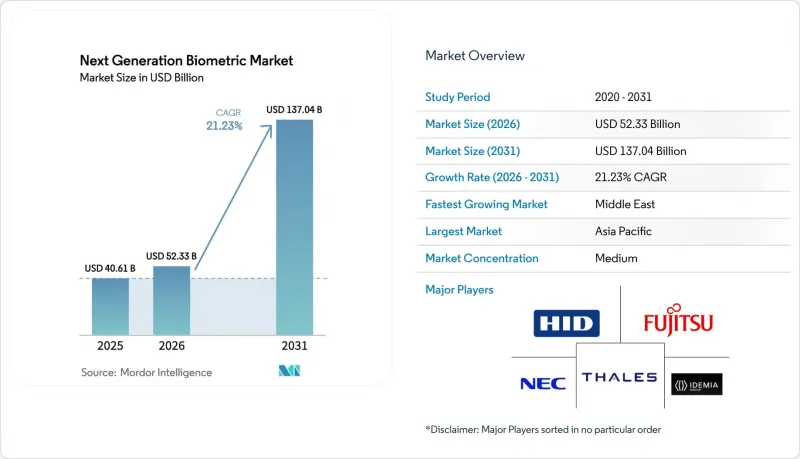
本報告生物識別方法(臉部認證、虹膜辨識等)、組件(硬體、軟體、服務)、功能(門禁管制、法醫學等)、終端使用者產業(政府、醫療保健、家用電子電器與家庭安防、零售與電子商務、教育等)以及地區進行細分。市場預測以美元計價。
全球下一代生物識別市場趨勢及洞察
政府主導推行國民身分證
各國正在推動公共基礎設施轉型,將可選的數位身分識別強制化,從而降低供應商受IT支出週期性波動的影響。在印度,到2025年,「Aadhaar」臉部認證認證將擴展到私人企業,使用戶無需紙本文件即可註冊金融科技服務。歐盟的目標是到2026年確保所有公民都能使用可互通的生物識別錢包,並將資料外洩事件的責任轉移給經各國政府認證的錢包提供者。奈及利亞和肯亞也在多邊資金的支持下,採取類似舉措,從而創造了對指紋和虹膜感測器的穩定需求。這種大規模採購正在縮短供應商的投資回收期,並重振整個下一代生物識別市場。
將生物識別整合到智慧型手機中
行動裝置正在樹立新的效能標準,同時也影響企業的預期。三星Galaxy S25中的超音波感測器誤識率低於1%,符合EMVCo支付標準。高通的大型3D Sonic Max感測器支援雙指認證,並瞄準高價值交易。蘋果的Face ID透過在其安全隔離區內進行所有處理,符合GDPR的資料最小化規則。隨著消費者每年解鎖智慧型手機數千次,銀行和醫療保健等產業需要跟上這種無縫體驗的步伐,加速下一代生物識別市場的整體普及。
對隱私和公民自由的擔憂
GDPR對「特殊類別」的處理要求獲得明確同意並採取嚴格的安全措施,違規行為(如Clearview AI案例所示)可能導致數百萬歐元的罰款。歐盟人工智慧法目前禁止在公共場所進行大多數即時臉部掃描,加州居民可以選擇不使用非必要的生物識別。民權組織持續指出,這些技術對少數族群的影響尤其嚴重,導致一些城市推出了禁令。因此,供應商需要為每個國家/地區維護不同的軟體版本,這增加了合規成本,並減緩了下一代生物識別市場的發展。
細分市場分析
指紋認證系統憑藉其悠久的歷史和穩固的基礎以及低廉的感測器成本,預計到2025年將佔據下一代生物識別認證市場39.26%的佔有率。然而,靜脈認證憑藉其非接觸式採集和近乎零欺騙風險,預計將以22.83%的複合年成長率成長,逐步挑戰指紋認證的現有市場佔有率。富士通的「PalmSecure」在日本銀行業的應用以及日立在醫院的部署,都清楚地展現了這項技術在現實世界中的發展勢頭。雖然臉部認證在旅遊和智慧型手機領域仍然廣泛應用,但虹膜辨識主要集中在國防和難民管理領域,其低誤配率使其高昂的成本也物有所值。掌紋、步態、語音和行為分析系統各自滿足不同的細分需求,而融合各種技術優勢並彌補其不足的多模態平台正在湧現。隨著各公司考慮升級其系統,下一代生物識別在多模態解決方案中的市場規模預計將會擴大,這反映出人們對多層安全性的信心日益增強。
三星專利的第二代超音波掌紋感測器預示著未來的融合趨勢,只需一個手勢即可同時滿足衛生和準確性要求。語音辨識的普及受到深度造假風險的限制,除非與生物辨識功能結合。同時,像BioCatch這樣的公司提供的行為生物辨識技術可在使用者會話期間提供持續身份驗證,從而減少金融應用中的詐欺行為。這些技術的進步正在促使資金從傳統的單模讀取器轉向軟體定義編配層,這種演變正在將下一代生物識別市場的關注點從硬體利潤率轉向業務收益。
2025年,硬體收入仍佔總收入的63.78%,但由於價格低於50美元的指紋模組帶來的價格壓力,利潤率正在下降。供應商目前正將演算法更新、合規性報告和增強的生物辨識功能整合到雲端訂閱服務中,這些服務正以每年21.77%的速度成長。 IDEMIA基於交易的收費驗證API正在吸引那些先前猶豫不決、不願進行大額資本投資的客戶,促使他們進行延遲支出。同時,下一代生物識別的硬體市場也受益於電子門禁和國民身分證自助服務終端感測器的定期更新,從而確保了收入的穩定成長,但利潤率仍然較低。
系統整合商透過將門禁控制、支付和電子護照認證整合到統一的控制面板中,創造了附加價值。隨著客戶選擇採用單一標準方案而非單獨管理不相容的讀卡器,軟體授權收入也隨之成長。高通的高階 3D Sonic Max 感測器憑藉其硬體差異化策略脫穎而出,該策略專注於更廣的採集範圍和設備內處理。然而,大多數供應商都認為,在下一代生物識別市場中,服務帶來的經常性收入才是提升顧客終身價值的最明確途徑。
區域分析
預計到2025年,亞太地區將佔全球銷售額的36.84%,主要得益於中國無所不在的監視錄影機和印度的Aadhaar平台。印度決定在2025年將臉部認證推廣到私部門,這將為金融科技和遠端醫療開闢新的管道,加速本地需求的成長。在中國,與社會信用檔案掛鉤的多模態檢查站正穩步推進;在日本,NEC的生物識別電子閘門正各大機場投入使用。在韓國,超過30萬韓元的行動交易必須進行生物識別驗證,這推動了智慧型手機讀卡機的普及。在澳大利亞,幾乎所有入境旅客都透過「智慧閘門」(SmartGate)進行通關,展現了大規模自動化邊境管制的典範。這些趨勢共同鞏固了亞太地區作為下一代生物識別市場最大貢獻者的地位。
中東地區正處於快速成長階段,預計到2031年複合年成長率將達到22.19%。阿拉伯聯合大公國通行證目前支援超過5000項公共和私人數位服務,沙烏地阿拉伯的目標是到2030年實現70%的數位身分普及率。卡達由於處理能力的提升,即使在世界盃之後仍繼續使用其基於虹膜辨識的機場系統,而以色列已為超過400萬公民發放了生物識別護照。這些國家主導的舉措為全球和區域供應商提供了穩定的訂單來源,從而推動了先前被主要系統整合商忽視的地區下一代生物識別市場的發展。
儘管北美和歐洲的監管日益嚴格,但它們也受益於政策的清晰度。歐盟的「數位身分錢包」計畫將於2026年強制實施跨國身分驗證,儘管隱私問題仍有爭議,但預計預算將得到保障。德國聯邦資訊安全辦公室現已發布旨在減少採購不確定性的技術指南。在美國,海關和邊防安全將臉部認證出境閘口擴展至32個機場,每年掃描超過1億名旅客。雖然南美和非洲國家仍處於實施初期,但奈及利亞和肯亞的生物識別身分計畫以及巴西和阿根廷的試點計畫表明,下一代生物識別市場最終將在新興經濟體中擴展。
其他好處:
- Excel格式的市場預測(ME)表
- 3個月的分析師支持
目錄
第1章:引言
- 研究假設和市場定義
- 調查範圍
第2章:調查方法
第3章執行摘要
第4章 市場狀況
- 市場概覽
- 市場促進因素
- 電子護照計畫的擴展
- 將生物識別技術整合到智慧型手機中
- 政府主導推行國民身分證制度
- 非接觸式3D靜脈成像技術的進步
- 去中心化區塊鏈數位身分的興起
- 用於遠端勞動力管理的多模態生物識別
- 市場限制因素
- 對隱私和公民自由的擔憂
- 系統實施初期成本高
- 演算法偏差導致監管加強。
- 近紅外線感測器供不應求
- 產業價值鏈分析
- 監理情勢
- 技術展望
- 宏觀經濟因素對市場的影響
- 波特五力分析
第5章 市場規模與成長預測
- 通過生物識別方法
- 臉部辨識
- 指紋認證
- 虹膜辨識
- 掌紋認證
- 語音辨識
- 靜脈認證
- 步行和行為生物特徵
- 多模態生物識別
- 按組件
- 硬體
- 軟體
- 服務
- 按功能
- 存取控制
- 身分識別與檢驗
- 支付和交易
- 監測
- 考勤管理
- 法醫學
- 其他功能
- 按最終用戶行業分類
- 政府
- 國防/公共安全
- 旅遊與移民
- 銀行和金融服務
- 衛生保健
- 家用電子電器與家庭安防
- 零售與電子商務
- 教育
- 其他終端用戶產業
- 按地區
- 北美洲
- 美國
- 加拿大
- 墨西哥
- 歐洲
- 德國
- 英國
- 法國
- 俄羅斯
- 其他歐洲國家
- 亞太地區
- 中國
- 日本
- 印度
- 韓國
- 澳洲
- 其他亞太國家
- 中東和非洲
- 中東
- 沙烏地阿拉伯
- 阿拉伯聯合大公國
- 其他中東國家
- 非洲
- 南非
- 埃及
- 其他非洲國家
- 中東
- 南美洲
- 巴西
- 阿根廷
- 其他南美國家
- 北美洲
第6章 競爭情勢
- 市場集中度
- 策略趨勢
- 市佔率分析
- 公司簡介
- IDEMIA Identity & Security France SAS
- NEC Corporation
- Thales SA
- Fujitsu Limited
- HID Global Corporation
- Fingerprint Cards AB
- Synaptics Incorporated
- Suprema Inc.
- Apple Inc.
- Samsung Electronics Co., Ltd.
- Qualcomm Incorporated
- Gemalto NV
- BioCatch Ltd.
- Aware, Inc.
- Cognitec Systems GmbH
- DERMALOG Identification Systems GmbH
- Vision-Box, SA
- Precise Biometrics AB
- IDEX Biometrics ASA
- Innovatrics, sro
第7章 市場機會與未來展望
According to Mordor Intelligence, the next generation biometric market size is projected to be USD 40.61 billion in 2025, USD 52.33 billion in 2026, and reach USD 137.04 billion by 2031, growing at a CAGR of 21.23% from 2026 to 2031.
This report is Segmented by Biometric Modality (Face Recognition, Iris Recognition, and More), Component (Hardware, Software, Services), Function (Access Control, Forensics, and More), End-User Industry (Government, Healthcare, Consumer Electronics and Home Security, Retail and E-Commerce, Education, and More), and Geography. The Market Forecasts are Provided in Terms of Value (USD).
Global Next Generation Biometric Market Trends and Insights
Government-Mandated National ID Rollouts
National programs are transforming optional digital IDs into mandatory public infrastructure that buffers vendors from cyclical IT spending. India expanded face-based Aadhaar authentication to private entities in 2025, enabling fintech onboarding without the need for paper documents. The European Union aims to have interoperable biometric wallets for all citizens by 2026, shifting liability for breaches from states to certified wallet providers. Nigeria and Kenya are following similar paths, backed by multilateral funding, which creates guaranteed demand for fingerprint and iris sensors. These high-volume procurements shorten vendor payback periods and lift the overall next generation biometric market.
Integration of Biometrics in Smartphones
Mobile devices are setting new performance baselines that ripple into enterprise expectations. Samsung's Galaxy S25 ultrasonic sensor achieves a false reject rate of less than 1% and meets EMVCo payment standards. Qualcomm's larger 3D Sonic Max allows two-finger verification, targeting high-value transactions. Apple's Face ID keeps all processing within its Secure Enclave, aligning with GDPR data-minimization rules. As consumers unlock phones thousands of times a year, sectors such as banking and healthcare must match that frictionless experience, accelerating adoption across the next generation biometric market.
Privacy and Civil-Liberty Concerns
Special-category status under the GDPR requires explicit consent and strict security measures, leading to multimillion-euro fines for non-compliance, as seen in the Clearview AI case. The EU AI Act now bans most real-time public face scans, and California residents can opt out of non-essential biometric use. Civil-rights groups continue to highlight disproportionate impact on minorities, prompting city-level bans. Vendors must therefore maintain country-specific software builds, which raises compliance costs and slows rollouts in the next generation biometric market.
Other drivers and restraints analyzed in the detailed report include:
- Advancements in Contactless 3D Vein Imaging
- Expansion of E-Passport Programs
- Algorithmic Bias Driving Stricter Regulation
For complete list of drivers and restraints, kindly check the Table Of Contents.
Segment Analysis
Fingerprint systems accounted for 39.26% of the next generation biometric market share in 2025, benefiting from long-established bases and low sensor prices. However, vein recognition is charting a 22.83% CAGR thanks to contactless capture and near-zero spoofing risk, positioning it to chip away at the entrenched modality. Fujitsu's PalmSecure rollouts in Japanese banking and Hitachi's hospital deployments illustrate real-world momentum. Face recognition remains ubiquitous in travel and smartphones, while iris recognition stays focused on defense and refugee management, where its low false-match rate justifies the higher costs. Palm-print, gait, voice, and behavioral systems each fill niche needs, and multimodal platforms are emerging to blend strengths and mask weaknesses. As enterprises evaluate upgrades, the next generation biometric market size for multimodal solutions is expected to widen, reflecting growing confidence in layered security.
Second-generation ultrasonic palm-print sensors, patented by Samsung, hint at a future convergence, allowing a single gesture to satisfy both hygiene and accuracy requirements. Voice recognition adoption is throttled by deepfake risks unless paired with liveness checks. Meanwhile, behavioral biometrics from firms such as BioCatch supply continuous authentication during a user session, reducing fraud in financial applications. Collectively, these advances are reallocating capital from legacy single-mode readers toward software-defined orchestration layers, an evolution that favors service revenue over hardware margins inside the next generation biometric market.
Hardware still accounted for 63.78% of revenue in 2025; however, pricing pressure from sub-USD 50 fingerprint modules has diluted margins. Vendors now package algorithm updates, compliance reporting, and liveness-detection enhancements into cloud subscriptions that grow at a rate of 21.77% annually. IDEMIA's pay-per-transaction API for identity verification captures deferred spend from customers who once balked at large capital layouts. At the same time, the next generation biometric market size for hardware is sustained by mandatory sensor refreshes in e-gates and national ID kiosks, ensuring a stable but lower-margin revenue floor.
System integrators are extracting value by stitching together access control, payments, and e-passport verification into unified dashboards. Software license income increases when clients opt to standardize on a single stack rather than managing disparate readers. Qualcomm's premium 3D Sonic Max sensors underline a hardware differentiation strategy focused on larger capture zones and on-device processing. Yet, most vendors view service annuities as the clearest path to expanding lifetime value within the next generation biometric market.
Complete Report Scope:
- By Biometric Modality
- Face Recognition
- Fingerprint Recognition
- Iris Recognition
- Palm-print Recognition
- Voice Recognition
- Vein Recognition
- Gait and Behavioral Biometrics
- Multimodal Biometrics
- By Component
- Hardware
- Software
- Services
- By Function
- Access Control
- Identification and Verification
- Payments and Transactions
- Surveillance and Monitoring
- Time and Attendance
- Forensics
- Other Functions
- By End-user Industry
- Government
- Defense and Public Safety
- Travel and Immigration
- Banking and Financial Services
- Healthcare
- Consumer Electronics and Home Security
- Retail and E-commerce
- Education
- Other End-user Industries
- By Geography
- North America
- United States
- Canada
- Mexico
- Europe
- Germany
- United Kingdom
- France
- Russia
- Rest of Europe
- Asia-Pacific
- China
- Japan
- India
- South Korea
- Australia
- Rest of Asia-Pacific
- Middle East and Africa
- Middle East
- Saudi Arabia
- United Arab Emirates
- Rest of Middle East
- Africa
- South Africa
- Egypt
- Rest of Africa
- Middle East
- South America
- Brazil
- Argentina
- Rest of South America
- North America
Geography Analysis
Asia-Pacific contributed 36.84% of 2025 revenue, anchored by China's ubiquitous surveillance cameras and India's Aadhaar platform. India's 2025 decision to extend face authentication to the private sector opened fintech and telemedicine channels that accelerate local demand. China continues installing multimodal checkpoints linked to social-credit profiles, while Japan relies on NEC's biometric e-gates across major airports. South Korea mandates biometric confirmation for mobile transactions exceeding KRW 300,000, thereby bolstering smartphone reader adoption. Australia processes almost all arrivals through SmartGate, showcasing automated border control at scale. Together, these developments maintain Asia-Pacific as the largest contributor to the next generation biometric market.
The Middle East is on a faster trajectory, with a 22.19% CAGR predicted through 2031. The UAE Pass now underpins more than 5,000 public and private digital services, and Saudi Arabia aims for 70% digital ID coverage by 2030. Qatar retained its iris-based airport system after the World Cup due to throughput gains, and Israel has issued biometric passports to more than 4 million citizens. These state-backed schemes provide firm order books for global and regional vendors, thereby expanding the next generation biometric market size in a geography that large integrators have historically overlooked.
North America and Europe face tighter regulation yet benefit from policy clarity. The EU Digital Identity Wallet will make cross-border credentialing mandatory by 2026, ensuring budget allocation even amid ongoing privacy debates. Germany's Federal Office for Information Security now publishes technical guidelines aimed at reducing procurement uncertainty. In the United States, Customs and Border Protection has expanded facial-matching exit gates to 32 airports, scanning more than 100 million passengers annually. South American and African nations are still in the early stages of their journeys, but Nigeria's and Kenya's biometric ID programs, as well as Brazil's and Argentina's pilots, suggest that the next generation biometric market will eventually expand across emerging economies.
- IDEMIA Identity & Security France SAS
- NEC Corporation
- Thales SA
- Fujitsu Limited
- HID Global Corporation
- Fingerprint Cards AB
- Synaptics Incorporated
- Suprema Inc.
- Apple Inc.
- Samsung Electronics Co., Ltd.
- Qualcomm Incorporated
- Gemalto N.V.
- BioCatch Ltd.
- Aware, Inc.
- Cognitec Systems GmbH
- DERMALOG Identification Systems GmbH
- Vision-Box, S.A.
- Precise Biometrics AB
- IDEX Biometrics ASA
- Innovatrics, s.r.o.
Additional Benefits:
- The market estimate (ME) sheet in Excel format
- 3 months of analyst support
TABLE OF CONTENTS
1 INTRODUCTION
- 1.1 Study Assumptions and Market Definition
- 1.2 Scope of the Study
2 RESEARCH METHODOLOGY
3 EXECUTIVE SUMMARY
4 MARKET LANDSCAPE
- 4.1 Market Overview
- 4.2 Market Drivers
- 4.2.1 Expansion Of E-Passport Programs
- 4.2.2 Integration Of Biometrics In Smartphones
- 4.2.3 Government-Mandated National ID Rollouts
- 4.2.4 Advancements In Contactless 3D Vein Imaging
- 4.2.5 Rise Of Decentralized Blockchain-Based Digital Identity
- 4.2.6 Multimodal Biometrics For Remote Workforce Management
- 4.3 Market Restraints
- 4.3.1 Privacy And Civil-Liberty Concerns
- 4.3.2 High Upfront System Costs
- 4.3.3 Algorithmic Bias Driving Stricter Regulation
- 4.3.4 Supply-Chain Shortages Of Near-IR Sensors
- 4.4 Industry Value Chain Analysis
- 4.5 Regulatory Landscape
- 4.6 Technological Outlook
- 4.7 Impact of Macroeconomic Factors on the Market
- 4.8 Porter's Five Forces Analysis
- 4.8.1 Bargaining Power of Suppliers
- 4.8.2 Bargaining Power of Buyers
- 4.8.3 Threat of New Entrants
- 4.8.4 Threat of Substitute Products
- 4.8.5 Intensity of Competitive Rivalry
5 MARKET SIZE AND GROWTH FORECASTS (VALUE)
- 5.1 By Biometric Modality
- 5.1.1 Face Recognition
- 5.1.2 Fingerprint Recognition
- 5.1.3 Iris Recognition
- 5.1.4 Palm-print Recognition
- 5.1.5 Voice Recognition
- 5.1.6 Vein Recognition
- 5.1.7 Gait and Behavioral Biometrics
- 5.1.8 Multimodal Biometrics
- 5.2 By Component
- 5.2.1 Hardware
- 5.2.2 Software
- 5.2.3 Services
- 5.3 By Function
- 5.3.1 Access Control
- 5.3.2 Identification and Verification
- 5.3.3 Payments and Transactions
- 5.3.4 Surveillance and Monitoring
- 5.3.5 Time and Attendance
- 5.3.6 Forensics
- 5.3.7 Other Functions
- 5.4 By End-user Industry
- 5.4.1 Government
- 5.4.2 Defense and Public Safety
- 5.4.3 Travel and Immigration
- 5.4.4 Banking and Financial Services
- 5.4.5 Healthcare
- 5.4.6 Consumer Electronics and Home Security
- 5.4.7 Retail and E-commerce
- 5.4.8 Education
- 5.4.9 Other End-user Industries
- 5.5 By Geography
- 5.5.1 North America
- 5.5.1.1 United States
- 5.5.1.2 Canada
- 5.5.1.3 Mexico
- 5.5.2 Europe
- 5.5.2.1 Germany
- 5.5.2.2 United Kingdom
- 5.5.2.3 France
- 5.5.2.4 Russia
- 5.5.2.5 Rest of Europe
- 5.5.3 Asia-Pacific
- 5.5.3.1 China
- 5.5.3.2 Japan
- 5.5.3.3 India
- 5.5.3.4 South Korea
- 5.5.3.5 Australia
- 5.5.3.6 Rest of Asia-Pacific
- 5.5.4 Middle East and Africa
- 5.5.4.1 Middle East
- 5.5.4.1.1 Saudi Arabia
- 5.5.4.1.2 United Arab Emirates
- 5.5.4.1.3 Rest of Middle East
- 5.5.4.2 Africa
- 5.5.4.2.1 South Africa
- 5.5.4.2.2 Egypt
- 5.5.4.2.3 Rest of Africa
- 5.5.4.1 Middle East
- 5.5.5 South America
- 5.5.5.1 Brazil
- 5.5.5.2 Argentina
- 5.5.5.3 Rest of South America
- 5.5.1 North America
6 COMPETITIVE LANDSCAPE
- 6.1 Market Concentration
- 6.2 Strategic Moves
- 6.3 Market Share Analysis
- 6.4 Company Profiles (includes Global Level Overview, Market Level Overview, Core Segments, Financials as Available, Strategic Information, Market Rank/Share for Key Companies, Products and Services, and Recent Developments)
- 6.4.1 IDEMIA Identity & Security France SAS
- 6.4.2 NEC Corporation
- 6.4.3 Thales SA
- 6.4.4 Fujitsu Limited
- 6.4.5 HID Global Corporation
- 6.4.6 Fingerprint Cards AB
- 6.4.7 Synaptics Incorporated
- 6.4.8 Suprema Inc.
- 6.4.9 Apple Inc.
- 6.4.10 Samsung Electronics Co., Ltd.
- 6.4.11 Qualcomm Incorporated
- 6.4.12 Gemalto N.V.
- 6.4.13 BioCatch Ltd.
- 6.4.14 Aware, Inc.
- 6.4.15 Cognitec Systems GmbH
- 6.4.16 DERMALOG Identification Systems GmbH
- 6.4.17 Vision-Box, S.A.
- 6.4.18 Precise Biometrics AB
- 6.4.19 IDEX Biometrics ASA
- 6.4.20 Innovatrics, s.r.o.
7 MARKET OPPORTUNITIES AND FUTURE OUTLOOK
- 7.1 White-space and Unmet-need Assessment

 全球步態辨識市場(2026-2030 年)
 生物識別卡:市場佔有率分析、產業趨勢與統計、成長預測(2026-2031)
 全球生物識別卡市場規模、佔有率、趨勢和成長分析報告(2026-2034年)生物識別:市場佔有率分析、產業趨勢與統計、成長預測(2026-2031)軍事生物識別:市場佔有率分析、產業趨勢與統計及成長預測(2026-2031 年)
 2026年全球軍事生物辨識市場報告
 生物識別系統市場-2026-2032年全球市場預測生物識別和身分管理市場:2026-2032年全球市場預測(按技術類型、組件、認證方法、應用、最終用戶和部署模式分類)消費性電子生物識別市場:2026-2032年全球市場預測(依產品、模式、技術、設備類型、接觸方式、外形規格、應用及銷售管道)生物識別市場:按組件、技術類型、交付方式、認證方式、行動性和最終用戶產業分類-2026-2032年全球市場預測