


 |
市場調查報告書
商品編碼
2122451
貴金屬催化劑:市場佔有率分析、產業趨勢與統計、成長預測(2026-2031)Precious Metal Catalysts - Market Share Analysis, Industry Trends & Statistics, Growth Forecasts (2026 - 2031) |
||||||

※ 本網頁內容可能與最新版本有所差異。詳細情況請與我們聯繫。
據 Mordor Intelligence 稱,2025 年貴金屬催化劑市場價值為 445.60 噸,預計到 2031 年將從 2026 年的 449.12 噸成長至 467.14 噸,預測期(2026-2031 年)複合年成長率為 0.79%。
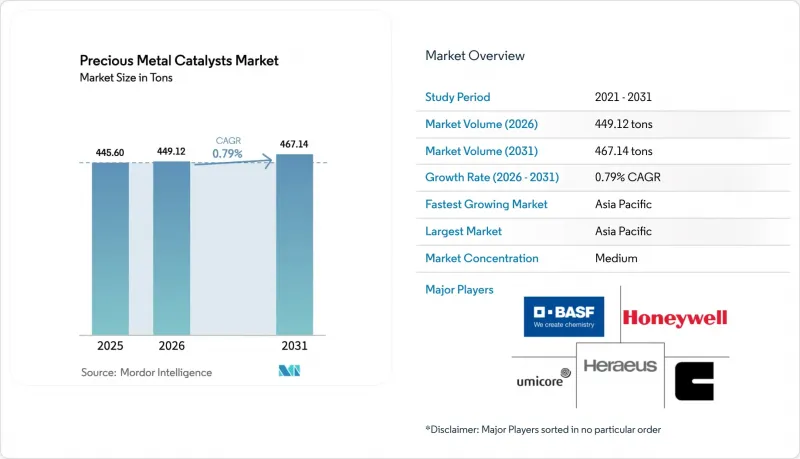
本報告按金屬類型(鉑、鈀等)、催化劑形態(粉末、顆粒/珠狀等)、製造過程(初始濕法浸漬、無電電鍍、電化學鍍等)、應用領域(汽車、製藥等)和地區(亞太地區、北美、歐洲等)進行細分。市場預測以噸為單位。
全球貴金屬觸媒市場趨勢及洞察
更嚴格的廢氣和固定源排放標準
歐盟委員會最終確定了將於2025年底實施的歐7排放標準,並計劃於2027年開始實施,該標準要求汽車製造商將每輛車的銠和鈀的負載容量提高15-20%。中國的國六b排放標準將於2024年7月生效,預計2025年,國內汽車製造商對鉑族金屬催化劑的需求將增加12%。印度的Bharat Stage VII排放標準(2028年4月生效)將擴大實際排放氣體法規的上限範圍,將摩托車納入其中,從而創建了一個新的目標細分市場。美國環保署(EPA)的Tier 4 Final排放標準也增加了對非道路柴油引擎鉑基氧化催化劑的需求。因此,產品附加價值將會提升,這將在一定程度上抵消內燃機(ICE)銷售成長乏力的影響。
石油煉製產業向高辛烷值無污染燃料轉型
國際海事組織 (IMO) 的硫排放上限和低硫汽油的區域性強制規定,正推動煉油廠進行升級改造,優先在其加氫裂解製程中使用氧化鋁負載鉑催化劑。沙烏地阿美位於吉讚的煉油廠於 2024 年投產,其整條加氫裂解生產線已安裝了超過 200 噸貴金屬催化劑。信實工業已累計12 億美元,用於其位於賈姆訥格爾的工廠在 2025 年前滿足 BS-VII 排放標準,這將推動對鉑錸催化劑需求的成長。這些投資支撐著一條平行成長路徑,將抵消電池式電動車(BEV) 普及而導致的汽車催化劑需求下降。
鉑族金屬價格持續波動與供應衝擊
2025年,由於南非礦場關閉導致供應減少18%,銠價在每盎司9,200美元至1,4,000美元之間波動。受制裁影響,俄羅斯鈀出口量減少40噸,迫使歐洲化合物生產商購買價格高昂的再生金屬。由於電解槽訂單,銥價飆漲35%,多個PEM項目被延後。不具備一體化回收能力的二級供應商被迫在固定價格合約下將利潤率壓縮400至600個基點。
基於細分市場的分析
鉑金憑藉在汽車催化劑、煉油廠和製藥領域的廣泛應用,預計到2025年將維持40.92%的市場佔有率。銥雖然絕對市佔率較小,但受PEM電解槽應用的推動,正以3.01%的複合年成長率快速成長。釕正在氯鹼和氨催化劑等細分市場中開拓市場,旨在提高製程經濟性。人工智慧最佳化的奈米顆粒已使1MW電解槽中銥的使用量減少了一半,進一步強化了「價值重於數量」的趨勢。
關鍵在於原子層沉積(ADD)技術。莊信萬豐公司透過在氧化鈦上形成銥點,成功地將氧氣生成率提高了50%,並將每兆瓦的金屬用量減少了一半。至於鉑金,其與鈀金價格差距的縮小為價格上漲創造了空間,配方方面的試驗仍在繼續。
到2025年,粉末催化劑的需求量將佔52.98%,由於其易於再生,粉末催化劑正逐漸成為製藥業間歇式反應器和煉油廠固定台的主流選擇。在汽車和固定式排放氣體的需求正以1.66%的複合年成長率成長。優美科(Umicore)的2025年無銠整體催化劑符合歐VI排放標準,同時減少了30%的鉑族金屬(PGM)用量。顆粒狀催化劑則瞄準了加氫反應器,其機械強度足以抵消成本優勢。由於整體催化劑具有很高的綜合效率,因此在排放氣體控制研發領域處於領先地位,但在間歇式製程柔軟性至關重要的領域,粉末催化劑仍保持著其優勢。
區域分析
預計到2025年,亞太地區將佔全球市場規模的39.82%,儘管受到中國新能源汽車政策的不利影響,仍有望以1.22%的複合年成長率成長。中國的「國六b」排放標準將使內燃機(ICE)的鉑族金屬(PGM)使用量在2025年成長14%,從而緩解催化劑需求下降的趨勢。日本3000億日圓的電解槽補貼正在推動供應鏈向銥回收轉型,田中公司已將其PEM催化劑產能提高了兩倍。印度的「Bharat Stage VII」排放標準將使摩托車催化劑的滲透率從目前的不足40%提升,從而創造巨大的成長空間。在韓國,預計2025年交付12,000套「NEXO」系統,這將維持對鉑陰極的強勁需求。
北美仍然是一個高價值市場。美國煉油商已投資8噸鉑催化劑,以符合2025年Tier 3硫排放法規的要求。在歐洲,銥的需求集中在德國、西班牙和荷蘭,主要得益於電解槽30億歐元的投資。在南美,巴西的乙醇摻混義務推動了鉑錸改質催化劑的採購。在中東,位於賈讚的新建加氫裂解裝置正在產生效益,而南非則正利用其國內鉑族金屬礦藏,建構具有競爭力的回收物流網路。
其他好處:
- Excel格式的市場預測(ME)表
- 3個月的分析師支持
目錄
第1章:引言
- 研究假設和市場定義
- 調查範圍
第2章:調查方法
第3章執行摘要
第4章 市場狀況
- 市場概覽
- 市場促進因素
- 更嚴格的廢氣和固定源排放標準
- 石油煉製產業向高辛烷值無污染燃料轉型
- 3. 在金屬基汽車觸媒中以鉑取代鈀
- 綠色氫能基礎設施的發展正在推動對銥/鉑催化劑的需求。
- 人工智慧設計的反應路徑減少了鉑族金屬的使用。
- 市場限制因素
- 鉑族金屬價格持續波動與供應衝擊
- 電動車 (EV) 的日益普及導致對內燃機 (ICE) 中使用的催化劑的需求下降。
- 回收率的上升正在降低原生需求。
- 價值鏈分析
- 波特五力模型
第5章 市場規模與成長預測
- 按金屬類型
- 鉑
- 鈀
- 銠
- 銥
- 釕
- 其他金屬(鋨、金、銀)
- 催化劑形式
- 粉末
- 顆粒/珠粒
- 擠壓製品和蜂窩
- 水洗塗層整體
- 透過製造程序
- 初始濕浸漬法
- 無電電鍍和電化學鍍
- 化學氣相沉積/原子層沉積
- 溶膠-凝膠法/沉澱法
- 其他先進的奈米結構技術
- 透過使用
- 車
- 製藥
- 石油化學產品
- 其他應用(電子/半導體、燃料電池等)
- 按地區
- 亞太地區
- 中國
- 日本
- 印度
- 韓國
- 東南亞國協
- 其他亞太國家
- 北美洲
- 美國
- 加拿大
- 墨西哥
- 歐洲
- 德國
- 英國
- 法國
- 義大利
- 其他歐洲國家
- 南美洲
- 巴西
- 阿根廷
- 其他南美國家
- 中東和非洲
- 沙烏地阿拉伯
- 南非
- 其他中東和非洲國家
- 亞太地區
第6章 競爭情勢
- 市場集中度
- 策略趨勢
- 市佔率和排名分析
- 公司簡介
- ALS
- American Elements
- BASF
- Catalytic Products International
- CHIMET
- Clariant
- Evonik Industries AG
- Heraeus Precious Metals
- Honeywell International, Inc.
- Kaili Catalyst New Materials Co., Ltd.
- ReMetall Deutschland AG
- Sabin Metal Corp.
- Shaanxi Kaida Chemical Co., Ltd.
- Stanford Advanced Materials
- Takasago International Corporation
- TANAKA Precious Metal Group Co., Ltd.
- Thermo Fisher Scientific Inc.
- Umicore
- Valterra Platinum Limited
第7章 市場機會與未來展望
According to Mordor Intelligence, the precious metal catalysts market size was valued at 445.60 tons in 2025 and is estimated to grow from 449.12 tons in 2026 to reach 467.14 tons by 2031, at a CAGR of 0.79% during the forecast period (2026-2031).
This report is Segmented by Metal Type (Platinum, Palladium, and More), Catalyst Form (Powder, Pellet/Bead, and More), Manufacturing Process (Incipient Wetness Impregnation, Electroless and Electrochemical Deposition, and More), Application (Automotive, Pharmaceutical, and More), and Geography (Asia-Pacific, North America, Europe, and More). Market Forecasts are Provided in Terms of Volume (Tons).
Global Precious Metal Catalysts Market Trends and Insights
Stricter Tail-Pipe and Stationary-Emission Standards
The European Commission finalized Euro 7 in late 2025 for 2027 implementation, forcing OEMs to raise rhodium and palladium loadings by 15-20% per vehicle. China's National VI-b, effective July 2024, triggered a 12% increase in PGM catalyst demand among domestic automakers in 2025. India's Bharat Stage VII (April 2028) will extend real-driving-emission caps to two-wheelers, creating a fresh addressable segment. U.S. EPA Tier 4 Final standards are simultaneously boosting platinum-based oxidation catalysts for non-road diesel engines. The net result is a value-accretive mix enrichment that partially offsets stagnant ICE volumes.
Petro-Refinery Shift to Higher-Octane Clean Fuels
International Maritime Organization sulfur caps and regional low-sulfur gasoline mandates are driving refinery upgrades that favor platinum-on-alumina catalysts for hydroprocessing. Saudi Aramco's Jazan refinery, commissioned in 2024, deployed more than 200 tons of precious-metal catalysts across its hydrocracking trains. Reliance Industries earmarked USD 1.2 billion in 2025 for BS-VII compliance at Jamnagar, anchoring incremental demand for platinum-rhenium catalysts. These investments underpin a parallel growth avenue that balances BEV-driven autocatalyst attrition.
Persistent PGM Price Volatility and Supply Shocks
Rhodium vacillated between USD 9,200 and USD 14,000/oz in 2025 after South African mine outages cut supply by 18%. Russian palladium exports fell 40 tons under sanctions, forcing European formulators to buy higher-priced recycled metal. Iridium jumped 35% on electrolyzer orders, deferring several PEM projects. Tier 2 suppliers without integrated recycling absorbed a 400-600 bp margin compression under fixed-price contracts.
Other drivers and restraints analyzed in the detailed report include:
- Platinum Substitution for Palladium in Tri-Metal Autocatalysts
- Green-Hydrogen Build-Out Spurring Ir/Pt Catalyst Demand
- EV Penetration Shrinking ICE Autocatalyst Demand
For complete list of drivers and restraints, kindly check the Table Of Contents.
Segment Analysis
Platinum retained a 40.92% share in 2025, anchored by its versatility across autocatalyst, refinery, and pharmaceutical platforms. Iridium, though small in absolute terms, is expanding at a 3.01% CAGR on the back of PEM electrolyzer deployment. Ruthenium is carving a niche in chlor-alkali and ammonia catalysts for process-economic gains. AI-optimized nanoparticles are halving iridium intensity in 1-MW electrolyzers, reinforcing a value-over-volume trajectory.
Atomic-layer deposition is crucial here: Johnson Matthey demonstrated 50% higher oxygen-evolution rates with iridium dots on titanium oxide, cutting metal intensity per MW in half. For platinum, narrowing discounts to palladium are opening price headroom that sustains formulation experimentation.
Powder catalysts accounted for 52.98% of 2025 demand, dominating pharmaceutical batch reactors and refinery fixed beds thanks to easy regeneration. Wash-coated monoliths are growing at a 1.66% CAGR, as automotive and stationary emission systems prize low pressure drop. Umicore's 2025 rhodium-free monolith meets Euro VI limits with 30% less total PGM. Pellet forms target hydrogenation reactors where mechanical strength offsets costs. Integration efficiencies place monoliths at the forefront of emission-control research and development, while powders retain primacy where batch flexibility prevails.
Complete Report Scope:
- By Metal Type
- Platinum
- Palladium
- Rhodium
- Iridium
- Ruthenium
- Other Metal Types (Osmium, Gold, Silver)
- By Catalyst Form
- Powder
- Pellet / Bead
- Extrudate and Honeycomb
- Wash-coated Monolith
- By Manufacturing Process
- Incipient Wetness Impregnation
- Electroless and Electrochemical Deposition
- Chemical Vapour / Atomic Layer Deposition
- Sol-Gel / Precipitation
- Other Advanced Nano-structuring
- By Application
- Automotive
- Pharmaceutical
- Petrochemicals
- Other Applications (Electronics and Semiconductor, Fuel Cells, etc.)
- By Geography
- Asia-Pacific
- China
- Japan
- India
- South Korea
- ASEAN Countries
- Rest of Asia-Pacific
- North America
- United States
- Canada
- Mexico
- Europe
- Germany
- United Kingdom
- France
- Italy
- Rest of Europe
- South America
- Brazil
- Argentina
- Rest of South America
- Middle East and Africa
- Saudi Arabia
- South Africa
- Rest of Middle-East and Africa
- Asia-Pacific
Geography Analysis
Asia-Pacific controlled 39.82% of the 2025 volume and is set to grow at a 1.22% CAGR despite China's NEV policy headwinds. China's National VI-b raised PGM loadings per ICE by 14% in 2025, cushioning catalyst volume decline. Japan's JPY 300 billion electrolyzer subsidy is pivoting the supply chain toward iridium recycling, with TANAKA tripling PEM catalyst capacity. India's Bharat Stage VII will boost two-wheeler catalyst penetration from below 40% today, adding significant upside. South Korea's 12,000 NEXO deliveries in 2025 kept platinum cathode volumes buoyant.
North America remains value-dense: U.S. refiners installed 8 tons of platinum catalysts to meet Tier 3 sulfur requirements in 2025. Europe's EUR 3 billion electrolyzer funding is funneling iridium demand into Germany, Spain, and the Netherlands. South America leans on Brazil's ethanol blend mandate, driving platinum-rhenium reforming catalyst purchases. The Middle East benefits from new hydrocracking trains at Jazan, while South Africa leverages domestic PGM mining for competitive recycling logistics.
- ALS
- American Elements
- BASF
- Catalytic Products International
- CHIMET
- Clariant
- Evonik Industries AG
- Heraeus Precious Metals
- Honeywell International, Inc.
- Kaili Catalyst New Materials Co., Ltd.
- ReMetall Deutschland AG
- Sabin Metal Corp.
- Shaanxi Kaida Chemical Co., Ltd.
- Stanford Advanced Materials
- Takasago International Corporation
- TANAKA Precious Metal Group Co., Ltd.
- Thermo Fisher Scientific Inc.
- Umicore
- Valterra Platinum Limited
Additional Benefits:
- The market estimate (ME) sheet in Excel format
- 3 months of analyst support
TABLE OF CONTENTS
1 Introduction
- 1.1 Study Assumptions and Market Definition
- 1.2 Scope of the Study
2 Research Methodology
3 Executive Summary
4 Market Landscape
- 4.1 Market Overview
- 4.2 Market Drivers
- 4.2.1 Stricter tail-pipe and stationary-emission standards
- 4.2.2 Petro-refinery shift to higher-octane clean fuels
- 4.2.3 Platinum substitution for palladium in tri-metal autocatalysts
- 4.2.4 Green-hydrogen build-out spurring Ir/Pt catalyst demand
- 4.2.5 AI-designed reaction pathways trimming PGM loadings
- 4.3 Market Restraints
- 4.3.1 Persistent PGM price volatility and supply shocks
- 4.3.2 EV penetration shrinking ICE autocatalyst demand
- 4.3.3 Rising recycling rates denting primary demand
- 4.4 Value Chain Analysis
- 4.5 Porter's Five Forces
- 4.5.1 Threat of New Entrants
- 4.5.2 Bargaining Power of Suppliers
- 4.5.3 Bargaining Power of Buyers
- 4.5.4 Threat of Substitutes
- 4.5.5 Competitive Rivalry
5 Market Size and Growth Forecasts (Volume)
- 5.1 By Metal Type
- 5.1.1 Platinum
- 5.1.2 Palladium
- 5.1.3 Rhodium
- 5.1.4 Iridium
- 5.1.5 Ruthenium
- 5.1.6 Other Metal Types (Osmium, Gold, Silver)
- 5.2 By Catalyst Form
- 5.2.1 Powder
- 5.2.2 Pellet / Bead
- 5.2.3 Extrudate and Honeycomb
- 5.2.4 Wash-coated Monolith
- 5.3 By Manufacturing Process
- 5.3.1 Incipient Wetness Impregnation
- 5.3.2 Electroless and Electrochemical Deposition
- 5.3.3 Chemical Vapour / Atomic Layer Deposition
- 5.3.4 Sol-Gel / Precipitation
- 5.3.5 Other Advanced Nano-structuring
- 5.4 By Application
- 5.4.1 Automotive
- 5.4.2 Pharmaceutical
- 5.4.3 Petrochemicals
- 5.4.4 Other Applications (Electronics and Semiconductor, Fuel Cells, etc.)
- 5.5 By Geography
- 5.5.1 Asia-Pacific
- 5.5.1.1 China
- 5.5.1.2 Japan
- 5.5.1.3 India
- 5.5.1.4 South Korea
- 5.5.1.5 ASEAN Countries
- 5.5.1.6 Rest of Asia-Pacific
- 5.5.2 North America
- 5.5.2.1 United States
- 5.5.2.2 Canada
- 5.5.2.3 Mexico
- 5.5.3 Europe
- 5.5.3.1 Germany
- 5.5.3.2 United Kingdom
- 5.5.3.3 France
- 5.5.3.4 Italy
- 5.5.3.5 Rest of Europe
- 5.5.4 South America
- 5.5.4.1 Brazil
- 5.5.4.2 Argentina
- 5.5.4.3 Rest of South America
- 5.5.5 Middle East and Africa
- 5.5.5.1 Saudi Arabia
- 5.5.5.2 South Africa
- 5.5.5.3 Rest of Middle-East and Africa
- 5.5.1 Asia-Pacific
6 Competitive Landscape
- 6.1 Market Concentration
- 6.2 Strategic Moves
- 6.3 Market Share (%)/Ranking Analysis
- 6.4 Company Profiles (includes Global level Overview, Market level overview, Core Segments, Financials as available, Strategic Information, Products and Services, and Recent Developments)
- 6.4.1 ALS
- 6.4.2 American Elements
- 6.4.3 BASF
- 6.4.4 Catalytic Products International
- 6.4.5 CHIMET
- 6.4.6 Clariant
- 6.4.7 Evonik Industries AG
- 6.4.8 Heraeus Precious Metals
- 6.4.9 Honeywell International, Inc.
- 6.4.10 Kaili Catalyst New Materials Co., Ltd.
- 6.4.11 ReMetall Deutschland AG
- 6.4.12 Sabin Metal Corp.
- 6.4.13 Shaanxi Kaida Chemical Co., Ltd.
- 6.4.14 Stanford Advanced Materials
- 6.4.15 Takasago International Corporation
- 6.4.16 TANAKA Precious Metal Group Co., Ltd.
- 6.4.17 Thermo Fisher Scientific Inc.
- 6.4.18 Umicore
- 6.4.19 Valterra Platinum Limited
7 Market Opportunities and Future Outlook
- 7.1 White-space and Unmet-need Assessment

 氨分解催化劑:市場佔有率分析、產業趨勢與統計、成長預測(2026-2031)
 2026-2030年全球氫燃料電池催化劑市場
 2026-2030年全球燃料電池催化劑市場
 貴金屬催化劑市場規模、佔有率和成長分析:按金屬類型、應用、形態、最終用戶、催化劑相和地區分類-2026-2033年產業預測
 催化劑市場規模、佔有率、成長、全球產業分析、區域趨勢及2026-2034年預測。
 永續觸媒技術市場預測至2034年-按催化劑類型、永續性承諾、製程、應用、最終用戶和地區分類的全球分析石油煉製催化劑:市場佔有率分析、產業趨勢與統計、成長預測(2026-2031)
 貴金屬催化劑市場-2026-2032年全球市場預測催化劑市場:2026-2032年全球市場預測(依產品類型、材料類型、反應類型、形態、最終用途及分銷通路分類)
 全球費托催化劑市場報告:2021-2032年歷史績效及預測