


 |
市場調查報告書
商品編碼
2120636
石油煉製催化劑:市場佔有率分析、產業趨勢與統計、成長預測(2026-2031)Refining Catalysts - Market Share Analysis, Industry Trends & Statistics, Growth Forecasts (2026 - 2031) |
||||||

※ 本網頁內容可能與最新版本有所差異。詳細情況請與我們聯繫。
預計到 2025 年,石油煉製催化劑市場規模將達到 124 萬噸,到 2031 年將達到 145 萬噸,而 2026 年為 127 萬噸,預測期內(2026-2031 年)複合年成長率為 2.69%。
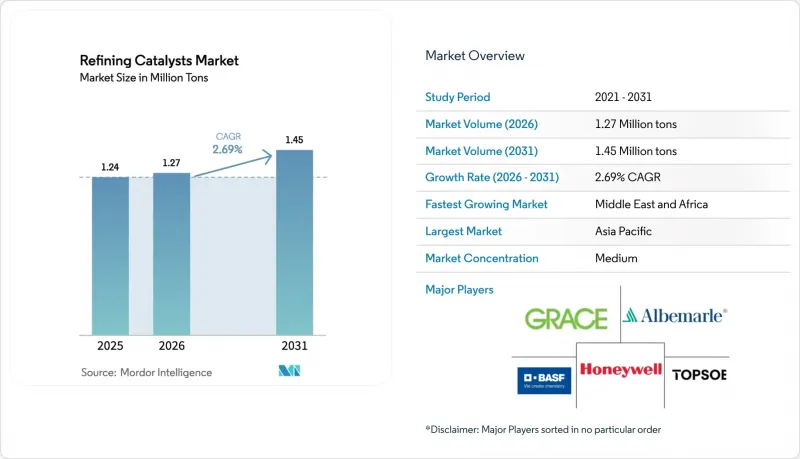
本報告按產品類型(鈷鉬合金、鎳鉬合金、氧化鋁基貴金屬、鎳鎢合金、沸石及其他)、製程(加氫、流體化媒裂、殘餘流體化媒裂、加氫裂解)和地區(北美、南美、歐洲、亞太、中東和非洲)進行細分。市場預測以噸為單位。
全球石油煉製催化劑市場趨勢及洞察
全球對硫含量的監管更加嚴格
國際海事組織(IMO)於2020年1月實施的船用燃料含硫量上限為0.50%,持續影響目前正對殘渣流進行加氫處理以供應合規船用燃料油的沿海煉油廠。中國將於2024年生效的全國性「國六」汽油和柴油標準將含硫量限制在10ppm,迫使國營煉油廠將氫氣加工能力提升至相當於每日約120萬桶。美國環保署(EPA)的Tier 3汽油標準也維持了10ppm的含硫量上限,這將推高對貴金屬氧化鋁催化劑的需求,此類催化劑可在適中的氫氣分壓下實現高級脫硫。歐盟燃料品質指令也採用了10ppm的標準,這將提升整個歐洲大陸對鎳鉬(NiMo)和鈷鉬(CoMo)的需求。由於多項監管期限重疊,預計這些法規將使基準複合年成長率(CAGR)提高0.8個百分點,主要影響將持續到2026年。
擴大亞太和中東地區的煉油產能
2024年至2028年間,中國、印度、沙烏地阿拉伯和科威特的待開發區和棕地專案將使原油蒸餾產能增加約300萬桶/日,這將需要為催化裂解(FCC)、加氫裂解和加氫脫硫裝置儲備數噸催化劑。沙烏地阿美和中國石化的福建煉油廠全面運作後,預計每年將消耗約1.2萬噸沸石基FCC催化劑;而印度古吉拉特邦帕古吉拉突邦和巴勞尼的擴建項目將推動當地對加氫裂解催化劑的需求,直至2027年。科威特祖爾煉油廠日處理61.5萬桶重質原油,並依賴鎳鎢(NiW)和鈷鉬(CoMo)殘渣加氫裂解催化劑來最大限度地提高中間餾分油的收率。這些建設項目總合預計複合年成長率(CAGR)提高0.9個百分點,並在2026年至2028年間達到峰值,屆時這些新裝置將達到額定產能。
鈷、鉑族金屬和其他重要金屬的價格波動
預計到2025年,由於剛果民主共和國鈷供應緊張,鈷價將上漲18%;而由於南非產量受限,鉑金和鈀金價格預計將上漲12%。含鈷量為2-4%(重量比)的鈷鉬加氫處理催化劑正面臨利潤率壓力,因為受管制的燃料價格限制了成本轉嫁。含鉑改質催化劑也面臨類似的壓力。鈀金價格上漲10%將使成品催化劑的成本每公斤增加約50美元。供應商正致力於透過開發不含鈷的鎳鎢基催化劑和加快回收來減輕價格波動的影響,但這些措施可能需要2-3年才能實現實用化化。預期價格波動將使基準複合年成長率下降0.4個百分點,其中2024年至2026年間的影響最為顯著,因為煉油廠將延長催化劑更換週期。
細分市場分析
預計到2025年,沸石將佔據石油煉製催化劑市場96.01%的佔有率,並預計以2.72%的年成長率成長至2031年。這種壓倒性的市場主導地位凸顯了石油煉製催化劑市場的核心在於流體化媒裂(FCC)工藝,該工藝將真空瓦斯油裂解為汽油、柴油和低碳烯烴。稀土元素Y型沸石仍是500 度C至550 度C提升管溫度範圍內的主要產品,而ZSM-5添加劑則提高了丙烯的產量。鈷鉬(CoMo)催化劑主要用於亞洲和中東地區處理高硫原料的加氫處理裝置。含鎳鉬(NiMo)催化劑則因其在煤油脫硫方面的應用而受到航空燃料煉製商的青睞。由於貴金屬的揮發性導致其應用受限,氧化鋁負載的貴金屬產品在重整應用中扮演獨特的角色。鎳鎢催化劑常用於重質原油產區殘渣的加氫反應。金屬有機框架(MOFs)等實驗性解決方案也在探索之中。科萊恩公司計劃於2025年推出的分級沸石,結合了微孔和介孔結構,標誌著該關鍵領域的創新發展。
儘管電動車的日益普及帶來了一定影響,但未來的車輛更換週期仍將支撐對沸石組合藥物的持續需求。隨著亞太地區為石化一體化而設計的FCC裝置需要更多地使用ZSM-5沸石,以及中東地區的殘渣加氫裂解裝置更傾向於使用耐金屬的NiW基化合物,市場正呈現多元化趨勢。目前初步試驗的無鈷NiW化合物預計將在未來取代柴油加氫處理系統中的CoMo基化合物,但預計在2028年之前不會實現商業化,這意味著在預測期中期之前,市場競爭格局將保持穩定。
區域分析
至2025年,亞太地區將佔全球煉油催化劑市場52.03%的佔有率。中國和沙烏地阿美福建煉廠最終每年將消耗1.2萬噸沸石,而印度基於與雅寶公司簽訂的價值4500萬美元的合約而製定的擴建計劃預計將顯著提振加氫裂化需求。到2028年,印尼、越南和泰國的東南亞計畫將新增約50萬桶/日的蒸餾產能,從而擴大加氫裂解和催化裂解(FCC)的機會。
由於煉油廠停產和電動車的興起,北美和歐洲的汽油需求正在下降。 2019年至2025年間,歐洲汽油需求預計將下降6%,而北美生產線將轉型生產丙烯和柴油,這些因素將導致催化劑規格的重新評估,而非需求的成長。美國三級排放標準穩定了貴金屬的需求,加拿大油砂平土機也維持了專業加氫裂解產品的需求。然而,由於工廠的合理化改造抵消了生產線升級的收益,這些成熟地區的煉油催化劑市場仍然停滯不前。
在南美洲,位於阿根廷的拉普拉塔加氫裂解裝置計畫於2027年運作,屆時每年將新增600噸需求。儘管亞洲在絕對產量上仍保持優勢,但這一成長鞏固了該地區在成長率方面的主導地位。
在中東和非洲,石油煉製催化劑的需求正顯著成長,預計2026年至2031年間的複合年成長率將達到2.78%。沙烏地阿拉伯的「液態烴製化學品」策略和科威特的祖爾重質原油平台正在創造對殘渣加氫裂解催化劑的穩定需求。在非洲,奈及利亞的丹格特煉油廠日產能達65萬桶,是長期成長的驅動力。該煉油廠預計於2026年全面運作,屆時每年將需要約5,000噸FCC及加氫裂解催化劑。此外,南非塞昆達煉油廠的天然氣轉化設備維修預計將使加氫裂解產能提高15%。
其他好處:
- Excel格式的市場預測(ME)表
- 3個月的分析師支持
目錄
第1章:引言
- 研究假設和市場定義
- 調查範圍
第2章:調查方法
第3章執行摘要
第4章 市場狀況
- 市場概覽
- 市場促進因素
- 全球對硫排放的監管更加嚴格
- 擴大亞太和中東地區的煉油產能
- 對高辛烷值汽油和石油原料的需求不斷增加。
- 生質能飼料共燒需要雙功能催化劑。
- 引入人工智慧驅動的催化劑性能分析
- 市場限制因素
- 鈷、鉑族金屬(貴金屬)和其他重要金屬的價格波動。
- 電動車的廣泛普及正在抑制汽油的長期需求。
- 該原油製化學品聯合裝置繞過了傳統設施。
- 價值鏈分析
- 波特五力模型
第5章 市場規模與成長預測
- 依產品類型
- CoMo
- NiMo
- 氧化鋁基貴金屬
- NiW
- 沸石
- 其他產品
- 透過流程
- 氫化
- 汽油
- 煤油
- 柴油引擎
- 真空瓦斯油
- 催化裂解汽油
- 剩餘原料
- 流體化媒裂(FCC)
- 殘渣流化催化裂解(RFCC)
- 加氫裂解
- 氫化
- 按地區
- 北美洲
- 美國
- 加拿大
- 墨西哥
- 南美洲
- 巴西
- 阿根廷
- 其他南美國家
- 歐洲
- 德國
- 英國
- 義大利
- 法國
- 西班牙
- 俄羅斯
- 其他歐洲國家
- 亞太地區
- 中國
- 印度
- 日本
- 韓國
- 東南亞國協
- 其他亞太國家
- 中東和非洲
- 南非
- 沙烏地阿拉伯
- 其他中東和非洲國家
- 北美洲
第6章 競爭情勢
- 市場集中度
- 策略趨勢
- 市佔率和排名分析
- 公司簡介
- Albemarle Corporation
- Axens
- BASF SE
- China Petrochemical Corporation
- Clariant
- CLG
- Evonik
- Exxon Mobil Corporation
- Honeywell International
- JGC C & C
- Johnson Matthey
- KNT Group
- Kuwait Catalyst Company
- Rezel Catalysts Corporation
- Shell plc
- Topsoe
- Umicore
- WR Grace & Co.
第7章 市場機會與未來展望
According to Mordor Intelligence, the refining catalysts market size was valued at 1.24 Million tons in 2025 and is estimated to grow from 1.27 Million tons in 2026 to reach 1.45 Million tons by 2031, at a CAGR of 2.69% during the forecast period (2026-2031).
This report is Segmented by Product Type (CoMo, Nimo, Alumina-Based Noble Metal, Niw, Zeolites, and Other Products), Process (Hydrotreating, Fluid Catalytic Cracking, Residue Fluid Catalytic Cracking, and Hydrocracking), and Geography (North America, South America, Europe, Asia-Pacific, and Middle East and Africa). Market Forecasts are Provided in Terms of Volume (Tons).
Global Refining Catalysts Market Trends and Insights
Stricter Global Sulfur-Cap Regulations
The International Maritime Organization's 0.50% sulfur limit for marine fuels, effective since January 2020, still reverberates across coastal refineries that now hydrotreat residual streams to supply compliant bunker blends. China's nationwide China VI gasoline and diesel standards, implemented in 2024, limit sulfur to 10 ppm and forced state-owned refiners to add hydrotreating capacity equal to nearly 1.2 million barrels per day of throughput. The United States Environmental Protection Agency's Tier 3 gasoline program maintains a comparable 10 ppm cap, bolstering demand for noble-metal alumina catalysts that reach deep desulfurization under moderate hydrogen partial pressures. Europe's Fuel Quality Directive replicates the 10 ppm threshold, reinforcing NiMo and CoMo demand throughout the continent. Overlapping mandates deliver a 0.8 percentage-point uplift to the base CAGR mainly through 2026 as multiple deadlines converge.
Refinery Capacity Build-Out in Asia-Pacific and Middle East
Greenfield and brownfield projects in China, India, Saudi Arabia, and Kuwait add roughly 3 million barrels per day of crude distillation between 2024 and 2028, translating into multi-ton catalyst charges for FCC, hydrotreating, and hydrocracking units. Saudi Aramco and China Petrochemical Corporation's Fujian complex will consume an estimated 12,000 tons of zeolite FCC catalysts annually at full stride, while India's Panipat, Gujarat, and Barauni expansions boost local hydrotreating demand through 2027. Kuwait's Al-Zour refinery processes 615,000 barrels per day of heavy crude, relying on NiW and CoMo residue hydrocracking catalysts to maximize middle-distillate yields. The combined build-out contributes a 0.9 percentage-point push to the forecast CAGR, peaking as these new units reach nameplate throughput over 2026-2028.
Volatility in Cobalt, PGMs, and Other Critical Metals
Cobalt prices rose 18% in 2025 on tight supply from the Democratic Republic of Congo, while platinum and palladium climbed 12% amid South African output curbs. CoMo hydrotreating catalysts that contain 2-4% cobalt by weight face margin compression because regulated fuel prices limit pass-through. Platinum-bearing reforming catalysts see similar strain: a 10% palladium rise inflates finished-catalyst cost by roughly USD 50 per kilogram. Suppliers pursue cobalt-free NiW chemistries and accelerate recycling to cushion volatility, yet commercialization may take two to three years. Price swings trim 0.4 percentage points from the base CAGR, with most impact between 2024 and 2026 as refiners lengthen change-out intervals.
Other drivers and restraints analyzed in the detailed report include:
- Rising Demand for Higher-Octane Gasoline and Petro-Feedstocks
- Bio-Feed Co-Processing Needs Dual-Function Catalysts
- EV Penetration Curbing Long-Term Gasoline Demand
For complete list of drivers and restraints, kindly check the Table Of Contents.
Segment Analysis
Zeolites captured 96.01% of the refining catalysts market share in 2025 and are expected to grow 2.72% annually through 2031. This extensive dominance underscores how the refining catalysts market revolves around FCC operations that crack vacuum gas oil into gasoline, diesel, and light olefins. Rare-earth Y-zeolites remain the workhorse at riser temperatures of 500 °C-550 °C, while ZSM-5 additives lifted propylene production. CoMo catalysts are primarily utilized in Asian and Middle Eastern hydrotreaters processing high-sulfur feeds. NiMo formulations are preferred by aviation fuel refiners for kerosene desulfurization. Alumina-supported noble-metal products play a niche role in reforming applications, as the volatility of precious metals limits broader adoption. NiW catalysts are commonly used for residue hydrocracking in heavy-crude regions. Experimental solutions, such as metal-organic frameworks, are also being explored. Clariant's planned 2025 launch of a hierarchical zeolite combining micro- and mesopores highlights incremental innovation within the dominant segment.
The upcoming replacement cycle underscores the sustained demand for zeolite formulations, despite the impact of electric vehicle adoption. Asia-Pacific FCC units designed for petrochemical integration are specifying higher ZSM-5 doses, while Middle Eastern residue hydrocrackers are favoring NiW systems with enhanced metal tolerance, contributing to market diversity. Cobalt-free NiW formulations entering pilot trials may eventually capture share from CoMo in diesel hydrotreaters, but commercialization is unlikely before 2028, suggesting a stable competitive mix through the midpoint of the forecast window.
Complete Report Scope:
- By Product Type
- CoMo
- NiMo
- Alumina-based Noble Metal
- NiW
- Zeolites
- Other Products
- By Process
- Hydrotreating
- Gasoline
- Kerosene
- Diesel
- Vacuum Gas Oil
- Catalytic-Cracking Gasoline
- Residual Feed
- Fluid Catalytic Cracking (FCC)
- Residue Fluid Catalytic Cracking (RFCC)
- Hydrocracking
- Hydrotreating
- By Geography
- North America
- United States
- Canada
- Mexico
- South America
- Brazil
- Argentina
- Rest of South America
- Europe
- Germany
- United Kingdom
- Italy
- France
- Spain
- Russia
- Rest of Europe
- Asia-Pacific
- China
- India
- Japan
- South Korea
- ASEAN Countries
- Rest of Asia-Pacific
- Middle-East and Africa
- South Africa
- Saudi Arabia
- Rest of Middle-East and Africa
- North America
Geography Analysis
Asia-Pacific accounted for a 52.03% share of the global refining catalyst market in 2025. China and Saudi Aramco's Fujian complex will eventually draw 12,000 tons of zeolite annually, and Indian expansions add significant hydrocracking demand under Albemarle's USD 45 million contract. Southeast Asian projects in Indonesia, Vietnam, and Thailand add about 500,000 barrels per day of distillation capacity through 2028, broadening hydrotreating and FCC opportunities.
North America and Europe face refinery shutdowns and electric-vehicle-driven gasoline decline. Europe's 6% gasoline retreat from 2019-2025 and North American unit reconfiguration toward propylene and diesel reshape catalyst specifications rather than spark volume growth. The United States Tier 3 rule keeps noble-metal demand steady, and Canada's oil-sands upgraders sustain specialized hydrocracking volume. Yet the refining catalysts market in these mature regions edges sideways as plant rationalization offsets unit upgrades.
In South America, Argentina's La Plata hydrocracker, scheduled for 2027, adds 600 tons of annual demand. These incremental additions solidify the region's leadership in growth rate terms, even if Asia alone retains absolute volume dominance.
The Middle East and Africa are witnessing a significant rise in demand for refining catalysts with the fastest 2.78% CAGR from 2026 to 2031. Saudi Arabia's liquids-to-chemicals agenda and Kuwait's Al-Zour heavy-crude platform generate constant demand for residue hydrocracking catalysts. Africa presents long-term upside through Nigeria's 650,000 barrels-per-day Dangote refinery, which when fully loaded in 2026 will require roughly 5,000 tons of FCC and hydrotreating catalysts each year. South Africa's Secunda gas-conversion retrofit will lift hydrotreating volume by 15%.
- Albemarle Corporation
- Axens
- BASF SE
- China Petrochemical Corporation
- Clariant
- CLG
- Evonik
- Exxon Mobil Corporation
- Honeywell International
- JGC C & C
- Johnson Matthey
- KNT Group
- Kuwait Catalyst Company
- Rezel Catalysts Corporation
- Shell plc
- Topsoe
- Umicore
- W. R. Grace & Co.
Additional Benefits:
- The market estimate (ME) sheet in Excel format
- 3 months of analyst support
TABLE OF CONTENTS
1 Introduction
- 1.1 Study Assumptions and Market Definition
- 1.2 Scope of the Study
2 Research Methodology
3 Executive Summary
4 Market Landscape
- 4.1 Market Overview
- 4.2 Market Drivers
- 4.2.1 Stricter global sulfur-cap regulations
- 4.2.2 Refinery capacity build-out in Asia-Pacific and Middle East
- 4.2.3 Rising demand for higher-octane gasoline and petro-feedstocks
- 4.2.4 Bio-feed co-processing needs dual-function catalysts
- 4.2.5 AI-driven catalyst performance analytics adoption
- 4.3 Market Restraints
- 4.3.1 Volatility in cobalt, PGMs and other critical metals
- 4.3.2 EV penetration curbing long-term gasoline demand
- 4.3.3 Crude-to-chemicals complexes bypass traditional units
- 4.4 Value Chain Analysis
- 4.5 Porter's Five Forces
- 4.5.1 Bargaining Power of Suppliers
- 4.5.2 Bargaining Power of Buyers
- 4.5.3 Threat of New Entrants
- 4.5.4 Threat of Substitutes
- 4.5.5 Degree of Competition
5 Market Size and Growth Forecasts (Volume)
- 5.1 By Product Type
- 5.1.1 CoMo
- 5.1.2 NiMo
- 5.1.3 Alumina-based Noble Metal
- 5.1.4 NiW
- 5.1.5 Zeolites
- 5.1.6 Other Products
- 5.2 By Process
- 5.2.1 Hydrotreating
- 5.2.1.1 Gasoline
- 5.2.1.2 Kerosene
- 5.2.1.3 Diesel
- 5.2.1.4 Vacuum Gas Oil
- 5.2.1.5 Catalytic-Cracking Gasoline
- 5.2.1.6 Residual Feed
- 5.2.2 Fluid Catalytic Cracking (FCC)
- 5.2.3 Residue Fluid Catalytic Cracking (RFCC)
- 5.2.4 Hydrocracking
- 5.2.1 Hydrotreating
- 5.3 By Geography
- 5.3.1 North America
- 5.3.1.1 United States
- 5.3.1.2 Canada
- 5.3.1.3 Mexico
- 5.3.2 South America
- 5.3.2.1 Brazil
- 5.3.2.2 Argentina
- 5.3.2.3 Rest of South America
- 5.3.3 Europe
- 5.3.3.1 Germany
- 5.3.3.2 United Kingdom
- 5.3.3.3 Italy
- 5.3.3.4 France
- 5.3.3.5 Spain
- 5.3.3.6 Russia
- 5.3.3.7 Rest of Europe
- 5.3.4 Asia-Pacific
- 5.3.4.1 China
- 5.3.4.2 India
- 5.3.4.3 Japan
- 5.3.4.4 South Korea
- 5.3.4.5 ASEAN Countries
- 5.3.4.6 Rest of Asia-Pacific
- 5.3.5 Middle-East and Africa
- 5.3.5.1 South Africa
- 5.3.5.2 Saudi Arabia
- 5.3.5.3 Rest of Middle-East and Africa
- 5.3.1 North America
6 Competitive Landscape
- 6.1 Market Concentration
- 6.2 Strategic Moves
- 6.3 Market Share/Ranking Analysis
- 6.4 Company Profiles (includes Global level Overview, Market level overview, Core Segments, Financials as available, Strategic Information, Market Rank/Share for key companies, Products and Services, and Recent Developments)
- 6.4.1 Albemarle Corporation
- 6.4.2 Axens
- 6.4.3 BASF SE
- 6.4.4 China Petrochemical Corporation
- 6.4.5 Clariant
- 6.4.6 CLG
- 6.4.7 Evonik
- 6.4.8 Exxon Mobil Corporation
- 6.4.9 Honeywell International
- 6.4.10 JGC C & C
- 6.4.11 Johnson Matthey
- 6.4.12 KNT Group
- 6.4.13 Kuwait Catalyst Company
- 6.4.14 Rezel Catalysts Corporation
- 6.4.15 Shell plc
- 6.4.16 Topsoe
- 6.4.17 Umicore
- 6.4.18 W. R. Grace & Co.
7 Market Opportunities and Future Outlook
- 7.1 White-space and Unmet-need Assessment

 氨分解催化劑:市場佔有率分析、產業趨勢與統計、成長預測(2026-2031)
 2026-2030年全球氫燃料電池催化劑市場
 2026-2030年全球燃料電池催化劑市場
 貴金屬催化劑市場規模、佔有率和成長分析:按金屬類型、應用、形態、最終用戶、催化劑相和地區分類-2026-2033年產業預測
 催化劑市場規模、佔有率、成長、全球產業分析、區域趨勢及2026-2034年預測。
 永續觸媒技術市場預測至2034年-按催化劑類型、永續性承諾、製程、應用、最終用戶和地區分類的全球分析貴金屬催化劑:市場佔有率分析、產業趨勢與統計、成長預測(2026-2031)
 貴金屬催化劑市場-2026-2032年全球市場預測催化劑市場:2026-2032年全球市場預測(依產品類型、材料類型、反應類型、形態、最終用途及分銷通路分類)
 全球費托催化劑市場報告:2021-2032年歷史績效及預測