


 |
市場調查報告書
商品編碼
2122431
雷射:市場佔有率分析、行業趨勢和統計數據、成長預測(2026-2031)Lasers - Market Share Analysis, Industry Trends & Statistics, Growth Forecasts (2026 - 2031) |
||||||

※ 本網頁內容可能與最新版本有所差異。詳細情況請與我們聯繫。
根據 Mordor Intelligence 預測,雷射市場規模將從 2025 年的 214.3 億美元成長到 2026 年的 229.2 億美元,然後在 2031 年達到 320.8 億美元,2026 年至 2031 年的複合年成長率為 6.96%。
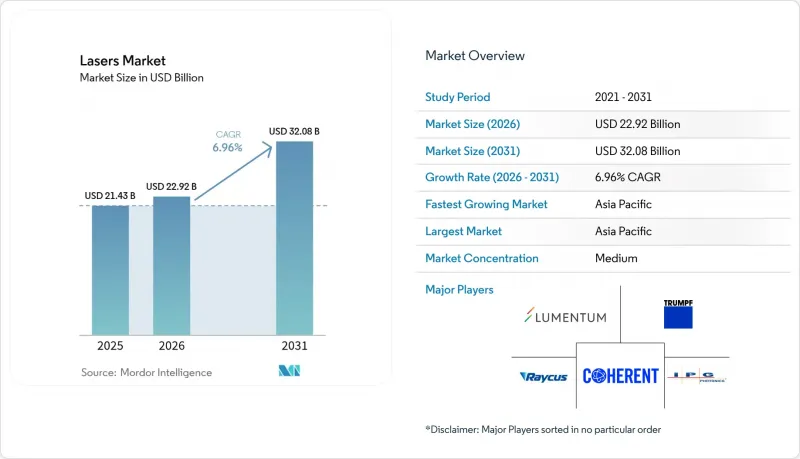
本報告按雷射類型(光纖雷射、二極體雷射及其他)、應用領域(材料加工及其他)、功率等級(低功率、中功率、高功率)、工作模式(連續波、脈衝)、終端用戶行業(電子和半導體及其他)以及地區(北美、南美、歐洲、亞太及其他)進行細分。市場預測以美元計價。
全球雷射市場趨勢與洞察
半導體後端封裝領域對高精度微加工的需求激增
扇出型晶圓級封裝和玻璃通孔 (TGV) 製程需要使用飛秒雷射和準分子雷射光源,以實現尺寸小於 10微米的微結構,脈衝間能量偏差小於 1%,從而確保在整個 300 毫米晶圓上形成均勻的通孔。以雷射成型的微凸塊取代焊線,可將互連電阻降低 40%,為3D晶片堆疊鋪路。原位監測和同步光束整形模組可提高良率並降低大批量晶圓廠的廢品率。亞太地區的晶圓代工廠持續採用承包雷射工作站,對超快光源供應商的需求顯著成長。隨著封裝生產線週期的縮短,對更高重複頻率的需求將會增加,預計高階超快光源的平均售價也將上漲。
擴大雷射積層製造技術在航太高溫合金零件中的應用。
目前,領先的航太製造商正在認證粉末層熔融光纖雷射器,該雷射可加工鈦鋁合金和鎳基高溫合金,材料利用率超過95%,其性能遠超機械加工。動態光束整形技術可將成型週期縮短40%,能耗降低60%,同時維持飛行硬體所需的微觀結構完整性。修訂後的AS9100標準明確提及雷射列印零件,並簡化了認證流程。美國和歐洲的引擎計畫正擴大採用「列印優先」的設計方法,用於加工那些經濟上難以實現的零件。這種轉變與寬體飛機現代化改造和計畫於2020年代末投入使用的高超音速推進專案對雷射技術的需求密切相關。
高純度砷化鎵和磷化銦外延晶片長期供不應求。
鎵和鍺的出口限制加劇了高功率雷射二極體所需的化合物半導體基板的供不應求。不同批次基板熱導率的差異迫使雷射製造商進行漫長的重新認證週期,導致出貨延遲和庫存積壓增加。儘管北美和歐洲的新興企業正在規劃新的晶體生長工廠,但設備前置作業時間和製程技術的取得意味著實際的大規模生產預計要到2027年或更晚才能開始。高品質基板價格的飆升導致元件成本以兩位數的速度成長,尤其是在工作於高結溫的雷射雷達和通訊雷射領域。製造商正嘗試採用矽基中介層來應對現有的外延晶圓供應,但性能下降仍然十分顯著。
細分市場分析
光纖雷射器憑藉其卓越的光束品質、全光纖結構和極低的維護需求,預計到2025年將佔據全球雷射市場41.40%的佔有率。同時,受定向能量武器和核融合實驗中對兆瓦級光學元件的需求驅動,固體雷射平台預計將以9.18%的複合年成長率實現最快成長。全球固體雷射市場預計到2031年將超過56.2億美元,反映了國防預算的變化趨勢。混合配置將板條型增益介質與鎧裝光纖傳輸線結合,有助於克服單光纖功率限制,同時保持亮度。二氧化碳雷射持續應用於厚壁切割領域,而二極體雷射則在泵浦陣列和直射光應用領域不斷擴展。準分子雷射和紫外線雷射在100奈米以下半導體微影術中至關重要,即使鑄造資本投資呈現週期性波動,它們也能支撐穩定的需求。
對分散式增益架構的持續研究有望在不引入熱致模式不穩定性的情況下實現功率擴展。雖然自由電子和量子級聯技術目前仍處於光譜學領域的小眾分支,但緊湊型加速器結構的突破性技術有望在未來使中紅外線波段的應用更加廣泛。符合IEC 60825-1安全標準會影響機殼設計,進而影響高度自動化工廠的整體部署成本。隨著應用邊界日益模糊,能夠將光纖的可靠性與固態元件的優勢相結合的供應商有望佔據市場主導地位。
至2025年,材料加工將在全球雷射市場維持30.10%的佔有率,涵蓋汽車、航太和一般工業領域的切割、焊接、鑽孔和積層製造流程。然而,感測器訂單,特別是LiDAR和光譜模組,預計將以8.58%的複合年成長率成長,預計在本十年末縮小與材料加工的差距。儘管重工業訂單仍存在週期性波動,但現有(棕地)工廠的維修項目正在支撐著潛在的市場需求。同時,醫療和美容雷射市場也在穩定成長,主要集中在門診領域,因為微創手術和快速恢復是這些領域優先考慮的因素。
微影技術的支出主要受大型晶圓代工廠先進製程節點量產擴張的驅動,每台極紫外光刻機都整合了多個高重複頻率準分子光源。下一代顯示器依靠超快修復技術來維持良率,從而提高面板的利潤率。軍方採購用於反無人機系統的高能系統加劇了市場需求的波動性,同時,公共部門對基礎光學研究的投入也在增加。隨著邊緣和雲端資料中心的激增,光連接模組的需求推動了通訊雷射的出貨量成長,進一步豐富了全球雷射市場的應用領域。
區域分析
預計到2025年,亞太地區將佔全球雷射市場的46.40%,並將在2031年之前以8.17%的複合年成長率持續成長,這主要得益於半導體製造工廠的集中、顯示器生產線的激增以及政府支持的光電園建設。中國在採購用於尖端光刻節點的準分子雷射和超快雷射方面主導,而日本則致力於改進精密加工應用的技術,以滿足對卓越光束品質的需求。韓國的OLED和microLED生產線保持著高運轉率,帶動了雷射服務合約的持續成長。印度的生產連結獎勵計畫計劃(PLI)鼓勵工具機製造商實現雷射切割和焊接能力的本地化,從而擴大了目標需求。台灣和新加坡分別憑藉其化合物半導體和精密工程叢集,推動了利基市場的需求。
北美位居第二,這得益於其航太工業的生產速度以及與兆瓦級定向能系統相關的國防合約。美國光電中心(隸屬於「美國製造」計畫)正在促進整合光電和量子級聯設計領域的新創公司成立。一個加拿大材料科學實驗室正與當地機械加工廠合作,進行雷射覆層和雷射硬化工藝的檢測;與此同時,用於電池托盤的光纖雷射焊接技術正在墨西哥電動汽車產業走廊蓬勃發展。跨境供應鏈受惠於美墨加協定(USMCA)下的監管協調,但出口限制使得高功率設備無法出口到某些特定出貨地。強制性環境監測也推動了國內對中紅外線氣體檢測模組的需求。
歐洲憑藉德國機械巨頭和法國國防系統整合商對高能科研雷射的推廣,佔了相當大的市場。在英國,雷射消熔正被用於加工航太複合材料,以最大限度地減少分層缺陷;義大利超級跑車製造商則採用多千瓦級碟片雷射器高效焊接鋁製底盤。歐盟範圍內的法規,包括符合機械指令和IEC 60825-1標準,規定了出口系統必須具備的安全特性。諸如DioHELIOS之類的聯合項目,體現了歐洲對核融合能源實行技術的重視,各聯盟匯集二極體雷射器方面的專業知識,以經濟高效的方式擴大規模。隨著綠色氫能計畫的擴展,歐洲各地對基於雷射的鈑金切割和管道焊接技術的興趣日益濃厚。
其他好處
- Excel格式的市場預測(ME)表
- 3個月的分析師支持
目錄
第1章:引言
- 研究假設和市場定義
- 調查範圍
第2章:調查方法
第3章執行摘要
第4章 市場狀況
- 市場概覽
- 市場促進因素
- 半導體後端封裝領域對高精度微加工的需求激增
- 擴大雷射積層製造技術在航太高溫合金零件中的應用。
- 自動駕駛系統中安裝的雷射雷達雷射數量增加
- 超快雷射在修復下一代OLED和microLED顯示器的應用日益廣泛
- 建構以政府資助的光電叢集為中心的區域製造業生態系統
- 用於鈑金切割的千瓦級光纖雷射的價格和性能得到了快速提升。
- 市場限制因素
- 高純度砷化鎵和磷化銦外延晶片長期供不應求。
- 限制向特定國家出口高功率雷射的出口管制體系
- 由於功率等級超過 30kW 時存在溫度控管的挑戰,切割厚度藍圖受到限制。
- 由於安全標準存在差異,OEM廠商的認證成本增加。
- 價值鏈分析
- 技術展望
- 監理情勢
- 波特五力分析
第5章 市場規模與成長預測
- 雷射型
- 光纖雷射
- 二極體雷射
- 二氧化碳雷射
- 固體雷射
- 準分子雷射/紫外線雷射
- 其他類型(量子級聯、自由電子)
- 透過使用
- 材料加工(切割、焊接、鑽孔)
- 通訊和光連接模組
- 醫療美容
- 微影術和半導體測量
- 軍事/國防
- 顯示器(OLED、MicroLED、投影)
- 感測器(LiDAR、光譜儀)
- 印刷和標記
- 按類型分類的額定輸出
- 低功率(1kW 或更低)
- 中功率(1-3kW)
- 高功率(3kW 或以上)
- 透過操作模式
- 連續波(CW)
- 脈衝類型(奈秒、皮秒、飛秒)
- 按最終用戶行業分類
- 電子和半導體
- 車
- 工業機械
- 衛生保健
- 航太/國防
- 研究與學術
- 按地區
- 北美洲
- 美國
- 加拿大
- 墨西哥
- 南美洲
- 巴西
- 阿根廷
- 其他南美國家
- 歐洲
- 德國
- 英國
- 法國
- 義大利
- 其他歐洲國家
- 亞太地區
- 中國
- 日本
- 韓國
- 印度
- 其他亞太國家
- 中東
- 沙烏地阿拉伯
- 阿拉伯聯合大公國
- 其他中東國家
- 非洲
- 南非
- 其他非洲地區
- 北美洲
第6章 競爭情勢
- 市場集中度
- 策略趨勢
- 市佔率分析
- 公司簡介
- Coherent Corp.
- IPG Photonics Corporation
- TRUMPF SE+Co. KG
- nLIGHT, Inc.
- Lumentum Holdings Inc.
- Jenoptik AG
- Novanta, Inc.
- Lumibird SA
- Wuhan Raycus Fiber Laser Technologies Co. Ltd
- Hans Laser Technology Industry Group Co., Ltd.
- Maxphotonics Co., Ltd.
- Keyence Corporation
- EKSPLA UAB
- MKS Instruments, Inc.(Spectra-Physics)
- Panasonic Corporation
- EdgeWave GmbH
- Civan Lasers Ltd.
- Synrad Laser Division
- Amonics Ltd.
- TOPTICA Photonics AG
第7章 市場機會與未來展望
According to Mordor Intelligence, the lasers market size is expected to grow from USD 21.43 billion in 2025 to USD 22.92 billion in 2026 and is forecast to reach USD 32.08 billion by 2031 at 6.96% CAGR over 2026-2031.
This report is Segmented by Laser Type (Fiber Lasers, Diode Lasers, and More), Application (Materials Processing, and More), Power Output (Low-Power, Medium-Power, High-Power), Mode of Operation (Continuous-Wave, Pulsed), End-User Industry (Electronics and Semiconductor, and More), and Geography (North America, South America, Europe, Asia-Pacific, and More). The Market Forecasts are Provided in Terms of Value (USD).
Global Lasers Market Trends and Insights
Surging Demand for High-Precision Micromachining in Semiconductor Back-End Packaging
Fan-Out Wafer Level Packaging and Through-Glass Via processes specify femtosecond and excimer sources that deliver sub-10 µm features with under-1% pulse-to-pulse energy deviation, ensuring uniform via formation across full 300 mm wafers. Replacing wire bonding with laser-formed micro-bumps reduces interconnect resistance by 40% and opens the path to three-dimensional chip stacks. Beam-shaping modules synchronized with in-situ monitoring raise yield and lower scrap rates in high-volume fabs. Asia-Pacific foundries continue to procure turnkey laser stations, creating a substantial pull on ultrafast source suppliers. As packaging line takt times tighten, demand for even higher repetition rates is expected to lift average selling prices in the premium ultrafast tier.
Growing Adoption of Additive Manufacturing Lasers for Aerospace Super-Alloy Parts
Aerospace primes now qualify powder-bed-fusion fiber lasers that process titanium aluminide and nickel super-alloys at material utilization rates above 95%, sharply outperforming subtractive machining. Dynamic beam shaping shortens build cycles by 40% and lowers energy consumption by 60%, while maintaining microstructure integrity critical for flight hardware. AS9100 revisions explicitly reference laser-printed parts, simplifying certification workflows. U.S. and European engine programs increasingly design for "print-first" geometries that cannot be machined economically. The shift ties laser demand to wide-body fleet renewal and hypersonic propulsion projects scheduled for late-decade entry into service.
Persistent Shortages of High-Grade Gallium Arsenide/Indium Phosphide Epi-Wafers
Export curbs on gallium and germanium intensify the scarcity of compound semiconductor substrates vital for high-power laser diodes. Variability in thermal conductivity across lots forces laser makers into lengthy re-qualification cycles, delaying shipments and elevating inventory buffers. Start-ups in North America and Europe plan new crystal-growth fabs, but tooling lead times and process know-how push meaningful volumes past 2027. Premium substrate pricing inflates the bill of materials by double digits, particularly for LiDAR and telecom lasers operating at elevated junction temperatures. Manufacturers are experimenting with silicon-based interposers to stretch the existing epi-wafer supply, yet performance penalties remain non-trivial.
Other drivers and restraints analyzed in the detailed report include:
- Rising Installation of LiDAR Lasers in Autonomous Mobility Stacks
- Expanding Use of Ultrafast Lasers for Next-Gen OLED and Micro-LED Display Repair
- Export-Control Regimes Limiting High-Power Laser Shipments to Certain Countries
For complete list of drivers and restraints, kindly check the Table Of Contents.
Segment Analysis
Fiber lasers held 41.40% of the global lasers market in 2025 thanks to robust beam quality, all-fiber architectures, and minimal service needs. Solid-state platforms, however, register the swiftest 9.18% CAGR to 2031 as directed-energy weapons and fusion experiments demand multi-megawatt optical chains. The global lasers market size for solid-state devices is projected to cross USD 5.62 billion by 2031, reflecting defense funding pipelines. Hybrid configurations that splice slab gain media into armored fiber delivery lines help transcend single-fiber power ceilings while preserving brightness. CO2 sources persist in thick-section cutting, whereas diode lasers expand in pump arrays and direct-write applications. Excimer and UV variants remain indispensable in sub-100 nm semiconductor lithography, anchoring steady demand despite cyclical foundry capex.
Ongoing research into distributed-gain architectures promises power scaling without thermally induced mode instabilities. Free-electron and quantum cascade technologies still occupy niche spectroscopy realms, but breakthroughs in compact accelerator structures could eventually democratize mid-infrared access. Safety compliance under IEC 60825-1 shapes enclosure designs, influencing total landed cost in high-automation factories. Vendors that fuse fiber reliability with solid-state punch position themselves to capture outsized share as application boundaries blur.
Materials processing retained a 30.10% share of the global lasers market in 2025, spanning cutting, welding, drilling, and additive build processes across automotive, aerospace, and general industry. Yet sensor deployments, notably LiDAR and spectroscopy modules, post an 8.58% CAGR, poised to narrow the gap by decade-end. Heavy-industry orders remain cyclical, but retrofit programs in brownfield plants sustain baseline volume. In parallel, medical and aesthetic lasers harvest incremental growth from outpatient procedures that favor low invasiveness and quick recovery.
Lithography expenditures hinge on advanced-node ramps at the top foundries, with each EUV scanner embedding multiple high-repetition excimer sources. Next-generation displays rely on ultrafast repair to maintain yield, unlocking higher panel profit margins. Military procurement of high-energy systems for counter-UAS duties injects lumpiness but also elevates public-sector funding for fundamental optics research. As edge and cloud data centers mushroom, optical interconnect demand boosts telecom laser volumes, reinforcing the application mix diversity within the global lasers market.
Complete Report Scope:
- By Laser Type
- Fiber Lasers
- Diode Lasers
- CO2 Lasers
- Solid-State Lasers
- Excimer and Ultraviolet Lasers
- Other Types (Quantum Cascade, Free-Electron)
- By Application
- Materials Processing (Cutting, Welding, Drilling)
- Communications and Optical Interconnects
- Medical and Aesthetic
- Lithography and Semiconductor Metrology
- Military and Defense
- Displays (OLED, Micro-LED, Projection)
- Sensors (LiDAR, Spectroscopy)
- Printing and Marking
- By Power Output
- Low-Power (Less than 1 kW)
- Medium-Power (1-3 kW)
- High-Power (More than 3 kW)
- By Mode of Operation
- Continuous-Wave (CW)
- Pulsed (ns, ps, fs)
- By End-User Industry
- Electronics and Semiconductor
- Automotive
- Industrial Machinery
- Healthcare
- Aerospace and Defense
- Research and Academia
- By Geography
- North America
- United States
- Canada
- Mexico
- South America
- Brazil
- Argentina
- Rest of South America
- Europe
- Germany
- United Kingdom
- France
- Italy
- Rest of Europe
- Asia-Pacific
- China
- Japan
- South Korea
- India
- Rest of Asia-Pacific
- Middle East
- Saudi Arabia
- United Arab Emirates
- Rest of Middle East
- Africa
- South Africa
- Rest of Africa
- North America
Geography Analysis
Asia-Pacific controlled 46.40% of the global lasers market in 2025 and is projected to compound at 8.17% CAGR to 2031, propelled by dense semiconductor fabs, burgeoning display lines, and state-backed photonics parks. China leads excimer and ultrafast procurement for advanced lithography nodes, while Japan refines precision machining applications that demand superior beam quality. South Korea's OLED and micro-LED lines maintain high utilization, feeding sustained laser service contracts. India's Production-Linked Incentive schemes entice machine-tool makers to localize laser cutting and welding capacities, widening addressable demand. Taiwan and Singapore contribute niche volumes from compound semiconductor and precision engineering clusters, respectively.
North America ranks second, buoyed by aerospace build rates and defense contracts for megawatt-class directed-energy systems. U.S. photonics hubs under the Manufacturing USA umbrella foster start-up formation in integrated photonics and quantum cascade designs. Canada's materials-science institutes partner with local machine shops to trial laser cladding and hardening, while Mexico's electric-vehicle corridor scales fiber-laser welding for battery trays. Cross-border supply chains benefit from USMCA harmonization, though export controls constrain outbound shipments of high-power units to certain destinations. Environmental-monitoring mandates also spur domestic demand for mid-infrared gas-sensing modules.
Europe holds notable share through Germany's machinery giants and France's defense integrators that champion high-energy research lasers. The United Kingdom pursues aerospace composites processing with laser ablation to minimize delamination defects, and Italy's super-car makers adopt multi-kW disk lasers to weld aluminum chassis efficiently. EU-wide regulations, including the Machinery Directive and IEC 60825-1 alignment, shape safety features embedded in export-grade systems. Collaborative programs like DioHELIOS illustrate Europe's focus on fusion-energy enablers, with consortiums pooling diode-laser expertise to drive cost-effective scaling. Growing green-hydrogen initiatives further elevate interest in laser-based plate cutting and pipe welding across the region.
- Coherent Corp.
- IPG Photonics Corporation
- TRUMPF SE + Co. KG
- nLIGHT, Inc.
- Lumentum Holdings Inc.
- Jenoptik AG
- Novanta, Inc.
- Lumibird SA
- Wuhan Raycus Fiber Laser Technologies Co. Ltd
- Hans Laser Technology Industry Group Co., Ltd.
- Maxphotonics Co., Ltd.
- Keyence Corporation
- EKSPLA UAB
- MKS Instruments, Inc. (Spectra-Physics)
- Panasonic Corporation
- EdgeWave GmbH
- Civan Lasers Ltd.
- Synrad Laser Division
- Amonics Ltd.
- TOPTICA Photonics AG
Additional Benefits:
- The market estimate (ME) sheet in Excel format
- 3 months of analyst support
TABLE OF CONTENTS
1 INTRODUCTION
- 1.1 Study Assumptions and Market Definition
- 1.2 Scope of the Study
2 RESEARCH METHODOLOGY
3 EXECUTIVE SUMMARY
4 MARKET LANDSCAPE
- 4.1 Market Overview
- 4.2 Market Drivers
- 4.2.1 Surging demand for high-precision micromachining in semiconductor back-end packaging
- 4.2.2 Growing adoption of additive manufacturing lasers for aerospace super-alloy parts
- 4.2.3 Rising installation of LiDAR lasers in autonomous mobility stacks
- 4.2.4 Expanding use of ultrafast lasers for next-gen OLED and micro-LED display repair
- 4.2.5 Government-funded photonics clusters driving regional manufacturing ecosystems
- 4.2.6 Rapid price/performance improvements in kW-class fiber lasers for sheet-metal cutting
- 4.3 Market Restraints
- 4.3.1 Persistent shortages of high-grade gallium arsenide/indium phosphide epi-wafers
- 4.3.2 Export-control regimes limiting high-power laser shipments to certain countries
- 4.3.3 Thermal-management challenges above 30 kW limiting cutting-thickness roadmap
- 4.3.4 Fragmented safety standards increasing certification costs for OEMs
- 4.4 Value Chain Analysis
- 4.5 Technological Outlook
- 4.6 Regulatory Landscape
- 4.7 Porter's Five Forces Analysis
- 4.7.1 Bargaining Power of Suppliers
- 4.7.2 Bargaining Power of Buyers
- 4.7.3 Threat of New Entrants
- 4.7.4 Threat of Substitutes
- 4.7.5 Degree of Competition
5 MARKET SIZE AND GROWTH FORECASTS (VALUE)
- 5.1 By Laser Type
- 5.1.1 Fiber Lasers
- 5.1.2 Diode Lasers
- 5.1.3 CO2 Lasers
- 5.1.4 Solid-State Lasers
- 5.1.5 Excimer and Ultraviolet Lasers
- 5.1.6 Other Types (Quantum Cascade, Free-Electron)
- 5.2 By Application
- 5.2.1 Materials Processing (Cutting, Welding, Drilling)
- 5.2.2 Communications and Optical Interconnects
- 5.2.3 Medical and Aesthetic
- 5.2.4 Lithography and Semiconductor Metrology
- 5.2.5 Military and Defense
- 5.2.6 Displays (OLED, Micro-LED, Projection)
- 5.2.7 Sensors (LiDAR, Spectroscopy)
- 5.2.8 Printing and Marking
- 5.3 By Power Output
- 5.3.1 Low-Power (Less than 1 kW)
- 5.3.2 Medium-Power (1-3 kW)
- 5.3.3 High-Power (More than 3 kW)
- 5.4 By Mode of Operation
- 5.4.1 Continuous-Wave (CW)
- 5.4.2 Pulsed (ns, ps, fs)
- 5.5 By End-User Industry
- 5.5.1 Electronics and Semiconductor
- 5.5.2 Automotive
- 5.5.3 Industrial Machinery
- 5.5.4 Healthcare
- 5.5.5 Aerospace and Defense
- 5.5.6 Research and Academia
- 5.6 By Geography
- 5.6.1 North America
- 5.6.1.1 United States
- 5.6.1.2 Canada
- 5.6.1.3 Mexico
- 5.6.2 South America
- 5.6.2.1 Brazil
- 5.6.2.2 Argentina
- 5.6.2.3 Rest of South America
- 5.6.3 Europe
- 5.6.3.1 Germany
- 5.6.3.2 United Kingdom
- 5.6.3.3 France
- 5.6.3.4 Italy
- 5.6.3.5 Rest of Europe
- 5.6.4 Asia-Pacific
- 5.6.4.1 China
- 5.6.4.2 Japan
- 5.6.4.3 South Korea
- 5.6.4.4 India
- 5.6.4.5 Rest of Asia-Pacific
- 5.6.5 Middle East
- 5.6.5.1 Saudi Arabia
- 5.6.5.2 United Arab Emirates
- 5.6.5.3 Rest of Middle East
- 5.6.6 Africa
- 5.6.6.1 South Africa
- 5.6.6.2 Rest of Africa
- 5.6.1 North America
6 COMPETITIVE LANDSCAPE
- 6.1 Market Concentration
- 6.2 Strategic Moves
- 6.3 Market Share Analysis
- 6.4 Company Profiles (includes Global-level Overview, Market-level Overview, Core Segments, Financials as available, Strategic Information, Market Rank/Share, Products and Services, Recent Developments)
- 6.4.1 Coherent Corp.
- 6.4.2 IPG Photonics Corporation
- 6.4.3 TRUMPF SE + Co. KG
- 6.4.4 nLIGHT, Inc.
- 6.4.5 Lumentum Holdings Inc.
- 6.4.6 Jenoptik AG
- 6.4.7 Novanta, Inc.
- 6.4.8 Lumibird SA
- 6.4.9 Wuhan Raycus Fiber Laser Technologies Co. Ltd
- 6.4.10 Hans Laser Technology Industry Group Co., Ltd.
- 6.4.11 Maxphotonics Co., Ltd.
- 6.4.12 Keyence Corporation
- 6.4.13 EKSPLA UAB
- 6.4.14 MKS Instruments, Inc. (Spectra-Physics)
- 6.4.15 Panasonic Corporation
- 6.4.16 EdgeWave GmbH
- 6.4.17 Civan Lasers Ltd.
- 6.4.18 Synrad Laser Division
- 6.4.19 Amonics Ltd.
- 6.4.20 TOPTICA Photonics AG
7 MARKET OPPORTUNITIES AND FUTURE OUTLOOK
- 7.1 White-space and Unmet-need Assessment

 2026年全球電池供電神經外科電源系統市場報告
 高功率雷射系統:市場佔有率分析、行業趨勢和統計數據、成長預測(2026-2031 年)印度雷射市場:市場佔有率分析、產業趨勢與統計、成長預測(2026-2031)
 全球戶外旋轉雷射水平儀市場:按傾角、測量範圍、傾角功能、分銷管道、價格範圍、應用和地區分類-預測至2032年
 國防雷射(2026):技術、應用與市場趨勢2026年顱骨牽引手術動力系統全球市場報告
 綠光雷射市場規模、佔有率和成長分析:按產品類型、功率輸出、工作模式、應用、最終用戶和地區分類-2026-2033年產業預測
 中紅外線雷射器市場規模、佔有率和成長分析:按類型、波長範圍、應用、技術、功率輸出和地區分類-2026-2033年產業預測
 可調式雷射光源市場預測至2034年-按技術、類型、波長、應用、最終用戶和地區分類的全球分析2026年全球綠光雷射市場報告