


 |
市場調查報告書
商品編碼
2124828
高功率雷射系統:市場佔有率分析、行業趨勢和統計數據、成長預測(2026-2031 年)High Power Laser Systems - Market Share Analysis, Industry Trends & Statistics, Growth Forecasts (2026 - 2031) |
||||||

※ 本網頁內容可能與最新版本有所差異。詳細情況請與我們聯繫。
根據 Mordor Intelligence 預測,高功率雷射系統市場將從 2025 年的 119 億美元成長到 2026 年的 125.6 億美元,然後在 2031 年達到 164.6 億美元,2026 年至 2031 年的複合年成長率為 5.55%。
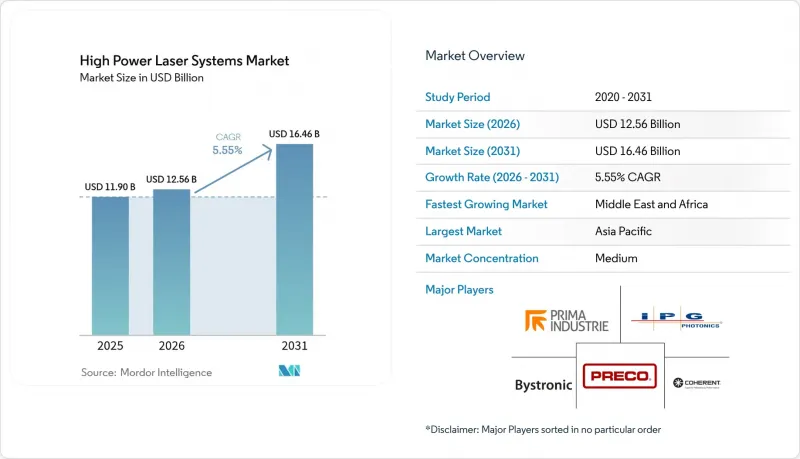
本報告按雷射光源類型(光纖雷射器、碟片雷射器、二極體雷射器等)、功率輸出(1-2 kW、2-6 kW、6 kW 及以上)、應用領域(切割、焊接、覆層等)、終端用戶行業(汽車、航太和國防等)、工作模式(連續波、脈衝、超快)和地區進行細分。市場預測以美元(USD)計價。
全球高功率雷射系統市場趨勢及洞察
為因應電動車轉型,推出車身本體的超高高功率切割生產線
電動車平台需要鋁製空間框架和複合材料組件。這些組件需要以雷射加工,精度達到0.1毫米,同時也要抑制鋰離子電池周圍的熱負荷。特斯拉位於奧斯汀的工廠採用功率為6千瓦或以上的光纖雷射系統焊接電池機殼,生產速度超過15公尺/分鐘。中國製造商比亞迪和寧德時代也紛紛效仿,比亞迪的「刀片電池」生產線配備了10千瓦的設備,用於加工3.2毫米厚的鋼製外殼。因此,比亞迪已與系統整合商和二極體供應商簽訂了多年合約。
疫情後製造業回流正在推動對光纖雷射自動化領域的投資。
全球供應鏈中斷迫使半導體、航太和醫療設備製造商將生產遷回國內。 《晶片與科學法案》要求投資520億美元用於美國晶圓廠產能建設,每個工廠都必須整合雷射切割、鑽孔和焊接單元。相干公司的SmartSense+平台提供人工智慧驅動的製程監控,即使在高產能下也能減少操作員干預並維持品質穩定。歐洲也出現了類似的趨勢,雷射自動化被用於抵消不斷上漲的人事費用,而且對設備的需求在工廠建設初期之後仍然持續存在。
資本投資回收期:對於從事小規模生產的中小型企業而言,為 4 年或更長。
一套4千瓦光纖單元的總承包接近50萬美元,如果運轉率低於60%,投資回收期將超過四年。百超科技和區域性銀行提供的融資方案透過將付款納入營運預算降低了進入門檻,但在訂單前景有限的新興市場,風險依然令人擔憂。
細分市場分析
光纖雷射器憑藉其50%的電能轉換效率和密封光纖的可靠性,預計到2025年將佔總銷售額的61.25%。超快光纖雷射正以6.95%的複合年成長率快速成長,滿足半導體和醫療元件領域對最大限度減少熱影響區的需求。二氧化碳雷射系統在切割厚非金屬材料和木材等領域仍然很受歡迎,而碟片雷射在一些汽車焊接等特殊應用中找到了用武之地,其平頂光束輪廓有助於提高穿透深度。二極體直接髮射平台在表面硬化生產線中應用日益廣泛,但其5千瓦的功率上限限制了其更廣泛的普及。隨著自動化技術的應用範圍擴展到主要原始設備製造商之外,預計到2031年,基於光纖平台的高功率雷射系統的市場規模將達到100.8億美元。
儘管來自中國供應商的競爭產品正在拉低平均售價(ASP),但光束耦合、模式控制和即時監控的智慧財產權鞏固了市場領導的地位。 IEC 60825 等安全標準推薦使用光纖,因為其發散角小,這促進了光纖在工廠環境中的整合,因為工廠環境無需大型防護機殼。千瓦級單晶發光二極體的持續研發有望催生新的光源架構,但預計在 2027 年之前不太可能商業化。
到2025年,功率在2-6千瓦範圍內的系統將佔據高功率雷射系統市場48.35%的佔有率,適用於測量汽車鋼板的厚度,切割速度可超過15公尺/分鐘,同時保持穩定的切割邊緣品質。預計到2031年,功率超過6千瓦的設備將以7.12%的複合年成長率成長,這主要得益於造船、重型機械和國防等行業高功率雷射(HEL)項目中對更深鑽孔和更厚板材加工的需求。漢氏雷射已成功展示了一款用於船舶子組件面板的150千瓦多光束產品,這代表了商業部署功率輸出的上限。
在功率超過 10 kW 的範圍內,溫度控管仍然是瓶頸,推動著微通道冷卻器和相變材料等領域的創新,以維持光束品質。相較之下,1-2 kW 的電源廣泛應用於電子和醫療器材等領域,低熱輸入可避免元件變形。技術藍圖表明,除了功率的持續提升外,還將結合自適應光束整形技術(將能量分成多個光斑),以實現並行處理並縮短生產線週期時間。
區域分析
預計到2025年,亞太地區將佔全球銷售額的38.60%,其成長主要得益於中國和日本精密設備技術的規模優勢。北京的「中國製造2025」計畫正在推動和加速國內汽車製造商採用電氣化技術。同時,武漢HG雷射和Raykas等公司正在提供具成本效益的平台,縮短本地處理器的投資回報週期。日本製造商如FANUC)正在整合滿足半導體微影術要求的先進光束控制技術,從而鞏固其在超快雷射器這一細分市場的區域領先地位。
歐洲是全球第二大市場,規模雖小,但在政策主導領域卻佔有主導地位。 《淨零排放工業法案》為雷射清洗和焊接提供補貼,以減少化學物質對環境的影響,從而促進了德國、法國和義大利等國的相關技術應用。歐洲各國國防機構共同資助高能量雷射示範項目,並透過供應商共用,對民用製造業產生連鎖反應。技術純熟勞工短缺仍然是阻礙因素,因此人們對人工智慧輔助機械的興趣日益濃厚,因為這類機械可以減少對操作人員專業知識的需求。
中東和非洲正處於最快的成長軌道上,預計到2031年複合年成長率將達到8.78%。沙烏地阿拉伯的「2030願景」正在推動航空航太、可再生能源和國內鋼鐵項目的發展,所有這些項目都依賴高功率雷射系統市場解決方案進行精密加工。阿拉伯聯合大公國(阿拉伯聯合大公國)正在投資建造一個維護、修理和大修(MRO)中心,該中心採用雷射覆層進行渦輪葉片維修。由於國內零件供應有限,阿拉伯聯合大公國需要與歐洲和亞洲的系統整合商建立合作關係,從而形成進口機械和本地化服務相結合的混合生態系統。
其他好處:
- Excel格式的市場預測(ME)表
- 3個月的分析師支持
目錄
第1章:引言
- 研究假設和市場定義
- 調查範圍
第2章:調查方法
第3章執行摘要
第4章 市場狀況
- 市場概覽
- 市場促進因素
- 向用於電動汽車白車身應用的高功率切割線過渡。
- 疫情後的製造業回流正在推動對光纖雷射自動化技術的投資。
- 對切割寬度小於50µm的航太微焊接的需求
- 人工智慧驅動的封閉回路型光束調節可減少廢料和能源成本。
- 國防部門的 HEL 升級計畫(100 千瓦及以上)正在加速採購。
- 歐盟的《淨零排放產業法案》為綠光雷射加工獎勵。
- 市場限制因素
- 資本投資回收期:對於從事小規模生產的中小型企業而言,需要 4 年以上。
- 加強高功率光束安全法規(IEC 60825-5)
- 鎵二極體的供應波動
- 熟練雷射加工技術人員短缺
- 產業供應鏈分析
- 監理情勢
- 技術展望
- 波特五力分析
第5章 市場規模與成長預測
- 依雷射光源類型
- 光纖雷射
- 光碟雷射
- 二極體雷射
- 二氧化碳雷射
- 其他雷射光源類型
- 依輸出類型
- 1~2 kW
- 2~6 kW
- 6千瓦或以上
- 透過使用
- 切割
- 焊接
- 覆材
- 硬化
- 清洗和消融
- 按最終用戶行業分類
- 車
- 航太/國防
- 電子和半導體
- 醫療器材
- 能源與電力
- 其他終端用戶產業
- 透過操作模式
- 連續波
- 脈衝型
- 超高速(ps/fs)
- 按地區
- 北美洲
- 美國
- 加拿大
- 墨西哥
- 南美洲
- 巴西
- 阿根廷
- 哥倫比亞
- 其他南美國家
- 歐洲
- 英國
- 德國
- 法國
- 義大利
- 西班牙
- 其他歐洲國家
- 亞太地區
- 中國
- 日本
- 韓國
- 印度
- 其他亞太國家
- 中東和非洲
- 中東
- 沙烏地阿拉伯
- 阿拉伯聯合大公國
- 其他中東國家
- 非洲
- 南非
- 埃及
- 其他非洲國家
- 中東
- 北美洲
第6章 競爭情勢
- 市場集中度
- 策略趨勢
- 市佔率分析
- 公司簡介
- TRUMPF SE+Co. KG
- IPG Photonics Corporation
- Coherent Corp.
- Han's Laser Technology Industry Group Co., Ltd.
- Bystronic AG
- Prima Industrie SpA
- EL.EN. SpA
- Preco Inc.
- HSG Laser
- Amada Co., Ltd.
- Mitsubishi Electric Corporation
- Wuhan HG Laser Engineering Co., Ltd.
- Raycus Fiber Laser Technologies Co., Ltd.
- nLIGHT, Inc.
- Lumentum Operations LLC
- Jenoptik AG
- Mazak Optonics Corp.
- FANUC Corporation
- Trotec Laser GmbH
- Universal Laser Systems, Inc.
第7章 市場機會與未來展望
According to Mordor Intelligence, the high power laser systems market size is expected to grow from USD 11.9 billion in 2025 to USD 12.56 billion in 2026 and is forecast to reach USD 16.46 billion by 2031 at 5.55% CAGR over 2026-2031.
This report is Segmented by Laser Source Type (Fiber Laser, Disk Laser, Diode Laser, and More), Power Output (1-2 KW, 2-6 KW, and Above 6 KW), Application (Cutting, Welding, Cladding, and More), End-User Industry (Automotive, Aerospace and Defense, and More), Mode of Operation (Continuous-Wave, Pulsed, and Ultrafast), and Geography. The Market Forecasts are Provided in Terms of Value (USD).
Global High Power Laser Systems Market Trends and Insights
Shift-to-EV Body-in-White Ultra-High-Power Cutting Lines
Electric-vehicle platforms require aluminum space frames and mixed-material assemblies that demand laser accuracy of 0.1 mm while limiting thermal load near lithium-ion cells. Tesla's Austin plant uses 6 kW+ fiber systems to weld battery enclosures at production speeds above 15 m/min. Chinese makers BYD and CATL extend the trend, with BYD's Blade Battery lines deploying 10 kW equipment for 3.2 mm steel housings. The resulting order flow locks in multi-year contracts for system integrators and diode suppliers.
Post-Pandemic Reshoring Driving Fiber-Laser Automation Investments
Global supply-chain shocks pushed semiconductor, aerospace, and medical manufacturers to reshore production. The CHIPS and Science Act directs USD 52 billion toward U.S. fab capacity, each facility integrating laser dicing, drilling, and welding cells. Coherent's SmartSense+ platform delivers AI process monitoring that reduces operator intervention and supports consistent quality at higher throughput. Similar moves in Europe use laser automation to offset higher labor costs, sustaining equipment demand beyond initial plant buildouts.
Cap-ex payback More than 4 yrs for SMEs in low-volume fabrication
Total turnkey costs for a 4 kW fiber cell approach USD 500,000, driving payback periods beyond 4 years when utilization falls below 60%. Financing programs from Bystronic and regional banks lower entry barriers by shifting payments to operating budgets, yet risk perceptions remain high in emerging markets where order visibility is limited.
Other drivers and restraints analyzed in the detailed report include:
- Demand for sub-50 μm kerf aerospace micro-welding
- AI-enabled closed-loop beam tuning lowers scrap and energy costs
- Gallium-Based Diode Supply Volatility
For complete list of drivers and restraints, kindly check the Table Of Contents.
Segment Analysis
Fiber lasers captured 61.25% revenue in 2025 on the strength of 50% wall-plug efficiency and sealed-fiber reliability. Ultrafast fiber variants advance at a 6.95% CAGR, addressing semiconductor and medical components that require minimal heat-affected zones. CO2 systems persist in thick non-metal and wood cutting, while disk lasers serve niche automotive welding, where top-hat beam profiles aid penetration. Diode direct-emission platforms grow in surface hardening lines, yet their 5 kW ceiling limits broader uptake. The high power laser systems market size for fiber platforms is expected to rise to USD 10.08 billion by 2031 as automation spreads beyond leading OEMs.
Competitive presses from Chinese vendors compress ASPs, but intellectual property in beam-combining, mode control, and real-time monitoring helps market leaders defend positions. Safety standards such as IEC 60825 favor fibers due to lower divergence, supporting factory-floor integration without large protective enclosures. Continuous R&D around kilowatt-class single-emitter diodes would unlock new source architectures, but commercialization is unlikely before 2027.
Systems in the 2-6 kW window commanded 48.35% of the high power laser systems market share in 2025, fitting automotive steel gauges and delivering cut speeds above 15 m/min with stable edge quality. Above-6 kW units are projected to post a 7.12% CAGR to 2031 as shipbuilding, heavy equipment, and defense HEL programs require deeper penetration and thicker plate processing. Han's Laser validated 150 kW multibeam products for ship subassembly panels, demonstrating the upper power limit in commercial deployment.
Thermal management remains a bottleneck beyond 10 kW, driving innovations in micro-channel coolers and phase-change materials that maintain beam quality. In contrast, 1-2 kW sources dominate electronics and medical tooling, where low heat input avoids component distortion. Technology roadmaps indicate continued power scaling paired with adaptive beam shaping that splits energy across multiple spots, enabling parallel processing and higher line takt times.
Complete Report Scope:
- By Laser Source Type
- Fiber Laser
- Disk Laser
- Diode Laser
- CO2 Laser
- Other Laser Source Types
- By Power Output
- 1 - 2 kW
- 2 - 6 kW
- Above 6 kW
- By Application
- Cutting
- Welding
- Cladding
- Hardening
- Cleaning and Ablation
- By End-user Industry
- Automotive
- Aerospace and Defense
- Electronics and Semiconductor
- Medical Devices
- Energy and Power
- Other End-user Industries
- By Mode of Operation
- Continuous-Wave
- Pulsed
- Ultrafast (ps/fs)
- By Geography
- North America
- United States
- Canada
- Mexico
- South America
- Brazil
- Argentina
- Colombia
- Rest of South America
- Europe
- United Kingdom
- Germany
- France
- Italy
- Spain
- Rest of Europe
- Asia-Pacific
- China
- Japan
- South Korea
- India
- Rest of Asia-Pacific
- Middle East and Africa
- Middle East
- Saudi Arabia
- United Arab Emirates
- Rest of Middle East
- Africa
- South Africa
- Egypt
- Rest of Africa
- Middle East
- North America
Geography Analysis
Asia-Pacific generated 38.60% of 2025 revenue, coupling China's scale with Japan's precision equipment capabilities. Beijing's "Made in China 2025" agenda spurs adoption as domestic automakers electrify fleets, while Wuhan HG Laser and Raycus provide cost-effective platforms that shorten ROI for local fabricators. Japanese producers such as FANUC integrate advanced beam control that aligns with semiconductor lithography requirements, reinforcing regional leadership in ultrafast niches.
Europe ranks second in value yet leads policy-driven segments. The Net-Zero Industry Act subsidizes laser cleaning and welding to reduce the environmental impact of chemicals, supporting uptake in Germany, France, and Italy. European defense agencies co-fund HEL demonstrators, creating spill-over to civilian manufacturing through shared supplier bases. Skilled-labor shortages remain a constraint, elevating interest in AI-assisted machines that reduce operator specialization.
Middle East and Africa represent the fastest trajectory with a 8.78% CAGR to 2031. Saudi Arabia's Vision 2030 pushes aviation, renewable energy, and local steel projects, each reliant on high-power laser systems market solutions for precision fabrication. The United Arab Emirates invests in maintenance-repair-overhaul hubs adopting laser cladding for turbine blade refurbishment. Limited domestic component supply urges partnerships with European and Asian integrators, shaping a hybrid ecosystem of imported machinery and localized service.
- TRUMPF SE + Co. KG
- IPG Photonics Corporation
- Coherent Corp.
- Han's Laser Technology Industry Group Co., Ltd.
- Bystronic AG
- Prima Industrie S.p.A.
- EL.EN. S.p.A.
- Preco Inc.
- HSG Laser
- Amada Co., Ltd.
- Mitsubishi Electric Corporation
- Wuhan HG Laser Engineering Co., Ltd.
- Raycus Fiber Laser Technologies Co., Ltd.
- nLIGHT, Inc.
- Lumentum Operations LLC
- Jenoptik AG
- Mazak Optonics Corp.
- FANUC Corporation
- Trotec Laser GmbH
- Universal Laser Systems, Inc.
Additional Benefits:
- The market estimate (ME) sheet in Excel format
- 3 months of analyst support
TABLE OF CONTENTS
1 INTRODUCTION
- 1.1 Study Assumptions and Market Definition
- 1.2 Scope of the Study
2 RESEARCH METHODOLOGY
3 EXECUTIVE SUMMARY
4 MARKET LANDSCAPE
- 4.1 Market Overview
- 4.2 Market Drivers
- 4.2.1 Shift-to-EV body-in-white ultra-high-power cutting lines
- 4.2.2 Post-pandemic reshoring driving fiber-laser automation investments
- 4.2.3 Demand for sub-50 µm kerf aerospace micro-welding
- 4.2.4 AI-enabled closed-loop beam tuning lowers scrap and energy costs
- 4.2.5 Defense HEL upgrade programs (Greater than 100 kW) accelerate procurement
- 4.2.6 EU "Net-Zero Industry Act" incentives for green laser processing
- 4.3 Market Restraints
- 4.3.1 Cap-ex payback More than 4 yrs for SMEs in low-volume fabrication
- 4.3.2 High-power beam safety regulations tightening (IEC 60825-5)
- 4.3.3 Gallium-based diode supply volatility
- 4.3.4 Skilled laser-process engineering talent shortage
- 4.4 Industry Supply Chain Analysis
- 4.5 Regulatory Landscape
- 4.6 Technological Outlook
- 4.7 Porter's Five Forces Analysis
- 4.7.1 Bargaining Power of Suppliers
- 4.7.2 Bargaining Power of Consumers
- 4.7.3 Threat of New Entrants
- 4.7.4 Intensity of Competitive Rivalry
- 4.7.5 Threat of Substitute Products
5 MARKET SIZE AND GROWTH FORECASTS (VALUE)
- 5.1 By Laser Source Type
- 5.1.1 Fiber Laser
- 5.1.2 Disk Laser
- 5.1.3 Diode Laser
- 5.1.4 CO2 Laser
- 5.1.5 Other Laser Source Types
- 5.2 By Power Output
- 5.2.1 1 - 2 kW
- 5.2.2 2 - 6 kW
- 5.2.3 Above 6 kW
- 5.3 By Application
- 5.3.1 Cutting
- 5.3.2 Welding
- 5.3.3 Cladding
- 5.3.4 Hardening
- 5.3.5 Cleaning and Ablation
- 5.4 By End-user Industry
- 5.4.1 Automotive
- 5.4.2 Aerospace and Defense
- 5.4.3 Electronics and Semiconductor
- 5.4.4 Medical Devices
- 5.4.5 Energy and Power
- 5.4.6 Other End-user Industries
- 5.5 By Mode of Operation
- 5.5.1 Continuous-Wave
- 5.5.2 Pulsed
- 5.5.3 Ultrafast (ps/fs)
- 5.6 By Geography
- 5.6.1 North America
- 5.6.1.1 United States
- 5.6.1.2 Canada
- 5.6.1.3 Mexico
- 5.6.2 South America
- 5.6.2.1 Brazil
- 5.6.2.2 Argentina
- 5.6.2.3 Colombia
- 5.6.2.4 Rest of South America
- 5.6.3 Europe
- 5.6.3.1 United Kingdom
- 5.6.3.2 Germany
- 5.6.3.3 France
- 5.6.3.4 Italy
- 5.6.3.5 Spain
- 5.6.3.6 Rest of Europe
- 5.6.4 Asia-Pacific
- 5.6.4.1 China
- 5.6.4.2 Japan
- 5.6.4.3 South Korea
- 5.6.4.4 India
- 5.6.4.5 Rest of Asia-Pacific
- 5.6.5 Middle East and Africa
- 5.6.5.1 Middle East
- 5.6.5.1.1 Saudi Arabia
- 5.6.5.1.2 United Arab Emirates
- 5.6.5.1.3 Rest of Middle East
- 5.6.5.2 Africa
- 5.6.5.2.1 South Africa
- 5.6.5.2.2 Egypt
- 5.6.5.2.3 Rest of Africa
- 5.6.5.1 Middle East
- 5.6.1 North America
6 COMPETITIVE LANDSCAPE
- 6.1 Market Concentration
- 6.2 Strategic Moves
- 6.3 Market Share Analysis
- 6.4 Company Profiles (includes Global level Overview, Market level overview, Core Segments, Financials as available, Strategic Information, Market Rank/Share, Products and Services, Recent Developments)
- 6.4.1 TRUMPF SE + Co. KG
- 6.4.2 IPG Photonics Corporation
- 6.4.3 Coherent Corp.
- 6.4.4 Han's Laser Technology Industry Group Co., Ltd.
- 6.4.5 Bystronic AG
- 6.4.6 Prima Industrie S.p.A.
- 6.4.7 EL.EN. S.p.A.
- 6.4.8 Preco Inc.
- 6.4.9 HSG Laser
- 6.4.10 Amada Co., Ltd.
- 6.4.11 Mitsubishi Electric Corporation
- 6.4.12 Wuhan HG Laser Engineering Co., Ltd.
- 6.4.13 Raycus Fiber Laser Technologies Co., Ltd.
- 6.4.14 nLIGHT, Inc.
- 6.4.15 Lumentum Operations LLC
- 6.4.16 Jenoptik AG
- 6.4.17 Mazak Optonics Corp.
- 6.4.18 FANUC Corporation
- 6.4.19 Trotec Laser GmbH
- 6.4.20 Universal Laser Systems, Inc.
7 MARKET OPPORTUNITIES AND FUTURE OUTLOOK
- 7.1 White-space and Unmet-need Assessment

 2026年全球電池供電神經外科電源系統市場報告
 印度雷射市場:市場佔有率分析、產業趨勢與統計、成長預測(2026-2031)
 全球戶外旋轉雷射水平儀市場:按傾角、測量範圍、傾角功能、分銷管道、價格範圍、應用和地區分類-預測至2032年
 國防雷射(2026):技術、應用與市場趨勢雷射:市場佔有率分析、行業趨勢和統計數據、成長預測(2026-2031)2026年顱骨牽引手術動力系統全球市場報告
 綠光雷射市場規模、佔有率和成長分析:按產品類型、功率輸出、工作模式、應用、最終用戶和地區分類-2026-2033年產業預測
 中紅外線雷射器市場規模、佔有率和成長分析:按類型、波長範圍、應用、技術、功率輸出和地區分類-2026-2033年產業預測
 可調式雷射光源市場預測至2034年-按技術、類型、波長、應用、最終用戶和地區分類的全球分析2026年全球綠光雷射市場報告