


 |
市場調查報告書
商品編碼
2122400
拉丁美洲乘用車市場:市場佔有率分析、產業趨勢與統計及成長預測(2026-2031 年)Latin America Passenger Car - Market Share Analysis, Industry Trends & Statistics, Growth Forecasts (2026 - 2031) |
||||||

※ 本網頁內容可能與最新版本有所差異。詳細情況請與我們聯繫。
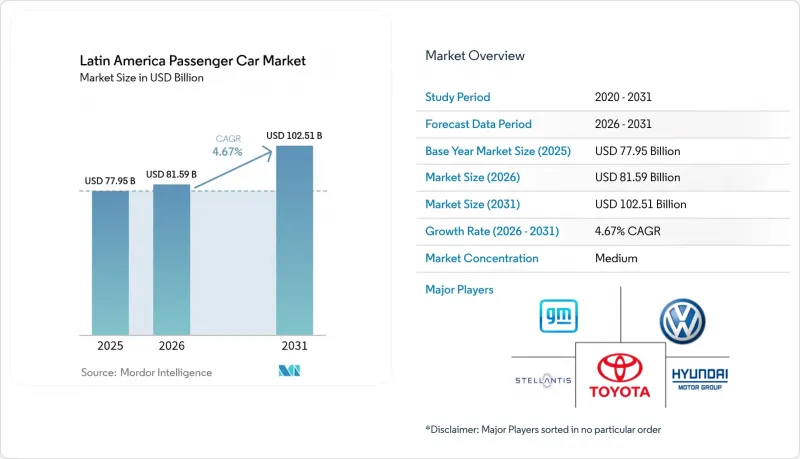
根據Mordor Intelligence預測,拉丁美洲乘用車市場規模預計在2026年達到815.9億美元,高於2025年的779.5億美元。預計到2031年,該市場規模將達到1,025.1億美元,2026年至2031年的複合年成長率為4.67%。
本報告按車輛類型(掀背車、轎車、其他)、車輛等級(入門級(A/B級)、中型(C級)、其他)、動力系統/燃料類型(汽油、柴油、其他)、銷售管道(OEM直銷、獨立經銷商)和國家/地區進行分類。市場預測以價值(美元)和銷售(輛)表示。
拉丁美洲乘用車市場的趨勢與洞察
疫情後家庭汽車擁有量強勁復甦
隨著疫情限制措施的逐步解除,私家車擁有量顯著成長。這一成長主要受工作方式轉變、共享出行依賴性降低以及郊區人口遷移趨勢的推動。在墨西哥,這種轉變導致輕型汽車銷量大幅成長,在經濟復甦的支撐下,預計這一成長勢頭將持續到2025年。同時,在巴西,近期的經濟復甦提振了消費者信心,促使更多人最終購買了先前推遲購買的汽車。需求依然強勁,尤其是在省會城市。在這些地區,公共運輸基礎設施有限,導致展示室客流量穩定,對個人出行解決方案的需求持續強勁。
中國汽車製造商資本的快速湧入和低成本電動車的進口
憑藉強大的國內電池供應鏈和政府資金籌措,中國汽車製造商正大力進軍拉丁美洲市場。例如,比亞迪透過在地化生產迅速擴大了在巴西的市場佔有率。這項策略不僅使其能夠規避進口關稅,還能實現更具競爭力的價格。長城汽車和奇瑞等品牌也紛紛效仿,加劇了該地區的價格競爭。雖然日益激烈的競爭擴大了消費者可選擇的經濟型電動車的範圍,但也給現有製造商帶來了壓力,擠壓了利潤空間,並改變了市場競爭格局。
由於披索和雷亞爾貶值,進口成本上升。
宏觀經濟壓力正影響拉丁美洲主要市場,進而影響汽車的可負擔性。巴西正努力應對貿易失衡問題,而阿根廷的工業產能仍未充分利用,這兩大問題都凸顯了廣泛的經濟緊張局勢。同時,該地貨幣貶值推高了進口零件的成本。為應對這一局面,汽車製造商紛紛提高車輛價格,這可能會延長更換週期,並抑制對非必要升級的需求。這些趨勢可能會減緩成長預期,並使維持長期市場擴張的努力變得更加複雜。
細分市場分析
到2025年,SUV/跨界車將佔拉丁美洲乘用車市場40.85%的佔有率,預計在預測期(2026-2031年)內將以4.88%的複合年成長率成長,超過所有其他車型。隨著小型車和B級車的普及,入門價格也呈現下降趨勢。消費者對SUV/跨界車的需求主要源自於其更高的安全性和更高的離地間隙,這使其更適合在未鋪設路面和易澇路段行駛。豐田的Hybrid Flex SUV舉措不僅充分利用了現有的乙醇基礎設施,也滿足了排放氣體法規的要求。同時,中國新興汽車製造商正在推出配置豐富的跨界車,其價格與傳統小型轎車相當,這偏好消費者轉向這些高底盤車型。
轎車和掀背車仍然有市場需求,尤其是在巴西沿海城市,都市區擁擠和燃油效率是重要的購車因素。然而,隨著家庭在車輛更換週期中升級到更高階的車型,這兩種車型的市佔率總合持續下降。多用途汽車(MPV)仍然是一個小眾市場,主要面向農村車隊營運商和大家庭,對他們而言,載客量比燃油效率更為重要。
預計到2025年,入門級A/B級車型將佔據拉丁美洲乘用車市場47.83%的佔有率,在預測期(2026-2031年)內複合年成長率(CAGR)為5.08%。這主要得益於具有競爭力的融資條件和政府對小型車的稅額扣抵。巴西和墨西哥融資管道的改善正在擴大目標市場,同時汽車製造商也利用平台通用來降低單位成本。
中型車C級車的目標客戶是不斷壯大的中產階級,但隨著消費者直接轉向緊湊型SUV,C級車面臨被替代的風險。高階D/E級車市場目前主要局限於富裕的都市區專業人士和政府用車用戶,但電動車的出現使其成為人們嚮往的車款。比亞迪的Dolphin Mini展示了價格親民的緊湊型電動車,結合稅收優惠政策,如何加速電動車技術的普及。
其他好處
- Excel格式的市場預測(ME)表
- 3個月的分析師支持
目錄
第1章:引言
- 研究假設和市場定義
- 調查範圍
第2章:調查方法
第3章執行摘要
第4章 市場狀況
- 市場概覽
- 市場促進因素
- 疫情後家庭汽車擁有量強勁復甦
- 中國汽車製造商資本的快速湧入和低成本電動車的進口
- 為避免美墨加協定/南方共同市場關稅上漲,原始設備製造商(OEM)紛紛將生產轉移回國內
- 汽車製造商重啟靈活燃料投資計劃
- 巴西和哥倫比亞推出稅收優惠政策,支持電動車發展
- 透過穩定半導體供應鏈消除生產延誤。
- 市場限制因素
- 由於披索和雷亞爾貶值,進口成本上升。
- 加快主要城市快速公車系統的擴張
- 一線城市以外地區公共充電站密度低。
- 到2027年,區域二氧化碳排放(車輛平均值)目標將更加嚴格。
- 價值供應鏈分析
- 監理情勢
- 技術展望
- 波特五力模型
第5章 市場規模與成長預測
- 按車輛類型
- 掀背車
- 轎車
- SUV/跨界車
- 多用途汽車(MPV)
- 按車輛類別
- 入門級(A/B)
- 中型(C)
- 全片幅(D/E)
- 按推進系統和燃料類型
- 汽油
- 柴油引擎
- 彈性燃料
- 油電混合車
- 電池電動車
- 按銷售管道
- OEM直營店
- 獨立經銷商
- 國家
- 巴西
- 墨西哥
- 阿根廷
- 哥倫比亞
- 智利
- 秘魯
- 其他拉丁美洲國家
第6章 競爭情勢
- 市場集中度
- 策略趨勢
- 市佔率分析
- 公司簡介
- General Motors Company
- Volkswagen AG
- Stellantis NV
- Toyota Motor Corporation
- Hyundai Motor Company
- Ford Motor Company
- Nissan Motor Corporation
- Renault SA
- Honda Motor Co., Ltd.
- Kia Corporation
- BMW AG
- Daimler AG(Mercedes-Benz)
- Chery Automobile
- BYD Auto
- SAIC-GM-Wuling
- Subaru Corporation
- Mazda Motor Corporation
- Geely Auto
- Audi AG
- Suzuki Motor Corporation
第7章 市場機會與未來展望
According to Mordor Intelligence, Latin America passenger car market size in 2026 is estimated at USD 81.59 billion, growing from 2025 value of USD 77.95 billion with 2031 projections showing USD 102.51 billion, growing at 4.67% CAGR over 2026-2031.
This report is Segmented by Vehicle Type (Hatchback, Sedan, and More), Vehicle Class (Entry-Level (A/B), Mid-Size (C), and More), Propulsion/Fuel Type (Gasoline, Diesel, and More), Sales Channel (OEM-Owned Stores and Independent Dealers), and Country. The Market Forecasts are Provided in Terms of Value (USD) and Volume (Units).
Latin America Passenger Car Market Trends and Insights
Resilient Post-Pandemic Rebound in Household Car Ownership
As pandemic restrictions eased, personal vehicle ownership saw a notable uptick. This surge was fueled by changing work habits, a diminished reliance on shared mobility, and a notable migration trend towards suburban areas. In Mexico, this shift has led to a pronounced increase in light-vehicle sales, a momentum that's projected to persist into 2025, buoyed by an improving economy. Meanwhile, in Brazil, a recent economic upswing has rekindled consumer confidence, prompting many to make vehicle purchases they had previously postponed. Notably, demand is particularly robust in secondary cities. Here, a limited public transportation infrastructure has resulted in consistent showroom traffic and a sustained appetite for personal mobility solutions.
Rapid Inflow of Chinese OEM Capital and Low-Cost EV Imports
Chinese automakers, bolstered by robust domestic battery supply chains and state-backed financing, are making significant inroads into Latin America. BYD, for instance, has swiftly captured market share in Brazil by localizing its production. This strategy not only sidesteps import tariffs but also allows for more competitive pricing. Following suit, brands like GWM and Chery are amplifying price competition in the region. While this surge in competition offers consumers a wider array of affordable electric vehicle choices, it simultaneously strains established manufacturers, squeezing their profit margins and altering the competitive dynamics.
Peso and Real Depreciation Inflating Import Costs
Key Latin American markets are feeling the pinch of macroeconomic pressures, impacting automotive affordability. Brazil grapples with external trade imbalances, and Argentina's industrial capacity remains underutilized, both highlighting broader economic strains. Concurrently, local currency weaknesses are inflating the costs of imported components. In response, automakers are hiking vehicle prices, potentially elongating replacement cycles and curbing demand for non-essential upgrades. Such dynamics could temper growth forecasts and complicate efforts to maintain long-term market expansion.
Other drivers and restraints analyzed in the detailed report include:
- OEM On-Shoring to Skirt USMCA/Mercosur Tariff Escalation
- Resumption of Automaker Flex-Fuel Investment Programs
- Acceleration of BRT Expansion in Major Metros
For complete list of drivers and restraints, kindly check the Table Of Contents.
Segment Analysis
SUVs/Crossovers accounted for 40.85% of the Latin America passenger car market in 2025 and are forecast to outpace all other body styles at a 4.88% CAGR during the forecast period (2026-2031). Buoyed by the increasing availability of sub-compact and B-segment variants, entry prices have seen a decline. Demand is driven by the vehicles' higher ground clearance, making them suitable for unpaved or flood-prone roads, and a prevailing perception of enhanced safety. Toyota's hybrid-flex SUV initiative not only leverages the current ethanol infrastructure but also tackles emissions caps. Meanwhile, Chinese newcomers are introducing feature-rich crossovers, priced similarly to traditional compacts, swaying consumer preference towards these taller vehicles.
Sedans and hatchbacks maintain relevance where urban congestion and fuel economy dominate decision factors, particularly across Brazil's coastal cities. However, their combined share continues to decline as households upgrade during replacement cycles. Multi-purpose vehicles remain niche, catering mainly to fleet operators and large families in rural areas where passenger capacity trumps efficiency.
Entry-level A/B models captured 47.83% of the Latin America passenger car market share in 2025, and with a 5.08% CAGR during the forecast period (2026-2031). Driven by competitive financing and governmental tax credits for compact cars. Credit access improvements in Brazil and Mexico expand the eligible buyer pool, while OEMs utilize platform commonality to cut per-unit costs.
Mid-size C-segment offerings cater to an expanding middle class, yet they face substitution risk as consumers transition directly to compact SUVs. Premium D/E classes stay limited to affluent urban professionals and government fleets, although EV variants add a new aspirational layer. BYD's Dolphin Mini illustrates how low-priced electric compacts can accelerate technology diffusion when paired with tax exemptions.
Complete Report Scope:
- By Vehicle Type
- Hatchback
- Sedan
- SUV / Crossover
- Multi-Purpose Vehicle (MPV)
- By Vehicle Class
- Entry-Level (A/B)
- Mid-Size (C)
- Full-Size (D/E)
- By Propulsion / Fuel Type
- Gasoline
- Diesel
- Flex-Fuel
- Hybrid Electric Vehicle
- Battery-Electric Vehicle
- By Sales Channel
- OEM-Owned Stores
- Independent Dealers
- By Country
- Brazil
- Mexico
- Argentina
- Colombia
- Chile
- Peru
- Rest of Latin America
List of Companies Covered in this Report:
- General Motors Company
- Volkswagen AG
- Stellantis N.V.
- Toyota Motor Corporation
- Hyundai Motor Company
- Ford Motor Company
- Nissan Motor Corporation
- Renault S.A.
- Honda Motor Co., Ltd.
- Kia Corporation
- BMW AG
- Daimler AG (Mercedes-Benz)
- Chery Automobile
- BYD Auto
- SAIC-GM-Wuling
- Subaru Corporation
- Mazda Motor Corporation
- Geely Auto
- Audi AG
- Suzuki Motor Corporation
Additional Benefits:
- The market estimate (ME) sheet in Excel format
- 3 months of analyst support
TABLE OF CONTENTS
1 Introduction
- 1.1 Study Assumptions & Market Definition
- 1.2 Scope of the Study
2 Research Methodology
3 Executive Summary
4 Market Landscape
- 4.1 Market Overview
- 4.2 Market Drivers
- 4.2.1 Resilient Post-Pandemic Rebound in Household Car Ownership
- 4.2.2 Rapid Inflow of Chinese OEM Capital and Low-Cost EV Imports
- 4.2.3 OEM On-Shoring to Skirt USMCA/Mercosur Tariff Escalation
- 4.2.4 Resumption of Automaker Flex-Fuel Investment Programs
- 4.2.5 EV-Friendly Fiscal Credits in Brazil and Colombia
- 4.2.6 Stabilizing Semiconductor Supply Chain Enabling Production Catch-Up
- 4.3 Market Restraints
- 4.3.1 Peso and Real Depreciation Inflating Import Costs
- 4.3.2 Acceleration of BRT Expansion in Major Metros
- 4.3.3 Limited Public Charging Density Outside Tier-1 Cities
- 4.3.4 Tightening Regional CO2 Fleet-Average Targets by 2027
- 4.4 Value / Supply-Chain Analysis
- 4.5 Regulatory Landscape
- 4.6 Technological Outlook
- 4.7 Porter's Five Forces
- 4.7.1 Bargaining Power of Suppliers
- 4.7.2 Bargaining Power of Buyers
- 4.7.3 Threat of New Entrants
- 4.7.4 Threat of Substitutes
- 4.7.5 Competitive Rivalry
5 Market Size & Growth Forecasts (Value and Volume)
- 5.1 By Vehicle Type
- 5.1.1 Hatchback
- 5.1.2 Sedan
- 5.1.3 SUV / Crossover
- 5.1.4 Multi-Purpose Vehicle (MPV)
- 5.2 By Vehicle Class
- 5.2.1 Entry-Level (A/B)
- 5.2.2 Mid-Size (C)
- 5.2.3 Full-Size (D/E)
- 5.3 By Propulsion / Fuel Type
- 5.3.1 Gasoline
- 5.3.2 Diesel
- 5.3.3 Flex-Fuel
- 5.3.4 Hybrid Electric Vehicle
- 5.3.5 Battery-Electric Vehicle
- 5.4 By Sales Channel
- 5.4.1 OEM-Owned Stores
- 5.4.2 Independent Dealers
- 5.5 By Country
- 5.5.1 Brazil
- 5.5.2 Mexico
- 5.5.3 Argentina
- 5.5.4 Colombia
- 5.5.5 Chile
- 5.5.6 Peru
- 5.5.7 Rest of Latin America
6 Competitive Landscape
- 6.1 Market Concentration
- 6.2 Strategic Moves
- 6.3 Market Share Analysis
- 6.4 Company Profiles (includes Global Level Overview, Market Level Overview, Core Segments, Financials as Available, Strategic Information, Market Rank/Share for Key Companies, Products and Services, SWOT Analysis, and Recent Developments)
- 6.4.1 General Motors Company
- 6.4.2 Volkswagen AG
- 6.4.3 Stellantis N.V.
- 6.4.4 Toyota Motor Corporation
- 6.4.5 Hyundai Motor Company
- 6.4.6 Ford Motor Company
- 6.4.7 Nissan Motor Corporation
- 6.4.8 Renault S.A.
- 6.4.9 Honda Motor Co., Ltd.
- 6.4.10 Kia Corporation
- 6.4.11 BMW AG
- 6.4.12 Daimler AG (Mercedes-Benz)
- 6.4.13 Chery Automobile
- 6.4.14 BYD Auto
- 6.4.15 SAIC-GM-Wuling
- 6.4.16 Subaru Corporation
- 6.4.17 Mazda Motor Corporation
- 6.4.18 Geely Auto
- 6.4.19 Audi AG
- 6.4.20 Suzuki Motor Corporation
7 Market Opportunities & Future Outlook
- 7.1 White-Space & Unmet-Need Assessment

 按地區分類的乘用車替代動力傳動系統技術細分(2026-2030 年)
 2026-2030年全球乘用車塑膠市場
 印度乘用車:市場佔有率分析、產業趨勢與統計及成長預測(2026-2031 年)印度乘用車市場成長機會:2026-2032年
 智慧交通控制市場預測至2034年-按組件、部署模式、技術、應用、最終用戶和地區分類的全球分析
 車輛即服務 (VaaS) 市場規模、佔有率和成長分析:按服務類型、車輛類型、最終用戶和地區分類-2026-2033 年產業預測
 乘用車市場規模、佔有率和成長分析:按燃料類型、車輛類型、分銷管道和地區分類-2026-2033年產業預測
 汽車市場機會、成長要素、產業趨勢分析及2026-2035年預測。
 2026年全球乘用車市場報告VaaS(車輛即服務)市場全球市場報告(2026年)