


 |
市場調查報告書
商品編碼
2100739
印度乘用車:市場佔有率分析、產業趨勢與統計及成長預測(2026-2031 年)India Passenger Car - Market Share Analysis, Industry Trends & Statistics, Growth Forecasts (2026 - 2031) |
||||||

※ 本網頁內容可能與最新版本有所差異。詳細情況請與我們聯繫。
根據 Mordor Intelligence 預測,印度乘用車市場規模將從 2025 年的 413.4 億美元成長到 2026 年的 444.5 億美元,然後在 2031 年達到 638.4 億美元,2026 年至 2031 年的複合年成長率為 7.51%。
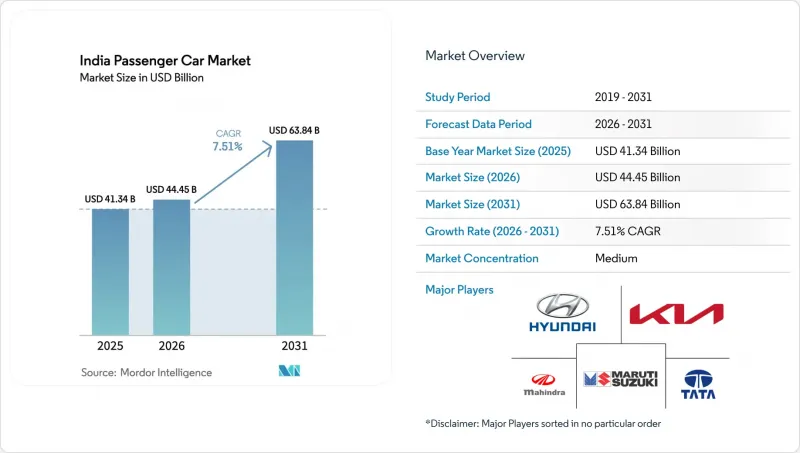
本報告按車輛類型(掀背車、MPV、轎車、SUV)、驅動方式(混合動力汽車和內燃機汽車)、變速箱(手排、自排、AMT/IMT、DCT/CVT)、價格區間(50萬印度盧比以下及其他)和所有權類型(個人和車隊)進行分類。預測數據以貨幣價值(美元)和銷售量(輛)表示。
印度乘用車市場趨勢與洞察
車身長度在4000-4400毫米之間的緊湊型SUV供應量正在迅速增加。
在預測期內,商品及服務稅 (GST) 的降低以及其他課稅的調整,促使眾多車身長度小於 4 公尺的 SUV 新車型上市。近期推出的車型,例如 Martí Fronx、現代 Ecstar、塔塔 Punch、馬恆達 XUV 3XO 和起亞 Sonnet,均受益於大幅的稅負減免,並取得了可觀的銷量。馬恆達 XUV 3XO 體現了市場對配置豐富的緊湊型 SUV 的強勁需求,上市後立即獲得了大量預訂單。雖然使用現代 K1 和馬恆達 Heartect 等通用平台可以將模具成本分攤到多個車型上,但這種叢集也加劇了價格競爭。隨著各品牌為因應庫存增加而推出捆綁式配件包和延長保固服務,中階市場的實際價格略有下降。
CNG基礎設施的發展將縮短實現營運成本與汽油持平所需的時間。
從2024年初到2025年底,CNG加氣站的數量顯著增加,在都市區提供了比汽油站價格更顯著的成本優勢。對於經常使用CNG的使用者來說,原廠配備CNG系統的車輛的投資回收期大幅縮短。這一趨勢使得Multi公司能夠大幅提升旗下多款CNG車型的銷售量。同時,現代和塔塔汽車也在透過為多款車型引入CNG選項來擴展其產品陣容。展望未來,監管機構已製定了雄心勃勃的目標,計劃在2020年代末期大幅增加加氣站的數量。然而,挑戰依然存在。由於諸如後備箱空間減少和動力輸出略有下降等權衡因素,CNG車輛在總銷量中所佔比例仍然很小。
經銷商庫存過剩超過 50 天的供應量,對 OEM 生產造成壓力。
流通庫存顯著增加,超過正常水平,導致大量車輛滯銷。為解決此問題,馬爾蒂於2026年1月大幅減產。同時,現代和塔塔採取措施支持經銷商融資,延長樓層平面圖期限,但這導致每輛車的利息成本增加。 2025年全年,印度儲備銀行將回購利率維持在穩定水平,這使得汽車貸款利率居高不下,並在假期季節抑制了需求。 2025年第四季,大幅折扣政策訂定,導致整車製造商毛利率大幅下降。
細分市場分析
預計到2025年,運動型多用途車(SUV)將佔印度乘用車交付量的53.47%,並預計在2031年之前以7.53%的年均成長率成長。車長小於4公尺的SUV,例如Martti Fronx、現代Ecstar和塔塔Punch,正受益於商品和服務稅(GST)的降低以及其他課稅的優惠。這項稅收優惠顯著降低了車輛整個生命週期的擁有成本,使這些SUV更易於被感興趣的家庭所接受。馬恆達Scorpio-N和XUV700的需求強勁,凸顯了後輪驅動和四輪驅動功能在高階市場的吸引力。同時,掀背車的市佔率正在下降,反映出首次購車者正轉向SUV的趨勢。轎車市場保持穩健,這得歸功於Martti Diar穩定的企業需求。此外,多用途車輛持續滿足大家庭的出行需求,尤其是在農村地區。
隨著SUV的日益普及,平台共用變得越來越普遍。現代的K1平台如今已成為多款車型的基礎,大幅降低了每款車型的研發成本。同時,Martí的「HARTECT」平台實現了靈活的車型變更,並提高了其位於古吉拉突邦工廠的生產效率。在競爭激烈的市場環境中,日產Magnite和雷諾Kaiger等車型的成功凸顯了售後服務比產品差異化更為重要。此外,像塔塔Curvv電動小轎車這樣具有創新車身設計的車型,即使在SUV細分市場日趨成熟的情況下,也展現出巨大的成長潛力,並已引起消費者的廣泛關注。
預計到2025年,內燃機汽車(ICE)將佔據83.35%的市場佔有率,而電動車(EV)預計到2031年將以7.61%的複合年成長率成長,這主要得益於PM E-DRIVE計劃帶來的顯著需求成長。塔塔汽車憑藉其Nexon EV、Tiago EV和Punch EV車型在電動車市場佔據主導地位,銷量強勁,並佔據了大部分市場佔有率。透過將這些車款策略性地定位在價格適中的區間,塔塔汽車成功擴大了其市場覆蓋範圍。相較之下,價格較高的現代Ioniq 5和起亞EV6的銷售量則較為有限。在內燃機車(ICE)中,汽油車仍然是最受歡迎的選擇,其次是柴油車,但CNG汽車也展現出強勁的成長勢頭,這主要得益於Martti的雙燃料車型系列。這凸顯了消費者擁有多樣化的選擇。
混合動力汽車市場成長迅猛,其中豐田Hi-Rider表現尤為突出。與汽油動力汽車相比,這款車燃油效率顯著提升,並享有稅收優惠。然而,插電式混合動力汽車和燃料電池汽車由於初始成本高昂、基礎設施不完善等因素,難以廣泛普及。未來排放氣體標準的明確政策將影響動力傳動系統技術的中期投資決策,但鑑於內燃機汽車持續強勁的表現,預計轉型將是一個漸進的過程,而非突飛猛進。
其他福利
- Excel格式的市場預測(ME)表
- 3個月的分析師支持
目錄
第1章:引言
- 研究假設和市場定義
- 調查範圍
第2章:調查方法
第3章執行摘要
第4章 主要產業趨勢
- 都市化、人口、汽車/大眾運輸需求
- 車輛擁有數量和汽車擁有率
- 電動車在汽車市場的滲透率
- 燃油價格與電費差異(每公里,內燃機汽車與電動車)
- 電動車和內燃機汽車的總擁有成本 (TCO) 差異
- 資金籌措和所有權模式(貸款、租賃、認購)
- 電池化學成分及電池組能量密度細分(磷酸鐵鋰電池與鎳錳電池,以及其他電池)
- 家庭、職場和公共場所充電樁的普及程度/安裝密度
- 快速充電網路滲透率和功率頻寬現狀
- 替代燃料基礎設施(燃料電池電動車的氫氣)
- 補貼和消費者獎勵(購買激勵、稅收激勵、通行費/停車費激勵)的價值
- OEM電動車產品線及未來車型計劃
- 價值鍊和通路分析
- 監管、財政和產業政策框架
第5章 市場狀況
- 市場概覽
- 市場促進因素
- 車身長度在 4000-4400 毫米之間的緊湊型 SUV 供應量正在迅速增加。
- CNG基礎設施的發展將縮短實現營運成本與汽油持平所需的時間。
- 以數位化為先導的年輕買家
- 電子商務驅動都市區零工車隊需求
- 汽車製造商正將印度作為小型汽車的全球出口中心。
- 我們專有的軟體定義車輛(SDV)技術堆疊縮短了車型開發週期。
- 市場限制因素
- 經銷商庫存過剩超過 50 天的供應量,對 OEM 生產造成壓力。
- 入門級掀背車市場價格競爭加劇,給利潤率帶來了壓力。
- 車身控制和ADAS ECU的長尾半導體短缺。
- 在主要城市以外,快速充電樁的運作並不穩定。
- 價值供應鏈分析
- 監理情勢
- 技術展望
- 波特五力模型
第6章 市場規模與成長預測
- 按車輛配置
- 掀背車
- MPV
- 轎車
- SUV
- 透過推進方法
- 混合動力汽車和電動車
- 電池式電動車
- 油電混合車
- 插電式混合動力電動車
- 燃料電池電動車
- 內燃機車(ICE)
- CNG
- 柴油引擎
- 汽油
- LPG
- 混合動力汽車和電動車
- 按變速器類型
- 手動的
- 自動(液力變矩器型)
- AMT/IMT
- DCT/CVT
- 按價格範圍
- 少於50萬印度盧比
- 50萬至100萬印度盧比
- 100萬至200萬印度盧比
- 超過200萬印度盧比
- 依所有權類型
- 個人
- 車隊(共乘、訂閱、租賃)
第7章 競爭情勢
- 策略趨勢
- 市佔率分析
- 公司簡介
- Maruti Suzuki India Limited
- Hyundai Motor India Limited
- Tata Motors Limited
- Mahindra & Mahindra Limited
- Kia Corporation
- Toyota Kirloskar Motor Pvt. Ltd.
- Honda Cars India Ltd.
- MG Motor India Pvt. Ltd.
- Renault India Pvt. Ltd.
- Nissan Motor India Pvt. Ltd.
- Volkswagen AG
- BYD India Pvt. Ltd.
- Audi AG
- BMW India Pvt. Ltd.
第8章 市場機會與未來展望
- 評估閒置頻段和未滿足的需求
第9章附錄
- 世界概覽
- 五力分析模型(全球)
- 全球價值鏈分析
- 市場動態(DRO)
- 資料來源與參考文獻
- 圖表一覽
- 主要發現
- 數據包
- 詞彙表
第10章:CEO應考慮的關鍵策略問題
According to Mordor Intelligence, the Indian passenger car market size is expected to grow from USD 41.34 billion in 2025 to USD 44.45 billion in 2026 and is forecast to reach USD 63.84 billion by 2031 at a 7.51% CAGR over 2026-2031.
This report is Segmented by Vehicle Configuration (Hatchback, MPV, Sedan, and SUV), Propulsion Type (Hybrid & Electric and ICE), Transmission (Manual, Automatic, AMT/IMT, and DCT/CVT), Price Band (Less Than or Equal To INR 5 Lakh and More), and Ownership (Personal and Fleet). Forecasts in Value (USD) and Volume (Units).
India Passenger Car Market Trends and Insights
Surging Compact-SUV Supply From 4,000-4,400 mm Length Bracket
Lower GST-plus-cess slabs spurred several launches in the sub-4-meter SUV segment during the forecast period. Recently launched models, including Maruti Fronx, Hyundai Exter, Tata Punch, Mahindra XUV 3XO, and Kia Sonet, collectively achieved significant sales volumes, with each benefiting from notable tax savings . Mahindra's XUV 3XO, highlighting the strong demand for feature-rich compact SUVs, received an overwhelming number of reservations shortly after its launch. While shared architectures, such as Hyundai's K1 and Maruti's Heartect, spread tooling costs across various models, this clustering heightened price competition. As brands offered bundled accessories and extended warranties to manage rising inventories, transaction prices in the mid-range segment experienced a slight decline.
CNG Infrastructure Build-Out Reducing Running-Cost Parity Time
Between early 2024 and late 2025, the number of CNG outlets experienced significant growth, offering a notable cost advantage over gasoline prices at urban pumps. For regular users, the payback period for factory-fitted CNG cars has become considerably shorter. This trend has driven Maruti to achieve substantial CNG sales across multiple models . Meanwhile, Hyundai and Tata have expanded their offerings by introducing CNG options in several models. Looking ahead, regulators have set ambitious targets for station expansion by the end of the decade. However, challenges persist: trade-offs like reduced boot space and slight power reductions have limited CNG adoption to a fraction of total volumes.
Dealer Inventory Overhang More Than 50 Days Pressuring OEM Production
Channel stock increased significantly, exceeding the usual levels, which resulted in a substantial number of unsold units. To address this issue, Maruti reduced its January 2026 production by a notable percentage. At the same time, Hyundai and Tata implemented measures to support dealer liquidity by extending floor-plan tenures, which led to additional interest expenses per car. Throughout 2025, the Reserve Bank of India maintained the repo rate at a steady level, keeping auto-loan rates relatively high and suppressing festive demand. During the last quarter of 2025, significant discounting caused a noticeable decline in OEM gross margins.
Other drivers and restraints analyzed in the detailed report include:
- Digital-First Aspirational Younger Buyers
- E-Commerce-Fuelled Urban Gig-Fleet Demand
- Intensifying Price War in Entry Hatchbacks Squeezing Margins
For complete list of drivers and restraints, kindly check the Table Of Contents.
Segment Analysis
Sports Utility Vehicles controlled 53.47% of 2025 deliveries within the Indian passenger car market size and should advance at a 7.53% trajectory to 2031. Sub-4-meter SUVs like the Maruti Fronx, Hyundai Exter, and Tata Punch benefit from a reduced GST-plus-cess slab. This tax break significantly lowers ownership costs over the vehicle's lifecycle, making these SUVs more accessible to aspirational households. Mahindra's Scorpio-N and XUV700 have demonstrated strong demand, highlighting the appeal of rear-wheel-drive and 4x4 features in the premium segment. Meanwhile, hatchbacks have seen a decline in market share, reflecting a trend of first-time buyers shifting towards SUVs. Sedans have maintained a stable presence, supported by consistent fleet demand for the Maruti Dzire, while multi-purpose vehicles continue to address the mobility needs of joint families, particularly in rural areas.
The surge in SUV popularity has led to shared platforms; Hyundai's K1 platform now underpins multiple models, achieving significant reductions in per-unit R&D costs. Maruti's Heartect platform, enabling flexible model transitions, has enhanced production efficiency at its Gujarat plant. In this competitive landscape, the performance of models like the Nissan Magnite and Renault Kiger underscores the importance of service accessibility over product differentiation. Furthermore, innovative body styles, such as Tata's Curvv EV coupe, which has attracted considerable consumer interest, indicate potential growth opportunities even as the segment matures.
Internal Combustion Engines kept 83.35% command in 2025; however, EVs are slated to record a 7.61% CAGR through 2031, aided by substantial PM E-DRIVE demand incentives. Tata Motors dominated the EV market, accounting for a significant share of sales with strong performance across its Nexon EV, Tiago EV, and Punch EV models. By strategically pricing these models in the affordable range, Tata Motors successfully broadened its market reach. In contrast, Hyundai's Ioniq 5 and Kia's EV6, positioned in the premium price segment, managed to capture only a limited volume. Among internal combustion engine (ICE) vehicles, gasoline remained the most preferred choice, followed by diesel, while CNG gained notable traction due to Maruti's bi-fuel offerings. This highlights the varied choices available to consumers.
The hybrid segment experienced notable growth, led by the Toyota Hyryder, which offers significant fuel efficiency improvements compared to gasoline and benefits from favorable tax rates. However, plug-in hybrids and fuel-cell vehicles have struggled to gain traction, hindered by their high initial costs and limited infrastructure. While clear policies on future emission standards will shape medium-term investment decisions in propulsion technologies, the current resilience of ICE vehicles suggests a gradual transition rather than a sudden shift.
Complete Report Scope:
- By Vehicle Configuration
- Hatchback
- Multi-Purpose Vehicle
- Sedan
- Sports Utility Vehicle
- By Propulsion Type
- Hybrid & Electric Vehicles
- Battery Electric
- Hybrid Electric
- Plug-in Hybrid Electric
- Fuel-cell Electric
- Internal Combustion Engine (ICE)
- CNG
- Diesel
- Gasoline
- LPG
- Hybrid & Electric Vehicles
- By Transmission Type
- Manual
- Automatic (Torque-Converter)
- Automated-Manual / iMT
- Dual-Clutch / CVT
- By Price Band
- Less than or equal to INR 5 lakh
- INR 5-10 lakh
- INR 10-20 lakh
- More than INR 20 lakh
- By Ownership Model
- Personal
- Fleet (Ride-hailing, Subscription, Leasing)
List of Companies Covered in this Report:
- Maruti Suzuki India Limited
- Hyundai Motor India Limited
- Tata Motors Limited
- Mahindra & Mahindra Limited
- Kia Corporation
- Toyota Kirloskar Motor Pvt. Ltd.
- Honda Cars India Ltd.
- MG Motor India Pvt. Ltd.
- Renault India Pvt. Ltd.
- Nissan Motor India Pvt. Ltd.
- Volkswagen AG
- BYD India Pvt. Ltd.
- Audi AG
- BMW India Pvt. Ltd.
Additional Benefits:
- The market estimate (ME) sheet in Excel format
- 3 months of analyst support
TABLE OF CONTENTS
1 Introduction
- 1.1 Study Assumptions & Market Definition
- 1.2 Scope of the Study
2 Research Methodology
3 Executive Summary
4 Key Industry Trend
- 4.1 Urbanization, Population & Vehicle/Transit Demand
- 4.2 Car Ownership & Motorization Rate
- 4.3 EV Penetration in Car Market
- 4.4 Fuel vs Electricity Price Spread (Per km, ICE vs EV)
- 4.5 EV vs ICE Total Cost of Ownership (TCO) Gap
- 4.6 Financing & Ownership Models (Loans, Leasing, Subscription)
- 4.7 Battery Chemistry Mix & Pack Energy Density (LFP vs NMC etc.)
- 4.8 Home, Workplace & Public Charger Access / Density
- 4.9 Fast-Charging Network Coverage & Power Bands
- 4.10 Alternative Fuels Infrastructure (Hydrogen for FCEVs)
- 4.11 Subsidy & Consumer Incentive Value (Purchase, Tax, Toll/Parking Benefits)
- 4.12 OEM EV Line-up & Model Pipeline
- 4.13 Value-Chain & Distribution-Channel Analysis
- 4.14 Regulatory, Fiscal & Industrial Policy Framework
5 Market Landscape
- 5.1 Market Overview
- 5.2 Market Drivers
- 5.2.1 Surging Compact-SUV Supply From 4000-4400 Mm Length Bracket
- 5.2.2 CNG Infrastructure Build-Out Reducing Running-Cost Parity Time
- 5.2.3 Digital-First Aspirational Younger Buyers
- 5.2.4 E-Commerce-Fuelled Urban Gig-Fleet Demand
- 5.2.5 OEMs Leveraging India as Global Small-Car Export Hub
- 5.2.6 In-House Software-Defined-Vehicle Stacks Lowering Model-Cycle Time
- 5.3 Market Restraints
- 5.3.1 Dealer Inventory Overhang More Than 50 Days Pressuring OEM Production
- 5.3.2 Intensifying Price War in Entry Hatchbacks Squeezing Margins
- 5.3.3 Long-Tail Chip Shortages in Body-Control & ADAS ECUS
- 5.3.4 Patchy Fast-Charger Uptime Outside Tier-1 Cities
- 5.4 Value / Supply-Chain Analysis
- 5.5 Regulatory Landscape
- 5.6 Technological Outlook
- 5.7 Porter's Five Forces
- 5.7.1 Threat of New Entrants
- 5.7.2 Bargaining Power of Suppliers
- 5.7.3 Bargaining Power of Buyers
- 5.7.4 Threat of Substitutes
- 5.7.5 Competitive Rivalry
6 Market Size & Growth Forecasts (Value (USD) and Volume (Units))
- 6.1 By Vehicle Configuration
- 6.1.1 Hatchback
- 6.1.2 Multi-Purpose Vehicle
- 6.1.3 Sedan
- 6.1.4 Sports Utility Vehicle
- 6.2 By Propulsion Type
- 6.2.1 Hybrid & Electric Vehicles
- 6.2.1.1 Battery Electric
- 6.2.1.2 Hybrid Electric
- 6.2.1.3 Plug-in Hybrid Electric
- 6.2.1.4 Fuel-cell Electric
- 6.2.2 Internal Combustion Engine (ICE)
- 6.2.2.1 CNG
- 6.2.2.2 Diesel
- 6.2.2.3 Gasoline
- 6.2.2.4 LPG
- 6.2.1 Hybrid & Electric Vehicles
- 6.3 By Transmission Type
- 6.3.1 Manual
- 6.3.2 Automatic (Torque-Converter)
- 6.3.3 Automated-Manual / iMT
- 6.3.4 Dual-Clutch / CVT
- 6.4 By Price Band
- 6.4.1 Less than or equal to INR 5 lakh
- 6.4.2 INR 5-10 lakh
- 6.4.3 INR 10-20 lakh
- 6.4.4 More than INR 20 lakh
- 6.5 By Ownership Model
- 6.5.1 Personal
- 6.5.2 Fleet (Ride-hailing, Subscription, Leasing)
7 Competitive Landscape
- 7.1 Strategic Moves
- 7.2 Market Share Analysis
- 7.3 Company Profiles (includes Global Level Overview, Market Level Overview, Core Segments, Financials as Available, Strategic Information, Market Rank/Share for Key Companies, Products and Services, SWOT Analysis, and Recent Developments)
- 7.3.1 Maruti Suzuki India Limited
- 7.3.2 Hyundai Motor India Limited
- 7.3.3 Tata Motors Limited
- 7.3.4 Mahindra & Mahindra Limited
- 7.3.5 Kia Corporation
- 7.3.6 Toyota Kirloskar Motor Pvt. Ltd.
- 7.3.7 Honda Cars India Ltd.
- 7.3.8 MG Motor India Pvt. Ltd.
- 7.3.9 Renault India Pvt. Ltd.
- 7.3.10 Nissan Motor India Pvt. Ltd.
- 7.3.11 Volkswagen AG
- 7.3.12 BYD India Pvt. Ltd.
- 7.3.13 Audi AG
- 7.3.14 BMW India Pvt. Ltd.
8 Market Opportunities & Future Outlook
- 8.1 White-space & Unmet-need Assessment
9 Appendix
- 9.1 Global Overview
- 9.2 Porter's Five Forces Framework (Global)
- 9.3 Global Value-Chain Analysis
- 9.4 Market Dynamics (DROs)
- 9.5 Sources & References
- 9.6 List of Tables & Figures
- 9.7 Primary Insights
- 9.8 Data Pack
- 9.9 Glossary of Terms
10 Key Strategic Questions for CEOs

 按地區分類的乘用車替代動力傳動系統技術細分(2026-2030 年)
 2026-2030年全球乘用車塑膠市場乘用車市場規模、市場佔有率、成長率、全球產業分析、區域洞察與未來預測(2026-2034)
 拉丁美洲乘用車市場:市場佔有率分析、產業趨勢與統計及成長預測(2026-2031 年)印度乘用車市場成長機會:2026-2032年
 智慧交通控制市場預測至2034年-按組件、部署模式、技術、應用、最終用戶和地區分類的全球分析
 車輛即服務 (VaaS) 市場規模、佔有率和成長分析:按服務類型、車輛類型、最終用戶和地區分類-2026-2033 年產業預測
 乘用車市場規模、佔有率和成長分析:按燃料類型、車輛類型、分銷管道和地區分類-2026-2033年產業預測
 汽車市場機會、成長要素、產業趨勢分析及2026-2035年預測。
 2026年全球乘用車市場報告