


 |
市場調查報告書
商品編碼
2122366
碳纖維增強熱塑性複合材料(CFRTP):市場佔有率分析、產業趨勢與統計及成長預測(2026-2031)Carbon Fiber Reinforced Thermoplastic (CFRTP) Composite - Market Share Analysis, Industry Trends & Statistics, Growth Forecasts (2026 - 2031) |
||||||

※ 本網頁內容可能與最新版本有所差異。詳細情況請與我們聯繫。
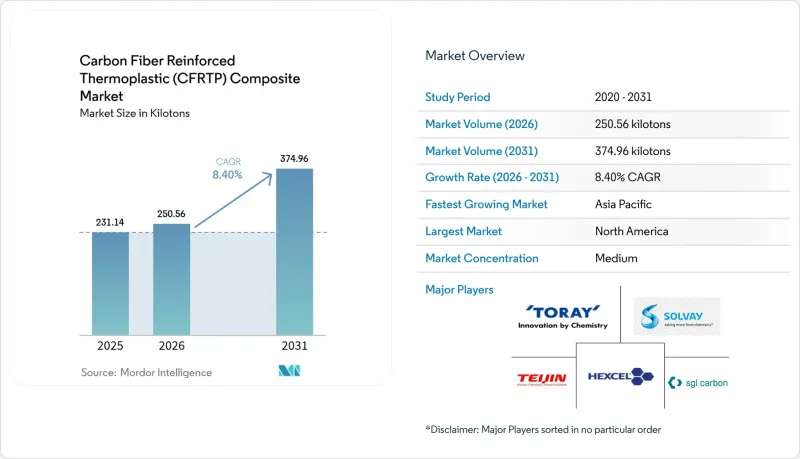
據 Mordor Intelligence 稱,碳纖維增強熱塑性塑膠 (CFRTP) 複合材料的市場規模預計在 2026 年達到 250.56 千噸,高於 2025 年的 231.14 千噸,預計到 2031 年將達到 374.96 千噸。
預計2026年至2031年複合年成長率將達8.40%。
本報告依原料(PAN基、瀝青基及其他)、樹脂(PEEK、PU及其他)、製造流程(壓縮成型、自動纖維鋪放(AFP)/膠帶層壓及其他)、終端用戶產業(航太與國防、汽車及其他)及地區(亞太、北美及其他)進行細分。市場預測以體積(千噸)為單位。
全球碳纖維增強熱塑性複合材料(CFRTP)市場趨勢及洞察
對輕型電動車結構的需求激增
汽車製造商正在擴大碳纖維增強熱塑性複合材料在電池外殼、車身面板和底盤部件中的應用,以延長續航里程並縮短充電時間。這種材料的可逆熔融特性使其能夠回收利用,符合中國和歐盟目前正在實施的循環經濟規則。此外,它還為車輛營運商提供了更便捷的維修方案,因為受損零件可以重新加熱和重塑,而無需更換。特斯拉在人形機器人中採用碳纖維複合材料,凸顯了其在汽車以外的廣泛應用,並顯示其具有擴展到多種移動出行平台的潛力。預計到2024年,中國將消耗6.9萬噸碳纖維,顯示亞洲的需求不斷成長。
加速擴大民航機生產
為滿足737 MAX和787夢幻客機不斷成長的產量目標,飛機製造商正在重組其供應鏈,這推動了對用於降低油耗的輔助結構部件的複合材料的持續需求。儘管銷售額有所下降,Hexel在第一季財報中重申了對輕質熱塑性解決方案的投資。飛機「電氣化程度提高」的趨勢正在推動熱塑性材料的應用,因為基體可以絕緣電線並整合除冰加熱器。歐洲熱塑性複合材料研究中心(TPRC)的努力正在加速批量生產零件的認證,並縮短從設計到投入使用的時間。與金屬相比,熱塑性材料具有更優異的抗疲勞性能,從而可以延長維護週期,這一優勢在新冠疫情衝擊後得到了航空公司的高度重視。
高昂的初始投資和製造成本
高壓釜、壓縮機和自動化纖維鋪放單元每條生產線的成本可能超過3000萬美元,這阻礙了企業進入對價格敏感的細分市場,並減緩了技術的普及速度。 SGL Carbon公司報告稱,其碳纖維部門2024年的銷售額將下降35.2%,原因是需求波動和高固定成本資產利用率不足。利默里克大學展示的等離子微波加熱技術可將能耗降低高達70%,但距離實用化仍需數年時間。由於原料——纖維——仍然比鋁或鋼更昂貴,複合材料尚未應用於經濟型汽車。只有當產量增加且模具成本可以攤提時,獲利能力才能提高,因此,在下游需求確定之前,原始設備製造商(OEM)對採用複合材料持謹慎態度。
細分市場分析
2025年,PAN基碳纖維增強熱塑性複合材料的產量將佔總產量的77.35%,這得益於成熟的生產線和在航太領域的良好口碑。其高拉伸模量使設計人員能夠在保持安全裕度的同時減輕結構重量。隨著現有企業維修其連續生產線以提高加工能力,PAN基碳纖維增強熱塑性複合材料的市場規模預計將以7.76%的複合年成長率穩步成長。經濟高效的再加熱循環降低了廢品率,提高了工廠的經濟效益。
包括再生纖維在內的其他原料,由於終端用戶積極推行循環採購目標,其複合年成長率(CAGR)高達9.42%,在所有原料中位居榜首。再生纖維目前仍能維持原生材料93.6%的拉伸強度,並正持續拓展其在二次負載領域的應用。 Syensqo和Trillium正在研究的生物基丙烯腈,預示著未來將長期轉向更環保的原料。具有金屬導電性的瀝青基特殊材料正被用於電池組的溫度控管。儘管其應用規模較小,但高溢價彌補了供應限制,從而維持了可觀的利潤率。
PEEK材料具有250 度C的連續工作溫度和化學惰性,預計到2025年將佔據34.25%的市場佔有率,複合年成長率(CAGR)為9.61%。其在碳纖維增強熱塑性複合材料領域的市場佔有率優勢尤為突出,尤其是在對阻燃性和煙霧毒性要求嚴格的領域,例如噴射引擎和海上平台。在醫療設備的應用不斷拓展,正在實現收入來源多元化,並將風險分散到各個行業。
在對成本較為敏感的領域,通常會使用聚氨酯(PU)、聚醚碸(PES)或聚乙烯亞胺(PEI),優先考慮價格因素而犧牲最高工作溫度。這些樹脂常用於中負荷的室內面板和家用電器。目前正在研發中的生物基聚乙烯亞胺可望在不影響機械性能的前提下,將永續性視為差異化優勢。樹脂生產商還在樹脂中添加奈米填料以提高導電性,從而加速航太系統中整合式除冰層的研發。
區域分析
到2025年,北美將佔據35.78%的市場佔有率,這主要得益於美國航太和國防工業,以及加拿大MRO(維修、修理和大修)設施的支援。東麗株式會社、赫克塞爾和索爾維等本土企業的存在縮短了前置作業時間,並保護了專案免受地緣政治風險的影響。政府根據《通膨控制法案》津貼正在促進國內氫氣罐的生產,並擴大下游產業的需求。
預計亞太地區將達到最高成長速度,到2031年複合年成長率將達到8.98%。中國正在擴大電動車生產規模,目前已擁有多條千噸級碳纖維生產線,降低了對傳統進口的依賴。日本的先驅企業東麗株式會社和帝人株式會社正在將其產能翻番,以滿足區域風電和海上計畫的需求。韓國正利用其電子技術專長,將電磁干擾屏蔽複合材料整合到5G基礎設施中。
在歐洲,強勁的需求與新的監管阻力交織在一起。德國汽車產業仍然是最大的熱塑性塑膠消費領域,但即將推出的回收法規正在加速向熱塑性塑膠的轉型。荷蘭熱塑性複合材料研究中心已成為原始設備製造商 (OEM) 和供應商之間研發合作的樞紐。斯堪的納維亞半島的風電投資和法國航太叢集正在抵消整體工業需求的低迷。
其他好處
- Excel格式的市場預測(ME)表
- 3個月的分析師支持
目錄
第1章:引言
- 研究假設和市場定義
- 調查範圍
第2章:調查方法
第3章執行摘要
第4章 市場狀況
- 市場概覽
- 市場促進因素
- 對輕型電動車結構的需求激增
- 加速擴大民航機生產
- 嚴格的全球排放法規和可回收性要求
- 在建築領域得到更廣泛的應用
- 氫氣壓力容器計劃的快速擴展
- 市場限制因素
- 高昂的初始投資和製造成本
- 大規模熱成型壓機產能短缺
- 航太領域供應鏈武器化的風險
- 價值鏈分析
- 波特五力模型
第5章 市場規模與成長預測
- 按原料
- 聚丙烯腈(PAN)
- 音調系統
- 其他原料(再生碳纖維等)
- 依樹脂類型
- 聚醚醚酮(PEEK)
- 聚氨酯(PU)
- 聚醚碸(PES)
- 聚醚醯亞胺(PEI)
- 其他樹脂(聚醯胺、聚碳酸酯等)
- 透過製造程序
- 壓縮成型/壓製成型
- 自動光纖鋪放(AFP)和膠帶層壓
- 射出成型和包覆成型
- 積層製造(碳纖維增強長絲)
- 按最終用戶行業分類
- 航太/國防
- 車
- 建造
- 電氣和電子設備
- 風力發電機
- 海上
- 體育用品
- 其他終端用戶產業(醫療保健等)
- 按地區
- 亞太地區
- 中國
- 日本
- 印度
- 韓國
- ASEAN
- 其他亞太國家
- 北美洲
- 美國
- 加拿大
- 墨西哥
- 歐洲
- 德國
- 英國
- 法國
- 義大利
- 西班牙
- 俄羅斯
- 北歐國家
- 其他歐洲國家
- 南美洲
- 巴西
- 阿根廷
- 其他南美國家
- 中東和非洲
- 沙烏地阿拉伯
- 南非
- 其他中東和非洲國家
- 亞太地區
第6章 競爭情勢
- 市場集中度
- 策略趨勢
- 市佔率和排名分析
- 公司簡介
- Arkema
- ARRIS Composites, Inc.
- Avient Corporation
- BASF
- Celanese Corporation
- DuPont
- Gurit Services AG, Zurich
- Hexcel Corporation
- Markforged
- Mitsubishi Chemical Corporation
- Quickstep
- SABIC
- SGL Carbon
- Syensqo
- Teijin Limited
- Toray Industries Inc.
- Victrex plc
第7章 市場機會與未來展望
According to Mordor Intelligence, carbon fiber reinforced thermoplastic composite market size in 2026 is estimated at 250.56 kilotons, growing from 2025 value of 231.14 kilotons with 2031 projections showing 374.96 kilotons, growing at 8.40% CAGR over 2026-2031.
This report is Segmented by Raw Material (PAN-Based, Pitch-Based, and More), Resin (PEEK, PU, and More), Manufacturing Process (Compression Molding, AFP/Tape Laying, and More), End-User Industry (Aerospace and Defense, Automotive, and More), and Geography (Asia-Pacific, North America, and More). The Market Forecasts are Provided in Terms of Volume (Kilotons).
Global Carbon Fiber Reinforced Thermoplastic (CFRTP) Composite Market Trends and Insights
Surging Demand for Lightweight EV Structures
Automakers increase carbon fiber thermoplastic use in battery enclosures, body panels, and chassis members to extend driving range and cut charging time. The material's reversible melt behavior supports end-of-life recycling, satisfying circular-economy rules now unfolding in China and the European Union. Fleet operators benefit from easier repair because damaged parts can be reheated and reshaped instead of replaced. Tesla's application of carbon fiber composites in its humanoid robot underscores versatility beyond vehicles, suggesting spillover into multiple mobility platforms. China consumed 69,000 metric tons of carbon fiber in 2024, evidence of a deepening Asian demand base.
Accelerating Commercial Aircraft Production Ramp-ups
Airframe OEMs are rebuilding supply chains to meet higher 737 MAX and 787 Dreamliner output targets, sustaining composite demand for secondary structures that cut fuel burn. Hexcel reaffirmed investment in lightweight thermoplastic solutions in its Q1 2025 earnings report, despite lower top-line sales. The shift to more-electric aircraft fosters thermoplastic adoption because the matrix insulates wiring and integrates anti-icing heaters. European initiatives under the ThermoPlastic Composites Research Center (TPRC) accelerate certification of large-volume parts, shortening design-to-flight timelines. Superior fatigue resistance over metals lengthens service intervals, an advantage keenly valued by airlines after COVID-19 disruptions.
High Initial Investment and Manufacturing Cost
Autoclaves, compression presses, and automated fiber placement cells can top USD 30 million per line, curbing entry and slowing adoption in price-sensitive segments. SGL Carbon reported a 35.2% sales drop in its Carbon Fibers unit in 2024, citing demand swings that leave high fixed-cost assets under-utilized. Plasma + microwave heating demonstrated at the University of Limerick cuts energy up to 70%, yet commercial readiness remains several years out. Raw fiber remains costlier than aluminum or steel, keeping composites out of economy-class vehicles. Economics improve only when volumes amortize tooling, thus OEMs hesitate until downstream demand is locked.
Other drivers and restraints analyzed in the detailed report include:
- Stringent Global Emission and Recyclability Mandates
- Rapid Scale-up of Hydrogen Pressure-Vessel Programs
- Limited Large-scale Thermoforming Press Capacity
For complete list of drivers and restraints, kindly check the Table Of Contents.
Segment Analysis
PAN-based grades delivered 77.35% of 2025 volume, underlining their entrenched production lines and aerospace heritage. High tensile modulus lets designers trim structural weight while meeting safety margins. The carbon fiber reinforced thermoplastic composite market size for PAN-based grades is projected to expand at a stable 7.76% CAGR as incumbents retrofit continuous lines for higher throughput. Cost-effective reheat cycles improve scrap rates, enhancing plant economics.
Other Raw Materials, including recycled fiber, register a 9.42% CAGR-the highest within raw materials-as end-users adopt circular procurement goals. Recycled fiber now retains 93.6% of virgin tensile strength, widening suitability for secondary load paths. Bio-sourced acrylonitrile under study by Syensqo and Trillium signals a longer-term pivot to greener feedstocks. Niche pitch-based grades serve thermal management in battery packs because of metal-like conductivity. Though volume small, premium pricing balances supply constraint, keeping margins attractive.
PEEK secured 34.25% 2025 share and leads growth at 9.61% CAGR thanks to 250 °C continuous-use temperature and chemical inertness. The carbon fiber reinforced thermoplastic composite market share advantage strengthens where flammability and smoke toxicity rules are strict, notably in jet engines and offshore platforms. Medical device usage diversifies revenue, spreading risk across sectors.
Cost-focused segments rely on PU, PES, or PEI which trade peak temperature for price. These resins feed interior panels and consumer electronics where operating loads are moderate. Bio-based PEI under exploration could add a sustainability differentiator without forfeiting mechanical properties. Resin formulators also blend nano-fillers to enhance conductivity, fostering integrated de-icing layers in aerospace systems.
Complete Report Scope:
- By Raw Material
- Polyacrylonitrile (PAN)-based Carbon Fiber Reinforced Composites (CFRTP)
- Pitch-based Carbon Fiber Reinforced Composites (CFRTP)
- Other Raw Materials (Recycled Carbon Fibers, etc.)
- By Resin
- Polyether Ether Ketone (PEEK)
- Polyurethane (PU)
- PolyetherSulfone (PES)
- Polyetherimide (PEI)
- Others (Polyamide, Polycarbonate, etc.)
- By Manufacturing Process
- Compression and Stamp Moulding
- Automated Fibre Placement / Tape Laying
- Injection and Over-Moulding
- Additive Manufacturing (Carbon Fiber-filled filaments)
- By End-user Industry
- Aerospace and Defence
- Automotive
- Construction
- Electrical and Electronics
- Wind Turbines
- Marine
- Sporting Equipments
- Other End-user Industries (Healthcare, etc.)
- By Geography
- Asia-Pacific
- China
- Japan
- India
- South Korea
- ASEAN Countries
- Rest of Asia-Pacific
- North America
- United States
- Canada
- Mexico
- Europe
- Germany
- United Kingdom
- France
- Italy
- Spain
- Russia
- NORDIC Countries
- Rest of Europe
- South America
- Brazil
- Argentina
- Rest of South America
- Middle-East and Africa
- Saudi Arabia
- South Africa
- Rest of Middle-East and Africa
- Asia-Pacific
Geography Analysis
North America held 35.78% share in 2025, anchored by the United States' aerospace and defence complex and supported by Canada's MRO hubs. Local presence of Toray, Hexcel, and Solvay shortens lead times, safeguarding programs against geopolitical risk. Government grants under the Inflation Reduction Act encourage domestic hydrogen tank production, widening downstream pull.
Asia-Pacific posts the fastest 8.98% CAGR to 2031. China scales electric-vehicle output and now hosts multiple kiloton-scale carbon fiber lines, reducing earlier import dependence. Japanese pioneers Toray and Teijin double capacity to serve regional wind and marine projects. South Korea leverages electronics know-how to integrate EMI-shielding composites into 5G infrastructure.
Europe mixes strong demand with new regulatory headwinds. Germany's auto base remains the largest segment consumer, but looming recyclability rules fast-track thermoplastic substitution. The ThermoPlastic Composites Research Center in the Netherlands anchors R&D alliances across OEMs and suppliers. Nordic wind investments and French aerospace clusters offset softness in general industrial demand.
- Arkema
- ARRIS Composites, Inc.
- Avient Corporation
- BASF
- Celanese Corporation
- DuPont
- Gurit Services AG, Zurich
- Hexcel Corporation
- Markforged
- Mitsubishi Chemical Corporation
- Quickstep
- SABIC
- SGL Carbon
- Syensqo
- Teijin Limited
- Toray Industries Inc.
- Victrex plc
Additional Benefits:
- The market estimate (ME) sheet in Excel format
- 3 months of analyst support
TABLE OF CONTENTS
1 Introduction
- 1.1 Study Assumptions and Market Definition
- 1.2 Scope of the Study
2 Research Methodology
3 Executive Summary
4 Market Landscape
- 4.1 Market Overview
- 4.2 Market Drivers
- 4.2.1 Surging demand for lightweight EV structures
- 4.2.2 Accelerating commercial aircraft production ramp-ups
- 4.2.3 Stringent global emission and recyclability mandates
- 4.2.4 Incresaing usage in the construction sector
- 4.2.5 Rapid scale-up of hydrogen pressure-vessel programs
- 4.3 Market Restraints
- 4.3.1 High initial investment and manufacturing cost
- 4.3.2 Limited large-scale thermoforming press capacity
- 4.3.3 Supply-chain weaponisation risk in aerospace
- 4.4 Value Chain Analysis
- 4.5 Porter's Five Forces
- 4.5.1 Bargaining Power of Suppliers
- 4.5.2 Bargaining Power of Buyers
- 4.5.3 Threat of New Entrants
- 4.5.4 Threat of Substitutes
- 4.5.5 Competitive Rivalry
5 Market Size and Growth Forecasts (Volume)
- 5.1 By Raw Material
- 5.1.1 Polyacrylonitrile (PAN)-based Carbon Fiber Reinforced Composites (CFRTP)
- 5.1.2 Pitch-based Carbon Fiber Reinforced Composites (CFRTP)
- 5.1.3 Other Raw Materials (Recycled Carbon Fibers, etc.)
- 5.2 By Resin
- 5.2.1 Polyether Ether Ketone (PEEK)
- 5.2.2 Polyurethane (PU)
- 5.2.3 PolyetherSulfone (PES)
- 5.2.4 Polyetherimide (PEI)
- 5.2.5 Others (Polyamide, Polycarbonate, etc.)
- 5.3 By Manufacturing Process
- 5.3.1 Compression and Stamp Moulding
- 5.3.2 Automated Fibre Placement / Tape Laying
- 5.3.3 Injection and Over-Moulding
- 5.3.4 Additive Manufacturing (Carbon Fiber-filled filaments)
- 5.4 By End-user Industry
- 5.4.1 Aerospace and Defence
- 5.4.2 Automotive
- 5.4.3 Construction
- 5.4.4 Electrical and Electronics
- 5.4.5 Wind Turbines
- 5.4.6 Marine
- 5.4.7 Sporting Equipments
- 5.4.8 Other End-user Industries (Healthcare, etc.)
- 5.5 By Geography
- 5.5.1 Asia-Pacific
- 5.5.1.1 China
- 5.5.1.2 Japan
- 5.5.1.3 India
- 5.5.1.4 South Korea
- 5.5.1.5 ASEAN Countries
- 5.5.1.6 Rest of Asia-Pacific
- 5.5.2 North America
- 5.5.2.1 United States
- 5.5.2.2 Canada
- 5.5.2.3 Mexico
- 5.5.3 Europe
- 5.5.3.1 Germany
- 5.5.3.2 United Kingdom
- 5.5.3.3 France
- 5.5.3.4 Italy
- 5.5.3.5 Spain
- 5.5.3.6 Russia
- 5.5.3.7 NORDIC Countries
- 5.5.3.8 Rest of Europe
- 5.5.4 South America
- 5.5.4.1 Brazil
- 5.5.4.2 Argentina
- 5.5.4.3 Rest of South America
- 5.5.5 Middle-East and Africa
- 5.5.5.1 Saudi Arabia
- 5.5.5.2 South Africa
- 5.5.5.3 Rest of Middle-East and Africa
- 5.5.1 Asia-Pacific
6 Competitive Landscape
- 6.1 Market Concentration
- 6.2 Strategic Moves
- 6.3 Market Share (%)/Ranking Analysis
- 6.4 Company Profiles (includes Global level Overview, Market level overview, Core Segments, Financials as available, Strategic Information, Market Rank/Share for key companies, Products and Services, and Recent Developments)
- 6.4.1 Arkema
- 6.4.2 ARRIS Composites, Inc.
- 6.4.3 Avient Corporation
- 6.4.4 BASF
- 6.4.5 Celanese Corporation
- 6.4.6 DuPont
- 6.4.7 Gurit Services AG, Zurich
- 6.4.8 Hexcel Corporation
- 6.4.9 Markforged
- 6.4.10 Mitsubishi Chemical Corporation
- 6.4.11 Quickstep
- 6.4.12 SABIC
- 6.4.13 SGL Carbon
- 6.4.14 Syensqo
- 6.4.15 Teijin Limited
- 6.4.16 Toray Industries Inc.
- 6.4.17 Victrex plc
7 Market Opportunities and Future Outlook
- 7.1 White-space and Unmet-need Assessment

 纖維增強複合材料:市場佔有率分析、行業趨勢和統計數據以及成長預測(2026-2031 年)天然纖維增強複合材料:市場佔有率分析、產業趨勢與統計、成長預測(2025-2031)
 纖維增強複合材料市場:依纖維類型、樹脂類型、製造流程、增強材料形式和應用分類-2026-2032年全球市場預測
 複合纖維市場規模、佔有率和成長分析:按結構、材料、應用、最終用途和地區分類-2026-2033年產業預測
 天然纖維增強複合材料市場:依纖維類型、基體類型、技術、應用、國家及地區分類-產業分析、市場規模、市佔率及2026年至2033年預測
 連續纖維複合材料市場:按樹脂類型、產品類型、增強材料類型、產業和地區分類(2026-2034 年)
 天然纖維增強複合材料市場:依纖維類型、聚合物、終端用戶產業(航太)及地區分類雙組分纖維:市場佔有率分析、產業趨勢與統計、成長預測(2026-2031)
 碳纖維熱塑性複合材料市場規模、佔有率和趨勢分析報告:按原料、應用、地區和細分市場分類(2026-2033 年)CFRTP市場:2026-2032年全球市場預測(按樹脂類型、產品類型、纖維類型、製造流程、應用和最終用戶分類)