


 |
市場調查報告書
商品編碼
2121765
天然纖維增強複合材料:市場佔有率分析、產業趨勢與統計、成長預測(2025-2031)Natural Fiber Reinforced Composites - Market Share Analysis, Industry Trends & Statistics, Growth Forecasts (2025 - 2031) |
||||||

※ 本網頁內容可能與最新版本有所差異。詳細情況請與我們聯繫。
根據 Mordor Intelligence 預測,天然纖維增強複合材料的市場規模預計將從 2025 年的 473 萬噸成長到 2026 年的 513 萬噸,然後從 2026 年到 2031 年以 8.53% 的複合年成長率成長,到 2031 年達到 772 萬噸。
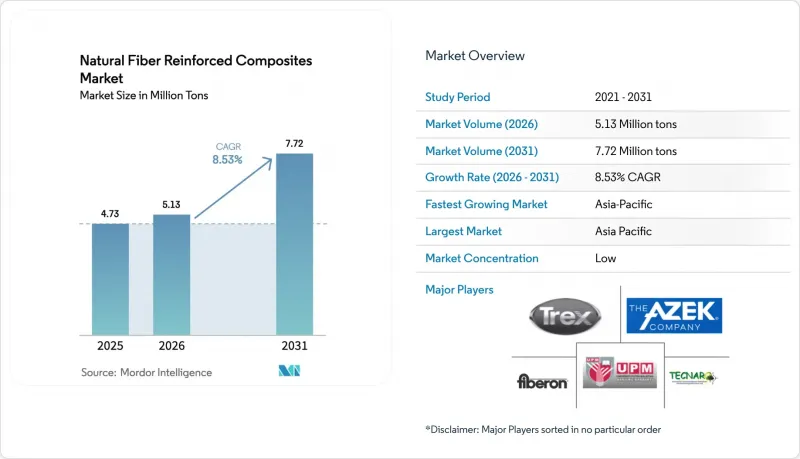
本報告按纖維類型(木質和非木質)、聚合物基體(熱固性樹脂、熱塑性塑膠、生物基聚合物)、加工技術(射出成型、壓縮成型、熔煉成型及其他)、用戶行業(汽車、航太、船舶及其他)和地區(亞太地區、北美地區、歐洲及其他)進行細分。市場預測以噸為單位。
全球天然纖維增強複合材料市場趨勢及洞察
關於汽車可回收性目標的法律和監管壓力
根據修訂後的歐盟報廢車輛指令(將於2024年生效),汽車製造商必須達到85%的品質回收率,任何違規行為都將面臨每輛車500歐元的罰款。這促使車門模組中即時開始使用亞麻和麻等替代材料。隨後,中國工業和資訊化部製定了相關法規,要求到2030年,國產品牌汽車的可回收率達到90%,並已開始試驗採購韌皮纖維電池外殼。加州對零件材料進行生命週期碳排放評分,並鼓勵採購比原生聚丙烯二氧化碳排放量低60%的生物基化合物,這給汽車製造商帶來了間接壓力。寶馬公司於2025年與Bcomp公司簽署了一項長期收購協議,以確保亞麻供應並避免監管處罰。隨著監管期限的臨近,天然纖維增強複合材料市場在三大洲的需求都在成長。
電動車平台輕量化技術的快速普及
電池式電動車額外增加的200公斤重量會降低其續航里程。以大麻複合複合材料取代玻璃纖維,可將椅背和行李架的重量減輕15%,每減重1公斤即可增加約0.3公里的續航里程,並使每輛車的電池成本降低15美元。 2025年的實驗室測試表明,大麻-聚丙烯複合材料的拉伸強度達到85兆帕,撓曲模數達到6.5吉帕,縮小了與玻璃纖維的性能差距。特斯拉正將天然纖維部件作為其即將推出的Model 2車型降低成本的手段,這表明這種做法的應用範圍將超越歐洲豪華品牌。中國新創公司蔚來汽車和小鵬汽車正將其亞麻基車門面板專案推進到檢驗階段,計劃於2027年實現量產,這印證了全球對電動車相關材料日益成長的需求。這些發展正在加速天然纖維增強複合材料向市場的滲透,而此時動力傳動系統的性能還遠未達到汽油動力汽車的水平。
吸濕引起的尺寸不穩定性
天然纖維在相對濕度為 85% 的環境中會吸收 8% 至 12% 的水分,導致零件膨脹並降低與基體的黏合強度。二次聚氨酯塗層或聚乙烯共擠出會使製造成本每公斤增加 0.40 至 0.60 美元,而乙醯化處理可將吸濕率降低至 4%,但會使纖維價格增加 25%。橡樹嶺國家實驗室 (ORNL) 2025 年的一項研究表明,麻纖維增強聚丙烯 (Hemp-PP) 板材在相對濕度為 95% 的環境中暴露 1000 小時後,其彎曲強度損失了 15%。目前,天然纖維增強複合材料在船舶領域的應用仍局限於水線以上的艙室模組,而將其整合到汽車外殼中則被推遲,直到多層阻隔層和混合玻璃纖維蒙皮普及為止。這些限制因素正在減緩天然纖維增強複合材料在潮濕環境下的市場滲透。
細分市場分析
由於原料成本低且擁有成熟的甲板供應鏈,預計2025年,木纖維將佔據天然纖維增強複合材料市場42.94%的佔有率。受BMW和Volvo採用亞麻車門面板的推動,非木質韌皮纖維預計到2031年將以9.45%的複合年成長率成長。這種面板比傳統面板薄25%,同時仍能滿足碰撞剛性要求。 2024年至2026年間,加拿大和美國的麻脫殼產能增加了四倍,確保了汽車專案的供應。歐洲的一些項目透過將洋麻和黃麻融入座椅外殼,提高了每公斤材料的機械效率。
同時,棉花廢料正被用於電動汽車座艙的隔音墊;在巴西,香蕉纖維和劍麻纖維則用於生產汽車後備箱襯墊。 Bcomp公司的「ampliTex」亞麻織物可用於製造半結構性航太面板,其價格比傳統木粉高出40%,從而提升了供應商在價值鏈中的地位。隨著碳減排標準的日益嚴格,原始設備製造商(OEM)優先考慮剛度與二氧化碳排放量比最高的纖維,而天然纖維增強複合材料市場的未來成長方向正轉向高等級韌皮纖維。
到2025年,熱塑性塑膠將佔總產量的55.82%,這主要歸功於聚丙烯能夠承受高達170 度C的成型溫度。機械回收循環正在降低射出成型成型內裝件的生命週期成本。然而,對生物基聚合物的需求正以9.21%的複合年成長率成長。由於泰國產量的增加,NatureWorks公司的「Ingeo」PLA成本已降至每公斤2.20美元,這使得PLA和亞麻混合物能夠以與ABS相當的成本用於家用電器機殼。儘管回收面臨挑戰,熱固性樹脂在風力發電機樑和船舶船體中仍然發揮著至關重要的作用,透過樹脂傳遞模塑(RTM)可以確保較高的玻璃化轉變溫度。此外,添加松木粉的聚氯乙烯(PVC)可避免使用鹵代阻燃劑作為窗框的增強材料,從而滿足嚴格的防火安全標準。整體而言,樹脂的應用分支反映了各個終端市場的需求。在汽車產業,人們正在推廣再生PP混合物;在建築業,人們更傾向於使用PVC-木材複合材料;在可再生能源產業,人們正在轉向使用環氧樹脂和韌皮纖維的混合材料。
區域分析
預計到2025年,亞太地區將佔天然纖維增強複合材料市場42.25%的佔有率,並在2031年之前以9.10%的複合年成長率成長,這主要得益於中國強制性回收計劃和印度住宅維修熱潮的推動。預計到2031年,該地區天然纖維增強複合材料的市場規模將超過350萬噸。儘管中國工業和資訊化部(工信部)的法規強調使用韌皮纖維裝飾條製造電池機殼,但蕪湖昊軒新建成的1.5萬噸擠出生產線正在為都市區人行道提供板材。東南亞的工廠正在以低於每噸300美元的原料成本加工椰子和香蕉纖維,使得擠出型材的成本競爭與乙烯基牆板的成本競爭相當。
歐洲是全球第二大生產國,同時也是創新領域的主導。德國供應商引進了超臨界二氧化碳處理技術,使亞麻的剛度提高了33%,從而能夠製造半結構板材框架。英國的BREEAM認證體系和法國的RE2020標準都為生物基外牆覆層授予了碳排放積分,因此建築師擴大採用木纖維PVC覆層。斯堪的納維亞的鋸木廠正在將林產品重新加工成聚丙烯「Formi」混合物,以加強循環經濟。
在北美,回收的鋸末和廢舊薄膜正被廣泛利用。 Trex公司95%的原料來自廢棄物,並預計2025年毛利率將提高到38%。美墨加協定(USMCA)的條款促進了以本地為中心的供應鏈發展,例如,墨西哥的一家一級供應商正在為底特律的一家汽車製造商生產天然纖維後備箱襯墊。南美洲擁有豐富的原料資源,如甘蔗渣、香蕉和劍麻,但由於加工能力有限,這些資源在國內的應用受到限制。
在中東和非洲,該市場仍處於探索階段。在阿拉伯聯合大公國,一個採用椰棗纖維增強板材作為核心材料的高層建築項目正在進行中,該建築已獲得LEED鉑金級認證,但廣泛的供應物流仍處於起步階段。這些區域性的發展表明,監管壓力和原料供應正在塑造天然纖維增強複合材料市場的未來。
其他好處
- Excel格式的市場預測(ME)表
- 3個月的分析師支持
目錄
第1章:引言
- 研究假設和市場定義
- 調查範圍
第2章:調查方法
第3章執行摘要
第4章 市場狀況
- 市場概覽
- 市場促進因素
- 關於汽車可回收性目標的法律和監管壓力
- 電動車平台輕量化技術的快速普及
- 高通量射出成型和壓縮成型生產線的進步
- 建材向綠建築認證過渡
- 利用超臨界二氧化碳進行纖維改質的生產線的出現,使得半結構部件的製造成為可能。
- 市場限制因素
- 吸濕引起的尺寸不穩定性
- 由於熱穩定性限制,高溫加工受到限制。
- 對生物消化需求的不斷成長加劇了對木質纖維素原料的競爭。
- 價值鏈分析
- 波特五力模型
第5章 市場規模與成長預測
- 依纖維類型
- 木頭
- 非木材
- 棉布
- 亞麻
- 洋麻
- 麻
- 其他非木質纖維(黃麻、劍麻、蕉麻、椰棕、棕櫚纖維、香蕉纖維)
- 通過聚合物基質
- 熱固性樹脂
- 熱塑性樹脂
- 聚乙烯
- 聚丙烯
- 聚氯乙烯
- 高性能熱塑性塑膠(PC、PA、PBT)
- 生物基聚合物(PLA、PHA、PBS)
- 透過加工技術
- 射出成型
- 壓縮成型
- 冥王星
- 樹脂轉注成形/VAR™
- 積層製造(使用NFC顆粒的3D列印)
- 按最終用戶行業分類
- 汽車和運輸業
- 航太(非關鍵應用)
- 海上
- 建築/施工
- 電氣和電子設備
- 運動和休閒用品
- 可再生能源(風力發電機零件)
- 按地區
- 亞太地區
- 中國
- 印度
- 日本
- 韓國
- 馬來西亞
- 泰國
- 印尼
- 越南
- 其他亞太國家
- 北美洲
- 美國
- 加拿大
- 墨西哥
- 歐洲
- 德國
- 英國
- 法國
- 義大利
- 西班牙
- 北歐國家
- 土耳其
- 俄羅斯
- 其他歐洲國家
- 南美洲
- 巴西
- 阿根廷
- 哥倫比亞
- 其他南美國家
- 中東和非洲
- 沙烏地阿拉伯
- 卡達
- 阿拉伯聯合大公國
- 奈及利亞
- 埃及
- 南非
- 其他中東和非洲國家
- 亞太地區
第6章 競爭情勢
- 市場集中度
- 策略趨勢
- 市佔率和排名分析
- 公司簡介
- Amorim Cork Solutions SA
- Bcomp Ltd.
- Beologic NV
- BPREG Composites
- Fiberon
- FKuR
- FlexForm Technologies
- Green Dot Bioplastics Inc.
- GreenGran BN
- JELU-WERK J. Ehrler GmbH and Co. KG
- Lingrove Inc.
- Plasthill Oy
- Procotex
- TECNARO GmbH
- Trex Company, Inc.
- UPM
- Wuhu Haoxuan Wood Plastic Composite Co.,Ltd
第7章 市場機會與未來展望
According to Mordor Intelligence, the natural fiber reinforced composites market size is expected to grow from 4.73 Million tons in 2025 to 5.13 Million tons in 2026 and is forecast to reach 7.72 Million tons by 2031 at 8.53% CAGR over 2026-2031.
This report is Segmented by Fiber (Wood and Non-Wood), Polymer Matrix (Thermosets, Thermoplastics, and Bio-Based Polymers), Processing Technology (Injection Molding, Compression Molding, Pultrusion, and More), End-User Industry (Automotive, Aerospace, Marine, and More), and Geography (Asia-Pacific, North America, Europe, and More). Market Forecasts are Provided in Terms of Volume (Tons).
Global Natural Fiber Reinforced Composites Market Trends and Insights
Legislative Pressure for Vehicle Recyclability Targets
The updated EU End-of-Life Vehicle Directive active since 2024 obliges automakers to achieve 85% mass recyclability or face fines of EUR 500 per non-compliant car, stimulating immediate substitutions toward flax and hemp door modules. China's Ministry of Industry and Information Technology followed with a 90% recyclability rule for domestic brands by 2030, triggering pilot procurement of bast-fiber battery enclosures. OEMs feel indirect pressure because California assigns lifecycle carbon scores to part dossiers, tilting sourcing toward bio-based compounds with 60% lower embodied CO2 than virgin polypropylene. BMW secured a long-term offtake contract with Bcomp in 2025 to guarantee flax supply and avoid regulatory penalties. As legislative deadlines converge, the natural fiber reinforced composites market experiences embedded demand pull across three continents.
Rapid Adoption of Lightweighting in EV Platforms
Battery-electric cars carry 200 kg extra mass that erodes driving range; substituting glass fiber with hemp composite trims 15% weight from seat backs and parcel shelves, translating to roughly 0.3 km additional range per kilogram saved and USD 15 battery savings per car. Laboratory tests in 2025 showed hemp-PP compounds achieving 85 MPa tensile strength and 6.5 GPa flexural modulus, closing the performance gap with glass fiber. Tesla flagged natural fiber parts as a cost-down lever for its forthcoming Model 2, indicating diffusion beyond premium European marques. Chinese start-ups NIO and XPeng have moved flax door-panel programs into validation for 2027 production, underscoring the global scope of EV-linked pull. These moves accelerate penetration in the natural fiber reinforced composites market ahead of drivetrain parity timelines.
Moisture Absorption Causing Dimensional Instability
Natural fibers absorb 8%-12% water at 85% relative humidity, swelling parts and weakening matrix bonds. Secondary polyurethane coatings or poly-ethylene co-extrusion add USD 0.40-0.60 per kg to manufacturing costs, while acetylation cuts moisture uptake to 4% but inflates fiber prices by 25%. A 2025 ORNL study showed 15% flexural-strength loss after 1,000 h exposure to 95% humidity for hemp-PP panels. Marine uses remain confined to above-waterline cabin modules, and automotive exterior-body integration is delayed until multilayer barriers or hybrid glass skins become routine. This constraint slows adoption in the natural fiber reinforced composites market for moisture-exposed applications.
Other drivers and restraints analyzed in the detailed report include:
- Advancements in High-Throughput Injection and Compression Molding Lines
- Shift Toward Green-Building Certifications in Construction Materials
- Limited Thermal Stability Restricting High-Temperature Processing
For complete list of drivers and restraints, kindly check the Table Of Contents.
Segment Analysis
Wood fiber captured 42.94% natural fiber reinforced composites market share in 2025 owing to its low feedstock cost and established decking supply chains. Non-wood bast fibers will post a 9.45% CAGR through 2031 as BMW and Volvo integrate flax door panels that are 25% thinner yet meet crash stiffness. Hemp decortication capacity in Canada and the U.S. quadrupled between 2024 and 2026, ensuring supply for automotive programs. European projects also blend kenaf and jute into seat shells, raising mechanical efficiency per kilogram.
In parallel, cotton waste feeds sound-insulation mats for EV cabins, and banana and sisal fibers support trunk-liner production in Brazil. Bcomp's ampliTex woven flax unlocks semi-structural aerospace panels that carry 40% premiums over commodity wood flour, nudging suppliers up the value chain. As carbon-reduction metrics grow stricter, OEMs favor fibers that deliver the highest stiffness-to-CO2 ratio, tilting future growth toward premium bast fibers within the natural fiber reinforced composites market.
Thermoplastics comprised 55.82% of the 2025 volume, driven by polypropylene's compatibility with 170 °C molding windows. Mechanical recycling loops lower lifecycle costs for injection-molded interior trims. However, bio-based polymer demand is rising at a 9.21% CAGR. NatureWorks' Ingeo PLA cost fell to USD 2.20 per kg after its Thai expansion, enabling PLA-flax blends in consumer electronics casings at cost parity with ABS. Thermosets stay relevant for wind-turbine spars and marine hulls where resin-transfer molding locks in high glass-transition temperatures, despite recycling obstacles. Polyvinyl chloride with pine flour reinforces window profiles for stringent fire codes, sidestepping halogenated flame retardants. Overall, divergent resin paths reflect end-market needs: automotive pushes recycled PP blends, construction prefers PVC wood composites, and renewable-energy players shift toward epoxy bast-fiber hybrids.
Complete Report Scope:
- By Fiber
- Wood Fiber Composites
- Non-wood Fiber Composites
- Cotton
- Flax
- Kenaf
- Hemp
- Other Non-wood Fibers (Jute, Sisal, Abaca, Coir, PALF, Banana)
- By Polymer Matrix
- Thermosets
- Thermoplastics
- Polyethylene
- Polypropylene
- Polyvinyl Chloride
- High-performance Thermoplastics (PC, PA, PBT)
- Bio-based Polymers (PLA, PHAs, PBS)
- By Processing Technology
- Injection Molding
- Compression Molding
- Pultrusion
- Resin Transfer Molding / VARTM
- Additive Manufacturing (3-D printing with NFC pellets)
- By End-user Industry
- Automotive and Transportation
- Aerospace (Non-critical)
- Marine
- Building and Construction
- Electrical and Electronics
- Sports and Leisure Goods
- Renewable Energy (Wind-turbine components)
- By Geography
- Asia-Pacific
- China
- India
- Japan
- South Korea
- Malaysia
- Thailand
- Indonesia
- Vietnam
- Rest of Asia-Pacific
- North America
- United States
- Canada
- Mexico
- Europe
- Germany
- United Kingdom
- France
- Italy
- Spain
- Nordic Countries
- Turkey
- Russia
- Rest of Europe
- South America
- Brazil
- Argentina
- Colombia
- Rest of South America
- Middle East and Africa
- Saudi Arabia
- Qatar
- United Arab Emirates
- Nigeria
- Egypt
- South Africa
- Rest of Middle East and Africa
- Asia-Pacific
Geography Analysis
Asia-Pacific held 42.25% natural fiber reinforced composites market share in 2025, pacing at 9.10% CAGR through 2031 on the back of Chinese recyclability mandates and India's home-upgrade wave. The region's natural fiber reinforced composites market size will surpass 3.5 million tons by 2031. China's MIIT rules elevate bast-fiber trims for battery enclosures, while Wuhu Haoxuan's new 15,000 t extrusion line supplies decking for municipal walkways. Southeast Asian plants process coconut and banana fibers at sub-USD 300 t feeds, making extruded profiles cost-competitive with vinyl siding.
Europe ranks second in volume yet leads innovation. Germany's suppliers operate supercritical-CO2 treatment to raise flax stiffness 33%, enabling semi-structural seat frames. The U.K.'s BREEAM regime and France's RE2020 code award carbon points for bio-based facades, pushing architects toward wood-fiber PVC cladding. Nordic mills divert forestry by-products into polypropylene Formi blends, tightening circular loops.
North America leverages reclaimed sawdust and post-consumer film. Trex harvests 95% waste inputs, improving gross margins to 38% in 2025. USMCA rules foster regionalized supply chains; Mexican tier-1s mold natural-fiber trunk liners for Detroit automakers. South America sits on abundant bagasse, banana, and sisal feedstocks, yet limited compounding capacity caps domestic conversion.
Middle East and Africa remain exploratory; UAE projects use date-palm fiber core panels in LEED Platinum towers, but broad supply logistics are nascent. These regional dynamics show that regulatory pressure and raw material availability shape the natural fiber reinforced composites market trajectory.
- Amorim Cork Solutions S.A.
- Bcomp Ltd.
- Beologic NV
- BPREG Composites
- Fiberon
- FKuR
- FlexForm Technologies
- Green Dot Bioplastics Inc.
- GreenGran BN
- JELU-WERK J. Ehrler GmbH and Co. KG
- Lingrove Inc.
- Plasthill Oy
- Procotex
- TECNARO GmbH
- Trex Company, Inc.
- UPM
- Wuhu Haoxuan Wood Plastic Composite Co.,Ltd
Additional Benefits:
- The market estimate (ME) sheet in Excel format
- 3 months of analyst support
TABLE OF CONTENTS
1 Introduction
- 1.1 Study Assumptions and Market Definition
- 1.2 Scope of the Study
2 Research Methodology
3 Executive Summary
4 Market Landscape
- 4.1 Market Overview
- 4.2 Market Drivers
- 4.2.1 Legislative pressure for vehicle recyclability targets
- 4.2.2 Rapid adoption of lightweighting in EV platforms
- 4.2.3 Advancements in high-throughput injection and compression molding lines
- 4.2.4 Shift toward green-building certifications in construction materials
- 4.2.5 Emergence of super-critical CO2 fiber-modification lines enabling semi-structural parts
- 4.3 Market Restraints
- 4.3.1 Moisture absorption causing dimensional instability
- 4.3.2 Limited thermal stability restricting high-temperature processing
- 4.3.3 Rising biodigestion demand competing for lignocellulosic feedstock
- 4.4 Value Chain Analysis
- 4.5 Porter's Five Forces
- 4.5.1 Bargaining Power of Suppliers
- 4.5.2 Bargaining Power of Buyers
- 4.5.3 Threat of New Entrants
- 4.5.4 Threat of Substitute Products
- 4.5.5 Degree of Competition
5 Market Size and Growth Forecasts (Volume)
- 5.1 By Fiber
- 5.1.1 Wood Fiber Composites
- 5.1.2 Non-wood Fiber Composites
- 5.1.2.1 Cotton
- 5.1.2.2 Flax
- 5.1.2.3 Kenaf
- 5.1.2.4 Hemp
- 5.1.2.5 Other Non-wood Fibers (Jute, Sisal, Abaca, Coir, PALF, Banana)
- 5.2 By Polymer Matrix
- 5.2.1 Thermosets
- 5.2.2 Thermoplastics
- 5.2.2.1 Polyethylene
- 5.2.2.2 Polypropylene
- 5.2.2.3 Polyvinyl Chloride
- 5.2.2.4 High-performance Thermoplastics (PC, PA, PBT)
- 5.2.3 Bio-based Polymers (PLA, PHAs, PBS)
- 5.3 By Processing Technology
- 5.3.1 Injection Molding
- 5.3.2 Compression Molding
- 5.3.3 Pultrusion
- 5.3.4 Resin Transfer Molding / VARTM
- 5.3.5 Additive Manufacturing (3-D printing with NFC pellets)
- 5.4 By End-user Industry
- 5.4.1 Automotive and Transportation
- 5.4.2 Aerospace (Non-critical)
- 5.4.3 Marine
- 5.4.4 Building and Construction
- 5.4.5 Electrical and Electronics
- 5.4.6 Sports and Leisure Goods
- 5.4.7 Renewable Energy (Wind-turbine components)
- 5.5 By Geography
- 5.5.1 Asia-Pacific
- 5.5.1.1 China
- 5.5.1.2 India
- 5.5.1.3 Japan
- 5.5.1.4 South Korea
- 5.5.1.5 Malaysia
- 5.5.1.6 Thailand
- 5.5.1.7 Indonesia
- 5.5.1.8 Vietnam
- 5.5.1.9 Rest of Asia-Pacific
- 5.5.2 North America
- 5.5.2.1 United States
- 5.5.2.2 Canada
- 5.5.2.3 Mexico
- 5.5.3 Europe
- 5.5.3.1 Germany
- 5.5.3.2 United Kingdom
- 5.5.3.3 France
- 5.5.3.4 Italy
- 5.5.3.5 Spain
- 5.5.3.6 Nordic Countries
- 5.5.3.7 Turkey
- 5.5.3.8 Russia
- 5.5.3.9 Rest of Europe
- 5.5.4 South America
- 5.5.4.1 Brazil
- 5.5.4.2 Argentina
- 5.5.4.3 Colombia
- 5.5.4.4 Rest of South America
- 5.5.5 Middle East and Africa
- 5.5.5.1 Saudi Arabia
- 5.5.5.2 Qatar
- 5.5.5.3 United Arab Emirates
- 5.5.5.4 Nigeria
- 5.5.5.5 Egypt
- 5.5.5.6 South Africa
- 5.5.5.7 Rest of Middle East and Africa
- 5.5.1 Asia-Pacific
6 Competitive Landscape
- 6.1 Market Concentration
- 6.2 Strategic Moves
- 6.3 Market Share(%)/Ranking Analysis
- 6.4 Company Profiles (includes Global level Overview, Market level overview, Core Segments, Financials, Strategic Information, Market Rank/Share, Products and Services, Recent Developments)
- 6.4.1 Amorim Cork Solutions S.A.
- 6.4.2 Bcomp Ltd.
- 6.4.3 Beologic NV
- 6.4.4 BPREG Composites
- 6.4.5 Fiberon
- 6.4.6 FKuR
- 6.4.7 FlexForm Technologies
- 6.4.8 Green Dot Bioplastics Inc.
- 6.4.9 GreenGran BN
- 6.4.10 JELU-WERK J. Ehrler GmbH and Co. KG
- 6.4.11 Lingrove Inc.
- 6.4.12 Plasthill Oy
- 6.4.13 Procotex
- 6.4.14 TECNARO GmbH
- 6.4.15 Trex Company, Inc.
- 6.4.16 UPM
- 6.4.17 Wuhu Haoxuan Wood Plastic Composite Co.,Ltd
7 Market Opportunities and Future Outlook
- 7.1 White-space and Unmet-need Assessment
- 7.2 Growing Product and Technological Innovations

 碳纖維增強熱塑性複合材料(CFRTP):市場佔有率分析、產業趨勢與統計及成長預測(2026-2031)纖維增強複合材料:市場佔有率分析、行業趨勢和統計數據以及成長預測(2026-2031 年)
 纖維增強複合材料市場:依纖維類型、樹脂類型、製造流程、增強材料形式和應用分類-2026-2032年全球市場預測
 複合纖維市場規模、佔有率和成長分析:按結構、材料、應用、最終用途和地區分類-2026-2033年產業預測
 天然纖維增強複合材料市場:依纖維類型、基體類型、技術、應用、國家及地區分類-產業分析、市場規模、市佔率及2026年至2033年預測
 連續纖維複合材料市場:按樹脂類型、產品類型、增強材料類型、產業和地區分類(2026-2034 年)
 天然纖維增強複合材料市場:依纖維類型、聚合物、終端用戶產業(航太)及地區分類雙組分纖維:市場佔有率分析、產業趨勢與統計、成長預測(2026-2031)
 碳纖維熱塑性複合材料市場規模、佔有率和趨勢分析報告:按原料、應用、地區和細分市場分類(2026-2033 年)CFRTP市場:2026-2032年全球市場預測(按樹脂類型、產品類型、纖維類型、製造流程、應用和最終用戶分類)