


 |
市場調查報告書
商品編碼
2122320
除生物劑:市場佔有率分析、產業趨勢與統計、成長預測(2026-2031)Biocides - Market Share Analysis, Industry Trends & Statistics, Growth Forecasts (2026 - 2031) |
||||||

※ 本網頁內容可能與最新版本有所差異。詳細情況請與我們聯繫。
據 Mordor Intelligence 稱,2026 年除生物劑市場規模估計為 1978 萬噸,預計在預測期(2026-2031 年)內將以 4.68% 的複合年成長率成長,到 2031 年達到 2486 萬噸。
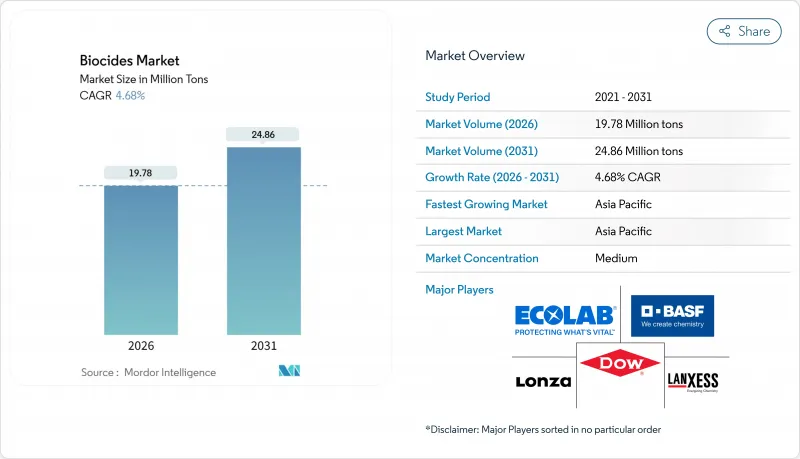
本報告按類型(鹵素化合物、金屬化合物、其他)、應用(水處理、醫藥及個人護理、木材防腐、其他)、作用機制(氧化型除生物劑、非氧化型除生物劑)和地區(亞太地區、北美地區、歐洲地區、南美地區、中東和非洲)進行細分。市場預測以噸為單位。
全球除生物劑市場趨勢與洞察
全球對水處理的需求正在增加。
對於二氧化氯和次氯酸鈉等氧化性化學品而言,市政和工業污水處理廠仍是最大的單一市場。這是因為這些藥劑能夠提供可靠的微生物控制,同時最大限度地降低每公升處理成本。 2024年美國修訂了第三階段消毒劑法規,降低了三鹵甲烷的允許濃度,此後,供水事業開始將過氧乙酸和紫外線氧化與傳統的氯處理相結合。中國強制推行的沿海工業冷卻水「零排放」政策,迫使營運商轉向基於異噻唑啉酮的非氧化性處理方案,以降低鹽度和化學需氧量(COD)。在中東地區,隨著海水淡化的快速發展,能夠最大限度減少膜生物污染並降低鹽水中餘氯的單氯胺基系統更受青睞。印度的「清潔恆河國家使命」正在資助一種結合紫外線和過氧乙酸的混合系統,用於新建的污水處理廠。該系統將除生物劑作為第二道屏障,而不是作為獨立的處理過程。這些發展趨勢結合起來,可望擴大高效低劑量氧化劑的應用範圍,使除生物劑市場保持成長勢頭直至 2031 年。
食品和飲料行業的需求不斷成長
衛生管理人員必須應對美國和歐盟之間差異巨大的殘留物標準,這加速了從普通氯沖洗劑向更高品質的過氧乙酸或季銨化合物組合藥物的轉變。美國食品藥物管理局 (FDA) 於 2025 年發布的指南允許在新鮮切好的蔬菜中使用 80 ppm 的過氧乙酸,而無需使用飲用水沖洗,預計每條生產線可節水 15%,並有助於加工商標準化一步式清洗流程。一家荷蘭乳製品合作社報告稱,改用季銨化合物泡沫後,就地清洗(CIP) 循環次數減少了 25%,提高了加工能力並減少了蒸氣用量。同時,飲料廠正在使用頻譜除生物劑,這些殺菌劑在無菌灌裝機中對酸性產品線中的酵母和黴菌均有效,BASF的「Preventol」在 pH 值 3-7 的範圍內取得了成功,證明了這一點。零售業對「潔淨標示」的需求促使製劑研發人員嘗試將山梨酸和那他黴素引入產品中。然而,劑量增加和使用期限縮短削弱了這些成分對消費者的部分吸引力。因此,活性成分的平均售價(每公斤)不斷上漲,即使除生物劑市場正向價格更高的細分市場轉移,其收入仍然成長。
與除生物劑相關的環境問題和健康損害
監管機構正在加強環境和毒性審查,導致核准流程延長,某些活性成分被徹底禁用。歐洲化學品管理局 (ECHA) 於 2024 年將溴硝醇和戊二醛列入其“候選清單”,要求用戶在有更安全的替代品時進行替代評估。美國環保署 (EPA) 的內分泌干擾物篩檢於 2025 年將三氯生和三氯卡班列入其中,促使消費品製造商在 18 個月內逐步淘汰這兩種成分,並將其在個人保健產品中的使用量減少 62%。歐盟目前規定工業污水中異噻唑啉酮類物質的水生毒性上限為 0.1 µg L⁻¹,迫使工廠升級到封閉回路型處理系統或繳納廢水附加費。雖然封裝技術有助於減少向環境的排放,但它會使生產成本增加 15-20%,從而擠壓通用產品線的利潤空間。這些更嚴格的法規總體上將預計複合年成長率降低 0.8 個百分點,並增加那些未能及時更新產品系列的供應商的合規風險。
細分市場分析
至2025年,鹵素化合物將佔全球總量的28.23%,並鞏固其作為除生物劑市場最廣泛使用化學品的地位。預計到2031年,該細分市場將以5.86%的複合年成長率成長,成長速度超過整體除生物劑市場,因為公共產業和工業用戶依賴他們已經熟悉且能夠大規模採購的氯基和溴基系統。氯在自來水處理方案中仍然發揮核心作用,因為操作人員可以透過控制pH值和延長接觸時間來滿足更嚴格的消毒副產物基準值,而無需徹底替換化學物質。另一方面,溴在高pH值環境中非常有效,因此是零液體排放冷卻塔的首選,因為在這些冷卻水塔中,必須最大限度地減少排污。金屬化合物,例如銅基防腐劑和銀離子基抗菌劑,則滿足了特定但高價值的需求。同時,酚類產品的市佔率持續被季銨鹽和過氧化物類產品蠶食,後者避免了酚類產品特有的氣味和表面變色問題。歐盟對異噻唑啉酮類化合物的監管審查加劇了有機硫類產品的壓力,而有機酸等替代類產品則受益於食品行業對「潔淨標示」抗菌劑的需求,這類抗菌劑無需進行完整的除生物劑註冊。
鹵代產品也受益於一體化的供應鏈。像陶氏這樣的供應商經營自己的氯和鹼生產設施,以保護利潤率免受原料價格波動的影響。二氧化氯發生器在現場的日益普及進一步降低了生命週期成本和運輸風險,為老牌供應商維繫客戶維繫奠定了基礎。然而,隨著市政供水事業投資於採用紫外線和高級氧化等多級處理製程以減少化學品用量,鹵代產品的銷售將面臨長期的上限。隨著除生物劑市場在2030年代逐步消化成本和監管方面的變化,那些以生物基或封裝替代品補充鹵代產品的供應商更有可能保障其利潤。
區域分析
預計到2025年,亞太地區將佔全球總量的35.32%,並在2031年之前維持5.22%的年複合成長率,這反映了該地區強勁的基礎設施投資和日益嚴格的水質法規。在中國,強制執行冷卻水零排放政策,迫使石化和金屬工廠轉型為封閉回路型系統,這需要持續施用除生物劑來抑制微生物腐蝕。在印度,「Jal Jeevan Mission」(旨在為所有農村家庭提供自來水的計畫)正在部署數百萬個小型加藥站,使用次氯酸鈉粉末以簡化物流。在日本,對冷卻塔迴路中退伍軍人菌的監測力度加大,推動了國內對無需排水系統即可在人口密集建築中安裝的非氧化性殺菌劑的需求。為了滿足東南亞製造地使用符合美國環保署(EPA)或歐盟標準的除生物劑以確保出口認證的要求,BASF已將其南京工廠的年產能提高了4萬噸,以加強其在該地區的供應鏈。
北美和歐洲合計佔全球消費量的一半,但由於市場成熟以及監管限制(優先考慮產品精益求精而非銷售擴張),成長緩慢。美國於2024年修訂了「更安全選擇」(Safer Choice)標準,禁止或限制使用18種活性成分,鼓勵供應商轉向生物基替代品,這些替代品雖然價格更高,但用量更少。加拿大針對授粉昆蟲安全性的重新評估計畫推遲了幾種常用活性成分的核准續期,加劇了供應的不確定性。歐洲集中化的歐盟核准流程將核准時間延長至三年,有利於擁有強大合規團隊的跨國公司。歐盟內部的需求主要集中在德國、英國和法國,這主要受汽車塗料、藥品和城市用水需求的驅動。
在南美洲、中東和非洲,隨著各國政府擴大水能基礎建設,需求顯著成長。在巴西,目前已允許使用二氧化氯和過氧乙酸作為飲用水中氯的替代品,這為引入現場製氯設備鋪平了道路。在阿根廷,為了符合更嚴格的排放法規,相關產業正在升級冷卻系統,促進了非氧化性產品的銷售。沙烏地阿拉伯的「2030願景」計畫旨在擴大海水淡化廠的規模,該計畫需要使用一氯胺來抑制膜生物污染,這為氧化劑生產商提供了一個重要的新市場。奈及利亞和埃及已從非洲開發銀行獲得津貼,用於安裝符合世界衛生組織標準的氯處理設備,預示著撒哈拉以南非洲地區未來氯處理量將會增加。
其他好處
- Excel格式的市場預測(ME)表
- 3個月的分析師支持
目錄
第1章:引言
- 研究假設和市場定義
- 調查範圍
第2章:調查方法
第3章執行摘要
第4章 市場狀況
- 市場概覽
- 市場促進因素
- 全球對水處理的需求正在增加。
- 食品和飲料行業的需求不斷成長
- 人們的健康和衛生意識日益增強。
- 油漆和塗料行業需求增加
- 監理機關對更安全替代方案的支持
- 市場限制因素
- 與除生物劑相關的環境問題和健康損害
- 原物料價格波動
- 高昂的研發成本
- 價值鏈分析
- 波特五力模型
第5章 市場規模與成長預測
- 按類型
- 鹵素化合物
- 金屬化合物
- 有機硫化合物
- 有機酸
- 酚類化合物
- 其他類型(季銨化合物)
- 透過使用
- 水處理
- 藥物和個人護理
- 木材防腐處理
- 飲食
- 油漆和塗料
- 其他用途(石油和天然氣、農業、消毒劑和衛生管理)
- 透過作用機制
- 氧化性除生物劑
- 非氧化性除生物劑
- 按地區
- 亞太地區
- 中國
- 印度
- 日本
- 韓國
- 泰國
- 馬來西亞
- 印尼
- 越南
- 其他亞太國家
- 北美洲
- 美國
- 加拿大
- 墨西哥
- 歐洲
- 德國
- 英國
- 義大利
- 法國
- 西班牙
- 俄羅斯
- 北歐的
- 其他歐洲國家
- 南美洲
- 巴西
- 阿根廷
- 其他南美國家
- 中東和非洲
- 沙烏地阿拉伯
- 阿拉伯聯合大公國
- 卡達
- 南非
- 奈及利亞
- 埃及
- 其他中東和非洲國家
- 亞太地區
第6章 競爭情勢
- 市場集中度
- 策略趨勢
- 市佔率和排名分析
- 公司簡介
- Albemarle Corporation
- Arxada
- Baker Hughes Company
- BASF SE
- Dow
- Ecolab
- IRO Group Inc.
- Italmatch AWS
- Kemipex
- Kemira
- LANXESS
- Lonza
- Merck KGaA
- Nouryon
- Solvay
- Stepan Company
- The Lubrizol Corporation
- Thor Group Ltd.
- Valtris Specialty Chemicals
- Veolia
- Vink Chemicals GmbH & Co. KG
第7章 市場機會與未來展望
According to Mordor Intelligence, the biocides market size is estimated at 19.78 million tons in 2026 and is expected to reach 24.86 million tons by 2031, at a CAGR of 4.68% during the forecast period (2026-2031).
This report is Segmented by Type (Halogen Compounds, Metallic Compounds, and More), Application (Water Treatment, Pharmaceutical and Personal-Care, Wood Preservation, and More), Mode of Action (Oxidizing Biocides and Non-Oxidizing Biocides), and Geography (Asia-Pacific, North America, Europe, South America, and Middle East and Africa). Market Forecasts are Provided in Terms of Volume (Tons).
Global Biocides Market Trends and Insights
Increasing Demand for Water Treatment Globally
Municipal and industrial treatment plants remain the single largest outlet for oxidizing chemistries such as chlorine dioxide and sodium hypochlorite, because these agents deliver reliable microbial control at the lowest cost per treated liter. The updated U.S. Stage 3 Disinfectants rule in 2024 lowered allowable trihalomethanes, prompting utilities to blend peracetic acid or ultraviolet oxidation with traditional chlorination. China's zero-discharge mandate for coastal industrial cooling water is pushing operators toward non-oxidizing isothiazolinone programs that limit salinity and chemical oxygen demand. Across the Middle East, rapid desalination expansion has favored monochloramine systems because they minimize membrane biofouling and lower residual chlorine in brine. India's National Mission for Clean Ganga funds ultraviolet-peracetic acid hybrids for new wastewater plants, which embed biocides as a secondary barrier rather than the lone treatment step. Together, these moves extend the serviceable universe for high-efficacy, low-dose oxidizers, sustaining the biocides market trajectory through 2031.
Growing Demand from the Food and Beverage Industry
Sanitation managers face a patchwork of residue limits that differ sharply between the United States and the European Union, accelerating the shift from commodity chlorine rinses to premium peracetic-acid or quaternary-ammonium blends. FDA guidance issued in 2025 allows 80 ppm peracetic acid on fresh-cut produce without a potable rinse, saving an estimated 15% water per line and encouraging processors to standardize around single-step protocols. Dutch dairy cooperatives reported 25% shorter clean-in-place cycles after switching to quaternary foams, a gain that lifts throughput and lowers steam use. Meanwhile, beverage plants fight yeast and mold in aseptic fillers with broad-spectrum biocides that remain efficacious across acidic product lines, evident in BASF Preventol's success at pH 3-7. Retail pressure for clean labels has prompted formulators to experiment with sorbic acid and natamycin; however, higher dosing rates and tighter application windows offset part of the consumer appeal. The net effect is a higher average selling price per active kilogram, bolstering revenue even when volumes shift toward costlier niches in the biocides market.
Environmental Issues and Health Hazards Related to Biocides
Regulators are elevating environmental and toxicological scrutiny, leading to longer approval pipelines and outright bans on specific actives. The European Chemicals Agency added bronopol and glutaraldehyde to its Candidate List in 2024, compelling users to run substitution assessments wherever safer options exist. The U.S. EPA's endocrine-disruption screen flagged triclosan and triclocarban in 2025, prompting consumer-goods makers to phase out both and cut usage in personal-care products by 62% within 18 months. Aquatic-toxicity caps on isothiazolinones in EU industrial discharges now stand at 0.1 µg L-1, forcing plants to upgrade to closed-loop treatments or pay wastewater surcharges. Encapsulation technologies help curb environmental release but raise production costs by 15-20%, squeezing margins on commodity lines. Collectively, tightening standards subtract 0.8 percentage points from the forecast CAGR and heighten compliance risk for suppliers that lag in portfolio renewal.
Other drivers and restraints analyzed in the detailed report include:
- Heightened Awareness of Health and Hygiene
- Rising Demand in Paints and Coatings Industry
- Fluctuating Raw Material Prices
For complete list of drivers and restraints, kindly check the Table Of Contents.
Segment Analysis
Halogen compounds accounted for 28.23% of global volume in 2025, underscoring their status as the most widely used chemistry in the biocides market share. This subsegment is forecast to grow at a 5.86% CAGR through 2031, outpacing the broader biocides market as utilities and industrial users rely on chlorine- and bromine-based systems they already understand and can purchase at scale. Chlorine remains central to potable-water programs because operators can meet stricter disinfection-by-product limits through pH control and improved contact-time protocols rather than wholesale chemistry swaps. Bromine's higher efficacy at elevated pH makes it the preferred choice for zero-liquid-discharge cooling towers where blowdown must be minimized. Metallic compounds, led by copper preservatives and silver-ion antimicrobials, satisfy niche yet high-value needs. Meanwhile, phenolics continue to lose share to quaternary ammonium and peroxide systems that avoid characteristic odor and surface staining. Regulatory reviews of isothiazolinones in the European Union pressure organosulfurs, but alternative pockets, such as organic acids, benefit from food-industry demand for clean-label antimicrobials exempt from full biocidal registration.
Halogens also derive strength from integrated supply chains; suppliers such as Dow operate captive chlor-alkali assets that hedge margin against feedstock swings. Growing installation of on-site chlorine dioxide generators further reduces lifecycle cost and transport risk, anchoring customer retention for established vendors. However, halogen volumes face a long-term ceiling as municipal utilities invest in multi-barrier treatment that incorporates ultraviolet or advanced oxidation to reduce chemical dosage. Suppliers that complement halogen products with bio-based or encapsulated alternatives will protect revenue as the biocides market absorbs both cost-driven and regulatory shifts in the 2030s.
Complete Report Scope:
- By Type
- Halogen Compounds
- Metallic Compounds
- Organosulfurs
- Organic Acids
- Phenolics
- Other Types (Quaternary Ammonium Compounds)
- By Application
- Water Treatment
- Pharmaceutical and Personal-care
- Wood Preservation
- Food and Beverage
- Paints and Coatings
- Other Applications (Oil and Gas, Agriculture, Disinfectants and Sanitization)
- By Mode of Action
- Oxidizing Biocides
- Non-oxidizing Biocides
- By Geography
- Asia-Pacific
- China
- India
- Japan
- South Korea
- Thailand
- Malaysia
- Indonesia
- Vietnam
- Rest of Asia-Pacific
- North America
- United States
- Canada
- Mexico
- Europe
- Germany
- United Kingdom
- Italy
- France
- Spain
- Russia
- Nordics
- Rest of Europe
- South America
- Brazil
- Argentina
- Rest of South America
- Middle East and Africa
- Saudi Arabia
- United Arab Emirates
- Qatar
- South Africa
- Nigeria
- Egypt
- Rest of Middle East and Africa
- Asia-Pacific
Geography Analysis
Asia-Pacific made up 35.32% of the 2025 volume and posts the fastest 5.22% CAGR through 2031, reflecting vigorous infrastructure spending and stricter water-quality laws. China's zero-discharge cooling-water mandate forces petrochemical and metals plants onto closed-loop systems that require constant biocide dosing to control microbial-induced corrosion. India's Jal Jeevan Mission, targeting universal rural water connections, rolls out millions of small dosing stations that rely on sodium hypochlorite powder for simplified logistics. Japan tightened Legionella monitoring in tower loops, lifting domestic demand for non-oxidizing solutions that can be deployed without draining systems in densely occupied buildings. Southeast Asian manufacturing hubs insist on EPA- or EU-compliant biocides to secure export certifications, prompting BASF to add 40,000 ton/year capacity at Nanjing for regional supply.
North America and Europe together account for half of global consumption, yet expand slowly because markets are mature and regulatory constraints drive reformulation rather than volume expansion. The United States advanced its Safer Choice standards in 2024, banning or limiting eighteen actives, thereby nudging suppliers toward bio-based alternatives that command higher prices but lower dose rates. Canada's re-evaluation program for pollinator safety delays renewal for several commonly used actives, adding supply uncertainty. Europe's centralized Union Authorization process now stretches approvals to three years, a burden that favors multinationals with robust regulatory teams. Demand inside the bloc concentrates in Germany, the United Kingdom, and France, driven by automotive coatings, pharmaceuticals, and municipal water.
South America and the Middle East and Africa are witnessing a significant rise in demand as governments expand water and energy infrastructure. Brazil now permits chlorine dioxide and peracetic acid as alternatives to chlorine in potable water, opening the door for on-site generation equipment. Argentina's industry upgrades cooling systems to comply with stricter discharge rules, supporting sales of non-oxidizing packages. Saudi Arabia's Vision 2030 desalination build-out calls for monochloramine to curb membrane biofouling, representing a significant new outlet for oxidizer producers. Nigeria and Egypt secure African Development Bank grants for WHO-compliant chlorination installations, signalling future upside in sub-Saharan volumes.
- Albemarle Corporation
- Arxada
- Baker Hughes Company
- BASF SE
- Dow
- Ecolab
- IRO Group Inc.
- Italmatch AWS
- Kemipex
- Kemira
- LANXESS
- Lonza
- Merck KGaA
- Nouryon
- Solvay
- Stepan Company
- The Lubrizol Corporation
- Thor Group Ltd.
- Valtris Specialty Chemicals
- Veolia
- Vink Chemicals GmbH & Co. KG
Additional Benefits:
- The market estimate (ME) sheet in Excel format
- 3 months of analyst support
TABLE OF CONTENTS
1 Introduction
- 1.1 Study Assumptions and Market Definition
- 1.2 Scope of the Study
2 Research Methodology
3 Executive Summary
4 Market Landscape
- 4.1 Market Overview
- 4.2 Market Drivers
- 4.2.1 Increasing Demand for Water Treatment Globally
- 4.2.2 Growing Demand from the Food and Beverage Industry
- 4.2.3 Heightened Awareness of Health and Hygiene
- 4.2.4 Rising Demand in Paints and Coatings Industry
- 4.2.5 Regulatory Support for Safer Alternatives
- 4.3 Market Restraints
- 4.3.1 Environmental Issues and Health Hazards Related to Biocides
- 4.3.2 Fluctuating Raw Material Prices
- 4.3.3 High Research and Development Costs
- 4.4 Value Chain Analysis
- 4.5 Porter's Five Forces
- 4.5.1 Bargaining Power of Suppliers
- 4.5.2 Bargaining Power of Buyers
- 4.5.3 Threat of New Entrants
- 4.5.4 Threat of Substitutes
- 4.5.5 Degree of Competition
5 Market Size and Growth Forecasts (Volume)
- 5.1 By Type
- 5.1.1 Halogen Compounds
- 5.1.2 Metallic Compounds
- 5.1.3 Organosulfurs
- 5.1.4 Organic Acids
- 5.1.5 Phenolics
- 5.1.6 Other Types (Quaternary Ammonium Compounds)
- 5.2 By Application
- 5.2.1 Water Treatment
- 5.2.2 Pharmaceutical and Personal-care
- 5.2.3 Wood Preservation
- 5.2.4 Food and Beverage
- 5.2.5 Paints and Coatings
- 5.2.6 Other Applications (Oil and Gas, Agriculture, Disinfectants and Sanitization)
- 5.3 By Mode of Action
- 5.3.1 Oxidizing Biocides
- 5.3.2 Non-oxidizing Biocides
- 5.4 By Geography
- 5.4.1 Asia-Pacific
- 5.4.1.1 China
- 5.4.1.2 India
- 5.4.1.3 Japan
- 5.4.1.4 South Korea
- 5.4.1.5 Thailand
- 5.4.1.6 Malaysia
- 5.4.1.7 Indonesia
- 5.4.1.8 Vietnam
- 5.4.1.9 Rest of Asia-Pacific
- 5.4.2 North America
- 5.4.2.1 United States
- 5.4.2.2 Canada
- 5.4.2.3 Mexico
- 5.4.3 Europe
- 5.4.3.1 Germany
- 5.4.3.2 United Kingdom
- 5.4.3.3 Italy
- 5.4.3.4 France
- 5.4.3.5 Spain
- 5.4.3.6 Russia
- 5.4.3.7 Nordics
- 5.4.3.8 Rest of Europe
- 5.4.4 South America
- 5.4.4.1 Brazil
- 5.4.4.2 Argentina
- 5.4.4.3 Rest of South America
- 5.4.5 Middle East and Africa
- 5.4.5.1 Saudi Arabia
- 5.4.5.2 United Arab Emirates
- 5.4.5.3 Qatar
- 5.4.5.4 South Africa
- 5.4.5.5 Nigeria
- 5.4.5.6 Egypt
- 5.4.5.7 Rest of Middle East and Africa
- 5.4.1 Asia-Pacific
6 Competitive Landscape
- 6.1 Market Concentration
- 6.2 Strategic Moves
- 6.3 Market Share/Ranking Analysis
- 6.4 Company Profiles (includes Global Overview, Market Level Overview, Core Segments, Financials, Strategic Information, Products and Services, Recent Developments)
- 6.4.1 Albemarle Corporation
- 6.4.2 Arxada
- 6.4.3 Baker Hughes Company
- 6.4.4 BASF SE
- 6.4.5 Dow
- 6.4.6 Ecolab
- 6.4.7 IRO Group Inc.
- 6.4.8 Italmatch AWS
- 6.4.9 Kemipex
- 6.4.10 Kemira
- 6.4.11 LANXESS
- 6.4.12 Lonza
- 6.4.13 Merck KGaA
- 6.4.14 Nouryon
- 6.4.15 Solvay
- 6.4.16 Stepan Company
- 6.4.17 The Lubrizol Corporation
- 6.4.18 Thor Group Ltd.
- 6.4.19 Valtris Specialty Chemicals
- 6.4.20 Veolia
- 6.4.21 Vink Chemicals GmbH & Co. KG
7 Market Opportunities and Future Outlook
- 7.1 White-space and Unmet-need Assessment

 金屬加工液消毒劑市場規模、佔有率和成長分析:按產品類型、功能、液體類型、應用、最終用戶產業和地區分類 - 產業預測,2026-2033年
 專業除生物劑:市場佔有率分析、產業趨勢及統計、成長預測(2026-2031)
 水處理消毒劑市場:依產品、配方、功能、給藥方法、銷售管道和應用分類-2026-2032年全球市場預測除生物劑市場:依類型、形態、溶解度、原料、應用及通路分類-2026-2032年全球市場預測
 特種殺菌劑市場規模、佔有率、成長、全球產業分析、區域洞察及2026-2034年預測
 溴基殺菌劑市場規模、佔有率和趨勢分析報告:按最終用途、地區和細分市場預測(2026-2033 年)五氯酚:市場佔有率分析、產業趨勢與統計、成長預測(2026-2031)
 除生物劑市場報告:按產品、應用和地區分類,2026-2034年
 除生物劑市場:依產品類型、應用和地區分類RO膜專用快速消毒劑市場:按技術、膜材料、運行模式、壓力類型、應用和最終用戶分類,全球預測,2026-2032年