


 |
市場調查報告書
商品編碼
2119026
專業除生物劑:市場佔有率分析、產業趨勢及統計、成長預測(2026-2031)Specialty Biocides - Market Share Analysis, Industry Trends & Statistics, Growth Forecasts (2026 - 2031) |
||||||

※ 本網頁內容可能與最新版本有所差異。詳細情況請與我們聯繫。
根據 Mordor Intelligence 預測,特種除生物劑市場規模預計將在 2025 年達到 133.2 億美元,並從 2026 年的 139.7 億美元成長到 2031 年的 187.2 億美元,在預測期(2026-2031 年內複合年成長率為 6.03%。
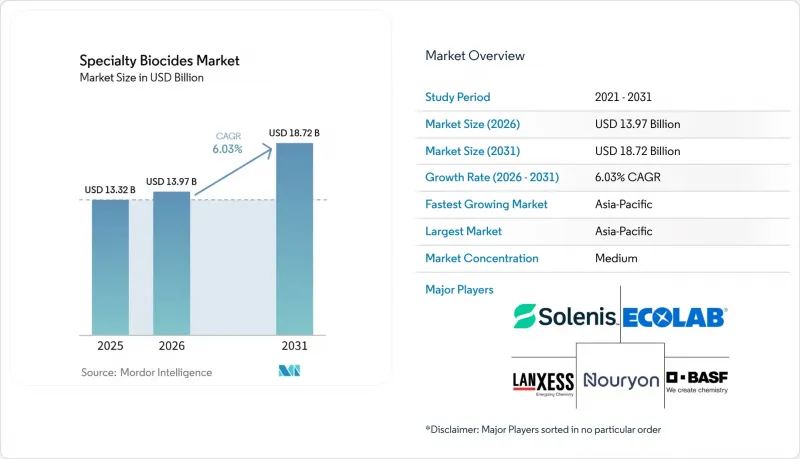
本報告按除生物劑類型(非氧化性除生物劑、氧化性除生物劑)、產品類型(鹵代除生物劑、有機硫除生物劑等)、應用領域(工業水處理、石油天然氣、紙漿和造紙等)以及地區(亞太地區、北美地區、歐洲地區、南美地區、中東和非洲)進行細分。市場預測以美元計價。
全球特種除生物劑市場趨勢與洞察
對水資源再利用的需求日益成長,以及對工業污水法規的遵守情況也日益複雜。
工業污水法規和水循環利用要求正在推動對特種除生物劑的需求。美國環保署 (EPA) 的零液體排放 (ZLD)水資源再利用法規於 2026 年 7 月 16 日生效,擴大了對全氟烷基物質 (PFAS) 和多氟烷基物質前驅物以及包括奈米銀殘留物在內的微量污染物的監測範圍。歐洲化學品管理局 (ECHA) 於 2026 年 7 月發布的關於含亞磷酸鹽的逆滲透阻垢劑的法規,提高了人們對非氯化活性系統的興趣。四羥甲基硫酸鏻 (THPS)、2,2-二溴-3-硝基丙醯胺 (DBNPA) 和過氧乙酸基體系適用於零液體排放和逆滲透預處理,因為它們可以緩解膜污染問題。因此,即使處理水量沒有增加,特種除生物劑市場的需求仍與法規遵循要求密切相關。
醫療機構對衛生和感染控制解決方案的需求正在成長。
醫療相關感染疾病(HACCP)持續推動醫療機構對高效表面感染疾病的需求,尤其是在特種除生物劑市場。世界衛生組織(WHO)的數據顯示,在任何時候,高所得國家每十名患者中就有一名受到HACCP的影響,而中低收入國家這一比例則高達四分之一。季銨化合物因其對常見醫院獲得性病原體(包括耐多藥肺炎克雷伯菌和鮑曼鮑氏不動桿菌)的有效性而仍然備受重視。 2025年的評估報告指出,標準化除生物劑敏感性測試存在不足,這可能會使抗藥性監測和未來的合理使用措施變得複雜。 Arxada公司於2026年6月宣布與Clorox Healthcare達成協議,將向北美醫療機構推廣其已獲美國環保署(EPA)註冊的Quanticare殺孢子技術(Spolicide技術)。 EPA針對醫院的「更安全選擇」(Safer Choice)認證要求可能會使擁有良好合規記錄的供應商更受青睞。
嚴格的毒性和環境法規,以控制除生物劑的活性成分。
活性成分的審查可能會延遲產品核准,並增加整個特種除生物劑市場(尤其是在歐洲)的合規成本。根據《除生物劑產品法規》,活性成分的審查可能需要 5 到 10 年。歐洲化學品管理局 (ECHA) 和歐洲食品安全局 (EFSA) 聯合發布的指南適用於 2026 年 4 月 1 日之後提交的除生物劑申請,該指南強制要求在實際飲用水處理條件下審查代謝物。這項評估包括氯化和臭氧處理等製程產生的副產品。歐盟實施條例 2026/1331 於 2026 年 6 月 4 日生效,修訂了已經過核准的次氯酸鈣除生物劑的行政和合規要求。雖然大型供應商可以將申請準備成本分攤到廣泛的產品系列中,但這會對小規模的區域性公司造成更大的負擔。
細分市場分析
至2025年,非氧化性除生物劑將佔據特種除生物劑市場62.34%的佔有率。它們在特種除生物劑市場的地位反映了其與逆滲透預處理、生產水回用和冷卻塔系統的兼容性。由於這些系統可能因氧化性活性成分而受損,因此非氧化性產品在膜密集型作業中發揮重要作用。 THPS和DBNPA廣泛應用於油田。異噻唑啉酮類製劑,包括MIT、CMIT和BIT,被廣泛應用於製造業的儲槽和冷卻水整體。有機硫和醛類除生物劑(包括戊二醛)也能滿足類似的需求,儘管它們在某些地區面臨監管壓力。
2026年至2031年間,植物來源替代品可望在特種除生物劑市場中發揮更重要的作用。 2025年的一項研究發現,這些替代品在其各自的應用中可達到80%至99.8%的抑制效率。這一優異性能為在需要重新評估傳統化學品的領域引入毒性較低的活性成分體系創造了空間。預計到2031年,氧化型除生物劑的複合年成長率將達到6.72%。這一成長主要得益於現場生產技術的進步以及對具有殺滅孢子功效的醫用消毒劑的需求。 EN 18087:2026標準對二氧化氯生產系統進行了規範,而Arxada公司於2025年10月推出了取得專利的現場過氧乙酸生產技術。
區域分析
到2025年,亞太地區將佔全球銷售額的41.66%,成為全球最大的特種除生物劑市場。中國市場成長的驅動力主要來自水處理需求以及基於有機鹵素吸收劑排放法規要求而轉向非氯化活性成分。印度市場的需求則得益於製藥、紡織和食品加工產業叢集對廢水排放法規的合規要求。 2025年1月,THOR中國在江蘇省鎮江市開設了一家苯並異噻唑啉酮(BIT)工廠。該工廠採用溶劑回收工藝,旨在擴大在亞太地區的生產和服務能力。
在北美,受水資源再利用需求、電力和化學加工以及醫療產業投資的推動,對特種除生物劑的需求正在形成成熟且活躍的市場。美國市場受益於藝康(Ecolab)、索理思(Solenis)和凱米拉(Chemira)等公司提供的高純度配方和數位化計量服務。與通用產品相比,這些產品和服務可以以更高的價格出售。由於歐盟的《除生物劑產品法規》,歐洲的合規環境最為嚴格。供應商可以利用其在監管方面的經驗,為監管相對寬鬆的出口市場提供服務。
南美洲是特種除生物劑的新興市場,其應用主要集中在巴西的城市水處理以及食品飲料加工領域。阿根廷的瓦卡穆埃爾塔油田開發計畫推動了油田微生物控制的需求。 SPE(美國石油工程師協會)的一篇論文描述了一種針對阿根廷傳統型油田開發中哈拉納菌屬(Haranaerobium)微生物的客製化解決方案。這項研究表明,根據當地微生物環境制定客製化方案至關重要。在中東和非洲,阿拉伯灣油田的水資源管理以及沙烏地阿拉伯和阿拉伯聯合大公國海水淡化產能的擴張推動了對殺菌劑的需求。除生物劑被用來抑制多級沖洗和逆滲透海水淡化系統中的生物污染。
其他好處:
- Excel格式的市場預測(ME)表
- 3個月的分析師支持
目錄
第1章:引言
- 市場分析與定義的前提條件
- 分析範圍
第2章 分析方法
第3章執行摘要
第4章 市場狀況
- 市場概覽
- 市場促進因素
- 對水資源再利用的需求日益成長,以及對工業污水法規的遵守情況也日益嚴格。
- 醫療機構對衛生和感染控制解決方案的需求正在成長。
- 擴大特殊除生物劑在油田水資源管理和資產保護的應用。
- 現場除生物劑生產技術和數位除生物劑管理技術的進步
- 人們對低碳和生物基特種除生物劑。
- 市場限制因素
- 嚴格的毒性和環境法規,以控制除生物劑的活性成分。
- 人們越來越關注微生物抗藥性和除生物劑效力下降的問題
- 與配方一致性以及不同地區監管標籤要求差異相關的問題。
- 價值鏈分析
- 波特五力分析
第5章:預測市場規模與成長率
- 按除生物劑類型
- 非氧化性除生物劑
- 氧化性除生物劑
- 依產品類型
- 鹵代除生物劑
- 有機硫除生物劑
- 季銨化合物(季銨鹽)
- 醛類除生物劑
- 酚類除生物劑
- 有機酸除生物劑
- 金屬基除生物劑
- 其他特殊除生物劑
- 透過使用
- 工業水處理
- 石油和天然氣
- 紙漿和造紙
- 個人護理和化妝品
- 醫療保健
- 油漆和塗料
- 食品/飲料加工
- 其他用途
- 按地區
- 亞太地區
- 中國
- 印度
- 日本
- 韓國
- 其他亞太國家
- 北美洲
- 美國
- 加拿大
- 墨西哥
- 歐洲
- 德國
- 英國
- 法國
- 義大利
- 俄羅斯
- 其他歐洲國家
- 南美洲
- 巴西
- 阿根廷
- 其他南美國家
- 中東和非洲
- 沙烏地阿拉伯
- 南非
- 其他中東和非洲國家
- 亞太地區
第6章 競爭情勢
- 市場集中度
- 策略趨勢
- 市佔率和排名分析
- 公司簡介
- Accepta Ltd.
- Arxada AG
- Baker Hughes Company
- BASF
- Clariant
- Dow
- Ecolab Inc.
- Kemira Oyj
- Lanxess
- Neogen Corporation
- Nouryon
- Solenis
- Thor Group Limited
- Troy Corporation
- Veolia Water Technologies
第7章 市場機會與未來展望
According to Mordor Intelligence, the specialty biocides market was valued at USD 13.32 billion in 2025 and is estimated to grow from USD 13.97 billion in 2026 to reach USD 18.72 billion by 2031, at a CAGR of 6.03% during the forecast period (2026-2031).
This report is Segmented by Biocide Type (Non-Oxidizing Biocides and Oxidizing Biocides), Product Type (Halogen-Based Biocides, Organosulfur Biocides, and More), Application (Industrial Water Treatment, Oil and Gas, Pulp and Paper, and More), and Geography (Asia-Pacific, North America, Europe, South America, and Middle-East and Africa). The Market Forecasts are Provided in Terms of Value (USD).
Global Specialty Biocides Market Trends and Insights
Increasing Demand for Water Reuse and Compliance with Industrial Wastewater Regulations
Industrial effluent rules and water recycling requirements are strengthening demand for specialty biocides. The US Environmental Protection Agency (EPA) industrial zero liquid discharge water reuse rule took effect on July 16, 2026, and expanded monitoring for micropollutants, including per- and polyfluoroalkyl substances (PFAS) precursors and nanosilver residues. A July 2026 European Chemicals Agency (ECHA) restriction affecting phosphite-containing reverse osmosis antiscalants, which raises interest in non-chlorine active systems. Tetrakis(hydroxymethyl)phosphonium sulfate (THPS), 2,2-dibromo-3-nitrilopropionamide (DBNPA), and peracetic acid systems are suited to zero liquid discharge and reverse osmosis pretreatment because they can reduce membrane fouling concerns. Demand in the specialty biocides market, therefore, remains linked to compliance needs even when treated water volumes do not rise.
Growing Demand for Institutional Hygiene and Infection Control Solutions
Healthcare-associated infections continue to support institutional demand for effective surface disinfection in the specialty biocides market. The World Health Organization reported that healthcare-associated infections affect one in ten patients in high-income countries and 1 in 4 patients in low- and middle-income countries at any given time. Quaternary ammonium compounds remain important because they are effective against common hospital pathogens, including multidrug-resistant Klebsiella pneumoniae and Acinetobacter baumannii. A 2025 review identified gaps in standardized biocide susceptibility testing, which can complicate resistance surveillance and future stewardship measures. Arxada announced a June 2026 agreement with Clorox Healthcare to introduce its EPA-registered Quanticare sporicidal technology in North American healthcare facilities. Hospital procurement requirements for EPA Safer Choice-certified products can favor suppliers with established compliance credentials.
Stringent Toxicological and Environmental Regulations Governing Active Biocidal Substances
Active-substance reviews can slow product approvals and increase compliance costs across the specialty biocides market, especially in Europe. The Biocidal Products Regulation reviews can take 5-10 years for an active substance. Joint ECHA and European Food Safety Authority (EFSA) guidance applies to biocide applications submitted from April 1, 2026, and requires review of transformation products under realistic drinking-water treatment conditions. The required assessment covers byproducts from processes such as chlorination and ozonation. EU Implementing Regulation 2026/1331 took effect on June 4, 2026 and changed administrative and compliance requirements for authorized calcium hypochlorite biocides. Large suppliers can spread dossier-development costs across broader portfolios, while smaller regional firms face a heavier burden.
Other drivers and restraints analyzed in the detailed report include:
- Increasing Use of Specialty Biocides in Oilfield Water Management and Asset Protection
- Advancements in In-Situ Biocide Generation and Digital Biocide Dosing Technologies
- Increasing Concerns Regarding Microbial Resistance and Reduced Biocide Effectiveness
For complete list of drivers and restraints, kindly check the Table Of Contents.
Segment Analysis
Non-oxidizing biocides held 62.34% of the specialty biocides market share in 2025. Their position in the specialty biocides market reflects compatibility with reverse osmosis pretreatment, produced-water reuse, and cooling-tower systems. These systems can be damaged by oxidizing actives, which gives non-oxidizing products a practical role in membrane-intensive operations. THPS and DBNPA are used widely in oilfield applications. Isothiazolinone formulations, including MIT, CMIT, and BIT, are used in in-can preservation and cooling-water programs across manufacturing. Organosulfur and aldehyde-based biocides, including glutaraldehyde, serve similar needs but face regulatory pressure in some jurisdictions.
Plant-derived alternatives could become more relevant within this specialty biocides market segment during 2026-2031. A 2025 review found that these alternatives achieved 80-99.8% inhibition efficiency in relevant applications. This performance creates room for lower-toxicity active systems where conventional chemistries face review. Oxidizing biocides are forecast to grow at a 6.72% CAGR through 2031. In-situ generation and demand for sporicidal healthcare disinfection support that growth. EN 18087:2026 supports chlorine dioxide generation systems, while Arxada introduced a patented on-site peracetic acid generation technology in October 2025.
Complete Report Scope:
- By Biocide Type
- Non-Oxidizing Biocides
- Oxidizing Biocides
- By Product Type
- Halogen-Based Biocides
- Organosulfur Biocides
- Quaternary Ammonium Compounds (Quats)
- Aldehyde Biocides
- Phenolic Biocides
- Organic Acid Biocides
- Metallic Biocides
- Other Specialty Biocides
- By Application
- Industrial Water Treatment
- Oil and Gas
- Pulp and Paper
- Personal Care and Cosmetics
- Healthcare
- Paints and Coatings
- Food and Beverage Processing
- Other Applications
- By Geography
- Asia-Pacific
- China
- India
- Japan
- South Korea
- Rest of Asia-Pacific
- North America
- United States
- Canada
- Mexico
- Europe
- Germany
- United Kingdom
- France
- Italy
- Russia
- Rest of Europe
- South America
- Brazil
- Argentina
- Rest of South America
- Middle-East and Africa
- Saudi Arabia
- South Africa
- Rest of Middle-East and Africa
- Asia-Pacific
Geography Analysis
Asia-Pacific held 41.66% of global revenue in 2025, making it the largest regional specialty biocides market. China's contribution is supported by water treatment demand and movement toward non-chlorine actives under absorbable organic halogen discharge requirements. India's demand is supported by wastewater compliance needs in pharmaceutical, textile, and food-processing clusters. THOR China opened a Benzisothiazolinone (BIT) plant in Zhenjiang, Jiangsu, in January 2025. The facility includes a solvent-recycling process and is intended to expand production and service capacity in the Asia-Pacific.
North America has a mature but active demand base in the specialty biocides market, supported by water reuse requirements, power and chemical processing, and healthcare investment. US demand benefits from high-purity formulations and digital dosing services supplied by Ecolab, Solenis, and Kemira. These offerings can obtain premium pricing compared with commodity supplies. Europe has the most demanding compliance setting because of the EU Biocidal Products Regulation. Suppliers can use that regulatory experience when serving less-regulated export markets.
South America is an emerging demand center in the specialty biocides market, with Brazil supporting municipal water treatment and food and beverage processing. Argentina's Vaca Muerta development supports demand for oilfield microbial control. An SPE paper described a tailored solution for Halanaerobium microorganisms in Argentine unconventional operations. This work shows why local microbial conditions can require customized programs. The Middle-East and Africa are supported by oilfield water management in the Arabian Gulf and growing desalination capacity in Saudi Arabia and the UAE. Biocides are used to manage biological fouling in multi-stage flash and reverse osmosis desalination systems.
- Accepta Ltd.
- Arxada AG
- Baker Hughes Company
- BASF
- Clariant
- Dow
- Ecolab Inc.
- Kemira Oyj
- Lanxess
- Neogen Corporation
- Nouryon
- Solenis
- Thor Group Limited
- Troy Corporation
- Veolia Water Technologies
Additional Benefits:
- The market estimate (ME) sheet in Excel format
- 3 months of analyst support
TABLE OF CONTENTS
1 Introduction
- 1.1 Study Assumptions and Market Definition
- 1.2 Scope of the Study
2 Research Methodology
3 Executive Summary
4 Market Landscape
- 4.1 Market Overview
- 4.2 Market Drivers
- 4.2.1 Increasing Demand for Water Reuse and Compliance with Industrial Wastewater Regulations
- 4.2.2 Growing Demand for Institutional Hygiene and Infection Control Solutions
- 4.2.3 Increasing Use of Specialty Biocides in Oilfield Water Management and Asset Protection
- 4.2.4 Advancements in In-Situ Biocide Generation and Digital Biocide Dosing Technologies
- 4.2.5 Growing Focus on Low-Carbon and Bio-Based Specialty Biocide Formulations
- 4.3 Market Restraints
- 4.3.1 Stringent Toxicological and Environmental Regulations Governing Active Biocidal Substances
- 4.3.2 Increasing Concerns Regarding Microbial Resistance and Reduced Biocide Effectiveness
- 4.3.3 Formulation Compatibility Challenges and Variations in Regional Regulatory Labeling Requirements
- 4.4 Value Chain Analysis
- 4.5 Porter's Five Forces Analysis
- 4.5.1 Threat of New Entrants
- 4.5.2 Bargaining Power of Suppliers
- 4.5.3 Bargaining Power of Buyers
- 4.5.4 Threat of Substitutes
- 4.5.5 Competitive Rivalry
5 Market Size and Growth Forecasts (Value)
- 5.1 By Biocide Type
- 5.1.1 Non-Oxidizing Biocides
- 5.1.2 Oxidizing Biocides
- 5.2 By Product Type
- 5.2.1 Halogen-Based Biocides
- 5.2.2 Organosulfur Biocides
- 5.2.3 Quaternary Ammonium Compounds (Quats)
- 5.2.4 Aldehyde Biocides
- 5.2.5 Phenolic Biocides
- 5.2.6 Organic Acid Biocides
- 5.2.7 Metallic Biocides
- 5.2.8 Other Specialty Biocides
- 5.3 By Application
- 5.3.1 Industrial Water Treatment
- 5.3.2 Oil and Gas
- 5.3.3 Pulp and Paper
- 5.3.4 Personal Care and Cosmetics
- 5.3.5 Healthcare
- 5.3.6 Paints and Coatings
- 5.3.7 Food and Beverage Processing
- 5.3.8 Other Applications
- 5.4 By Geography
- 5.4.1 Asia-Pacific
- 5.4.1.1 China
- 5.4.1.2 India
- 5.4.1.3 Japan
- 5.4.1.4 South Korea
- 5.4.1.5 Rest of Asia-Pacific
- 5.4.2 North America
- 5.4.2.1 United States
- 5.4.2.2 Canada
- 5.4.2.3 Mexico
- 5.4.3 Europe
- 5.4.3.1 Germany
- 5.4.3.2 United Kingdom
- 5.4.3.3 France
- 5.4.3.4 Italy
- 5.4.3.5 Russia
- 5.4.3.6 Rest of Europe
- 5.4.4 South America
- 5.4.4.1 Brazil
- 5.4.4.2 Argentina
- 5.4.4.3 Rest of South America
- 5.4.5 Middle-East and Africa
- 5.4.5.1 Saudi Arabia
- 5.4.5.2 South Africa
- 5.4.5.3 Rest of Middle-East and Africa
- 5.4.1 Asia-Pacific
6 Competitive Landscape
- 6.1 Market Concentration
- 6.2 Strategic Moves
- 6.3 Market Share (%)/Ranking Analysis
- 6.4 Company Profiles (includes Global Overview, Market Overview, Core Segments, Financials as available, Strategic Information, Products and Services, and Recent Developments)
- 6.4.1 Accepta Ltd.
- 6.4.2 Arxada AG
- 6.4.3 Baker Hughes Company
- 6.4.4 BASF
- 6.4.5 Clariant
- 6.4.6 Dow
- 6.4.7 Ecolab Inc.
- 6.4.8 Kemira Oyj
- 6.4.9 Lanxess
- 6.4.10 Neogen Corporation
- 6.4.11 Nouryon
- 6.4.12 Solenis
- 6.4.13 Thor Group Limited
- 6.4.14 Troy Corporation
- 6.4.15 Veolia Water Technologies
7 Market Opportunities and Future Outlook
- 7.1 White-Space and Unmet-Need Assessment

 金屬加工液消毒劑市場規模、佔有率和成長分析:按產品類型、功能、液體類型、應用、最終用戶產業和地區分類 - 產業預測,2026-2033年
 除生物劑:市場佔有率分析、產業趨勢與統計、成長預測(2026-2031)
 水處理消毒劑市場:依產品、配方、功能、給藥方法、銷售管道和應用分類-2026-2032年全球市場預測除生物劑市場:依類型、形態、溶解度、原料、應用及通路分類-2026-2032年全球市場預測
 特種殺菌劑市場規模、佔有率、成長、全球產業分析、區域洞察及2026-2034年預測
 溴基殺菌劑市場規模、佔有率和趨勢分析報告:按最終用途、地區和細分市場預測(2026-2033 年)五氯酚:市場佔有率分析、產業趨勢與統計、成長預測(2026-2031)
 除生物劑市場報告:按產品、應用和地區分類,2026-2034年
 除生物劑市場:依產品類型、應用和地區分類RO膜專用快速消毒劑市場:按技術、膜材料、運行模式、壓力類型、應用和最終用戶分類,全球預測,2026-2032年