


 |
市場調查報告書
商品編碼
2122318
聚合物微球:市場佔有率分析、產業趨勢與統計、成長預測(2026-2031)Polymer Microspheres - Market Share Analysis, Industry Trends & Statistics, Growth Forecasts (2026 - 2031) |
||||||

※ 本網頁內容可能與最新版本有所差異。詳細情況請與我們聯繫。
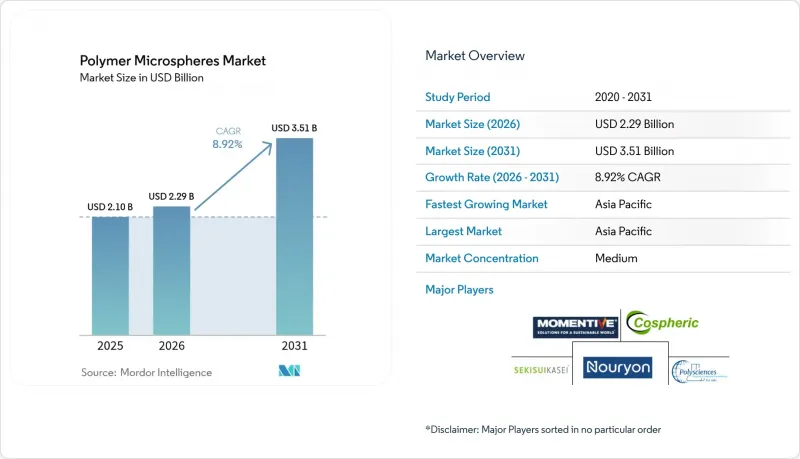
根據 Mordor Intelligence 預測,聚合物微球市場規模將從 2025 年的 21 億美元成長到 2026 年的 22.9 億美元,到 2031 年將達到 35.1 億美元,2026 年至 2031 年的複合年成長率為 8.92%。
本報告按類型(可膨脹微球、可生物分解微球)、材料成分(聚苯乙烯(PS)、聚甲基丙烯酸甲酯(PMMA)、聚乙烯(PE)、其他)、最終用戶行業(生命科學和製藥、化妝品和個人護理、油漆和塗料、其他)以及地區(亞太地區、北美、歐洲、南美、中東和非洲)進行分類。
全球聚合物微球市場趨勢與洞察
標靶藥物傳遞和緩釋藥物的應用範圍擴大
PLGA和其他生物可分解載體能夠實現精確的藥物釋放曲線,這正促使製劑研發人員從傳統片劑轉向注射或植入式微球系統。生技藥品的包封能力提高了穩定性,減少了冷鏈損耗,並增強了治療效果。微流體造技術如今能夠生產粒徑分佈窄的產品,克服了傳統製劑批次間差異的問題。美國食品藥物管理局(FDA)已批准超過15種基於PLGA的產品,樹立了明確的監管先例。個人化醫療計畫利用可調控的釋放動力學,實現基於個別藥物動力學特徵的給藥。已具備無菌微球生產能力的製藥公司正透過建立高轉化成本來鞏固其競爭優勢。
汽車和運輸設備零件對輕質填充材的需求
歐洲監管機構強制要求降低整車重量,以幫助實現二氧化碳排放強度目標,這推動了在內飾件、保險桿橫樑和引擎室部件中使用含有中空球的聚合物。這種聚合物可以在不影響機械剛性的前提下降低25%的密度,從而延長電動車的續航里程。微球技術帶來的低壓成型製程也縮短了生產週期,提高了工廠的生產效率。與複合材料生產商合作開發此類材料的供應商正在獲得多年採購合約。隨著電池式電動車產量佔有率的增加,車身本體每減重一公斤,都能為汽車製造商帶來實質的成本節約和續航里程的提升。
化妝品和洗漱用品中微塑膠的監管
歐盟法規將沖洗化妝品中的微塑膠含量限制在0.01%以內,實際上禁止了臉部磨砂膏和牙膏中常見的傳統聚苯乙烯微粒。全球品牌正在對其配方進行標準化,以符合單一的監管標準,這導致一次性化妝品的重要市場流失。沒有可生物分解替代品的供應商正面臨銷售的直接下滑。此外,由於資源轉移到合規性測試,新產品開發週期也受到影響,導致相關類別的新產品上市延遲。雖然可生物分解替代品能帶來更高的利潤率,但這種短期轉變為嚴重依賴個人護理領域的公司帶來了現金流挑戰。
細分市場分析
2025年,可膨脹型複合材料的銷售額佔比達52.05%。這主要得益於其在汽車和建築複合材料領域的穩定應用,在這些領域,可控膨脹能夠在不影響強度的前提下降低密度。儘管規模較小,但可生物分解型複合材料預計將以10.74%的複合年成長率快速成長,因為監管機構和製藥研發公司更傾向於使用PLGA和聚己內酯基質來實現藥物的控釋。亞太地區的複合材料生產商傳統上專注於生產可膨脹球體作為輕質填料,但為了滿足未來的需求,他們正在拓展業務,增加可生物分解產品的產能。
製藥契約製造生產商已簽訂長期供貨契約,以確保後期臨床試驗項目的產能,從而保證了累積訂單。相較之下,通用型可膨脹產品正面臨日益激烈的價格競爭,尤其來自中國和印度等利用其低成本優勢的本土生產商。因此,預計到2031年,聚合物微球市場的整體銷售結構將轉向利潤率更高的生物分解型產品。
區域分析
亞太地區在製藥、半導體組裝和汽車製造領域佔據主導地位,預計2025年將佔全球市場規模的36.88%。該地區預計10.31%的複合年成長率主要得益於其原料成本優勢以及電動車裝配線的擴張,而電動車組裝優先考慮輕質填料。在印度,由於國內製藥產量增加以及本土化妝品品牌採用受監管的可生物分解替代品,市場成長正在進一步加速。出口型供應商正利用其成熟的物流網路向北美和歐洲出貨,進一步鞏固了亞太地區作為聚合物微球市場主要生產中心的地位。
該地區預計年複合成長率將達到10.31%,這主要得益於有利的原料成本以及電動車組裝的擴張,而電動車裝配線優先使用輕質填料。在印度,由於國內藥品產量增加以及本土化妝品品牌採用受監管的可生物分解替代品,成長速度正在進一步加快。出口型供應商正利用其成熟的物流網路向北美和歐洲出貨,從而鞏固亞太地區作為聚合物微球市場主要生產中心的地位。
在北美,藥物輸送技術的創新和嚴格的企業平均燃油經濟性(CAFE)法規(包括減重目標)維持了強勁的消費需求。受託研究機構(CRO)和原始設備製造商(OEM)正與微球供應商合作,開發符合自身性能標準的專用等級產品。在歐洲,REACH法規中關於微塑膠的實施迫使混料商採用可生物分解的微球。這項監管措施正在加速個人保健產品和塗料領域的產品成分重組。在南美、中東和非洲,隨著產業多元化的推進,微球的採用率較為溫和,但由於當地產能有限,供應依賴進口。
其他好處
- Excel格式的市場預測(ME)表
- 3個月的分析師支持
目錄
第1章:引言
- 研究假設和市場定義
- 調查範圍
第2章:調查方法
第3章執行摘要
第4章 市場狀況
- 市場概覽
- 市場促進因素
- 標靶藥物傳遞和緩釋藥物的應用範圍擴大
- 汽車和運輸設備零件對輕質填充材的需求
- 微電子製造業的激增
- 利用聚合物微球生長3D列印材料
- 生物基可膨脹微球在低碳建築材料的應用。
- 市場限制因素
- 化妝品和洗漱用品中微塑膠的監管
- 石化原料價格波動與供應中斷風險
- 超均一可生物分解微球大規模生產的挑戰
- 價值鏈分析
- 波特五力模型
第5章 市場規模與成長預測
- 按類型
- 可膨脹微球
- 可生物分解的微球
- 按材料組成
- 聚苯乙烯(PS)
- 聚甲基丙烯酸甲酯(PMMA)
- 聚乙烯(PE)
- 聚氨酯(PU)
- 生物可分解聚合物(PLGA、PCL 等)
- 其他材料(尼龍、聚偏氟乙烯等)
- 按最終用戶行業分類
- 生命科學與製藥
- 化妝品和個人護理
- 油漆和塗料
- 電子設備
- 陶瓷和複合材料
- 塑膠
- 其他終端用戶產業(3D列印、農業等)
- 按地區
- 亞太地區
- 中國
- 印度
- 日本
- 韓國
- 其他亞太國家
- 北美洲
- 美國
- 加拿大
- 墨西哥
- 歐洲
- 德國
- 英國
- 法國
- 義大利
- 其他歐洲國家
- 南美洲
- 巴西
- 阿根廷
- 其他南美國家
- 中東和非洲
- 沙烏地阿拉伯
- 南非
- 其他中東和非洲國家
- 亞太地區
第6章 競爭情勢
- 市場集中度分析
- 策略性舉措(併購、合資、合作)
- 市佔率和排名分析
- 公司簡介
- Bangs Laboratories Inc.
- CD Bioparticles
- Cospheric LLC
- DiaSorin SpA
- Evonik Industries AG
- Matsumoto Yushi Seiyaku Co., Ltd.
- Merck KGaA
- Momentive
- Nouryon
- Phosphorex Inc.
- PolyMicrospheres
- Polysciences Inc.
- Sekisui Kasei Co., Ltd.
- Sphere Fluidics Ltd.
- Sunjin Chemical Co., Ltd.
- Thermo Fisher Scientific Inc.
第7章 市場機會與未來展望
According to Mordor Intelligence, the polymer microspheres market size is expected to grow from USD 2.10 billion in 2025 to USD 2.29 billion in 2026 and is forecast to reach USD 3.51 billion by 2031 at 8.92% CAGR over 2026-2031.
This report is Segmented by Type (Expandable Microspheres, and Biodegradable Microspheres), Material Composition (Polystyrene (PS), Polymethyl-Methacrylate (PMMA), Polyethylene (PE), and More), End-User Industry (Life Sciences and Pharmaceuticals, Cosmetics and Personal Care, Paints and Coatings, and More), and Geography (Asia-Pacific, North America, Europe, South America, and Middle-East and Africa).
Global Polymer Microspheres Market Trends and Insights
Rising Adoption in Targeted Drug Delivery and Controlled-Release Pharmaceuticals
Precise release profiles achievable with PLGA and other biodegradable carriers have shifted formulators away from traditional tablets toward injectable or implantable microsphere systems. The capability to encapsulate biologics improves stability, which reduces cold-chain losses and enhances therapeutic outcomes. Microfluidic manufacturing now delivers narrow particle-size distributions that overcome historic batch variability. The United States Food and Drug Administration has cleared more than 15 PLGA-based products, providing clear regulatory precedents. Personalized-medicine programs exploit tunable release kinetics, enabling dosing designed around individual pharmacokinetic profiles. Pharmaceutical companies that already own sterile microsphere capacity build high switching costs that reinforce competitive moats.
Demand for Lightweight Fillers in Automotive and Transportation Components
Regulators in Europe require fleetwide weight reductions that support CO2 intensity targets, encouraging polymers that integrate hollow spheres into interior trim, bumper beams, and under-hood parts. Density can fall by 25% with no loss in mechanical stiffness, a gain that extends electric vehicle driving range. Lower-pressure molding made possible by microspheres also trims cycle times, which improves plant productivity. Suppliers that co-develop grades with compounders lock in multiyear sourcing agreements. As battery-electric models account for a larger share of production, every kilogram removed from the body in white delivers tangible cost and range advantages for original equipment manufacturers.
Restrictions on Micro-Plastics in Cosmetics and Toiletries
European Union regulation limits microplastic content in rinse-off cosmetics to 0.01%, effectively banning conventional polystyrene spheres in facial scrubs and toothpastes. Global brands harmonize formulations to a single compliant standard, which removes a significant volume outlet for disposable grades. Suppliers that lack biodegradable alternatives see immediate revenue declines. New product development cycles also divert resources toward regulatory testing, slowing launches in adjacent categories. While bio-degradable replacements offer higher margins, the short-term shift challenges cash flows for firms heavily exposed to personal care.
Other drivers and restraints analyzed in the detailed report include:
- Surge in Micro-Electronics Manufacturing
- Growth of 3-D Printing Feedstocks Using Polymer Microspheres
- Production-Scale Challenges in Ultra-Uniform Biodegradable Microspheres
For complete list of drivers and restraints, kindly check the Table Of Contents.
Segment Analysis
Expandable grades captured 52.05% of 2025 revenue, underpinned by steady use in automotive and construction composites, where controlled expansion lowers density without sacrificing strength. Biodegradable grades, while smaller, are forecast to grow fastest at 10.74% CAGR as regulators and drug developers favor PLGA and polycaprolactone matrices for controlled drug release. Asia-Pacific formulators historically focused on expandable spheres for lightweight fillers, now diversifying into bio-degradable capacity to hedge future demand.
Pharmaceutical contractors lock in long-term supply agreements that secure capacity for late-stage clinical programs, stabilizing order books. By contrast, generic expandable products face intensifying price competition, especially from domestic producers in China and India that leverage low-cost bases. As a result, revenue mix across the polymer microspheres market tilts toward higher-margin biodegradable segments through 2031.
Complete Report Scope:
- By Type
- Expandable Microspheres
- Biodegradable Microspheres
- By Material Composition
- Polystyrene (PS)
- Polymethyl-methacrylate (PMMA)
- Polyethylene (PE)
- Polyurethane (PU)
- Biodegradable Polymers (PLGA, PCL, etc.)
- Others (Nylon, PVDF, etc.)
- By End-User Industry
- Life Sciences and Pharmaceuticals
- Cosmetics and Personal Care
- Paints and Coatings
- Electronics
- Ceramics and Composites
- Plastics
- Other End-User Industries (3-D Printing, Agriculture, etc.)
- By Geography
- Asia-Pacific
- China
- India
- Japan
- South Korea
- Rest of Asia-Pacific
- North America
- United States
- Canada
- Mexico
- Europe
- Germany
- United Kingdom
- France
- Italy
- Rest of Europe
- South America
- Brazil
- Argentina
- Rest of South America
- Middle-East and Africa
- Saudi Arabia
- South Africa
- Rest of Middle-East and Africa
- Asia-Pacific
Geography Analysis
Asia-Pacific holds a 36.88% share of the 2025 global value, reflecting its dominance in pharmaceutical manufacturing, semiconductor assembly, and automotive production. The region's 10.31% forecast CAGR stems from cost advantages in feedstocks and expanding electric-vehicle assembly lines that value lightweight fillers. India amplifies growth as domestic pharmaceutical output rises, and local cosmetics brands adopt compliant, degradable alternatives. Export-oriented suppliers leverage established logistics to ship to North America and Europe, reinforcing Asia-Pacific's role as the primary production hub for the polymer microspheres market.
The region's 10.31% forecast CAGR stems from cost advantages in feedstocks and expanding electric-vehicle assembly lines that value lightweight fillers. India amplifies growth as domestic pharmaceutical output rises, and local cosmetics brands adopt compliant, degradable alternatives. Export-oriented suppliers leverage established logistics to ship to North America and Europe, reinforcing Asia-Pacific's role as the primary production hub for the polymer microspheres market.
North America maintains strong consumption through innovation in drug delivery and stringent corporate average fuel economy regulations that embed lightweighting targets. Contract research organizations and original equipment manufacturers collaborate with microsphere suppliers on proprietary grades that meet unique performance criteria. Europe enforces micro-plastic restrictions under REACH, compelling formulators to adopt biodegradable spheres. This legislative push drives rapid product reformulation across personal care and paints. South America and the Middle-East, and Africa experience moderate uptake as industrial diversification advances, but supply relies on imports due to limited local production capacity.
- Bangs Laboratories Inc.
- CD Bioparticles
- Cospheric LLC
- DiaSorin S.p.A
- Evonik Industries AG
- Matsumoto Yushi Seiyaku Co., Ltd.
- Merck KGaA
- Momentive
- Nouryon
- Phosphorex Inc.
- PolyMicrospheres
- Polysciences Inc.
- Sekisui Kasei Co., Ltd.
- Sphere Fluidics Ltd.
- Sunjin Chemical Co., Ltd.
- Thermo Fisher Scientific Inc.
Additional Benefits:
- The market estimate (ME) sheet in Excel format
- 3 months of analyst support
TABLE OF CONTENTS
1 Introduction
- 1.1 Study Assumptions and Market Definition
- 1.2 Scope of the Study
2 Research Methodology
3 Executive Summary
4 Market Landscape
- 4.1 Market Overview
- 4.2 Market Drivers
- 4.2.1 Rising Adoption in Targeted Drug Delivery and Controlled-Release Pharmaceuticals
- 4.2.2 Demand for Lightweight Fillers in Automotive and Transportation Components
- 4.2.3 Surge in Micro-Electronics Manufacturing
- 4.2.4 Growth of 3-D Printing Feedstocks Using Polymer Microspheres
- 4.2.5 Emergence of Bio-Based Expandable Microspheres for Low-Carbon Building Materials
- 4.3 Market Restraints
- 4.3.1 Restrictions on Micro-Plastics in Cosmetics and Toiletries
- 4.3.2 Volatile Petrochemical Feedstock Prices and Supply Disruption Risk
- 4.3.3 Production-Scale Challenges in Ultra-Uniform Biodegradable Microspheres
- 4.4 Value Chain Analysis
- 4.5 Porter's Five Forces
- 4.5.1 Bargaining Power of Suppliers
- 4.5.2 Bargaining Power of Buyers
- 4.5.3 Threat of New Entrants
- 4.5.4 Threat of Substitutes
- 4.5.5 Competitive Rivalry
5 Market Size and Growth Forecasts (Value)
- 5.1 By Type
- 5.1.1 Expandable Microspheres
- 5.1.2 Biodegradable Microspheres
- 5.2 By Material Composition
- 5.2.1 Polystyrene (PS)
- 5.2.2 Polymethyl-methacrylate (PMMA)
- 5.2.3 Polyethylene (PE)
- 5.2.4 Polyurethane (PU)
- 5.2.5 Biodegradable Polymers (PLGA, PCL, etc.)
- 5.2.6 Others (Nylon, PVDF, etc.)
- 5.3 By End-User Industry
- 5.3.1 Life Sciences and Pharmaceuticals
- 5.3.2 Cosmetics and Personal Care
- 5.3.3 Paints and Coatings
- 5.3.4 Electronics
- 5.3.5 Ceramics and Composites
- 5.3.6 Plastics
- 5.3.7 Other End-User Industries (3-D Printing, Agriculture, etc.)
- 5.4 By Geography
- 5.4.1 Asia-Pacific
- 5.4.1.1 China
- 5.4.1.2 India
- 5.4.1.3 Japan
- 5.4.1.4 South Korea
- 5.4.1.5 Rest of Asia-Pacific
- 5.4.2 North America
- 5.4.2.1 United States
- 5.4.2.2 Canada
- 5.4.2.3 Mexico
- 5.4.3 Europe
- 5.4.3.1 Germany
- 5.4.3.2 United Kingdom
- 5.4.3.3 France
- 5.4.3.4 Italy
- 5.4.3.5 Rest of Europe
- 5.4.4 South America
- 5.4.4.1 Brazil
- 5.4.4.2 Argentina
- 5.4.4.3 Rest of South America
- 5.4.5 Middle-East and Africa
- 5.4.5.1 Saudi Arabia
- 5.4.5.2 South Africa
- 5.4.5.3 Rest of Middle-East and Africa
- 5.4.1 Asia-Pacific
6 Competitive Landscape
- 6.1 Market Concentration Analysis
- 6.2 Strategic Moves (Mergers and Acquisitions, JVs, Collaborations)
- 6.3 Market Share (%)/Ranking Analysis
- 6.4 Company Profiles (includes Global level Overview, Market level overview, Core Segments, Financials as available, Strategic Information, Market Rank/Share for key companies, Products and Services, and Recent Developments)
- 6.4.1 Bangs Laboratories Inc.
- 6.4.2 CD Bioparticles
- 6.4.3 Cospheric LLC
- 6.4.4 DiaSorin S.p.A
- 6.4.5 Evonik Industries AG
- 6.4.6 Matsumoto Yushi Seiyaku Co., Ltd.
- 6.4.7 Merck KGaA
- 6.4.8 Momentive
- 6.4.9 Nouryon
- 6.4.10 Phosphorex Inc.
- 6.4.11 PolyMicrospheres
- 6.4.12 Polysciences Inc.
- 6.4.13 Sekisui Kasei Co., Ltd.
- 6.4.14 Sphere Fluidics Ltd.
- 6.4.15 Sunjin Chemical Co., Ltd.
- 6.4.16 Thermo Fisher Scientific Inc.
7 Market Opportunities and Future Outlook
- 7.1 White-space and Unmet-Need Assessment

 超細玻璃微球市場:全球市場預測,2026-2032年熱膨脹微球市場-2026年至2032年全球市場預測
 可膨脹微球:市場佔有率分析、產業趨勢與統計、成長預測(2026-2031)
 微球市場報告:趨勢、預測與競爭分析(至2035年)聚氨酯微球市場-全球預測,2026-2032年微球:市佔率分析、產業趨勢與統計、成長預測(2026-2031)微球市場:2026-2032年全球市場預測(依產品類型、材料類型、尺寸、功能、最終用戶和分銷管道分類)
 氧化鋁氣泡市場規模、佔有率和趨勢分析報告:按產品純度、最終用途、地區和細分市場預測(2026-2033 年)
 金屬微球市場商業機會、成長要素、產業趨勢分析及2026-2035年預測
 全球微球市場:按類型、原料和應用分類-預測(至2031年)