


 |
市場調查報告書
商品編碼
2119151
可膨脹微球:市場佔有率分析、產業趨勢與統計、成長預測(2026-2031)Expandable Microspheres - Market Share Analysis, Industry Trends & Statistics, Growth Forecasts (2026 - 2031) |
||||||

※ 本網頁內容可能與最新版本有所差異。詳細情況請與我們聯繫。
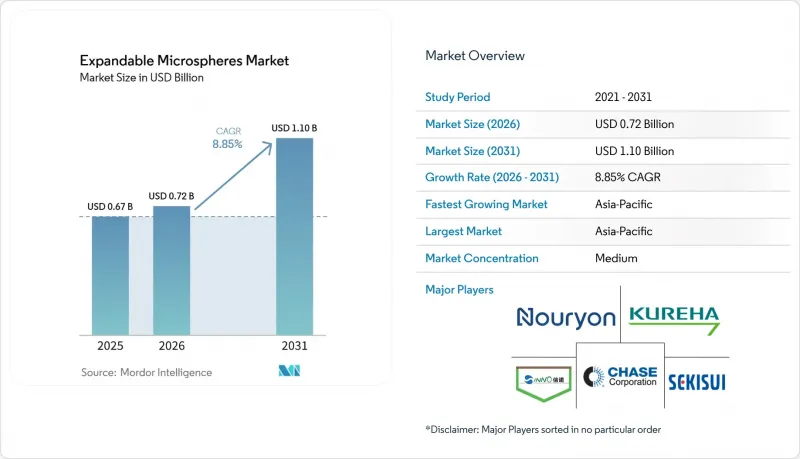
據 Mordor Intelligence 稱,2025 年充氣微球市值為 6.7 億美元,預計到 2031 年將達到 11 億美元,而 2026 年為 7.2 億美元,預測期(2026-2031 年)的複合年成長率為 8.85%。
本報告按類型(乾式和濕式)、聚合物類型(聚丙烯酸酯 (PAE)、聚醋酸乙烯酯 (PVA)、醋酸乙烯酯乙烯酯 (VAE))、終端用戶行業(汽車、建築等)和地區(亞太地區、北美地區、歐洲地區、南美地區、中東和非洲地區)進行細分。市場預測以美元 (USD) 為單位。
全球充氣微球市場趨勢及洞察
對輕質聚合物改質劑的需求日益成長
對更輕產品的需求推動了對能夠保持機械性能的填料系統的需求。可膨脹微球以1%至2%的重量比使用時,可降低零件密度高達40%。這種高效性促使其在聚合物化合物中廣泛應用,使製造商無需大幅改變製程即可實現減重。美國、中國和歐盟的燃油效率法規進一步提升了輕量化汽車零件的價值。電池式電動車(BEV)的普及進一步加大了減輕重量的壓力,尤其是在電池系統周圍的組裝中。據Nourion公司稱,「Expancel HP 92」透過在汽車底盤塗料中兼具低密度和耐壓性,滿足了這些應用的性能要求。
擴大隔熱材料和節能建築材料的使用
隨著節能建築技術的進步,市場對可添加到現有塗料、輕質混凝土、接縫材料和牆板中的隔熱添加劑的需求日益成長。發泡微球透過形成閉孔結構來降低導熱係數,從而減輕運輸重量。這使得建築材料製造商無需重新設計整個建築系統即可提高隔熱性能。修訂後的《建築能源性能指令》於2024年5月生效,對歐盟範圍內的新建和維修建築提出了相關要求。預計這些要求將延長隔熱材料材料的採購週期。此外,在南亞和東南亞地區,可膨脹微球市場在預製板的可膨脹塗料和薄保溫層領域也找到了新的商機。
特種聚合物和發泡原料價格的波動
發泡微球的生產依賴於丙烯腈、甲基丙烯腈以及異丁烷和異戊烷等低沸點烴類化合物。雖然這些原料的價格會受到石油化學產品價格波動的影響,但特種級中間體的產量實際上低於通用單體。對於缺乏腈類原料垂直整合的歐洲契約製造和亞洲小規模生產商而言,通用原物料價格上漲可能會對其利潤率造成更大的壓力。此外,如果供應商無法提供穩定的多年價格,價格的不確定性可能會延誤客戶的認證工作。根據歐盟委員會關於合成聚合物微粒的2023/2055號條例,發泡微球市場在歐洲還面臨額外的合規成本。該條例的第一項義務已於2025年10月17日生效,要求濕泡沫微球供應商提供有關其使用和處置的信息,報告要求將分階段實施,直至2027年。
細分市場分析
截至2025年,乾粉微球佔據了可膨脹微球市場58.32%的佔有率。這一地位反映了其與擠出、射出成型和壓延工藝的兼容性,這種高流動性粉末能夠很好地融入現有的混煉工藝中。乾粉型微球無需在物料處理和加工過程中進行溶劑管理。此外,在對進料規格要求嚴格的應用中,乾粉型微球還能達到更精確的粒徑控制。這種一致性對於汽車和航太航太等對污染控制要求極高的產業至關重要。乾粉型可膨脹微球市場規模的成長也得益於主流聚合物加工設備的廣泛應用。加工商只需對物料處理流程進行極小的改動,即可將這些乾粉型微球整合到其熟悉的製程中。這些因素使得乾粉型微球非常適合那些需要可靠加工性能的應用。
在所有產品類型中,濕微球的成長速度最快,2026年至2031年的複合年成長率(CAGR)達到9.41%。隨著配方設計師從溶劑型產品轉向水性體系,水性塗料和黏合劑市場正在不斷擴大。濕漿料能夠使薄膜的膨脹更加均勻,有助於在基材表面形成更光滑的蜂巢狀結構。裝飾塗料、紡織品和紙張塗料均受益於此表面一致性。當需要在大面積塗層表面達到均勻塗覆時,這種形態尤其適用。 2025年3月,Nurion推出了“Expancel XS200”,這是一款用於室內裝飾塗料的超細幹級微球。此次發布表明,在高階塗料中,更細的顆粒尺寸至關重要,因為表面光潔度和塗料重量的減輕都是關鍵考慮因素。不具備生產細顆粒能力的製造商可能會在高價值裝飾塗料和特殊塗料應用方面面臨限制。
區域分析
預計到2025年,亞太地區將佔據39.65%的市場佔有率,並在2026年至2031年間以9.66%的複合年成長率成長。中國擁有大規模的汽車生產基地,並積極推廣電動車。其特種化學品領域擁有許多國內微球製造商,這些製造商在標準級應用領域具有價格競爭力。印度的建設活動推動了對輕質隔熱材料的需求。日本和韓國是技術研發和高階產品生產中心。松本油化株式會社、積水化學株式會社、KUREHA株式會社和久美屋株式會社等企業鞏固了該地區在高溫高精度級產品領域的地位。
北美和歐洲分別是發泡微球市場規模第二和第三大地區。這兩個地區的市場需求均由高階汽車認證、環保標準和建築維修項目的需求所驅動,導致單位產品需求量高。北美的需求主要集中在美國和加拿大的汽車密封劑和建築保溫塗料領域。 Nourion公司位於威斯康辛州格林貝的Expancel生產基地為該地區的供應提供支援。德國、法國和英國是歐洲汽車和建築應用領域的主要消費國。歐洲供應商還需遵守REACH法規,這有利於那些擁有成熟產品管理能力的公司。
南美洲、中東和非洲的需求規模較小,但呈現成長趨勢。巴西透過其東南部工業區的汽車組裝和建設活動來滿足南美洲的需求。作為其製造網路的一部分,Nourion 在巴西設有“Expacel”的生產系統。在中東和非洲,沙烏地阿拉伯的建設活動和南非的汽車製造地推動了短期需求。沙烏地阿拉伯的基礎設施發展計畫支持輕質建材添加劑的採購。南非豪登省和東開普省的製造業活動也促進了對汽車級材料的需求。與規模大規模的製造業市場相比,所有這些地區的市場滲透率仍然較低,這為供應商提供了投資空間。
其他好處:
- Excel格式的市場預測(ME)表
- 3個月的分析師支持
目錄
第1章:引言
- 研究假設和市場定義
- 調查範圍
第2章:調查方法
第3章執行摘要
第4章 市場狀況
- 市場概覽
- 市場促進因素
- 對輕質聚合物改質劑的需求日益成長
- 擴大隔熱材料和節能建築材料的使用
- 擴大汽車內裝組件的採用範圍,以減輕重量並提高 NVH 性能。
- 消費品和體育用品領域對高性能、低密度材料的需求日益成長。
- 透過節約材料和能源,擴大永續製造方式的應用。
- 市場限制因素
- 特種聚合物和發泡原料價格的波動
- 製造和最終用途加工方面的限制以及溫度限制
- 來自其他輕質填充材和化學發泡的競爭
- 價值鏈分析
- 波特五力分析
第5章 市場規模與成長預測
- 按類型
- 乾燥
- 濕的
- 按聚合物類型
- 聚丙烯酸酯(PAE)
- 聚乙酸乙烯酯(PVA)
- 醋酸乙烯酯(VAE)
- 按最終用戶行業分類
- 車
- 建造
- 消費品
- 運動休閒
- 包裝
- 紡織品
- 按地區
- 亞太地區
- 中國
- 印度
- 日本
- 韓國
- 其他亞太國家
- 北美洲
- 美國
- 加拿大
- 墨西哥
- 歐洲
- 德國
- 英國
- 法國
- 義大利
- 俄羅斯
- 其他歐洲國家
- 南美洲
- 巴西
- 阿根廷
- 其他南美國家
- 中東和非洲
- 沙烏地阿拉伯
- 南非
- 其他中東和非洲國家
- 亞太地區
第6章 競爭情勢
- 市場集中度
- 策略趨勢
- 市佔率和排名分析
- 公司簡介
- Chase Corp.
- Crerax Science and Technology Co. Ltd.
- DONGJIN SEMICHEM CO LTD.
- Hunan Farida Technology Co.,Ltd.
- Kumyang Co. Ltd.
- KUREHA CORPORATION
- Matsumoto Yushi-Seiyaku Co. Ltd.
- Nanjing Chemical Material Corp.
- Nouryon
- Qingdao Sinno Chemical Co.,Ltd
- SEKISUI CHEMICAL CO., LTD.
- Trelleborg
- Waytop Microspheres Co., Ltd
- Zhejiang Joysun Advanced Material Co., Ltd.
第7章 市場機會與未來展望
According to Mordor Intelligence, the expandable microspheres market size was valued at USD 0.67 billion in 2025 and is estimated to grow from USD 0.72 billion in 2026 to reach USD 1.10 billion by 2031, at a CAGR of 8.85% during the forecast period (2026-2031).
This report is Segmented by Type (Dry and Wet), Polymer Type (Polyacrylic Ester (PAE), Polyvinyl Acetate (PVA), and Vinyl Acetate Ethylene (VAE)), End-User Industry (Automotive, Construction, and More), and Geography (Asia-Pacific, North America, Europe, South America, and Middle-East and Africa). The Market Forecasts are Provided in Terms of Value (USD).
Global Expandable Microspheres Market Trends and Insights
Rising Demand for Lightweight Polymer-Modified Materials
The need to reduce product weight is driving demand for filler systems that preserve mechanical performance. Expandable microspheres can reduce part density by up to 40% at use levels of 1% to 2% by weight. This efficiency supports their use in polymer compounds where manufacturers seek lower weight without major process changes. Fuel economy requirements in the United States, China, and the European Union continue to reinforce the value of lighter vehicle components. Battery electric vehicles add further pressure to control mass, particularly in assemblies around battery systems. Nouryon states that Expancel HP 92 supports low density and pressure resistance in automotive underbody coatings, reflecting the performance requirements of these applications.
Growing Adoption in Thermal Insulation and Energy-Efficient Building Materials
Energy-efficient construction is increasing demand for insulation additives that can be incorporated into existing coatings, lightweight concrete, joint compounds, and wall panels. Expandable microspheres create closed-cell air structures that can lower thermal conductivity and reduce transport weight. This allows building material producers to improve thermal performance without redesigning the full construction system. The revised Energy Performance of Buildings Directive entered into force in May 2024 and sets requirements for new buildings and renovation activities across the European Union. These requirements support a longer procurement cycle for materials used in thermal insulation. The expandable microspheres market is also finding opportunities in intumescent coatings and thin thermal layers for prefabricated panels used in South and Southeast Asia.
Volatility in Raw Material Prices for Specialty Polymers and Blowing Agents
Expandable microsphere production depends on acrylonitrile, methacrylonitrile, and low-boiling hydrocarbons such as isobutane and isopentane. These inputs are exposed to petrochemical price movements, while specialty-grade intermediates have lower output than commodity monomers. European contract manufacturers and smaller Asian producers without nitrile feedstock integration can face greater margin pressure during commodity upswings. Price uncertainty can also delay customer qualification work when suppliers cannot provide stable multi-year pricing. The expandable microspheres market faces additional compliance costs in Europe under Commission Regulation (EU) 2023/2055 on synthetic polymer microparticles. The first obligations took effect on October 17, 2025, requiring wet-form microsphere suppliers to provide use and disposal information, with reporting requirements phased through 2027.
Other drivers and restraints analyzed in the detailed report include:
- Increasing Use of Automotive Interior Components for Weight Reduction and NVH Improvement
- Growing Demand for High-Performance and Low-Density Materials in Consumer Goods and Sports Equipment
- Processing and Temperature Limitations During Manufacturing and End-Use Applications
For complete list of drivers and restraints, kindly check the Table Of Contents.
Segment Analysis
Dry-type microspheres held 58.32% of the expandable microspheres market share in 2025. Their position reflects compatibility with extrusion, injection molding, and calendering, where free-flowing powders fit established compounding processes. Dry grades eliminate the need for solvent management during material handling and processing. They also support tighter particle-size control in applications with demanding incoming-material specifications. Automotive and aerospace formulations value this consistency where contamination control is important. The expandable microspheres market size for dry formats is further supported by the wide installed base of mainstream polymer processing equipment. Processors can incorporate these grades into familiar workflows with limited changes to material handling. These factors make dry grades suitable for applications that require dependable processing behavior.
Wet-type microspheres recorded the fastest growth within the type segment, at a 9.41% CAGR from 2026 to 2031. Water-based coatings and adhesives are expanding as formulators shift toward aqueous systems rather than solvent-borne alternatives. Wet slurries can provide more uniform expansion in thin films and help create a smoother cell structure at the substrate surface. Decorative paints, textiles, and paper coatings benefit from this surface consistency. The format is particularly relevant where consistent application across a broad coated surface is required. In March 2025, Nouryon launched Expancel XS200, an extra-small dry-grade microsphere for interior decorative paints. The launch indicates that smaller particle sizes are important in premium coatings, where surface finish and paint weight reduction are both relevant considerations. Producers without small-particle capabilities may face constraints in high-value decorative and specialty coating applications.
Complete Report Scope:
- By Type
- Dry
- Wet
- By Polymer Type
- Polyacrylic Ester (PAE)
- Polyvinyl Acetate (PVA)
- Vinyl Acetate Ethylene (VAE)
- By End-User Industry
- Automotive
- Construction
- Consumer Goods
- Sports and Leisure
- Packaging
- Textile
- By Geography
- Asia-Pacific
- China
- India
- Japan
- South Korea
- Rest of Asia-Pacific
- North America
- United States
- Canada
- Mexico
- Europe
- Germany
- United Kingdom
- France
- Italy
- Russia
- Rest of Europe
- South America
- Brazil
- Argentina
- Rest of South America
- Middle-East and Africa
- Saudi Arabia
- South Africa
- Rest of Middle-East and Africa
- Asia-Pacific
Geography Analysis
Asia-Pacific accounted for 39.65% of the market in 2025 and is forecast to grow at a 9.66% CAGR from 2026 to 2031. China combines a large automotive production base with an active rollout of electric vehicles. Its specialty chemical sector includes domestic microsphere producers that compete on price in standard-grade applications. India's construction activity supports demand for lightweight insulating materials. Japan and South Korea are centers of technology development and advanced-grade production. Matsumoto Yushi-Seiyaku, Sekisui Chemical, KUREHA Corporation, and Kumyang support the region's position in high-temperature and high-precision grades.
North America and Europe are the second- and third-largest geographic markets for expandable microspheres. Both regions have higher value-per-unit demand driven by premium automotive qualifications, environmental standards, and building renovation activity. North American demand includes automotive sealing compounds and construction insulation coatings in the United States and Canada. Nouryon operates an Expancel production facility in Green Bay, Wisconsin, which supports regional supply. Germany, France, and the United Kingdom are key European consumption centers for automotive and construction applications. European suppliers also face REACH documentation requirements, which favor firms with established product stewardship capabilities.
South America, the Middle-East, and Africa are smaller but developing demand areas. Brazil supports South American demand through automotive assembly and construction activity in its southeastern industrial belt. Nouryon maintains Expancel production capabilities in Brazil as part of its manufacturing network. In the Middle-East and Africa, near-term demand is driven by Saudi Arabia's construction activity and South Africa's automotive manufacturing base. Saudi Arabia's infrastructure programs are supporting the procurement of additives for lightweight building materials. South Africa contributes to automotive-grade demand through manufacturing activity in Gauteng and the Eastern Cape. Both regions remain less penetrated than larger manufacturing markets, leaving room for supplier investment.
- Chase Corp.
- Crerax Science and Technology Co. Ltd.
- DONGJIN SEMICHEM CO LTD.
- Hunan Farida Technology Co.,Ltd.
- Kumyang Co. Ltd.
- KUREHA CORPORATION
- Matsumoto Yushi-Seiyaku Co. Ltd.
- Nanjing Chemical Material Corp.
- Nouryon
- Qingdao Sinno Chemical Co.,Ltd
- SEKISUI CHEMICAL CO., LTD.
- Trelleborg
- Waytop Microspheres Co., Ltd
- Zhejiang Joysun Advanced Material Co., Ltd.
Additional Benefits:
- The market estimate (ME) sheet in Excel format
- 3 months of analyst support
TABLE OF CONTENTS
1 Introduction
- 1.1 Study Assumptions and Market Definition
- 1.2 Scope of the Study
2 Research Methodology
3 Executive Summary
4 Market Landscape
- 4.1 Market Overview
- 4.2 Market Drivers
- 4.2.1 Rising Demand for Lightweight Polymer-Modified Materials
- 4.2.2 Growing Adoption in Thermal Insulation and Energy-Efficient Building Materials
- 4.2.3 Increasing Use in Automotive Interior Components for Weight Reduction and NVH Improvement
- 4.2.4 Growing Demand for High-Performance and Low-Density Materials in Consumer Goods and Sports Equipment
- 4.2.5 Increasing Adoption in Sustainable Manufacturing Through Material and Energy Savings
- 4.3 Market Restraints
- 4.3.1 Volatility in Raw Material Prices for Specialty Polymers and Blowing Agents
- 4.3.2 Processing and Temperature Limitations During Manufacturing and End-Use Applications
- 4.3.3 Competition from Alternative Lightweight Fillers and Chemical Foaming Agents
- 4.4 Value Chain Analysis
- 4.5 Porter's Five Forces Analysis
- 4.5.1 Threat of New Entrants
- 4.5.2 Bargaining Power of Suppliers
- 4.5.3 Bargaining Power of Buyers
- 4.5.4 Threat of Substitutes
- 4.5.5 Competitive Rivalry
5 Market Size and Growth Forecasts (Value)
- 5.1 By Type
- 5.1.1 Dry
- 5.1.2 Wet
- 5.2 By Polymer Type
- 5.2.1 Polyacrylic Ester (PAE)
- 5.2.2 Polyvinyl Acetate (PVA)
- 5.2.3 Vinyl Acetate Ethylene (VAE)
- 5.3 By End-User Industry
- 5.3.1 Automotive
- 5.3.2 Construction
- 5.3.3 Consumer Goods
- 5.3.4 Sports and Leisure
- 5.3.5 Packaging
- 5.3.6 Textile
- 5.4 By Geography
- 5.4.1 Asia-Pacific
- 5.4.1.1 China
- 5.4.1.2 India
- 5.4.1.3 Japan
- 5.4.1.4 South Korea
- 5.4.1.5 Rest of Asia-Pacific
- 5.4.2 North America
- 5.4.2.1 United States
- 5.4.2.2 Canada
- 5.4.2.3 Mexico
- 5.4.3 Europe
- 5.4.3.1 Germany
- 5.4.3.2 United Kingdom
- 5.4.3.3 France
- 5.4.3.4 Italy
- 5.4.3.5 Russia
- 5.4.3.6 Rest of Europe
- 5.4.4 South America
- 5.4.4.1 Brazil
- 5.4.4.2 Argentina
- 5.4.4.3 Rest of South America
- 5.4.5 Middle-East and Africa
- 5.4.5.1 Saudi Arabia
- 5.4.5.2 South Africa
- 5.4.5.3 Rest of Middle-East and Africa
- 5.4.1 Asia-Pacific
6 Competitive Landscape
- 6.1 Market Concentration
- 6.2 Strategic Moves
- 6.3 Market Share (%)/Ranking Analysis
- 6.4 Company Profiles (includes Global Overview, Market Overview, Core Segments, Financials as available, Strategic Information, Products and Services, and Recent Developments)
- 6.4.1 Chase Corp.
- 6.4.2 Crerax Science and Technology Co. Ltd.
- 6.4.3 DONGJIN SEMICHEM CO LTD.
- 6.4.4 Hunan Farida Technology Co.,Ltd.
- 6.4.5 Kumyang Co. Ltd.
- 6.4.6 KUREHA CORPORATION
- 6.4.7 Matsumoto Yushi-Seiyaku Co. Ltd.
- 6.4.8 Nanjing Chemical Material Corp.
- 6.4.9 Nouryon
- 6.4.10 Qingdao Sinno Chemical Co.,Ltd
- 6.4.11 SEKISUI CHEMICAL CO., LTD.
- 6.4.12 Trelleborg
- 6.4.13 Waytop Microspheres Co., Ltd
- 6.4.14 Zhejiang Joysun Advanced Material Co., Ltd.
7 Market Opportunities and Future Outlook
- 7.1 White-Space and Unmet-Need Assessment

 超細玻璃微球市場:全球市場預測,2026-2032年熱膨脹微球市場-2026年至2032年全球市場預測
 聚合物微球:市場佔有率分析、產業趨勢與統計、成長預測(2026-2031)
 微球市場報告:趨勢、預測與競爭分析(至2035年)聚氨酯微球市場-全球預測,2026-2032年微球:市佔率分析、產業趨勢與統計、成長預測(2026-2031)微球市場:2026-2032年全球市場預測(依產品類型、材料類型、尺寸、功能、最終用戶和分銷管道分類)
 氧化鋁氣泡市場規模、佔有率和趨勢分析報告:按產品純度、最終用途、地區和細分市場預測(2026-2033 年)
 金屬微球市場商業機會、成長要素、產業趨勢分析及2026-2035年預測
 全球微球市場:按類型、原料和應用分類-預測(至2031年)