


 |
市場調查報告書
商品編碼
2120310
微球:市佔率分析、產業趨勢與統計、成長預測(2026-2031)Microspheres - Market Share Analysis, Industry Trends & Statistics, Growth Forecasts (2026 - 2031) |
||||||

※ 本網頁內容可能與最新版本有所差異。詳細情況請與我們聯繫。
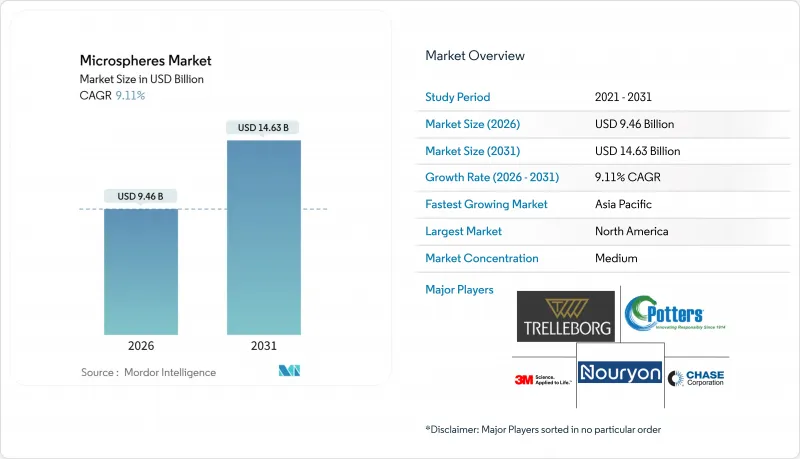
根據 Mordor Intelligence 估計,微球市場在 2026 年的價值為 94.6 億美元,預計在預測期(2026-2031 年)內將以 9.11% 的複合年成長率成長,到 2031 年達到 146.3 億美元。
本報告按原料(玻璃、聚合物、陶瓷、飛灰、金屬及其他)、類型(中空和實心)、應用領域(汽車、航太、化妝品、石油天然氣、油漆和塗料、醫療技術、複合材料及其他)以及地區(亞太、北美、歐洲、南美、中東和非洲)進行細分。市場預測以美元計價。
全球微球市場趨勢與洞察
在先進醫學影像和標靶藥物傳輸領域不斷拓展應用。
釔-90玻璃微球正逐漸成為經動脈放射栓塞治療肝細胞癌的黃金標準。這得歸功於波士頓科學公司的TheraSphere和Certex公司的SIR-Spheres在LEGACY和DOORwaY90研究中取得的顯著成就。 2024年,造影的聚合物微球(例如Eye90)成功通過了首次人體安全性評估,增強了手術過程中的視覺化效果。同時,PLGA包覆的碳奈米顆粒已成功完成淋巴結紋身的臨床前檢驗,為傳統染料提供了無毒替代方案。 FDA的510(k)核准途徑將加速其商業化進程,但需要對顆粒大小和放射性核種進行嚴格測試。這項要求凸顯了微球市場精準性的重要性。此外,隨著局部治療在醫院的日益普及,玻璃微球供應商正發現一個穩定且不斷成長的持續收入來源。
推動電動車和航太複合材料的減重
受電動車電池組普及的推動,原始設備製造商 (OEM) 擴大採用中空玻璃微球。透過將這些微球整合到熱塑性外殼和底盤護板中,OEM 成功地在不影響抗衝擊性的前提下顯著減輕了零件重量。 3M 的 K 系列和 S 系列微球正引領著輕量化高拉伸模量成品的誕生。目前,主要的航太製造商正在使用填充微球的 Syntaxfoam 材料,將其應用於雷達罩和整流罩等產品。繼波音 787 和空中巴士 A350 之後,這些創新技術正被引入下一代飛機。樹脂黏度降低、介電性能提升和孔隙率降低等優勢增強了中空微球的吸引力,確保了微球市場的持續成長。
玻璃用丙烯腈和堿灰的價格波動。
2025年6月,美國丙烯腈價格維持平穩,但中國價格下降。同時,由於丙烯供不應求擠壓了聚合物微球的利潤空間,歐洲丙烯腈價格飆升。中國和土耳其對堿灰的限制加劇了玻璃微球生產商的成本波動。現貨買家正努力應對季度價格的大幅波動,這進一步影響了合成泡沫和浮力模組專案的獲利能力。
細分市場分析
到2026年,玻璃將佔銷售額的47.71%,預計其成長速度將超過其他原料,到2031年複合年成長率將達到10.83%。推動這成長的兩大主要因素是用於放射性栓塞療法的釔-90微球和用於航太及深海鑽探合成複合材料的中空鈉鈣球。此外,玻璃也符合AASHTO M 247道路標線屈光標準的要求,因此也維持基本需求。聚合物微球位居第二,其中Nouriyon公司於2024年12月推出的生物基產品「Expancel BIO」在滿足永續性審核要求的同時,也保證了其膨脹率。陶瓷、飛灰和金屬微球分別滿足高壓丙烷、低成本輕質混凝土和高密度零件積層製造等特定需求,從而確保了微球市場原料選擇的多樣性。
遵守相關法規是選擇標準的關鍵。品質控制標準貫穿整個供應鏈,品管透過 ISO 13320 雷射衍射法確認,膨脹溫度曲線則透過 ISO 11357 DSC(差示掃描量熱法)測量。因此,微球產業重視那些既擁有廣泛的材料種類又具備嚴謹分析能力的製造商。歐盟新近訂定的奈米材料禁令(2024/858 號法規)限制了苯乙烯-丙烯酸酯奈米共聚物的使用,從而推動了市場對更大粒徑和玻璃製品的需求。玻璃製造商受益於二氧化矽的垂直整合,使其受堿灰價格波動的影響較小。而聚合物製造商則需要規避丙烯腈價格波動的風險,或採取生物基生產路線。因此,預計未來十年玻璃微球在微球市場的佔有率將有所成長,尤其是在腫瘤學、航太複合材料和智慧城市基礎設施等領域。
區域分析
預計到2026年,北美將佔全球銷售額的39.62%。明尼蘇達州和麻州醫療設備產業高度集中,推動了無線電嵌入微珠市場的發展。同時,作為複合材料產業中心的西雅圖和威奇托,對用於下一代飛機機身的玻璃微珠的需求不斷成長。 Nurion公司已擴大在格林貝的業務,並為密西根州和安大略省市場建立了電動車密封劑的本地供應鏈。美國國防部對道路標線規範的修訂,確保了各州交通部門玻璃微珠的穩定供應。此外,加拿大油砂井的水泥填充以及墨西哥的汽車內裝應用,進一步鞏固了北美在微珠市場的主導地位。
預計到2031年,亞太地區的複合年成長率將達到11.89%。中國電動車產量的不斷成長推動了電池外殼用玻璃珠的需求。總部位於上海的Klelux公司提供種類繁多的玻璃珠、聚合物珠、陶瓷珠和金屬珠,以滿足多元化的市場需求。日本的KUREHA在東京和休士頓均設有研發中心,協助全球複合材料製造商認證新的材料等級。在印度,國家高速公路反光標線的推廣推動了玻璃珠進口量的成長。在韓國,固體聚合物微球被用於半導體無塵室的過濾器檢驗。此外,東協作為汽車零件核心市場的崛起,也為微球市場創造了進一步的成長潛力。
在歐洲,微球市場面臨許多挑戰,例如禁止在化妝品中使用聚合物微珠的2023/2055號法規,以及規範顆粒分散的2025/2365號法規。德國汽車原始設備製造商(OEM)正在將可膨脹微粒應用於電動車電池機殼,但遵守REACH法規的相關成本對資本投資構成了挑戰。法國航太產業的領導企業正轉向使用填充微球的預浸料,而英國離岸風力發電產業則在使用由Syntaxfoam製成的浮力模組。位於努里永的Sundosval工廠在滿足歐洲對生物基微球的需求方面發揮著至關重要的作用。儘管其在全球市場(包括南美和中東/非洲)的佔有率較小,但由於巴西鹽鹽層下鑽探活動和沙烏地阿拉伯道路安全措施的推動,微球需求不時激增,從而形成了一個地域分佈廣泛的微球市場。
其他好處:
- Excel格式的市場預測(ME)表
- 3個月的分析師支持
目錄
第1章:引言
- 研究假設和市場定義
- 調查範圍
第2章:調查方法
第3章執行摘要
第4章 市場狀況
- 市場概覽
- 市場促進因素
- 在先進醫學影像和標靶藥物傳輸領域不斷拓展應用。
- 為減輕電動車和航太複合材料的重量所做的努力
- 智慧城市計畫對反光隔熱道路標線塗料的需求激增。
- 分散式 3D微流體控制造技術正在推動對客製化球體的需求。
- 層壓混凝土在地球外建築的應用
- 市場限制因素
- 玻璃用丙烯腈和堿灰的價格波動。
- 加強化妝品中微塑膠的監管
- 擴充性微球發泡供應產能瓶頸
- 價值鏈分析
- 波特五力模型
- 價格分析
第5章 市場規模與成長預測
- 按成分
- 玻璃
- 聚合物
- 陶瓷
- 飛灰
- 金屬
- 其他
- 按類型
- 中空的
- 固體的
- 透過使用
- 車
- 航太
- 化妝品
- 石油和天然氣
- 油漆和塗料
- 醫療技術
- 複合材料
- 其他
- 按地區
- 亞太地區
- 中國
- 印度
- 日本
- 韓國
- 東南亞國協
- 其他亞太國家
- 北美洲
- 美國
- 加拿大
- 墨西哥
- 歐洲
- 德國
- 英國
- 義大利
- 法國
- 其他歐洲國家
- 南美洲
- 巴西
- 阿根廷
- 其他南美國家
- 中東和非洲
- 沙烏地阿拉伯
- 南非
- 其他中東和非洲國家
- 亞太地區
第6章 競爭情勢
- 市場集中度
- 策略趨勢
- 市佔率和排名分析
- 公司簡介
- 3M
- Bangs Laboratories Inc.
- Chase Corporation
- Cospheric LLC
- Crerax Science and Technology Co. Ltd.
- Kureha Corporation
- Luminex Corporation(Diasorin Spa)
- Matsumoto Yushi-seiyaku Co. Ltd
- Merck KGaA
- Merit Medical Systems
- Momentive
- Mo-sci Corporation(Heraeus Holdings)
- Nouryon
- Potters Industries LLC
- PQ Corporation
- Siemens Healthineers AG
- Trelleborg AB
第7章 市場機會與未來展望
According to Mordor Intelligence, the microspheres market size is estimated at USD 9.46 billion in 2026, and is expected to reach USD 14.63 billion by 2031, at a CAGR of 9.11% during the forecast period (2026-2031).
This report is Segmented by Raw Material (Glass, Polymer, Ceramics, Fly Ash, Metallic, and Others), Type (Hollow and Solid), Application (Automotive, Aerospace, Cosmetics, Oil and Gas, Paints and Coatings, Medical Technology, Composites, and Others), and Geography (Asia-Pacific, North America, Europe, South America, and Middle-East and Africa). The Market Forecasts are Provided in Terms of Value (USD).
Global Microspheres Market Trends and Insights
Increasing Application in Advanced Medical Imaging and Targeted Drug Delivery
Yttrium-90 glass microspheres have emerged as the gold standard for transarterial radioembolization in treating hepatocellular carcinoma. This follows the impressive outcomes demonstrated in Boston Scientific's TheraSphere and Sirtex's SIR-Spheres, as highlighted in the LEGACY trial and the DOORwaY90 study. In 2024, polymer spheres, like Eye90, which carry contrast agents, successfully navigated first-in-human safety assessments, bolstering intraprocedural visualization. Meanwhile, PLGA-encapsulated carbon nanoparticles achieved preclinical validation for lymph-node tattooing, offering a non-toxic alternative to conventional dyes. While the FDA's 510(k) pathway expedites commercialization, it demands stringent testing on particle size and radionuclides. This requirement underscores the need for precision in the microspheres market. Furthermore, as hospitals increasingly adopt localized therapies, it solidifies and boosts the recurring revenue streams for suppliers of glass microspheres.
Lightweighting Push in Electric Vehicle and Aerospace Composites
Electric-vehicle battery packs are prompting OEMs to turn to hollow glass microspheres. By integrating these microspheres into thermoplastic housings and underbody shields, OEMs are achieving a significant reduction in component mass without sacrificing impact resistance. 3M's K- and S-series bubbles are paving the way for lightweight finished parts with high tensile moduli. Major aerospace players are now turning to microsphere-filled syntactic foams for applications like radomes and fairings. Following the lead of the Boeing 787 and Airbus A350, these innovations are making their way into next-generation airframes. The advantages of lower resin viscosity, enhanced dielectric properties, and reduced voids bolster the appeal of hollow variants, ensuring continued growth for the microspheres market.
Volatile Acrylonitrile and Glass-Grade Soda-Ash Prices
In June 2025, U.S. prices for acrylonitrile remained steady, while in China, it was more affordable. However, European prices surged, driven by propylene shortages that tightened margins for polymer microspheres. Meanwhile, restrictions on soda ash in both China and Turkey have intensified cost fluctuations for producers of glass microspheres. Spot buyers are grappling with significant price swings within the quarter, adding complexity to the project economics of syntactic foams and buoyancy modules.
Other drivers and restraints analyzed in the detailed report include:
- Surge in Reflective and Insulating Road-Marking Paints for Smart-City Projects
- Decentralized 3-D Microfluidic Fabrication Boosting Custom Sphere Demand
- Tightening Bans on Microplastics in Cosmetics
For complete list of drivers and restraints, kindly check the Table Of Contents.
Segment Analysis
Glass held 47.71% of 2026 revenue and is forecast to outpace other raw materials at 10.83% CAGR through 2031. Its dual pull comes from yttrium-90 radioembolization beads and hollow soda-lime spheres used in syntactic composites for aerospace and deepwater drilling. Glass also satisfies AASHTO M 247 mandates for road-marking refractive index, preserving a baseline volume stream. Polymer grades rank second; Nouryon's bio-attributed Expancel BIO launch in December 2024 meets sustainability audits without compromising expansion ratios. Ceramic, fly-ash, and metallic spheres each address niche needs-high-pressure proppants, low-cost lightweight concrete, and additive manufacturing of dense parts-ensuring a diversified raw-material palette across the microspheres market.
Regulatory compliance shapes preferences: ISO 13320 laser diffraction confirms particle-size, while ISO 11357 DSC profiles expansion temperatures, embedding quality discipline across supply chains. The microspheres industry, therefore, rewards producers that pair material breadth with analytical rigor. Emerging EU nano-material bans (Regulation 2024/858) restrict styrene-acrylate nano-copolymers, redirecting demand to larger-sized polymer or glass options. Glass producers benefit from vertical silica integration, insulating them from soda-ash volatility. Polymer players, however, must hedge acrylonitrile swings or adopt bio-routes. Consequently, glass's share within the microspheres market is likely to rise through the decade, especially in oncology, aerospace composites, and smart-city infrastructure.
Complete Report Scope:
- By Raw Material
- Glass
- Polymer
- Ceramics
- Fly Ash
- Metallic
- Others
- By Type
- Hollow
- Solid
- By Application
- Automotive
- Aerospace
- Cosmetics
- Oil and Gas
- Paints and Coatings
- Medical Technology
- Composites
- Others
- By Geography
- Asia-Pacific
- China
- India
- Japan
- South Korea
- ASEAN Countries
- Rest of Asia-Pacific
- North America
- United States
- Canada
- Mexico
- Europe
- Germany
- United Kingdom
- Italy
- France
- Rest of Europe
- South America
- Brazil
- Argentina
- Rest of South America
- Middle-East and Africa
- Saudi Arabia
- South Africa
- Rest of Middle-East and Africa
- Asia-Pacific
Geography Analysis
North America generated 39.62% of 2026 revenue. Minnesota and Massachusetts, with their concentrated medical-device clusters, bolster the market for radioembolization beads. Meanwhile, composite hubs in Seattle and Wichita are fueling the demand for glass bubbles in next-generation airframes. Nouryon expanded in Green Bay, establishing local supply lines for EV sealants catering to markets in Michigan and Ontario. Updated road-marking specifications from the DoD ensure consistent procurement of glass beads by state DOTs. Additionally, Canadian oil-sands well-cementing and automotive interiors in Mexico further solidify North America's dominant position in the microspheres market.
Asia Pacific is forecast to log an 11.89% CAGR to 2031. China's production of EV units boosts the demand for glass bubbles in battery housings. Crerax, based in Shanghai, provides a range of spheres - glass, polymer, ceramic, and metallic - reflecting the market's demand diversity. Kureha from Japan operates research and development hubs in both Tokyo and Houston, assisting global composites clients in qualifying new grades. India's push for reflective road markings on national highways is driving up glass-bead imports. In South Korea, solid polymer spheres are being utilized for filter validation in semiconductor cleanrooms. Furthermore, ASEAN's emergence as a hub for automotive components adds another layer of growth potential for the microspheres market.
Europe faces challenges with Regulation 2023/2055, which prohibits polymer microbeads in cosmetics, and Regulation 2025/2365, which enforces controls on pellet loss. While German automotive OEMs are incorporating expandable spheres into EV battery enclosures, the costs associated with REACH compliance are raising capital expenditure challenges. Aerospace leaders in France are turning to microsphere-filled prepregs, and the offshore wind industry in the U.K. is utilizing syntactic-foam buoyancy modules. Nouryon's facility in Sundsvall is playing a pivotal role in meeting Europe's demand for bio-attributed grades. Although South America and the Middle-East and Africa collectively hold a smaller share of the global market, Brazil's pre-salt drilling activities and road-safety initiatives in Saudi Arabia are generating sporadic surges in demand, ensuring a geographically diverse microspheres market.
- 3M
- Bangs Laboratories Inc.
- Chase Corporation
- Cospheric LLC
- Crerax Science and Technology Co. Ltd.
- Kureha Corporation
- Luminex Corporation (Diasorin Spa)
- Matsumoto Yushi-seiyaku Co. Ltd
- Merck KGaA
- Merit Medical Systems
- Momentive
- Mo-sci Corporation (Heraeus Holdings)
- Nouryon
- Potters Industries LLC
- PQ Corporation
- Siemens Healthineers AG
- Trelleborg AB
Additional Benefits:
- The market estimate (ME) sheet in Excel format
- 3 months of analyst support
TABLE OF CONTENTS
1 Introduction
- 1.1 Study Assumptions and Market Definition
- 1.2 Scope of the Study
2 Research Methodology
3 Executive Summary
4 Market Landscape
- 4.1 Market Overview
- 4.2 Market Drivers
- 4.2.1 Increasing application in advanced medical imaging and targeted drug delivery
- 4.2.2 Lightweighting push in Electric vehicle and aerospace composites
- 4.2.3 Surge in reflective and insulating road-marking paints for smart-city projects
- 4.2.4 Decentralised 3-D microfluidic fabrication boosting custom sphere demand
- 4.2.5 Adoption in additive-manufactured concrete for off-planet construction
- 4.3 Market Restraints
- 4.3.1 Volatile acrylonitrile and glass-grade soda-ash prices
- 4.3.2 Tightening bans on micro-plastics in cosmetics
- 4.3.3 Capacity bottlenecks in expandable-microsphere blowing-agent supply
- 4.4 Value Chain Analysis
- 4.5 Porter's Five Forces
- 4.5.1 Bargaining Power of Suppliers
- 4.5.2 Bargaining Power of Buyers
- 4.5.3 Threat of New Entrants
- 4.5.4 Threat of Substitutes
- 4.5.5 Degree of Competition
- 4.6 Pricing Analysis
5 Market Size and Growth Forecasts (Value)
- 5.1 By Raw Material
- 5.1.1 Glass
- 5.1.2 Polymer
- 5.1.3 Ceramics
- 5.1.4 Fly Ash
- 5.1.5 Metallic
- 5.1.6 Others
- 5.2 By Type
- 5.2.1 Hollow
- 5.2.2 Solid
- 5.3 By Application
- 5.3.1 Automotive
- 5.3.2 Aerospace
- 5.3.3 Cosmetics
- 5.3.4 Oil and Gas
- 5.3.5 Paints and Coatings
- 5.3.6 Medical Technology
- 5.3.7 Composites
- 5.3.8 Others
- 5.4 By Geography
- 5.4.1 Asia-Pacific
- 5.4.1.1 China
- 5.4.1.2 India
- 5.4.1.3 Japan
- 5.4.1.4 South Korea
- 5.4.1.5 ASEAN Countries
- 5.4.1.6 Rest of Asia-Pacific
- 5.4.2 North America
- 5.4.2.1 United States
- 5.4.2.2 Canada
- 5.4.2.3 Mexico
- 5.4.3 Europe
- 5.4.3.1 Germany
- 5.4.3.2 United Kingdom
- 5.4.3.3 Italy
- 5.4.3.4 France
- 5.4.3.5 Rest of Europe
- 5.4.4 South America
- 5.4.4.1 Brazil
- 5.4.4.2 Argentina
- 5.4.4.3 Rest of South America
- 5.4.5 Middle-East and Africa
- 5.4.5.1 Saudi Arabia
- 5.4.5.2 South Africa
- 5.4.5.3 Rest of Middle-East and Africa
- 5.4.1 Asia-Pacific
6 Competitive Landscape
- 6.1 Market Concentration
- 6.2 Strategic Moves
- 6.3 Market Share(%)/Ranking Analysis
- 6.4 Company Profiles (includes Global-level Overview, Market-level Overview, Core Segments, Financials, Strategic Info, Products and Services, Recent Developments)
- 6.4.1 3M
- 6.4.2 Bangs Laboratories Inc.
- 6.4.3 Chase Corporation
- 6.4.4 Cospheric LLC
- 6.4.5 Crerax Science and Technology Co. Ltd.
- 6.4.6 Kureha Corporation
- 6.4.7 Luminex Corporation (Diasorin Spa)
- 6.4.8 Matsumoto Yushi-seiyaku Co. Ltd
- 6.4.9 Merck KGaA
- 6.4.10 Merit Medical Systems
- 6.4.11 Momentive
- 6.4.12 Mo-sci Corporation (Heraeus Holdings)
- 6.4.13 Nouryon
- 6.4.14 Potters Industries LLC
- 6.4.15 PQ Corporation
- 6.4.16 Siemens Healthineers AG
- 6.4.17 Trelleborg AB
7 Market Opportunities and Future Outlook
- 7.1 White-space and Unmet-need Assessment

 超細玻璃微球市場:全球市場預測,2026-2032年熱膨脹微球市場-2026年至2032年全球市場預測
 可膨脹微球:市場佔有率分析、產業趨勢與統計、成長預測(2026-2031)聚合物微球:市場佔有率分析、產業趨勢與統計、成長預測(2026-2031)
 微球市場報告:趨勢、預測與競爭分析(至2035年)聚氨酯微球市場-全球預測,2026-2032年微球市場:2026-2032年全球市場預測(依產品類型、材料類型、尺寸、功能、最終用戶和分銷管道分類)
 氧化鋁氣泡市場規模、佔有率和趨勢分析報告:按產品純度、最終用途、地區和細分市場預測(2026-2033 年)
 金屬微球市場商業機會、成長要素、產業趨勢分析及2026-2035年預測
 全球微球市場:按類型、原料和應用分類-預測(至2031年)