


 |
市場調查報告書
商品編碼
2122304
可程式設計積體電路:市場佔有率分析、產業趨勢與統計資料、成長預測(2026-2031 年)Programmable ASIC - Market Share Analysis, Industry Trends & Statistics, Growth Forecasts (2026 - 2031) |
||||||

※ 本網頁內容可能與最新版本有所差異。詳細情況請與我們聯繫。
據 Mordor Intelligence 稱,2025 年可程式 ASIC 的市場規模為 202.2 億美元,預計將從 2026 年的 219.9 億美元成長到 2031 年的 335.1 億美元。
預測期(2026-2031 年)的複合年成長率預計為 8.79%。
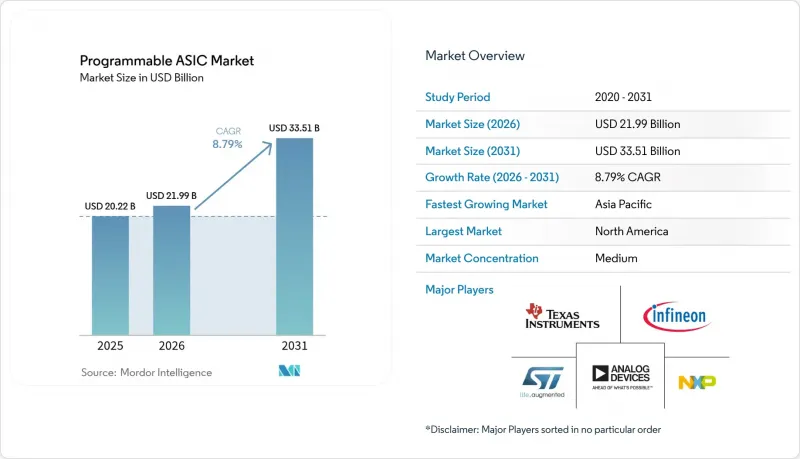
本報告依ASIC類型(結構化ASIC、全客製化ASIC等)、終端用戶產業(家用電子電器、通訊與網路等)、應用領域(AI/ML加速器、物聯網/邊緣設備等)、製程節點(28奈米以上、16/14奈米、10/7奈米、5/4/3奈米)及地區進行細分。市場預測以美元(USD)為單位。
全球可程式ASIC市場趨勢與洞察
物聯網和邊緣設備的激增
越來越多的終端設備配備了互聯感測器,這促使原始設備製造商 (OEM) 傾向於選擇既能實現低功耗運行又能滿足不斷演進的演算法運行需求的晶片。可程式專用積體電路 (ASIC) 透過實現超越微控制器的「單次操作功耗」特性,同時保持製造後的柔軟性,滿足了這項需求。例如,預計到 2025 年,人工智慧驅動的穿戴式裝置的出貨量將超過 1,000 萬台,這表明規模經濟效應足以證明採用客製化遮罩的合理性。嵌入在金屬層級的硬體安全功能將有助於製造商遵守即將訂定的設備認證法規。隨著智慧家庭設備、工業探針和醫療穿戴式裝置向「始終運作」方向融合,可編程 ASIC 市場有望受益於從純軟體定義解決方案的穩步轉變。
引入人工智慧/機器學習加速器
雲端服務供應商現在將自主研發的推理引擎視為應對GPU供應限制的保障,以及提高效率的手段,在穩定的工作負載環境下,這些引擎可以將總體擁有成本 (TCO) 降低高達40%。客戶對高頻寬記憶體、向量引擎和低延遲互連的需求,正將市場焦點轉向支援晶片組的結構化ASIC,這種ASIC代表了FPGA和完全客製化晶片之間的一種中間選擇。能夠將先進節點設計與垂直整合封裝結合的產業領導者,已經簽署了多年採購協議,這凸顯了可程式ASIC市場對AI專用元件的持續旺盛需求。
先進製程的高非重複性工程費用與遮罩成本
3nm以下製程節點的高昂非迭代設計成本(NRE)阻礙了小批量生產專案的開展,並迫使中型客戶轉向結構化ASIC和成熟節點的替代方案。設計團隊必須掌握複雜的工具鏈並考慮設計中的可變性,這增加了進度安排和流片的風險。代工廠的集中化加劇了談判的不對稱性。主要節點的晶圓價格持續上漲,產能預訂提前長達12個月,限制了向新設計的靈活過渡。
細分市場分析
到2025年,結構化設計將佔可程式設計ASIC市場收入的38.05%,鞏固其作為中等客製化和低流片風險項目首選方案的地位。由於僅頂層金屬層不同,掩模組週轉速度很快,成本僅為完全客製化的幾分之一,使OEM廠商能夠在不犧牲性能的前提下跟上消費性電子產品的開發週期。相較之下,受5G毫米波和衛星鏈路部署的推動,射頻ASIC預計到2031年將實現9.42%的複合年成長率,成為所有裝置類別中成長最快的。射頻元件將低雜訊放大器、移相器和功率級整合到單一晶片上,省去了曾經導致營運商認證延遲的基板級調整製程。
在超大規模運算的經濟效益中,每瓦運算效率至關重要,而完全客製化的實現方案仍然不可或缺。但如今,它們與晶片級結構化模組可以共存於同一個多晶片模組中。混合訊號產品在物聯網節點、汽車雷達和智慧工廠感測器等應用中日益普及,這些應用都需要高精度類比數位轉換器 (ADC) 與數位邏輯相結合。尤其重要的是介電橋封裝技術的出現,它使代工廠能夠將針對模擬電路最佳化的成熟節點與最先進的計算單元相結合,從而在不增加材料清單(BOM) 成本的情況下擴展結構化專用整合電路 (ASIC) 的應用範圍。
到2025年,行動和家庭娛樂品牌將推動消費性電子產業躍居銷售榜首。這主要得益於對顯示引擎、連接晶片組和電池續航最佳化功能的需求,這些功能超越了現有商用處理器的效率極限。邊緣人工智慧在音訊和視訊領域的應用,提高了單一設備的晶片含量,為可編程ASIC市場創造了有利的多年更新周期。汽車製造商雖然出貨量有所下降,但隨著軟體定義汽車(SDV)中集中式運算和分區架構的引入,其市佔率成長速度最快。 ISO 26262標準中的安全關鍵要求需要確定性時序和硬體冗餘,而可程式ASIC是實現這些要求的理想解決方案。
工業設備製造商和協作機器人製造商也擴大採用客製化半導體,因為其能夠在無風扇環境下整合即時控制迴路和機器視覺加速功能。在醫療領域,穿戴式生物感測器和成像設備正在利用基於檢驗的180 奈米和 110 奈米製程節點的超低功耗前端,這證實了成熟製程節點的可編程性仍然具有重要的商業性價值。通訊設備供應商繼續採用具有自適應管線的高吞吐量網路處理器,以適應未來的標準升級,這支撐了該領域穩定的中個位數成長前景。
區域分析
預計北美將在2025年營收排名中位居榜首,在可程式ASIC市場佔據38.20%的市場佔有率。這項成果主要得益於對超大規模資料中心的投資、《晶片法案》(CHIPS Act)的獎勵,以及矽谷、奧斯汀和鳳凰城周邊地區長期以來密集的設計服務。國內晶圓代工廠的擴張(例如英特爾在亞利桑那州投資200億美元的擴建計畫)增強了該地區的供應鏈韌性,同時也為國防安全設備提供了先進的生產節點。
亞太地區預計將成為成長最快的地區,2026年至2031年的複合年成長率將達到9.61%,這主要得益於中國政府主導的產能擴張、韓國垂直整合的記憶體和邏輯叢集以及日本在設備和材料方面的深厚專業知識。到2028年,該全部區域的資本投資預計將超過4,700億美元,這將有助於成熟和前沿產能的擴張,並降低無晶圓廠新創企業在該地區進入市場的門檻。
歐洲憑藉著功能安全法規和碳中和製造目標,在汽車和工業電子領域實現了差異化發展,從而保持了穩步成長的勢頭。德國的晶圓製造在地化措施以及計畫中的台積電德勒斯登合資企業可望拓展下游封裝和測試生態系統,縮短供應鏈,並為歐盟系統整合商提供智慧財產權保護。
其他好處:
- Excel格式的市場預測(ME)表
- 3個月的分析師支持
目錄
第1章:引言
- 研究假設和市場定義
- 調查範圍
第2章:調查方法
第3章執行摘要
第4章 市場狀況
- 市場概覽
- 市場促進因素
- 物聯網和邊緣設備的激增
- 引入人工智慧/機器學習加速器
- 快速部署5G基礎設施
- 汽車產業向ADAS和電氣化轉型
- 由於基於晶片組的異構整合,結構化ASIC的應用正在不斷擴大。
- 促進國防領域國產化、安全、可重構專用積體電路(晶片法)
- 市場限制因素
- 先進節點的高非重複工程費用和掩模成本
- 鑄造產能限制與供應衝擊
- 設計日益複雜,導致產品上市時間延長。
- 開放原始碼硬體(RISC-V)正在削弱對客製開發的ASIC的需求。
- 產業價值鏈分析
- 監理情勢
- 技術展望
- 波特五力分析
- 投資和資金籌措趨勢
- 宏觀經濟因素的影響
第5章 市場規模與成長預測
- ASIC 類型
- 結構化專用積體電路
- 完全客製化的ASIC晶片
- 平台/半客製化ASIC
- 混合訊號專用積體電路
- RF ASIC
- 按最終用途行業分類
- 家用電子產品
- 通訊與網路
- 汽車和運輸業
- 工業與機器人
- 航太/國防
- 衛生保健
- 其他
- 透過使用
- AI/ML加速器
- 物聯網/邊緣設備
- 5G/網路基礎設施
- 資料中心和雲
- 汽車ADAS和電氣化
- 醫療器材
- 工業控制和PLC
- 按行程節點
- 28奈米或更大
- 16/14 nm
- 10/7 nm
- 5/4/3 nm
- 按地區
- 北美洲
- 美國
- 加拿大
- 南美洲
- 巴西
- 阿根廷
- 其他南美國家
- 歐洲
- 德國
- 法國
- 英國
- 義大利
- 俄羅斯
- 其他歐洲國家
- 亞太地區
- 中國
- 日本
- 印度
- 韓國
- 澳洲
- 其他亞太國家
- 中東和非洲
- 中東
- 沙烏地阿拉伯
- UAE
- 土耳其
- 其他中東國家
- 非洲
- 南非
- 奈及利亞
- 肯亞
- 其他非洲國家
- 中東
- 北美洲
第6章 競爭情勢
- 市場集中度
- 策略趨勢
- 市佔率分析
- 公司簡介
- Intel Corporation
- Broadcom Inc.
- Marvell Technology, Inc.
- AMD(Xilinx)
- Microchip Technology Inc.(Microsemi)
- Lattice Semiconductor Corporation
- QuickLogic Corporation
- Taiwan Semiconductor Manufacturing Co. Ltd.
- Samsung Electronics Co., Ltd.(Samsung Foundry)
- GlobalFoundries Inc.
- United Microelectronics Corporation
- Fujitsu Semiconductor Ltd.
- STMicroelectronics NV
- Infineon Technologies AG
- NXP Semiconductors NV
- onsemi Corporation
- Texas Instruments Incorporated
- Renesas Electronics Corporation
- Faraday Technology Corporation
- Global Unichip Corp.
- Andes Technology Corporation
- Skyworks Solutions, Inc.
- Dialog Semiconductor plc
- Analog Devices, Inc.
第7章 市場機會與未來展望
According to Mordor Intelligence, the programmable ASIC market size was valued at USD 20.22 billion in 2025 and estimated to grow from USD 21.99 billion in 2026 to reach USD 33.51 billion by 2031, at a CAGR of 8.79% during the forecast period (2026-2031).
This report is Segmented by ASIC Type (Structured ASIC, Full-Custom ASIC, and More), End-Use Industry (Consumer Electronics, Telecommunications and Networking, and More), Application (AI/ML Accelerators, IoT/Edge Devices, and More), Process Node (above 28 Nm, 16/14 Nm, 10/7 Nm, and 5/4/3 Nm), and Geography. The Market Forecasts are Provided in Terms of Value (USD).
Global Programmable ASIC Market Trends and Insights
Proliferation of IoT and Edge Devices
Growth in connected-sensor endpoints is prompting OEMs to favor silicon that balances low-power operation with the headroom to execute evolving algorithms. Programmable ASICs meet this need by delivering a power-per-operation profile that outperforms microcontrollers yet retains post-fabrication flexibility. Shipments of AI-enabled wearables, for example, surpassed 10 million units in 2025, illustrating volume economics that justify custom masks. Hardware-rooted security functions embedded at the metal-layer level help makers comply with pending device-authentication regulations. As smart-home appliances, industrial probes and medical wearables converge around always-on inference, the programmable ASIC market is expected to benefit from a steady migration away from purely software-defined solutions.
Adoption of AI/ML Accelerators
Cloud operators now view proprietary inference engines as a hedge against GPU supply constraints and as an efficiency lever capable of trimming total cost of ownership by up to 40% on workload-stable fleets. Customer demand for high-bandwidth memory, vector engines and low-latency interconnects has moved the center of gravity toward chiplet-enabled structured ASICs, which offer a middle path between FPGAs and full-custom silicon. Industry leaders that can pair advanced-node design with vertically integrated packaging have already secured multi-year purchase commitments, underscoring the durable pull of AI-specific devices in the programmable ASIC market.
High NRE and Mask Costs at Advanced Nodes
Steep non-recurring engineering outlays at 3 nm and below are discouraging lower-volume projects and pushing mid-tier customers toward structured or mature-node alternatives. Design teams must master complex tool chains and guard-band for variability, inflating both schedule and tape-out risk. Foundry concentration amplifies bargaining asymmetry: wafer pricing at leading nodes continues to rise as capacity books out 12 months in advance, limiting agile pivots to new designs.
Other drivers and restraints analyzed in the detailed report include:
- Rapid Deployment of 5G Infrastructure
- Chiplet-Based Heterogeneous Integration
- Foundry Capacity Constraints and Supply Shocks
For complete list of drivers and restraints, kindly check the Table Of Contents.
Segment Analysis
Structured designs accounted for 38.05% of programmable ASIC market revenue in 2025, underscoring their status as the default option for projects that demand moderate customization with lower tape-out risk. Because only the top metal layers vary, mask sets can be turned around faster and at a fraction of full-custom cost, letting OEMs hit consumer-electronics rhythms without ceding performance. In contrast, RF ASICs, buoyed by 5G mmWave and satellite-link deployments, are forecast to post a 9.42% CAGR to 2031, the swiftest clip among all device classes. RF variants integrate low-noise amplifiers, phase shifters and power stages into single die, eliminating board-level tuning steps that once slowed carrier certification.
Full-custom implementations remain indispensable where watt-per-tera-operation efficiency drives hyperscale economics, but they now coexist with chiplet-sized structured blocks inside the same multichip modules. Mixed-signal flavors are gaining visibility as IoT nodes, automotive radar and smart-factory sensors all require high-accuracy ADCs stitched to digital logic. Crucially, the advent of dielectric bridge packaging is letting foundries marry analog-optimized mature nodes with bleeding-edge compute tiles, raising the ceiling on structured ASIC applicability without penalizing bill-of-materials cost.
Mobile and home-entertainment brands kept consumer electronics at the top of the revenue table in 2025, driven by demand for display engines, connectivity chipsets and battery-life optimizers that exceed the efficiency envelope of off-the-shelf processors. The shift toward edge AI audio and video enhances silicon content per device, locking in a multi-year refresh cycle favorable to the programmable ASIC market. Automotive OEMs, while smaller by shipment volume, are staging the fastest proportional gains as software-defined vehicles roll out centralized compute and zonal architectures. Safety-critical requirements under ISO 26262 necessitate deterministic timing and hardware redundancy that programmable ASICs are well-placed to deliver.
Industrial equipment builders and collaborative-robot manufacturers are also ramping custom silicon footprints, attracted by the ability to fuse real-time control loops with machine-vision acceleration inside fan-less thermal envelopes. In the medical domain, wearable biosensors and imaging modalities are leveraging ultra-low-power front-ends supplied on validated 180 nm and 110 nm nodes, reaffirming that mature-node programmability remains commercially relevant. Telecom vendors continue to lean on high-throughput network processors that embed adaptive pipelines capable of future standards upgrade, reinforcing the segment's steady mid-single-digit growth outlook.
Complete Report Scope:
- By ASIC Type
- Structured ASIC
- Full-Custom ASIC
- Platform / Semi-Custom ASIC
- Mixed-Signal ASIC
- RF ASIC
- By End-Use Industry
- Consumer Electronics
- Telecommunications and Networking
- Automotive and Transportation
- Industrial and Robotics
- Aerospace and Defense
- Healthcare
- Others
- By Application
- AI/ML Accelerators
- IoT / Edge Devices
- 5G / Networking Infrastructure
- Data Center and Cloud
- Automotive ADAS and Electrification
- Medical Devices
- Industrial Control and PLCs
- By Process Node
- above 28 nm
- 16/14 nm
- 10/7 nm
- 5/4/3 nm
- By Geography
- North America
- United States
- Canada
- South America
- Brazil
- Argentina
- Rest of South America
- Europe
- Germany
- France
- United Kingdom
- Italy
- Russia
- Rest of Europe
- Asia Pacific
- China
- Japan
- India
- South Korea
- Australia
- Rest of Asia Pacific
- Middle East and Africa
- Middle East
- Saudi Arabia
- UAE
- Turkey
- Rest of Middle East
- Africa
- South Africa
- Nigeria
- Kenya
- Rest of Africa
- Middle East
- North America
Geography Analysis
North America topped 2025 revenue tables at a 38.20% programmable ASIC market share, an outcome propelled by hyperscale data-center investments, CHIPS Act incentives and long-standing design-service density clustered around Silicon Valley, Austin and Phoenix. Domestic foundry expansions, Intel's USD 20 billion Arizona build-out among them, strengthen local supply resilience while opening advanced-node access for defense-oriented secure devices.
Asia Pacific is primed for the quickest 2026-2031 climb at a forecast 9.61% CAGR, anchored by sovereign capacity drives in China, South Korea's vertically integrated memory-logic supercluster, and Japan's equipment and materials depth. Capital expenditure pledges north of USD 470 billion across the region through 2028 support both mature and bleeding-edge capacity adds, lowering entry hurdles for regional fab-less startups.
Europe maintains a disciplined growth trajectory, using functional-safety regulation and carbon-neutral manufacturing goals to differentiate its automotive and industrial electronics sectors. Localized wafer fabrication initiatives in Germany and the planned TSMC Dresden joint venture are expected to add downstream packaging and test ecosystems, giving EU system houses shorter supply lines and IP-protection assurances.
- Intel Corporation
- Broadcom Inc.
- Marvell Technology, Inc.
- AMD (Xilinx)
- Microchip Technology Inc. (Microsemi)
- Lattice Semiconductor Corporation
- QuickLogic Corporation
- Taiwan Semiconductor Manufacturing Co. Ltd.
- Samsung Electronics Co., Ltd. (Samsung Foundry)
- GlobalFoundries Inc.
- United Microelectronics Corporation
- Fujitsu Semiconductor Ltd.
- STMicroelectronics N.V.
- Infineon Technologies AG
- NXP Semiconductors N.V.
- onsemi Corporation
- Texas Instruments Incorporated
- Renesas Electronics Corporation
- Faraday Technology Corporation
- Global Unichip Corp.
- Andes Technology Corporation
- Skyworks Solutions, Inc.
- Dialog Semiconductor plc
- Analog Devices, Inc.
Additional Benefits:
- The market estimate (ME) sheet in Excel format
- 3 months of analyst support
TABLE OF CONTENTS
1 INTRODUCTION
- 1.1 Study Assumptions and Market Definition
- 1.2 Scope of the Study
2 RESEARCH METHODOLOGY
3 EXECUTIVE SUMMARY
4 MARKET LANDSCAPE
- 4.1 Market Overview
- 4.2 Market Drivers
- 4.2.1 Proliferation of IoT and edge devices
- 4.2.2 Adoption of AI/ML accelerators
- 4.2.3 Rapid deployment of 5G infrastructure
- 4.2.4 Automotive shift toward ADAS and electrification
- 4.2.5 Chiplet-based heterogeneous integration boosts structured ASIC uptake
- 4.2.6 Defense push for on-shore secure reconfigurable ASICs (CHIPS Act)
- 4.3 Market Restraints
- 4.3.1 High NRE and mask costs at advanced nodes
- 4.3.2 Foundry capacity constraints and supply shocks
- 4.3.3 Rising design complexity lengthening time-to-market
- 4.3.4 Open-source hardware (RISC-V) diluting proprietary ASIC demand
- 4.4 Industry Value Chain Analysis
- 4.5 Regulatory Landscape
- 4.6 Technological Outlook
- 4.7 Porter's Five Forces Analysis
- 4.7.1 Bargaining Power of Suppliers
- 4.7.2 Bargaining Power of Buyers
- 4.7.3 Threat of New Entrants
- 4.7.4 Threat of Substitutes
- 4.7.5 Intensity of Competitive Rivalry
- 4.8 Investment and Funding Trends
- 4.9 Impact of Macroeconomic Factors
5 MARKET SIZE AND GROWTH FORECASTS (VALUE)
- 5.1 By ASIC Type
- 5.1.1 Structured ASIC
- 5.1.2 Full-Custom ASIC
- 5.1.3 Platform / Semi-Custom ASIC
- 5.1.4 Mixed-Signal ASIC
- 5.1.5 RF ASIC
- 5.2 By End-Use Industry
- 5.2.1 Consumer Electronics
- 5.2.2 Telecommunications and Networking
- 5.2.3 Automotive and Transportation
- 5.2.4 Industrial and Robotics
- 5.2.5 Aerospace and Defense
- 5.2.6 Healthcare
- 5.2.7 Others
- 5.3 By Application
- 5.3.1 AI/ML Accelerators
- 5.3.2 IoT / Edge Devices
- 5.3.3 5G / Networking Infrastructure
- 5.3.4 Data Center and Cloud
- 5.3.5 Automotive ADAS and Electrification
- 5.3.6 Medical Devices
- 5.3.7 Industrial Control and PLCs
- 5.4 By Process Node
- 5.4.1 above 28 nm
- 5.4.2 16/14 nm
- 5.4.3 10/7 nm
- 5.4.4 5/4/3 nm
- 5.5 By Geography
- 5.5.1 North America
- 5.5.1.1 United States
- 5.5.1.2 Canada
- 5.5.2 South America
- 5.5.2.1 Brazil
- 5.5.2.2 Argentina
- 5.5.2.3 Rest of South America
- 5.5.3 Europe
- 5.5.3.1 Germany
- 5.5.3.2 France
- 5.5.3.3 United Kingdom
- 5.5.3.4 Italy
- 5.5.3.5 Russia
- 5.5.3.6 Rest of Europe
- 5.5.4 Asia Pacific
- 5.5.4.1 China
- 5.5.4.2 Japan
- 5.5.4.3 India
- 5.5.4.4 South Korea
- 5.5.4.5 Australia
- 5.5.4.6 Rest of Asia Pacific
- 5.5.5 Middle East and Africa
- 5.5.5.1 Middle East
- 5.5.5.1.1 Saudi Arabia
- 5.5.5.1.2 UAE
- 5.5.5.1.3 Turkey
- 5.5.5.1.4 Rest of Middle East
- 5.5.5.2 Africa
- 5.5.5.2.1 South Africa
- 5.5.5.2.2 Nigeria
- 5.5.5.2.3 Kenya
- 5.5.5.2.4 Rest of Africa
- 5.5.5.1 Middle East
- 5.5.1 North America
6 COMPETITIVE LANDSCAPE
- 6.1 Market Concentration
- 6.2 Strategic Moves
- 6.3 Market Share Analysis
- 6.4 Company Profiles {(includes Global level Overview, Market level overview, Core Segments, Financials as available, Strategic Information, Market Rank/Share, Products and Services, Recent Developments)}
- 6.4.1 Intel Corporation
- 6.4.2 Broadcom Inc.
- 6.4.3 Marvell Technology, Inc.
- 6.4.4 AMD (Xilinx)
- 6.4.5 Microchip Technology Inc. (Microsemi)
- 6.4.6 Lattice Semiconductor Corporation
- 6.4.7 QuickLogic Corporation
- 6.4.8 Taiwan Semiconductor Manufacturing Co. Ltd.
- 6.4.9 Samsung Electronics Co., Ltd. (Samsung Foundry)
- 6.4.10 GlobalFoundries Inc.
- 6.4.11 United Microelectronics Corporation
- 6.4.12 Fujitsu Semiconductor Ltd.
- 6.4.13 STMicroelectronics N.V.
- 6.4.14 Infineon Technologies AG
- 6.4.15 NXP Semiconductors N.V.
- 6.4.16 onsemi Corporation
- 6.4.17 Texas Instruments Incorporated
- 6.4.18 Renesas Electronics Corporation
- 6.4.19 Faraday Technology Corporation
- 6.4.20 Global Unichip Corp.
- 6.4.21 Andes Technology Corporation
- 6.4.22 Skyworks Solutions, Inc.
- 6.4.23 Dialog Semiconductor plc
- 6.4.24 Analog Devices, Inc.
7 MARKET OPPORTUNITIES AND FUTURE OUTLOOK
- 7.1 White-space and Unmet-Need Assessment

 2026年全球客製化系統晶片專用積體電路(ASIC)市場報告
 ASIC晶片市場報告:趨勢、預測和競爭分析(至2035年)
 CXL 儲存控制器 IC:市場佔有率分析、產業趨勢與統計資料、成長預測(2026-2031 年)
 全球ASIC市場預測至2034年:按類型、設計方法、製程節點、設計服務、應用、最終用戶和地區分類
 專用積體電路(ASIC)市場:按技術、技術節點、設計類型和應用分類的全球市場預測,2026-2032年
 專用積體電路市場-全球產業規模、佔有率、趨勢、機會、預測:按產品類型、應用、地區和競爭對手分類,2021-2031年人工智慧專用積體電路晶片市場:按類型、應用、最終用途、國家和地區分類-全球產業分析、市場規模、市場佔有率及2026年至2033年預測
 專用積體電路(ASIC)市場規模、佔有率、趨勢和預測:按產品類型、應用和地區分類,2026-2034年
 ASIC晶片市場:按類型、應用和地區分類
 專用積體電路 (ASIC) 市場分析及至 2035 年預測:按類型、產品、技術、組件、應用、材料類型、製程、部署、最終用戶和功能分類