


 |
市場調查報告書
商品編碼
2099873
CXL 儲存控制器 IC:市場佔有率分析、產業趨勢與統計資料、成長預測(2026-2031 年)CXL Memory Controller IC - Market Share Analysis, Industry Trends & Statistics, Growth Forecasts (2026 - 2031) |
||||||

※ 本網頁內容可能與最新版本有所差異。詳細情況請與我們聯繫。
根據 Mordor Intelligence 預測,CXL 儲存控制器 IC 市場規模將從 2025 年的 3,547 萬美元和 2026 年的 7,081 萬美元成長到 2031 年的 3.1263 億美元,2026 年至 2031 年的年複合成長率(CAGR)為 34.58%。
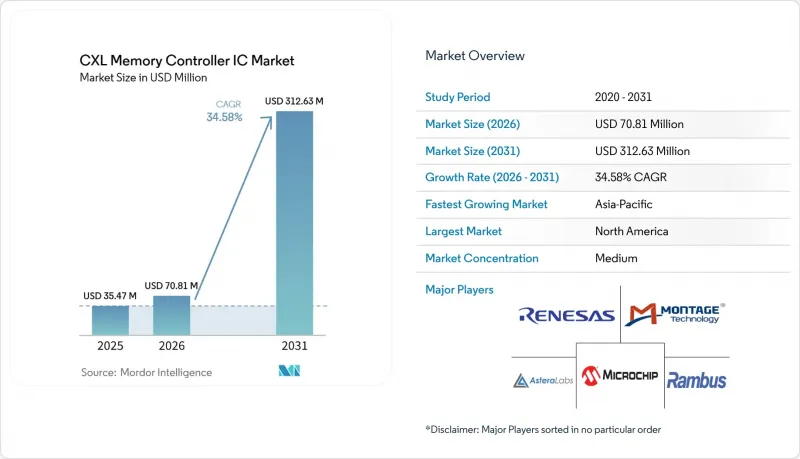
本報告按控制器部署類型(例如,用於 CXL 記憶體裝置的控制器 IC)、CXL 規格(例如,CXL 3.0)、連接的記憶體介面(例如,DDR5、DDR4)、終端外形尺寸(例如,PCIe擴充卡)、工作負載(例如,AI 推理、RAG、KV 快取)、最終用戶(例如,超大規模資料中心業者)。市場預測以美元 (USD) 為單位。
全球CXL記憶體控制器IC市場趨勢與洞察
擴展人工智慧伺服器的記憶體頻寬
CXL記憶體控制器IC市場最強勁的需求源自於加速器運算的成長與標準伺服器設計中可用記憶體頻寬之間日益擴大的差距。伺服器DDR5記憶體每GB價格仍然昂貴,而插槽引腳數量的限制使得在不進行重大平台重新設計的情況下,記憶體通道的擴展空間受到限制,因此,對於大規模AI部署而言,外部記憶體連接更為實用。 CXL透過利用PCIe物理層提供低延遲的連貫記憶體連接來解決此限制,使營運商能夠在不重新設計主機晶片的情況下擴展記憶體容量。 CXL聯盟於2025年10月發布的一項基準測試表明,在Milvus RAG叢集,使用CXL連接的DRAM代替僅使用本地DRAM的配置,可使VectorDB搜尋工作負載的效能提升高達19%。此外,推理系統中大規模KV快取的成長也推動了CXL記憶體控制器IC市場的發展,因為更長的上下文視窗和更高的平行處理能力可能會將每台伺服器的記憶體需求推高至Terabyte。 Astera Labs 已證明,Leo 控制器可以卸載 KV 快取負載,與僅使用 HBM 記憶體的配置相比,可降低服務交付成本,這也是超大規模資料中心業者在真實雲端評估環境中部署這些產品的原因之一。
採用超大規模資料中心業者進行記憶體池化和解耦
超大規模資料中心業者正日益塑造CXL記憶體控制器IC市場,將記憶體池化從實驗室概念轉變為生產架構決策。一項針對2026年機器學習推理分離式應用的研究表明,採用CXL連接的嵌入式表可以將伺服器數量減少高達25%,從而為資料中心負責人提供了部署機架級控制器晶片的直接運營依據。 Marvell透過量產其Structera S 20256 CXL 2.0交換器並發表Structera S 30260,進一步推動了CXL記憶體控制器IC市場的發展。 Structera S 30260擁有260條頻道、高達48 TB的共用記憶體和4 TB/s的累積頻寬。這些池化設計的重要性遠不止於銷量,因為它們增加了交換矩陣功能、多主機支援和更高的可靠性,所有這些都提高了每個機架的收益,優於基本的擴展控制器。此外,Astera Labs 在 2025 年開放運算專案全球高峰會上展示了機架級記憶體概念,重申記憶體碎片化正成為一個商業性問題,控制器供應商正在直接針對雲端和人工智慧叢集解決這個問題。隨著這些參考部署成為標準平台模板,CXL 記憶體控制器 IC 市場預計將從單一設計採用轉向更廣泛的多機架部署。
生態系統互通性和檢驗複雜性
CXL 記憶體控制器 IC 市場仍面臨著切實的商業化限制,因為認證需要涵蓋 CPU、記憶體模組、控制器晶片和軟體層,而不是僅限於單一供應商的產品堆疊。三星將 CXL 3.1 CMM-D 的量產推遲至 2027 年,顯示 CPU 平台進度的延遲同時影響了多個產品藍圖,導致控制器收入累計進一步延遲。在 ASPLOS 2026 會議上發表的研究也表明,目前仍缺乏能夠連接不同快取一致性架構的標準化互通機制,這使得安全檢驗多供應商部署變得困難。此外,報告指出,更新關鍵 CXL 子功能的檢驗IP 可能需要數週的工程工作,而標準的快速演進也給供應商帶來了沉重的認證負擔。儘管 CXL 聯盟的認證流程很有幫助,但由於目前藍圖中 CXL 1.1、2.0、3.x 和 4.0 的重疊,CXL 記憶體控制器 IC 市場仍然面臨著巨大的多版本檢驗負擔。
細分市場分析
2025年,直連式CXL記憶體擴充控制器IC的銷售額佔比高達71.28%,顯示CXL記憶體控制器IC市場仍依賴最簡單的商業部署模式。這些控制器易於整合到現有的x86伺服器環境中,因為在首批部署中無需交換器矽晶或互連架構管理層。這種簡易性是CXL記憶體控制器IC產業的關鍵因素,因為早期買家更重視認證速度和即時平台相容性,而非更廣泛的可組合記憶體功能。 Astera Labs和Montage的產品均符合這一趨勢,這得益於它們與基於DDR5的控制器系列的合作。這些控制器系列目前正在進行大規模部署的客戶認證流程。 2025年的剩餘銷售額則分佈在記憶體池化和共用控制器、以設備為導向的控制器設計以及滿足更專業部署需求的客製化整合式3型控制器ASIC。
預計到2031年,光纖連接或機架級記憶體控制器IC將以35.58%的複合年成長率成長,使其成為CXL記憶體控制器IC市場中最具活力的部署路徑。這種成長並非僅源自於產品需求的增加;這些產品具備交換功能、多主機記憶體共用以及更嚴格的RAS(可靠性、可用性和可維護性)要求,使其比直接連接的擴展設備複雜得多。這些特性支撐了更高的平均售價,與單主機擴充卡相比,機架級平台每次部署可帶來更高的效益。 Marvell的Structera S 30260體現了這一轉變,它支援260條通道上高達48 TB的共用內存,並為16或32個CPU或GPU提供4 TB/s的累積頻寬。因此,CXL記憶體控制器IC市場正從專注於伺服器擴充的第一階段轉向專注於共用記憶體架構的第二階段,後者正在變革機架層級的記憶體配置方式。
預計到 2025 年,CXL 1.1 和 CXL 2.0 將佔該細分市場收入的 87.36%,這證實了目前 CXL 記憶體控制器 IC 市場仍然以第一代商用產品為主,這些產品適用於池化和可擴展記憶體。許多已量產的商用產品是在 PCIe 5.0 時代設計的,並符合這一基礎,專注於可操作的擴展用例,而不是廣泛的架構能力。 Marvell 的 Structera 系列透過與兩大主流伺服器 CPU 架構和三大 DRAM 供應商實現互通性,鞏固了其市場地位,為客戶提供了更清晰的部署路徑。雖然更新的 CXL 3.x 控制器仍在不斷發展,但其量產取決於伺服器平台的發佈時間以及配套軟體和檢驗流程的成熟度。因此,隨著後續規範通過認證流程,CXL 2.0 將繼續推動 CXL 記憶體控制器 IC 市場獲利。
儘管量產預計要到預測期後半段才會開始,但CXL 4.0預計將成為CXL記憶體控制器IC市場中成長最快的規格細分領域,複合年成長率(CAGR)將達到35.51%。 CXL 4.0規範於2025年11月發布,將鏈路速度提升至128 GT/s,增加了對捆綁端口和原生x2頻寬的支持,並提高了大規模部署的內存可維護性。 Montage Technology也展示了其基於MXC Gen3晶片的動態容量裝置已準備好投入實用化,並支援即時多主機共用,這表明生態系統發展已超越概念階段。此外,該報告指出,Panmnesia已發布旨在實現極低往返延遲的CXL 4.0鏈路控制器IP,這表明即使在量產晶片問世之前,上游設計工作也已在進行中。因此,CXL 儲存控制器 IC 市場目前的情況是,短期收入仍取決於成熟的標準,但未來的成長將取決於早期對未來修訂的努力。
區域分析
到2025年,北美將佔據CXL記憶體控制器IC市場63.52%的佔有率,這清楚地展現了其在商業部署活動中的核心地位。這項領先優勢反映了超大規模資料中心業者中心營運商的投資重點,因為最大的雲端基礎設施供應商始終是首批願意認證並採用這項新型連貫記憶體技術的買家。 2025年11月微軟Azure M系列的部署意義特別重大,因為它標誌著CXL附加記憶體首次在商業雲端環境中部署,推動該地區從測試階段邁入下一階段。美國強大的半導體設計基礎也為其提供了支持,這有利於控制器開發、合作夥伴認證以及平台供應商和雲端客戶之間更緊密的合作。加拿大和墨西哥雖然規模較小,但透過與北美雲端需求相契合的託管和區域資料中心活動,發揮著不可或缺的作用。
預計亞太地區將成為CXL記憶體控制器積體電路(IC)市場成長最快的地區,到2031年複合年成長率(CAGR)將達到35.48%,並有望成為供應端最重要的成長區域。韓國仍然是核心市場,三星電子和SK海力士在CXL記憶體模組的開發中發揮關鍵作用,這將影響模組相對於商用控制器的價值佔比。中國正透過蒙太奇科技不斷擴大其市場佔有率。憑藉其控制器藍圖和對外形規格的支持,中國在CXL記憶體控制器IC市場中作為通用晶片佔據著穩固的地位。歐洲的發展方向則有所不同,德國、英國和法國更多地與國家主導的人工智慧專案和高效能運算(HPC)計劃聯繫在一起,而不是在超大規模平台領域處於主導。日本也透過人工智慧基礎設施、機器人技術和高效能運算推動需求,其元件和封裝基礎支撐著一個廣泛的高階伺服器記憶體硬體生態系統。
儘管南美洲在CXL記憶體控制器IC市場中所佔佔有率仍然很小,但該地區正通過巴西和智利等國的託管設施和超大規模資料中心業者邊緣節點,逐步建立進入市場的路徑。這條路徑至關重要,因為本地化的雲端容量和資料主權需求可能會在機架級大規模應用之前,就催生對大容量記憶體伺服器配置的早期需求。中東和非洲也處於早期階段,沙烏地阿拉伯、阿拉伯聯合大公國和南非的大規模資料中心建設計畫正在為未來的部署奠定實體基礎。目前,這些地區可能會先採用大量使用標準DRAM的伺服器設計,然後隨著CXL拓樸結構在主流OEM平台中的普及,逐步遷移到更先進的CXL拓樸結構。
其他好處:
- Excel格式的市場預測(ME)表
- 3個月的分析師支持
目錄
第1章:引言
- 研究假設和市場定義
- 調查範圍
第2章:調查方法
第3章執行摘要
第4章 市場狀況
- 市場概覽
- 市場促進因素
- 擴展人工智慧伺服器的記憶體頻寬
- 超大規模引入記憶體池和記憶體分解
- 遷移到 CXL 2.0 和 CXL 3.x 生態系統
- 機架級記憶體利用率和整體擁有成本最佳化
- 低延遲連貫連接,用於加速器和 CPU 記憶體擴展
- 共用記憶體架構中的安全性和 RAS 要求
- 市場限制因素
- 生態系統互通性和檢驗複雜性
- 高昂的非重複性工程費用和矽封裝成本
- 分散式記憶體軟體堆疊的不成熟
- 除了超大規模和高階伺服器領域之外,部署成長有限。
- 產業價值鏈分析
- 技術展望
- 監理情勢
- 波特五力分析
第5章 市場規模與成長預測
- 按控制器部署狀態
- CXL記憶體控制器IC
- CXL 記憶體池和共用控制器 IC
- 光纖連接/機架級記憶體控制器積體電路
- 直連式CXL記憶體擴充控制器IC
- 客製化/整合 CXL 3 型控制器 ASIC
- CXL規格
- CXL 1.1/CXL 2.0
- CXL 3.0
- CXL 3.1/CXL 3.2
- CXL 4.0
- 附加記憶體介面
- DDR5
- DDR4
- 支援多代DDR4和DDR5記憶體。
- 異構DRAM/HBM相容架構
- 持久性/非揮發性 CXL 記憶體架構
- 按端點外形規格
- PCIe擴充卡
- 基於 DIMM 的 CXL擴充卡
- EDSFF CXL 記憶體模組 - E1.S/E3.S
- CXL 儲存設備/擴充盒
- 機架級/可組合儲存系統
- 按工作量
- AI推理、RAG、KV快取
- AI訓練與GPU周邊記憶體擴展
- 高效能運算和科學運算
- 記憶體內資料庫和分析
- 虛擬化和雲端原生工作負載
- 企業資料庫和ERP
- 電信雲端和邊緣運算
- 最終用戶
- 超大規模資料中心業者
- 雲端服務供應商
- 公司
- 託管和託管服務提供者
- 通訊業者和邊緣服務供應商
- 政府、研究機構、超級計算中心
- 按地區
- 北美洲
- 美國
- 加拿大
- 墨西哥
- 歐洲
- 德國
- 英國
- 法國
- 義大利
- 其他歐洲國家
- 亞太地區
- 中國
- 日本
- 韓國
- 印度
- 東南亞
- 其他亞太國家
- 南美洲
- 中東和非洲
- 北美洲
第6章 競爭情勢
- 市場集中度
- 策略趨勢
- Vendor Positioning Analysis
- 公司簡介
- Astera Labs, Inc.
- Montage Technology Co., Ltd.
- Microchip Technology Incorporated
- Panmnesia, Inc.
- Rambus Inc.
- Renesas Electronics Corporation
- Samsung Electronics Co., Ltd.
- SK hynix Inc.
- Intel Corporation
- Marvell Technology, Inc.
- Broadcom Inc.
- MemVerge, Inc.
- Ampere Computing LLC
- TORmem Inc.
- Micron Technology, Inc.
- Advanced Micro Devices, Inc.
- Cisco Systems, Inc.
第7章 市場機會與未來展望
According to Mordor Intelligence, the CXL memory controller IC market size is projected to expand from USD 35.47 million in 2025 and USD 70.81 million in 2026 to USD 312.63 million by 2031, registering a CAGR of 34.58% between 2026 and 2031.
This report is Segmented by Controller Deployment (CXL Memory Appliance Controller ICs, and More), CXL Specification (CXL 3. 0, and More), Attached Memory Interface (DDR5, DDR4, and More), Endpoint Form Factor (PCIe Add-In Cards, and More), Workload (AI Inference, RAG, and KV Cache, and More), End User (Hyperscalers, and More), and Geography. The Market Forecasts are Provided in Terms of Value (USD).
Global CXL Memory Controller IC Market Trends and Insights
AI Server Memory Bandwidth Expansion
The strongest demand in the CXL memory controller IC market stems from the widening mismatch between the growth of accelerator compute and the memory bandwidth available in standard server designs. Server DDR5 still carries a high per-gigabyte cost, and socket pin limits limit how far memory channels can be expanded without a broader platform redesign, making off-processor memory attachment more practical for large AI deployments. CXL addresses that constraint by using the PCIe physical layer to connect coherent memory with low latency, which gives operators more room to scale memory capacity without reworking host silicon. A CXL Consortium benchmark released in October 2025 showed up to 19% higher performance in VectorDB search workloads when CXL-connected DRAM was used instead of a local DRAM-only setup in Milvus RAG clusters. The CXL memory controller IC market is also supported by the growth of large KV caches in inference systems, as longer context windows and higher concurrency can push memory needs into terabyte-per-server ranges. Astera Labs has shown that Leo controllers can offload KV cache demands, lowering serving costs compared to HBM-only memory configurations, which helps explain why hyperscalers have moved these products into live cloud evaluation environments.
Hyperscale Adoption Of Memory Pooling and Disaggregation
Hyperscalers are increasingly shaping the CXL memory controller IC market by turning memory pooling from a lab concept into a production architecture decision. A 2026 deployment study on disaggregated machine learning inference showed that CXL-attached embedding tables could reduce server count by up to 25%, providing data center buyers with a direct operational case for controller silicon adoption at rack scale. Marvell moved this part of the CXL memory controller IC market forward by putting its Structera S 20256 CXL 2.0 switch into production and then announcing the Structera S 30260 with 260 lanes, support for up to 48 TB of shared memory, and 4 TB/s of cumulative bandwidth. These pooling designs matter more than unit volumes alone because they add fabric capability, multi-host support, and more complex reliability features, all of which raise revenue per rack compared with basic expansion controllers. Astera Labs also demonstrated rack-scale memory concepts at the Open Compute Project Global Summit 2025, reinforcing that memory fragmentation is becoming a commercial problem that controller vendors now address directly for cloud and AI fleets. As those reference deployments become standard platform templates, the CXL memory controller IC market is likely to shift from isolated design wins toward broader multi-rack adoption.
Ecosystem Interoperability and Validation Complexity
The CXL memory controller IC market still faces a real commercialization constraint because qualification must happen across CPUs, memory modules, controller silicon, and software layers rather than within a single vendor stack. The delay of Samsung's CXL 3.1 CMM-D mass production to 2027 shows how a slip in CPU platform timing can slow multiple product roadmaps at once, which pushes controller revenue recognition further out. Research published at ASPLOS 2026 also found that bridges across different cache-coherence architectures still lack standardized interoperability mechanisms, making mixed-vendor deployments harder to validate safely. The input further notes that verification IP updates can require several weeks of engineering work for major CXL sub-features, which turns rapid standards progress into a practical qualification burden for suppliers. Even though the CXL Consortium certification process helps, the overlap of CXL 1.1, 2.0, 3.x, and 4.0 in active roadmaps means the CXL memory controller IC market still carries a heavy multi-version validation load.
Other drivers and restraints analyzed in the detailed report include:
- Migration To CXL 2.0 and CXL 3.x Ecosystem
- Rack-Level Memory Utilization and TCO Optimization
- High NRE and Silicon Implementation Cost
For complete list of drivers and restraints, kindly check the Table Of Contents.
Segment Analysis
Direct-Attached CXL Memory Expansion Controller ICs accounted for 71.28% of revenue in 2025, indicating that the CXL memory controller IC market still relies on the simplest commercial deployment model. These controllers fit more easily into existing x86 server environments because they do not require switch silicon or fabric management layers for first-wave adoption. That simplicity matters in the CXL memory controller IC industry because early buyers have prioritized qualification speed and immediate platform compatibility over broader composable memory features. Astera Labs and Montage products both align with this pattern, as the input ties them to DDR5-based controller families that are already undergoing customer qualification for large-scale deployments. The remaining 2025 revenue base sat across memory pooling and sharing controllers, appliance-oriented controller designs, and custom integrated Type-3 controller ASICs that address more specialized deployment needs.
Fabric-Attached or Rack-Scale Memory Controller ICs are projected to grow at a 35.58% CAGR through 2031, making them the most dynamic deployment path in the CXL memory controller IC market. That growth says more than rising unit demand, because these products add switching, multi-host memory sharing, and heavier RAS requirements that are materially more complex than direct-attached expansion devices. Those features support higher average selling prices and give rack-scale platforms a larger revenue footprint per deployment than single-host add-in cards. Marvell's Structera S 30260 reflects that shift, with support for up to 48 TB of shared memory over 260 lanes and 4 TB/s of cumulative bandwidth for 16 or 32 CPUs or GPUs. The CXL memory controller IC market is therefore moving from a first phase focused on server expansion to a second phase focused on shared memory fabrics that change memory provisioning at the rack level.
CXL 1.1 and CXL 2.0 accounted for 87.36% of segment revenue in 2025, confirming that the current CXL memory controller IC market remains anchored in the first commercial generation of pooled and expanded memory. Most merchant products already in active production fit this base, as they were designed for the PCIe 5.0 era and focus on practical expansion use cases rather than broader fabric capabilities. Marvell's Structera family has reinforced that position by achieving interoperability across both major server CPU architectures and all 3 leading DRAM suppliers, providing customers with a clearer path to deployment. Newer CXL 3.x controllers are still building design momentum, but mass production depends on server platform timing and on the maturity of supporting software and validation flows. The CXL memory controller IC market, therefore, continues to monetize CXL 2.0 today while later specifications move through the qualification funnel.
CXL 4.0 is projected to be the fastest-growing specification segment, with a 35.51% CAGR, even though the production window for this part of the CXL memory controller IC market is later in the forecast period. The November 2025 release of the CXL 4.0 specification doubled link speed to 128 GT/s, added bundled ports, native x2-width support, and expanded memory serviceability for larger deployments. Montage Technology also demonstrated Dynamic Capacity Device readiness with live multi-host sharing on its MXC Gen3 silicon, showing that ecosystem development is already moving beyond concept work. The input further notes that Panmnesia has disclosed CXL 4.0 link controller IP with very low round-trip latency targets, indicating that upstream design work is underway even before broad-production silicon arrives. This leaves the CXL memory controller IC market in a position where near-term revenue still comes from mature standards, while future growth rates are being set by early work on later revisions.
Complete Report Scope:
- By Controller Deployment
- CXL Memory Appliance Controller ICs
- CXL Memory Pooling and Sharing Controller ICs
- Fabric-Attached / Rack-Scale Memory Controller ICs
- Direct-Attached CXL Memory Expansion Controller ICs
- Custom / Integrated CXL Type-3 Controller ASICs
- By CXL Specification
- CXL 1.1 / CXL 2.0
- CXL 3.0
- CXL 3.1 / CXL 3.2
- CXL 4.0
- By Attached Memory Interface
- DDR5
- DDR4
- DDR4 and DDR5 Multi-Generation Support
- Heterogeneous DRAM / HBM-Enabled Architectures
- Persistent / Non-Volatile CXL Memory Architectures
- By Endpoint Form Factor
- PCIe Add-In Cards
- DIMM-Based CXL Add-In Cards
- EDSFF CXL Memory Modules - E1.S / E3.S
- CXL Memory Appliances / Expansion Boxes
- Rack-Scale / Composable Memory Systems
- By Workload
- AI Inference, RAG, and KV Cache
- AI Training and GPU-Adjacent Memory Expansion
- HPC and Scientific Computing
- In-Memory Databases and Analytics
- Virtualization and Cloud-Native Workloads
- Enterprise Database and ERP
- Telecom Cloud and Edge
- By End User
- Hyperscalers
- Cloud Service Providers
- Enterprises
- Colocation and Managed Hosting Providers
- Telecom Operators and Edge Providers
- Government, Research Laboratories, and Supercomputing Centers
- By Geography
- North America
- United States
- Canada
- Mexico
- Europe
- Germany
- United Kingdom
- France
- Italy
- Rest of Europe
- Asia-Pacific
- China
- Japan
- South Korea
- India
- Southeast Asia
- Rest of Asia-Pacific
- South America
- Middle East and Africa
- North America
Geography Analysis
North America held 63.52% of the CXL memory controller IC market share in 2025, which makes it the clear center of commercial deployment activity. That lead reflects where hyperscaler spending is concentrated, since the largest cloud infrastructure operators remain the first buyers willing to qualify and deploy new coherent memory technologies. The Microsoft Azure M-series rollout in November 2025 was especially important because it marked the first announced production cloud deployment of CXL-attached memory and moved the region beyond test environments. The United States also benefits from a strong semiconductor design base, which supports controller development, partner qualification, and tighter links between platform vendors and cloud customers. Canada and Mexico play a smaller but useful role through colocation and regional data center activity tied to North American cloud demand.
Asia-Pacific is projected to record the fastest growth in the CXL memory controller integrated circuit (IC) market size, with a 35.48% CAGR through 2031, making it the most important supply-side growth region. South Korea remains central because Samsung Electronics and SK hynix sit at the heart of CXL-capable memory module development and can influence how much value stays with modules versus merchant controllers. China adds weight through Montage Technology, whose controller roadmap and form factor support give the region a visible merchant silicon presence in the CXL memory controller IC market. Europe is developing from a different angle, with Germany, the United Kingdom, and France tied more closely to sovereign AI programs and high-performance computing efforts than to hyperscale platform leadership. Japan also adds demand through AI infrastructure, robotics, and HPC, while its component and packaging base supports the broader hardware ecosystem for advanced server memory.
South America is still a small part of the CXL memory controller IC market, but the region has a gradual entry path through colocation facilities and hyperscaler edge nodes in countries such as Brazil and Chile. That route matters because localized cloud capacity and data sovereignty needs can create early demand for higher-memory server configurations before broader rack-scale adoption appears. The Middle East and Africa are also in the early phase, with large data center construction programs in Saudi Arabia, the United Arab Emirates, and South Africa building the physical base for later adoption. For now, these regions are more likely to deploy standard DRAM-heavy server designs first, then move to advanced CXL topologies as they become more common in mainstream OEM platforms.
- Astera Labs, Inc.
- Montage Technology Co., Ltd.
- Microchip Technology Incorporated
- Panmnesia, Inc.
- Rambus Inc.
- Renesas Electronics Corporation
- Samsung Electronics Co., Ltd.
- SK hynix Inc.
- Intel Corporation
- Marvell Technology, Inc.
- Broadcom Inc.
- MemVerge, Inc.
- Ampere Computing LLC
- TORmem Inc.
- Micron Technology, Inc.
- Advanced Micro Devices, Inc.
- Cisco Systems, Inc.
Additional Benefits:
- The market estimate (ME) sheet in Excel format
- 3 months of analyst support
TABLE OF CONTENTS
1 INTRODUCTION
- 1.1 Study Assumptions and Market Definition
- 1.2 Scope of the Study
2 RESEARCH METHODOLOGY
3 EXECUTIVE SUMMARY
4 MARKET LANDSCAPE
- 4.1 Market Overview
- 4.2 Market Drivers
- 4.2.1 AI Server Memory Bandwidth Expansion
- 4.2.2 Hyperscale Adoption of Memory Pooling and Disaggregation
- 4.2.3 Migration to CXL 2.0 and CXL 3.x Ecosystem
- 4.2.4 Rack-Level Memory Utilization and TCO Optimization
- 4.2.5 Low-Latency Coherent Attach for Accelerators and CPU Memory Expansion
- 4.2.6 Security and RAS Demand in Shared Memory Fabrics
- 4.3 Market Restraints
- 4.3.1 Ecosystem Interoperability and Validation Complexity
- 4.3.2 High NRE and Silicon Implementation Cost
- 4.3.3 Software Stack Immaturity for Disaggregated Memory
- 4.3.4 Limited Volume Ramp Outside Hyperscale and Premium Server Segments
- 4.4 Industry Value Chain Analysis
- 4.5 Technological Outlook
- 4.6 Regulatory Landscape
- 4.7 Porter's Five Forces Analysis
- 4.7.1 Bargaining Power of Suppliers
- 4.7.2 Bargaining Power of Buyers
- 4.7.3 Threat of New Entrants
- 4.7.4 Threat of Substitutes
- 4.7.5 Intensity of Competitive Rivalry
5 MARKET SIZE AND GROWTH FORECASTS (VALUE)
- 5.1 By Controller Deployment
- 5.1.1 CXL Memory Appliance Controller ICs
- 5.1.2 CXL Memory Pooling and Sharing Controller ICs
- 5.1.3 Fabric-Attached / Rack-Scale Memory Controller ICs
- 5.1.4 Direct-Attached CXL Memory Expansion Controller ICs
- 5.1.5 Custom / Integrated CXL Type-3 Controller ASICs
- 5.2 By CXL Specification
- 5.2.1 CXL 1.1 / CXL 2.0
- 5.2.2 CXL 3.0
- 5.2.3 CXL 3.1 / CXL 3.2
- 5.2.4 CXL 4.0
- 5.3 By Attached Memory Interface
- 5.3.1 DDR5
- 5.3.2 DDR4
- 5.3.3 DDR4 and DDR5 Multi-Generation Support
- 5.3.4 Heterogeneous DRAM / HBM-Enabled Architectures
- 5.3.5 Persistent / Non-Volatile CXL Memory Architectures
- 5.4 By Endpoint Form Factor
- 5.4.1 PCIe Add-In Cards
- 5.4.2 DIMM-Based CXL Add-In Cards
- 5.4.3 EDSFF CXL Memory Modules - E1.S / E3.S
- 5.4.4 CXL Memory Appliances / Expansion Boxes
- 5.4.5 Rack-Scale / Composable Memory Systems
- 5.5 By Workload
- 5.5.1 AI Inference, RAG, and KV Cache
- 5.5.2 AI Training and GPU-Adjacent Memory Expansion
- 5.5.3 HPC and Scientific Computing
- 5.5.4 In-Memory Databases and Analytics
- 5.5.5 Virtualization and Cloud-Native Workloads
- 5.5.6 Enterprise Database and ERP
- 5.5.7 Telecom Cloud and Edge
- 5.6 By End User
- 5.6.1 Hyperscalers
- 5.6.2 Cloud Service Providers
- 5.6.3 Enterprises
- 5.6.4 Colocation and Managed Hosting Providers
- 5.6.5 Telecom Operators and Edge Providers
- 5.6.6 Government, Research Laboratories, and Supercomputing Centers
- 5.7 By Geography
- 5.7.1 North America
- 5.7.1.1 United States
- 5.7.1.2 Canada
- 5.7.1.3 Mexico
- 5.7.2 Europe
- 5.7.2.1 Germany
- 5.7.2.2 United Kingdom
- 5.7.2.3 France
- 5.7.2.4 Italy
- 5.7.2.5 Rest of Europe
- 5.7.3 Asia-Pacific
- 5.7.3.1 China
- 5.7.3.2 Japan
- 5.7.3.3 South Korea
- 5.7.3.4 India
- 5.7.3.5 Southeast Asia
- 5.7.3.6 Rest of Asia-Pacific
- 5.7.4 South America
- 5.7.5 Middle East and Africa
- 5.7.1 North America
6 COMPETITIVE LANDSCAPE
- 6.1 Market Concentration
- 6.2 Strategic Moves
- 6.3 Vendor Positioning Analysis
- 6.4 Company Profiles (includes Global Level Overview, Market Level Overview, Core Segments, Financials as available, Strategic Information, Market Rank/Share, Products and Services, Recent Developments)
- 6.4.1 Astera Labs, Inc.
- 6.4.2 Montage Technology Co., Ltd.
- 6.4.3 Microchip Technology Incorporated
- 6.4.4 Panmnesia, Inc.
- 6.4.5 Rambus Inc.
- 6.4.6 Renesas Electronics Corporation
- 6.4.7 Samsung Electronics Co., Ltd.
- 6.4.8 SK hynix Inc.
- 6.4.9 Intel Corporation
- 6.4.10 Marvell Technology, Inc.
- 6.4.11 Broadcom Inc.
- 6.4.12 MemVerge, Inc.
- 6.4.13 Ampere Computing LLC
- 6.4.14 TORmem Inc.
- 6.4.15 Micron Technology, Inc.
- 6.4.16 Advanced Micro Devices, Inc.
- 6.4.17 Cisco Systems, Inc.
7 MARKET OPPORTUNITIES AND FUTURE OUTLOOK
- 7.1 White-Space and Unmet-Need Assessment

 2026年全球客製化系統晶片專用積體電路(ASIC)市場報告
 可程式設計積體電路:市場佔有率分析、產業趨勢與統計資料、成長預測(2026-2031 年)
 ASIC晶片市場報告:趨勢、預測和競爭分析(至2035年)
 全球ASIC市場預測至2034年:按類型、設計方法、製程節點、設計服務、應用、最終用戶和地區分類
 專用積體電路(ASIC)市場:按技術、技術節點、設計類型和應用分類的全球市場預測,2026-2032年
 專用積體電路市場-全球產業規模、佔有率、趨勢、機會、預測:按產品類型、應用、地區和競爭對手分類,2021-2031年人工智慧專用積體電路晶片市場:按類型、應用、最終用途、國家和地區分類-全球產業分析、市場規模、市場佔有率及2026年至2033年預測
 專用積體電路(ASIC)市場規模、佔有率、趨勢和預測:按產品類型、應用和地區分類,2026-2034年
 ASIC晶片市場:按類型、應用和地區分類
 專用積體電路 (ASIC) 市場分析及至 2035 年預測:按類型、產品、技術、組件、應用、材料類型、製程、部署、最終用戶和功能分類