


 |
市場調查報告書
商品編碼
2122295
類比和混合訊號IP:市場佔有率分析、行業趨勢和統計數據、成長預測(2026-2031年)Analog And Mixed Signal IP - Market Share Analysis, Industry Trends & Statistics, Growth Forecasts (2026 - 2031) |
||||||

※ 本網頁內容可能與最新版本有所差異。詳細情況請與我們聯繫。
據 Mordor Intelligence 稱,2025 年模擬和混合訊號 IP 市值為 2.2322 億美元,預計到 2031 年將達到 5.1266 億美元,而 2026 年為 2.5637 億美元,預測期(2026-2031 年)的複合年成長率為 14.86%。
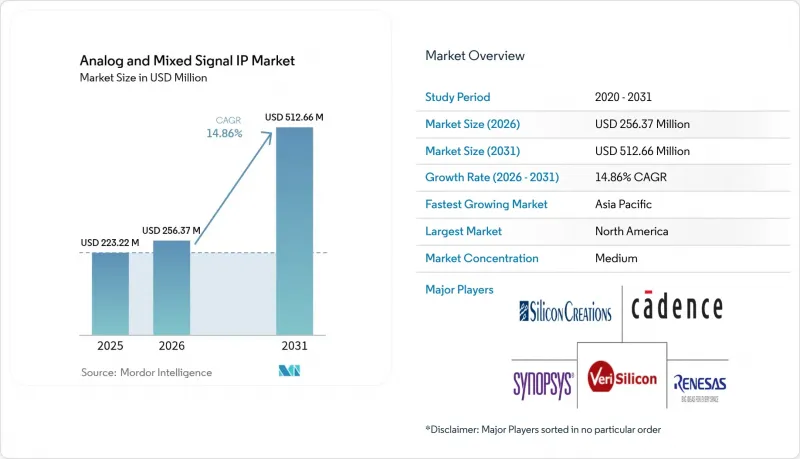
本報告依設計類型(韌體/軟IP、硬IP)、產品類型(A2D及D2A轉換器、電源管理模組、射頻等)、終端用戶產業(家用電子電器、通訊及其他)、製程節點(7奈米及以下、8奈米至16奈米、20奈米至45奈米、65奈米以上)及地區進行細分。市場預測以美元計價。
全球模擬及混合訊號IP市場趨勢及洞察
對低功耗連網型設備的需求日益成長
物聯網終端和穿戴式感測器需要功耗低於 1 毫瓦的類比前端,才能將電池壽命延長至 10 年,而這對於分立元件來說難以實現。氮化鎵 (GaN) 和碳化矽 (SiC) IP 目前已實現低於 100 納安的靜態電流,從而能夠製造無需紐扣電池的工業監控節點。歐洲的永續產品生態設計法規強制要求產品貼有能源效率標籤,加速了超低功耗類比 IP 在消費性電子和工業產品的應用。智慧型手機設計人員正在獲得電源門控 IP 的授權,該 IP 可以關閉空閒的類比路徑,從而將待機功耗降低 40% 至 60%。亞太地區的需求最為旺盛,對成本敏感的穿戴式裝置製造商優先考慮電池壽命而非單純的吞吐量。因此,超低漏電流庫正日益成為類比和混合訊號 IP 市場中邊緣元件的首選方案。
邊緣人工智慧推理工作負載的快速成長
網路邊緣的機器學習推理需要類比數位轉換器(ADC),其取樣率需超過每秒1吉取樣,同時維持70分貝以上的訊號雜訊比,以達到即時分類。汽車雷達系統依賴符合AEC-Q100標準的高精度Delta-Σ轉換器,這推動了對汽車級模組化IP合約的新需求。超大規模雲端供應商在行動電話基地台部署推理加速器時,將類比前端直接整合到5奈米ASIC中,以降低延遲,從而縮短獨立類比晶片的供應鏈。智慧相機和工業視覺系統要求連續ADC的取樣率達到每秒1000萬次,解析度為16位,只有針對FinFET節點最佳化的硬IP才能可靠地滿足此規格。這些需求正在縮短設計週期,並進一步加速北美邊緣AI新創公司對類比和混合訊號IP的需求。
AMS協同模擬中的檢驗瓶頸
類比模組需要連續時間模擬引擎,而數位邏輯中使用的離散事件加速技術無法從中受益,這使得檢驗週期延長了3到5倍。到了2024年,寄生電容和基板耦合已經削弱傳統的SPICE模型,導致7奈米節點的首次晶片成功率下降至62%。 Cadence公司推出了基於機器學習的寄生元件提取技術,但其應用僅限於能夠資助專業團隊的頂級公司。電源管理IP和數位核心的聯合模擬每次迭代可能需要高達5萬CPU小時,這可能會使流片延遲長達12個月。小規模的無廠半導體公司為了確保首次良率而過度設計,犧牲了電源效率,這正在減緩類比和混合訊號IP市場的短期成長。
細分市場分析
儘管硬IP在2024年仍僅佔少數佔有率,但隨著基於晶片組的架構日趨成熟,預計到2031年,其複合年成長率將達到16.78%。英特爾的「Meteor Lake」處理器證明,預先表徵的電壓調節器和時脈分配硬IP與同等軟IP相比,可將功耗降低20%。將於2024年獲批的「通用晶片組互連高速標準(UCI-Express)」實現了晶片間類比訊號傳輸的標準化,使供應商能夠交付即插即用的晶片單元,並確保其在不同製程節點上的效能。在類比和混合訊號IP市場,除了50萬至200萬美元的預付款外,1%至3%的額外專利費也變得越來越普遍,這使得這些價格對於智慧型手機和汽車零件供應商的大批量生產而言是可以接受的。
預計到2025年,硬IP和軟IP將佔據類比和混合訊號IP市場佔有率的54.19%,對於成本敏感的消費性電子產品和物聯網設備而言,它們仍然至關重要,因為在這些設備中,不同晶圓代工廠之間的可移植性至關重要。軟IP以寄存器傳輸級(RTL)代碼的形式交付,允許對模擬拓撲進行客製化,但需要大規模的重新檢驗,這會將產品上市時間延長至多九個月。目前,晶圓代工廠正在對3奈米環柵(GaA)製程的硬IP進行預認證,以幫助客戶降低先進節點專案的風險。隨著晶片生態系統的擴展,硬IP的類比和混合訊號IP市場預計將呈指數級成長,但由於軟IP的柔軟性足以彌補效能上的不足,因此它仍將在傳統節點中繼續使用。
預計到2025年,電源管理模組將佔總銷售額的36.25%,凸顯其在從穿戴式裝置到電動車等所有半導體領域的廣泛應用。電壓調節器IP能夠在0.5伏特至48伏特的電壓範圍內工作,並保持90%以上的效率,是區域控制器和高頻寬記憶體堆疊的關鍵組件。同時,受毫米波5G和低地球軌道衛星終端部署的推動,射頻IP預計將以16.26%的複合年成長率成長。隨著行動電話製造商對雜訊係數低於3分貝的低雜訊放大器和輸出功率為25分貝毫瓦的功率放大器的需求不斷成長,支援24吉赫以上射頻應用的類比和混合訊號射頻模組IP的市場規模也在不斷擴大。
支援 112 Gigabit傳輸速度的高速 SerDes 和時脈數據恢復 IP,現在無需重定時器即可在 2 公尺長的銅線上傳輸數據,為資料中心交換器的每個連接埠節省 50 至 100 美元的成本。轉換器 IP 在工業自動化和醫療成像領域仍然至關重要,而溫度感測器和振盪器則滿足了航太領域的特定需求。在類比和混合訊號 IP 市場,成熟的電源管理產品與高成長的射頻領域的發展機會實現了策略平衡,使供應商能夠在電源、射頻和資料轉換產品線方面保持多元化的產品組合。
區域分析
預計到2025年,亞太地區將在類比和混合訊號IP市場佔據領先地位,市場佔有率將達到40.65%,並將在2031年之前以15.65%的複合年成長率成長。中國國家積體電路發展基金會於2024年投資470億美元用於國內類比IP項目,以在美國出口限制下實現自主研發。日本與台積電(TSMC)的晶圓代工廠合作已確保了2奈米原型生產能力,為國內汽車和工業客戶提供支援。韓國正在授權用於人工智慧伺服器的高頻寬記憶體和晶片互連IP,而印度的2.5萬名模擬工程專業人員則負責處理來自北美和歐洲的IP開發契約,從而降低了全球客戶的設計成本。
在超大規模資料中心營運商和汽車OEM廠商的推動下,北美預計到2025年將佔據28.12%的市場佔有率。 《晶片與科學法案》撥款110億美元用於先進封裝和晶片組技術,刺激了本地對晶片間模擬IP的需求。英特爾在亞利桑那州投資200億美元的擴建計畫包括一個模擬認證實驗室,引入第三方IP合作夥伴對18A節點進行檢驗。加拿大供應商麥格納正在將經過認證的類比IP整合到區域控制器中,而墨西哥瓜達拉哈拉叢集正在崛起為汽車和工業領域的近岸設計中心。
歐洲佔約22.28%的市場佔有率,其中德國、法國和義大利處於領先地位。旨在2030年將該地區半導體市場佔有率翻倍的《歐洲晶片法案》正在投資430億歐元(約470億美元),並將優先發展用於電動車和可再生能源系統的類比和電源管理IP。英飛凌正與Cadence和ARM合作,以增強其車規級IP;意法半導體則正在共同開發氮化鎵(GaN)功率IP,目標是實現充電器95%的效率。總部位於英國的AlphaWave IP已籌集4.5億英鎊(約5.75億美元)用於擴展其SerDes和晶片組合,從而鞏固歐洲在高速連接領域的地位。儘管南美、中東和非洲合計總合佔有率不足9%,但巴西的電動車計畫和沙烏地阿拉伯的智慧城市計畫正在創造獨特的商機。
其他好處:
- Excel格式的市場預測(ME)表
- 3個月的分析師支持
目錄
第1章:引言
- 研究假設和市場定義
- 調查範圍
第2章:調查方法
第3章執行摘要
第4章 市場狀況
- 市場概覽
- 市場促進因素
- 對低功耗連網型設備的需求日益成長
- 邊緣人工智慧推理工作負載的快速成長
- 智慧型手機中相容5G的射頻前端的普及
- 汽車原始設備製造商向基於區域的架構轉變
- 採用基於晶片組的異質整合
- 人們對以安全為中心的模擬 IP(無法以實體方式複製的功能)越來越感興趣。
- 市場限制因素
- AMS協同模擬中的檢驗瓶頸
- 10奈米以下節點類比電路設計人員短缺
- 多晶片系統授權的複雜性
- 對銷往中國的EDA/IP的地緣政治出口限制
- 價值鏈分析
- 監理情勢
- 技術展望
- 宏觀經濟因素對市場的影響
- 波特五力分析
第5章 市場規模與成長預測
- 有意為之
- 韌體/軟體IP
- 硬IP
- 依產品
- A2D 和 D2A 轉換器
- 電源管理模組
- RF
- 其他產品
- 按最終用戶行業分類
- 家用電子產品
- 電訊
- 車
- 產業
- 其他終端用戶產業
- 按行程節點
- 7奈米或更小
- 8 nm~16 nm
- 20 nm~45 nm
- 65奈米或以上
- 按地區
- 北美洲
- 美國
- 加拿大
- 墨西哥
- 南美洲
- 巴西
- 阿根廷
- 其他南美國家
- 歐洲
- 德國
- 英國
- 法國
- 義大利
- 俄羅斯
- 其他歐洲國家
- 亞太地區
- 中國
- 日本
- 韓國
- 印度
- 其他亞太國家
- 中東
- 沙烏地阿拉伯
- 阿拉伯聯合大公國
- 土耳其
- 其他中東國家
- 非洲
- 南非
- 奈及利亞
- 其他非洲國家
- 北美洲
第6章 競爭情勢
- 市場集中度
- 策略趨勢
- 市佔率分析
- 公司簡介
- Cadence Design Systems Inc.
- Synopsys Inc.
- ARM Ltd.
- VeriSilicon Holdings Co. Ltd.
- Silicon Creations LLC
- Renesas Electronics Corporation
- Advanced Micro Devices Inc.(Xilinx)
- Intel Corporation
- Analog Devices Inc.
- Texas Instruments Incorporated
- Rambus Inc.
- Faraday Technology Corporation
- GlobalFoundries Inc.
- Ceva Inc.
- MACOM Technology Solutions Holdings Inc.
- Infineon Technologies AG
- Microchip Technology Inc.
- Marvell Technology Inc.
- SemiFive Inc.
- Alphawave IP Group plc
第7章 市場機會與未來展望
According to Mordor Intelligence, the analog and mixed signal IP market size was valued at USD 223.22 million in 2025 and estimated to grow from USD 256.37 million in 2026 to reach USD 512.66 million by 2031, at a CAGR of 14.86% during the forecast period (2026-2031).
This report is Segmented by Design (Firm/Soft IP, and Hard IP), Product (A2D and D2A Converters, Power Management Modules, RF, and More), End-User Industry (Consumer Electronics, Telecommunication, and More), Process Node (7 Nm and Below, 8 Nm To 16 Nm, 20 Nm To 45 Nm, and 65 Nm and Above), and Geography. The Market Forecasts are Provided in Terms of Value (USD).
Global Analog And Mixed Signal IP Market Trends and Insights
Growing Demand for Low-Power Connected Devices
Internet-of-Things endpoints and wearable sensors need analog front ends operating below 1 milliwatt so their batteries last a decade, a target that discrete components struggle to meet. Gallium-nitride and silicon-carbide IP now deliver sub-100-nanoampere quiescent currents, enabling coin-cell-free industrial monitoring nodes. The European Ecodesign for Sustainable Products Regulation mandates energy-efficiency labels, accelerating uptake of ultra-low-power analog IP across consumer and industrial products. Smartphone designers are licensing power-gating IP that shuts down idle analog paths, trimming standby drain by 40-60%. Demand is most intense in Asia-Pacific, where cost-sensitive wearables makers prize battery life over raw throughput. Consequently, the analog and mixed signal IP market increasingly positions ultra-low-leakage libraries as a default option for edge devices.
Rapid Proliferation of Edge AI Inference Workloads
Machine-learning inference at the network edge requires analog-to-digital converters sampling above 1 giga sample per second while sustaining more than 70 decibels of signal-to-noise ratio for real-time classification. Automotive radar systems rely on precision delta-sigma converters qualified to AEC-Q100 standards, driving fresh IP contracts for automotive-grade blocks. Hyperscale cloud providers deploying inference accelerators at cell towers embed analog front ends directly onto 5-nanometer ASICs to cut latency, compressing the standalone analog-chip supply chain. Smart cameras and industrial vision systems are pushing successive-approximation ADCs toward 16-bit resolution at 10 mega samples per second, a specification reliably met only by hard IP optimized for FinFET nodes. These needs shorten design cycles, reinforcing the analog and mixed signal IP market momentum among North American edge-AI startups.
Verification Bottlenecks for AMS Co-Simulation
Analog blocks need continuous-time simulation engines that cannot benefit from the discrete-event acceleration used for digital logic, stretching verification cycles by three-to-five times. First-time silicon success at 7-nanometer nodes fell to 62% in 2024 because parasitic capacitance and substrate coupling undermine traditional SPICE models. Cadence introduced machine-learning-assisted parasitic extraction, yet uptake remains limited to tier-one firms able to fund specialized teams. Co-simulating power-management IP with digital cores can consume up to 50,000 CPU-hours per iteration, pushing tape-out by as much as 12 months. Smaller fabless houses over-design margins, compromising power efficiency to secure first-pass yields, which tempers near-term analog and mixed signal IP market growth.
Other drivers and restraints analyzed in the detailed report include:
- Expansion of 5G-Enabled RF Front ends in Smartphones
- Automotive OEM Pivot to Zonal Architectures
- Scarcity of Analog Design Talent in Sub-10 nm Nodes
For complete list of drivers and restraints, kindly check the Table Of Contents.
Segment Analysis
Hard IP captured a minority share in 2024, yet it is projected to grow at 16.78% CAGR through 2031 as chiplet-based architectures mature. Intel's Meteor Lake processor demonstrated that pre-characterized voltage-regulator and clock-distribution hard IP can trim power by 20% relative to soft equivalents. Universal Chiplet Interconnect Express, ratified in 2024, formalizes die-to-die analog signalling, allowing vendors to ship plug-and-play tiles that guarantee performance across process nodes. The analog and mixed signal IP market increasingly sees premium fees USD 500,000 to USD 2 million up front plus 1-3% royalties for these hardened blocks, a price acceptable to high-volume smartphone and automotive suppliers.
Firm and soft IP, which held 54.19% of analog and mixed signal IP market share in 2025, remains vital in cost-sensitive consumer and Internet-of-Things devices where portability across foundries is paramount. Soft IP delivered as register-transfer-level code allows tailoring of analog topologies but forces extensive re-verification, stretching time-to-market by up to nine months. Foundries now pre-qualify hard IP for 3-nanometer gate-all-around processes, helping customers de-risk advanced-node projects. As chiplet ecosystems widen, the analog and mixed signal IP market size for hard IP is set to leap, though soft IP will persist in legacy nodes because its flexibility outweighs performance trade-offs.
Power-management modules captured 36.25% revenue in 2025, underscoring their ubiquity across every semiconductor category from wearables to electric vehicles. Voltage-regulator IP capable of 0.5-volt to 48-volt operation while sustaining more than 90% efficiency is indispensable in zonal controllers and high-bandwidth-memory stacks. Yet RF IP is forecast to grow at a 16.26% CAGR on the back of millimeter-wave 5G rollouts and low-Earth-orbit satellite terminals. The analog and mixed signal IP market size for RF blocks serving 24-plus-gigahertz applications is swelling as handset makers need low-noise amplifiers with noise figures below 3 decibels and power amplifiers delivering 25 decibel-milliwatts.
High-speed SerDes and clock-data-recovery IP at 112-gigabit-per-second rates now reach 2-meter copper traces without retimers, saving USD 50-100 per port in data-center switches. Converter IP remains essential in industrial automation and medical imaging, while temperature sensors and oscillators address niche aerospace needs. The analog and mixed signal IP market strategically balances mature power-management products with high-growth RF opportunities, ensuring that vendors maintain diversified portfolios across power, RF, and data-conversion lines.
Complete Report Scope:
- By Design
- Firm/Soft IP
- Hard IP
- By Product
- A2D and D2A Converters
- Power Management Modules
- RF
- Other Products
- By End-User Industry
- Consumer Electronics
- Telecommunication
- Automotive
- Industrial
- Other End-User Industries
- By Process Node
- 7 nm and Below
- 8 nm - 16 nm
- 20 nm - 45 nm
- 65 nm and Above
- By Geography
- North America
- United States
- Canada
- Mexico
- South America
- Brazil
- Argentina
- Rest of South America
- Europe
- Germany
- United Kingdom
- France
- Italy
- Russia
- Rest of Europe
- Asia Pacific
- China
- Japan
- South Korea
- India
- Rest of Asia Pacific
- Middle East
- Saudi Arabia
- United Arab Emirates
- Turkey
- Rest of Middle East
- Africa
- South Africa
- Nigeria
- Rest of Africa
- North America
Geography Analysis
Asia-Pacific led with 40.65% analog and mixed signal IP market share in 2025 and is forecast to grow at 15.65% CAGR through 2031. China's National Integrated Circuit Fund directed USD 47 billion into domestic analog IP programs in 2024 to reach self-sufficiency amid U.S. export controls. Japan's foundry alliances with Taiwan Semiconductor Manufacturing Company secure capacity for 2-nanometer prototypes, supporting local automotive and industrial clients. South Korea licenses high-bandwidth-memory and chiplet interconnect IP for AI servers, while India's 25,000-strong analog-engineering workforce handles outsourced IP development contracts from North America and Europe, lowering design costs for global customers.
North America held 28.12% share in 2025, driven by hyperscale data-center operators and vehicle OEMs. The CHIPS and Science Act earmarked USD 11 billion for advanced packaging and chiplets, stimulating local demand for die-to-die analog IP. Intel's USD 20 billion Arizona expansion includes analog qualification labs, inviting third-party IP partners to validate on the 18A node. Canadian supplier Magna integrates certified analog IP into zonal controllers, while Mexico's Guadalajara cluster emerges as a near-shore design hub for automotive and industrial segments.
Europe commanded about 22.28% share, with Germany, France, and Italy at the forefront. The European Chips Act commits EUR 43 billion (USD 47 billion) toward doubling regional semiconductor share by 2030 and prioritizes analog and power-management IP for electric-vehicle and renewable-energy systems. Infineon partnered with Cadence and ARM to enrich its automotive-grade IP, and STMicroelectronics co-develops gallium-nitride power IP targeting 95% charger efficiency. The United Kingdom's Alphawave IP raised GBP 450 million (USD 575 million) to scale its SerDes and chiplet portfolios, strengthening Europe's role in high-speed connectivity. South America, the Middle East and Africa collectively contribute under 9%, though Brazil's electric-vehicle programs and Saudi Arabia's smart-city projects produce niche opportunities.
- Cadence Design Systems Inc.
- Synopsys Inc.
- ARM Ltd.
- VeriSilicon Holdings Co. Ltd.
- Silicon Creations LLC
- Renesas Electronics Corporation
- Advanced Micro Devices Inc. (Xilinx)
- Intel Corporation
- Analog Devices Inc.
- Texas Instruments Incorporated
- Rambus Inc.
- Faraday Technology Corporation
- GlobalFoundries Inc.
- Ceva Inc.
- MACOM Technology Solutions Holdings Inc.
- Infineon Technologies AG
- Microchip Technology Inc.
- Marvell Technology Inc.
- SemiFive Inc.
- Alphawave IP Group plc
Additional Benefits:
- The market estimate (ME) sheet in Excel format
- 3 months of analyst support
TABLE OF CONTENTS
1 INTRODUCTION
- 1.1 Study Assumptions and Market Definition
- 1.2 Scope of the Study
2 RESEARCH METHODOLOGY
3 EXECUTIVE SUMMARY
4 MARKET LANDSCAPE
- 4.1 Market Overview
- 4.2 Market Drivers
- 4.2.1 Growing Demand for Low-Power Connected Devices
- 4.2.2 Rapid Proliferation of Edge AI Inference Workloads
- 4.2.3 Expansion of 5G-Enabled RF Front-Ends in Smartphones
- 4.2.4 Automotive OEM Pivot to Zonal Architectures
- 4.2.5 Adoption of Chiplet-Based Heterogeneous Integration
- 4.2.6 Heightened Focus on Security-Centric Analog IP (Physically Unclonable Functions)
- 4.3 Market Restraints
- 4.3.1 Verification Bottlenecks for AMS Co-Simulation
- 4.3.2 Scarcity of Analog Design Talent in Sub-10 nm Nodes
- 4.3.3 Licensing Complexity in Multi-Die Systems
- 4.3.4 Geopolitical Export Controls on EDA/IP to China
- 4.4 Value-Chain Analysis
- 4.5 Regulatory Landscape
- 4.6 Technological Outlook
- 4.7 Impact of Macroeconomic Factors on the Market
- 4.8 Porter's Five Forces Analysis
- 4.8.1 Threat of New Entrants
- 4.8.2 Bargaining Power of Buyers
- 4.8.3 Bargaining Power of Suppliers
- 4.8.4 Threat of Substitute Products
- 4.8.5 Intensity of Competitive Rivalry
5 MARKET SIZE AND GROWTH FORECASTS (VALUE)
- 5.1 By Design
- 5.1.1 Firm/Soft IP
- 5.1.2 Hard IP
- 5.2 By Product
- 5.2.1 A2D and D2A Converters
- 5.2.2 Power Management Modules
- 5.2.3 RF
- 5.2.4 Other Products
- 5.3 By End-User Industry
- 5.3.1 Consumer Electronics
- 5.3.2 Telecommunication
- 5.3.3 Automotive
- 5.3.4 Industrial
- 5.3.5 Other End-User Industries
- 5.4 By Process Node
- 5.4.1 7 nm and Below
- 5.4.2 8 nm - 16 nm
- 5.4.3 20 nm - 45 nm
- 5.4.4 65 nm and Above
- 5.5 By Geography
- 5.5.1 North America
- 5.5.1.1 United States
- 5.5.1.2 Canada
- 5.5.1.3 Mexico
- 5.5.2 South America
- 5.5.2.1 Brazil
- 5.5.2.2 Argentina
- 5.5.2.3 Rest of South America
- 5.5.3 Europe
- 5.5.3.1 Germany
- 5.5.3.2 United Kingdom
- 5.5.3.3 France
- 5.5.3.4 Italy
- 5.5.3.5 Russia
- 5.5.3.6 Rest of Europe
- 5.5.4 Asia Pacific
- 5.5.4.1 China
- 5.5.4.2 Japan
- 5.5.4.3 South Korea
- 5.5.4.4 India
- 5.5.4.5 Rest of Asia Pacific
- 5.5.5 Middle East
- 5.5.5.1 Saudi Arabia
- 5.5.5.2 United Arab Emirates
- 5.5.5.3 Turkey
- 5.5.5.4 Rest of Middle East
- 5.5.6 Africa
- 5.5.6.1 South Africa
- 5.5.6.2 Nigeria
- 5.5.6.3 Rest of Africa
- 5.5.1 North America
6 COMPETITIVE LANDSCAPE
- 6.1 Market Concentration
- 6.2 Strategic Moves
- 6.3 Market Share Analysis
- 6.4 Company Profiles (includes Global Level Overview, Market Level Overview, Core Segments, Financials as available, Strategic Information, Market Rank/Share for Key Companies, Products and Services, and Recent Developments)
- 6.4.1 Cadence Design Systems Inc.
- 6.4.2 Synopsys Inc.
- 6.4.3 ARM Ltd.
- 6.4.4 VeriSilicon Holdings Co. Ltd.
- 6.4.5 Silicon Creations LLC
- 6.4.6 Renesas Electronics Corporation
- 6.4.7 Advanced Micro Devices Inc. (Xilinx)
- 6.4.8 Intel Corporation
- 6.4.9 Analog Devices Inc.
- 6.4.10 Texas Instruments Incorporated
- 6.4.11 Rambus Inc.
- 6.4.12 Faraday Technology Corporation
- 6.4.13 GlobalFoundries Inc.
- 6.4.14 Ceva Inc.
- 6.4.15 MACOM Technology Solutions Holdings Inc.
- 6.4.16 Infineon Technologies AG
- 6.4.17 Microchip Technology Inc.
- 6.4.18 Marvell Technology Inc.
- 6.4.19 SemiFive Inc.
- 6.4.20 Alphawave IP Group plc
7 MARKET OPPORTUNITIES AND FUTURE OUTLOOK
- 7.1 White-Space and Unmet-Need Assessment

 高速介面控制器晶片市場:全球市場預測,2026-2032年
 2026-2030年全球高頻寬記憶體IP市場
 介面IP市場:依連接方式、通訊速度、介面類型、應用和地區分類記憶體介面晶片市場:依產品、記憶體技術、應用和地區分類
 託管型 MPLS:市場佔有率分析、產業趨勢與統計資料、成長預測(2026-2031 年)
 類比和混合訊號IP市場規模、佔有率和成長分析:按IP類型、功能類型、應用、整合類型、最終用戶、技術節點和地區分類-2026-2033年產業預測DRAM IP 控制器:市場佔有率分析、行業趨勢和統計數據、成長預測(2026-2031 年)
 汽車通訊協定市場規模、佔有率和成長分析:按協議技術、功能、車輛驅動系統和地區分類-2026-2033年產業預測DRAM記憶體介面IP:市場佔有率分析、產業趨勢與統計、成長預測(2026-2031年)
 2026年全球託管多重協定標籤交換(MPLS)市場報告