


 |
市場調查報告書
商品編碼
2122289
石英振盪器:市場佔有率分析、產業趨勢與統計、成長預測(2026-2031)Quartz Crystal Oscillators - Market Share Analysis, Industry Trends & Statistics, Growth Forecasts (2026 - 2031) |
||||||

※ 本網頁內容可能與最新版本有所差異。詳細情況請與我們聯繫。
據 Mordor Intelligence 稱,2025 年石英晶體振盪器市值為 14.8 億美元,預計到 2031 年將達到 18.1 億美元,而 2026 年為 15.3 億美元,預測期(2026-2031 年)的複合年成長率為 3.38%。
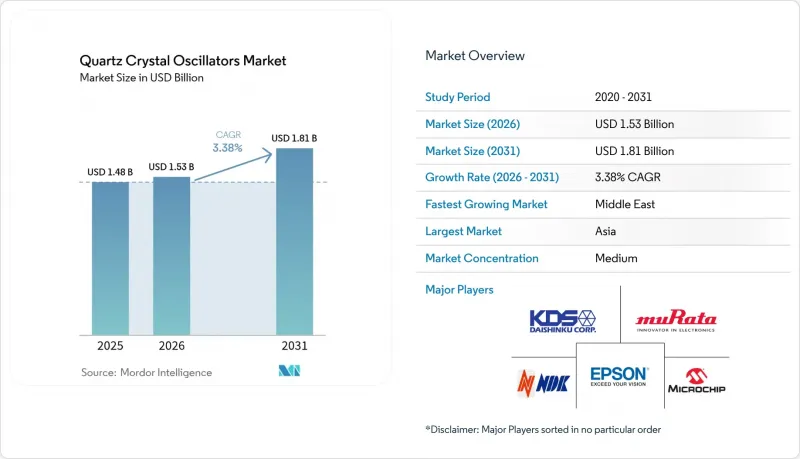
本報告按電路類型(簡單封裝晶體振盪器 (SPXO)、溫度補償晶體振盪器 (TCXO)、其他)、安裝類型(表面黏著技術貼裝、其他)、晶體切割方式(AT切割、其他)、最終用戶(消費性電子、通訊網路、其他)和地區進行細分。市場預測以美元 (USD) 為單位。
全球晶體振盪器市場趨勢及洞察
由於 5G 基地台的普及,對高度穩定定時的需求日益成長。
隨著4G從僅頻分同步過渡到5G時分雙工(TDD)架構,需要達到可追溯至UTC的±1.5µs的相位精度,這迫使營運商在射頻頭和主時鐘中部署ePRTC級OCXO和TCXO。諸如ITU-T G.8272.1之類的標準規定了±30ns的精度限制,而像Rakon這樣的供應商正在推動OCXO的小型化,使其即使在GNSS訊號中斷的情況下也能保持穩定運作。高密度城市環境中的每個小型基地台節點現在都整合了自己的精密時鐘源,隨著從廣域基地台部署轉向分散式天線系統(DAS),對這些設備的需求正在急劇成長。諸如Oscilloquartz OSA 5430之類的解決方案將光原子鐘整合到面向未來的5G授時架構中,進一步提升了石英振盪器在皮秒級抖動接受度至關重要的場景中的重要性。
ADAS 和自動駕駛電子設備需要低抖動時鐘來源
L3級自動駕駛增加了感測器融合和即時運算的負載,這些運算必須透過車載乙太網路在亞納秒級的精度範圍內同步。 Skyworks和SiTime已認證其符合AEC-Q100和ISO 26262標準的低抖動振盪器,在持續運作的情況下實現了亞微瓦級的功耗,同時能夠承受超過20g的振動峰值。 TDK預測電動車產量將成長27%,這意味著隨著分區ECU取代分散式架構,每個底盤的定時節點數量也將隨之增加。 PCIe連接的集中式處理器需要RMS相位雜訊低於100fs的時脈源,在此閾值下,石英晶體振盪器在高可靠性環境中仍佔據主導地位。
由於基於MEMS的矽振盪器的興起,入門級SPXO的市場佔有率受到侵蝕。
SiTime及其少數競爭對手目前正在出貨可承受50,000g衝擊、最高工作溫度達125 度C的可程式MEMS時鐘,其優勢在智慧型手機、運動攝影機和工業IoT等領域備受青睞。出貨量正呈爆炸式成長,SiTime累計2024年銷售額將達到1.44億美元,較過去十年成長七倍,這表明其在對成本敏感的設計中得到了廣泛認可。然而,在相位雜訊為0.18 ps rms、電源電流為3 mA、啟動時間小於100 µs等關鍵指標的領域,石英晶體振盪器仍佔據主導地位,並持續在高性能石英晶體振盪器領域發揮重要作用。
細分市場分析
到2025年,SPXO將佔據石英晶體振盪器市場36.30%的佔有率,這反映出其在消費性電子產品中的廣泛應用。雖然TCXO目前的市佔率較小,但預計在5G無線電、工業4.0閘道和ADAS模組等領域將以每年4.05%的速度成長,在這些領域,熱穩定性比物料清單成本更為重要。 VCXO在光互連領域佔據著獨特的地位,該領域對石英晶體振盪器的市場規模需求與56 Gbps以上鎖相環(PLL)訊號的精度直接相關。
NDK、 Epson和 Lacon 正在競相降低 OCXO 的Epson,從而將亞 ppb 級穩定性從核心網路擴展到邊緣節點。 Epson 的「OG7050CAN」比傳統產品體積縮小了 85%,功耗降低了 56%,為 OCXO 進軍機架式基頻單元鋪平了道路。同時,FCXO 架構正在量子運算測試平台中湧現,該平台需要 10⁻¹⁴ 的短期穩定性,而標準截止頻率無法達到這項要求。因此,石英晶體振盪器市場的細分格局得以維持,而專業供應商則能夠獲得極高的利潤率。
到2025年,表面黏著技術封裝預計將佔銷售額的81.20%,因為智慧型手機、穿戴式裝置和物聯網感測器對回流焊接且相容自動化貼片生產線的元件的需求日益成長。石英晶體振盪器市場持續向晶片級和微封裝尺寸轉型,大新空工業株式會社(Daishinku Kogyo)厚度僅為0.5毫米的SPXO在體積效率方面樹立了行業標竿。
通孔式封裝持續維持3.55%的複合年成長率。這是因為在國防航空電子設備和惡劣環境下使用的機械設備中,能夠承受反覆熱循環的插座式封裝更受青睞。大型振盪器還配備了高階OCXO所必需的加熱控制腔,從而維持了一個規模雖小但盈利的細分市場。目前,供應商之間的差異化主要體現在鍍層的化學成分和無鉛可焊性上,這些參數對於保護汽車和鐵路號誌領域的現有設備至關重要,因為這些領域的設備設計壽命超過15年。
區域分析
到2025年,亞太地區將佔全球銷售額的45.10%,其中中國、日本和韓國的晶片產量佔全球總產量的70%以上,並且是頂級振盪器製造商的聚集地。 SEMI預測,到2025年,該地區的晶圓開工量將成長7%,預計這將推動測試測量台和光刻步進機對時序元件的需求成長。 NDK和Epson等傳統供應商憑藉其國內石英礦和垂直整合的晶圓廠,繼續保持著亞皮秒級抖動性能的領先地位。
北美正受惠於超大規模資料中心建設的擴張和蓬勃發展的航太業。 RTX公司2024年的銷售額預計達到807億美元,凸顯了國防項目對飛彈導引系統和安全通訊載重中抗輻射晶體振盪器的需求。在歐洲,工業自動化和電動車生態系統的蓬勃發展推動了TCXO在確定性網路中的應用。儘管宏觀經濟成長放緩,德國的「工業4.0」舉措和法國的製造業振興措施仍為此趨勢提供了助力。
中東地區目前市場佔有率小規模,但年複合成長率(CAGR),達到3.78%,主要得益於阿拉伯聯合大公國和沙烏地阿拉伯電信業者加速推進5G和智慧城市網路建設。各國多元化政策正在推動半導體組裝計畫的發展,進一步刺激對分立式時序元件的需求。在拉丁美洲和非洲,由於4G的持續主導地位和電子產品產能有限,5G的普及速度較為緩慢。但小型基地台密度的不斷提高以及農業領域物聯網示範計畫的發展,預示著需求將逐步成長,從而推動全球石英晶體振盪器市場出貨量的成長。
其他好處
- Excel格式的市場預測(ME)表
- 3個月的分析師支持
目錄
第1章:引言
- 研究假設和市場定義
- 調查範圍
第2章:調查方法
第3章執行摘要
第4章 市場狀況
- 市場概覽
- 市場促進因素
- 由於 5G 基地台的普及,對高度穩定定時的需求日益成長。
- ADAS 和自動駕駛電子設備需要低抖動時鐘來源
- 穿戴式裝置小型化的趨勢導致 SMD 和微封裝石英晶體的應用日益增加。
- 透過在現有工廠引入工業 4.0,擴大工業 TCXO 的應用。
- 利用衛星衛星群擴大低地球軌道酬載中OCXO的部署
- 資料中心向 400G/800G光連接模組的轉變正在推動低相位雜訊VCXO 的廣泛應用。
- 市場限制因素
- 由於基於MEMS的矽振盪器的興起,入門級SPXO的市場佔有率受到侵蝕。
- 高純度合成石英供應鏈價格波動
- 由於設計和引進週期超過 3-5 年,快速更換供應商受到限制。
- 戰略航太零件的出口管制
- 產業生態系分析
- 技術展望
- 波特五力分析
第5章 市場規模與成長預測
- 電路類型
- 簡易封裝型晶體振盪器(SPXO)
- 溫度補償晶體振盪器(TCXO)
- 電壓調節器晶體振盪器(VCXO)
- 頻率控制晶體振盪器(FCXO)
- 恆溫晶體振盪器(OCXO)
- 其他電路類型
- 按安裝類型
- 表面黏著技術型
- 通孔
- 切割水晶
- AT 切割
- BT 切口
- SC 切割
- 最終用戶
- 家用電子產品
- 通訊網路
- 工業自動化和物聯網
- 汽車(ADAS、資訊娛樂系統、電動車動力傳動系統)
- 航太/國防
- 醫療和保健設備
- 其他
- 按地區
- 北美洲
- 美國
- 加拿大
- 墨西哥
- 歐洲
- 德國
- 英國
- 法國
- 北歐的
- 其他歐洲國家
- 南美洲
- 巴西
- 其他南美國家
- 亞太地區
- 中國
- 日本
- 印度
- 東南亞
- 其他亞太國家
- 中東和非洲
- 中東
- 波灣合作理事會(GCC)成員國
- 土耳其
- 其他中東國家
- 非洲
- 南非
- 其他非洲地區
- 中東
- 北美洲
第6章 競爭情勢
- 市場集中度
- 策略趨勢
- 市佔率分析
- 公司簡介
- Nihon Dempa Kogyo Co., Ltd.(NDK)
- Epson Device Corporation
- Daishinku Corp.(KDS)
- Murata Manufacturing Co., Ltd.
- Microchip Technology Inc.(Microsemi/Vectron)
- TXC Corporation
- Rakon Ltd.
- SiTime Corporation
- Epson Toyocom
- River Eletec Corp.
- Siward Crystal Technology
- Hosonic Electronic Co., Ltd.
- CTS Corporation
- NDK石英(亞洲)
- Bliley Technologies
- KYOCERA Crystal Device
- Integral Petrovsky Plant
- Fortune Semiconductor
- ICM(International Crystal Mfg.)
- Euroquartz Ltd.
第7章 市場機會與未來展望
According to Mordor Intelligence, the quartz crystal oscillators market size was valued at USD 1.48 billion in 2025 and estimated to grow from USD 1.53 billion in 2026 to reach USD 1.81 billion by 2031, at a CAGR of 3.38% during the forecast period (2026-2031).
This report is Segmented Into Circuit Type (Simple Packaged Crystal Oscillator (SPXO), Temperature-Compensated Crystal Oscillator (TCXO), and More), Mounting Type (Surface Mount, and More), Crystal Cut (AT-Cut and More), End-User (Consumer Electronics, Telecom and Networking and More), and Geography. The Market Forecasts are Provided in Terms of Value (USD).
Global Quartz Crystal Oscillators Market Trends and Insights
Proliferation of 5G Base-Stations Elevating High-Stability Timing Demand
The shift from 4G frequency-only synchronisation to 5G's time-division-duplex architecture imposes UTC-traceable phase accuracy within +-1.5 µs, compelling operators to deploy ePRTC-grade OCXOs and TCXOs in radio heads and grandmasters.Specifications such as ITU-T G.8272.1 prescribe +-30 ns limits, encouraging vendors like Rakon to miniaturise OCXOs able to holdover during GNSS loss. Each small-cell node in dense urban layouts now embeds its own precision source, multiplying unit demand as macro-only roll-outs give way to distributed antenna systems. Solutions such as Oscilloquartz OSA 5430 integrate optical atomic references to future-proof 5G timing architectures, reinforcing quartz relevance where picosecond-level jitter tolerance is mandatory.
ADAS and Autonomous Driving Electronics Requiring Low-Jitter Clock Sources
Level-3 autonomy increases sensor fusion and real-time compute loads that must align to sub-ns windows over automotive Ethernet. Skyworks and SiTime have qualified low-jitter oscillators to AEC-Q100 and ISO 26262 standards, delivering power budgets below 1 µW for always-on domains while surviving vibration peaks above 20 g. TDK forecasts 27% electric-vehicle production growth, implying a parallel expansion in timing nodes per chassis as zonal ECUs replace distributed architectures. Centralised processors linked by PCIe demand clock sources with RMS phase-noise under 100 fs, a threshold still favouring quartz in high-reliability settings.
Emergence of MEMS-Based Silicon Oscillators Cannibalising Entry-Level SPXO
SiTime and a handful of rivals now ship programmable MEMS clocks that withstand 50,000 g shocks and operate up to 125 °C, benefits that resonate in smart-phones, action cameras and industrial IoT . Unit absorption escalated after SiTime posted USD 144 million revenue in 2024, up seven-fold in a decade, indicating broad acceptance in cost-sensitive designs. Yet quartz retains supremacy where 0.18 ps rms phase-noise, 3 mA supply current and sub-100 µs start-up dominate the specification sheet, sustaining the Quartz crystal oscillators market at the high-performance end.
Other drivers and restraints analyzed in the detailed report include:
- Miniaturisation Trend in Wearables Fuelling µ-Package XTAL Adoption
- Industry-4.0 Retro-fits in Brown-Field Plants Boosting Industrial-Grade TCXO Uptake
- Price Volatility in High-Purity Synthetic Quartz Supply Chain
For complete list of drivers and restraints, kindly check the Table Of Contents.
Segment Analysis
SPXOs held 36.30% of the Quartz crystal oscillators market in 2025, reflecting their ubiquity in mass-market electronics. TCXOs, while accounting for a smaller slice today, are projected to expand 4.05% annually as 5G radios, Industry 4.0 gateways and ADAS modules place thermal-stability above BOM cost. VCXOs uphold a niche in optical interconnects where the Quartz crystal oscillators market size requirement ties directly to phase-locked loop accuracy at 56 Gbps and above.
NDK, Epson and Rakon race to shrink power draw in OCXOs so that sub-ppb stability migrates from core networks to edge nodes. Epson's OG7050CAN, 85% smaller than legacy devices yet delivering 56% lower power, signals a pathway for OCXO penetration into rack-mounted base-band units . Meanwhile, FCXO architectures surface in quantum-computing testbeds that demand 10-14 short-term stability unattainable by standard cuts. The resulting mix preserves the fragmented character of the Quartz crystal oscillators market while enabling specialist suppliers to capture outsized margins.
Surface-mount packages accounted for 81.20% revenue in 2025 as smartphones, wearables and IoT sensors pursue reflow-solderable components compatible with automated pick-and-place lines. The Quartz crystal oscillators market continues shifting toward chip-scale and µ-package footprints, with Daishinku's 0.5 mm-high SPXOs setting industry benchmarks in volumetric efficiency.
Through-hole formats still chart a 3.55% CAGR because defense avionics and harsh-environment machinery favour socketed replacements that survive repeated thermal cycling. Large-body oscillators also host heater-regulated chambers indispensable for high-end OCXOs, sustaining a profitable if narrow segment. Supplier differentiation now hinges on plating chemistry and lead-free solderability, parameters that protect installed bases across automotive and rail signalling where design lifecycles exceed 15 years.
Complete Report Scope:
- By Circuit Type
- Simple Packaged Crystal Oscillator (SPXO)
- Temperature-Compensated Crystal Oscillator (TCXO)
- Voltage-Controlled Crystal Oscillator (VCXO)
- Frequency-Controlled Crystal Oscillator (FCXO)
- Oven-Controlled Crystal Oscillator (OCXO)
- Other Circuit Types
- By Mounting Type
- Surface-Mount
- Thru-Hole
- By Crystal Cut
- AT-Cut
- BT-Cut
- SC-Cut
- By End-User
- Consumer Electronics
- Telecom and Networking
- Industrial Automation and IoT
- Automotive (ADAS, Infotainment, EV Powertrain)
- Aerospace and Defense
- Medical and Healthcare Devices
- Others
- By Geography
- North America
- United States
- Canada
- Mexico
- Europe
- Germany
- United Kingdom
- France
- Nordics
- Rest of Europe
- South America
- Brazil
- Rest of South America
- Asia-Pacific
- China
- Japan
- India
- South-East Asia
- Rest of Asia-Pacific
- Middle East and Africa
- Middle East
- Gulf Cooperation Council Countries
- Turkey
- Rest of Middle East
- Africa
- South Africa
- Rest of Africa
- Middle East
- North America
Geography Analysis
Asia-Pacific commanded 45.10% of 2025 revenue as China, Japan and South Korea manufactured more than 70% of global chips and housed tier-one oscillator makers. SEMI projects wafer starts in the region to climb 7% in 2025, translating into incremental pull-through for timing devices across test-and-measurement benches and lithography steppers. Japan's heritage suppliers such as NDK and Epson exploit local quartz mines and vertically integrated fabs to retain leadership in sub-pS jitter performance.
North America benefits from hyperscale data-centre build-outs and a vibrant aerospace sector. RTX recorded USD 80.7 billion sales in 2024, underlining defense programmes that specify rad-hard quartz oscillators in missile guidance and secure communication payloads. Europe advances industrial-automation and electric-vehicle ecosystems that favour TCXO deployments for deterministic networking; Germany's Industry 4.0 initiatives and France's manufacturing revitalisation create tailwinds despite macroeconomic slowdowns.
The Middle East, while currently holding a modest slice, registers the fastest 3.78% CAGR to 2031 as operators in the United Arab Emirates and Saudi Arabia fast-track 5G and smart-city grids. National diversification drives semiconductor assembly programmes that in turn consume discrete timing parts. Latin America and Africa lag broader adoption because 4G still predominates and electronics production remains limited, yet small-cell densification and IoT agriculture pilots hint at incremental demand that sustains global volume growth within the Quartz crystal oscillators market.
- Nihon Dempa Kogyo Co., Ltd. (NDK)
- Epson Device Corporation
- Daishinku Corp. (KDS)
- Murata Manufacturing Co., Ltd.
- Microchip Technology Inc. (Microsemi/Vectron)
- TXC Corporation
- Rakon Ltd.
- SiTime Corporation
- Epson Toyocom
- River Eletec Corp.
- Siward Crystal Technology
- Hosonic Electronic Co., Ltd.
- CTS Corporation
- NDK Quartz (Asia)
- Bliley Technologies
- KYOCERA Crystal Device
- Integral Petrovsky Plant
- Fortune Semiconductor
- ICM (International Crystal Mfg.)
- Euroquartz Ltd.
Additional Benefits:
- The market estimate (ME) sheet in Excel format
- 3 months of analyst support
TABLE OF CONTENTS
1 INTRODUCTION
- 1.1 Study Assumptions and Market Definition
- 1.2 Scope of the Study
2 RESEARCH METHODOLOGY
3 EXECUTIVE SUMMARY
4 MARKET LANDSCAPE
- 4.1 Market Overview
- 4.2 Market Drivers
- 4.2.1 Proliferation of 5G Base-Stations Elevating High-Stability Timing Demand
- 4.2.2 ADAS and Autonomous Driving Electronics Requiring Low-Jitter Clock Sources
- 4.2.3 Miniaturisation Trend in Wearables Fueling SMD and µ-Package XTAL Adoption
- 4.2.4 Industry-4.0 Retro-fits in Brown-Field Plants Boosting Industrial-Grade TCXO Uptake
- 4.2.5 Satellite Mega-Constellations Expanding OCXO Deployment in LEO Payloads
- 4.2.6 Data-Centre Optical Interconnect Migration to 400/800 G Driving Low-Phase-Noise VCXO
- 4.3 Market Restraints
- 4.3.1 Emergence of MEMS-Based Silicon Oscillators Cannibalising Entry-Level SPXO
- 4.3.2 Price Volatility in High-Purity Synthetic Quartz Supply Chain
- 4.3.3 Design-in Cycles Exceeding 3-5 Years Limiting Rapid Vendor Switching
- 4.3.4 Regulatory Export Controls on Strategic Aerospace Components
- 4.4 Industry Eco System Analysis
- 4.5 Technological Outlook
- 4.6 Porter's Five Forces Analysis
- 4.6.1 Bargaining Power of Suppliers
- 4.6.2 Bargaining Power of Buyers
- 4.6.3 Threat of New Entrants
- 4.6.4 Threat of Substitutes
- 4.6.5 Intensity of Rivalry
5 MARKET SIZE AND GROWTH FORECASTS (VALUES)
- 5.1 By Circuit Type
- 5.1.1 Simple Packaged Crystal Oscillator (SPXO)
- 5.1.2 Temperature-Compensated Crystal Oscillator (TCXO)
- 5.1.3 Voltage-Controlled Crystal Oscillator (VCXO)
- 5.1.4 Frequency-Controlled Crystal Oscillator (FCXO)
- 5.1.5 Oven-Controlled Crystal Oscillator (OCXO)
- 5.1.6 Other Circuit Types
- 5.2 By Mounting Type
- 5.2.1 Surface-Mount
- 5.2.2 Thru-Hole
- 5.3 By Crystal Cut
- 5.3.1 AT-Cut
- 5.3.2 BT-Cut
- 5.3.3 SC-Cut
- 5.4 By End-User
- 5.4.1 Consumer Electronics
- 5.4.2 Telecom and Networking
- 5.4.3 Industrial Automation and IoT
- 5.4.4 Automotive (ADAS, Infotainment, EV Powertrain)
- 5.4.5 Aerospace and Defense
- 5.4.6 Medical and Healthcare Devices
- 5.4.7 Others
- 5.5 By Geography
- 5.5.1 North America
- 5.5.1.1 United States
- 5.5.1.2 Canada
- 5.5.1.3 Mexico
- 5.5.2 Europe
- 5.5.2.1 Germany
- 5.5.2.2 United Kingdom
- 5.5.2.3 France
- 5.5.2.4 Nordics
- 5.5.2.5 Rest of Europe
- 5.5.3 South America
- 5.5.3.1 Brazil
- 5.5.3.2 Rest of South America
- 5.5.4 Asia-Pacific
- 5.5.4.1 China
- 5.5.4.2 Japan
- 5.5.4.3 India
- 5.5.4.4 South-East Asia
- 5.5.4.5 Rest of Asia-Pacific
- 5.5.5 Middle East and Africa
- 5.5.5.1 Middle East
- 5.5.5.1.1 Gulf Cooperation Council Countries
- 5.5.5.1.2 Turkey
- 5.5.5.1.3 Rest of Middle East
- 5.5.5.2 Africa
- 5.5.5.2.1 South Africa
- 5.5.5.2.2 Rest of Africa
- 5.5.5.1 Middle East
- 5.5.1 North America
6 COMPETITIVE LANDSCAPE
- 6.1 Market Concentration
- 6.2 Strategic Moves
- 6.3 Market Share Analysis
- 6.4 Company Profiles {(includes Global-level Overview, Market-level Overview, Core Segments, Financials, Strategic Information, Market Rank/Share, Products and Services, Recent Developments)}
- 6.4.1 Nihon Dempa Kogyo Co., Ltd. (NDK)
- 6.4.2 Epson Device Corporation
- 6.4.3 Daishinku Corp. (KDS)
- 6.4.4 Murata Manufacturing Co., Ltd.
- 6.4.5 Microchip Technology Inc. (Microsemi/Vectron)
- 6.4.6 TXC Corporation
- 6.4.7 Rakon Ltd.
- 6.4.8 SiTime Corporation
- 6.4.9 Epson Toyocom
- 6.4.10 River Eletec Corp.
- 6.4.11 Siward Crystal Technology
- 6.4.12 Hosonic Electronic Co., Ltd.
- 6.4.13 CTS Corporation
- 6.4.14 NDK Quartz (Asia)
- 6.4.15 Bliley Technologies
- 6.4.16 KYOCERA Crystal Device
- 6.4.17 Integral Petrovsky Plant
- 6.4.18 Fortune Semiconductor
- 6.4.19 ICM (International Crystal Mfg.)
- 6.4.20 Euroquartz Ltd.
7 MARKET OPPORTUNITIES AND FUTURE OUTLOOK
- 7.1 White-Space and Unmet-Need Assessment

 差分輸出晶體振盪器市場:全球市場預測,2026-2032年
 晶體振盪器:市場佔有率分析、產業趨勢與統計、成長預測(2026-2031)
 陶瓷石英振盪器市場規模、佔有率和成長分析:按產品配置、封裝尺寸、輸出頻率、最終用途產業和地區分類-2026-2033年產業預測晶體振盪器市場:2026-2032年全球市場預測(依振盪器類型、封裝、頻段、應用及通路分類)
 水晶製品市場機會、成長要素、產業趨勢分析及2026-2035年預測
 晶體振盪器市場規模、佔有率、趨勢和預測:按類型、晶體切割類型、安裝方式、最終用戶和地區分類,2026-2034年
 2026-2030年全球晶體振盪器市場
 拉曼晶體市場規模、佔有率和成長分析:按產品類型、應用、終端用戶產業、分銷管道、形狀和地區分類-2026-2033年產業預測晶體振盪器市場:2026-2032年全球市場預測(依封裝類型、頻率、技術、應用及通路分類)
 晶體振盪器市場:按類型、安裝方式、終端用戶產業和地區分類