

 |
市場調查報告書
商品編碼
2071391
水晶製品市場機會、成長要素、產業趨勢分析及2026-2035年預測Crystal Products Market Opportunity, Growth Drivers, Industry Trend Analysis, and Forecast 2026 - 2035 |
||||||

全球水晶製品市場預計到 2025 年價值 89 億美元,並將以 4.4% 的複合年成長率成長,到 2035 年達到 136 億美元。
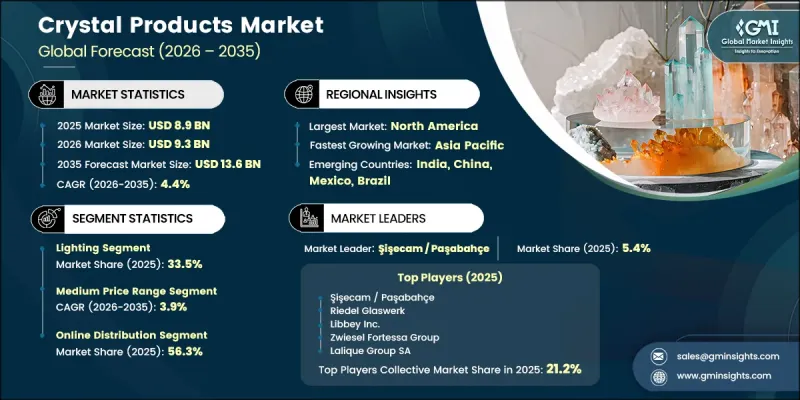
市場成長主要受消費者偏好向高階、手工和設計感十足的生活方式產品轉變的驅動,自由裁量權擴大用於展現家居美學和個性的室內裝飾。全球送禮文化的興起、旅館和休閒產業的穩定成長,以及各消費群體對手工製品和永續生產方式日益成長的認可,都進一步支撐了市場需求。可支配收入的增加和對生活方式導向型消費的日益關注,正在增強市場的長期穩定性。消費者正逐漸從純粹的功能性消費轉向體驗式消費,而水晶製品則被視為高雅品味和個性的象徵。這一趨勢在北美和西歐等已開發市場尤為顯著,這些市場擁有較高的品牌認知度和完善的零售生態系統,為高階消費行為提供了支撐。自2021年以來,隨著室內裝潢和家具支出的增加,水晶製品在自由裁量權支出組成中的地位進一步鞏固,高階品類在需求成長中所佔佔有率也逐年擴大。
| 市場範圍 | |
|---|---|
| 開始年份 | 2025 |
| 預測期 | 2026-2035 |
| 上市時的市場規模 | 89億美元 |
| 預測金額 | 136億美元 |
| 複合年成長率 | 4.4% |
預計到2025年,照明市場將佔據33.5%的市場佔有率,並在2035年之前以4.6%的複合年成長率成長。持續的豪華住宅、豪華酒店開發以及注重裝飾照明解決方案的建築室內設計項目投資,是推動市場需求成長的主要動力。水晶燈具,包括水晶燈、垂飾燈和壁燈,在豪華住宅和商業設施中,尤其是在全球新興旅遊目的地的高階酒店中,仍然廣泛應用。
預計到2025年,中價位市場將佔據47.6%的市場佔有率,並在2035年之前以3.9%的複合年成長率成長。此細分市場吸引了廣泛的消費者群體,包括注重品質的家庭、企業禮品採購商以及追求性價比的飯店餐飲企業。隨著價格的不斷上漲,此價位段的競爭日益激烈,製造商們致力於提升產品的耐用性、設計柔軟性以及可機洗性,同時保持價格的親民。 RONA、Libbey Inc.、Zwiesel Fortessa Group、Riedel Glaswerk和Bormioli Rocco等品牌正透過兼具實用功能和精緻美學的多元化產品系列,進一步鞏固其市場地位。
預計到2025年,北美水晶製品市場將佔據42%的市場佔有率,成為最大的區域貢獻者。美國將引領整體需求,而加拿大則提供穩定的次市場基礎。該地區的成長得益於強勁的消費者購買力、完善的高階零售生態系統以及企業禮品管道的穩定需求,這些因素共同推動了持續的商業活動。美國市場動態依然強勁,高階禮品市場在整個經濟週期中持續成長,表現優於其他自由裁量權消費品類別。
目錄
第1章:調查方法和範圍
第2章執行摘要
第3章 行業洞察
- 產業生態系分析
- 原物料供應商
- 晶體製造商和加工商
- 設計與工藝的層次感(手工製作與機器製造)
- 批發商和公司
- 零售與電子商務通路
- 最終消費者
- 利潤率
- 每個階段增加的價值
- 影響價值鏈的因素
- 影響產業的因素
- 促進因素
- 消費者對高階室內裝潢用品和奢華生活方式產品的需求不斷成長。
- 飯店、餐飲和餐飲業的強勁成長正在推動商業需求。
- 全球送禮文化的擴展和企業禮品市場的成長。
- 潛在風險和挑戰
- 供應鏈中斷與原物料價格波動
- 有關鉛含量的法規正在增加合規成本。
- 機會
- 利用無鉛環保晶體進行產品創新
- 拓展電子商務和直接面對消費者的銷售管道
- 促進因素
- 成長潛力分析
- 技術與創新展望
- 晶體切割和拋光技術的進步
- 雷射雕刻和精密蝕刻技術的創新
- 無鉛晶體配方方面的進展
- 永續製造技術
- 智慧互聯水晶產品
- 監管和授權框架
- 歐盟關於水晶玻璃製品中鉛含量的指令
- 美國FDA和CPSC關於含鉛家用產品的標準
- REACH合規性與化學品安全法規
- 永續發展與循環經濟指南
- 價格分析
- 按產品類型分析歷史價格趨勢
- 依球員類型分類的定價策略(高級球員、超值球員、成本加成球員)
- 貿易數據分析
- 按產品類別分類的進出口量和進口額趨勢
- 主要貿易路線及關稅的影響
- 人工智慧和生成式人工智慧對市場的影響
- 利用人工智慧改造現有經營模式
- 按細分市場分類的生成式人工智慧用例和部署藍圖
- 風險、限制和監管考量
- 目前分銷基礎設施和通路滲透情況
- 按地區與業態(現代零售與傳統零售)分類的通路覆蓋率
- 缺乏最後一公里基礎設施和不斷變化的管道
第4章 競爭情勢
- 介紹
- 企業市佔率分析
- 按地區
- 企業矩陣分析
- 主要市場公司的競爭分析
- 競爭定位矩陣
- 主要進展
- 併購
- 夥伴關係和聯盟
- 新產品發布
- 業務拓展計劃
第5章 市場估算與預測:依產品類型分類,2022-2035年
- 酒吧用品
- 玻璃
- 醒酒器
- 投手
- 搖晃器
- 其他(酒吧配件等)
- 照明
- 水晶燈
- 檯燈
- 燭台
- 其他(壁燈、壁燈燈具等)
- 居家裝飾
- 花瓶
- 裝飾品
- 杯墊
- 其他物品(展示架、裝飾碗等)
- 其他(珠寶飾品和手錶)
第6章 市場估計與預測:依材料分類,2022-2035年
- 鉛晶
- 全鉛晶體(含30%或以上氧化鉛)
- 鉛晶體(含24-30%氧化鉛)
- 無鉛晶體
- 鋇晶體
- 鉀晶體
- 其他(二氧化鈦基、氧化鋅基)
第7章 市場估計與預測:依價格區間分類,2022-2035年
- 低的
- 中等的
- 高的
第8章 市場估算與預測:依最終使用者分類,2022-2035年
- 住宅
- 商業
- 酒吧/休息室
- 餐廳和高級餐廳
- 飯店和度假村
- 其他(活動場地、餐飲公司、企業禮品採購商)
第9章 市場估價與預測:依通路分類,2022-2035年
- 線上
- 企業網站
- 電子商務網站
- 離線
- 專賣店
- 超級市場和大賣場
- 百貨公司
- 其他(免稅店、快閃店、手工藝品展)
第10章 市場估價與預測:依地區分類,2022-2035年
- 北美洲
- 美國
- 加拿大
- 歐洲
- 德國
- 英國
- 法國
- 義大利
- 西班牙
- 亞太地區
- 中國
- 日本
- 印度
- 澳洲
- 韓國
- 拉丁美洲
- 巴西
- 墨西哥
- 阿根廷
- 中東和非洲
- 南非
- 沙烏地阿拉伯
- UAE
第11章:公司簡介
- 世界公司
- Bandai Namco/BANDAI SPIRITS
- Good Smile Company
- Kotobukiya Co., Ltd.
- Medicom Toy Corporation
- Kaiyodo Co., Ltd.
- Takara Tomy Co., Ltd.
- Max Factory
- 當地公司
- Abysse Corp
- SEGA Corporation
- Bushiroad Inc.
- Alter Co., Ltd.
- Furyu Corporation
- Phat!Company
- Taito Corporation
- 新興企業
- Stronger Co., Ltd.
- Sentinel Co., Ltd.
- Pop Mart
- HobbyMax
- Union Creative
- Myethos
- APEX Innovation
The Global Crystal Products Market was valued at USD 8.9 billion in 2025 and is estimated to grow at a CAGR of 4.4% to reach USD 13.6 billion by 2035.
Market growth is shaped by a clear shift in consumer preference toward premium, artisanal, and design-led lifestyle goods, with discretionary spending increasingly directed toward home aesthetics and expressive interior styling. Demand is further supported by the expansion of global gifting traditions, steady growth in the hospitality and leisure sector, and rising appreciation for handcrafted and sustainable production methods across consumer segments. Higher disposable incomes and a growing focus on lifestyle-oriented consumption are reinforcing long-term market stability. Consumers are increasingly shifting from purely functional purchases to experience-driven buying behavior, where crystal products serve as symbols of taste, refinement, and personal identity. This trend is especially visible in developed markets such as North America and Western Europe, where strong brand recognition and well-established retail ecosystems encourage premium purchasing behavior. Rising expenditure on home decor and furnishings since 2021 has further strengthened the position of crystal products within discretionary spending baskets, with premium categories capturing a larger share of incremental demand growth over time.
| Market Scope | |
|---|---|
| Start Year | 2025 |
| Forecast Year | 2026-2035 |
| Start Value | $8.9 Billion |
| Forecast Value | $13.6 Billion |
| CAGR | 4.4% |
The lighting segment held a 33.5% share in 2025 and is projected to grow at a CAGR of 4.6% through 2035. Demand is strongly supported by ongoing investments in high-end residential construction, luxury hospitality developments, and architectural interior design projects that prioritize decorative lighting solutions. Crystal-based lighting fixtures, including chandeliers, pendant systems, and wall-mounted decorative installations, continue to be widely integrated into upscale residential and commercial environments, particularly in premium hospitality developments across expanding global tourism destinations.
The medium price segment held a 47.6% share in 2025, growing at a CAGR of 3.9% through 2035. This segment appeals to a wide consumer base, including aspirational households, corporate gifting buyers, and hospitality operators seeking a balance between quality and cost efficiency. Competitive intensity in this tier has increased as manufacturers focus on improving durability, design flexibility, and dishwasher-safe product engineering while maintaining accessible pricing structures. Brands such as RONA, Libbey Inc., Zwiesel Fortessa Group, Riedel Glaswerk, and Bormioli Rocco continue to strengthen their presence through diversified product portfolios that combine functional performance with aesthetic refinement.
North America Crystal Products Market held a 42% share in 2025, making it the largest regional contributor, with the United States leading overall demand and Canada providing a steady secondary market base. Regional growth is supported by strong consumer purchasing power, a well-developed premium retail ecosystem, and consistent demand from corporate gifting channels that generate recurring commercial activity. Market dynamics in the United States remain particularly resilient, as premium gifting continues to outperform broader discretionary spending categories across economic cycles.
Key companies operating in the Global Crystal Products Market include Lalique, Villeroy & Boch, Crystal Bohemia, Pasabahce / Sisecam, RCR Cristalleria Italiana, Saint-Louis, Moser, Stolzle Lausitz, Dartington Crystal, Schonbek, Preciosa, Zwiesel Fortessa Group, Libbey Inc., Riedel Glaswerk, RONA, Bormioli Rocco, Luigi Bormioli, Lucaris Crystal (Ocean Glass PCL), Diamondlife Lighting Group, and Vista Alegre / Atlantis Crystal. Companies in the crystal products market are strengthening their competitive positioning by focusing on premium design innovation and expanding collections that emphasize craftsmanship, heritage appeal, and modern aesthetics. Many manufacturers are investing in advanced glassmaking technologies to improve clarity, durability, and precision in product detailing. Sustainability initiatives, including energy-efficient production methods and recyclable packaging, are being increasingly adopted to align with evolving consumer expectations. Firms are also expanding omnichannel retail strategies by integrating flagship boutiques with strong e-commerce platforms to enhance global reach. Personalization and customization services are being introduced to capture high-value gifting demand, while collaborations with designers and hospitality brands are helping strengthen brand prestige.
Table of Contents
Chapter 1 Methodology and Scope
- 1.1 Market scope and definition
- 1.2 Research design
- 1.2.1 Research approach
- 1.2.2 Data collection methods
- 1.3 Data mining sources
- 1.3.1 Global
- 1.3.2 Regional/Country
- 1.4 Base estimates and calculations
- 1.4.1 Base year calculation
- 1.4.2 Key trends for market estimation
- 1.5 Primary research and validation
- 1.5.1 Primary sources
- 1.6 Forecast model
- 1.7 Research assumptions and limitations
Chapter 2 Executive Summary
- 2.1 Industry 360° synopsis
- 2.2 Key market trends
- 2.2.1 Regional
- 2.2.2 Product type
- 2.2.3 Material
- 2.2.4 Price
- 2.2.5 End user
- 2.2.6 Distribution channel
Chapter 3 Industry Insights
- 3.1 Industry ecosystem analysis
- 3.1.1 Raw material suppliers
- 3.1.2 Crystal manufacturers & processing units
- 3.1.3 Design & craftsmanship layer (artisan vs. machine-made)
- 3.1.4 Wholesale distributors & trading companies
- 3.1.5 Retail & e-commerce channels
- 3.1.6 End consumers
- 3.1.7 Profit margin
- 3.1.8 Value addition at each stage
- 3.1.9 Factor affecting the value chain
- 3.2 Industry impact forces
- 3.2.1 Growth drivers
- 3.2.1.1 Rising consumer demand for premium home decor & luxury lifestyle products
- 3.2.1.2 Robust growth in hospitality, f&b, and hotel sectors driving commercial demand
- 3.2.1.3 Expanding gifting culture & corporate gifting market globally.
- 3.2.2 Pitfalls & challenges
- 3.2.2.1 Supply chain disruptions & raw material price volatility
- 3.2.2.2 Regulatory restrictions on lead content raising compliance costs
- 3.2.3 Opportunities
- 3.2.3.1 Product innovation with lead-free and eco-friendly crystal
- 3.2.3.2 Expanding e-commerce and direct-to-consumer channels
- 3.2.1 Growth drivers
- 3.3 Growth potential analysis
- 3.4 Technology and innovation landscape
- 3.4.1 Advances in crystal cutting & polishing technologies
- 3.4.2 Laser engraving & precision etching innovations
- 3.4.3 Lead-free crystal formulation advances
- 3.4.4 Sustainable manufacturing technologies
- 3.4.5 Smart & connected crystal products
- 3.5 Regulatory & licensing framework
- 3.5.1 EU Directive on lead content in crystal glassware
- 3.5.2 U.S. FDA & CPSC standards for lead-containing household products
- 3.5.3 REACH compliance & chemical safety regulations
- 3.5.4 Sustainability & circular economy directives
- 3.6 Pricing analysis (driven by primary research)
- 3.6.1 Historical price trend analysis by product category
- 3.6.2 Pricing strategy by player type (premium / value / cost-plus)
- 3.7 Trade data analysis (driven by paid database) (HS code- 6815)
- 3.7.1 Import/export volume & value trends by product category
- 3.7.2 Key trade corridors & tariff impact
- 3.8 Impact of AI & generative AI on the market
- 3.8.1 AI-driven disruption of existing business models
- 3.8.2 GenAI use cases & adoption roadmap by segment
- 3.8.3 Risks, limitations & regulatory considerations
- 3.9 Distribution infrastructure & channel penetration landscape (driven by primary research)
- 3.9.1 Channel coverage by region & format (modern vs. Traditional trade)
- 3.9.2 Last-mile infrastructure gaps & emerging channel shifts
Chapter 4 Competitive Landscape, 2025
- 4.1 Introduction
- 4.2 Company market share analysis
- 4.2.1 By region
- 4.2.1.1 North America
- 4.2.1.2 Europe
- 4.2.1.3 Asia Pacific
- 4.2.1.4 Latin America
- 4.2.1.5 Middle East and Africa
- 4.2.1 By region
- 4.3 Company matrix analysis
- 4.4 Competitive analysis of major market players
- 4.5 Competitive positioning matrix
- 4.6 Key developments
- 4.6.1 Mergers & acquisitions
- 4.6.2 Partnerships & collaborations
- 4.6.3 New product launches
- 4.6.4 Expansion plans
Chapter 5 Market Estimates and Forecast, By Product Type, 2022 - 2035 (USD Billion) (Million Units)
- 5.1 Key trends
- 5.2 Barware
- 5.2.1 Glasses
- 5.2.2 Decanters
- 5.2.3 Pitchers
- 5.2.4 Shakers
- 5.2.5 Others (bar accessories, etc.)
- 5.3 Lighting
- 5.3.1 Chandeliers
- 5.3.2 Table lamps
- 5.3.3 Candleholders
- 5.3.4 Others (sconces, wall fixtures, etc.)
- 5.4 Home decor
- 5.4.1 Vases
- 5.4.2 Figurines
- 5.4.3 Coasters
- 5.4.4 Others (display stands, decorative bowls, etc.)
- 5.5 Others (jewelry & watches)
Chapter 6 Market Estimates and Forecast, By Material, 2022 - 2035 (USD Billion) (Million Units)
- 6.1 Key trends
- 6.2 Lead crystal
- 6.2.1 Full lead crystal (≥30% lead oxide)
- 6.2.2 Lead crystal (24-30% lead oxide)
- 6.3 Lead-free crystal
- 6.3.1 Barium crystal
- 6.3.2 Potassium crystal
- 6.3.3 Others (titanium oxide-based, zinc oxide-based)
Chapter 7 Market Estimates and Forecast, By Price Range, 2022 - 2035 (USD Billion) (Million Units)
- 7.1 Key trends
- 7.2 Low
- 7.3 Medium
- 7.4 High
Chapter 8 Market Estimates and Forecast, By End User, 2022 - 2035 (USD Billion) (Million Units)
- 8.1 Key trends
- 8.2 Residential
- 8.3 Commercial
- 8.3.1 Bars & lounges
- 8.3.2 Restaurants & fine dining
- 8.3.3 Hotels & resorts
- 8.3.4 Others (event venues, caterers, corporate gifting buyers)
Chapter 9 Market Estimates and Forecast, By Distribution Channel, 2022 - 2035 (USD Billion) (Million Units)
- 9.1 Key trends
- 9.2 Online
- 9.2.1 Company website
- 9.2.2 E-commerce website
- 9.3 Offline
- 9.3.1 Specialty stores
- 9.3.2 Supermarkets & hypermarkets
- 9.3.3 Department stores
- 9.3.4 Others (duty-free, pop-up retail, craft fairs)
Chapter 10 Market Estimates and Forecast, By Region, 2022 - 2035 (USD Billion) (Million Units)
- 10.1 Key trends
- 10.2 North America
- 10.2.1 U.S.
- 10.2.2 Canada
- 10.3 Europe
- 10.3.1 Germany
- 10.3.2 UK
- 10.3.3 France
- 10.3.4 Italy
- 10.3.5 Spain
- 10.4 Asia Pacific
- 10.4.1 China
- 10.4.2 Japan
- 10.4.3 India
- 10.4.4 Australia
- 10.4.5 South Korea
- 10.5 Latin America
- 10.5.1 Brazil
- 10.5.2 Mexico
- 10.5.3 Argentina
- 10.6 Middle East and Africa
- 10.6.1 South Africa
- 10.6.2 Saudi Arabia
- 10.6.3 UAE
Chapter 11 Company Profiles
- 11.1 Global players
- 11.1.1 Bandai Namco / BANDAI SPIRITS
- 11.1.2 Good Smile Company
- 11.1.3 Kotobukiya Co., Ltd.
- 11.1.4 Medicom Toy Corporation
- 11.1.5 Kaiyodo Co., Ltd.
- 11.1.6 Takara Tomy Co., Ltd.
- 11.1.7 Max Factory
- 11.2 Regional players
- 11.2.1 Abysse Corp
- 11.2.2 SEGA Corporation
- 11.2.3 Bushiroad Inc.
- 11.2.4 Alter Co., Ltd.
- 11.2.5 Furyu Corporation
- 11.2.6 Phat! Company
- 11.2.7 Taito Corporation
- 11.3 Emerging players
- 11.3.1 Stronger Co., Ltd.
- 11.3.2 Sentinel Co., Ltd.
- 11.3.3 Pop Mart
- 11.3.4 HobbyMax
- 11.3.5 Union Creative
- 11.3.6 Myethos
- 11.3.7 APEX Innovation

 差分輸出晶體振盪器市場:全球市場預測,2026-2032年
 石英振盪器:市場佔有率分析、產業趨勢與統計、成長預測(2026-2031)晶體振盪器:市場佔有率分析、產業趨勢與統計、成長預測(2026-2031)
 陶瓷石英振盪器市場規模、佔有率和成長分析:按產品配置、封裝尺寸、輸出頻率、最終用途產業和地區分類-2026-2033年產業預測晶體振盪器市場:2026-2032年全球市場預測(依振盪器類型、封裝、頻段、應用及通路分類)
 晶體振盪器市場規模、佔有率、趨勢和預測:按類型、晶體切割類型、安裝方式、最終用戶和地區分類,2026-2034年
 2026-2030年全球晶體振盪器市場
 拉曼晶體市場規模、佔有率和成長分析:按產品類型、應用、終端用戶產業、分銷管道、形狀和地區分類-2026-2033年產業預測晶體振盪器市場:2026-2032年全球市場預測(依封裝類型、頻率、技術、應用及通路分類)
 晶體振盪器市場:按類型、安裝方式、終端用戶產業和地區分類