


 |
市場調查報告書
商品編碼
2120500
晶體振盪器:市場佔有率分析、產業趨勢與統計、成長預測(2026-2031)Crystal Oscillator - Market Share Analysis, Industry Trends & Statistics, Growth Forecasts (2026 - 2031) |
||||||

※ 本網頁內容可能與最新版本有所差異。詳細情況請與我們聯繫。
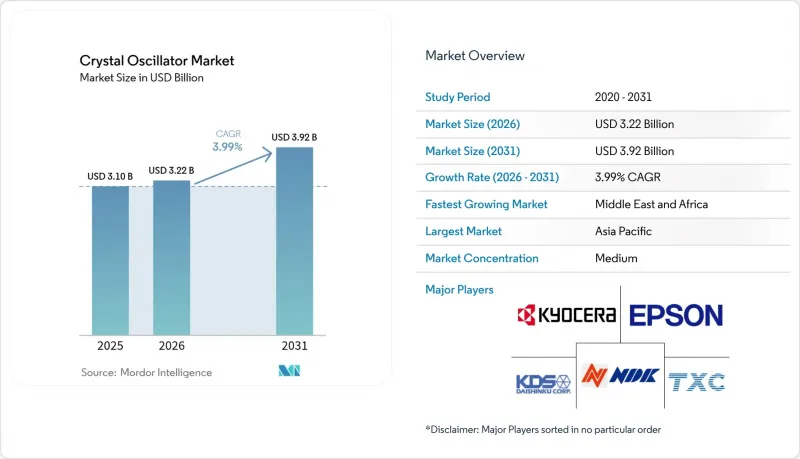
根據 Mordor Intelligence 估計,晶體振盪器市場在 2026 年的價值將達到 32.2 億美元,高於 2025 年的 31 億美元,預計到 2031 年將達到 39.2 億美元。
預計從 2026 年到 2031 年,其複合年成長率將達到 3.99%。
本報告按晶體類型(溫度補償型 (TCXO)、恆溫型 (OCXO)、電壓調節器(VCXO) 及其他)、安裝方式(表面黏著技術、通孔)、晶體切割方式(AT 切割、BT 切割、SC 切割及其他)、終端用戶產業(消費電子、電信網路、航太與國防及其他)以及以及國防地區進行細分。市場預測以美元 (USD) 為單位。
全球晶體振盪器市場趨勢及洞察
5G RRH 和小型基地台部署的激增推動了對超高穩定性 TCXO 的需求增加。
5G網路要求頻率和相位匹配精度在1.5µs以內,以防止上行鏈路和下行鏈路干擾。目前,遠端射頻單元(RRH)採用±50ppb的TCXO,並且由於GNSS在遭受欺騙時依賴精確時間協定(PTP)維持機制,因此時序越來越被視為一項服務品質(QoS)安全措施。網路業者指定使用愛普生(Epson)的SC切割石英晶體共振器,這種振盪器具有抗熱衝擊能力;而小型基地台供應商則為GNSS不可用的室內站點整合基板級OCXO備份。
汽車雷達和ADAS的廣泛應用推動了對GHz頻段OCXO的需求增加。
將雷達頻率轉移到 77-79 GHz 頻段可以實現厘米級解析度,但要避免重影,需要使用抖動低於 100 fs 的 OCXO。配備八個或更多雷達模組的車輛依靠連貫定時來融合感測器數據,從而實現 L3 級自動駕駛。 Skyworks 的 Si5332 時鐘產生器符合 ISO 26262 標準,並提供相位陣列同步功能,滿足了此要求。該裝置必須通過 AEC-Q200 認證,並在 -40 度C至 125 度C的溫度範圍內工作,這構成了很高的准入門檻,並將競爭限制在擁有豐富汽車行業經驗的公司。
MEMS 時鐘產生器的平均售價 (ASP) 下降,正在削弱對低階晶體振盪器 (XO) 的需求。
SiTime 的時脈 SoC 整合了鎖相環 (PLL)、共振器和頻譜功能,可將基板面積減少 50%,並使 OEM 廠商能夠省去多個 SPXO。雖然晶體振盪器仍能以 MEMS 一半的電流實現 0.18 ps 的抖動,但其靈活的頻率範圍和更少的 SKU 數量正吸引著注重成本的買家。隨著 MEMS 產量的增加,通用 SPXO 的平均售價面臨下行壓力,促使晶體共振器供應商將更多精力集中在高階 OCXO 和汽車產品線上。
細分市場分析
到2025年,TCXO將佔晶體振盪器市場35.78%的佔有率。這主要得益於通訊設備在預算有限的情況下對±100ppb穩定性的迫切需求。持續的微型化技術使得2.0 x 1.6mm的封裝尺寸得以實現,同時仍能保持±1ppm的性能。然而,OCXO細分市場正引領成長,預計到2031年將以4.18%的複合年成長率持續成長,這主要得益於低地球軌道衛星和5G邊緣伺服器對亞ppm級穩定性的需求。這些趨勢將使OCXO在精密基礎設施投資的晶體振盪器市場中進一步擴大市場佔有率。
Epson系列OCXO採用雙爐設計、複合晶體切割和數位溫度補償技術,將預熱功耗降低了56%。 SPXO繼續為對成本敏感的消費品運作,而VCXO則擴大應用於需要按需頻率調整的時間敏感網路(TSN)閘道器。儘管MEMS基XO的面積成本較高,但在優先考慮封裝尺寸而非相位雜訊的設計中,它們仍被廣泛使用。 FCXO和SAW元件仍處於小眾市場,主要用於偵測設備和毫米波鏈路。
預計到2025年,表面黏著技術封裝將佔總銷售額的68.05%,隨著智慧型手機和物聯網設備中基板密度的不斷提高,這一佔有率也將持續成長。自動化貼裝技術縮短了組裝時間,使設計人員能夠將元件放置在PCB的兩面,進一步加速了晶體振盪器市場向晶片級整合的轉型。通孔貼裝僅在焊點強度易受振動和溫度梯度影響的應用中仍能保持其市場佔有率,例如鐵路號誌模組和火箭發射系統中的航空電子設備。
傳統的國防和航太專案通常採用通孔封裝,以確保現場維修和氣密性。 Rakon 符合航太標準的 HC45 封裝即使經過 10 年老化,仍能維持 ±0.1 ppm 的精確度,並符合 QML-V篩檢標準。同時,表面黏著技術藍圖元件在回流焊接測試中以每小時 1000 次的頻率進行循環,以適應民用生產線的使用。儘管這兩種封裝方式都非常重要,但由於這種兩極分化,晶體振盪器市場整體上對適用於拾放應用的封裝尺寸產品的需求正在成長。
區域分析
到2025年,亞太地區將佔晶體振盪器市場銷售額的47.15%,這主要得益於日本的合成晶體高壓釜和中國的PCB組裝規模。由於中國行動電話產量下滑,日本的出貨量下降。儘管2024年元件出貨量年減了25%,但該地區8吋晶圓切割產能仍佔主導地位。中國大力推動國產5G無線模組,持續推動SPXO的大規模採購,進而協助製造商抵禦行動電話市場低迷的影響。韓國和台灣地區專注於晶圓中游加工,實現了區域內的閉合迴路供應鏈,並降低了每個振盪器的物流成本。
北美在基於MEMS的軍用級OCXO市場佔據重要佔有率。矽谷的SiTime採用無晶圓廠模式,利用台積電的MEMS生產線;而Microchip位於新罕布夏州的晶體工廠則生產Vectron品牌的航太晶體振盪器。國防預算和資料中心升級優先考慮性能而非價格,這推高了該地區晶體振盪器市場的平均售價。
在歐洲,我們專注於供應鏈風險避險策略。 QuartzCom的瑞士晶圓和德國研發叢集正在降低過度依賴日本帶來的風險。歐盟RoHS法規的最後期限正在加速無鉛產品的重新認證,為本地測試機構帶來業務收益。中東和非洲是成長最快的地區,複合年成長率達5.49%,其中沙烏地阿拉伯價值2.66億美元的半導體中心引領成長,中心到2030年將擁有50家設計公司。利雅德和杜拜的智慧城市部署進一步擴大了晶體振盪器市場的基礎,推動了物聯網閘道器和5G小型基地台對高精度定時的區域需求。南美洲的成長速度仍較為溫和,主要得益於巴西和哥倫比亞電信業者的設備升級,但物流距離和上游供應限制限制了成長。
其他福利
- Excel格式的市場預測(ME)表
- 3個月的分析師支持
目錄
第1章:引言
- 研究假設和市場定義
- 調查範圍
第2章:調查方法
第3章執行摘要
第4章 市場狀況
- 市場概覽
- 市場促進因素
- 5G RRH 和小型基地台部署的激增推動了對超高穩定性 TCXO 的需求增加。
- 汽車雷達和ADAS的廣泛應用推動了對GHz頻段OCXO的需求增加。
- 在空間受限的低地球軌道衛星中,從銣振盪器過渡到高度穩定的OCXO。
- 穿戴式裝置和物聯網節點的快速普及使得小型 SPXO/MEMS-XO 混合裝置變得至關重要。
- 透過工廠車間數位化(工業4.0)推廣VCXO在時間敏感型網路的應用
- 由於軟體定義無線電向軍事應用的轉變,SCC OCXO 的採購量增加。
- 市場限制因素
- MEMS 時鐘產生器的平均售價 (ASP) 下降,正在削弱對低階晶體振盪器 (XO) 的需求。
- 合成石英晶片供應鏈中的脆弱性(主要在日本)
- 高溫漂移限制了 XO 在 SiC動力傳動系統中的應用。
- 由於歐盟RoHS法規對無鉛焊料的應用範圍進行了更嚴格的限制,導致重新認證成本增加。
- 產業價值鏈分析
- 監理展望
- 技術展望
- 波特五力分析
- 宏觀經濟趨勢對晶體振盪器市場的影響
第5章 市場規模與成長預測
- 晶體類型
- 溫度補償型(TCXO)
- 烤箱控制(OCXO)
- 電壓調節器(VCXO)
- 簡化包裝類型(SPXO)
- 頻率控制(FCXO)
- 基於MEMS的晶體振盪器
- 其他晶體類型
- 透過實施方法
- 表面黏著技術
- 通孔
- 切割水晶
- AT 切割
- BT 切口
- SC 切割
- 其他(IT-CUT、FC-Cut)
- 按最終用戶行業分類
- 家用電子產品
- 通訊網路
- 車
- 航太/國防
- 工業自動化
- 醫療保健
- 研究/測量
- 其他
- 按地區
- 北美洲
- 美國
- 加拿大
- 墨西哥
- 歐洲
- 德國
- 英國
- 法國
- 北歐的
- 其他歐洲國家
- 南美洲
- 巴西
- 其他南美國家
- 亞太地區
- 中國
- 日本
- 印度
- 東南亞
- 其他亞太國家
- 中東和非洲
- 中東
- 波灣合作理事會(GCC)成員國
- 土耳其
- 其他中東國家
- 非洲
- 南非
- 其他非洲地區
- 中東
- 北美洲
第6章 競爭情勢
- 市場集中度
- 策略趨勢
- 市佔率分析
- 公司簡介
- Seiko Epson Corporation
- Kyocera Corporation
- Nihon Dempa Kogyo(NDK)Co. Ltd
- Daishinku Corp.
- TXC Corporation
- SiTime Corporation
- Rakon Ltd
- Vectron International(Microchip)
- Siward Crystal Technology Co. Ltd
- Hosonic Electronic Co. Ltd
- Fox Electronics
- CTS Corporation
- Abracon LLC
- ECS Inc.
- Micro Crystal AG
- Jauch Quartz GmbH
- Statek Corporation
- River Eletec Corporation
- Mercury Electronic Ind Co. Ltd
- Raltron Electronics Corporation
- Aker Technology Co. Ltd
- NEL Frequency Controls Inc.
- WTL Frequency Products Co. Ltd
第7章 市場機會與未來展望
According to Mordor Intelligence, the crystal oscillator market size in 2026 is estimated at USD 3.22 billion, growing from 2025 value of USD 3.10 billion with 2031 projections showing USD 3.92 billion, growing at 3.99% CAGR over 2026-2031.
This report is Segmented by Crystal Type (Temperature-Compensated (TCXO), Oven-Controlled (OCXO), Voltage-Controlled (VCXO), and More), Mounting Scheme (Surface-Mount, and Thru-Hole), Crystal Cut (AT-Cut, BT-Cut, SC-Cut, and More), End-User Industry (Consumer Electronics, Telecom and Networking, Aerospace and Defense, and More), and Geography. The Market Forecasts are Provided in Terms of Value (USD).
Global Crystal Oscillator Market Trends and Insights
Surge in 5G RRH and Small-Cell Deployments Requiring Ultra-Stable TCXOs
5G networks demand frequency and phase alignment within 1.5 µs to prevent uplink-downlink interference. Remote Radio Heads now embed +-50 ppb TCXOs and rely on Precision Time Protocol holdover when GNSS is spoofed, elevating timing from a cost line item to a quality-of-service safeguard. Network operators specify SC-cut crystal units from Epson that survive thermal shock, while small-cell vendors integrate board-level OCXO backups for indoor sites where GNSS is unavailable.
Automotive Radar and ADAS Uptake Driving GHz-Level OCXO Demand
The shift to 77-79 GHz radar enables centimeter-scale resolution but necessitates OCXOs with sub-100 fs jitter to avoid ghost targets. Vehicles hosting eight or more radar modules depend on coherent timing to fuse sensor data for Level-3 autonomy. Skyworks' Si5332 clock generator delivers ISO26262 compliance and phased-array synchronization to meet this requirement. Entry barriers rise because devices must pass AEC-Q200 and function from -40 °C to 125 °C, limiting competition to firms with deep automotive pedigrees.
MEMS Clock-Generator ASP Erosion Cannibalising Low-End Quartz XOs
SiTime's Clock-SoC integrates PLLs, resonators, and spread-spectrum functions, shrinking board area by 50% and letting OEMs drop multiple SPXOs. Although quartz still delivers 0.18 ps jitter at half the current of MEMS, the flexible frequency menu and reduced SKU count entice cost-sensitive buyers. Average selling prices on commodity SPXOs face down-pressure as MEMS volume grows, prompting quartz suppliers to double down on premium OCXO and automotive lines.
Other drivers and restraints analyzed in the detailed report include:
- Migration from Rubidium to High-Stability OCXOs in Space-Constrained LEO Satellites
- Rapid Proliferation of Wearable/IoT Nodes Mandating Miniature SPXOs and MEMS-XO Hybrids
- Supply-Chain Fragility of Synthetic Quartz Wafers
For complete list of drivers and restraints, kindly check the Table Of Contents.
Segment Analysis
The TCXO category held a 35.78% slice of the crystal oscillator market in 2025, supported by telecom equipment that values +-100 ppb stability within tight budgets. Continuous miniaturization now reaches 2.0 X 1.6 mm packages without sacrificing +-1 ppm performance. However, the OCXO subsegment leads growth at 4.18% CAGR to 2031, fueled by LEO satellites and 5G edge servers demanding sub-ppm holdover. These trends position OCXOs to capture a larger share of the crystal oscillator market size for precision infrastructure spending.
OCXOs leverage double-oven designs, composite crystal cuts, and digital temperature compensation to slash warm-up power by 56% in Epson's OG7050CAN series. Simple Packaged Crystal Oscillators keep cost-driven consumer goods ticking, while VCXOs gain in Time-Sensitive Networking gateways that must retune frequency on demand. MEMS-based XOs command design wins where footprint trumps phase noise, despite higher BOM cost. FCXOs and SAW devices remain niche, serving test equipment and mm-wave links.
Surface-mount packages owned 68.05% revenue in 2025 and expand alongside smartphone and IoT board densities. Automated placement trims assembly minutes and frees designers to stack components on both PCB sides, reinforcing the crystal oscillator market's shift toward chip-level integration. The through-hole share persists only where vibration or thermal gradients threaten solder-joint integrity, such as rail-signaling modules or launch-vehicle avionics.
Legacy defense and space programs specify through-hole cans for field repairs and hermeticity. Rakon's space-qualified HC45 package offers 10-year aging below +-0.1 ppm, meeting QML-V screening levels. Meanwhile, surface-mount roadmap devices test 1,000-cycle-per-hour reflow profiles to endure consumer production lines. The dichotomy ensures both schemes stay relevant, although volume tilts further toward pick-and-place friendly outlines across the wider crystal oscillator market.
Complete Report Scope:
- By Crystal Type
- Temperature-Compensated (TCXO)
- Oven-Controlled (OCXO)
- Voltage-Controlled (VCXO)
- Simple Packaged (SPXO)
- Frequency-Controlled (FCXO)
- MEMS-Based Crystal Oscillators
- Other Crystal Types
- By Mounting Scheme
- Surface-Mount
- Thru-Hole
- By Crystal Cut
- AT-Cut
- BT-Cut
- SC-Cut
- Others (IT-CUT, FC-Cut)
- By End-user Industry
- Consumer Electronics
- Telecom and Networking
- Automotive
- Aerospace and Defense
- Industrial Automation
- Medical and Healthcare
- Research and Measurement
- Other Industries
- By Geography
- North America
- United States
- Canada
- Mexico
- Europe
- Germany
- United Kingdom
- France
- Nordics
- Rest of Europe
- South America
- Brazil
- Rest of South America
- Asia-Pacific
- China
- Japan
- India
- South-East Asia
- Rest of Asia-Pacific
- Middle East and Africa
- Middle East
- Gulf Cooperation Council Countries
- Turkey
- Rest of Middle East
- Africa
- South Africa
- Rest of Africa
- Middle East
- North America
Geography Analysis
Asia Pacific held 47.15% of crystal oscillator market revenue in 2025, anchored by Japan's synthetic quartz autoclaves and China's PCB assembly scale. Japanese volumes dipped on weak Chinese handset output, with parts shipments down 25% year-on-year in 2024, yet regional capacity remained unrivaled for 8-inch wafer slicing. China's push for indigenous 5G radios still drives bulk SPXO purchases, cushioning producers against handset softness. South Korea and Taiwan specialize in midstream wafer processing, enabling regional closed-loop supply that lowers logistics cost per oscillator.
North America commands premium share in MEMS-based and military-grade OCXOs. SiTime's Silicon Valley fabless model co-opts TSMC MEMS lines, while Microchip's New Hampshire crystal plant supports Vectron-labelled aerospace cans. Defense budgets and datacenter upgrades prioritize performance over price, thus supporting higher average selling prices within the regional crystal oscillator market.
Europe concentrates on supply-chain hedge strategies. QuartzCom's Swiss wafers and Germany's R&D clusters mitigate Japan concentration risk. EU RoHS deadlines accelerate lead-free requalifications, creating services revenue for local test houses. Middle East and Africa advance fastest at 5.49% CAGR, spearheaded by Saudi Arabia's USD 266 million semiconductor hub forming 50 design houses by 2030. Smart-city rollouts in Riyadh and Dubai further expand regional demand for precise timing in IoT gateways and 5G small cells, broadening the crystal oscillator market footprint. South America remains modest, driven mainly by carrier upgrades in Brazil and Colombia, but logistic distances and limited upstream supply temper growth.
- Seiko Epson Corporation
- Kyocera Corporation
- Nihon Dempa Kogyo (NDK) Co. Ltd
- Daishinku Corp.
- TXC Corporation
- SiTime Corporation
- Rakon Ltd
- Vectron International (Microchip)
- Siward Crystal Technology Co. Ltd
- Hosonic Electronic Co. Ltd
- Fox Electronics
- CTS Corporation
- Abracon LLC
- ECS Inc.
- Micro Crystal AG
- Jauch Quartz GmbH
- Statek Corporation
- River Eletec Corporation
- Mercury Electronic Ind Co. Ltd
- Raltron Electronics Corporation
- Aker Technology Co. Ltd
- NEL Frequency Controls Inc.
- WTL Frequency Products Co. Ltd
Additional Benefits:
- The market estimate (ME) sheet in Excel format
- 3 months of analyst support
TABLE OF CONTENTS
1 INTRODUCTION
- 1.1 Study Assumptions and Market Definition
- 1.2 Scope of the Study
2 RESEARCH METHODOLOGY
3 EXECUTIVE SUMMARY
4 MARKET LANDSCAPE
- 4.1 Market Overview
- 4.2 Market Drivers
- 4.2.1 Surge in 5G RRH and Small-Cell Deployments Requiring Ultra-Stable TCXOs
- 4.2.2 Automotive Radar and ADAS Uptake Driving GHz-level OCXO Demand
- 4.2.3 Migration from Rubidium to High-Stability OCXOs in Space-Constrained LEO Satellites
- 4.2.4 Rapid Proliferation of Wearable/IoT Nodes Mandating Miniature SPXOs and MEMS-XO Hybrids
- 4.2.5 Factory-Floor Digitalisation (Industry 4.0) Elevating VCXO Use in Time-Sensitive Networking
- 4.2.6 Military Conversion to Software-Defined Radios Boosting SC-Cut OCXO Procurement
- 4.3 Market Restraints
- 4.3.1 MEMS Clock-Generator ASP Erosion Cannibalising Low-End Quartz XOs
- 4.3.2 Supply-Chain Fragility of Synthetic Quartz Wafers (Japan-Centric)
- 4.3.3 High-Temperature Drift Limiting XO Adoption in SiC-Based Powertrains
- 4.3.4 Stringent EU RoHS Lead-Free Solder Windows Raising Requalification Cost
- 4.4 Industry Value Chain Analysis
- 4.5 Regulatory Outlook
- 4.6 Technological Outlook
- 4.7 Porter's Five Forces Analysis
- 4.7.1 Bargaining Power of Suppliers
- 4.7.2 Bargaining Power of Buyers
- 4.7.3 Threat of New Entrants
- 4.7.4 Threat of Substitute Products
- 4.7.5 Intensity of Competitive Rivalry
- 4.8 Impact of Macroeconomic Trends on the Crystal Oscillator Market
5 MARKET SIZE AND GROWTH FORECASTS (VALUES)
- 5.1 By Crystal Type
- 5.1.1 Temperature-Compensated (TCXO)
- 5.1.2 Oven-Controlled (OCXO)
- 5.1.3 Voltage-Controlled (VCXO)
- 5.1.4 Simple Packaged (SPXO)
- 5.1.5 Frequency-Controlled (FCXO)
- 5.1.6 MEMS-Based Crystal Oscillators
- 5.1.7 Other Crystal Types
- 5.2 By Mounting Scheme
- 5.2.1 Surface-Mount
- 5.2.2 Thru-Hole
- 5.3 By Crystal Cut
- 5.3.1 AT-Cut
- 5.3.2 BT-Cut
- 5.3.3 SC-Cut
- 5.3.4 Others (IT-CUT, FC-Cut)
- 5.4 By End-user Industry
- 5.4.1 Consumer Electronics
- 5.4.2 Telecom and Networking
- 5.4.3 Automotive
- 5.4.4 Aerospace and Defense
- 5.4.5 Industrial Automation
- 5.4.6 Medical and Healthcare
- 5.4.7 Research and Measurement
- 5.4.8 Other Industries
- 5.5 By Geography
- 5.5.1 North America
- 5.5.1.1 United States
- 5.5.1.2 Canada
- 5.5.1.3 Mexico
- 5.5.2 Europe
- 5.5.2.1 Germany
- 5.5.2.2 United Kingdom
- 5.5.2.3 France
- 5.5.2.4 Nordics
- 5.5.2.5 Rest of Europe
- 5.5.3 South America
- 5.5.3.1 Brazil
- 5.5.3.2 Rest of South America
- 5.5.4 Asia-Pacific
- 5.5.4.1 China
- 5.5.4.2 Japan
- 5.5.4.3 India
- 5.5.4.4 South-East Asia
- 5.5.4.5 Rest of Asia-Pacific
- 5.5.5 Middle East and Africa
- 5.5.5.1 Middle East
- 5.5.5.1.1 Gulf Cooperation Council Countries
- 5.5.5.1.2 Turkey
- 5.5.5.1.3 Rest of Middle East
- 5.5.5.2 Africa
- 5.5.5.2.1 South Africa
- 5.5.5.2.2 Rest of Africa
- 5.5.5.1 Middle East
- 5.5.1 North America
6 COMPETITIVE LANDSCAPE
- 6.1 Market Concentration
- 6.2 Strategic Moves
- 6.3 Market Share Analysis
- 6.4 Company Profiles (includes Global-level Overview, Market-level Overview, Core Segments, Financials as available, Strategic Information, Market Rank/Share for key companies, Products and Services, and Recent Developments)
- 6.4.1 Seiko Epson Corporation
- 6.4.2 Kyocera Corporation
- 6.4.3 Nihon Dempa Kogyo (NDK) Co. Ltd
- 6.4.4 Daishinku Corp.
- 6.4.5 TXC Corporation
- 6.4.6 SiTime Corporation
- 6.4.7 Rakon Ltd
- 6.4.8 Vectron International (Microchip)
- 6.4.9 Siward Crystal Technology Co. Ltd
- 6.4.10 Hosonic Electronic Co. Ltd
- 6.4.11 Fox Electronics
- 6.4.12 CTS Corporation
- 6.4.13 Abracon LLC
- 6.4.14 ECS Inc.
- 6.4.15 Micro Crystal AG
- 6.4.16 Jauch Quartz GmbH
- 6.4.17 Statek Corporation
- 6.4.18 River Eletec Corporation
- 6.4.19 Mercury Electronic Ind Co. Ltd
- 6.4.20 Raltron Electronics Corporation
- 6.4.21 Aker Technology Co. Ltd
- 6.4.22 NEL Frequency Controls Inc.
- 6.4.23 WTL Frequency Products Co. Ltd
7 MARKET OPPORTUNITIES AND FUTURE OUTLOOK
- 7.1 White-space and Unmet-Need Assessment

 差分輸出晶體振盪器市場:全球市場預測,2026-2032年
 石英振盪器:市場佔有率分析、產業趨勢與統計、成長預測(2026-2031)
 陶瓷石英振盪器市場規模、佔有率和成長分析:按產品配置、封裝尺寸、輸出頻率、最終用途產業和地區分類-2026-2033年產業預測晶體振盪器市場:2026-2032年全球市場預測(依振盪器類型、封裝、頻段、應用及通路分類)
 水晶製品市場機會、成長要素、產業趨勢分析及2026-2035年預測
 晶體振盪器市場規模、佔有率、趨勢和預測:按類型、晶體切割類型、安裝方式、最終用戶和地區分類,2026-2034年
 2026-2030年全球晶體振盪器市場
 拉曼晶體市場規模、佔有率和成長分析:按產品類型、應用、終端用戶產業、分銷管道、形狀和地區分類-2026-2033年產業預測晶體振盪器市場:2026-2032年全球市場預測(依封裝類型、頻率、技術、應用及通路分類)
 晶體振盪器市場:按類型、安裝方式、終端用戶產業和地區分類