


 |
市場調查報告書
商品編碼
2122264
氮化鎵射頻半導體元件:市場佔有率分析、產業趨勢與統計及成長預測(2026-2031)GaN RF Semiconductor Devices - Market Share Analysis, Industry Trends & Statistics, Growth Forecasts (2026 - 2031) |
||||||

※ 本網頁內容可能與最新版本有所差異。詳細情況請與我們聯繫。
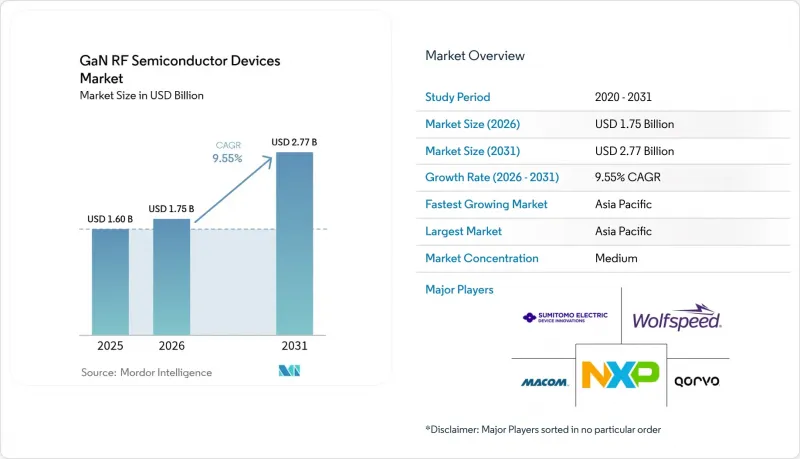
據 Mordor Intelligence 稱,GaN 射頻半導體裝置市場預計到 2026 年價值 17.5 億美元,高於 2025 年的 16 億美元,預計到 2031 年將達到 27.7 億美元。
預計從 2026 年到 2031 年,其複合年成長率將達到 9.55%。
本報告按應用(國防和航太、通訊基礎設施、其他)、裝置類型(分離式射頻功率電晶體、MMIC 和單晶片功率放大器、其他)、基板技術(GaN-on-SiC、GaN-on-Si、其他)、頻段(VHF/UHF(低於 1GHz)、L/S 頻段(1-4GHz)、其他國家和歐洲地區分類(低於 1GHz)。
全球氮化鎵射頻半導體元件市場趨勢及洞察
亞太地區5G大型基地台和小型基地台的部署
在中國、韓國和日本部署的大規模MIMO基地台架構依賴最多64通道的功率放大器,其中氮化鎵(GaN)相比LDMOS可實現15-20%的能源效率提升,從而降低站點級營運成本。開放式無線接入網路(Open-RAN)標準化進一步削弱了無線硬體與供應商之間的聯繫,使得專業的GaN供應商能夠在遠端射頻單元(RRH)升級市場中佔據市場佔有率。中國移動迄今為止規模最大的部署驗證了實際應用的可靠性,而Qorvo 0.013%的故障率進一步增強了營運商的信心。由於向200mm晶圓的過渡,每瓦成本(USD/W)的逐步降低,為GaN射頻半導體裝置市場進一步滲透到農村和室內環境中的小型基地台層奠定了基礎。營運商的節能目標與GaN的低發熱量特性相契合,促進了優先考慮效率指標而非組件價格的採購框架的發展。
美國和歐盟為AESA雷達現代化改造提供資金籌措
美國國防部已將氮化鎵(GaN)技術升級至“製造就緒10級”,並為其2024-2025年的下一代雷達項目撥款超過30億美元。這引發了高功率單晶微波積體電路(MMIC)產量在未來幾年內的持續成長。歐洲各國國防部門也紛紛效仿,在其遠程監控和電子戰系統現代化改造週期中採用GaN技術,GaN卓越的功率密度顯著提升了探測距離和干擾能力。霍尼韋爾公司斥資2,990萬美元,利用GaN技術維修海軍的低頻寬發送器,充分體現了其致力於減少設備老化和提高頻段柔軟性的決心。能夠承受200 W/mm²熱通量的封裝技術的突破性進展已擴展到下游商用無線電通訊設備領域,從而將GaN射頻半導體裝置的市場拓展至國防領域之外。
在6GHz及以下頻段的基地台中,採用LDMOS會增加成本。
2024年,6GHz以下無線設備的GaN功率放大器與LDMOS相比價格相差40%。儘管節能效應在部署後的18個月內即可縮小這一差距,但新興市場的轉型速度仍緩慢。德州儀器轉向8吋GaN-on-Si製造程序,使晶圓成本降低了10%以上,但宏觀經濟壓力持續抑制電信業者的資本投資,尤其是在印度和東南亞部分地區。因此,電信設備OEM廠商維持了雙供應商策略,既保障了LDMOS的供應,也限制了GaN射頻半導體裝置市場的短期成長潛力。
細分市場分析
2025年,電信基礎設施佔銷售額的42.65%,構成了氮化鎵(GaN)射頻半導體裝置市場的基礎。基地台供應商採用GaN技術,實現了宏無線電單元更小的面積和55.2%的汲極效率。這降低了冷卻負荷和塔頂重量,而這對於高密度5G部署至關重要。開放式無線存取網(Open-RAN)的解耦使得獨立的功率放大器專家贏得了設計訂單,而Soytech的特殊基板則降低了插入損耗並提高了每個站點的覆蓋範圍。電信業者基於GaN前端進行了6G亞太赫茲頻段的試點測試,使GaN射頻半導體裝置市場在2025年保持了強勁的成長動能。汽車雷達在2024年的市佔率較小,但預計到2031年將以17.95%的複合年成長率成長。中國強制的高級駕駛輔助系統和韓國的聯網汽車生態系統推動了對79GHz成像雷達的需求。在這一領域,氮化鎵(GaN)實現了毫米波功率密度,同時又不影響可靠性。先導計畫可望推動未來產量的擴大。一項與200mm GaN-on-Si晶圓相關的成本降低藍圖有望實現與主流汽車電子產品的兼容性,並擴大GaN射頻半導體裝置市場的規模。在國防和航太領域,GaN的抗輻射性能和輸出功率被應用於雷達、電子戰和衛星通訊有效載荷。在消費性電子領域,GaN功率放大器應用於Wi-Fi 7路由器和行動電話前端,展現了其在小訊號領域的潛力。在工業機器人領域,採用GaN HEMT的6.78MHz無線充電發送器得到了應用,凸顯了跨領域擴張和收入來源多元化的趨勢。
分立式功率電晶體預計在2025年佔據45.75%的市場佔有率,這反映了雷達、廣播和大型基地台無線電等領域成熟的設計引進週期。 MACOM的產品系列展現了可擴展性,支援GaN射頻半導體裝置市場,功率範圍從2W到7kW。採用螺栓固定封裝並增強散熱性能,實現了超過80%的漏極效率,即使在嚴苛的工作週期下也能延長裝置壽命。單晶微波積體電路(MMIC)功率放大器成長最快,預計到2031年複合年成長率將達到18.65%。 MMIC將增益級和偏壓網路整合在緊湊的晶片上,因此在相位陣列模組、空間受限的衛星通訊終端和毫米波回程傳輸無線電中備受青睞。 Qorvo的寬頻QPA2210D便是這一趨勢的例證,與分離式裝置相比,其功率附加效率提高了6dB。增強型氮化鎵電晶體正被用於射頻開關和前端模組中,以處理熱切換負載,而 C 波段衛星鏈路中的低雜訊放大器正開始取代砷化鎵,從而擴大了氮化鎵射頻半導體元件產業的產業版圖。
區域分析
預計亞太地區將引領市場,到2025年將佔全球銷售額的33.80%,並維持17.80%的複合年成長率直至2031年。中國5G基地台的快速成長、本土氮化鎵(GaN)代工廠的擴張以及「第三次半導體熱潮」政策的支持,促進了該地區的自給自足。韓國專注於人工智慧中心和汽車雷達,而日本則憑藉其在消費性電子領域的成功經驗和碳化矽(SiC)基板供應能力。台灣先進的後端服務加速了氮化鎵矽基(GaN-on-Si)的成本最佳化,從而強化了氮化鎵射頻半導體裝置市場的成長週期。
北美位居第二,這得益於美國的國防預算和龐大的衛星網路衛星群。政府對國內晶圓廠的資助,例如Polar Semiconductor公司在明尼蘇達州的GaN-on-Si項目,增強了供應鏈的韌性。加拿大電信基礎設施的現代化和墨西哥汽車電子產業叢集,在北美大陸範圍內實現了需求多元化,保護了區域GaN射頻半導體裝置市場免受單一產業波動的影響。
在歐洲,成長主要得益於汽車雷達領域的領先地位和節能工業的發展。德國主導採用79GHz汽車感測器,法國專注於航太領域的有效載荷,而英國則優先加強其電子戰能力,尤其是在該頻段。歐盟對戰略自主的支持為合資企業提供了津貼,例如IQE-X-FAB的650V氮化鎵平台,從而促進了以本地為中心的價值鏈發展,進而推動了歐盟內部氮化鎵射頻半導體裝置市場的擴張。
該技術在巴西的廣泛應用、波灣合作理事會(GCC)成員國智慧城市的建設以及在澳洲進行的低地球軌道回程傳輸測試,都顯示了該技術在全球範圍內傳播的軌跡。
其他好處
- Excel格式的市場預測(ME)表
- 3個月的分析師支持
目錄
第1章:引言
- 研究假設和市場定義
- 調查範圍
第2章:調查方法
第3章執行摘要
第4章 市場狀況
- 市場概覽
- 市場促進因素
- 亞太地區5G大型基地台和小型基地台的部署
- 美國和歐盟為AESA雷達現代化改造提供資金籌措
- 低地球軌道/中地球軌道衛星通訊衛星群的有效載荷需求
- 毫米波汽車成像雷達在中國和韓國的普及
- 面向工業4.0機器人的高功率無線充電
- Open-RAN遠端射頻單元的快速普及
- 市場限制因素
- 在6GHz及以下頻段的基地台中,採用LDMOS會增加成本。
- SiC 在功率超過 3kW 的戰術雷達模組中的穿透能力
- 外延片和基板供應瓶頸(150mm 和 200mm)
- 溫度控管和可靠性超過 200W/mm²
- 價值鏈分析
- 技術展望
- 氮化鎵矽基元件的大規模生產及向200毫米製程過渡
- 監理展望
- 國際電信聯盟(ITU)和美國聯邦通訊委員會(FCC)為5G/6G和雷達分配的頻段
- 波特五力分析
- RF-GaN專利趨勢
- 宏觀經濟因素對市場的影響
第5章 市場規模與成長預測
- 透過使用
- 國防/航太
- 通訊基礎設施
- 家用電子產品
- 汽車(ADAS、V2X)
- 工業和能源
- 資料中心和高效能電源鏈路
- 依設備類型
- 分離式射頻功率電晶體
- MMIC(單晶片功率放大器)
- 射頻開關前端模組
- 低雜訊驅動放大器
- 透過基板技術
- GaN-on-SiC
- GaN-on-Si
- 氮化鎵/鑽石/先進複合材料
- 按頻段
- 甚高頻/超高頻(低於1GHz)
- L/S波段(1-4GHz)
- C/ X波段(4-12GHz)
- Ku/ Ka波段(12-40 GHz)
- 毫米波(40GHz以上,包括5G FR2)
- 按地區
- 北美洲
- 美國
- 加拿大
- 墨西哥
- 南美洲
- 巴西
- 阿根廷
- 其他南美國家
- 歐洲
- 德國
- 英國
- 法國
- 義大利
- 西班牙
- 其他歐洲國家
- 亞太地區
- 中國
- 日本
- 韓國
- 印度
- 台灣
- 其他亞太國家
- 中東和非洲
- 中東
- 沙烏地阿拉伯
- 阿拉伯聯合大公國
- 土耳其
- 其他中東國家
- 非洲
- 南非
- 其他非洲地區
- 中東
- 北美洲
第6章 競爭情勢
- 市場集中度
- 策略趨勢
- 市佔率分析
- 公司簡介
- Wolfspeed, Inc.
- Qorvo, Inc.
- Sumitomo Electric Device Innovations
- NXP Semiconductors NV
- MACOM Technology Solutions-GaN-on-SiC
- Broadcom Inc.
- Infineon Technologies AG
- RFHIC Corp.
- Ampleon Netherlands BV
- Mitsubishi Electric Corporation
- Fujitsu Ltd.(GaN RF)
- Northrop Grumman Microelectronics
- Integra Technologies, Inc.
- Analog Devices Inc.
- WIN Semiconductors Corp.
- Finwave Semiconductor Inc.
- Tagore Technology Inc.
- Guerrilla RF
- SEDI-Silent-Solutions Engineering(EU)
- Teledyne e2v HiRel
第7章 市場機會與未來展望
According to Mordor Intelligence, the GaN RF semiconductor devices market size in 2026 is estimated at USD 1.75 billion, growing from 2025 value of USD 1.60 billion with 2031 projections showing USD 2.77 billion, growing at 9.55% CAGR over 2026-2031.
This report is Segmented by Application (Defense and Aerospace, Telecom Infrastructure, and More), Device Type (Discrete RF Power Transistors, MMIC / Monolithic Power Amplifiers, and More), Substrate Technology (GaN-On-SiC, GaN-On-Si, and More), Frequency Band (VHF / UHF (<1 GHz), L / S-Band (1-4 GHz), and More), and Geography (North America, South America, Europe, Asia-Pacific, and Middle East and Africa).
Global GaN RF Semiconductor Devices Market Trends and Insights
5G macro- and small-cell roll-outs accelerate GaN adoption
Massive-MIMO base-station architectures installed across China, Korea, and Japan relied on up to 64 power-amplifier channels, where gallium nitride delivered a 15-20% energy-efficiency uplift versus LDMOS, cutting site-level operating costs. Open-RAN standardization further decoupled radio hardware from system vendors, enabling specialist GaN suppliers to win sockets for remote-radio-head upgrades. Record deployments by China Mobile validated field reliability, while Qorvo's 0.013% failure rate reinforced operator confidence. Progressive reductions in USD/W output through 200 mm wafer migration positioned the GaN RF semiconductor devices market for broader penetration of rural and deep-indoor small-cell layers. Telecom carriers' energy-saving targets aligned with GaN's lower heat dissipation, catalyzing procurement frameworks that rewarded efficiency metrics over component price.
U.S./EU AESA radar modernization drives high-power demand
The U.S. Department of Defense elevated GaN to Manufacturing Readiness Level 10 and allocated more than USD 3 billion for next-generation radar programs between 2024-2025, triggering multi-year production ramps for high-power monolithic microwave integrated circuits (MMICs). European ministries mirrored this trajectory through long-range surveillance and electronic-warfare refresh cycles, where GaN's superior power density increased detection range and jamming effectiveness. Honeywell's USD 29.9 million contract to retrofit Navy low-band transmitters with GaN exemplified obsolescence mitigation and spectrum agility priorities. Packaging breakthroughs that survived 200 W/mm heat flux migrated downstream to commercial telecom radios, expanding the GaN RF semiconductor devices market beyond defense silos.
Cost premium tempers penetration in price-sensitive deployments
In 2024, GaN power amplifiers carried a 40% price delta over LDMOS for sub-6 GHz radios, delaying transitions in emerging markets, even though energy savings absorbed the gap within 18 months of operation. Texas Instruments' move to 8-inch GaN-on-Si fabrication lowered die cost by more than 10%, but macroeconomic pressures still constrained carrier capex, especially in India and parts of Southeast Asia. Telecom OEMs, therefore, maintained dual-sourcing strategies, sustaining LDMOS volume and limiting near-term upside for the GaN RF semiconductor devices market.
Other drivers and restraints analyzed in the detailed report include:
- LEO/MEO sat-com constellation payload demand
- mmWave automotive imaging radar adoption in China and South Korea
- Epi-wafer and substrate shortages create production chokepoints
For complete list of drivers and restraints, kindly check the Table Of Contents.
Segment Analysis
Telecom infrastructure accounted for 42.65% of 2025 revenue, anchoring the GaN RF semiconductor devices market. Base-station vendors adopted GaN to unlock smaller footprints and a 55.2% drain efficiency benchmark in macro radio units. This translates to reduced cooling loads and lower tower-top weight, critical for dense 5G rollouts. Open-RAN disaggregation encouraged independent power-amplifier specialists to capture design wins, while Soitec's engineered substrates reduced insertion losses, boosting coverage per site. The GaN RF semiconductor devices market retained momentum through 2025 as operators trialed 6 G sub-THz pilots that presupposed GaN front ends.Automotive radar remained a modest slice in 2024 but is forecast to expand at an 17.95% CAGR to 2031. China's mandatory advanced-driver-assistance mandates and South Korea's connected-car ecosystem spurred demand for 79 GHz imaging radar, where GaN handled millimeter-wave power density without compromising reliability. V2X communication pilots incorporating GaN PA-LNA modules amplify volume prospects. Cost-down roadmaps tied to 200 mm GaN-on-Si wafers promised alignment with mainstream vehicle electronics, creating scale for the wider GaN RF semiconductor devices market.Across defense and aerospace, radar, electronic warfare, and sat-com payloads drew on GaN's radiation tolerance and output power. Consumer electronics adopted GaN PAs for Wi-Fi 7 routers and handset front ends, validating smaller-signal opportunities. Industrial robotics embraced 6.78 MHz wireless-charging transmitters powered by GaN HEMTs, underscoring cross-sector breadth that diversified revenue streams.
Discrete power transistors captured 45.75% share in 2025, reflecting entrenched design-in cycles across radar, broadcast, and macro-cell radios. MACOM's portfolio spanned 2 W to 7 kW, illustrating scalability that underpinned the GaN RF semiconductor devices market. Thermal-enhanced bolt-down packages supported >80% drain efficiency, extending device lifetimes in harsh duty cycles.Monolithic microwave integrated-circuit power amplifiers delivered the fastest growth, projected at 18.65% CAGR through 2031. Phased-array modules, space-constrained sat-com terminals, and mmWave backhaul radios favored MMICs that collapsed gain stages and bias networks into compact dies. Qorvo's wideband QPA2210D exemplified this trend, offering 6 dB higher power-added efficiency versus discrete alternatives. RF switches and front-end modules employed enhancement-mode GaN transistors to handle hot-switching stresses, while low-noise amplifiers began displacing GaAs in C-Band satellite links, broadening the GaN RF semiconductor devices industry landscape.
Complete Report Scope:
- By Application
- Defense and Aerospace
- Telecom Infrastructure
- Consumer Electronics
- Automotive (ADAS, V2X)
- Industrial and Energy
- Data Centers and High-Efficiency Power Links
- By Device Type
- Discrete RF Power Transistors
- MMIC / Monolithic Power Amplifiers
- RF Switches and Front-End Modules
- Low-Noise and Driver Amplifiers
- By Substrate Technology
- GaN-on-SiC
- GaN-on-Si
- GaN-on-Diamond and Advanced Composites
- By Frequency Band
- VHF / UHF (<1 GHz)
- L / S-Band (1-4 GHz)
- C / X-Band (4-12 GHz)
- Ku / Ka-Band (12-40 GHz)
- mmWave (>40 GHz, incl. 5G FR2)
- By Geography
- North America
- United States
- Canada
- Mexico
- South America
- Brazil
- Argentina
- Rest of South America
- Europe
- Germany
- United Kingdom
- France
- Italy
- Spain
- Rest of Europe
- Asia-Pacific
- China
- Japan
- South Korea
- India
- Taiwan
- Rest of Asia-Pacific
- Middle East and Africa
- Middle East
- Saudi Arabia
- United Arab Emirates
- Turkey
- Rest of Middle East
- Africa
- South Africa
- Rest of Africa
- Middle East
- North America
Geography Analysis
Asia-Pacific led with 33.80% of 2025 revenue and is projected to advance at an 17.80% CAGR through 2031. China's 5 G base-station surge, local GaN foundry build-outs, and policy support under the "third semiconductor wave" catalyzed regional self-reliance. Korea focused on AI-centers and automotive radar, while Japan leveraged consumer-electronics legacy and SiC substrate supply. Taiwan's advanced backend services accelerated GaN-on-Si cost optimization, reinforcing the GaN RF semiconductor devices market growth loop.
North America ranked second, buoyed by the U.S. defense budget and satellite-internet mega constellations. Government funding for domestic fabs, such as Polar Semiconductor's Minnesota GaN-on-Si project, supported supply-chain resiliency. Canada's telecom revamps and Mexico's automotive-electronics clusters created continental demand diversity that insulated the regional GaN RF semiconductor devices market from single-sector volatility.
Europe combined automotive radar leadership with energy-efficient industrial drives. Germany spearheaded 79 GHz vehicle sensor roll-outs, France emphasized aerospace payloads, and the United Kingdom prioritized spectrum-dominated electronic-warfare upgrades. EU strategic autonomy packages channelled grants to joint ventures such as IQE-X-FAB's 650 V GaN platform, nurturing a localized value chain that underpinned the GaN RF semiconductor devices market size expansion in the bloc.
Emerging adoption across Brazil, Gulf Cooperation Council smart-city rollouts, and Australia's low-Earth-orbit backhaul trials showcased the technology's global diffusion trajectory.
- Wolfspeed, Inc.
- Qorvo, Inc.
- Sumitomo Electric Device Innovations
- NXP Semiconductors N.V.
- MACOM Technology Solutions - GaN-on-SiC
- Broadcom Inc.
- Infineon Technologies AG
- RFHIC Corp.
- Ampleon Netherlands B.V.
- Mitsubishi Electric Corporation
- Fujitsu Ltd. (GaN RF)
- Northrop Grumman Microelectronics
- Integra Technologies, Inc.
- Analog Devices Inc.
- WIN Semiconductors Corp.
- Finwave Semiconductor Inc.
- Tagore Technology Inc.
- Guerrilla RF
- SEDI - Silent-Solutions Engineering (EU)
- Teledyne e2v HiRel
Additional Benefits:
- The market estimate (ME) sheet in Excel format
- 3 months of analyst support
TABLE OF CONTENTS
1 INTRODUCTION
- 1.1 Study Assumptions and Market Definition
- 1.2 Scope of the Study
2 RESEARCH METHODOLOGY
3 EXECUTIVE SUMMARY
4 MARKET LANDSCAPE
- 4.1 Market Overview
- 4.2 Market Drivers
- 4.2.1 5G Macro- and Small-Cell Roll-outs across Asia-Pacific
- 4.2.2 U.S./EU AESA Radar Modernization Funding
- 4.2.3 LEO / MEO Sat-Com Constellation Payload Demand
- 4.2.4 mmWave Automotive Imaging Radar Adoption in China and South Korea
- 4.2.5 High-Power Wireless Charging for Industrie 4.0 Robotics
- 4.2.6 Rapid Proliferation of Open-RAN Remote Radio Heads
- 4.3 Market Restraints
- 4.3.1 Cost Premium vs. LDMOS in Sub-6 GHz Base-Stations
- 4.3.2 SiC Encroachment in >3 kW Tactical Radar Blocks
- 4.3.3 Epi-wafer and Sub-strate Supply Bottlenecks (150 and 200 mm)
- 4.3.4 Thermal Management and Reliability at >200 W/mm
- 4.4 Value Chain Analysis
- 4.5 Technological Outlook
- 4.5.1 GaN-on-Si Mass-Production and 200 mm Transition
- 4.6 Regulatory Outlook
- 4.6.1 ITU and FCC Spectrum Releases for 5G/6G and Radar
- 4.7 Porter's Five Forces Analysis
- 4.7.1 Bargaining Power of Buyers
- 4.7.2 Bargaining Power of Suppliers
- 4.7.3 Threat of New Entrants
- 4.7.4 Threat of Substitutes
- 4.7.5 Intensity of Competitive Rivalry
- 4.8 RF-GaN Patent Landscape
- 4.9 Imapct of Macroeconomic Factors on the Market
5 MARKET SIZE AND GROWTH FORECASTS (VALUE)
- 5.1 By Application
- 5.1.1 Defense and Aerospace
- 5.1.2 Telecom Infrastructure
- 5.1.3 Consumer Electronics
- 5.1.4 Automotive (ADAS, V2X)
- 5.1.5 Industrial and Energy
- 5.1.6 Data Centers and High-Efficiency Power Links
- 5.2 By Device Type
- 5.2.1 Discrete RF Power Transistors
- 5.2.2 MMIC / Monolithic Power Amplifiers
- 5.2.3 RF Switches and Front-End Modules
- 5.2.4 Low-Noise and Driver Amplifiers
- 5.3 By Substrate Technology
- 5.3.1 GaN-on-SiC
- 5.3.2 GaN-on-Si
- 5.3.3 GaN-on-Diamond and Advanced Composites
- 5.4 By Frequency Band
- 5.4.1 VHF / UHF (<1 GHz)
- 5.4.2 L / S-Band (1-4 GHz)
- 5.4.3 C / X-Band (4-12 GHz)
- 5.4.4 Ku / Ka-Band (12-40 GHz)
- 5.4.5 mmWave (>40 GHz, incl. 5G FR2)
- 5.5 By Geography
- 5.5.1 North America
- 5.5.1.1 United States
- 5.5.1.2 Canada
- 5.5.1.3 Mexico
- 5.5.2 South America
- 5.5.2.1 Brazil
- 5.5.2.2 Argentina
- 5.5.2.3 Rest of South America
- 5.5.3 Europe
- 5.5.3.1 Germany
- 5.5.3.2 United Kingdom
- 5.5.3.3 France
- 5.5.3.4 Italy
- 5.5.3.5 Spain
- 5.5.3.6 Rest of Europe
- 5.5.4 Asia-Pacific
- 5.5.4.1 China
- 5.5.4.2 Japan
- 5.5.4.3 South Korea
- 5.5.4.4 India
- 5.5.4.5 Taiwan
- 5.5.4.6 Rest of Asia-Pacific
- 5.5.5 Middle East and Africa
- 5.5.5.1 Middle East
- 5.5.5.1.1 Saudi Arabia
- 5.5.5.1.2 United Arab Emirates
- 5.5.5.1.3 Turkey
- 5.5.5.1.4 Rest of Middle East
- 5.5.5.2 Africa
- 5.5.5.2.1 South Africa
- 5.5.5.2.2 Rest of Africa
- 5.5.5.1 Middle East
- 5.5.1 North America
6 COMPETITIVE LANDSCAPE
- 6.1 Market Concentration
- 6.2 Strategic Moves
- 6.3 Market Share Analysis
- 6.4 Company Profiles (includes Global level Overview, Market level overview, Core Segments, Financials as available, Strategic Information, Market Rank/Share for key companies, Products and Services, and Recent Developments)
- 6.4.1 Wolfspeed, Inc.
- 6.4.2 Qorvo, Inc.
- 6.4.3 Sumitomo Electric Device Innovations
- 6.4.4 NXP Semiconductors N.V.
- 6.4.5 MACOM Technology Solutions - GaN-on-SiC
- 6.4.6 Broadcom Inc.
- 6.4.7 Infineon Technologies AG
- 6.4.8 RFHIC Corp.
- 6.4.9 Ampleon Netherlands B.V.
- 6.4.10 Mitsubishi Electric Corporation
- 6.4.11 Fujitsu Ltd. (GaN RF)
- 6.4.12 Northrop Grumman Microelectronics
- 6.4.13 Integra Technologies, Inc.
- 6.4.14 Analog Devices Inc.
- 6.4.15 WIN Semiconductors Corp.
- 6.4.16 Finwave Semiconductor Inc.
- 6.4.17 Tagore Technology Inc.
- 6.4.18 Guerrilla RF
- 6.4.19 SEDI - Silent-Solutions Engineering (EU)
- 6.4.20 Teledyne e2v HiRel
7 MARKET OPPORTUNITIES AND FUTURE OUTLOOK
- 7.1 White-Space and Unmet-Need Assessment

 射頻氮化鎵技術專利趨勢分析(2026 年)
 射頻氮化鎵:市場佔有率分析、行業趨勢和統計數據、成長預測(2026-2031 年)2026-2034年全球氮化鎵市場規模、佔有率、趨勢和成長分析報告射頻氮化鎵技術專利監測器
 射頻氮化鎵市場規模、佔有率和成長分析:按應用、產品類型、基板、最終用戶和地區分類-2026-2033年產業預測
 射頻氮化鎵市場:依產品、材料組成、晶圓尺寸、應用和終端用戶產業分類-全球預測,2026-2032年
 射頻氮化鎵(RF GaN)元件市場分析及預測(至2035年):依類型、產品類型、技術、元件、應用、材料類型、製程、部署狀態、最終用戶及功能分類微波氮化鎵 (GaN) 市場分析及預測(至 2035 年):按類型、產品類型、技術、組件、應用、材料類型、裝置、最終用戶、功能和安裝類型分類氮化鎵高頻功率放大器市場分析及預測(至2035年):按類型、產品類型、技術、組件、應用、最終用戶、功能、安裝類型、解決方案和模式分類高頻氮化鎵市場分析及預測(至2035年):依類型、產品類型、服務、技術、組件、應用、材料類型、裝置、最終用戶、功能分類