


 |
市場調查報告書
商品編碼
2122173
美國活性碳:市場佔有率分析、行業趨勢和統計數據、成長預測(2026-2031)United States Activated Carbon - Market Share Analysis, Industry Trends & Statistics, Growth Forecasts (2026 - 2031) |
||||||

※ 本網頁內容可能與最新版本有所差異。詳細情況請與我們聯繫。
據 Mordor Intelligence 稱,美國活性碳市場預計將從 2025 年的 216.24 千噸成長到 2026 年的 223.64 千噸,到 2031 年達到 270.52 千噸,預計 2026 年至 2031 年達到 270.52 千噸,預計 2026 年至 2031 年的複合年成長率為 3.8%。
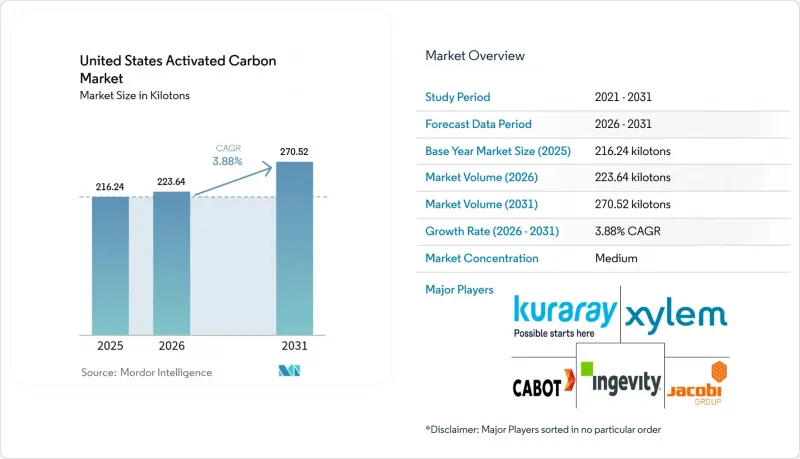
本報告按產品類型(顆粒活性碳、粉末活性碳、擠壓或造粒活性碳)、應用領域(水質淨化淨化、氣體淨化、金屬提取、製藥及其他應用)和終端用戶行業(水處理、食品飲料、醫療保健、汽車等)進行細分。市場預測以噸為單位。
美國活性碳市場的趨勢和洞察
美國環保署關於飲用水中 PFAS/PFOA 的規定
2024年4月生效的《國家飲用水主要法規》規定,全氟辛酸(PFOA)和全氟辛烷磺酸(PFOS)的最高允許濃度為4兆分之一(4 ppt),這將迫使大約6000至8000個地方供水系統在2029年前安裝顆粒活性碳層。聯邦政府的PFAS減排資金和各州的循環貸款計畫正在加速合約簽訂,符合NSF/ANSI 61標準認證且具備國內再生能力的供應商更受青睞。小規模供水事業正透過聯合採購協議進行合作,以降低單位成本,而密西根州和紐約州等州則提供配套津貼以縮短投資回收期。雖然離子交換樹脂有時也用於一些小眾的低流量系統,但活性碳因其能夠處理多種污染物且易於殘留物管理而保持優勢。供應商現在銷售的物聯網感測器可以預測過濾介質的突破性變化,這種服務模式確保了多年的售後市場收入。
逐步淘汰燃煤發電廠的汞排放
2024年修訂的《汞和有害空氣標準》(MATS)將現有設施的排放限值降低至0.003磅/吉瓦時,要求燃煤發電廠供應商更傾向於簽訂2-3年期的指數掛鉤契約,而非10年期合約。隨著燃煤發電廠退役速度在2030年後加快,供應商正將重點放在符合45Q碳權額度條件的燃氣渦輪機碳捕集項目上,以部分抵消煤炭需求的下降。
原生蒸氣活化需要很高的能源成本。
蒸氣活化每噸氫氣消耗3-5兆瓦時(MWh)的能源,而天然氣價格的波動正給未進行供應避險的工廠的利潤率帶來壓力。重新運作可降低約40%的能耗,從而減輕負擔,但飲用水用戶要求在再生介質獲得批准前進行嚴格的滲濾液檢測。第45V條的氫氣稅額扣抵預計將在2028年之前使電解蒸氣生產成為可能,但資金壁壘意味著大多數生產商在中期內仍將繼續使用傳統燃料。因此,供應商將合約與亨利樞紐期貨價格掛鉤,或試驗生質能衍生合成氣。這種策略使他們能夠獲得可再生燃料積分,但也使製程控制變得複雜。
細分市場分析
到2025年,顆粒狀活性碳的銷售額將佔總銷售量的46.37%。這主要歸功於公共產業和工業用戶對其在反沖洗過程中穩定性以及易於獲取本地重新運作窯的偏好。重新運作能力是循環採購模式的基礎,這種模式既能滿足企業的永續性目標,又能保護買家免受原生活性碳價格波動的影響。同時,擠壓或造粒活性碳預計在2026年至2031年間將以4.34%的年均成長率成長,超過美國活性碳市場的整體成長率。為減少丁烷穿透,汽車蒸發排放槽(符合Tier 3排放標準)擴大採用大直徑顆粒活性碳;此外,顆粒活性碳的低脆性也是製藥業連續生產線的重要考量。
擠出成型技術的創新正在重新定義價值提案。KURARAY CO. LTD.公司於2024年推出的4毫米顆粒活性炭,比表面積高達1200平方公尺/克,吸附量比傳統的3毫米產品提升了20%。通用汽車公司(GM)斥資5億美元的混合動力卡車計畫預計將至少在2028年之前持續推動對活性碳罐的強勁需求。同時,粉末狀活性碳仍主要用於一些戰術性應用,例如解決地表水處理廠間歇性的異味問題,以及在燃煤發電廠中用於汞噴射。這些趨勢共同凸顯了美國活性碳市場在產品層面的多速發展特性。
其他好處:
- Excel格式的市場預測(ME)表
- 3個月的分析師支持
目錄
第1章:引言
- 研究假設和市場定義
- 調查範圍
第2章:調查方法
第3章執行摘要
第4章 市場狀況
- 市場概覽
- 市場促進因素
- 美國環保署關於飲用水中 PFAS/PFOA 的規定
- 分階段淘汰燃煤發電廠汞排放
- 對工業廢氣中的揮發性有機化合物(VOCs)制定更嚴格的法規
- 藥物原料藥(API)生產能力的快速擴張
- 利用活性碳的電網級超級電容項目
- 市場限制因素
- 原生蒸氣活化的高能耗成本
- 與矽膠、生物炭和先進膜技術的競爭。
- 氣候變遷對椰殼原料供應帶來風險
- 價值鏈分析
- 波特五力模型
第5章 市場規模與成長預測
- 依產品類型
- 顆粒活性碳
- 粉末活性碳
- 擠壓或造粒活性碳
- 透過使用
- 水質淨化
- 氣體純化
- 金屬提取
- 製藥
- 其他用途
- 按最終用戶行業分類
- 水處理
- 食品/飲料
- 衛生保健
- 車
- 工業加工
- 其他終端用戶產業
第6章 競爭情勢
- 市場集中度
- 策略趨勢
- 市佔率(%)/排名分析
- 公司簡介
- Advanced Emissions Solutions, Inc.
- Albemarle Corporation
- Arq, Inc.
- Boyce Carbon.
- Cabot Corporation
- Carbon Activated Corporation
- CarbUSA
- CPL Activated Carbons
- Donau Chemie AG
- General Carbon Corporation
- Ingevity
- JACOBI CARBONS GROUP
- KURARAY CO., LTD.
- Kureha Corporation
- Prominent Systems, Inc.
- Puragen Activated Carbons
- Veolia
- Xylem
第7章 市場機會與未來展望
According to Mordor Intelligence, the United States activated carbon market size is expected to increase from 216.24 kilotons in 2025 to 223.64 kilotons in 2026 and reach 270.52 kilotons by 2031, growing at a CAGR of 3.88% over 2026-2031.
This report is Segmented by Product Type (Granular Activated Carbon, Powdered Activated Carbon, and Extruded or Pelletized Activated Carbon), Application (Water Purification, Gas Purification, Metal Extraction, Medicine, and Other Applications), End-User Industry (Water Treatment, Food and Beverage, Healthcare, Automotive, and More). The Market Forecasts are Provided in Terms of Volume (Tons).
United States Activated Carbon Market Trends and Insights
EPA Regulations on PFAS/PFOA in Drinking Water
The April 2024 National Primary Drinking Water Regulation sets a 4-parts-per-trillion maximum for PFOA and PFOS, forcing roughly 6,000-8,000 community systems to adopt granular activated carbon beds by 2029. Federal PFAS remediation funds and state revolving loans accelerate contract awards, rewarding vendors with NSF/ANSI 61 listings and domestic regeneration capacity. Smaller utilities collaborate through cooperative purchasing agreements to lower unit costs, and states including Michigan and New York provide matching grants that shorten payback periods. Ion-exchange resins appear in niche low-flow installations, but carbon's multi-contaminant profile and simpler residuals management preserve its dominance. Suppliers are now bundling media with IoT sensors that predict breakthrough, a service model that locks in multi-year aftermarket revenue.
Phase-Out of Mercury Emissions from Coal-Fired Utilities
The 2024 Mercury and Air Toxics Standards revision trims existing-unit limits to 0.003 lb/GWh, necessitating powdered activated carbon injection at 30 GW of lignite and sub-bituminous capacity by late 2027. Each 500-MW boiler adds 5,000-15,000 tons of annual demand, and brominated grades fetch price premiums for dual mercury-SO3 capture. Forward-curve volatility in coal retirement schedules prompts suppliers to favor two- to three-year indexed contracts rather than decade-long agreements. As retirements accelerate after 2030, vendors pivot toward gas-turbine carbon-capture projects that qualify for 45Q credits, partly offsetting the coal decline.
High Energy Cost of Virgin Steam Activation
Steam activation consumes 3-5 MWh per ton, and natural-gas price swings compress margins for plants without hedged supply. Reactivation, needing roughly 40% less energy, offers relief, yet potable-water users demand rigorous leachate testing before approving reused media. Section 45V hydrogen tax credits could enable electrolytic steam by 2028, but capital hurdles keep most producers on conventional fuel through the medium term. Vendors therefore index contracts to Henry Hub futures and experiment with biomass-derived syngas, a strategy that earns renewable-fuel credits but complicates process control.
Other drivers and restraints analyzed in the detailed report include:
- Tightening VOC Limits for Industrial Air Streams
- Rapid Expansion of Pharmaceutical API Capacity
- Competition from Silica Gel, Biochar, and Advanced Membranes
For complete list of drivers and restraints, kindly check the Table Of Contents.
Segment Analysis
Granular activate carbon commanded 46.37% of volume in 2025 as utilities and industrial users favored their backwash stability and ready access to regional reactivation kilns. Reactivation capacity underpins a circular procurement model that answers corporate sustainability goals and shields buyers from virgin-price volatility. At the same time, extruded or pelletized activated carbon is projected to grow 4.34% annually between 2026 and 2031, outpacing the broader United States activated carbon market. Automotive evaporative-emission canisters, mandated under Tier 3 regulations, increasingly specify larger-diameter pellets to mitigate butane breakthrough, while pharmaceutical continuous-manufacturing lines value the pellets' low friability.
Extruded innovation reshapes value propositions. Kuraray's 2024 4-mm pellet with 1,200 m2/g surface area offers 20% higher adsorption than legacy 3-mm formats. General Motors' USD 500 million hybrid-truck program keeps canister demand buoyant at least through 2028. Meanwhile, powdered carbon remains tactical, serving episodic taste-and-odor events in surface-water plants and mercury-injection duties at coal stations. Together, these dynamics reinforce the multi-speed nature of the United States activated carbon market size at the product-form level.
Complete Report Scope:
- By Product Type
- Granular Activated Carbon
- Powdered Activated Carbon
- Extruded or Pelletized Activated Carbon
- By Application
- Water Purification
- Gas Purification
- Metal Extraction
- Medicine
- Other Applications
- By End-user Industry
- Water Treatment
- Food and Beverage
- Healthcare
- Automotive
- Industrial Processing
- Other End-user Industries
List of Companies Covered in this Report:
- Advanced Emissions Solutions, Inc.
- Albemarle Corporation
- Arq, Inc.
- Boyce Carbon.
- Cabot Corporation
- Carbon Activated Corporation
- CarbUSA
- CPL Activated Carbons
- Donau Chemie AG
- General Carbon Corporation
- Ingevity
- JACOBI CARBONS GROUP
- KURARAY CO., LTD.
- Kureha Corporation
- Prominent Systems, Inc.
- Puragen Activated Carbons
- Veolia
- Xylem
Additional Benefits:
- The market estimate (ME) sheet in Excel format
- 3 months of analyst support
TABLE OF CONTENTS
1 Introduction
- 1.1 Study Assumptions and Market Definition
- 1.2 Scope of the Study
2 Research Methodology
3 Executive Summary
4 Market Landscape
- 4.1 Market Overview
- 4.2 Market Drivers
- 4.2.1 EPA Regulations on PFAS/PFOA in Drinking Water
- 4.2.2 Phase-Out of Mercury Emissions from Coal-Fired Utilities
- 4.2.3 Tightening VOC Limits for Industrial Air Streams
- 4.2.4 Rapid Expansion of Pharmaceutical API Capacity
- 4.2.5 Grid-Scale Super-capacitor Projects Using Activated Carbon
- 4.3 Market Restraints
- 4.3.1 High Energy Cost of Virgin Steam Activation
- 4.3.2 Competition from Silica Gel, Biochar and Advanced Membranes
- 4.3.3 Climate-Driven Supply Risk for Coconut-Shell Feedstocks
- 4.4 Value Chain Analysis
- 4.5 Porter's Five Forces
- 4.5.1 Bargaining Power of Suppliers
- 4.5.2 Bargaining Power of Consumers
- 4.5.3 Threat of New Entrants
- 4.5.4 Threat of Substitute Products and Services
- 4.5.5 Degree of Competition
5 Market Size and Growth Forecasts (Volume)
- 5.1 By Product Type
- 5.1.1 Granular Activated Carbon
- 5.1.2 Powdered Activated Carbon
- 5.1.3 Extruded or Pelletized Activated Carbon
- 5.2 By Application
- 5.2.1 Water Purification
- 5.2.2 Gas Purification
- 5.2.3 Metal Extraction
- 5.2.4 Medicine
- 5.2.5 Other Applications
- 5.3 By End-user Industry
- 5.3.1 Water Treatment
- 5.3.2 Food and Beverage
- 5.3.3 Healthcare
- 5.3.4 Automotive
- 5.3.5 Industrial Processing
- 5.3.6 Other End-user Industries
6 Competitive Landscape
- 6.1 Market Concentration
- 6.2 Strategic Moves
- 6.3 Market Share (%)/ Ranking Analysis
- 6.4 Company Profiles (includes Global level Overview, Market level overview, Core Segments, Financials as available, Strategic Information, Products and Services, and Recent Developments)
- 6.4.1 Advanced Emissions Solutions, Inc.
- 6.4.2 Albemarle Corporation
- 6.4.3 Arq, Inc.
- 6.4.4 Boyce Carbon.
- 6.4.5 Cabot Corporation
- 6.4.6 Carbon Activated Corporation
- 6.4.7 CarbUSA
- 6.4.8 CPL Activated Carbons
- 6.4.9 Donau Chemie AG
- 6.4.10 General Carbon Corporation
- 6.4.11 Ingevity
- 6.4.12 JACOBI CARBONS GROUP
- 6.4.13 KURARAY CO., LTD.
- 6.4.14 Kureha Corporation
- 6.4.15 Prominent Systems, Inc.
- 6.4.16 Puragen Activated Carbons
- 6.4.17 Veolia
- 6.4.18 Xylem
7 Market Opportunities and Future Outlook
- 7.1 White-space and Unmet-Need Assessment

 2026-2030年全球活性碳市場
 歐洲活性碳:市場佔有率分析、產業趨勢與統計、成長預測(2026-2031)活性碳:市場佔有率分析、行業趨勢和統計數據、成長預測(2026-2031)
 活性碳市場:2026-2032年全球市場預測(依產品類型、原料、孔徑分佈、活化製程、終端應用產業及應用領域分類)碳排放預測和情境建模軟體:市場佔有率分析、行業趨勢和統計數據、成長預測(2026-2031 年)
 煤的活性炭市場規模、佔有率和成長分析:按產品類型、活化製程、應用、終端用戶產業和地區分類-2026-2033年產業預測
 活性碳產品市場-全球產業規模、佔有率、趨勢、機會和預測:按原料、應用、分銷通路、地區和競爭格局分類,2021-2031年煤的活性炭:市場佔有率分析、產業趨勢與統計、成長預測(2026-2031)
 活性碳市場:依產品類型、原料類型、最終用戶和地區分類廢氣吸附淨化系統市場:依技術、吸附劑類型、產品類型、運作模式、流量、應用和最終用戶分類-2026-2032年全球預測