


 |
市場調查報告書
商品編碼
2121928
電池管理系統:市場佔有率分析、產業趨勢與統計、成長預測(2026-2031)Battery Management System - Market Share Analysis, Industry Trends & Statistics, Growth Forecasts (2026 - 2031) |
||||||

※ 本網頁內容可能與最新版本有所差異。詳細情況請與我們聯繫。
據 Mordor Intelligence 稱,電池管理系統 (BMS) 市場預計到 2026 年價值 115.5 億美元,高於 2025 年的 99.6 億美元,預計到 2031 年將達到 241.7 億美元。
預計 2026 年至 2031 年的複合年成長率為 15.94%。
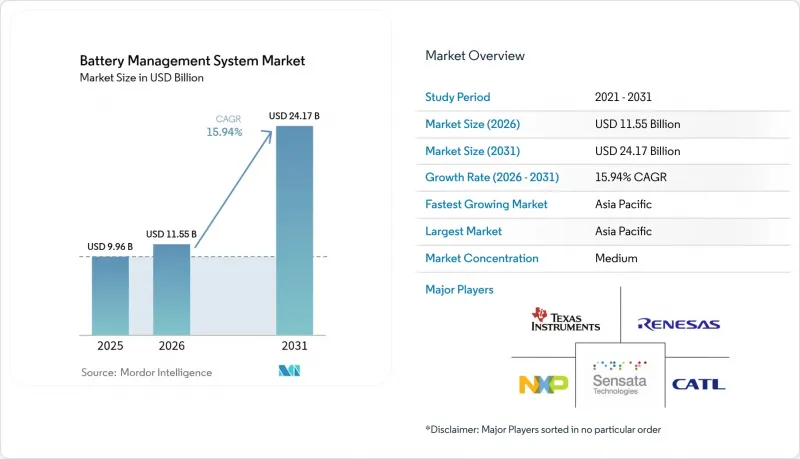
本報告按電池類型(鋰離子電池、鉛酸電池、鎳基電池、液流電池和全固體)、拓撲結構(集中式、分散式、模組化和混合式)、組件(硬體和軟體)、電壓範圍(低、中、高)、應用(汽車、固定式儲能、家用電子電器等)和地區(北美、歐洲、亞太地區、南美等分類。
全球電池管理系統(BMS)市場趨勢與洞察
電動車產量的激增推高了對高壓電池管理系統(BMS)的需求。
預計到2024年,全球電池式電動車(BEV)銷量將超過1,390萬輛,到2027年將超過3,000萬輛。因此,電池管理系統(BMS)市場的供應商正在開發符合ASIL D標準的解決方案,用於監控商用車電池組中多達360個電芯。通用汽車(GM)等汽車製造商正在採用無線BMS設計,將線束佈線減少90%,從而降低重量並縮短組裝時間。由於800V高壓平台需要先進的溫度控管演算法和即時診斷功能,BMS的定位正在發生變化,不再只是被動安全裝置,而是能夠實現快速充電的主動元件。目前,圍繞專有通訊積體電路的供應鏈夥伴關係正在決定高階電動車領域的平台採用。
鋰離子電池價格的下降導致目標市場擴大。
到2024年,某些配置的鋰離子電池成本將降至每千瓦時100美元以下,這將使先前依賴鉛酸電池組的新型工業和住宅項目得以應用。這種價格較親民的化學電池趨勢正在推動電池管理系統(BMS)在堆高機、通訊UPS和微型行動車輛等新興市場應用領域的滲透。供應商正積極回應,推出簡化的基板,在降低組件成本的同時,確保必要的安全性。模組化BMS套件可滿足從1千瓦時住宅太陽能發電系統到兆瓦時儲能設施等各種應用需求,支援快速部署並透過減少維護停機時間來降低成本。
半導體短缺限制了電池管理系統(BMS)的出貨量。
由於晶圓代工廠優先生產利潤更高的智慧型手機晶片,預計汽車級類比和電源晶片的供不應求將持續到2026年。電池管理系統(BMS)市場的供應商正在重新設計基板以匹配現有的引腳配置,協商多年供貨契約,甚至投資建造新的200毫米生產線以確保配額。超過52週的前置作業時間迫使汽車製造商累積過多的庫存,佔用營運資金並延遲新車型的推出。
細分市場分析
儘管鋰離子電池預計在2025年將佔據52.74%的市場佔有率,但固體電池正以41.38%的複合年成長率快速成長,預計將在2028年左右實現商業化。豐田的目標是將續航里程提升20%,並實現10分鐘快速充電,同時致力於將全新的電阻感測邏輯整合到所有電池管理系統(BMS)中。由於磷酸鐵鋰電池(LFP)和高鎳鎳鈷鋰電池(NMC)的價格持續走低,鋰離子電池仍佔據電池管理系統(BMS)市場的大部分佔有率,但鉛酸電池仍廣泛應用於起動電池領域。液流電池和鎳基電池則服務於一些特定的工業應用,這些應用需要能夠承受超過一小時的放電時間和極端溫度環境。
到 2025 年,分散式基板將佔銷售額的 42.45%,以 22.96% 的複合年成長率推動創新。將處理能力分配到各個模組可以縮短線束長度並提高容錯能力。恩智浦的超寬頻晶片組可將佈線減少高達 90%,使設計人員能夠創建任意形狀的滑板式電池組。雖然集中式設計在低成本滑板車和電動工具中很常見,但模組化機架在實際儲存應用中表現出色。混合佈局透過將主 ECU 與無線蜂窩節點結合,實現了成本和效能之間的平衡。
區域分析
預計到2025年,亞太地區將佔全球電動車銷售額的60.92%,並將在2031年之前以19.08%的年均成長率成長。中國的規模優勢使得原料提煉、電池製造和整車組裝能夠在同一產業叢集內完成,從而降低了國內電池管理系統(BMS)板的採購成本。光是寧德時代(CATL)一家就佔2024年前三個季度全球電動車電池產能出貨量的36.7%,並且正在投資研發需要新一代控制器的全電池診斷能力。印度已撥款6000萬美元用於促進該國電動車的普及,這為區域供應商訂單創造了條件。日本和韓國則透過提供高精度積體電路和汽車軟體的專業技術,完善了這項生態系統。
北美位居第二,這得益於其“通膨控制法案”,該法案將稅額扣抵與在地採購的電池掛鉤。通用汽車(GM)已累計350億美元用於一項電動車計劃,該計劃利用其自主研發的「Ultium」無線電池管理系統(BMS)簡化電池組的種類。特斯拉、Rivian 和其他老牌汽車製造商正在美國中西部地區建造超級工廠,以滿足對高壓基板組件的需求。加州和德克薩斯州在電網儲能部署方面處於領先地位,預計到2024年,兩州將分別新增超過2吉瓦時的儲能容量,從而推動對公用事業級電池管理系統的需求。
在歐洲,嚴格的碳排放法規與再生電池技術的創新相結合。汽車製造商正在開發800V動力系統,以實現更快的充電速度和更輕的電纜。歐盟電池法規強制要求材料可追溯性和回收利用,並要求製造商在其電池組中整合安全的資料記錄器,以確保合規性。南美洲以及中東和非洲地區仍處於起步階段,但潛力巨大。在智利豐富的鋰資源和南非可再生能源目標的支持下,儲能電站正在進行試點項目,測試成本最佳化的電池管理系統(BMS)基板,為未來的發展奠定基礎。
其他好處:
- Excel格式的市場預測(ME)表
- 3個月的分析師支持
目錄
第1章:引言
- 研究假設和市場定義
- 調查範圍
第2章:調查方法
第3章執行摘要
第4章 市場狀況
- 市場概覽
- 市場促進因素
- 電動車產量的激增推動了對高壓電池管理系統 (BMS) 的需求。
- 鋰離子電池組價格的下降正在擴大目標市場。
- 政府安全標準和碳排放法規正在加速這些措施的實施。
- 開發電網級儲能設施需要在電力公司層級配備電池管理系統 (BMS)。
- 向 800V動力傳動系統的轉變正在為混合動力汽車創造對下一代 BMS(電池管理系統)的需求。
- 無線電池管理系統架構實現了靈活的電池組設計。
- 市場限制因素
- 先進的建築管理系統(BMS)整合和認證成本高昂。
- 半導體短缺抑制了電池管理系統(BMS)的出貨量。
- 擴大針對聯網BMS平台的網路攻擊目標範圍
- 由於世界各國對二手電池的監管規定不一致,電池再利用的進程正在放緩。
- 供應鏈分析
- 監理情勢
- 技術展望
- 波特五力模型
第5章 市場規模與成長預測
- 依電池類型
- 鋰離子
- 鉛酸
- 鎳基
- 液流電池
- 固態電池
- 拓樸
- 集中
- 去中心化
- 模組化的
- 混合
- 按組件
- 硬體
- 軟體
- 按電壓範圍
- 低電壓(36伏特或以下)
- 中壓(36-60伏特)
- 高電壓(60伏特或更高)
- 透過使用
- 車
- 固定式儲能
- 家用電子產品
- 工業和通訊用UPS
- 醫療器材
- 航太/船舶
- 按地區
- 北美洲
- 美國
- 加拿大
- 墨西哥
- 歐洲
- 德國
- 英國
- 法國
- 義大利
- 西班牙
- 俄羅斯
- 其他歐洲國家
- 亞太地區
- 中國
- 日本
- 印度
- 韓國
- 東南亞國協
- 澳洲和紐西蘭
- 其他亞太國家
- 南美洲
- 巴西
- 阿根廷
- 智利
- 其他南美國家
- 中東和非洲
- 沙烏地阿拉伯
- 阿拉伯聯合大公國
- 南非
- 埃及
- 其他中東和非洲國家
- 北美洲
第6章 競爭情勢
- 市場集中度
- 策略趨勢(併購、聯盟、購電協議)
- 市場佔有率分析(主要公司的市場排名和佔有率)
- 公司簡介
- Sensata Technologies
- Texas Instruments
- Renesas Electronics
- NXP Semiconductors
- Analog Devices
- Eberspaecher Vecture
- Elithion
- LION Smart
- Nuvation Energy
- CATL
- LG Energy Solution
- BYD Co.
- Panasonic Holdings
- Infineon Technologies
- Denso
- Mitsubishi Electric
- Johnson Matthey
- Lithium Balance
- Preh GmbH
- Ewert Energy
第7章 市場機會與未來展望
According to Mordor Intelligence, battery management system market size in 2026 is estimated at USD 11.55 billion, growing from 2025 value of USD 9.96 billion with 2031 projections showing USD 24.17 billion, growing at 15.94% CAGR over 2026-2031.
This report is Segmented by Battery Type (Lithium-Ion, Lead-Acid, Nickel-Based, Flow Batteries, and Solid-State), Topology (Centralized, Distributed, Modular, and Hybrid), Component (Hardware and Software), Voltage Range (Low, Medium, and High), Application (Automotive, Stationary Energy Storage, Consumer Electronics, and More), and Geography (North America, Europe, Asia-Pacific, South America, and More).
Global Battery Management System Market Trends and Insights
EV production boom fuels demand for high-voltage BMS
Global battery-electric vehicle sales surpassed 13.9 million units in 2024 and are projected to exceed 30 million by 2027, prompting Battery Management System market vendors to engineer ASIL D-compliant solutions that monitor up to 360 cells in commercial vehicle packs. Automakers such as General Motors deploy wireless BMS designs that remove 90% of harness wiring, thus reducing mass and assembly time. High-voltage 800 V platforms demand advanced thermal algorithms and real-time diagnostics, repositioning the BMS as an active enabler of fast charging rather than a passive safeguard. Supply-chain partnerships around proprietary communication ICs now decide platform wins in premium EV segments.
Falling lithium-ion pack prices expand addressable markets
Lithium-ion costs dipped below USD 100 per kWh in select configurations in 2024, unlocking new industrial and residential projects that previously relied on lead-acid packs. The affordable chemistry trend fosters Battery Management System market penetration into forklifts, telecom UPS, and emerging-market micro-mobility fleets. Vendors respond with simplified boards that retain essential safety while trimming the bill of materials cost. Modular BMS kits scale from 1 kWh solar-home systems to multi-MWh storage farms, supporting quick deployment and reduced servicing downtime.
Semiconductor shortages constrain BMS shipments
Automotive-grade analog and power chips remain in short supply through 2026 as foundries prioritize higher-margin smartphone nodes. Battery Management System market suppliers redesign boards around available pin-outs, negotiate multi-year supply contracts, and even bankroll new 200 mm lines to protect allocations. Lead times exceeding 52 weeks compel vehicle manufacturers to hold excess inventory, tying up working capital and delaying the introduction of new models.
Other drivers and restraints analyzed in the detailed report include:
- Government safety & carbon mandates accelerate adoption
- Grid-scale storage build-out requires utility-grade BMS
- High integration & certification cost for advanced BMS
For complete list of drivers and restraints, kindly check the Table Of Contents.
Segment Analysis
Lithium-ion retained 52.74% revenue in 2025, yet solid-state boards sprint ahead at 41.38% CAGR as commercial launches near 2028. Toyota targets 20% range gains and 10-minute charges, demanding brand-new impedance-detection logic inside every BMS. The Battery Management System market share for lithium-ion remains sizable thanks to ever-cheaper LFP and high-nickel NMC, while lead-acid lingers in starter batteries. Flow and nickel chemistries address niche industrial operations requiring hour-long discharge or extreme temperature resilience.
Distributed boards controlled 42.45% revenue in 2025 and led innovation with a 22.96% CAGR. Processing power is spread across modules, trimming harness length, and elevating fault tolerance. NXP's ultra-wideband chipset eliminates up to 90% of wiring, allowing designers to craft skateboard packs of any shape. Centralized designs prevail in budget scooters and power tools, while modular racks excel in utility storage. Hybrid layouts combine a master ECU with wireless cell nodes to strike a balance between cost and performance.
Complete Report Scope:
- By Battery Type
- Lithium-ion
- Lead-acid
- Nickel-based
- Flow Batteries
- Solid-state
- By Topology
- Centralized
- Distributed
- Modular
- Hybrid
- By Component
- Hardware
- Software
- By Voltage Range
- Low (Up to 36 V)
- Medium (36 to 60 V)
- High (Above 60 V)
- By Application
- Automotive
- Stationary Energy Storage
- Consumer Electronics
- Industrial and Telecom UPS
- Medical Devices
- Aerospace and Marine
- By Geography
- North America
- United States
- Canada
- Mexico
- Europe
- Germany
- United Kingdom
- France
- Italy
- Spain
- Russia
- Rest of Europe
- Asia-Pacific
- China
- Japan
- India
- South Korea
- ASEAN Countries
- Australia and New Zealand
- Rest of Asia-Pacific
- South America
- Brazil
- Argentina
- Chile
- Rest of South America
- Middle East and Africa
- Saudi Arabia
- United Arab Emirates
- South Africa
- Egypt
- Rest of Middle East and Africa
- North America
Geography Analysis
The Asia-Pacific region accounted for 60.92% of the revenue in 2025 and is projected to grow at a 19.08% annual rate through 2031. China's scale drives raw-material refining, cell manufacturing, and final vehicle assembly in the same industrial clusters, thereby lowering the landed cost of domestic BMS boards. CATL alone shipped 36.7% of global EV battery capacity in the first three quarters of 2024 and invests in embedded cell-to-pack diagnostics that demand next-generation controllers. India allocates USD 60 million to boost local EV uptake, giving regional suppliers a path to volume contracts. Japan and South Korea contribute precision ICs and automotive software expertise, rounding out the ecosystem.
North America ranks second as the Inflation Reduction Act ties tax credits to locally sourced batteries. General Motors budgets USD 35 billion for EV programs that rely on in-house Ultium wireless BMS to streamline pack variants. Tesla, Rivian, and legacy automakers are breaking ground on giga-factories across the Midwest, anchoring demand for high-voltage board assemblies. California and Texas lead grid storage installations, each topping 2 GWh added in 2024, driving utility-grade BMS volume.
Europe combines stringent carbon rules with innovation in second-life batteries. Automakers are pursuing 800V drivetrains, seeking faster charging and lighter cables. The EU Battery Regulation mandates material traceability and recycling, prompting manufacturers to embed a secure on-pack data logger to ensure compliance. South America and the Middle East & Africa remain early-stage yet promising. Chile's lithium wealth and South Africa's renewable goals encourage pilot energy-storage farms that test cost-optimized BMS boards, laying the groundwork for future growth.
- Sensata Technologies
- Texas Instruments
- Renesas Electronics
- NXP Semiconductors
- Analog Devices
- Eberspaecher Vecture
- Elithion
- LION Smart
- Nuvation Energy
- CATL
- LG Energy Solution
- BYD Co.
- Panasonic Holdings
- Infineon Technologies
- Denso
- Mitsubishi Electric
- Johnson Matthey
- Lithium Balance
- Preh GmbH
- Ewert Energy
Additional Benefits:
- The market estimate (ME) sheet in Excel format
- 3 months of analyst support
TABLE OF CONTENTS
1 Introduction
- 1.1 Study Assumptions & Market Definition
- 1.2 Scope of the Study
2 Research Methodology
3 Executive Summary
4 Market Landscape
- 4.1 Market Overview
- 4.2 Market Drivers
- 4.2.1 EV production boom fuels demand for high-voltage BMS
- 4.2.2 Falling lithium-ion pack prices expand addressable markets
- 4.2.3 Government safety & carbon mandates accelerate adoption
- 4.2.4 Grid-scale storage build-out requires utility-grade BMS
- 4.2.5 800-V power-train shift creates need for next-gen HV BMS
- 4.2.6 Wireless BMS architectures enable flexible pack design
- 4.3 Market Restraints
- 4.3.1 High integration & certification cost for advanced BMS
- 4.3.2 Semiconductor shortages constrain BMS shipments
- 4.3.3 Growing cyber-attack surface of connected BMS platforms
- 4.3.4 Patchy global rules for 2nd-life batteries slow reuse
- 4.4 Supply-Chain Analysis
- 4.5 Regulatory Landscape
- 4.6 Technological Outlook
- 4.7 Porter's Five Forces
- 4.7.1 Bargaining Power of Suppliers
- 4.7.2 Bargaining Power of Buyers
- 4.7.3 Threat of New Entrants
- 4.7.4 Threat of Substitutes
- 4.7.5 Competitive Rivalry
5 Market Size & Growth Forecasts
- 5.1 By Battery Type
- 5.1.1 Lithium-ion
- 5.1.2 Lead-acid
- 5.1.3 Nickel-based
- 5.1.4 Flow Batteries
- 5.1.5 Solid-state
- 5.2 By Topology
- 5.2.1 Centralized
- 5.2.2 Distributed
- 5.2.3 Modular
- 5.2.4 Hybrid
- 5.3 By Component
- 5.3.1 Hardware
- 5.3.2 Software
- 5.4 By Voltage Range
- 5.4.1 Low (Up to 36 V)
- 5.4.2 Medium (36 to 60 V)
- 5.4.3 High (Above 60 V)
- 5.5 By Application
- 5.5.1 Automotive
- 5.5.2 Stationary Energy Storage
- 5.5.3 Consumer Electronics
- 5.5.4 Industrial and Telecom UPS
- 5.5.5 Medical Devices
- 5.5.6 Aerospace and Marine
- 5.6 By Geography
- 5.6.1 North America
- 5.6.1.1 United States
- 5.6.1.2 Canada
- 5.6.1.3 Mexico
- 5.6.2 Europe
- 5.6.2.1 Germany
- 5.6.2.2 United Kingdom
- 5.6.2.3 France
- 5.6.2.4 Italy
- 5.6.2.5 Spain
- 5.6.2.6 Russia
- 5.6.2.7 Rest of Europe
- 5.6.3 Asia-Pacific
- 5.6.3.1 China
- 5.6.3.2 Japan
- 5.6.3.3 India
- 5.6.3.4 South Korea
- 5.6.3.5 ASEAN Countries
- 5.6.3.6 Australia and New Zealand
- 5.6.3.7 Rest of Asia-Pacific
- 5.6.4 South America
- 5.6.4.1 Brazil
- 5.6.4.2 Argentina
- 5.6.4.3 Chile
- 5.6.4.4 Rest of South America
- 5.6.5 Middle East and Africa
- 5.6.5.1 Saudi Arabia
- 5.6.5.2 United Arab Emirates
- 5.6.5.3 South Africa
- 5.6.5.4 Egypt
- 5.6.5.5 Rest of Middle East and Africa
- 5.6.1 North America
6 Competitive Landscape
- 6.1 Market Concentration
- 6.2 Strategic Moves (M&A, Partnerships, PPAs)
- 6.3 Market Share Analysis (Market Rank/Share for key companies)
- 6.4 Company Profiles (includes Global level Overview, Market level overview, Core Segments, Financials as available, Strategic Information, Products & Services, and Recent Developments)
- 6.4.1 Sensata Technologies
- 6.4.2 Texas Instruments
- 6.4.3 Renesas Electronics
- 6.4.4 NXP Semiconductors
- 6.4.5 Analog Devices
- 6.4.6 Eberspaecher Vecture
- 6.4.7 Elithion
- 6.4.8 LION Smart
- 6.4.9 Nuvation Energy
- 6.4.10 CATL
- 6.4.11 LG Energy Solution
- 6.4.12 BYD Co.
- 6.4.13 Panasonic Holdings
- 6.4.14 Infineon Technologies
- 6.4.15 Denso
- 6.4.16 Mitsubishi Electric
- 6.4.17 Johnson Matthey
- 6.4.18 Lithium Balance
- 6.4.19 Preh GmbH
- 6.4.20 Ewert Energy
7 Market Opportunities & Future Outlook
- 7.1 White-space & Unmet-Need Assessment

 電池管理系統市場預測至2034年—按電池類型、組件、拓撲結構、車輛類型、應用和地區分類的全球分析
 主動平衡器市場:全球市場預測,2026-2032年軟體定義鋰電池保護基板市場:全球市場預測,2026-2032年
 工業電池管理系統市場規模、佔有率、成長率及全球產業分析、區域趨勢及2026年至2034年預測全球電池管理系統專利情報(2026 年)-專利趨勢、應用趨勢、主要專利持有人策略分析、技術領域、閒置頻段及未來智慧財產權展望
 鋰離子電池安全系統:市場佔有率分析、行業趨勢和統計數據、成長預測(2026-2031 年)電動車電池管理系統市場預測至2034年—按組件、電池類型、拓撲結構、車輛類型、應用和地區分類的全球分析
 全球電池管理系統(BMS)市場:按組件、電池類型、應用、電壓、國家和地區分類-產業分析、市場規模、市場佔有率和預測(2026-2033 年)電池管理系統(BMS)半導體市場:預測(至2034年)-按組件、電池類型、應用和地區分類的全球分析電動自行車電池管理系統:市場佔有率分析、產業趨勢與統計、成長預測(2025-2030)