


 |
市場調查報告書
商品編碼
2119330
鋰離子電池安全系統:市場佔有率分析、行業趨勢和統計數據、成長預測(2026-2031 年)Lithium-Ion Battery Safety Systems - Market Share Analysis, Industry Trends & Statistics, Growth Forecasts (2026 - 2031) |
||||||

※ 本網頁內容可能與最新版本有所差異。詳細情況請與我們聯繫。
據 Mordor Intelligence 稱,2025 年鋰離子電池安全系統市值為 116.7 億美元,預計到 2031 年將達到 288.4 億美元,而 2026 年為 135.8 億美元,預測期(2026-2031 年)的複合成長率為 16.26%。
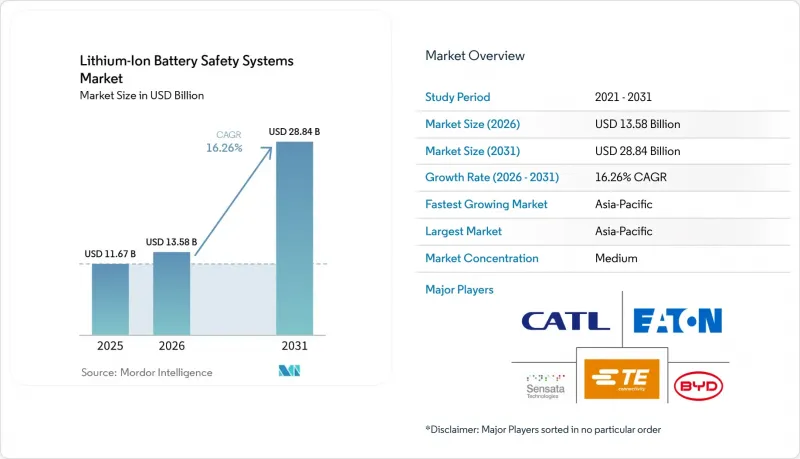
本報告按安全系統(溫度控管管理、電流感應器、電池放電單元、熔斷器等)、電池化學成分(磷酸鐵鋰電池、鎳鈷錳酸鋰電池、鎳鈷酸鋰電池等)、應用領域(電動車、家用電子電器、儲能系統、工業、航太與國防、船舶等)以及航太地區(北美、歐洲船舶、亞太地區、中東、中東和非洲)進行細分。市場預測以美元計價。
全球鋰離子電池安全系統市場趨勢及洞察
電動車和電動出行電池組的擴展
到2025年,全球電動車電池部署量將達到1.2太瓦時(TWh),其中輕型車輛將佔85%以上。如此龐大的規模使得汽車專案成為電池監控和故障回應系統的主要需求領域。向800V車輛架構的過渡增加了電池單元間的電壓應力和溫度波動。這要求類比電路的容差比傳統的400V平台更嚴格,故障響應速度也更快。 2026年6月,德克薩斯)發布了一款整合電化學電阻譜(EIS)引擎的26節電池監視器。此監視器能夠偵測電池單元的熱失控風險,並通過了ISO 26262 ASIL-D認證。因此,在鋰離子電池安全系統市場,能夠將符合汽車功能安全標準與預測性診斷功能結合的供應商將更具優勢。
提高電網級儲能系統的安全性
預計2025年,全球電池儲能容量將增加108吉瓦,較2024年成長40%。其中,磷酸鐵鋰電池(LFP電池)佔新增容量的近90%,因此儲能容量的擴張與針對其化學成分的特定監測和冷卻需求密切相關。大型棱柱形電池在波動的環境條件下運行,其發熱模式與汽車電池組截然不同。因此,儲能專案需要專門針對固定式應用設計的熱控制邏輯,而不是簡單地複製汽車解決方案。 2025年1月發生的莫斯蘭丁火災迫使1,500名居民撤離,凸顯了大型設施安全措施不足的嚴重後果。鋰離子電池安全系統市場正受惠於在儲能專案設計階段更早開展設施級防火測試和風險評估。
高昂的實施成本和技術複雜性限制了其廣泛應用。
先進的安全系統,例如多區域液冷、無線電池管理系統 (BMS) 和整合式電池斷開裝置,會使電池組的總成本增加 8% 至 15%。這限制了新興經濟體中注重成本的汽車製造商和客戶的採用。在東南亞和印度,早期二輪車和三輪車電氣化專案中的安全設備通常僅符合監管規定的最低標準。克萊斯勒 Pacifica 插電式混合動力汽車召回事件涉及 LG Energy Solutions 生產的電芯,這表明電芯和 BMS 規格不達標會對實際應用造成潛在影響。雖然共用用於溫度控管和 BMS 功能的硬體平台可以降低成本,但這需要研發資源,而小型供應商往往缺乏這些資源。此外,鋰離子電池安全系統市場還需要支付認證費用,以符合 ISO 26262、IEC 62619、UN 38.3 和區域性要求。
細分市場分析
到2025年,電池管理系統(BMS)將佔據鋰離子電池安全系統市場38.4%的佔有率。 BMS能夠監測各種電池化學體系中的單體電壓、電流、溫度、健康狀態(SOH)和均衡功能。它們還提供集中控制,用於故障檢測和響應。 BMS技術正從閾值的保護轉向能夠更早識別潛在故障的系統。中國供應商正在利用邊緣神經網路的整合,將SOC估計誤差降低到±1.5%以下。對於大量使用磷酸鐵鋰電池(LFP)的電池專案而言,這項能力正變得越來越重要。
預計到2031年,溫度控管系統將以17.2%的複合年成長率成長。快速充電、能量密度提升以及儲能設施的擴張,都增加了這些系統必須管理的熱負荷。中國於2026年發布了“T/CQPRA 0173-2026”,明確了智慧互聯新能源汽車電池溫度控管的技術要求。隔離開關、電池隔離單元和熔斷器在防止過電流、過熱和短路方面發揮重要作用。寧德時代(CATL)於2025年11月選擇Mersen作為其客製化熔斷器供應商,並於2026年7月與福特和Leapmotor簽署契約,這充分體現了獲得多家客戶認證的價值。此外,隨著UL 9540A第六版擴大了氣體和爆炸危險評估的範圍,其他安全系統(例如氣體檢測、壓力釋放裝置和消防系統整合)的重要性也日益凸顯。
區域分析
預計到2025年,亞太地區將佔全球鋰離子電池銷售額的55.6%,並將在2031年之前以18.6%的複合年成長率成長。該地區是全球最大的鋰離子電池系統生產和需求中心。中國佔全球電動車電池部署量的60%,以及全球鋰離子電池標稱產能的80%以上。中國將於2026年7月生效的GB38031-2025標準要求新認證的驅動電池機型必須具備防火防爆性能。歐盟、東南亞和中東的監管機構正在努力與該標準接軌。
2025年,日本電池管理系統(BMS)市場規模達5.909億美元。 2030年可再生能源發電比達到36-38%,2040年達到50%的目標,正在推動電池的普及應用。在印度,隨著電動二輪車和三輪車熱傳遞測試要求的訂定,AIS-156和AIS-038 Rev. 2標準正在實施,對安全系統的需求也在不斷成長。韓國仍然是一個重要的市場,電池製造商正在投資磷酸鐵鋰電池(LFP)、全固體和鈉離子電池技術。三星SDI已宣布計劃在2040年向其位於蔚山和天安的工廠投資25兆韓元(約177億美元)。這些投資正在擴大區域安全系統供應商必須應對的化學成分範圍。
北美是鋰離子電池安全系統的第二大區域市場。通貨膨脹抑制法案的激勵措施、NFPA 855 標準要求以及 UL 9540 合規性正在推動美國對認證設備的需求。加州 2026 年消防法案修正案(AB 1285 法案)加強了對電池儲能設施安全系統的要求。福特、日產和克萊斯勒在 2026 年的電池召回事件也促使人們對電池檢驗實踐進行持續嚴格的審查。歐洲則排名第三,德國、法國和英國是汽車電池管理系統 (BMS) 的主要需求國,而歐盟電池法規則強制要求使用數位電池護照和健康狀態 (SOH) 報告。南美洲和中東及非洲仍處於起步階段,但巴西、智利、沙烏地阿拉伯和阿拉伯聯合大公國的儲能和電池相關專案活動正在增加。
其他好處:
- Excel格式的市場預測(ME)表
- 3個月的分析師支持
目錄
第1章:引言
- 研究假設和市場定義
- 調查範圍
第2章:調查方法
第3章執行摘要
第4章 市場狀況
- 市場概覽
- 市場促進因素
- 電動車和電動出行電池組的擴展
- 提高電網級儲能系統的安全性
- 快速充電和高壓電池組的普及
- 加強電池安全和運輸方面的法規。
- 預測性診斷和即時電池健康監測
- 無線和軟體定義電池安全架構
- 市場限制因素
- 高昂的整合成本和檢驗成本
- 全球安全標準不一致
- 半導體和感測器的供應風險
- 網路安全與互聯BMS責任風險
- 供應鏈分析
- 波特五力分析
- 科技趨勢
- 監理情勢
- 投資分析
第5章 市場規模與成長預測
- 透過安全系統
- 電池管理系統(BMS)
- 溫度控管系統
- 電流中斷裝置(CID)
- 電池斷開裝置(BDU)
- 熔斷器和電路保護裝置
- 其他安全系統
- 電池化學成分
- 磷酸鋰鐵(LFP)
- 鎳錳鈷(NMC)
- 鎳鈷鋁合金(NCA)
- 其他鋰離子電池化學成分
- 透過使用
- 電動車
- 家用電子產品
- 能源儲存系統(ESS)
- 工業設備
- 航太/國防
- 海上
- 其他用途
- 按地區
- 北美洲
- 美國
- 加拿大
- 墨西哥
- 歐洲
- 德國
- 法國
- 義大利
- 西班牙
- 英國
- 波蘭
- 俄羅斯
- 其他歐洲國家
- 亞太地區
- 中國
- 印度
- 日本
- 韓國
- 澳洲
- 印尼
- 越南
- 泰國
- 其他亞太國家
- 南美洲
- 巴西
- 阿根廷
- 智利
- 其他南美國家
- 中東和非洲
- 沙烏地阿拉伯
- 阿拉伯聯合大公國
- 埃及
- 南非
- 摩洛哥
- 其他中東和非洲國家
- 北美洲
第6章 競爭情勢
- 市場集中度
- 策略趨勢
- 市佔率分析
- 公司簡介
- Analog Devices Inc.
- BYD Company Limited
- Contemporary Amperex Technology Co., Limited
- Dana Incorporated
- DENSO Corporation
- Eaton Corporation plc
- Eberspacher Gruppe GmbH & Co. KG
- Hanon Systems Co., Ltd.
- Lithium Balance A/S
- Littelfuse, Inc.
- MAHLE GmbH
- Mersen
- Nuvation Energy
- NXP Semiconductors NV
- Robert Bosch GmbH
- Sensata Technologies, Inc.
- TE Connectivity Ltd.
- Texas Instruments Incorporated
- Valeo SE
第7章 市場機會與未來展望
According to Mordor Intelligence, the lithium-Ion battery safety systems market size was valued at USD 11.67 billion in 2025 and is estimated to grow from USD 13.58 billion in 2026 to reach USD 28.84 billion by 2031, at a CAGR of 16.26% during the forecast period (2026-2031).
This report is Segmented by Safety System (BMS, Thermal Management, CID, BDU, Fuses, Others), Battery Chemistry (LFP, NMC, NCA, Others), Application (Electric Vehicles, Consumer Electronics, ESS, Industrial, Aerospace and Defense, Marine, Others), and Geography (North America, Europe, Asia-Pacific, South America, Middle East and Africa). The Market Forecasts are Provided in Terms of Value (USD).
Global Lithium-Ion Battery Safety Systems Market Trends and Insights
EV and E-Mobility Battery Pack Expansion
Global electric vehicle battery deployment reached 1.2 TWh in 2025, with light-duty vehicles accounting for more than 85% of the volume. This scale makes automotive programs the principal demand base for battery monitoring and fault-response systems. The move toward 800V vehicle architectures increases voltage stress and thermal variation across cells. It requires tighter analog tolerances and faster fault responses than earlier 400V platforms. Texas Instruments introduced its 26-cell battery monitor with an integrated electrochemical impedance spectroscopy engine in June 2026, enabling cell-level detection of thermal-runaway risk and providing ISO 26262 ASIL-D certification. The lithium-ion battery safety systems market, therefore, favors suppliers that combine automotive functional safety compliance with predictive diagnostic capability.
Grid-Scale Storage Safety Upgrades
Global additions of battery energy storage capacity reached 108 GW in 2025, a 40% increase from 2024. LFP batteries accounted for nearly 90% of the new capacity, linking storage growth closely to chemistry-specific monitoring and cooling requirements. Large prismatic cells operating under changing ambient conditions create heat patterns that differ from those of automotive battery packs. Storage projects consequently need thermal control logic designed for stationary use, rather than adapted vehicle solutions. The Moss Landing fire in January 2025 led to the evacuation of 1,500 residents and highlighted the consequences of inadequate safety arrangements in large installations. The lithium-ion battery safety systems market is benefiting as installation-level fire testing and hazard evaluation move earlier into energy storage project design.
High Integration Costs and Technical Complexity Constraining Adoption
Advanced safety systems, including multi-zone liquid cooling, wireless BMS, and integrated battery disconnect units, add 8-15% to total battery pack cost. This limits adoption among cost-sensitive vehicle makers and customers in emerging economies. In Southeast Asia and India, early two-wheeler and three-wheeler electrification programs often limit safety content to the regulatory minimum. A recall involving Chrysler Pacifica plug-in hybrid vehicles and LG Energy Solution cells demonstrated how cell or BMS specification weaknesses can create field consequences. Shared hardware platforms for thermal management and BMS functions can reduce costs, but they require research and development resources that smaller suppliers may not have. The lithium-ion battery safety systems market also carries certification costs across ISO 26262, IEC 62619, UN 38.3, and regional requirements.
Other drivers and restraints analyzed in the detailed report include:
- Stricter Battery Safety and Transport Compliance
- Fast-Charging and High-Voltage Pack Adoption
- Interoperability and Standardization Gaps Slowing Multi-Chemistry Deployment
For complete list of drivers and restraints, kindly check the Table Of Contents.
Segment Analysis
Battery management systems held 38.4% of the lithium-ion battery safety systems market in 2025. They monitor cell voltage, current, temperature, state of health, and balancing functions across battery chemistries. They also provide the central control function for fault detection and response. BMS technology is moving from threshold-based protection toward systems that identify potential faults earlier. Chinese suppliers are using edge neural network integration to achieve state-of-charge estimation errors below +-1.5%. This capability is becoming more relevant for procurement requirements in LFP-heavy battery programs.
Thermal management systems are forecast to record a 17.2% CAGR through 2031. Faster charging, higher energy density, and expanding energy storage installations are increasing the heat load that these systems must manage. China published T/CQPRA 0173-2026 in 2026, setting technical requirements for battery thermal management in intelligent connected new-energy vehicles. Current interruption devices, battery disconnect units, and fuses protect against overcurrent, thermal, and short-circuit events. Mersen's November 2025 selection by CATL for custom fuses and its July 2026 contracts with Ford and Leapmotor show the value of multi-customer qualification. Other safety systems, including gas detection, pressure-relief equipment, and fire suppression integration, are gaining relevance because UL 9540A sixth edition expanded gas and explosion hazard evaluation.
Complete Report Scope:
- By Safety System
- Battery Management Systems (BMS)
- Thermal Management Systems
- Current Interruption Devices (CID)
- Battery Disconnect Units (BDU)
- Fuses and Circuit Protection Devices
- Other Safety Systems
- By Battery Chemistry
- Lithium Iron Phosphate (LFP)
- Nickel Manganese Cobalt (NMC)
- Nickel Cobalt Aluminum (NCA)
- Other Lithium-Ion Chemistries
- By Application
- Electric Vehicles
- Consumer Electronics
- Energy Storage Systems (ESS)
- Industrial Equipment
- Aerospace and Defense
- Marine
- Other Applications
- By Geography
- North America
- United States
- Canada
- Mexico
- Europe
- Germany
- France
- Italy
- Spain
- United Kingdom
- Poland
- Russia
- Rest of Europe
- Asia-Pacific
- China
- India
- Japan
- South Korea
- Australia
- Indonesia
- Vietnam
- Thailand
- Rest of Asia-Pacific
- South America
- Brazil
- Argentina
- Chile
- Rest of South America
- Middle East and Africa
- Saudi Arabia
- United Arab Emirates
- Egypt
- South Africa
- Morocco
- Rest of Middle East and Africa
- North America
Geography Analysis
Asia-Pacific held 55.6% of global revenue in 2025 and is forecast to grow at an 18.6% CAGR through 2031. The region is both the largest production center and the largest demand center for lithium-ion battery systems. China accounted for 60% of global electric vehicle battery deployment and more than 80% of global lithium-ion manufacturing nameplate capacity. China's GB38031-2025 rule came into effect in July 2026 and requires no fire or explosion in newly declared traction battery models. Regulators in the European Union, Southeast Asia, and the Middle East are reviewing the framework for potential alignment.
Japan's BMS value reached USD 590.9 million in 2025. Its renewable generation targets of 36-38% by 2030 and 50% by 2040 support battery storage deployment. India is expanding safety system demand through AIS-156 and AIS-038 Revision 2 thermal propagation testing requirements for electric two-wheelers and three-wheelers. South Korea remains important because battery manufacturers are investing in LFP, solid-state, and sodium-ion technologies. Samsung SDI announced a KRW 25 trillion investment plan, equivalent to USD 17.7 billion, for its Ulsan and Cheonan facilities through 2040. These investments broaden the chemistry profiles that regional safety suppliers must support.
North America is the second-largest regional market in the lithium-ion battery safety systems market. Inflation Reduction Act incentives, NFPA 855 requirements, and UL 9540 compliance support demand for certified equipment in the United States. California's 2026 Fire Code updates, following AB 1285, increase safety system requirements for battery energy storage installations. Ford, Nissan, and Chrysler battery recalls during 2026 also maintain scrutiny of battery validation practices. Europe ranks third, with Germany, France, and the United Kingdom supporting automotive BMS demand, while the EU Battery Regulation requires digital battery passports and state-of-health reporting. South America, the Middle East, and Africa remain earlier-stage areas, though Brazil, Chile, Saudi Arabia, and the United Arab Emirates are adding storage and battery-related project activity.
- Analog Devices Inc.
- BYD Company Limited
- Contemporary Amperex Technology Co., Limited
- Dana Incorporated
- DENSO Corporation
- Eaton Corporation plc
- Eberspacher Gruppe GmbH & Co. KG
- Hanon Systems Co., Ltd.
- Lithium Balance A/S
- Littelfuse, Inc.
- MAHLE GmbH
- Mersen
- Nuvation Energy
- NXP Semiconductors N.V.
- Robert Bosch GmbH
- Sensata Technologies, Inc.
- TE Connectivity Ltd.
- Texas Instruments Incorporated
- Valeo SE
Additional Benefits:
- The market estimate (ME) sheet in Excel format
- 3 months of analyst support
TABLE OF CONTENTS
1 INTRODUCTION
- 1.1 Study Assumptions and Market Definition
- 1.2 Scope of the Study
2 RESEARCH METHODOLOGY
3 EXECUTIVE SUMMARY
4 MARKET LANDSCAPE
- 4.1 Market Overview
- 4.2 Market Drivers
- 4.2.1 EV and E-Mobility Battery Pack Expansion
- 4.2.2 Grid-Scale Storage Safety Upgrades
- 4.2.3 Fast-Charging and High-Voltage Pack Adoption
- 4.2.4 Stricter Battery Safety and Transport Compliance
- 4.2.5 Predictive Diagnostics and Real-Time Battery Health Monitoring
- 4.2.6 Wireless and Software-Defined Battery Safety Architectures
- 4.3 Market Restraints
- 4.3.1 High Integration and Validation Cost
- 4.3.2 Fragmented Global Safety Standards
- 4.3.3 Semiconductor and Sensor Supply Exposure
- 4.3.4 Cybersecurity and Connected-BMS Liability Risk
- 4.4 Supply-Chain Analysis
- 4.5 Porter's Five Forces Analysis
- 4.6 Technology Outlook
- 4.7 Regulatory Landscape
- 4.8 Investment Analysis
5 MARKET SIZE AND GROWTH FORECASTS
- 5.1 By Safety System
- 5.1.1 Battery Management Systems (BMS)
- 5.1.2 Thermal Management Systems
- 5.1.3 Current Interruption Devices (CID)
- 5.1.4 Battery Disconnect Units (BDU)
- 5.1.5 Fuses and Circuit Protection Devices
- 5.1.6 Other Safety Systems
- 5.2 By Battery Chemistry
- 5.2.1 Lithium Iron Phosphate (LFP)
- 5.2.2 Nickel Manganese Cobalt (NMC)
- 5.2.3 Nickel Cobalt Aluminum (NCA)
- 5.2.4 Other Lithium-Ion Chemistries
- 5.3 By Application
- 5.3.1 Electric Vehicles
- 5.3.2 Consumer Electronics
- 5.3.3 Energy Storage Systems (ESS)
- 5.3.4 Industrial Equipment
- 5.3.5 Aerospace and Defense
- 5.3.6 Marine
- 5.3.7 Other Applications
- 5.4 By Geography
- 5.4.1 North America
- 5.4.1.1 United States
- 5.4.1.2 Canada
- 5.4.1.3 Mexico
- 5.4.2 Europe
- 5.4.2.1 Germany
- 5.4.2.2 France
- 5.4.2.3 Italy
- 5.4.2.4 Spain
- 5.4.2.5 United Kingdom
- 5.4.2.6 Poland
- 5.4.2.7 Russia
- 5.4.2.8 Rest of Europe
- 5.4.3 Asia-Pacific
- 5.4.3.1 China
- 5.4.3.2 India
- 5.4.3.3 Japan
- 5.4.3.4 South Korea
- 5.4.3.5 Australia
- 5.4.3.6 Indonesia
- 5.4.3.7 Vietnam
- 5.4.3.8 Thailand
- 5.4.3.9 Rest of Asia-Pacific
- 5.4.4 South America
- 5.4.4.1 Brazil
- 5.4.4.2 Argentina
- 5.4.4.3 Chile
- 5.4.4.4 Rest of South America
- 5.4.5 Middle East and Africa
- 5.4.5.1 Saudi Arabia
- 5.4.5.2 United Arab Emirates
- 5.4.5.3 Egypt
- 5.4.5.4 South Africa
- 5.4.5.5 Morocco
- 5.4.5.6 Rest of Middle East and Africa
- 5.4.1 North America
6 COMPETITIVE LANDSCAPE
- 6.1 Market Concentration
- 6.2 Strategic Moves
- 6.3 Market Share Analysis
- 6.4 Company Profiles (includes Global Level Overview, Market Level Overview, Core Segments, Financials as available, Strategic Information, Market Rank/Share, Products and Services, Recent Developments)
- 6.4.1 Analog Devices Inc.
- 6.4.2 BYD Company Limited
- 6.4.3 Contemporary Amperex Technology Co., Limited
- 6.4.4 Dana Incorporated
- 6.4.5 DENSO Corporation
- 6.4.6 Eaton Corporation plc
- 6.4.7 Eberspacher Gruppe GmbH & Co. KG
- 6.4.8 Hanon Systems Co., Ltd.
- 6.4.9 Lithium Balance A/S
- 6.4.10 Littelfuse, Inc.
- 6.4.11 MAHLE GmbH
- 6.4.12 Mersen
- 6.4.13 Nuvation Energy
- 6.4.14 NXP Semiconductors N.V.
- 6.4.15 Robert Bosch GmbH
- 6.4.16 Sensata Technologies, Inc.
- 6.4.17 TE Connectivity Ltd.
- 6.4.18 Texas Instruments Incorporated
- 6.4.19 Valeo SE
7 MARKET OPPORTUNITIES AND FUTURE OUTLOOK
- 7.1 White-Space and Unmet-Need Assessment

 電池管理系統市場預測至2034年—按電池類型、組件、拓撲結構、車輛類型、應用和地區分類的全球分析
 主動平衡器市場:全球市場預測,2026-2032年軟體定義鋰電池保護基板市場:全球市場預測,2026-2032年
 工業電池管理系統市場規模、佔有率、成長率及全球產業分析、區域趨勢及2026年至2034年預測全球電池管理系統專利情報(2026 年)-專利趨勢、應用趨勢、主要專利持有人策略分析、技術領域、閒置頻段及未來智慧財產權展望電動車電池管理系統市場預測至2034年—按組件、電池類型、拓撲結構、車輛類型、應用和地區分類的全球分析
 電池管理系統:市場佔有率分析、產業趨勢與統計、成長預測(2026-2031)
 全球電池管理系統(BMS)市場:按組件、電池類型、應用、電壓、國家和地區分類-產業分析、市場規模、市場佔有率和預測(2026-2033 年)電池管理系統(BMS)半導體市場:預測(至2034年)-按組件、電池類型、應用和地區分類的全球分析電動自行車電池管理系統:市場佔有率分析、產業趨勢與統計、成長預測(2025-2030)