


 |
市場調查報告書
商品編碼
2121921
生物基琥珀酸:市場佔有率分析、行業趨勢和統計數據以及成長預測(2026-2031 年)Bio-Based Succinic Acid - Market Share Analysis, Industry Trends & Statistics, Growth Forecasts (2026 - 2031) |
||||||

※ 本網頁內容可能與最新版本有所差異。詳細情況請與我們聯繫。
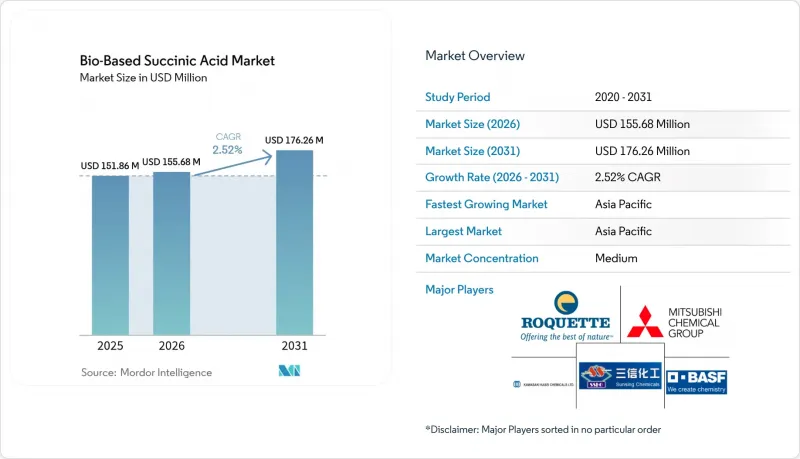
據 Mordor Intelligence 稱,2025 年生物衍生琥珀酸的市場規模為 1.5186 億美元,預計到 2031 年將達到 1.7626 億美元,而 2026 年為 1.5568 億美元,預測期(2026-2031 年)的複合年成長率為 2.52%。
本報告按應用領域(工業、製藥、個人護理、油漆塗料及其他)、原料(玉米葡萄糖、甘蔗和甜菜蔗糖、木質纖維素生質能等)以及地區(亞太、北美、歐洲、南美以及中東和非洲)進行細分。市場預測以美元計價。
全球生物基琥珀酸市場趨勢及洞察
擴大綠色化學品在工業聚合物中的應用
工程塑膠、熱固性樹脂和彈性體製造商正持續以經認證的生物基替代品取代化石基原料。BASF已產品系列獲得ISCC+認證,並推出了含有40%可再生原料的生物基丙烯酸乙酯,從而減少了30%的從搖籃到大門的碳排放。同時,聚氨酯領域也積極推動生物基1,4-丁二醇的研發,該原料直接來自琥珀酸發酵。這項生產流程由Genomatica公司率先開發,透過技術授權進一步推廣至中國製造商。由於PBS樹脂本身就是由琥珀酸和1,4-丁二醇合成的,因此琥珀酸酯產量的增加將惠及包括包裝材料、多層薄膜和一次性消費性電子元件在內的眾多應用領域。隨著品牌所有者提高其範圍 3 脫碳目標,採購團隊優先考慮能夠證明其在減少溫室氣體排放方面有良好記錄的供應商,這進一步推動了生物衍生琥珀酸市場對大規模生產聚合物應用的需求。
原油價格波動促使人們轉向生物能源路線。
當原油價格重複波動在閾值80美元以上時,石化衍生琥珀酸的成本優勢會週期性地被削弱,促使加工商簽訂現成的生物基路線協議,以避免原料價格的突然波動風險。歐盟委員會的工業碳管理計畫透過為替代化石基中間體的計畫提供資金津貼和稅額扣抵抵免,支持這一經濟趨勢。日本主要企業三菱化學、三井化學和旭化成正在石腦油裂解裝置中試驗使用生質能石腦油,以履行日本的淨零排放承諾,同時降低價格波動風險。儘管在原油價格低迷時期,生物基琥珀酸的發展勢頭可能會暫時放緩,但採購部門正擴大制定包含概率加權原油價格趨勢的總擁有成本(TCO)情景,即使在原油價格前景悲觀的情況下,也能為生物基琥珀酸市場創造戰略空間。
與石油衍生的琥珀酸相比,生產成本更高。
根據技術經濟模型,在目前電價水準下,市售生物基琥珀酸的最低價格估計為每公斤2.5至2.7美元。即使在原油價格低迷的情況下,此價格區間仍高於石油基琥珀酸的現貨價格。造成這種價格差異的原因在於生物基琥珀酸的滅菌過程需要消耗能源,且需要多級沉澱工藝,此外,不銹鋼發酵槽的資本投入也較高。雖然碳排放稅和高階小眾市場在一定程度上抵消了這種價格差異,但樹脂和塗料行業的大型用戶仍然對價格非常敏感。製程整合——例如連續發酵、原位產品回收以及使用耐低pH值的微生物——展現出良好的前景,但生物基琥珀酸能否在價格上與石油基產品持平,取決於這些技術能否從試點階段加速推進到5萬噸的額定產能。
細分市場分析
2025年,工業應用將佔生物基琥珀酸市場佔有率的42.65%,主要應用領域包括PBS包裝薄膜、可生物分解地膜和聚氨酯中間體,總消耗量將達到數千噸。這些領域的需求正以可預測的速度成長,因為加工商正在簽訂多年期照付不議契約,以支持工廠的運轉率,從而穩定整個生物基琥珀酸市場。在整個預測期內,個人護理行業將呈現最快的成長曲線,複合年成長率(CAGR)為3.73%,這主要得益於免洗祛痘產品、天然除臭劑和溫和去角質產品等特殊產品形式的貢獻。皮膚科研究證實,1%的琥珀酸凝膠可以抑制痤瘡丙酸桿菌的生長,且不會引起刺激。這使得品牌可以將這種更環保的活性成分與現有的BETA-羥基酸產品並列銷售。配方開發人員在緩釋基質中加入琥珀酸緩衝液以維持 pH 值,而包衣製造商正在測試琥珀酸基多元醇,這些多元醇在保證生物分解性的同時,還能提供高固態含量,從而在製藥領域得到穩步應用。
隨著產量的擴大,終端市場的價格差異顯著。工業樹脂買家在保持穩定採購量的同時,努力爭取更低的噸價。同時,個人護理和製藥用戶為了滿足微生物純度和可追溯性要求,接受更高的價格,這有助於生產商確保利潤率。這些趨勢正在推動一種雙通路模式的形成:早期採用者將基礎產能用於聚合物生產,並將改進的發酵槽產能用於特種批次生產。隨著各下游產業對生命週期評估(LCA)指標的重視,跨領域綜效正在顯現。醫療領域的成功案例為化妝品行業的功效聲明提供了可信度,而包裝行業的機械可回收性測試結果則確保了消費品製造商的最終處置符合循環經濟的承諾。總而言之,這些趨勢支持了這樣一種觀點:應用多樣性在提升整個生物基琥珀酸市場的收入穩定性方面發揮核心作用。
區域分析
亞太地區佔最大市場佔有率,預計到2025年將佔生物基琥珀酸市場33.05%,並持續以3.66%的複合年成長率成長至2031年。中國各省政府正向生技產業園區提供低利率貸款,以促進專用於生產琥珀酸和1,4-丁二醇的5萬噸級發酵槽的快速擴建。國家發展和改革委員會已將生物化學品納入「十四五」規劃的優先發展領域,並增加稅收優惠以降低現金成本的損益平衡點。在日本,政府已撥款補貼生質能與石腦油的共加工,作為實現碳中和綠色成長策略的一部分。為此,三菱化學、三井化學和旭化成聯合投資建設了試點裂解裝置,這些裝置將為琥珀酸基聚酯提供原料。韓國正透過其生物戰略技術藍圖支持類似的舉措,而印度則專注於原料供應,擴大其碎米乙醇項目,該項目預計將糖化產品重新用於化學發酵槽。這些努力協同增強了政策支持和規模經濟效益,鞏固了亞太地區在生物基琥珀酸市場的領先地位。
在北美,先進的合成生物學叢集、高風險接受度創業投資資金和各州無污染燃料獎勵推動了相關產業的蓬勃發展。美國農業部已將琥珀酸列為2025年生質能研發議程中的優先產品,並建立了菌株工程和廢物流評估的津貼框架。加州的低碳燃料標準(LCFS)為生物來源二氧化碳利用提供積分倍增,發酵廠正在利用這項機制,在整合碳捕獲設備時獲得額外收入。 Green Plains公司的清潔糖子公司已成功生產出碳足跡降低40%的葡萄糖,目前內布拉斯加州的一家合約發酵廠正在對此原料進行試驗。加拿大正在對用於生化產品製造的設備實施加速折舊措施,墨西哥正在考慮為生物中間體提供激勵措施,以振興其北部工業走廊。這些政策和基礎設施要素共同構成了一個肥沃的生態系統,支持該地區生物基琥珀酸市場的穩定擴張。
歐洲未來的發展取決於嚴格的監管,這些監管將碳成本納入每一噸石化產品的生產成本。歐盟委員會的《2040年氣候中和路線藍圖》優先考慮公共採購中的二氧化碳捕集與利用(CCU)產品。德國的國家生物經濟戰略正透過研發津貼和原料物流計劃,將甜菜殘渣整合到諸如萊納(Leuna)等化學工業園區。法國正在試行消費品碳足跡標籤,從而推動對檢驗的低排放中間體的需求。英國的工業碳移除差價合約(CfD)機制保證最低支付額,鼓勵北海碳封存井和發酵廠的選址。歐洲的生產成本高於亞洲平均水平,但品牌所有者的壓力和綠色融資管道的暢通維持了其競爭優勢。因此,歐洲已成為生物基琥珀酸市場的主要高階市場,吸收了高純度等級和特殊產品,這些產品也因此具有更高的定價合理性。
其他好處:
- Excel格式的市場預測(ME)表
- 3個月的分析師支持
目錄
第1章:引言
- 研究假設和市場定義
- 調查範圍
第2章:調查方法
第3章執行摘要
第4章 市場狀況
- 市場概覽
- 市場促進因素
- 擴大綠色化學品在工業聚合物中的應用
- 原油價格波動促使人們轉向生物能源路線。
- 政府獎勵和碳定價法規
- 基因改造微生物可顯著降低下游成本。
- 品牌擁有者基於循環經濟的採購要求
- 市場限制因素
- 與石油衍生的琥珀酸相比,生產成本較高。
- 農產品原物料價格波動
- 來自新興生物基己二酸生產途徑的競爭
- 價值鏈分析
- 波特五力模型
第5章 市場規模與成長預測
- 透過使用
- 產業
- 製藥
- 個人護理
- 油漆和塗料
- 其他
- 按原料
- 玉米來源的葡萄糖
- 蔗糖來自甘蔗和甜菜
- 木質纖維素生質能
- 粗甘油和廢物流
- 生物電化學途徑(含二氧化碳)
- 按地區
- 亞太地區
- 中國
- 日本
- 印度
- 韓國
- 其他亞太國家
- 北美洲
- 美國
- 加拿大
- 墨西哥
- 歐洲
- 德國
- 英國
- 法國
- 義大利
- 其他歐洲國家
- 南美洲
- 巴西
- 阿根廷
- 其他南美國家
- 中東和非洲
- 沙烏地阿拉伯
- 南非
- 其他中東和非洲國家
- 亞太地區
第6章 競爭情勢
- 市場集中度
- 策略趨勢
- 市佔率和排名分析
- 公司簡介
- Anhui Sunsing Chemicals Co. Ltd.
- BASF SE
- dsm-firmenich
- Kawasaki Kasei Chemicals Ltd.
- Mitsubishi Chemical Group Corporation
- Reverdia
- Roquette Freres
- Technip Energies NV
第7章 市場機會與未來展望
According to Mordor Intelligence, the bio-Based succinic acid market size was valued at USD 151.86 million in 2025 and estimated to grow from USD 155.68 million in 2026 to reach USD 176.26 million by 2031, at a CAGR of 2.52% during the forecast period (2026-2031).
This report is Segmented by Application (Industrial, Pharmaceuticals, Personal Care, Paints and Coatings, Other Applications), Feedstock Source (Corn-Derived Glucose, Sugarcane & Beet Sucrose, Lignocellulosic Biomass, and More), and Geography (Asia-Pacific, North America, Europe, South America, Middle East and Africa). The Market Forecasts are Provided in Terms of Value (USD).
Global Bio-Based Succinic Acid Market Trends and Insights
Increasing Adoption of Green Chemicals in Industrial Polymers
Manufacturers of engineering plastics, thermoset resins, and elastomers continue to swap fossil building blocks for certified bio-alternatives. BASF secured ISCC+ certification for more than 60 portfolio products and introduced a bio-based ethyl acrylate featuring 40% renewable content that cuts cradle-to-gate emissions by 30%. Parallel initiatives in polyurethane chains rely on bio-1,4-butanediol derived directly from succinic acid fermentations, a pathway pioneered by Genomatica and scaled further through technology licensing to Chinese producers. Because PBS resin is already synthesized from succinic acid and 1,4-butanediol, every incremental gain in succinate output ripples through packaging, mulch film, and single-use appliance parts. As brand owners escalate scope-3 decarbonization targets, procurement teams favor suppliers able to document greenhouse-gas savings, reinforcing the pull on the bio-based succinic acid market toward high-volume polymer applications.
Volatility in Crude-Oil Prices Prompting Switch to Bio-Routes
Oil-price swings above the USD 80 per-barrel threshold regularly erode the cost advantage enjoyed by petrochemical succinic acid, nudging converters to lock in offtake agreements for bio-routes that insulate them from feedstock shocks. The European Commission's industrial carbon-management plan complements this economic push by aligning capital grants and tax credits with projects that displace fossil intermediates. Japanese majors Mitsubishi Chemical, Mitsui Chemicals, and Asahi Kasei have responded by trialing biomass naphtha in naphtha crackers to derisk volatility while meeting national net-zero pledges. Although low oil phases can stall momentum temporarily, purchasing departments increasingly model total-cost-of-ownership scenarios that assign probability-weighted oil trajectories, keeping a strategic wedge for the bio-based succinic acid market even under bearish crude forecasts.
Higher Production Costs Versus Petro-Based Succinic Acid
Techno-economic models place the price floor for commercial bio-based succinic acid between USD 2.5 and 2.7 per kilogram at today's utility tariffs, a band still above the spot price of petro-derived equivalents in low-oil scenarios. The delta stems from sterilization energy demand, multi-step precipitation, and the capital intensity of stainless-steel fermenters. While carbon levies and premium niches partially offset the spread, large-volume users in resins and coatings remain price sensitive. Process intensification-continuous fermentation, in-situ product removal, and low-pH tolerant microbes-holds promise, but the timeline for parity hinges on accelerating these technologies from pilot to 50 kiloton nameplate capacity.
Other drivers and restraints analyzed in the detailed report include:
- Government Incentives & Carbon-Pricing Regulations
- Engineered Micro-Organisms Slashing Downstream Costs
- Agricultural Feedstock Price Volatility
For complete list of drivers and restraints, kindly check the Table Of Contents.
Segment Analysis
Industrial uses captured 42.65% of the bio-based succinic acid market share in 2025, anchored by PBS packaging films, biodegradable mulch, and polyurethane intermediates that together consume multi-kiloton volumes. Demand in these channels scales predictably because converters sign multi-year take-or-pay contracts that underpin plant-load factors, thereby stabilizing the overall bio-based succinic acid market. Over the forecast horizon, personal care presents the sharpest growth curve at a 3.73% CAGR, lifting contribution from specialty formats such as leave-on acne treatments, natural deodorants, and mild exfoliants. Dermatology studies confirm that 1% succinic acid gels diminish Propionibacterium acnes proliferation without triggering irritation, which allows brands to position greener actives alongside existing beta-hydroxy acids. Pharmaceutical uptake continues steadily as formulators incorporate succinate buffers to maintain pH in controlled-release matrices, while coatings makers experiment with succinate-based polyols that give high-solids content yet ensure biodegradability.
Parallel to volume expansion, price realization differs widely among end markets. Industrial resin buyers negotiate lower per-tonne tariffs yet provide consistent offtake. Personal care and pharmaceutical users accept a premium due to microbiological purity and traceability requirements, creating a margin hedge for producers. These dynamics encourage a dual-channel model in which early adopters allocate baseline capacity to polymers and consume upgraded fermenter runs for specialty batches. Because each downstream sector prioritizes life-cycle-assessment metrics, cross-segment synergies emerge: credentials validated in medicine lend credibility to cosmetic claims, while mechanical recyclability tests in packaging reassure consumer-goods owners that end-of-life outcomes align with circular-economy pledges. Together, these patterns affirm the central role of application diversity in extending revenue stability across the bio-based succinic acid market.
Complete Report Scope:
- By Application
- Industrial
- Pharmaceuticals
- Personal Care
- Paints and Coatings
- Other Applications
- By Feedstock Source
- Corn-derived Glucose
- Sugarcane and Beet Sucrose
- Lignocellulosic Biomass
- Crude Glycerol and Waste Streams
- CO2-coupled Bio-electrochemical Routes
- By Geography
- Asia-Pacific
- China
- Japan
- India
- South Korea
- Rest of Asia-Pacific
- North America
- United States
- Canada
- Mexico
- Europe
- Germany
- United Kingdom
- France
- Italy
- Rest of Europe
- South America
- Brazil
- Argentina
- Rest of South America
- Middle East and Africa
- Saudi Arabia
- South Africa
- Rest of Middle East and Africa
- Asia-Pacific
Geography Analysis
Asia-Pacific owned the largest regional slice, representing 33.05% of the bio-based succinic acid market in 2025 and cruising toward a 3.66% CAGR through 2031. China's provincial governments funnel low-interest loans into industrial-biotech parks, enabling rapid scale-up of 50 kiloton fermenters dedicated to succinic acid and 1,4-butanediol. The National Development and Reform Commission integrates bio-chemicals into its Five-Year Plan incentives, adding tax holidays that lower cash-cost breakevens. In Japan, the Green Growth Strategy for Carbon Neutrality allocates subsidies for biomass naphtha co-processing, prompting Mitsubishi Chemical, Mitsui Chemicals, and Asahi Kasei to co-invest in pilot crackers that will feed succinate-based polyesters. South Korea supports similar ambitions through its Bio-Strategic Technology blueprint, while India focuses on feedstock supply by expanding broken-rice ethanol programs that could divert saccharified streams into chemical fermenters. Altogether, these initiatives compound policy support with scale economies, reinforcing Asia-Pacific's leadership in the bio-based succinic acid market.
North America sustains robust activity through advanced synthetic-biology clusters, risk-tolerant venture funding, and state-level clean-fuel incentives. The United States Department of Agriculture frames succinic acid as a high-priority product in its 2025 Biomass Research and Development Agenda, unlocking grant pools for strain engineering and waste-stream valorization. California's Low Carbon Fuel Standard awards credit multipliers to biogenic CO2 utilization, a mechanism that fermentation plants leverage for additional revenue when they integrate carbon capture units. Green Plains' clean-sugar subsidiary demonstrated 40% lower carbon footprint dextrose, a feedstock now trialed by contract fermenters in Nebraska. Canada provides accelerated depreciation for equipment deployed in biochemicals, and Mexico evaluates concessions for bio-intermediates to spur northern industrial corridors. Collectively, these policy and infrastructure elements create a fertile ecosystem that underpins steady expansion of the bio-based succinic acid market within the region.
Europe's trajectory hinges on regulatory stringency that embeds carbon costs into every tonne of petrochemical output. The European Commission's 2040 climate-neutral roadmap positions carbon-capture-and-utilization products for priority offtake in public procurement. Germany's National Bioeconomy Strategy supplements R&D grants with feedstock logistics programs to integrate sugar-beet residues into chemical parks such as Leuna. France pilots carbon-footprint labeling on consumer goods, elevating demand for verified low-emission intermediates. The United Kingdom's Contracts for Difference-style mechanism for industrial carbon removal assures payment floors, encouraging fermentation plants to co-locate with sequestration wells in the North Sea. While production costs exceed Asian averages, brand-owner pressure and access to green-finance instruments maintain competitive momentum. Consequently, Europe operates as the principal premium market within the bio-based succinic acid market, absorbing high-purity grades and specialty volumes that justify elevated pricing.
- Anhui Sunsing Chemicals Co. Ltd.
- BASF SE
- dsm-firmenich
- Kawasaki Kasei Chemicals Ltd.
- Mitsubishi Chemical Group Corporation
- Reverdia
- Roquette Freres
- Technip Energies N.V.
Additional Benefits:
- The market estimate (ME) sheet in Excel format
- 3 months of analyst support
TABLE OF CONTENTS
1 Introduction
- 1.1 Study Assumptions and Market Definition
- 1.2 Scope of the Study
2 Research Methodology
3 Executive Summary
4 Market Landscape
- 4.1 Market Overview
- 4.2 Market Drivers
- 4.2.1 Increasing adoption of green chemicals in industrial polymers
- 4.2.2 Volatility in crude-oil prices prompting switch to bio-routes
- 4.2.3 Government incentives and carbon-pricing regulations
- 4.2.4 Engineered micro-organisms slashing downstream costs
- 4.2.5 Circular-economy sourcing mandates from brand owners
- 4.3 Market Restraints
- 4.3.1 Higher production costs versus petro-based succinic acid
- 4.3.2 Agricultural feedstock price volatility
- 4.3.3 Competition from emerging bio-adipic acid pathways
- 4.4 Value Chain Analysis
- 4.5 Porter's Five Forces
- 4.5.1 Bargaining Power of Suppliers
- 4.5.2 Bargaining Power of Buyers
- 4.5.3 Threat of New Entrants
- 4.5.4 Threat of Substitutes
- 4.5.5 Degree of Competition
5 Market Size and Growth Forecasts (Value)
- 5.1 By Application
- 5.1.1 Industrial
- 5.1.2 Pharmaceuticals
- 5.1.3 Personal Care
- 5.1.4 Paints and Coatings
- 5.1.5 Other Applications
- 5.2 By Feedstock Source
- 5.2.1 Corn-derived Glucose
- 5.2.2 Sugarcane and Beet Sucrose
- 5.2.3 Lignocellulosic Biomass
- 5.2.4 Crude Glycerol and Waste Streams
- 5.2.5 CO2-coupled Bio-electrochemical Routes
- 5.3 By Geography
- 5.3.1 Asia-Pacific
- 5.3.1.1 China
- 5.3.1.2 Japan
- 5.3.1.3 India
- 5.3.1.4 South Korea
- 5.3.1.5 Rest of Asia-Pacific
- 5.3.2 North America
- 5.3.2.1 United States
- 5.3.2.2 Canada
- 5.3.2.3 Mexico
- 5.3.3 Europe
- 5.3.3.1 Germany
- 5.3.3.2 United Kingdom
- 5.3.3.3 France
- 5.3.3.4 Italy
- 5.3.3.5 Rest of Europe
- 5.3.4 South America
- 5.3.4.1 Brazil
- 5.3.4.2 Argentina
- 5.3.4.3 Rest of South America
- 5.3.5 Middle East and Africa
- 5.3.5.1 Saudi Arabia
- 5.3.5.2 South Africa
- 5.3.5.3 Rest of Middle East and Africa
- 5.3.1 Asia-Pacific
6 Competitive Landscape
- 6.1 Market Concentration
- 6.2 Strategic Moves
- 6.3 Market Share(%)/Ranking Analysis
- 6.4 Company Profiles (includes Global level Overview, Market level overview, Core Segments, Financials as available, Strategic Information, Market Rank/Share for key companies, Products and Services, and Recent Developments)
- 6.4.1 Anhui Sunsing Chemicals Co. Ltd.
- 6.4.2 BASF SE
- 6.4.3 dsm-firmenich
- 6.4.4 Kawasaki Kasei Chemicals Ltd.
- 6.4.5 Mitsubishi Chemical Group Corporation
- 6.4.6 Reverdia
- 6.4.7 Roquette Freres
- 6.4.8 Technip Energies N.V.
7 Market Opportunities and Future Outlook
- 7.1 White-space and Unmet-Need Assessment
- 7.2 Sustainable Dyes Made from Bio-based Succinic Acid

 磺基琥珀酸酯市場:全球市場預測,2026-2032年琥珀酸市場:按類型、形態、純度等級、技術、應用和分銷管道分類-2026-2032年全球市場預測
 生物己二酸市場商機、成長要素、產業趨勢分析及2026-2035年預測。
 琥珀酸:市場佔有率分析、產業趨勢與統計、成長預測(2026-2031)
 磺基琥珀酸酯市場規模、佔有率和成長分析:按類型、應用、功能、劑型、終端用戶產業、分銷管道和地區分類-2026-2033年產業預測
 琥珀酸市場報告:趨勢、預測及競爭分析(至2035年)
 全球聚丁二酸丁二醇酯市場規模、佔有率、趨勢和成長分析報告(2026-2034年)琥珀酸全球市場規模、佔有率、趨勢和成長分析報告(2026-2034)
 2026-2030年全球琥珀酸市場磺基琥珀酸酯市場機會、成長要素、產業趨勢分析及2026年至2035年預測