


 |
市場調查報告書
商品編碼
2101588
生物己二酸市場商機、成長要素、產業趨勢分析及2026-2035年預測。Bio-Adipic Acid Market Opportunity, Growth Drivers, Industry Trend Analysis, and Forecast 2026 - 2035 |
||||||

全球生物己二酸市場預計到 2025 年將價值 1.531 億美元,並將以 12.7% 的複合年成長率成長,到 2035 年達到 5.06 億美元。
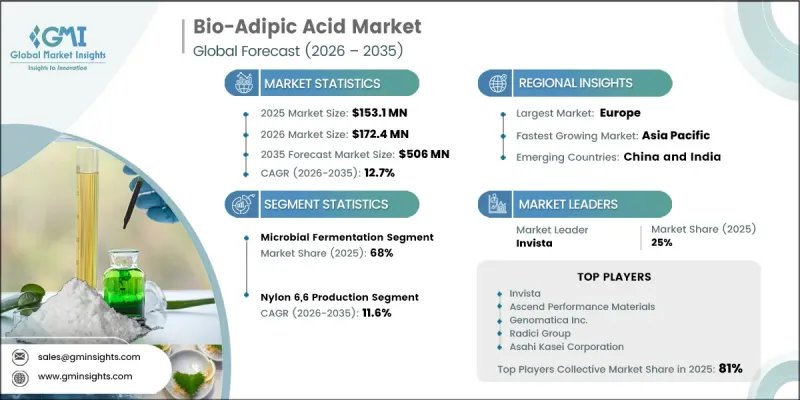
隨著製造商加速向可再生原料和低碳化學製造製程轉型,全球生物己二酸市場持續成長。微生物發酵、生物基原料轉化技術以及一體化生物煉製製程的進步,正在提高生產效率,並縮小生物基產品與傳統替代品之間的成本差距。工業領域日益重視減少溫室氣體排放的法規,為生物己二酸在多個終端應用產業的更廣泛應用創造了有利條件。同時,企業永續發展措施的加強以及對環保材料需求的成長,持續推動全球供應鏈中生物基化學中間體的應用。製造商也在透過擴大永續生產能力和提高製程可擴展性來應對不斷變化的採購需求。對可再生化學技術的持續投資,以及對低排放製造解決方案日益成長的需求,預計將支撐全球生物己二酸市場的長期成長,並在整個預測期內增強其商業性前景。
| 市場範圍 | |
|---|---|
| 開始年份 | 2025 |
| 預測期 | 2026-2035 |
| 上市時的市場規模 | 1.531億美元 |
| 預測金額 | 5.06億美元 |
| 複合年成長率 | 12.7% |
預計到2025年,微生物發酵將佔據68%的市場佔有率,並在2035年之前以12.3%的複合年成長率成長。該領域之所以能保持主導地位,是因為它與多種可再生原料相容,並且能夠支援高度可擴充性的生物基生產過程。工業發酵、菌株最佳化、代謝工程和製程效率方面的持續技術進步,正在推動生產性能的不斷提升和商業性應用的不斷擴大。對永續製造技術的投資增加,進一步鞏固了微生物發酵在全球生物己二酸市場的主導地位。
預計到2025年,尼龍6,6生產領域將佔據58%的市場佔有率,並在2035年之前以11.6%的複合年成長率成長。生物基己二酸的需求仍然強勁,因為它可以直接取代現有尼龍6,6生產流程中的傳統己二酸,而無需對生產過程進行重大改造。對永續聚合物生產的日益重視,以及對環保工程材料需求的不斷成長,持續推動該應用領域的市場成長。整體,生物基原料在工業生產上的廣泛應用,也進一步鞏固了尼龍6,6生產中對生物基己二酸的長期需求。
預計到2025年,北美生物己二酸市佔率將達到32%,並在2035年之前以12.1%的複合年成長率成長。美國佔該地區銷售額的85.1%,繼續保持其作為北美整體市場成長最大貢獻者的地位。持續的監管力度,包括減少溫室氣體排放、增加對可再生化學品生產的投資以及加強對永續工業生產的支持,都進一步推動了該地區的需求。隨著生物基技術的不斷進步和可再生化學品商業化的不斷擴大,預計在預測期內,北美將進一步鞏固主導地位。
目錄
第1章:調查方法和範圍
第2章執行摘要
第3章 行業洞察
- 產業生態系分析
- 供應商情況
- 利潤率
- 每個階段增加的價值
- 影響價值鏈的因素
- 中斷
- 影響產業的因素
- 促進因素
- 產業潛在風險與挑戰
- 市場機遇
- 成長潛力分析
- 監理情勢
- 波特的分析
- PESTLE分析
- 價格趨勢
- 按地區
- 透過生產技術
- 未來市場趨勢
- 技術與創新展望
- 最新科技趨勢
- 新興技術
- 專利趨勢
- 貿易統計
- 主要進口國
- 主要出口國
- 永續性和環境方面
- 永續計劃
- 減少廢棄物策略
- 生產中的能源效率
- 具有環保意識的舉措
第4章 競爭情勢
- 介紹
- 企業市佔率分析
- 按地區
- 北美洲
- 歐洲
- 亞太地區
- LATAM
- 中東和非洲
- 按地區
- 企業矩陣分析
- 主要市場公司的競爭分析
- 競爭定位矩陣
- 主要進展
- 併購
- 夥伴關係和聯盟
- 新產品發布
- 業務拓展計劃
第5章 市場估算與預測:依生產技術分類,2022年至2035年
- 微生物發酵
- 以葡萄糖/醣類為原料的發酵
- 木質纖維素生質能發酵
- 脂肪酸/植物油發酵
- 催化轉化
- 化學催化轉化
- 生物催化/酵素轉化
- 半生物合成(混合)
第6章 市場估計與預測:依應用領域分類,2022年至2035年
- 尼龍6,6的產量
- 尼龍6,6纖維
- 尼龍6,6樹脂
- 聚氨酯
- 軟性聚氨酯泡棉
- 硬質聚氨酯泡棉
- 聚氨酯彈性體和黏合劑
- 己二酸酯(塑化劑)
- 二辛基己二酸(DOA)
- 己二酸二異癸酯(DIDA)等
- 潤滑劑
- 合成基礎油
- 低溫潤滑劑
- 塗料和油漆
- 聚醯胺塗層
- 聚酯塗層
- 食品添加物
- 酸味劑和pH緩衝劑
- 膨鬆劑
- 其他
第7章 市場估計與預測:依等級分類,2022年至2035年
- 工業級
- 食品級
第8章 市場估算與預測:依最終使用者分類,2022年至2035年
- 車
- 引擎室和結構部件
- 車內使用
- 電動汽車應用
- 紡織品及紡織產品
- 服裝和襪子
- 工業紡織品
- 地毯和室內裝飾品
- 電氣和電子設備
- 連接器、開關、外殼
- 電纜和電線的絕緣材料
- 建造
- 聚氨酯保溫泡沫
- 密封劑、黏合劑和塗料
- 食品/飲料
- 飲料和乳製品
- 加工食品和烘焙點心
- 其他(包裝、藥品、化妝品)
第9章 市場估計與預測:依地區分類,2022年至2035年
- 北美洲
- 美國
- 加拿大
- 歐洲
- 德國
- 英國
- 法國
- 西班牙
- 義大利
- 其他歐洲國家
- 亞太地區
- 中國
- 印度
- 日本
- 澳洲
- 韓國
- 其他亞太國家
- 拉丁美洲
- 巴西
- 墨西哥
- 阿根廷
- 其他拉丁美洲國家
- 中東和非洲
- 沙烏地阿拉伯
- 南非
- UAE
- 其他中東和非洲國家
第10章:公司簡介
- Invista
- Ascend Performance Materials
- Genomatica Inc.
- Radici Group
- Asahi Kasei Corporation
- OzoneBio Inc.
- BASF SE
- twig.bio
- Sumatra Biorenewables
The Global Bio-Adipic Acid Market was valued at USD 153.1 million in 2025 and is estimated to grow at a CAGR of 12.7% to reach USD 506 million by 2035.
The global bio-adipic acid market continues to gain momentum as manufacturers accelerate the transition toward renewable raw materials and lower-carbon chemical production processes. Advancements in microbial fermentation, bio-based feedstock conversion technologies, and integrated biorefinery operations are improving production efficiency while narrowing the cost difference between bio-based and conventional alternatives. Increasing regulatory emphasis on reducing industrial greenhouse gas emissions is creating favorable conditions for wider adoption of bio-adipic acid across multiple end-use industries. At the same time, growing corporate sustainability commitments and stronger demand for environmentally responsible materials continue to encourage greater use of bio-based chemical intermediates throughout global supply chains. Manufacturers are also responding to evolving procurement requirements by expanding sustainable production capabilities and improving process scalability. Continued investment in renewable chemical technologies, combined with rising demand for low-emission manufacturing solutions, is expected to support long-term market expansion and strengthen the commercial outlook for the global bio-adipic acid market throughout the forecast period.
| Market Scope | |
|---|---|
| Start Year | 2025 |
| Forecast Year | 2026-2035 |
| Start Value | $153.1 Million |
| Forecast Value | $506 Million |
| CAGR | 12.7% |
Microbial fermentation accounted for 68% share in 2025 and is expected to grow at a CAGR of 12.3% through 2035. The segment maintains its leading position because of its compatibility with a broad range of renewable feedstocks and its ability to support scalable bio-based production processes. Ongoing technological advancements in industrial fermentation, strain optimization, metabolic engineering, and process efficiency continue to improve production performance while supporting higher commercial adoption. Growing investments in sustainable manufacturing technologies further reinforce the dominance of microbial fermentation within the global bio-adipic acid market.
The nylon 6,6 production segment held 58% share in 2025 and is projected to grow at a CAGR of 11.6% through 2035. Demand remains strong because bio-adipic acid serves as a direct substitute for conventional adipic acid in existing nylon 6,6 manufacturing processes without requiring significant production modifications. Increasing preference for sustainable polymer production, combined with rising demand for environmentally responsible engineering materials, continues to support market growth across this application segment. Expanding adoption of bio-based raw materials throughout industrial manufacturing further strengthens long-term demand for bio-adipic acid in nylon 6,6 production.
North America Bio-Adipic Acid Market accounted for 32% share in 2025 and is forecast to grow at a CAGR of 12.1% through 2035. The United States represented 85.1% of regional revenue, maintaining its position as the largest contributor to market growth across North America. Continued regulatory emphasis on greenhouse gas emission reduction, growing investment in renewable chemical production, and increasing support for sustainable industrial manufacturing continue to strengthen regional demand. Ongoing advancements in bio-based technologies and expanding commercialization of renewable chemicals are expected to reinforce North America's leading role in the global bio-adipic acid market during the forecast period.
Major companies operating in the global bio-adipic acid market include Ascend Performance Materials, Asahi Kasei Corporation, Invista, Genomatica Inc., and Radici Group. Companies participating in the global bio-adipic acid market focus on technology innovation, production scale expansion, and sustainability initiatives to strengthen their competitive position. Manufacturers continue investing in research and development to improve microbial fermentation efficiency, optimize bio-based feedstock utilization, and reduce production costs. Many companies also expand manufacturing capabilities and strengthen vertically integrated production models to improve supply chain efficiency and meet growing commercial demand. Strategic partnerships, joint development programs, and long-term customer agreements help accelerate product commercialization and broaden market reach. Businesses further differentiate themselves by emphasizing renewable production processes, regulatory compliance, and high-quality bio-based materials that align with evolving sustainability goals.
Table of Contents
Chapter 1 Methodology & Scope
- 1.1 Research approach
- 1.2 Quality Commitments
- 1.2.1 GMI AI policy & data integrity commitment
- 1.2.1.1 Source consistency protocol
- 1.2.1 GMI AI policy & data integrity commitment
- 1.3 Research Trail & Confidence Scoring
- 1.3.1 Research Trail Components
- 1.3.2 Scoring Components
- 1.4 Data Collection
- 1.4.1 Partial list of primary sources
- 1.5 Data mining sources
- 1.5.1 Paid sources
- 1.5.1.1 Sources, by region
- 1.5.1 Paid sources
- 1.6 Base estimates and calculations
- 1.6.1 Base year calculation for any one approach
- 1.7 Forecast model
- 1.7.1 Quantified market impact analysis
- 1.7.1.1 Mathematical impact of growth parameters on forecast
- 1.7.1 Quantified market impact analysis
- 1.8 Research transparency addendum
- 1.8.1 Source attribution framework
- 1.8.2 Quality assurance metrics
- 1.8.3 Our commitment to trust
Chapter 2 Executive Summary
- 2.1 Industry 360° synopsis
- 2.2 Key market trends
- 2.2.1 Regional
- 2.2.2 By Production Technology
- 2.2.3 By Application
- 2.2.4 By Grade
- 2.2.5 By End User
- 2.3 TAM Analysis, 2026 - 2035
- 2.4 CXO perspectives: Strategic imperatives
Chapter 3 Industry Insights
- 3.1 Industry ecosystem analysis
- 3.1.1 Supplier landscape
- 3.1.2 Profit margin
- 3.1.3 Value addition at each stage
- 3.1.4 Factor affecting the value chain
- 3.1.5 Disruptions
- 3.2 Industry impact forces
- 3.2.1 Growth drivers
- 3.2.2 Industry pitfalls and challenges
- 3.2.3 Market opportunities
- 3.3 Growth potential analysis
- 3.4 Regulatory landscape
- 3.4.1 North America
- 3.4.2 Europe
- 3.4.3 Asia Pacific
- 3.4.4 Latin America
- 3.4.5 Middle East & Africa
- 3.5 Porter's analysis
- 3.6 PESTEL analysis
- 3.7 Price trends
- 3.7.1 By region
- 3.7.2 By Production Technology
- 3.8 Future market trends
- 3.9 Technology and Innovation landscape
- 3.9.1 Current technological trends
- 3.9.2 Emerging technologies
- 3.10 Patent Landscape
- 3.11 Trade statistics (HS code)
- 3.11.1 Major importing countries
- 3.11.2 Major exporting countries
- 3.12 Sustainability and environmental aspects
- 3.12.1 Sustainable practices
- 3.12.2 Waste reduction strategies
- 3.12.3 Energy efficiency in production
- 3.12.4 Eco friendly initiatives
Chapter 4 Competitive Landscape, 2025
- 4.1 Introduction
- 4.2 Company market share analysis
- 4.2.1 By region
- 4.2.1.1 North America
- 4.2.1.2 Europe
- 4.2.1.3 Asia Pacific
- 4.2.1.4 LATAM
- 4.2.1.5 MEA
- 4.2.1 By region
- 4.3 Company matrix analysis
- 4.4 Competitive analysis of major market players
- 4.5 Competitive positioning matrix
- 4.6 Key developments
- 4.6.1 Mergers & acquisitions
- 4.6.2 Partnerships & collaborations
- 4.6.3 New Product Launches
- 4.6.4 Expansion Plans
Chapter 5 Market Estimates and Forecast, By Production Technology, 2022 to 2035 (USD Million) (Tons)
- 5.1 Key trends
- 5.2 Microbial Fermentation
- 5.2.1 Glucose / Sugar-Based Fermentation
- 5.2.2 Lignocellulosic Biomass Fermentation
- 5.2.3 Fatty Acid / Vegetable Oil-Based Fermentation
- 5.3 Catalytic Conversion
- 5.3.1 Chemo-Catalytic Conversion
- 5.3.2 Biocatalytic / Enzymatic Conversion
- 5.4 Semi-Biosynthetic (Hybrid)
Chapter 6 Market Estimates and Forecast, By Application, 2022 to 2035 (USD Million) (Tons)
- 6.1 Key trends
- 6.2 Nylon 6,6 Production
- 6.2.1 Nylon 6,6 Fiber
- 6.2.2 Nylon 6,6 Resin
- 6.3 Polyurethanes
- 6.3.1 Flexible Polyurethane Foam
- 6.3.2 Rigid Polyurethane Foam
- 6.3.3 Polyurethane Elastomers & Adhesives
- 6.4 Adipate Esters (Plasticizers)
- 6.4.1 Dioctyl Adipate (DOA)
- 6.4.2 Diisodecyl Adipate (DIDA) & Others
- 6.5 Lubricants
- 6.5.1 Synthetic Base Oils
- 6.5.2 Low-Temperature Lubricants
- 6.6 Coatings & Paints
- 6.6.1 Polyamide-Based Coatings
- 6.6.2 Polyester-Based Coatings
- 6.7 Food Additives
- 6.7.1 Acidulants & pH Buffers
- 6.7.2 Leavening Agents
- 6.8 Others
Chapter 7 Market Estimates and Forecast, By Grade, 2022 to 2035 (USD Million) (Tons)
- 7.1 Key trends
- 7.2 Industrial Grade
- 7.3 Food Grade
Chapter 8 Market Estimates and Forecast, By End User, 2022 to 2035 (USD Million) (Tons)
- 8.1 Key trends
- 8.2 Automotive
- 8.2.1 Under-Hood & Structural Components
- 8.2.2 Interior Applications
- 8.2.3 EV-Specific Applications
- 8.3 Textiles & Fibers
- 8.3.1 Apparel & Hosiery
- 8.3.2 Industrial Textiles
- 8.3.3 Carpets & Home Furnishings
- 8.4 Electrical & Electronics
- 8.4.1 Connectors, Switches & Housings
- 8.4.2 Cable & Wire Insulation
- 8.5 Construction
- 8.5.1 Polyurethane Insulation Foams
- 8.5.2 Sealants, Adhesives & Coatings
- 8.6 Food & Beverage
- 8.6.1 Beverages & Dairy
- 8.6.2 Processed & Baked Foods
- 8.7 Others (Packaging, Pharma, Cosmetics)
Chapter 9 Market Estimates and Forecast, By Region, 2022 to 2035 (USD Million) (Tons)
- 9.1 Key trends
- 9.2 North America
- 9.2.1 U.S.
- 9.2.2 Canada
- 9.3 Europe
- 9.3.1 Germany
- 9.3.2 UK
- 9.3.3 France
- 9.3.4 Spain
- 9.3.5 Italy
- 9.3.6 Rest of Europe
- 9.4 Asia Pacific
- 9.4.1 China
- 9.4.2 India
- 9.4.3 Japan
- 9.4.4 Australia
- 9.4.5 South Korea
- 9.4.6 Rest of Asia Pacific
- 9.5 Latin America
- 9.5.1 Brazil
- 9.5.2 Mexico
- 9.5.3 Argentina
- 9.5.4 Rest of Latin America
- 9.6 Middle East and Africa
- 9.6.1 Saudi Arabia
- 9.6.2 South Africa
- 9.6.3 UAE
- 9.6.4 Rest of Middle East and Africa
Chapter 10 Company Profiles
- 10.1 Invista
- 10.2 Ascend Performance Materials
- 10.3 Genomatica Inc.
- 10.4 Radici Group
- 10.5 Asahi Kasei Corporation
- 10.6 OzoneBio Inc.
- 10.7 BASF SE
- 10.8 twig.bio
- 10.9 Sumatra Biorenewables

 磺基琥珀酸酯市場:全球市場預測,2026-2032年
 生物基琥珀酸:市場佔有率分析、行業趨勢和統計數據以及成長預測(2026-2031 年)琥珀酸市場:按類型、形態、純度等級、技術、應用和分銷管道分類-2026-2032年全球市場預測琥珀酸:市場佔有率分析、產業趨勢與統計、成長預測(2026-2031)
 磺基琥珀酸酯市場規模、佔有率和成長分析:按類型、應用、功能、劑型、終端用戶產業、分銷管道和地區分類-2026-2033年產業預測
 琥珀酸市場報告:趨勢、預測及競爭分析(至2035年)
 全球聚丁二酸丁二醇酯市場規模、佔有率、趨勢和成長分析報告(2026-2034年)琥珀酸全球市場規模、佔有率、趨勢和成長分析報告(2026-2034)
 2026-2030年全球琥珀酸市場
 磺基琥珀酸酯市場機會、成長要素、產業趨勢分析及2026年至2035年預測