


 |
市場調查報告書
商品編碼
2073442
琥珀酸:市場佔有率分析、產業趨勢與統計、成長預測(2026-2031)Succinic Acid - Market Share Analysis, Industry Trends & Statistics, Growth Forecasts (2026 - 2031) |
||||||

※ 本網頁內容可能與最新版本有所差異。詳細情況請與我們聯繫。
據 Mordor Intelligence 稱,琥珀酸市場預計到 2026 年價值 3.215 億美元,高於 2025 年的 2.9343 億美元,預計到 2031 年將達到 5.0728 億美元。
預計從 2026 年到 2031 年,其複合年成長率將達到 9.56%。
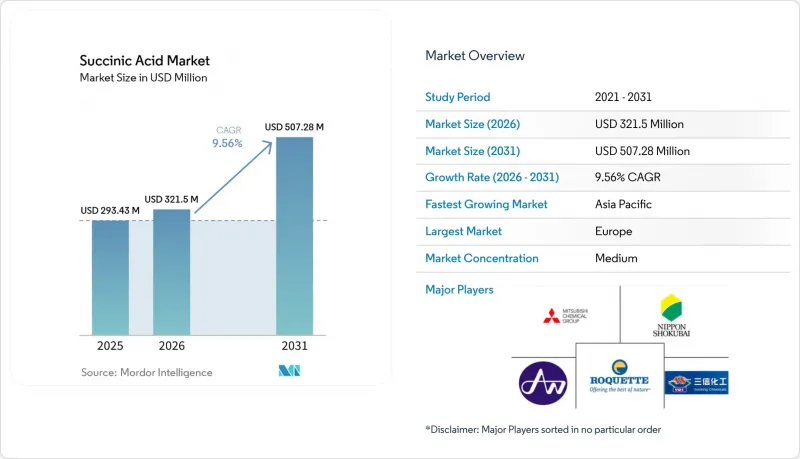
本報告按產品類型(石油基和生物基)、等級(工業/技術級、食品級、醫藥級、化妝品級)、應用領域(工業化學品、食品飲料、醫藥、個人護理和化妝品、其他)以及地區(北美、歐洲、亞太、南美、中東和非洲)進行細分。市場預測以美元計價。
全球琥珀酸市場趨勢及洞察
對可生物分解聚合物的需求日益成長
隨著汽車和包裝產業強制要求使用可生物分解材料取代傳統塑膠,聚丁二酸丁二醇酯(PBS)的生產正成為推動丁二酸需求成長要素。慕尼黑工業大學的研究人員利用海洋細菌Vibrio natriegens,顯著提高了發酵效率,將生產時間從傳統的24-48小時縮短至2-3小時。這項技術進步克服了一個重要的瓶頸:發酵過程的規模化能力,而這先前一直限制著生物基丁二酸的競爭力。為了遵守循環經濟法規,聚合物製造商擴大要求在PBS生產中使用生物基丁二酸,尤其是在歐洲,因為歐洲的「生產者延伸責任制」(EPR)框架對不可生物分解的包裝材料處以罰款。
對生物衍生化學品的監管支持
各國政府獎勵生物基化學品發展的政策架構正在逐步形成,琥珀酸在美國能源局2025年永續化學圓桌會議上被認定為工業脫碳的優先平台化學品。在生物基化學品需求不斷成長的推動下,各國正大力投資生技。根據印度科技部2024年的數據,印度政府啟動了「BioF3(生物技術促進經濟、環境和就業)」政策,旨在促進國內高性能生物技術的生產。美國食品藥物管理局(FDA)已批准琥珀酸作為食品用途的「公認安全(GRAS)」物質,這消除了其在食品和飲料配方中增加使用的監管障礙,並設定了調味料和肉品中琥珀酸的最大允許含量。這些監管批准為生物基琥珀酸生產商提供了優先市場進入,同時也確立了有利於擁有成熟生產能力的製造商的品質標準。
缺乏商業規模的生產基礎設施
包括BioAmber在內的幾家先鋒企業的破產,不僅減少了可用產能,也阻礙了對製造基礎設施的新投資。在發展中地區,建造發酵設施所需的技術專長和資金籌措匱乏,生產集中在現有的化學製造地。生物基生產的特殊性要求其設備和製程與傳統化工廠截然不同,這限制了現有設施的改造,並增加了資本需求。原料供應鏈的發展未能跟上產能需求的步伐,對於需要投資預處理基礎設施的非食品生質能原料而言,這種落後尤為明顯。
細分市場分析
預計2026年至2031年間,生物基琥珀酸的複合年成長率將達到11.02%,石油基琥珀酸在2025年仍將維持58.82%的市佔率。生物基琥珀酸生產的高速成長反映了永續生產方式的日益普及,這主要得益於監管要求和企業環境目標的推動。向生物基生產的轉變符合全球永續性以及整個產業日益增強的環保意識。石油基琥珀酸由於基礎設施完善且成本低廉,仍維持著市場主導地位,尤其是在價格敏感性高於環境考量的工業應用領域,這一趨勢更為顯著。
石油基生產的成本優勢源自於數十年來製程的最佳化以及現有設施的規模經濟。生物基替代品在食品、藥品和化妝品等高階領域正日益受到青睞。在這些領域,對永續性的需求支撐了更高的價格,消費者的偏好也影響他們的購買決策。此外,由於終端用戶對環保產品的需求不斷成長,這些高階領域也越來越願意承擔生物基生產方式帶來的額外成本。
區域分析
憑藉其完善的法律規範和成熟的生物基化學品生產基礎設施,預計到2025年,歐洲將佔據31.64%的市場佔有率。德國和法國擁有完善的化學綜合體,有利於下游加工和分銷,正在推動區域產能的成長。該地區針對包裝材料的生產者延伸責任制(EPR)框架,也催生了對以生物基琥珀酸為原料生產的可生物分解聚合物的優先需求。
亞太地區正崛起為成長最快的地區,預計2026年至2031年複合年成長率將達到10.31%,主要得益於中國、印度和東南亞的快速工業化和製造業產能擴張。曉星集團在越南投資10億美元建設生物基1,4-丁二醇生產基地,便是該地區在生物基化學品製造領域戰略地位的絕佳例證。該廠的目標是到2026年實現年產5萬噸。中國在化學品製造領域的領先地位為擴大琥珀酸生產規模提供了成熟的基礎設施,而印度蓬勃發展的製藥和個人護理行業則推動了對高等級產品需求的成長。該地區擁有豐富的農業廢棄物原料,例如稻草和玉米秸稈,這些原料為生物基生產提供了經濟高效的原料。政府支持工業脫碳和循環經濟發展的政策,也全部區域生物基化學品的應用創造了有利條件。
儘管面臨來自亞洲低成本生產的競爭壓力,北美仍保持著重要的市場佔有率。美國農業部發布的《2024年生質能供應鏈報告》指出,充足的原料供應是其關鍵競爭優勢,完善的農業基礎設施為可再生原料的供應提供了保障。美國能源局永續化學圓桌會議已將琥珀酸列為工業脫碳的平台化學品,並為國內生產的發展提供政策支持。 BioAmber在加拿大商業化的失敗為風險管理和市場開發策略提供了經驗教訓,凸顯了進行切合實際的成本預測和市場價格假設的重要性。
其他好處:
- Excel格式的市場預測(ME)表
- 3個月的分析師支持
目錄
第1章:引言
- 研究假設和市場定義
- 調查範圍
第2章:調查方法
第3章執行摘要
第4章 市場狀況
- 市場概覽
- 市場促進因素
- 對可生物分解聚合物的需求增加
- 對生物基化學品的監管支持
- 在食品飲料產業中作為酸度調節劑和增味劑的應用日益廣泛。
- 個人護理和化妝品行業的需求不斷成長
- 生物基生產技術的進步
- 對環保溶劑和工業化學品的需求日益成長
- 市場限制因素
- 高昂的生產成本
- 商業規模的生產基礎設施有限。
- 高能耗的廢水處理方法正在損害環境效益。
- 與替代生物衍生酸的競爭
- 供應鏈分析
- 監理展望
- 波特五力模型
第5章 市場規模與成長預測
- 依產品類型
- 石油衍生的
- 生物基
- 按年級
- 工業/技術級
- 食品級
- 醫藥級
- 化妝品級
- 透過使用
- 工業化學品
- 食品/飲料
- 製藥
- 個人護理化妝品
- 其他
- 按地區
- 北美洲
- 美國
- 加拿大
- 墨西哥
- 其他北美國家
- 歐洲
- 英國
- 德國
- 法國
- 義大利
- 西班牙
- 俄羅斯
- 其他歐洲國家
- 亞太地區
- 中國
- 印度
- 日本
- 澳洲
- 其他亞太國家
- 南美洲
- 巴西
- 阿根廷
- 其他南美國家
- 中東和非洲
- 沙烏地阿拉伯
- 南非
- 其他中東和非洲國家
- 北美洲
第6章 競爭情勢
- 市場集中度
- 策略趨勢
- 市場排名分析
- 公司簡介
- Roquette Freres
- Mitsubishi Chemical Group
- Nippon Shokubai Co., Ltd.
- Air Water Performance Chemical Inc.
- Jinan Finer Chemical Co., Ltd
- Anhui Sunsing Chemicals
- Haihang Group
- Henan GP Chemicals Co.,Ltd
- Kunshan Odowell Co. Ltd
- Royal DSM(Reverdia)
- Wenzhou Blue Dolphin New Material Co., Ltd
- Ensince Industry Co., Ltd
- Carl Roth GmbH+Co. KG
- Axiom Chemicals Pvt. Ltd.
- LCY Biosciences Inc.
- Fengchen Group Co.,Ltd
- Shandong Biotech
- Shandong Feiyang Chemical
- Spectrum Chemical Mfg.
- Thermo Fisher Scientific
第7章 市場機會與未來展望
According to Mordor Intelligence, succinic acid market size in 2026 is estimated at USD 321.5 million, growing from 2025 value of USD 293.43 million with 2031 projections showing USD 507.28 million, growing at 9.56% CAGR over 2026-2031.
This report is Segmented Into Product Type (Petro and Bio-Based), Grade (Industrial/Technical, Food, Pharmaceuticals, and Cosmetic), Application (Industrial Chemicals, Food and Beverages, Pharmaceuticals, Personal Care and Cosmetics, and Others), and Geography (North America, Europe, Asia-Pacific, South America, and Middle East and Africa). The Market Forecasts are Provided in Terms of Value (USD).
Global Succinic Acid Market Trends and Insights
Rising demand for biodegradable polymers
Polybutylene succinate (PBS) production has emerged as the primary growth catalyst for succinic acid demand, with automotive and packaging industries mandating biodegradable alternatives to conventional plastics. Technical University of Munich researchers achieved breakthrough fermentation efficiency using the marine bacterium Vibrio natriegens, reducing production time to 2-3 hours compared to traditional 24-48 hour cycles. This technological advancement addresses the critical bottleneck of fermentation scalability that previously limited bio-based succinic acid competitiveness. Polymer manufacturers increasingly specify bio-based succinic acid for PBS production to meet circular economy regulations, particularly in Europe, where extended producer responsibility frameworks penalize non-biodegradable packaging materials.
Regulatory support for bio-based chemicals
Government policy frameworks have crystallized around bio-based chemical incentives, with the U.S. Department of Energy's 2025 sustainable chemistry roundtable identifying succinic acid as a priority platform chemical for industrial decarbonization . Owing to the rising demand for bio-based chemicals, various countries are investing heavily in biotechnology initiatives. According to the Ministry of Science and Technology data from 2024, the Government of India launched the BioF3 (Biotechnology for Economy, Environment and Employment) policy to foster high-performance biotechnology manufacturing in the country . FDA recognition of succinic acid as Generally Recognized as Safe (GRAS) for food applications removes regulatory barriers for expanded usage in food and beverage formulations, with maximum allowable levels established for condiments and meat products. These regulatory endorsements create preferential market access for bio-based succinic acid producers while establishing quality standards that favor established manufacturers with proven production capabilities.
Limited commercial-scale production infrastructure
The collapse of several pioneering companies, including BioAmber, has reduced available production capacity while deterring new investment in manufacturing infrastructure. Developing regions lack the technical expertise and capital access required for fermentation facility construction, concentrating production in established chemical manufacturing hubs. The specialized nature of bio-based production requires different equipment and processes compared to traditional chemical plants, limiting the ability to repurpose existing facilities and increasing capital requirements. Feedstock supply chain development lags behind production capacity needs, particularly for non-food biomass sources that require preprocessing infrastructure investment.
Other drivers and restraints analyzed in the detailed report include:
- Expanding food and beverage usage as acidity regulator and flavor enhancer
- Growing demand in personal care and cosmetics
- Competition from alternative bio-based acids
For complete list of drivers and restraints, kindly check the Table Of Contents.
Segment Analysis
Bio-based succinic acid is projected to grow at a CAGR of 11.02% during 2026-2031, while petro-based succinic acid maintains a 58.82% market share in 2025. The higher growth rate of bio-based production reflects increasing adoption of sustainable manufacturing methods, driven by regulatory requirements and corporate environmental goals. The shift toward bio-based production aligns with global sustainability initiatives and growing environmental consciousness across industries. Petro-based production retains its market leadership due to established infrastructure and lower costs, particularly in industrial applications where price sensitivity outweighs environmental concerns.
The cost advantage of petro-based production stems from decades of process optimization and economies of scale in existing facilities. Bio-based alternatives are gaining traction in premium segments such as food, pharmaceuticals, and cosmetics, where sustainability requirements justify higher prices and consumer preferences influence purchasing decisions. These premium segments demonstrate increasing willingness to absorb the additional costs associated with bio-based production methods, driven by end-user demand for environmentally responsible products.
Complete Report Scope:
- By Product Type
- Petro-based
- Bio-based
- By Grade
- Industrial/Technical Grade
- Food Grade
- Pharmaceutical Grade
- Cosmetic Grade
- By Application
- Industrial Chemicals
- Food and Beverage
- Pharmaceuticals
- Personal Care and Cosmetics
- Others
- By Geography
- North America
- United States
- Canada
- Mexico
- Rest of North America
- Europe
- United Kingdom
- Germany
- France
- Italy
- Spain
- Russia
- Rest of Europe
- Asia-Pacific
- China
- India
- Japan
- Australia
- Rest of Asia-Pacific
- South America
- Brazil
- Argentina
- Rest of South America
- Middle East and Africa
- Saudi Arabia
- South Africa
- Rest of Middle East and Africa
- North America
Geography Analysis
Europe commands 31.64% market share in 2025, leveraging established regulatory frameworks supporting bio-based chemicals and mature manufacturing infrastructure. Germany and France lead regional production capacity with integrated chemical complexes that facilitate downstream processing and distribution. The region's extended producer responsibility frameworks for packaging materials create preferential demand for biodegradable polymers derived from bio-based succinic acid.
Asia-Pacific emerges as the fastest-growing region with 10.31% CAGR for 2026-2031, driven by rapid industrialization and expanding manufacturing capacity across China, India, and Southeast Asia. Hyosung's USD 1 billion investment in Vietnam for bio-based 1,4-butanediol production exemplifies the region's strategic positioning in bio-based chemical manufacturing, with the facility targeting 50,000 metric tons of annual capacity by 2026. China's dominance in chemical manufacturing provides established infrastructure for succinic acid production scale-up, while India's growing pharmaceutical and personal care industries create expanding demand for higher-grade products. The region benefits from abundant agricultural waste feedstocks, including rice straw and corn stalks that provide cost-effective raw materials for bio-based production. Government policies supporting industrial decarbonization and circular economy development create favorable conditions for bio-based chemical adoption across the region.
North America maintains a significant market presence despite facing competitive pressure from lower-cost Asian production. The U.S. Department of Agriculture's 2024 biomass supply chain report identifies abundant feedstock availability as a key competitive advantage, with established agricultural infrastructure supporting renewable raw material supply . The U.S. Department of Energy's sustainable chemistry roundtable prioritizes succinic acid as a platform chemical for industrial decarbonization, providing policy support for domestic production development. Canada's experience with BioAmber's failed commercialization provides lessons for risk management and market development strategies, highlighting the importance of realistic cost projections and market pricing assumptions.
- Roquette Freres
- Mitsubishi Chemical Group
- Nippon Shokubai Co., Ltd.
- Air Water Performance Chemical Inc.
- Jinan Finer Chemical Co., Ltd
- Anhui Sunsing Chemicals
- Haihang Group
- Henan GP Chemicals Co.,Ltd
- Kunshan Odowell Co. Ltd
- Royal DSM (Reverdia)
- Wenzhou Blue Dolphin New Material Co., Ltd
- Ensince Industry Co., Ltd
- Carl Roth GmbH + Co. KG
- Axiom Chemicals Pvt. Ltd.
- LCY Biosciences Inc.
- Fengchen Group Co.,Ltd
- Shandong Biotech
- Shandong Feiyang Chemical
- Spectrum Chemical Mfg.
- Thermo Fisher Scientific
Additional Benefits:
- The market estimate (ME) sheet in Excel format
- 3 months of analyst support
TABLE OF CONTENTS
1 INTRODUCTION
- 1.1 Study Assumptions and Market Definition
- 1.2 Scope of the Study
2 RESEARCH METHODOLOGY
3 EXECUTIVE SUMMARY
4 MARKET LANDSCAPE
- 4.1 Market Overview
- 4.2 Market Drivers
- 4.2.1 Rising demand for biodegradable polymers
- 4.2.2 Regulatory support for bio-based chemicals
- 4.2.3 Expanding food and beverage usage as acidity regulator and flavor enhancer
- 4.2.4 Growing demand in personal care and cosmetics
- 4.2.5 Advancements in bio-based production technologies
- 4.2.6 Rising demand for green solvents and industrial chemicals
- 4.3 Market Restraints
- 4.3.1 High production costs
- 4.3.2 Limited commercial-scale production infrastructure
- 4.3.3 Energy-intensive purification undermining eco-benefits
- 4.3.4 Competition from alternative bio-based acids
- 4.4 Supply Chain Analysis
- 4.5 Regulatory Outlook
- 4.6 Porter's Five Forces
- 4.6.1 Threat of New Entrants
- 4.6.2 Bargaining Power of Buyers/Consumers
- 4.6.3 Bargaining Power of Suppliers
- 4.6.4 Threat of Substitute Products
- 4.6.5 Intensity of Competitive Rivalry
5 MARKET SIZE AND GROWTH FORECASTS (VALUE)
- 5.1 By Product Type
- 5.1.1 Petro-based
- 5.1.2 Bio-based
- 5.2 By Grade
- 5.2.1 Industrial/Technical Grade
- 5.2.2 Food Grade
- 5.2.3 Pharmaceutical Grade
- 5.2.4 Cosmetic Grade
- 5.3 By Application
- 5.3.1 Industrial Chemicals
- 5.3.2 Food and Beverage
- 5.3.3 Pharmaceuticals
- 5.3.4 Personal Care and Cosmetics
- 5.3.5 Others
- 5.4 By Geography
- 5.4.1 North America
- 5.4.1.1 United States
- 5.4.1.2 Canada
- 5.4.1.3 Mexico
- 5.4.1.4 Rest of North America
- 5.4.2 Europe
- 5.4.2.1 United Kingdom
- 5.4.2.2 Germany
- 5.4.2.3 France
- 5.4.2.4 Italy
- 5.4.2.5 Spain
- 5.4.2.6 Russia
- 5.4.2.7 Rest of Europe
- 5.4.3 Asia-Pacific
- 5.4.3.1 China
- 5.4.3.2 India
- 5.4.3.3 Japan
- 5.4.3.4 Australia
- 5.4.3.5 Rest of Asia-Pacific
- 5.4.4 South America
- 5.4.4.1 Brazil
- 5.4.4.2 Argentina
- 5.4.4.3 Rest of South America
- 5.4.5 Middle East and Africa
- 5.4.5.1 Saudi Arabia
- 5.4.5.2 South Africa
- 5.4.5.3 Rest of Middle East and Africa
- 5.4.1 North America
6 COMPETITIVE LANDSCAPE
- 6.1 Market Concentration
- 6.2 Strategic Moves
- 6.3 Market Ranking Analysis
- 6.4 Company Profiles (includes Global level Overview, Market level overview, Core Segments, Financials (if available), Strategic Information, Market Rank/Share for key companies, Products and Services, and Recent Developments)
- 6.4.1 Roquette Freres
- 6.4.2 Mitsubishi Chemical Group
- 6.4.3 Nippon Shokubai Co., Ltd.
- 6.4.4 Air Water Performance Chemical Inc.
- 6.4.5 Jinan Finer Chemical Co., Ltd
- 6.4.6 Anhui Sunsing Chemicals
- 6.4.7 Haihang Group
- 6.4.8 Henan GP Chemicals Co.,Ltd
- 6.4.9 Kunshan Odowell Co. Ltd
- 6.4.10 Royal DSM (Reverdia)
- 6.4.11 Wenzhou Blue Dolphin New Material Co., Ltd
- 6.4.12 Ensince Industry Co., Ltd
- 6.4.13 Carl Roth GmbH + Co. KG
- 6.4.14 Axiom Chemicals Pvt. Ltd.
- 6.4.15 LCY Biosciences Inc.
- 6.4.16 Fengchen Group Co.,Ltd
- 6.4.17 Shandong Biotech
- 6.4.18 Shandong Feiyang Chemical
- 6.4.19 Spectrum Chemical Mfg.
- 6.4.20 Thermo Fisher Scientific
7 MARKET OPPORTUNITIES AND FUTURE OUTLOOK

 磺基琥珀酸酯市場:全球市場預測,2026-2032年
 生物基琥珀酸:市場佔有率分析、行業趨勢和統計數據以及成長預測(2026-2031 年)琥珀酸市場:按類型、形態、純度等級、技術、應用和分銷管道分類-2026-2032年全球市場預測
 生物己二酸市場商機、成長要素、產業趨勢分析及2026-2035年預測。
 磺基琥珀酸酯市場規模、佔有率和成長分析:按類型、應用、功能、劑型、終端用戶產業、分銷管道和地區分類-2026-2033年產業預測
 琥珀酸市場報告:趨勢、預測及競爭分析(至2035年)
 全球聚丁二酸丁二醇酯市場規模、佔有率、趨勢和成長分析報告(2026-2034年)琥珀酸全球市場規模、佔有率、趨勢和成長分析報告(2026-2034)
 2026-2030年全球琥珀酸市場磺基琥珀酸酯市場機會、成長要素、產業趨勢分析及2026年至2035年預測