


 |
市場調查報告書
商品編碼
2121886
亞太地區嬰幼兒食品包裝:市場佔有率分析、產業趨勢與統計及成長預測(2026-2031)APAC Baby Food Packaging - Market Share Analysis, Industry Trends & Statistics, Growth Forecasts (2026 - 2031) |
||||||

※ 本網頁內容可能與最新版本有所差異。詳細情況請與我們聯繫。
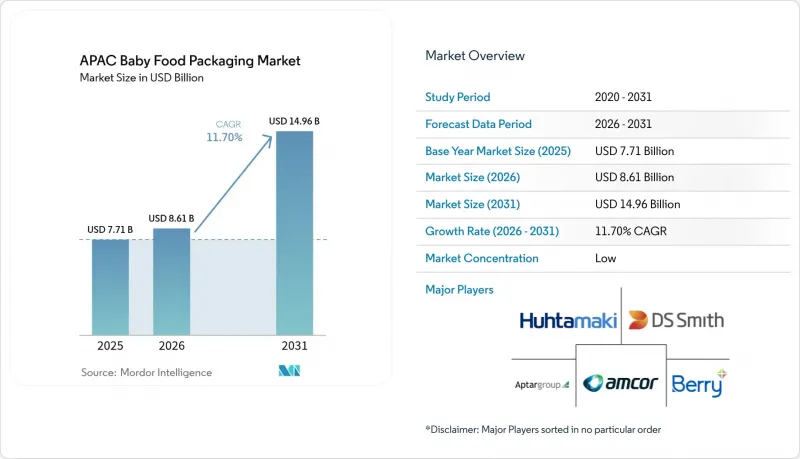
根據 Mordor Intelligence 預測,亞太地區嬰兒食品包裝市場規模將從 2025 年的 77.1 億美元成長到 2026 年的 86.1 億美元,到 2031 年將達到 149.6 億美元,2026 年至 2031 年的複合年成長率為 11.70%。
本報告按材料(塑膠、紙板、金屬、玻璃、生質塑膠)、包裝類型(瓶子、金屬罐、紙箱等)、產品類型(乾燥嬰兒食品、液體配方奶粉、粉狀配方奶粉等)、年齡層(0-6 個月、6-12 個月、1-2 歲、2-3 歲)、銷售管道(/大型超級市場、便利商店(/大賣場、便利市場)和地區分類。
亞太地區嬰幼兒食品包裝市場趨勢與洞察
包裝嬰兒食品和嬰兒配方奶粉的需求不斷增加。
2024年,中國嬰幼兒配方奶粉市場仍維持強勁成長,外資品牌銷售額成長8%,超高階市場佔37%的市佔率。亞太地區的都市區父母傾向於選擇安全、保存期限長、營養價值高的產品,這推動了對多層阻隔膜和高階包裝的需求。代際財富轉移提升了千禧世代的購買力,他們更注重產品的便利性和高品質,而非自製替代品。儘管都市區之間仍存在差距,但大都會圈已成為需求高度集中的高密度叢集。
都市區雙薪家庭數量不斷增加
雙薪家庭優先考慮能夠滿足其忙碌日常生活需求的包裝。帶吸嘴的包裝袋方便外出哺乳,易於重新密封,且不易弄髒,符合父母的期望。在韓國和新加坡,隨著經濟實力的增強,高階、分量適中的包裝正在加速普及;隨著女性勞動參與率的提高,越南和印尼也開始出現類似的趨勢。因此,各大品牌紛紛優先採用符合人體工學的形狀、柔軟的覆膜以及單手即可開啟的快速開口設計。
對一次性塑膠製品實施嚴格監管
在印度,許多硬質容器類別被強制要求在2025年達到30%的再生材料含量,需要加速研發和認證流程。製造商面臨經認證的消費後再生樹脂(PCR樹脂)採購成本增加,以及關於滲出物和氣味方面更嚴格的規範。新加坡和印尼也在實施類似的措施,這進一步加劇了跨國供應鏈的複雜性,因為它們必須應對不同的合規期限。
細分市場分析
2025年,塑膠在亞太地區嬰幼兒食品包裝市場佔據主導地位,銷售額佔比高達46.15%。然而,在泰國投資促進政策和跨國品牌碳中和承諾的支持下,預計到2031年,生質塑膠的複合年成長率將達到17.85%。隨著NatureWorks和SKC等公司產能的提升,生物塑膠與石油基聚合物的成本差距正在縮小,預計亞太地區嬰幼兒食品包裝市場將成為生質塑膠市場成長最快的領域。泰國和越南的政府補貼降低了投資門檻,而加工性能的提升也使得生物基PLA和PBAT薄膜的耐熱性和密封強度能夠與傳統軟包裝相媲美。
在一些新興市場,價格敏感度仍然限制了可堆肥包裝的普及,但高階和有機嬰兒食品品牌正將可堆肥包裝融入其品牌故事中。玻璃容器在高階禮品市場仍佔據重要地位,但其重量和易碎性正在降低其在電子商務領域的競爭力。隨著市場轉向更輕的阻隔層壓材料,對金屬罐的需求正在下降。紙板,通常與生物阻隔塗層結合使用,作為一種高階二級包裝材料,仍然佔據著一定的市場佔有率。
至2025年,袋裝產品將在亞太地區嬰幼兒食品包裝市場佔據32.55%的佔有率。受便於嬰兒自主進食的吸嘴設計的推動,該市場預計將以15.35%的複合年成長率成長。因此,在亞太地區的嬰幼兒食品包裝市場中,袋裝產品的成長速度超過了硬質容器。瓶裝產品對即飲配方奶粉仍然很重要,但SIG和利樂等公司的包裝系統目前正與標榜低碳足跡的單一材料軟包裝競爭。由於重量劣勢,金屬罐的展示吸引力正在下降,在會員製商店中,它們正被具有類似阻隔性能的立式袋所取代。
製造商高度重視包裝的物流優勢,因為它能減少進貨量和倉儲空間。對零售商而言,消費者偏好輕便包裝有助於提高貨架陳列密度和銷售效率。在印尼和菲律賓,一次性產品的可負擔性優先於永續性考量,小包裝袋仍然是一種經濟實惠的選擇。雖然高檔有機食物泥仍使用玻璃瓶,但人們正逐漸轉向使用更輕的PET瓶。
其他好處:
- Excel格式的市場預測(ME)表
- 3個月的分析師支持
目錄
第1章:引言
- 研究假設和市場定義
- 調查範圍
第2章:調查方法
第3章執行摘要
第4章 市場狀況
- 市場概覽
- 市場促進因素
- 包裝嬰兒食品和配方奶粉的需求不斷增加。
- 都市區雙薪家庭數量增加
- 有組織的零售和電子商務的擴張
- 品牌主導下朝向更便利的袋裝形式轉型。
- 政府對生物基包裝生產線的補貼
- OEM廠商對內部軟性加工能力的投資
- 市場限制因素
- 對一次性塑膠製品實施嚴格監管
- 食品級樹脂價格波動
- 人們偏好自製嬰兒食品
- 東南亞新興經濟體回收基礎設施的差異
- 永續發展趨勢
- 監理情勢
- 技術展望
- 波特五力分析
- 投資分析
第5章 市場規模與成長預測
- 材料
- 塑膠
- 紙板
- 金屬
- 玻璃
- 生質塑膠
- 按包裝類型
- 瓶子
- 金屬罐
- 紙盒
- 罐
- 其他
- 依產品
- 嬰兒乾糧
- 液態奶粉
- 奶粉配方
- 零食和手指食品
- 其他
- 按年齡層
- 0-6個月
- 6-12個月大
- 1-2歲
- 2-3歲
- 透過分銷管道
- 超級市場/大賣場
- 便利商店
- 藥局/藥局
- 線上零售
- 其他
- 國家
- 中國
- 印度
- 日本
- 韓國
- 印尼
- 泰國
- 馬來西亞
- 其他亞太國家
第6章 競爭情勢
- 市場集中度
- 策略趨勢
- 市佔率分析
- 公司簡介
- Amcor PLC
- Huhtamaki Oyj
- Berry Global Inc.
- Aptar Group Inc.
- Winpak Ltd.
- Tetra Laval
- Constantia Flexibles
- Uflex Ltd.
- DS Smith Plc
- Ball Corporation
- Mondi Group
- SIG Combibloc
- Sealed Air Corp.
- Toyo Seikan Group
- Sonoco Products Co.
- Gualapack SpA
- ProAmpac LLC
- Takigawa Corporation
- Visy Industries
- Nihon Yamamura Glass Co.
- Shenzhen Beauty Star Co.
第7章 市場機會與未來展望
According to Mordor Intelligence, the APAC baby food packaging market size is expected to grow from USD 7.71 billion in 2025 to USD 8.61 billion in 2026 and is forecast to reach USD 14.96 billion by 2031 at 11.70% CAGR over 2026-2031.
This report is Segmented by Material (Plastic, Paperboard, Metal, Glass, Bioplastics), Package Type (Bottles, Metal Cans, Cartons, and More), Product (Dried Baby Food, Liquid Milk Formula, Powder Milk Formula and More), Age Group (0-6 Months, 6-12 Months, 1-2 Years, 2-3 Years), Distribution Channel (Supermarkets/Hypermarkets, Convenience Stores and More), and Geography.
APAC Baby Food Packaging Market Trends and Insights
Growing demand for packaged baby food and infant formula
China's infant formula segment stayed resilient in 2024 as foreign brands logged 8% sales growth, with the super-premium tier securing 37% share. Parents in urban APAC favor products that guarantee safety, extended shelf life and superior nutrition, prompting demand for multi-layer barrier films and premium finishes. Generational wealth transfer brings millennial purchasing power that privileges convenience and perceived quality over homemade alternatives. Urban-rural divides remain, yet metropolitan centers have become high-density demand clusters.
Rising dual-income urban households
Households with two earners value packaging that supports hectic routines. Spouted pouches enable on-the-go feeding, easy resealability and reduced mess, aligning with parental expectations. Affluence in South Korea and Singapore accelerates adoption of premium, portion-controlled packs, while Vietnam and Indonesia are beginning to mirror the trend as female labor participation rises. Brands are therefore prioritizing ergonomic shapes, soft-touch laminates and quick-open closures suitable for one-hand use.
Stringent bans on single-use plastics
India mandates 30% recycled content by 2025 in many rigid categories, forcing accelerated R&D and qualification cycles. Producers face added costs for certified PCR resin and tighter specifications on migration and odor. Parallel measures in Singapore and Indonesia add complexity for multinational supply chains that must juggle differing compliance deadlines.
Other drivers and restraints analyzed in the detailed report include:
- Expansion of organised retail and e-commerce
- Brand-led shift toward convenience pouch formats
- Volatility in food-grade resin pricing
For complete list of drivers and restraints, kindly check the Table Of Contents.
Segment Analysis
Plastic dominated the APAC baby food packaging market in 2025 with 46.15% revenue share. Bioplastics, however, are charting an 17.85% CAGR to 2031, supported by Thailand's pro-investment regime and multinational brand pledges on carbon neutrality. The APAC baby food packaging market size for bioplastics is expected to grow the fastest as capacity from NatureWorks and SKC reduces cost differentials with petro-based polymers. Government subsidies in Thailand and Vietnam lower capital thresholds, while improved processability allows bio-based PLA and PBAT films to match heat resistance and sealing integrity of conventional flexibles.
Price sensitivity still limits uptake in several emerging economies, yet premium and organic baby food brands are using compostable packs as a brand story. Glass maintains relevance in luxury gifting, yet its weight and fragility reduce competitiveness in e-commerce. Metal can demand is retreating in favor of lighter barrier laminates. Paperboard, often coupled with bio-barrier coatings, retains a niche for premium secondary packs.
Pouches held 32.55% share of the APAC baby food packaging market in 2025. They are forecast to expand at 15.35% CAGR, propelled by spouted designs that support independent toddler feeding. The APAC baby food packaging market size for pouches is therefore widening more quickly than rigid formats. Bottles stay important for ready-to-drink formula, but SIG and Tetra systems now compete with mono-material flexibles that claim lower carbon footprints. Metal cans are losing shelf appeal due to weight penalties and are being displaced in club stores by stand-up pouches with fitments that offer similar barrier levels.
Manufacturers appreciate the logistics benefits of pouches, which reduce inbound freight volumes and warehouse space. Retailers gain faced-up shelf density and improved sell-through as consumers embrace the lighter format. Sachets remain a cost-effective option in Indonesia and the Philippines, where single-use affordability trumps sustainability concerns. Jars persist for premium organic purees but are trending toward lightweight PET rather than glass.
Complete Report Scope:
- By Material
- Plastic
- Paperboard
- Metal
- Glass
- Bioplastics
- By Package Type
- Bottles
- Metal Cans
- Cartons
- Jars
- Others
- By Product
- Dried Baby Food
- Liquid Milk Formula
- Powder Milk Formula
- Snacks and Finger Foods
- Others
- By Age Group
- 0-6 Months
- 6-12 Months
- 1-2 Years
- 2-3 Years
- By Distribution Channel
- Supermarkets / Hypermarkets
- Convenience Stores
- Pharmacies and Drugstores
- Online Retail
- Others
- By Country
- China
- India
- Japan
- South Korea
- Indonesia
- Thailand
- Malaysia
- Rest of Asia-Pacific
List of Companies Covered in this Report:
- Amcor PLC
- Huhtamaki Oyj
- Berry Global Inc.
- Aptar Group Inc.
- Winpak Ltd.
- Tetra Laval
- Constantia Flexibles
- Uflex Ltd.
- DS Smith Plc
- Ball Corporation
- Mondi Group
- SIG Combibloc
- Sealed Air Corp.
- Toyo Seikan Group
- Sonoco Products Co.
- Gualapack SpA
- ProAmpac LLC
- Takigawa Corporation
- Visy Industries
- Nihon Yamamura Glass Co.
- Shenzhen Beauty Star Co.
Additional Benefits:
- The market estimate (ME) sheet in Excel format
- 3 months of analyst support
TABLE OF CONTENTS
1 INTRODUCTION
- 1.1 Study Assumptions and Market Definition
- 1.2 Scope of the Study
2 RESEARCH METHODOLOGY
3 EXECUTIVE SUMMARY
4 MARKET LANDSCAPE
- 4.1 Market Overview
- 4.2 Market Drivers
- 4.2.1 Growing demand for packaged baby food and infant formula
- 4.2.2 Rising dual-income urban households
- 4.2.3 Expansion of organised retail and e-commerce
- 4.2.4 Brand-led shift toward convenience pouch formats
- 4.2.5 Government subsidies for bio-based packaging lines
- 4.2.6 OEM investment in in-house flexible converting capacity
- 4.3 Market Restraints
- 4.3.1 Stringent bans on single-use plastics
- 4.3.2 Volatility in food-grade resin pricing
- 4.3.3 Cultural preference for home-cooked baby food
- 4.3.4 Recycling-infrastructure gaps across emerging SE-Asian economies
- 4.4 Sustainability Trends
- 4.5 Regulatory Landscape
- 4.6 Technological Outlook
- 4.7 Porter's Five Forces Analysis
- 4.7.1 Threat of New Entrants
- 4.7.2 Bargaining Power of Buyers
- 4.7.3 Bargaining Power of Suppliers
- 4.7.4 Threat of Substitutes
- 4.7.5 Competitive Rivalry
- 4.8 Investment Analysis
5 MARKET SIZE AND GROWTH FORECASTS (VALUE)
- 5.1 By Material
- 5.1.1 Plastic
- 5.1.2 Paperboard
- 5.1.3 Metal
- 5.1.4 Glass
- 5.1.5 Bioplastics
- 5.2 By Package Type
- 5.2.1 Bottles
- 5.2.2 Metal Cans
- 5.2.3 Cartons
- 5.2.4 Jars
- 5.2.5 Others
- 5.3 By Product
- 5.3.1 Dried Baby Food
- 5.3.2 Liquid Milk Formula
- 5.3.3 Powder Milk Formula
- 5.3.4 Snacks and Finger Foods
- 5.3.5 Others
- 5.4 By Age Group
- 5.4.1 0-6 Months
- 5.4.2 6-12 Months
- 5.4.3 1-2 Years
- 5.4.4 2-3 Years
- 5.5 By Distribution Channel
- 5.5.1 Supermarkets / Hypermarkets
- 5.5.2 Convenience Stores
- 5.5.3 Pharmacies and Drugstores
- 5.5.4 Online Retail
- 5.5.5 Others
- 5.6 By Country
- 5.6.1 China
- 5.6.2 India
- 5.6.3 Japan
- 5.6.4 South Korea
- 5.6.5 Indonesia
- 5.6.6 Thailand
- 5.6.7 Malaysia
- 5.6.8 Rest of Asia-Pacific
6 COMPETITIVE LANDSCAPE
- 6.1 Market Concentration
- 6.2 Strategic Moves
- 6.3 Market Share Analysis
- 6.4 Company Profiles (includes Global-level Overview, Market-level overview, Core Segments, Financials as available, Strategic Information, Market Rank/Share, Products and Services, Recent Developments)
- 6.4.1 Amcor PLC
- 6.4.2 Huhtamaki Oyj
- 6.4.3 Berry Global Inc.
- 6.4.4 Aptar Group Inc.
- 6.4.5 Winpak Ltd.
- 6.4.6 Tetra Laval
- 6.4.7 Constantia Flexibles
- 6.4.8 Uflex Ltd.
- 6.4.9 DS Smith Plc
- 6.4.10 Ball Corporation
- 6.4.11 Mondi Group
- 6.4.12 SIG Combibloc
- 6.4.13 Sealed Air Corp.
- 6.4.14 Toyo Seikan Group
- 6.4.15 Sonoco Products Co.
- 6.4.16 Gualapack SpA
- 6.4.17 ProAmpac LLC
- 6.4.18 Takigawa Corporation
- 6.4.19 Visy Industries
- 6.4.20 Nihon Yamamura Glass Co.
- 6.4.21 Shenzhen Beauty Star Co.
7 MARKET OPPORTUNITIES AND FUTURE OUTLOOK
- 7.1 White-space and Unmet-need Assessment

 2026-2030年全球嬰幼兒食品包裝市場
 嬰兒食品玻璃包裝:市場佔有率分析、產業趨勢與統計及成長預測(2026-2031)
 嬰兒食品包裝市場:全球市場預測,2026-2032年嬰兒食品包裝:市場佔有率分析、產業趨勢與統計、成長預測(2026-2031)
 全球嬰幼兒食品包裝市場:市場規模、佔有率、成長和行業分析:按材料類型、產品類型和區域預測(至2034年)
 嬰兒食品包裝市場報告:按產品、材料、包裝類型和地區分類(2026-2034 年)
 嬰兒食品包裝市場規模、佔有率、成長及全球產業分析:按類型和應用、區域的洞察,2026-2034年預測
 嬰兒食品包裝市場規模、佔有率和成長分析(按材料、包裝類型、食品類型、分銷管道和地區分類)-2026-2033年產業預測中東和非洲嬰兒食品包裝:市場佔有率分析、產業趨勢、成長預測(2025-2030)北美嬰兒食品包裝:市場佔有率分析、行業趨勢和成長預測(2025-2030)