


 |
市場調查報告書
商品編碼
2121879
嬰兒食品包裝:市場佔有率分析、產業趨勢與統計、成長預測(2026-2031)Baby Food Packaging - Market Share Analysis, Industry Trends & Statistics, Growth Forecasts (2026 - 2031) |
||||||

※ 本網頁內容可能與最新版本有所差異。詳細情況請與我們聯繫。
據 Mordor Intelligence 稱,2025 年嬰兒食品包裝市場價值 82 億美元,預計到 2031 年將從 2026 年的 88.6 億美元成長至 125.6 億美元,預測期(2026-2031 年)的複合年成長率預計為 7.22%。
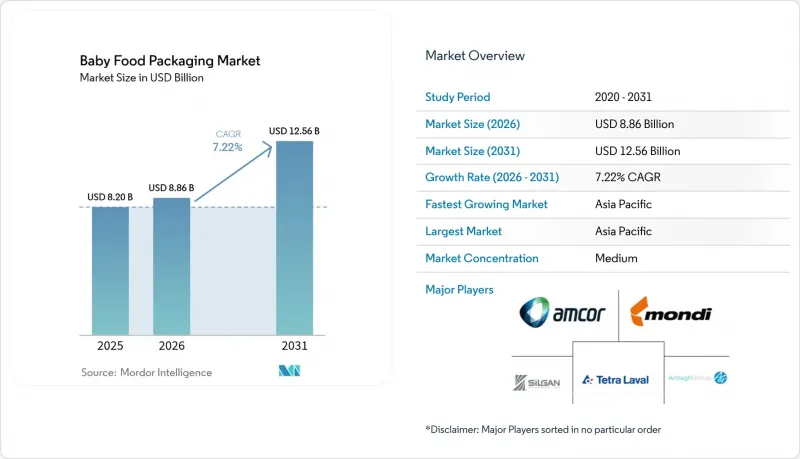
本報告按材料(塑膠、紙板、金屬、玻璃、生質塑膠)、包裝類型(瓶裝、紙盒裝、罐裝、袋裝、盒中袋)、產品(液態奶、乾燥嬰兒食品、奶粉、已烹調嬰兒食品、嬰兒零食)和地區進行細分。市場預測以美元計價。
全球嬰幼兒食品包裝市場趨勢及洞察
嬰兒食品袋裝產品的普及,以便利性為首要考量。
輕便可重複密封的包裝袋已成為都市區市場外餵的必備品,因為父母越來越重視便攜性和份量控制。 SIG Combibloc 的「Prime 55」線上無菌填充系統將於 2024 年推出,該系統一步完成吸嘴安裝和無菌填充,從而簡化了生產線並減少了第三方滅菌環節。 IMA 集團的「FillShape」設備將於 2025 年由多家歐洲加工商採用,該設備可生產直立式包裝袋,方便在貨架上醒目展示。在日本和韓國,由於單親家庭和祖父母等需要快速準備的餵食方式,零售連鎖店在 2025 年實現了包裝袋銷售額兩位數的成長。此外,線上零售商也青睞包裝袋,因為與玻璃瓶相比,包裝袋重量更輕,可以降低運輸成本並減少破損投訴。
都市區雙薪家庭尋求節省時間的套餐優惠
根據中國國家統計局的數據,到2025年,都市區嬰幼兒家庭中雙薪家庭的比例將達到68%,高於2020年的54%。由於時間緊迫,消費者越來越傾向於選擇無需冷藏、常溫保存的袋裝和盒裝產品,這一趨勢在冷鏈基礎設施不發達的二、三線城市尤為明顯。為了滿足這項需求,利樂公司於2025年在印度推出了200毫升帶旋蓋的無菌紙盒裝產品。巴西和墨西哥也出現了類似的趨勢,預計到2025年,兩國的都市化將超過85%,自2023年以來,超級市場中嬰兒食品袋裝產品的滲透率加倍。在東南亞,袋裝產品的價格比玻璃罐裝產品高出15%至20%,但由於消費者認為這種包裝形式更方便,因此周轉率仍然很高。
塑膠永續性引發的強烈反對和法律法規
法國將於2024年對原生塑膠徵收每公斤0.50歐元的稅,這將使包裝袋樹脂的成本上漲8%至12%。英國將於2025年推出生產者延伸責任制(EPR),對不可回收的複合材料徵收每噸最高1000英鎊的額外費用。德國和荷蘭的零售商已開始停止銷售未使用單一材料解決方案的嬰兒食品品牌。歐洲環境署(EEB)2025年的調查顯示,72%的家長願意為纖維或玻璃製成的包裝支付10%的附加費。儘管紙盒、可回收包裝袋和玻璃罐在成本和重量方面存在劣勢,但這些趨勢正在加速向這些包裝方式的轉變。
細分市場分析
儘管預計到2025年塑膠將佔銷售額的43.87%,但紙板預計將以8.21%的速度成長,成為所有材料中成長率最高的。這主要得益於生產者延伸責任制(EPR)下對纖維回收率高的材料所給予的優惠待遇。利樂包裝盒在歐洲造紙廠的回收率已達90%,因此符合降低EPR費用的條件。同時,SIG CombiBloc的植物來源聚合物阻隔層進一步降低了化石基成分的含量。預計嬰兒食品紙板包裝市場也將反映出這一成長勢頭,尤其是在市政回收基礎設施完善的地區。
加工商正持續測試水性塗層和等離子沉澱阻隔層,以賦予紙板足夠的防潮性能,使其能夠抵禦酸性食物泥的侵蝕。金屬罐作為高階蒸餾食品的利基市場,依然佔有一席之地,但正面臨來自不含雙酚A(BPA)塗層的價格壓力。玻璃包裝保持著「純淨」的形象,但在電子商務領域存在重量和易碎等劣勢。生質塑膠因其可堆肥性而備受青睞,但其價格比聚乙烯高出40-60%,且由於缺乏廣泛的回收系統,其對嬰幼兒食品包裝市場的即時影響有限。
區域分析
預計到2025年,亞太地區將佔全球銷售額的42.52%,預計年增率為8.14%,是所有地區中成長率最高的。中國主要電商企業正在實施QR碼溯源,增強家長對商品真實性的信任。在印度的二線城市,政府的冷鏈計畫正在提升「最後一公里」配送的可靠性,從而實現了兩位數的成長。在日本和韓國等成熟市場,高階玻璃瓶的銷售仍然強勁;而在印尼、泰國和越南,適用於常溫物流的軟包裝袋正逐漸佔據主導地位。
北美擁有第二大市場佔有率,這得益於嚴格的法律規範和廣泛的有機食品標籤。隨著自製嬰兒食品趨勢的興起,北美市場成長放緩。家長紛紛購買桌上型攪拌機和可重複使用的矽膠袋,導致包裝食物泥的需求下降。加拿大遵循美國的安全標準,但同時要求雙語標籤。在墨西哥,隨著主要城市連鎖超級市場擴大嬰幼兒食品的種類,袋裝食品的使用率正在迅速成長。
在歐洲,嚴格的永續性法規與有機產品的高滲透率並存。德國、法國和英國優先推廣單一成分的袋裝產品,以控制生產者延伸責任(EPR)成本,而義大利和西班牙仍然偏好透明玻璃瓶裝。在東歐國家,收入的成長促使人們轉向使用單份包裝的袋裝產品。在南美洲,特別是巴西和阿根廷,由於都市區冷藏設施不足,袋裝產品推動了市場擴張。此外,在中東和非洲,隨著外籍人士和中產階級的增加,西式飲食習慣正在傳播。
其他好處:
- Excel格式的市場預測(ME)表
- 3個月的分析師支持
目錄
第1章:引言
- 研究假設和市場定義
- 調查範圍
第2章:調查方法
第3章執行摘要
第4章 市場狀況
- 市場概覽
- 市場促進因素
- 嬰兒食品袋因其便利性而廣受歡迎。
- 都市區的雙薪家庭正在尋找節省時間的工作方式。
- 針對嬰幼兒安全的更嚴格法規正在推動對高階包裝的需求增加。
- 無菌豆芽包裝袋填充生產線正變得越來越普及。
- 生產者延伸責任制(EPR)對可回收性的獎勵
- 人工智慧驅動的個人化營養套件設計創新
- 市場限制因素
- 塑膠永續性引發的強烈反對和法律法規
- 化學工業中雙酚A合規成本壓力
- 藥用級噴嘴樹脂供應瓶頸
- 自製嬰兒食品的趨勢正在降低對市售產品的需求。
- 供應鏈分析
- 監理情勢
- 技術展望
- 波特五力模型
- 對影響市場的宏觀經濟因素進行評估
第5章 市場規模與成長預測
- 材料
- 塑膠
- 紙板
- 金屬
- 玻璃
- 生質塑膠
- 按包裝類型
- 瓶子
- 紙盒
- 罐
- 小袋
- 盒中袋
- 依產品
- 液態奶粉
- 嬰兒乾糧
- 奶粉
- 加工嬰兒食品
- 嬰兒零食
- 按地區
- 北美洲
- 美國
- 加拿大
- 墨西哥
- 南美洲
- 巴西
- 阿根廷
- 其他南美國家
- 歐洲
- 德國
- 英國
- 法國
- 義大利
- 西班牙
- 其他歐洲國家
- 亞太地區
- 中國
- 日本
- 印度
- 韓國
- 東南亞
- 其他亞太國家
- 中東
- 沙烏地阿拉伯
- 阿拉伯聯合大公國
- 土耳其
- 其他中東國家
- 非洲
- 南非
- 奈及利亞
- 埃及
- 其他非洲國家
- 北美洲
第6章 競爭情勢
- 市場集中度
- 策略趨勢
- 市佔率分析
- 公司簡介
- Amcor PLC
- Tetra Laval Group
- Mondi Group
- Ardagh Group
- Silgan Holdings Inc.
- Sonoco Products Company
- Winpak Ltd
- DS Smith PLC
- SIG Combibloc Group
- Cheer Pack North America
- Gualapack Group
- Scholle IPN
- UFlex Ltd
- ProAmpac LLC
- Huhtamaki Oyj
- AptarGroup Inc.
- Plastipak Packaging Inc.
- Crown Holdings Inc.
- Sealed Air Corp.
第7章 市場機會與未來展望
According to Mordor Intelligence, the baby food packaging market size was valued at USD 8.20 billion in 2025 and is estimated to grow from USD 8.86 billion in 2026 to reach USD 12.56 billion by 2031, at a CAGR of 7.22% during the forecast period (2026-2031).
This report is Segmented by Material (Plastic, Paperboard, Metal, Glass, and Bioplastics), Package Type (Bottles, Cartons, Jars, Pouches, and Bag-In-Box), Product (Liquid Milk Formula, Dried Baby Food, Powder Milk Formula, Prepared Baby Food, and Baby Snacks), and by Geography. The Market Forecasts are Provided in Terms of Value (USD).
Global Baby Food Packaging Market Trends and Insights
Convenience-Driven Adoption Of Baby Food Pouches
Lightweight, resealable pouches have become the default format for on-the-go feeding in urban markets because caregivers value portability and portion control. SIG Combibloc's Prime 55 in-line aseptic system, launched in 2024, combines spout attachment and sterile filling in one pass, trimming line complexity and third-party sterilization steps. IMA Group's FillShape equipment, adopted by several European converters in 2025, enables upright-shaped pouches that command front-of-shelf visibility. Retail chains in Japan and South Korea reported double-digit growth in pouch sales in 2025 as single-parent families and grandparents sought formats that minimize preparation time. Online retailers also favor pouches because lower weight reduces freight costs and breakage claims versus glass jars.
Urban Dual-Income Households Demanding Time-Saving Formats
China's National Bureau of Statistics recorded that 68% of urban households with infants had two working parents in 2025, up from 54% in 2020. The time squeeze is steering shoppers toward ambient-stable pouches and cartons that need no refrigeration, especially in tier-2 and tier-3 cities where cold-chain gaps persist. Tetra Pak debuted a 200-milliliter aseptic carton with a twist cap in India in 2025 to meet this need. Similar behavior is emerging in Brazil and Mexico, where urbanization rates topped 85% in 2025, and supermarket penetration of baby food pouches doubled since 2023. Although pouch units carry a 15-20% price premium over jars in Southeast Asia, velocity remains higher because shoppers equate the format with convenience
Plastics Sustainability Backlash And Legislation
France imposed a EUR 0.50 per kilogram tax on virgin plastic in 2024, lifting pouch resin costs by 8-12%. The United Kingdom's EPR scheme, launched in 2025, levies surcharges of up to GBP 1,000 per tonne on non-recyclable laminates. German and Dutch retailers have begun delisting baby-food brands that lack mono-material solutions, and a 2025 European Environmental Bureau survey found that 72% of parents are willing to pay a 10% premium for fiber- or glass-based packaging. These dynamics accelerate the shift to paperboard cartons, recyclable pouches, and glass jars despite cost and weight downsides.
Other drivers and restraints analyzed in the detailed report include:
- Stricter Infant-Safety Regulations Expanding Premium Packaging
- Aseptic Spouted-Pouch Filling Lines Gaining Ground
- BPA/Chemicals Compliance Cost Pressures
For complete list of drivers and restraints, kindly check the Table Of Contents.
Segment Analysis
Plastic captured 43.87% of 2025 revenue, yet paperboard is forecast to expand at 8.21%, the highest among materials, as EPR schemes reward substrates that can demonstrate high fiber recovery rates. Tetra Pak cartons already achieve 90% recyclability in European mills, qualifying for reduced EPR fees, while SIG Combibloc's plant-based polymer barrier further lowers fossil content. The baby food packaging market for paperboard is projected to reflect this momentum, especially in regions with mature municipal sorting infrastructure.
Converters continue to trial water-based coatings and plasma-deposited barriers that give paperboard sufficient moisture resistance for acidic purees. Metal cans remain a niche for premium retort products but face price erosion from BPA-free coatings. Glass maintains a purity halo but suffers weight and breakage penalties in e-commerce. Bioplastics, though attractive for their compostability claims, cost 40-60% more than polyethylene and lack widespread collection systems, limiting their immediate impact on the baby food packaging market.
Complete Report Scope:
- By Material
- Plastic
- Paperboard
- Metal
- Glass
- Bioplastics
- By Package Type
- Bottles
- Cartons
- Jars
- Pouches
- Bag-in-Box
- By Product
- Liquid Milk Formula
- Dried Baby Food
- Powder Milk Formula
- Prepared Baby Food
- Baby Snacks
- By Geography
- North America
- United States
- Canada
- Mexico
- South America
- Brazil
- Argentina
- Rest of South America
- Europe
- Germany
- United Kingdom
- France
- Italy
- Spain
- Rest of Europe
- Asia-Pacific
- China
- Japan
- India
- South Korea
- Southeast Asia
- Rest of Asia-Pacific
- Middle East
- Saudi Arabia
- United Arab Emirates
- Turkey
- Rest of Middle East
- Africa
- South Africa
- Nigeria
- Egypt
- Rest of Africa
- North America
Geography Analysis
Asia-Pacific accounted for 42.52% of 2025 revenue and is projected to expand at 8.14%, the fastest regional pace. E-commerce majors in China have embraced QR-code traceability, reinforcing parent confidence in authenticity. India's tier-2 cities post double-digit growth as government cold-chain programs improve last-mile reliability. Mature markets such as Japan and South Korea sustain premium glass-jar sales, whereas Indonesia, Thailand, and Vietnam lean on pouches compatible with ambient logistics.
North America ranks second in size, underpinned by stringent regulatory oversight and widespread organic labeling. Growth moderates as a do-it-yourself baby-food movement gains traction: parents invest in countertop blenders and reusable silicone pouches, trimming demand for packaged purees. Canada mirrors U.S. safety rules but layers bilingual labeling requirements; Mexico chalks up brisk pouch adoption as supermarket chains widen infant-nutrition assortments in major cities.
Europe balances tough sustainability mandates with high organic penetration. Germany, France, and the United Kingdom prioritize mono-material pouches to curb EPR fees, while Italy and Spain still favor transparent glass jars. Eastern European countries transition toward portion-controlled pouches as incomes rise. South America, led by Brazil and Argentina, is witnessing pouch-driven expansion in urban hubs with patchy refrigeration, and the Middle East and Africa are following Western feeding habits as expatriate populations and middle classes grow.
- Amcor PLC
- Tetra Laval Group
- Mondi Group
- Ardagh Group
- Silgan Holdings Inc.
- Sonoco Products Company
- Winpak Ltd
- DS Smith PLC
- SIG Combibloc Group
- Cheer Pack North America
- Gualapack Group
- Scholle IPN
- UFlex Ltd
- ProAmpac LLC
- Huhtamaki Oyj
- AptarGroup Inc.
- Plastipak Packaging Inc.
- Crown Holdings Inc.
- Sealed Air Corp.
Additional Benefits:
- The market estimate (ME) sheet in Excel format
- 3 months of analyst support
TABLE OF CONTENTS
1 INTRODUCTION
- 1.1 Study Assumptions and Market Definition
- 1.2 Scope of the Study
2 RESEARCH METHODOLOGY
3 EXECUTIVE SUMMARY
4 MARKET LANDSCAPE
- 4.1 Market Overview
- 4.2 Market Drivers
- 4.2.1 Convenience-Driven Adoption Of Baby Food Pouches
- 4.2.2 Urban Dual-Income Households Demanding Time-Saving Formats
- 4.2.3 Stricter Infant-Safety Regulations Expanding Premium Packaging
- 4.2.4 Aseptic Spouted-Pouch Filling Lines Gaining Ground
- 4.2.5 Extended-Producer-Responsibility Incentives For Recyclability
- 4.2.6 Ai-Led Personalised-Nutrition Pack Design Innovations
- 4.3 Market Restraints
- 4.3.1 Plastics Sustainability Backlash And Legislation
- 4.3.2 Bpa/Chemicals Compliance Cost Pressures
- 4.3.3 Supply Bottlenecks Of Pharma-Grade Spout Resins
- 4.3.4 DIY Baby-Food Trend Reducing Packaged Demand
- 4.4 Supply-Chain Analysis
- 4.5 Regulatory Landscape
- 4.6 Technological Outlook
- 4.7 Porter's Five Forces
- 4.7.1 Threat of New Entrants
- 4.7.2 Bargaining Power of Buyers
- 4.7.3 Bargaining Power of Suppliers
- 4.7.4 Threat of Substitute Products
- 4.7.5 Intensity of Competitive Rivalry
- 4.8 Assesment of Macroeconomic Factors on the Market
5 MARKET SIZE AND GROWTH FORECASTS (VALUE)
- 5.1 By Material
- 5.1.1 Plastic
- 5.1.2 Paperboard
- 5.1.3 Metal
- 5.1.4 Glass
- 5.1.5 Bioplastics
- 5.2 By Package Type
- 5.2.1 Bottles
- 5.2.2 Cartons
- 5.2.3 Jars
- 5.2.4 Pouches
- 5.2.5 Bag-in-Box
- 5.3 By Product
- 5.3.1 Liquid Milk Formula
- 5.3.2 Dried Baby Food
- 5.3.3 Powder Milk Formula
- 5.3.4 Prepared Baby Food
- 5.3.5 Baby Snacks
- 5.4 By Geography
- 5.4.1 North America
- 5.4.1.1 United States
- 5.4.1.2 Canada
- 5.4.1.3 Mexico
- 5.4.2 South America
- 5.4.2.1 Brazil
- 5.4.2.2 Argentina
- 5.4.2.3 Rest of South America
- 5.4.3 Europe
- 5.4.3.1 Germany
- 5.4.3.2 United Kingdom
- 5.4.3.3 France
- 5.4.3.4 Italy
- 5.4.3.5 Spain
- 5.4.3.6 Rest of Europe
- 5.4.4 Asia-Pacific
- 5.4.4.1 China
- 5.4.4.2 Japan
- 5.4.4.3 India
- 5.4.4.4 South Korea
- 5.4.4.5 Southeast Asia
- 5.4.4.6 Rest of Asia-Pacific
- 5.4.5 Middle East
- 5.4.5.1 Saudi Arabia
- 5.4.5.2 United Arab Emirates
- 5.4.5.3 Turkey
- 5.4.5.4 Rest of Middle East
- 5.4.6 Africa
- 5.4.6.1 South Africa
- 5.4.6.2 Nigeria
- 5.4.6.3 Egypt
- 5.4.6.4 Rest of Africa
- 5.4.1 North America
6 COMPETITIVE LANDSCAPE
- 6.1 Market Concentration
- 6.2 Strategic Moves
- 6.3 Market Share Analysis
- 6.4 Company Profiles (includes Global level Overview, Market level overview, Core Segments, Financials as available, Strategic Information, Market Rank/Share for key companies, Products and Services, and Recent Developments)
- 6.4.1 Amcor PLC
- 6.4.2 Tetra Laval Group
- 6.4.3 Mondi Group
- 6.4.4 Ardagh Group
- 6.4.5 Silgan Holdings Inc.
- 6.4.6 Sonoco Products Company
- 6.4.7 Winpak Ltd
- 6.4.8 DS Smith PLC
- 6.4.9 SIG Combibloc Group
- 6.4.10 Cheer Pack North America
- 6.4.11 Gualapack Group
- 6.4.12 Scholle IPN
- 6.4.13 UFlex Ltd
- 6.4.14 ProAmpac LLC
- 6.4.15 Huhtamaki Oyj
- 6.4.16 AptarGroup Inc.
- 6.4.17 Plastipak Packaging Inc.
- 6.4.18 Crown Holdings Inc.
- 6.4.19 Sealed Air Corp.
7 MARKET OPPORTUNITIES AND FUTURE OUTLOOK
- 7.1 White-space and Unmet-need Assessment

 2026-2030年全球嬰幼兒食品包裝市場
 嬰兒食品玻璃包裝:市場佔有率分析、產業趨勢與統計及成長預測(2026-2031)
 嬰兒食品包裝市場:全球市場預測,2026-2032年亞太地區嬰幼兒食品包裝:市場佔有率分析、產業趨勢與統計及成長預測(2026-2031)
 全球嬰幼兒食品包裝市場:市場規模、佔有率、成長和行業分析:按材料類型、產品類型和區域預測(至2034年)
 嬰兒食品包裝市場報告:按產品、材料、包裝類型和地區分類(2026-2034 年)
 嬰兒食品包裝市場規模、佔有率、成長及全球產業分析:按類型和應用、區域的洞察,2026-2034年預測
 嬰兒食品包裝市場規模、佔有率和成長分析(按材料、包裝類型、食品類型、分銷管道和地區分類)-2026-2033年產業預測中東和非洲嬰兒食品包裝:市場佔有率分析、產業趨勢、成長預測(2025-2030)北美嬰兒食品包裝:市場佔有率分析、行業趨勢和成長預測(2025-2030)