


 |
市場調查報告書
商品編碼
2121831
電子黏合劑:市場佔有率分析、產業趨勢和統計數據、成長預測(2026-2031)Electronics Adhesives - Market Share Analysis, Industry Trends & Statistics, Growth Forecasts (2026 - 2031) |
||||||

※ 本網頁內容可能與最新版本有所差異。詳細情況請與我們聯繫。
根據 Mordor Intelligence 預測,電子設備黏合劑的市場規模預計將從 2025 年的 65.1 億美元成長到 2026 年的 70.7 億美元,到 2031 年將達到 106.9 億美元,2026 年至 2031 年的複合年成長率為 8.63%。
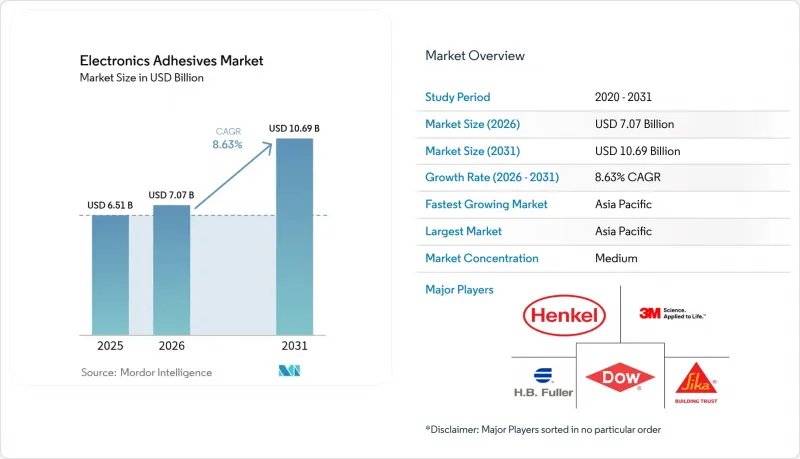
本報告按樹脂類型(環氧樹脂、丙烯酸樹脂等)、產品類型(導電型、導熱型等)、應用領域(三防膠、表面黏著技術等)、終端用戶產業(消費性電子產品、IT硬體等)和地區(亞太地區、北美地區、歐洲地區等)進行細分。市場預測以美元計價。
全球電子黏合劑市場趨勢與洞察
高密度包裝的激增
高密度封裝將鍵合線的公差縮小到微米級,這要求黏合劑具有窄黏度範圍、可控的脫氣性能以及能夠吸收堆疊晶片間熱膨脹差異的彈性模量。在晶圓級封裝 (WLP) 和 3D 整合中,鍵結表面會經歷回流焊接溫度的波動,峰值約為 260 度C ,而新配方的環氧-矽氧烷混合材料能夠滿足此溫度閾值。 DELO 最新的晶圓級產品系列能夠承受如此高的溫度,同時保持適用於高精度噴頭所需的流動性。這些性能優異的材料的應用範圍正在從智慧型手機擴展到高級駕駛輔助系統 (ADAS) 的控制單元和緊湊型工業感測器,所有這些應用都面臨著與消費性電子設備相同的空間限制。
對表面黏著技術(SMT)的需求不斷成長,而這需要使用黏合劑。
表面貼裝技術 (SMT) 最初是一種降低成本的工具,如今它能夠實現超細間距貼裝,使元件間距小於焊膏的容差。黏合劑透過重新分配覆晶封裝內的熱機械應力並防止錫晶鬚生長,從而降低穿戴式電子產品的現場故障率。汽車資訊娛樂基板對膠合劑提出了更高的要求,例如振動阻尼和 1000 小時的熱循環耐久性,這推動了對專用環氧-聚醯亞胺混合物的需求。設備製造商正在透過高通量噴射點膠機(可將線上循環時間縮短高達 40%)和兩階段熱/紫外線固化站來滿足這一需求,從而促進黏合劑在電子黏合劑市場的應用。
環氧樹脂和丙烯酸酯原料價格波動
環氧氯丙烷供應中斷和運費上漲已將環氧樹脂現貨價格推至多年來的高位,擠壓了小規模化合物生產商的毛利率。美國國際貿易委員會 (ITC) 對某些亞洲環氧樹脂進口的裁決導致加徵關稅,其影響在幾週內便波及到合約重新談判。複合材料樹脂生產商隨即提價,每噸漲價 150 至 200 歐元,直接推高了黏合劑的成本。大型供應商透過簽訂多年期供應合約來規避風險,而區域性專業生產商則面臨營運資金緊張的困境,這可能會減緩創新步伐。
細分市場分析
環氧樹脂仍然是最重要的電子黏合劑,預計到2025年將佔電子黏合劑市場銷售額的29.74%。其高周向強度、介電穩定性和耐腐蝕性使其在汽車引擎室模組和工業驅動裝置中佔據穩固地位。同時,丙烯酸樹脂以10.78%的複合年成長率成長,透過光熱結合固化速度更快,且對基板具有更高的柔軟性,這些特性在智慧型手機鏡頭堆疊黏合中備受青睞。利用木質素和植物油衍生物開發生物基環氧樹脂旨在減少碳足跡,同時保持260 度C的峰值耐溫性能。在專業組裝製造商中,環氧樹脂和丙烯酸酯的混合樹脂因其能夠在單一配方中實現快速固化而備受關注。這種傳統強度與新型靈活性的結合,凸顯了推動電子黏合劑市場發展的多元化配方藍圖。
第二代聚氨酯系統專為高振動環境而設計,例如暴露於道路衝擊的電池模組。同時,矽酮和氰基丙烯酸酯在高溫功率元件和快速緊固應用領域仍佔據著一定的市場佔有率。監管機構對雙酚A二縮水甘油醚的關注迫使環氧樹脂供應商轉向替代單體,但其長期需求仍然強勁。製造商不斷透過專有的韌性增強劑來提升產品差異化,這些增強劑可將動作溫度範圍從-55 度C擴展至175 度C ,從而鞏固環氧樹脂黏合劑的主導地位,即使丙烯酸黏合劑的出貨量也在成長。
到2025年,導電膠將佔總銷售額的43.25%,在焊點空洞可能威脅電路連續性的場合,導電膠至關重要。銀箔環氧樹脂在覆晶黏接領域佔據主導地位,而鎳基環氧樹脂則為5G天線提供經濟高效的電磁干擾屏蔽。紫外光固化黏合劑正以11.42%的複合年成長率快速成長,透過將生產線週期縮短至數秒,並實現現場光學檢測,顯著提高了相機模組工廠的一次合格率。採用氮化鋁或氮化硼填料配製的導熱膠,散熱能力高達5 W/mK,可延長LED光通量保持時間和變頻器運作。
非導電結構環氧樹脂在需要與高壓線路隔離的領域,尤其是在牽引逆變器和資料中心電源中,保持穩定的需求。結合了紫外線預固化和熱後固化的混合雙固化產品,正逐漸成為複雜3D組件的理想選擇。目前豐富的性能選擇正在推動電子黏合劑市場的發展,使設計人員能夠同時最佳化電氣、熱學和光學參數。
區域分析
預計到2025年,亞太地區將佔全球電子黏合劑銷售額的58.21%,成為該市場最大的區域支柱。在中國當地,受國家對先進封裝生產線的補貼以及晶圓級底部填充產能擴張的推動,2024年電子產品產量增加了11.3%。隨著美國自2025年4月起對電子設備進口實施部分關稅豁免,泰國和越南吸引了新的外國直接投資,組裝計畫也轉移到東協叢集。從樹脂反應釜到全自動SMT生產線,該地區一體化的供應鏈正在縮短前置作業時間,並增強其成本優勢。
由於《晶片與科學法案》(CHIPS and Science Act),北美「回流」運動正在加速推進。該法案撥款520億美元用於國內晶圓製造。對上游工程的這筆資本投資刺激了下游製程黏合劑的需求,例如無塵室級底部填充劑和液態導熱界面材料。同樣,在加拿大魁北克走廊,一家優先使用生物基化學品的新型印刷電子先導工廠已運作,這體現了歐洲在永續性所做的努力。
在歐洲,隨著歐盟獨特的《歐盟晶片法案》強化區域微電子價值鏈,電子黏合劑市場正呈現復甦跡象。包括逐步實施的PFAS法規在內的環境法規,正在活性化無氟潤滑填料的研發。德國一級汽車供應商正致力於為儀錶板顯示器提供可剝離型黏合劑的認證,而斯堪地那維亞電子製造服務(EMS)供應商則專注於低溫固化以降低能耗。
南美洲、中東和非洲正成為新的成長前沿。在巴西馬瑙斯自由貿易區,家用電子電器組裝蓬勃發展,催生了對適用於熱帶潮濕環境的中等黏度丙烯酸黏合劑的需求。阿拉伯聯合大公國(阿拉伯聯合大公國)正透過將自由區優惠政策與人工智慧研發園區相結合,打造區域物流中心,這有望促進當地黏合劑混合廠的建立。儘管目前這些地區的規模較小,但它們為那些希望降低生產集中於傳統地區所帶來的風險的企業提供了多元化經營的機會。
其他好處:
- Excel格式的市場預測(ME)表
- 3個月的分析師支持
目錄
第1章:引言
- 研究假設和市場定義
- 調查範圍
第2章:調查方法
第3章執行摘要
第4章 市場狀況
- 市場概覽
- 市場促進因素
- 高密度包裝需求激增
- 對需要黏合劑的表面黏著技術(SMT)的需求增加。
- Mini-LED 和 Micro-LED 背光技術的應用日益廣泛
- 電子黏合劑的技術進步
- 家用電器生產規模擴大
- 市場限制因素
- 環氧樹脂和丙烯酸酯原料價格波動
- 遵守嚴格的VOC法規和RoHS/REACH法規的成本。
- 超薄軟式電路板因熱失配而導致的故障
- 價值鏈分析
- 波特五力模型
第5章 市場規模與成長預測
- 依樹脂類型
- 環氧樹脂
- 丙烯酸纖維
- 聚氨酯
- 其他樹脂類型(矽酮、氰基丙烯酸酯等)
- 依產品類型
- 導電
- 熱導率
- 紫外線固化
- 其他產品類型(非導電型等)
- 透過使用
- 三防膠
- 表面黏著技術
- 封裝
- 金屬絲釘合
- 其他應用(底部填充、晶片黏接)
- 按最終用戶行業分類
- 消費性硬體
- IT硬體
- 車
- 其他終端用戶產業(工業、電力電子等)
- 按地區
- 亞太地區
- 中國
- 日本
- 印度
- 韓國
- 東南亞國協
- 其他亞太國家
- 北美洲
- 美國
- 加拿大
- 墨西哥
- 歐洲
- 德國
- 英國
- 法國
- 義大利
- 西班牙
- 俄羅斯
- 北歐國家
- 其他歐洲國家
- 南美洲
- 巴西
- 阿根廷
- 其他南美國家
- 中東和非洲
- 沙烏地阿拉伯
- 南非
- 其他中東和非洲國家
- 亞太地區
第6章 競爭情勢
- 市場集中度
- 策略趨勢
- 市佔率和排名分析
- 公司簡介
- 3M
- Arkema
- Avery Dennison
- BASF
- DELO
- Dow
- Dymax Corporation
- HB Fuller Company
- Henkel AG and Co. KGaA
- Huntsman International LLC.
- ITW Engineered Polymers
- Master Bond Inc.
- NAMICS CORPORATION
- Panacol-Elosol GmbH
- Parker Hannifin Corp
- Permabond LLC
- Pidilite Industries Ltd.
- Shin-Etsu Chemical Co., Ltd.
第7章 市場機會與未來展望
According to Mordor Intelligence, the electronics adhesives market size is expected to grow from USD 6.51 billion in 2025 to USD 7.07 billion in 2026 and is forecast to reach USD 10.69 billion by 2031 at 8.63% CAGR over 2026-2031.
This report is Segmented by Resin Type (Epoxy, Acrylic, and More), Product Type (Electrically Conductive, Thermally Conductive, and More), Application (Conformal Coating, Surface Mounting, and More), End-User Industry (Consumer Hardware, IT Hardware, and More), and Geography (Asia-Pacific, North America, Europe, and More). The Market Forecasts are Provided in Terms of Value (USD).
Global Electronics Adhesives Market Trends and Insights
Surge in High-Density Packaging
High-density packaging pushes bond lines toward micron-level tolerances, demanding adhesives with tight-viscosity windows, controlled outgassing, and elastic moduli that absorb differential expansion among stacked die. Wafer-level packaging (WLP) and 3D integration expose joints to reflow excursions that peak near 260 °C, a threshold met by newly formulated epoxy-siloxane hybrids. DELO's latest wafer-level range sustains that temperature while maintaining flow behavior suitable for precision jetting heads. Robust materials have broadened beyond smartphones into advanced driver-assistance systems (ADAS) control units and compact industrial sensors, both of which mirror consumer device space constraints.
Increase in Demand for Surface-Mount Technology Requiring Adhesives
SMT once filled cost-reduction roles but now enables ultra-fine-pitch assembly where component clearances fall below solder paste tolerances. Underfill adhesives redistribute thermo-mechanical stress in flip-chip packages and arrest tin-whisker propagation, cutting field-failure rates in wearable electronics. Automotive infotainment boards add further requirements for vibration damping and 1,000-hour thermal-cycling durability, elevating demand for specialty epoxy-polyimide blends. Equipment makers respond with high-throughput jet dispensers and dual-stage thermal/UV curing stations that shrink in-line takt times by up to 40%, reinforcing adhesive uptake throughout the electronics adhesives market.
Volatility in Epoxy and Acrylate Feedstock Prices
Epichlorohydrin supply disruptions and freight surcharges pushed spot epoxy prices to multi-year highs, crimping gross margins for small formulators. The U.S. International Trade Commission's ruling against certain Asian epoxy imports introduced additional tariffs that filtered into contract renegotiations within weeks. Composite-grade resin producers responded with EUR 150-200 per-ton price hikes, directly raising adhesive cost bases. While top-tier vendors hedge via multi-year supply deals, regional specialists face working-capital strain that may curb innovation pace.
Other drivers and restraints analyzed in the detailed report include:
- Increasing Mini-LED and Micro-LED Backlighting Adoption
- Growing Technological Advancements in Electronic Adhesives
- Stringent VOC and RoHS/REACH Compliance Costs
For complete list of drivers and restraints, kindly check the Table Of Contents.
Segment Analysis
Epoxy resins remained paramount, accounting for 29.74% of 2025 revenue within the electronics adhesives market. Their high cohesive strength, dielectric stability, and resistance to harsh fluids keep them entrenched in under-the-hood automotive modules and industrial drives. Meanwhile, acrylic chemistries, expanding at an 10.78% CAGR, offer faster light-plus-heat curing and greater substrate flexibility, features prized by smartphone lens-stack bonding. Bio-based epoxy initiatives, leveraging lignin and vegetable-oil derivatives, aim to cut carbon footprints without sacrificing 260 °C peak-temperature capability. Across specialty assembly houses, hybrid epoxy-acrylate blends are gaining traction where manufacturers need snap-cure attributes in a single formulation. This interplay of legacy robustness and emerging agility underscores the diverse formulation roadmap powering the electronics adhesives market.
Second-tier polyurethane systems address vibration-rich settings such as battery modules that face road-surface shocks, whereas silicone and cyanoacrylate niches persist for high-temperature power devices and rapid fixturing. Regulatory attention on bisphenol-A diglycidyl ether is nudging epoxy suppliers toward alternative monomers, yet long-term demand fundamentals remain intact. Manufacturers continue to differentiate through proprietary toughening agents that widen operating windows from -55 °C to 175 °C, thereby cementing epoxy's leadership even as acrylic volumes accelerate.
Electrically conductive grades delivered 43.25% of 2025 sales, proving indispensable wherever solder voids threaten circuit continuity. Silver-flake epoxies dominate flip-chip die-attach, while nickel-loaded versions offer cost-effective EMI shielding for 5G antennas. UV-curing adhesives, scaling at a 11.42% CAGR, compress line tact times to seconds and enable in-situ optical inspection, elevating first-pass yields in camera module factories. Thermally conductive variants, infused with aluminum nitride or boron nitride fillers, dissipate up to 5 W/mK, extending LED lumen maintenance and inverter uptime.
Non-conductive structural epoxies sustain demand where isolation from high-voltage traces is non-negotiable, notably in traction inverters and data-center power supplies. Hybrid dual-cure products that combine UV pre-gelling with thermal post-cure are emerging as the go-to option for complex three-dimensional assemblies. The breadth of performance profiles available today strengthens the electronics adhesives market, giving designers latitude to optimize electrical, thermal, and optical parameters simultaneously.
Complete Report Scope:
- By Resin Type
- Epoxy
- Acrylic
- Polyurethane
- Other Resin Types (Silicone, Cyanoacrylate, etc.)
- By Product Type
- Electrically Conductive
- Thermally Conductive
- UV Curing
- Other Product Types (Non-conductive, etc.)
- By Application
- Conformal Coating
- Surface Mounting
- Encapsulation
- Wire Tacking
- Other Applications (Underfill, Die-Attach)
- By End-user Industry
- Consumer Hardware
- IT Hardware
- Automotive
- Other End-user Industries (Industrial and Power Electronics, etc.)
- By Geography
- Asia-Pacific
- China
- Japan
- India
- South Korea
- ASEAN Countries
- Rest of Asia-Pacific
- North America
- United States
- Canada
- Mexico
- Europe
- Germany
- United Kingdom
- France
- Italy
- Spain
- Russia
- NORDIC Countries
- Rest of Europe
- South America
- Brazil
- Argentina
- Rest of South America
- Middle-East and Africa
- Saudi Arabia
- South Africa
- Rest of Middle-East and Africa
- Asia-Pacific
Geography Analysis
Asia-Pacific contributed 58.21% of 2025 revenue, making it the single largest regional pillar of the electronics adhesives market. Mainland China raised electronics output by 11.3% in 2024 through state grants for advanced packaging lines and local wafer-level underfill capacity expansions. Thailand and Vietnam absorbed fresh foreign direct investment after the United States granted selected tariff exemptions on electronics imports from April 2025, redirecting assembly programs into ASEAN clusters. The region's integrated supply base-from resin reactors to fully automated SMT lines-compresses lead times and reinforces its cost leadership.
North America's reshoring narrative gained momentum via the CHIPS and Science Act, which allocates USD 52 billion toward domestic wafer fabrication. This upstream capital outlay is stimulating downstream adhesive demand for clean-room-grade underfills and liquid thermal interface materials. Canada's Quebec corridor likewise hosts new printed-electronics pilot plants that prioritize bio-based chemistries, mirroring sustainability pushes seen in Europe.
Europe is charting an electronics adhesives market size rebound as its own EU Chips Act strengthens local microelectronic value chains. Environmental regulations, including progressive PFAS limitations, are galvanizing R&D into fluorine-free lubricious fillers. Germany's automotive Tier 1s are qualifying debondable grades for dashboard displays, while Scandinavian EMS providers emphasize low-temperature curing to shrink energy footprints.
South America and the Middle East and Africa represent emerging frontiers. Brazil's Manaus free-trade zone is broadening consumer-electronic assembly, opening opportunities for mid-viscosity acrylics tailored to tropical humidity. The United Arab Emirates is positioning itself as a regional logistics hub, pairing free-zone incentives with AI-centered R&D parks that could seed localized adhesive blending plants. Though smaller today, these geographies add diversification prospects for firms eager to de-risk concentration within traditional production centers.
- 3M
- Arkema
- Avery Dennison
- BASF
- DELO
- Dow
- Dymax Corporation
- H.B. Fuller Company
- Henkel AG and Co. KGaA
- Huntsman International LLC.
- ITW Engineered Polymers
- Master Bond Inc.
- NAMICS CORPORATION
- Panacol-Elosol GmbH
- Parker Hannifin Corp
- Permabond LLC
- Pidilite Industries Ltd.
- Shin-Etsu Chemical Co., Ltd.
Additional Benefits:
- The market estimate (ME) sheet in Excel format
- 3 months of analyst support
TABLE OF CONTENTS
1 Introduction
- 1.1 Study Assumptions and Market Definition
- 1.2 Scope of the Study
2 Research Methodology
3 Executive Summary
4 Market Landscape
- 4.1 Market Overview
- 4.2 Market Drivers
- 4.2.1 Surge in High-Density Packaging Demand
- 4.2.2 Increase in Demand for Surface Mount Technology requiring Adhesives
- 4.2.3 Increasing Mini-LED and Micro-LED Backlighting Adoption
- 4.2.4 Growing Technological Advancements in Electronic Adhesives
- 4.2.5 Expansion of Consumer Electronics Production
- 4.3 Market Restraints
- 4.3.1 Volatility in Epoxy and Acrylate Feedstock Prices
- 4.3.2 Stringent VOC and RoHS/REACH Compliance Costs
- 4.3.3 Thermal-Mismatch Failures in Ultra-Thin Flexible Substrates
- 4.4 Value Chain Analysis
- 4.5 Porter's Five Forces
- 4.5.1 Bargaining Power of Suppliers
- 4.5.2 Bargaining Power of Buyers
- 4.5.3 Threat of New Entrants
- 4.5.4 Threat of Substitutes
- 4.5.5 Degree of Competition
5 Market Size and Growth Forecasts (Value)
- 5.1 By Resin Type
- 5.1.1 Epoxy
- 5.1.2 Acrylic
- 5.1.3 Polyurethane
- 5.1.4 Other Resin Types (Silicone, Cyanoacrylate, etc.)
- 5.2 By Product Type
- 5.2.1 Electrically Conductive
- 5.2.2 Thermally Conductive
- 5.2.3 UV Curing
- 5.2.4 Other Product Types (Non-conductive, etc.)
- 5.3 By Application
- 5.3.1 Conformal Coating
- 5.3.2 Surface Mounting
- 5.3.3 Encapsulation
- 5.3.4 Wire Tacking
- 5.3.5 Other Applications (Underfill, Die-Attach)
- 5.4 By End-user Industry
- 5.4.1 Consumer Hardware
- 5.4.2 IT Hardware
- 5.4.3 Automotive
- 5.4.4 Other End-user Industries (Industrial and Power Electronics, etc.)
- 5.5 By Geography
- 5.5.1 Asia-Pacific
- 5.5.1.1 China
- 5.5.1.2 Japan
- 5.5.1.3 India
- 5.5.1.4 South Korea
- 5.5.1.5 ASEAN Countries
- 5.5.1.6 Rest of Asia-Pacific
- 5.5.2 North America
- 5.5.2.1 United States
- 5.5.2.2 Canada
- 5.5.2.3 Mexico
- 5.5.3 Europe
- 5.5.3.1 Germany
- 5.5.3.2 United Kingdom
- 5.5.3.3 France
- 5.5.3.4 Italy
- 5.5.3.5 Spain
- 5.5.3.6 Russia
- 5.5.3.7 NORDIC Countries
- 5.5.3.8 Rest of Europe
- 5.5.4 South America
- 5.5.4.1 Brazil
- 5.5.4.2 Argentina
- 5.5.4.3 Rest of South America
- 5.5.5 Middle-East and Africa
- 5.5.5.1 Saudi Arabia
- 5.5.5.2 South Africa
- 5.5.5.3 Rest of Middle-East and Africa
- 5.5.1 Asia-Pacific
6 Competitive Landscape
- 6.1 Market Concentration
- 6.2 Strategic Moves
- 6.3 Market Share(%)/Ranking Analysis
- 6.4 Company Profiles (includes Global level Overview, Market level overview, Core Segments, Financials as available, Strategic Information, Market Rank/Share for key companies, Products and Services, and Recent Developments)
- 6.4.1 3M
- 6.4.2 Arkema
- 6.4.3 Avery Dennison
- 6.4.4 BASF
- 6.4.5 DELO
- 6.4.6 Dow
- 6.4.7 Dymax Corporation
- 6.4.8 H.B. Fuller Company
- 6.4.9 Henkel AG and Co. KGaA
- 6.4.10 Huntsman International LLC.
- 6.4.11 ITW Engineered Polymers
- 6.4.12 Master Bond Inc.
- 6.4.13 NAMICS CORPORATION
- 6.4.14 Panacol-Elosol GmbH
- 6.4.15 Parker Hannifin Corp
- 6.4.16 Permabond LLC
- 6.4.17 Pidilite Industries Ltd.
- 6.4.18 Shin-Etsu Chemical Co., Ltd.
7 Market Opportunities and Future Outlook
- 7.1 White-space and Unmet-Need Assessment

 光學透明膠(OCA) 市場分析及至 2035 年預測:類型、產品、技術、組件、應用、形式、材料類型、最終用戶、功能室內裝飾黏合劑市場分析與預測(至2035年):類型、產品、技術、應用、形式、材料類型、最終用戶、功能、安裝類型、解決方案
 2026年全球縱向接縫密封劑市場報告
 衛生黏合劑:市場佔有率分析、產業趨勢和統計數據、成長預測(2026-2031)2026年全球光學透明樹脂市場報告
 冷封黏合劑市場規模、佔有率和成長分析:按產品化學成分、軟包裝應用、目標終端用戶產業和地區分類-2026-2033年產業預測
 眼科黏合劑市場規模、佔有率和成長分析:按產品類型、應用、適應症、最終用戶和地區分類-2026-2033年產業預測
 2026-2030年全球黏合劑市場
 丙烯酸樹脂黏合劑市場-全球產業規模、佔有率、趨勢、機會、預測:按應用、分銷方式、地區和競爭格局分類,2021-2031年智慧黏合劑市場-全球產業規模、佔有率、趨勢、機會、預測:按技術、應用、地區和競爭格局分類,2021-2031年