


 |
市場調查報告書
商品編碼
2120255
衛生黏合劑:市場佔有率分析、產業趨勢和統計數據、成長預測(2026-2031)Hygiene Adhesives - Market Share Analysis, Industry Trends & Statistics, Growth Forecasts (2026 - 2031) |
||||||

※ 本網頁內容可能與最新版本有所差異。詳細情況請與我們聯繫。
根據 Mordor Intelligence 估計,衛生黏合劑市場在 2026 年的價值將達到 35.1 億美元,高於 2025 年的 33.6 億美元,預計到 2031 年將達到 43.9 億美元。
預計 2026 年至 2031 年的複合年成長率為 4.55%。
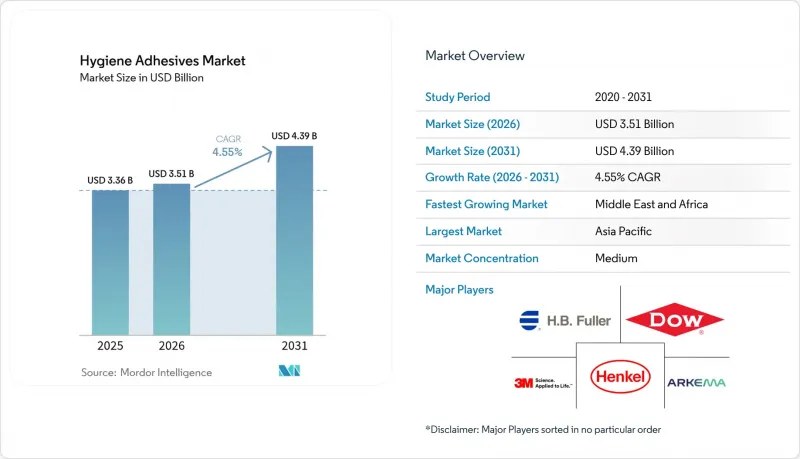
本報告按樹脂類型(乙烯-醋酸乙烯酯共聚物、苯乙烯-乙烯-丁二烯-苯乙烯共聚物、苯乙烯-異戊二烯-苯乙烯共聚物、苯乙烯-丁二烯-苯乙烯共聚物等)、產品類型(紡織品和不織布)、最終用途產品(嬰兒護理、成人護理等)以及北美地區(亞洲地區、美國地區)以及北美地區進行細分。市場預測以美元計價。
全球衛生黏合劑市場趨勢及洞察
全球一次性嬰兒尿布的消費量正在增加。
2021年至2023年,中國紙尿褲滲透率從81.5%上升至89%,家長越來越傾向於選擇更薄、低致敏性且採用先進SEBS基彈性黏合劑的紙尿褲。雖然每片紙尿褲的黏合劑用量較2020年減少了約30%,但由於優質彈性系統價格上漲15-20%,單片紙尿褲的價值反而有所提升。寶潔和Unicharm Corp等跨國公司正在推動在地化生產,以降低關稅和縮短運輸時間,使區域性生產商能夠共同開發滿足特定需求的客製化產品。長效型和夜用型紙尿褲的需求進一步推動了對耐濕結構性黏著劑的需求,這類黏合劑即使在長時間接觸液體後也能保持黏合強度。因此,儘管東亞地區的出生率有所放緩,但嬰兒用品領域仍然是衛生黏合劑市場中最大的銷售量。
加速女性用衛生用品在新興亞洲國家的普及
印度衛生棉的銷售額預計將從2024年的15億美元成長到2030年的30億美元,這主要得益於2018年取消了12%的商品和服務稅,以及公共部門在農村地區(此前衛生棉使用率僅為33.5%)擴大了供應。隨著需求的成長,用於黏合吸收芯的建築黏合劑以及用於護翼的壓敏黏著劑的需求也日益增加。供應商正優先研發低氣味、符合ISO 10993標準的化學成分,以減少皮膚刺激申訴,並爭取首次使用者的市場佔有率。印度、印尼和菲律賓部分地區的邦政府強制要求使用可堆肥衛生棉,這加速了以植物油和澱粉為原料,與纖維素黏合劑一同分解的生物基熱熔膠的研發。
石油基樹脂價格波動給生產商的利潤率帶來了壓力。
乙烯和丙烯的成本與原油價格波動和煉油廠運轉率密切相關。儘管由於中國庫存過剩,EVA價格在2024年下半年有所回落,但由於自2020年以來對裂解設備投資不足,預計到2026年將出現供不應求。衛生用品黏合劑生產商的平均EBITDA獲利率在8%至12%之間,很少將原物料價格上漲的全部成本轉嫁給消費者,因此他們正在嘗試使用EVA和SEBS的混合樹脂來降低成本風險,同時又不影響固化速度。大型尿布生產商正在考慮進行後向整合,以確保樹脂供應並獲得附加價值。
細分市場分析
2025年,乙烯-醋酸乙烯酯共聚物(EVA)佔據了衛生黏合劑市場40.92%的佔有率,這反映了其成本競爭力和廣泛的設備相容性。然而,預計到2031年,SEBS將以6.12%的複合年成長率成長,成長高於衛生黏合劑市場的整體成長率。這是因為加工商優先考慮耐熱性,即使在長時間使用的情況下,SEBS也能在體溫下保持黏合強度。 SIS憑藉其快乾特性,在建築黏合劑領域繼續保持主導地位,用於固定高吸水性芯材,而SEBS在壓敏黏著劑領域仍屬於小眾產品。將於2024年以HB Fuller「Full-Hook」系列產品商業化的EVA-SEBS混合體系,展示了複合材料設計師如何在成本和耐熱性之間取得平衡。
不同地區的偏好差異進一步加劇了這種分歧。中國製造商繼續使用EVA,因為他們的供應鏈成熟,配方調整幅度極小。相較之下,日本和歐洲的加工商正在加速採用SEBS,以滿足REACH法規的排放上限要求。一項於2024年提交的關於改性苯乙烯共聚物的專利申請,該共聚物具有更長的開放時間,展現了持續的創新,旨在實現每分鐘超過1000件的生產線速度。
區域分析
預計亞太地區將成為衛生黏合劑市場的主要驅動力,到2025年將佔據46.10%的市場佔有率。這主要得益於中國預計到2026年對熱熔膠的需求量將達到16萬噸,以及衛生棉在印度的快速普及。中國消費者持續轉向需要高性能彈性黏合劑的高階紙尿褲,而印度則致力於提高衛生棉在農村地區的普及率。在日本,成人紙尿褲的銷售量正在超過嬰兒紙尿褲,這推動了對即使在體溫下也能保持黏合強度的高剝離強度SEBS黏合劑的需求。快速都市化的東南亞國協帶來了新的成長機遇,但分銷網路的分散性仍然給供應商的服務交付帶來了沉重的負擔。
北美和歐洲市場雖已成熟,但在優質化和嚴格的環境法規的推動下,仍然盈利豐厚。陶氏化學2024年的銷售成長放緩,但仍持續投資於特種樹脂;漢高在美國升級自動化工廠,也體現了其對高機械化化工技術的持續投入。歐洲的「生產者延伸責任制」(EPR)法規正在加速向生物基和水性黏合劑的轉型;贏創正在出售其通用業務,以籌集資金用於特種添加劑的研發。
中東和非洲目前僅為中等規模市場,但預計到2031年將以5.74%的複合年成長率成長,這主要得益於「沙烏地阿拉伯2030願景」下醫療基礎設施的擴張,以及阿拉伯聯合大公國醫療支出預計將從2023年的208億美元增至2028年的267億美元。零售基礎設施的擴張和冷鏈的完善正在拓寬衛生用品的分銷範圍。巴西是南美洲的核心市場,但面臨貨幣不確定性。然而,如果通膨保持穩定,潛在需求可能會在2020年代末期得到刺激。
其他好處:
- Excel格式的市場預測(ME)表
- 3個月的分析師支持
目錄
第1章:引言
- 研究假設和市場定義
- 調查範圍
第2章:調查方法
第3章執行摘要
第4章 市場狀況
- 市場概覽
- 市場促進因素
- 全球一次性尿布消費量增加
- 亞洲新興國家加速採用女性用衛生用品
- 由於人口老化,對成人失禁用品的需求正在擴大。
- 針對低揮發性有機化合物和生物基化學品的永續性舉措
- 超快速固化熱熔系統的自動化需求
- 市場限制因素
- 石油樹脂價格波動給生產商的利潤率帶來了壓力。
- 黏合劑滲漏和異味導致消費者申訴。
- 超音波黏合技術的興起導致黏合劑用量減少。
- 價值鏈分析
- 波特五力模型
第5章 市場規模與成長預測
- 依樹脂類型
- 乙烯-醋酸乙烯酯共聚物(EVA)
- 苯乙烯-乙烯-丁二烯-苯乙烯(SEBS)
- 苯乙烯-異戊二烯-苯乙烯(SIS)
- 苯乙烯-丁二烯-苯乙烯(SBS)
- 其他樹脂類型
- 依產品類型
- 織物
- 不織布
- 按最終用途產品
- 嬰兒護理
- 成人護理
- 女性用衛生用品
- 其他用途
- 按地區
- 亞太地區
- 中國
- 印度
- 日本
- 韓國
- 東南亞國協
- 其他亞太國家
- 北美洲
- 美國
- 加拿大
- 墨西哥
- 歐洲
- 德國
- 英國
- 義大利
- 法國
- 西班牙
- 俄羅斯
- 其他歐洲國家
- 南美洲
- 巴西
- 阿根廷
- 其他南美國家
- 中東和非洲
- 沙烏地阿拉伯
- 南非
- 其他中東和非洲國家
- 亞太地區
第6章 競爭情勢
- 市場集中度
- 策略趨勢
- 市佔率(%)/排名分析
- 公司簡介
- 3M
- Abifor AG
- ADTEK Malaysia Sdn Bhd
- Arkema
- Avery Dennison Corporation
- Colquimica Adhesives
- Dow
- Evonik Industries AG
- Exxon Mobil Corporation
- Focus Hotmelt Company
- HB Fuller Company
- Henkel AG & Co. KGaA
- Huntsman Corporation
- ICHEMCO srl
- Jowat AG
- Lohmann GmbH & Co. KG
- NANPAO RESINS CHEMICAL GROUP
- OMNOVA Solutions Inc.
- Palmetto Adhesives
- Savare Specialty Adhesives LLC
- Sika AG
- TEX YEAR INDUSTRIES INC.
第7章 市場機會與未來展望
According to Mordor Intelligence, hygiene adhesives market size in 2026 is estimated at USD 3.51 billion, growing from 2025 value of USD 3.36 billion with 2031 projections showing USD 4.39 billion, growing at 4.55% CAGR over 2026-2031.
This report is Segmented by Resin Type (Ethylene-Vinyl Acetate, Styrene-Ethylene-Butadiene-Styrene, Styrene-Isoprene-Styrene, Styrene-Butadiene-Styrene, and More), Product Type (Woven and Non-Woven), End-Use Product (Baby Care, Adult Care, and More), and Geography (Asia-Pacific, North America, Europe, South America, and Middle East and Africa). The Market Forecasts are Provided in Terms of Value (USD).
Global Hygiene Adhesives Market Trends and Insights
Rising Consumption of Disposable Baby Diapers Worldwide
China's diaper penetration climbed from 81.5% in 2021 to 89% in 2023, and parents are trading up to thinner, hypoallergenic designs that rely on advanced SEBS-based elastic adhesives. Although the adhesive weight per diaper is falling by roughly 30% compared to 2020 designs, the value per unit is rising because premium elastic systems carry 15%-20% price increases. Multinationals such as Procter & Gamble and Unicharm have localized production to reduce tariffs and freight time, which allows regional formulators to co-develop tailored grades. Extended-wear and overnight products further drive demand for moisture-resistant construction adhesives that retain bond strength under sustained exposure to liquids. The baby segment, therefore, remains the single largest volume outlet for the hygiene adhesives market despite slower birth rates in East Asia.
Accelerating Feminine Hygiene Adoption in Emerging Asia
India's sanitary-pad sales are expected to expand from USD 1.5 billion in 2024 to USD 3.0 billion by 2030, driven by the 2018 removal of a 12% goods and services tax and public-sector distribution in rural districts, where pad usage stood at only 33.5%. Rising demand translates into higher construction-adhesive volumes to bond super-absorbent cores and into pressure-sensitive grades for wings. Suppliers are prioritizing low-odor, ISO 10993-compliant chemistries to mitigate skin-irritation complaints and capture market share among first-time users. State mandates for compostable pads in parts of India, Indonesia, and the Philippines are stimulating R&D in bio-based hot-melts derived from plant oils and starches that disintegrate alongside cellulose substrates.
Petro-Resin Price Volatility Eroding Producer Margins
Ethylene and propylene costs track crude swings and refinery run rates. EVA prices softened in late 2024 amid inventory overhang in China, yet underinvestment in cracker capacity since 2020 signals a likely deficit by 2026. Hygiene adhesive formulators average 8%-12% EBITDA margins and seldom pass through feedstock spikes in full, prompting experiments with hybrid EVA-SEBS blends that temper cost risk without compromising cure speed. Larger diaper converters are studying backward integration to secure resin supply and capture added value.
Other drivers and restraints analyzed in the detailed report include:
- Aging Populations Boosting Adult-Incontinence Demand
- Sustainability Push Toward Low-VOC and Bio-Based Chemistries
- Adhesive Bleed and Odor; Emerging Ultrasonic Bonding
For complete list of drivers and restraints, kindly check the Table Of Contents.
Segment Analysis
Ethylene-vinyl acetate controlled 40.92% hygiene adhesives market share in 2025, reflecting its competitive cost and broad equipment compatibility. SEBS, however, is forecasted to grow at a 6.12% CAGR through 2031, outstripping the overall hygiene adhesives market as converters prioritize heat resistance that maintains bond integrity at body temperature over extended wear. SIS continues to lead in construction adhesives that anchor super-absorbent cores thanks to its fast-tack nature, while SBS remains a niche in pressure-sensitive tapes. Hybrid EVA-SEBS systems, commercialized in H.B. Fuller's Full-Hook line during 2024, demonstrate how formulators balance cost with thermal durability.
Regional preferences amplify divergence. Chinese producers stay with EVA because supply chains are entrenched and formulation tweaks are minimal. In contrast, Japanese and European converters are accelerating the adoption of SEBS to meet REACH emission ceilings. Patent filings in 2024 covering modified styrene block copolymers with longer open time indicate sustained innovation aimed at line speeds above 1,000 pieces per minute.
Complete Report Scope:
- By Resin Type
- Ethylene-vinyl acetate (EVA)
- Styrene-ethylene-butadiene-styrene (SEBS)
- Styrene-isoprene-styrene (SIS)
- Styrene-butadiene-styrene (SBS)
- Other Resin Types
- By Product Type
- Woven
- Non-woven
- By End-use Product
- Baby Care
- Adult Care
- Feminine Care
- Other Applications
- By Geography
- Asia-Pacific
- China
- India
- Japan
- South Korea
- ASEAN Countries
- Rest of Asia-Pacific
- North America
- United States
- Canada
- Mexico
- Europe
- Germany
- United Kingdom
- Italy
- France
- Spain
- Russia
- Rest of Europe
- South America
- Brazil
- Argentina
- Rest of South America
- Middle-East and Africa
- Saudi Arabia
- South Africa
- Rest of Middle-East and Africa
- Asia-Pacific
Geography Analysis
The Asia-Pacific region dominated the hygiene adhesives market with a 46.10% market share in 2025, underpinned by China's forecasted demand of 160,000 tonnes of hot-melt adhesives in 2026 and India's rapid uptake of sanitary pads. Chinese consumers continue to shift toward premium diaper formats that require high-performance elastic adhesives, while Indian initiatives aim to increase pad penetration in rural villages. Japan exemplifies demographic inversion as adult diapers overtake baby volumes, spurring demand for high-peel SEBS adhesives that maintain bond integrity at body temperature. Quickly urbanizing ASEAN economies supply greenfield growth, although distribution fragmentation keeps service intensity high for suppliers.
North America and Europe are mature but lucrative markets, driven by premiumization and stringent environmental regulations. Dow reported softer 2024 sales yet continues to invest in specialty resins, and Henkel's US automation upgrades demonstrate a continued commitment to machine-friendly chemistries. Extended producer responsibility statutes in Europe are accelerating the switch to bio-based and waterborne adhesives, with Evonik divesting its commodity business to fund specialty additive development.
The Middle East and Africa, while only a midsize base today, are expected to grow at 5.74% CAGR to 2031 on the back of Saudi Vision 2030 healthcare build-outs and a projected UAE health spend rise from USD 20.8 billion in 2023 to USD 26.7 billion by 2028. Expanding retail infrastructure and improved cold chains widen distribution for hygiene products. Brazil anchors South America yet faces currency uncertainty; however, stable inflation paths could unleash latent demand in the latter half of the decade.
- 3M
- Abifor AG
- ADTEK Malaysia Sdn Bhd
- Arkema
- Avery Dennison Corporation
- Colquimica Adhesives
- Dow
- Evonik Industries AG
- Exxon Mobil Corporation
- Focus Hotmelt Company
- H.B. Fuller Company
- Henkel AG & Co. KGaA
- Huntsman Corporation
- ICHEMCO s.r.l.
- Jowat AG
- Lohmann GmbH & Co. KG
- NANPAO RESINS CHEMICAL GROUP
- OMNOVA Solutions Inc.
- Palmetto Adhesives
- Savare Specialty Adhesives LLC
- Sika AG
- TEX YEAR INDUSTRIES INC.
Additional Benefits:
- The market estimate (ME) sheet in Excel format
- 3 months of analyst support
TABLE OF CONTENTS
1 Introduction
- 1.1 Study Assumptions & Market Definition
- 1.2 Scope of the Study
2 Research Methodology
3 Executive Summary
4 Market Landscape
- 4.1 Market Overview
- 4.2 Market Drivers
- 4.2.1 Rising consumption of disposable baby diapers worldwide
- 4.2.2 Accelerating feminine hygiene adoption in emerging Asia
- 4.2.3 Aging populations boosting adult-incontinence demand
- 4.2.4 Sustainability push toward low-VOC and bio-based chemistries
- 4.2.5 Automation need for ultra-fast-setting hot-melt systems
- 4.3 Market Restraints
- 4.3.1 Petro-resin price volatility eroding producer margins
- 4.3.2 Adhesive bleed and odour raising consumer complaints
- 4.3.3 Emerging ultrasonic bonding reducing adhesive usage
- 4.4 Value Chain Analysis
- 4.5 Porter's Five Forces
- 4.5.1 Bargaining Power of Suppliers
- 4.5.2 Bargaining Power of Buyers
- 4.5.3 Threat of New Entrants
- 4.5.4 Threat of Substitutes
- 4.5.5 Degree of Competition
5 Market Size & Growth Forecasts (Value)
- 5.1 By Resin Type
- 5.1.1 Ethylene-vinyl acetate (EVA)
- 5.1.2 Styrene-ethylene-butadiene-styrene (SEBS)
- 5.1.3 Styrene-isoprene-styrene (SIS)
- 5.1.4 Styrene-butadiene-styrene (SBS)
- 5.1.5 Other Resin Types
- 5.2 By Product Type
- 5.2.1 Woven
- 5.2.2 Non-woven
- 5.3 By End-use Product
- 5.3.1 Baby Care
- 5.3.2 Adult Care
- 5.3.3 Feminine Care
- 5.3.4 Other Applications
- 5.4 By Geography
- 5.4.1 Asia-Pacific
- 5.4.1.1 China
- 5.4.1.2 India
- 5.4.1.3 Japan
- 5.4.1.4 South Korea
- 5.4.1.5 ASEAN Countries
- 5.4.1.6 Rest of Asia-Pacific
- 5.4.2 North America
- 5.4.2.1 United States
- 5.4.2.2 Canada
- 5.4.2.3 Mexico
- 5.4.3 Europe
- 5.4.3.1 Germany
- 5.4.3.2 United Kingdom
- 5.4.3.3 Italy
- 5.4.3.4 France
- 5.4.3.5 Spain
- 5.4.3.6 Russia
- 5.4.3.7 Rest of Europe
- 5.4.4 South America
- 5.4.4.1 Brazil
- 5.4.4.2 Argentina
- 5.4.4.3 Rest of South America
- 5.4.5 Middle-East and Africa
- 5.4.5.1 Saudi Arabia
- 5.4.5.2 South Africa
- 5.4.5.3 Rest of Middle-East and Africa
- 5.4.1 Asia-Pacific
6 Competitive Landscape
- 6.1 Market Concentration
- 6.2 Strategic Moves
- 6.3 Market Share (%)/ Ranking Analysis
- 6.4 Company Profiles (includes Global level Overview, Market level overview, Core Segments, Financials as available, Strategic Information, Market Rank/Share for key companies, Products & Services, and Recent Developments)
- 6.4.1 3M
- 6.4.2 Abifor AG
- 6.4.3 ADTEK Malaysia Sdn Bhd
- 6.4.4 Arkema
- 6.4.5 Avery Dennison Corporation
- 6.4.6 Colquimica Adhesives
- 6.4.7 Dow
- 6.4.8 Evonik Industries AG
- 6.4.9 Exxon Mobil Corporation
- 6.4.10 Focus Hotmelt Company
- 6.4.11 H.B. Fuller Company
- 6.4.12 Henkel AG & Co. KGaA
- 6.4.13 Huntsman Corporation
- 6.4.14 ICHEMCO s.r.l.
- 6.4.15 Jowat AG
- 6.4.16 Lohmann GmbH & Co. KG
- 6.4.17 NANPAO RESINS CHEMICAL GROUP
- 6.4.18 OMNOVA Solutions Inc.
- 6.4.19 Palmetto Adhesives
- 6.4.20 Savare Specialty Adhesives LLC
- 6.4.21 Sika AG
- 6.4.22 TEX YEAR INDUSTRIES INC.
7 Market Opportunities and Future Outlook
- 7.1 White-space and Unmet-Need Assessment

 光學透明膠(OCA) 市場分析及至 2035 年預測:類型、產品、技術、組件、應用、形式、材料類型、最終用戶、功能室內裝飾黏合劑市場分析與預測(至2035年):類型、產品、技術、應用、形式、材料類型、最終用戶、功能、安裝類型、解決方案
 電子黏合劑:市場佔有率分析、產業趨勢和統計數據、成長預測(2026-2031)
 2026年全球縱向接縫密封劑市場報告2026年全球光學透明樹脂市場報告
 冷封黏合劑市場規模、佔有率和成長分析:按產品化學成分、軟包裝應用、目標終端用戶產業和地區分類-2026-2033年產業預測
 眼科黏合劑市場規模、佔有率和成長分析:按產品類型、應用、適應症、最終用戶和地區分類-2026-2033年產業預測
 2026-2030年全球黏合劑市場
 丙烯酸樹脂黏合劑市場-全球產業規模、佔有率、趨勢、機會、預測:按應用、分銷方式、地區和競爭格局分類,2021-2031年智慧黏合劑市場-全球產業規模、佔有率、趨勢、機會、預測:按技術、應用、地區和競爭格局分類,2021-2031年