


 |
市場調查報告書
商品編碼
2121811
非公路用車輛引擎:市場佔有率分析、行業趨勢和統計數據以及成長預測(2026-2031 年)Off Highway Vehicle Engine - Market Share Analysis, Industry Trends & Statistics, Growth Forecasts (2026 - 2031) |
||||||

※ 本網頁內容可能與最新版本有所差異。詳細情況請與我們聯繫。
根據 Mordor Intelligence 預測,非公路用車輛預計將在 2025 年達到 453.7 億美元,2026 年達到 479.4 億美元,到 2031 年達到 662.1 億美元,2026 年至 2031 年的複合年成長率為 6.67%。
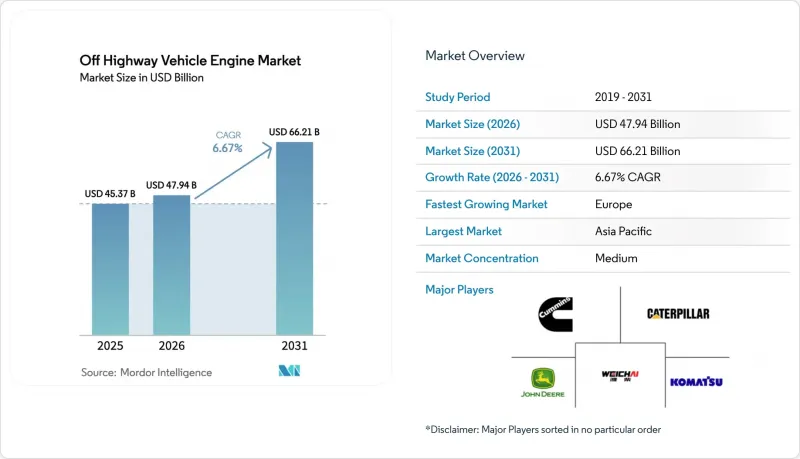
本報告按車輛類型(農業機械、施工機械等)、功率輸出(30馬力以下及以上)、燃料類型(柴油、汽油等)、排氣量(2公升以下及以上)、驅動技術(傳統內燃機等)及地區進行細分。市場預測以價值(美元)和銷售(台)表示。
全球非公路用車輛引擎市場趨勢及洞察
大型全球基礎建設項目(七國集團和「一帶一路」計劃)
七國集團全球基礎設施夥伴關係和中國的「一帶一路」計劃等全球性舉措正在推動對道路、港口和能源資產的大量投資。這些投資催生了基礎設施項目對重型機械的巨大需求。加拿大即將推出的聯邦預算將重點放在交通運輸和綠色能源發展,進一步凸顯了對履帶式挖土機和平平土機等設備的需求。此外,計畫所在國通常會在工程完工幾年後才實施歐盟式的排放氣體法規。這一趨勢有利於擁有符合第五階段排放標準模組化產品線的引擎製造商,使他們能夠確保初始設備銷售以及後續的改裝和維修機會。能夠策略性地設計零件以滿足這些要求的供應商,將更有利於提高每台引擎的終身收益。歷史趨勢證實了基礎設施支出與施工機械利用率之間存在很強的相關性,這支撐了非公路用車輛引擎市場的成長潛力。
亞太地區和非洲農業機械化的進展
2025會計年度,印度農業機械貸款發放金額顯著成長,這主要得益於大幅降低新曳引機成本的補貼政策。儘管歐洲每公頃曳引機密度仍然很高,但撒哈拉以南非洲地區的曳引機密度卻低得多,這表明該地區存在巨大的更新換代需求。 2024年,中國農業機械生產取得了顯著進展,國內製造商專注於為小規模農戶設計並配備滿足其需求的引擎的曳引機。巴西和澳洲的大型商業農場更傾向於選擇120-400馬力、具備精準導航功能的曳引機,而亞洲和非洲的農民則尋求50馬力以下、可分七年付款的曳引機,這迫使引擎製造商根據不同地區的需求調整產品線。這種兩極化的需求模式既推動了小型柴油引擎的銷售成長,也支撐了對高利潤、大馬力曳引機的需求。
小型設備的電氣化進程正在加速。
沃爾沃建築設備公司的ECR25電動挖土機可提供一整天的運作時間,並顯著降低柴油燃料成本,使高運轉率的建築公司能夠在合理的時間內收回投資。 JCB的19C-1E和Caterpillar的301.9等電動小型挖土機在室內和都市區計畫中也具有類似的經濟效益,這些計畫對零排放和低噪音的要求至關重要。電池驅動的挖土機在歐洲6噸以下挖土機市場正穩步成長,隨著充電基礎設施的擴展,預計其市場佔有率將顯著擴大。由於無需更換機油且活動部件數量減少,電池驅動的小型挖土機的維護需求也隨之降低,進一步提高了成本效益。然而,這種轉變主要影響的是小型引擎,目前對中高功率柴油引擎的影響甚微。
細分市場分析
預計到2025年,施工機械將佔總銷售量的59.04%,凸顯其在非公路用車輛引擎市場的主導地位。亞洲的都市化以及美國和歐盟經濟獎勵策略支持的基礎設施升級,使得履帶式挖土機、輪式裝載機和後鏟式裝載機保持較高的運轉率。採礦設備雖然銷售量較小,但卻是成長最快的產業。其預計8.33%的複合年成長率與電動車供應鏈中銅和鋰需求的激增相吻合,這需要自動駕駛運輸卡車和每年可運作4000至5000小時的高負載容量液壓挖掘機。農業機械位居第二,預計未來幾十年非洲的曳引機普及率將持續成長。同時,在林業和物料搬運等細分領域,柴油引擎的高能量密度對於遠端作業和連續輪班運作至關重要。
在施工機械領域,每7-10年一次的定期更換確保了引擎供應商穩定的基礎銷售量。相較之下,採礦業的引擎更換週期為12-15年,由於運作時間較長,售後市場零件的收入來源更為穩定。雖然建築業由全球性原始設備製造商(OEM)主導,但農業機械行業的市場分佈日益分散,馬恆達在印度市場佔據領先地位,約翰迪爾在北美市場領先,濰柴在中國市場領先。這種類似馬賽克的格局使得規模經濟難以實現,但也保護了那些根據當地法規和燃油品質要求客製化引擎的專業製造商。
2025年,31-70馬力功率輸出範圍將佔總出貨量的65.18%,預計到2031年將以8.12%的複合年成長率持續成長,凸顯其在非公路用車輛引擎市場的重要性。此輸出範圍主要應用於小型曳引機、滑移裝載機和小型挖土機,這些設備受益於針對小規模農戶和都市區承包商的補貼計畫。久保田的「V5009 Stage V」系列引擎是平台創新的典範,它整合了免維護顆粒過濾器和可變幾何渦輪增壓器,從而同時滿足排放氣體法規和燃油效率目標。
功率低於30馬力的引擎已開始應用於電池日益普及的商用車輛。同時,功率在71至120馬力之間的引擎則被用於中型輪式裝載機和後鏟式裝載機。功率超過120馬力的引擎雖然數量較少,但由於採礦和大規模基礎設施項目對運作週期的高要求,其銷售價格和售後市場收入都很高。像洋馬和FPT工業這樣的供應商,憑藉其功率範圍涵蓋31至120馬力的靈活架構,年銷量超過5萬台,足以攤銷研發成本。這種規模在功率超過400馬力的引擎細分市場是無法實現的。
區域分析
預計到2025年,亞太地區將佔非公路用車輛引擎市場39.12%的佔有率,並預計在2031年之前保持顯著的複合年成長率。中國國內建築業的蓬勃發展以及印度農業機械融資的大幅成長,凸顯了該地區的兩大成長引擎。儘管來自日本的出口有所放緩,但隨著「一帶一路」計畫的積極推進,東南亞地區的出口量已出現復甦跡象。韓國HX系列挖土機配備了歐五排放標準的引擎,目標市場是歐洲和北美,這反映出亞洲原始設備製造商(OEM)正努力提升產品價值。
歐洲是成長最快的地區,年複合成長率達7.23%,這主要得益於向歐五排放標準的過渡以及氫化植物油(HVO)的普及。德國的鐵路和可再生能源計畫推動了對中型引擎的強勁需求,而法國精密農業的激勵措施也促進了曳引機的普及。英國脫歐後的貿易協定正在為珀金斯等英國引擎製造商拓展出口管道。西方制裁抑制了俄羅斯對高性能引擎的需求,但這一缺口正被中國的Tier 3引擎所填補。
在《基礎設施投資與就業法案》的支持下,北美預計在2025年佔據相當大的銷售佔有率。在美國,住宅開工量已達到關鍵里程碑,推動了對小型設備的需求成長。同時,加拿大的大規模綠色基礎設施計畫也促進了履帶式曳引機和平土機的銷售。在南美洲,巴西農業的擴張,特別是大豆產量的成長,支撐了市場成長,進而推動了對大馬力曳引機的需求。在中東和非洲,沙烏地阿拉伯「2030願景」下的大規模發展項目以及南非礦業機械的現代化改造推動了市場穩步成長,儘管市場規模仍然相對較小。
其他好處:
- Excel格式的市場預測(ME)表
- 3個月的分析師支持
目錄
第1章:引言
- 研究假設和市場定義
- 調查範圍
第2章:調查方法
第3章執行摘要
第4章 市場狀況
- 市場概覽
- 市場促進因素
- 一項龐大的全球基礎建設項目(七國集團和「一帶一路」計劃)
- 亞太地區和非洲農業機械化的進展
- 更嚴格的第五階段/第五級法規引發了一輪領先購買和改裝的浪潮。
- 原始設備製造商向模組化混合動力相容引擎平台的過渡
- 與HVO/可再生柴油引擎的兼容性擴大了內燃機的效用。
- 利用遠端資訊處理技術進行預測性維護可以縮短更換週期。
- 市場限制因素
- 加速小型設備的電氣化
- 後處理成本上升和對價格敏感的買家
- 產品價格波動給汽車製造商的利潤率帶來了壓力。
- 延長租賃車輛的大修週期
- 價值供應鏈分析
- 監理情勢
- 技術展望
- 波特五力模型
第5章 市場規模與成長預測
- 車輛類型
- 農業機械
- 工程機械
- 採礦設備
- 林業和物料運輸設備
- 依輸出類型
- 30馬力或以下
- 31~70 HP
- 71~120 HP
- 121~400 HP
- 400馬力或以上
- 按燃料類型
- 柴油引擎
- 汽油
- 天然氣/沼氣
- 油電混合車、電動車和燃料電池車
- 按引擎排氣量
- 2公升或更少
- 2.1~3.5 L
- 3.6~7 L
- 7公升或更多
- 透過推進技術
- 傳統內燃機(ICE)
- 混合
- 電池式電動車
- 燃料電池電動車
- 按地區
- 北美洲
- 美國
- 加拿大
- 其他北美國家
- 南美洲
- 巴西
- 阿根廷
- 其他南美國家
- 歐洲
- 德國
- 英國
- 法國
- 俄羅斯
- 西班牙
- 其他歐洲國家
- 亞太地區
- 中國
- 日本
- 印度
- 韓國
- 其他亞太國家
- 中東和非洲
- 沙烏地阿拉伯
- 阿拉伯聯合大公國
- 埃及
- 土耳其
- 南非
- 其他中東和非洲國家
- 北美洲
第6章 競爭情勢
- 策略趨勢
- 市佔率分析
- 公司簡介
- AGCO Corporation
- Caterpillar Inc.
- Cummins Inc.
- Deere & Company
- Deutz AG
- Komatsu Ltd.
- Mahindra Powerol
- Scania AB
- Volvo Penta
- Yanmar Holdings Co., Ltd.
- Weichai Power Co., Ltd.
- Kubota Corporation
- Perkins Engines Company Limited
- MAN Engines
- Rolls-Royce Power Systems AG
- HD Hyundai Infracore Co., Ltd.
- FPT Industrial SPA
- Rehlko Engines(Kohler Engines)
- Motorenfabrik Hatz GmbH & Co. KG
第7章 市場機會與未來展望
According to Mordor Intelligence, the off-highway vehicle engine market size is projected to be USD 45.37 billion in 2025, USD 47.94 billion in 2026, and reach USD 66.21 billion by 2031, growing at a CAGR of 6.67% from 2026 to 2031.
This report is Segmented by Vehicle Type (Agricultural Machinery, Construction Equipment, and More), Power Output (Less Than or Equal To 30 HP, and More), Fuel Type (Diesel, Gasoline, and More), Engine Displacement (Less Than or Equal To 2 L, and More), Propulsion Technology (Conventional ICE, and More), and Geography. The Market Forecasts are Provided in Terms of Value (USD) and Volume (Units).
Global Off Highway Vehicle Engine Market Trends and Insights
Massive Global Infrastructure Pipeline (G7 and BRI)
Global initiatives, such as the G7 Partnership for Global Infrastructure and Investment and China's Belt and Road Initiative, are driving significant investments into roads, ports, and energy assets. These investments are creating substantial demand for heavy machinery in infrastructure projects. Canada's federal budget for the near future highlights a strong focus on transport and green-energy development, further underscoring the need for equipment such as crawler excavators and motor graders. Additionally, host nations often implement EU-style emissions regulations a few years after project completion. This trend benefits engine manufacturers with modular Stage V lines, enabling them to secure both initial equipment sales and subsequent retrofitting opportunities. Suppliers who strategically design components to meet these requirements are positioned to achieve higher lifetime revenue per engine. Historical trends confirm a strong correlation between infrastructure spending and construction equipment utilization, reinforcing the growth potential of the off-highway vehicle engine market.
Growing Mechanization of Agriculture in Asia-Pacific and Africa
In fiscal 2025, Indian farm-equipment credit disbursements experienced significant growth, driven by subsidies that substantially reduce the cost of new tractors. While Europe maintains a high density of tractors per hectare, Sub-Saharan Africa continues to operate at a much lower level, highlighting a considerable opportunity for replacement. In 2024, China's agricultural machinery production saw notable progress, with domestic manufacturers focusing on tractors designed for smallholder farms, equipped with engines suitable for their needs. Large commercial farms in Brazil and Australia favor 120-400 horsepower units with precision guidance, whereas Asian and African growers seek sub-50 horsepower designs financed over seven years, forcing engine builders to regionalize product lines. The bifurcated demand pattern sustains volume growth for compact diesels while supporting margin-rich high-horsepower models.
Accelerating Electrification of Compact Equipment
Volvo CE's ECR25 Electric excavator offers a full workday of runtime and significantly reduces diesel costs, enabling high-utilization contractors to achieve a return on investment within a reasonable timeframe. JCB's 19C-1E and Caterpillar's 301.9 electric minis provide comparable economic benefits for indoor or urban projects where zero emissions and low noise are critical. Battery-electric models are steadily gaining traction in Europe's sub-6-ton excavator market, with expectations of substantial growth as charging infrastructure continues to expand. The lower maintenance requirements, which eliminate oil changes and reduce the number of moving parts, further enhance the cost-effectiveness of battery-powered compact excavators. However, this shift primarily impacts smaller engines, while mid- and high-horsepower diesel engines remain largely unaffected for now.
Other drivers and restraints analyzed in the detailed report include:
- Stricter Stage V / Tier 5 Norms Triggering Pre-Buy and Retrofit Cycles
- OEM Shift to Modular Hybrid-Ready Engine Platforms
- Escalating After-Treatment Cost Vs. Price-Sensitive Buyers
For complete list of drivers and restraints, kindly check the Table Of Contents.
Segment Analysis
Construction machinery accounted for 59.04% of 2025 revenue, underscoring its dominance within the off-highway vehicle engine market size. Urbanization across Asia and stimulus-backed infrastructure renewal in the United States and the EU keep crawler excavators, wheel loaders, and backhoe loaders on high utilization schedules. Mining equipment, although smaller in volume, is the fastest riser; its 8.33% forecast CAGR aligns with the soaring demand for copper and lithium in EV supply chains, which require autonomous haul trucks and high-tonnage hydraulic shovels capable of operating for 4,000-5,000 hours per year. Agricultural machinery ranks second overall, with tractor density in Africa poised for multi-decade growth. At the same time, forestry and material-handling niches rely on diesel's high energy density for remote or continuous-shift operations.
Recurring construction replacement every 7-10 years locks in a dependable baseline volume for engine suppliers, whereas the 12-15 year mining cycle produces a richer aftermarket parts annuity due to higher duty hours. Global OEMs dominate the construction sector but face regional fragmentation in agriculture, where Mahindra leads in India, Deere rules North America, and Weichai powers much of China. This mosaic makes scale economies elusive, yet it also protects specialized players that tailor engines to local regulation and fuel quality.
The 31-70 horsepower bracket accounted for 65.18% of unit shipments in 2025 and is projected to expand at an 8.12% CAGR through 2031, underscoring its importance to the off-highway vehicle engine market. Compact tractors, skid-steer loaders, and mini excavators dominate this band, benefiting from subsidy programs that target smallholders and urban contractors. Kubota's V5009 Stage V series exemplifies platform renewal, integrating maintenance-free particulate filters and variable-geometry turbochargers to meet both emissions and fuel-efficiency goals .
Sub-30-horsepower engines power utility vehicles where batteries are already encroaching, while the 71-120-horsepower set serves mid-sized wheel and backhoe loaders. Units above 120 horsepower, although fewer in number, generate premium pricing and aftermarket revenue due to their demanding duty cycles in mining and large infrastructure projects. Suppliers with flexible architectures that span 31-120 horsepower, such as Yanmar and FPT Industrial, amortize R&D costs across volumes exceeding 50,000 units per year, a scale that is unreachable in the 400-horsepower-and-above niche.
Complete Report Scope:
- By Vehicle Type
- Agricultural Machinery
- Construction Equipment
- Mining Equipment
- Forestry and Material-Handling Equipment
- By Power Output
- Less than or equal to 30 HP
- 31-70 HP
- 71-120 HP
- 121-400 HP
- More than 400 HP
- By Fuel Type
- Diesel
- Gasoline
- Natural-/Bio-Gas
- Hybrid-Electric and Fuel-Cell
- By Engine Displacement
- Less than or equal 2 L
- 2.1 to 3.5 L
- 3.6 to 7 L
- More than 7 L
- By Propulsion Technology
- Conventional ICE
- Hybrid
- Battery-Electric
- Fuel-Cell Electric
- By Geography
- North America
- United States
- Canada
- Rest of North America
- South America
- Brazil
- Argentina
- Rest of South America
- Europe
- Germany
- United Kingdom
- France
- Russia
- Spain
- Rest of Europe
- Asia-Pacific
- China
- Japan
- India
- South Korea
- Rest of Asia-Pacific
- Middle East and Africa
- Saudi Arabia
- United Arab Emirates
- Egypt
- Turkey
- South Africa
- Rest of Middle East and Africa
- North America
Geography Analysis
Asia-Pacific controlled 39.12% of the off-highway vehicle engine market in 2025 and is expected to advance at a notable CAGR to 2031. China's domestic construction boom and India's significant jump in farm-equipment credit underscore the region's dual growth engines. Japanese shipments softened, but exporters recouped volume in Southeast Asia, where Belt and Road projects remain active. South Korea's HX Series excavators, fitted with Stage V engines, target Europe and North America, reflecting Asian OEMs' push up the value curve.
Europe is the fastest-growing region, with a 7.23% CAGR, driven by Stage V retrofits and HVO adoption. Germany's rail and renewable program keeps demand steady for mid-sized engines, while France's precision-farming incentives lift tractor penetration. Post-Brexit trade deals widen export lanes for engine builders in the United Kingdom, like Perkins. Western sanctions curtail Russian demand for high-spec engines, allowing Chinese Tier 3 units to backfill the gap.
North America held a notable share of 2025 turnover, underpinned by the Infrastructure Investment and Jobs Act. In the United States, housing starts reached a significant milestone, driving increased demand for compact equipment. Meanwhile, Canada's extensive green-infrastructure initiative has stimulated purchases of crawlers and graders. In South America, market growth is supported by agricultural expansion in Brazil, particularly in soybean production, which boosts the need for high-horsepower tractors. The Middle East and Africa are experiencing steady growth, driven by large-scale development projects under Saudi Vision 2030 and equipment replacements in South African mines, although the market remains relatively smaller in size.
- AGCO Corporation
- Caterpillar Inc.
- Cummins Inc.
- Deere & Company
- Deutz AG
- Komatsu Ltd.
- Mahindra Powerol
- Scania AB
- Volvo Penta
- Yanmar Holdings Co., Ltd.
- Weichai Power Co., Ltd.
- Kubota Corporation
- Perkins Engines Company Limited
- MAN Engines
- Rolls-Royce Power Systems AG
- HD Hyundai Infracore Co., Ltd.
- FPT Industrial S.P.A.
- Rehlko Engines (Kohler Engines)
- Motorenfabrik Hatz GmbH & Co. KG
Additional Benefits:
- The market estimate (ME) sheet in Excel format
- 3 months of analyst support
TABLE OF CONTENTS
1 Introduction
- 1.1 Study Assumptions & Market Definition
- 1.2 Scope of the Study
2 Research Methodology
3 Executive Summary
4 Market Landscape
- 4.1 Market Overview
- 4.2 Market Drivers
- 4.2.1 Massive Global Infrastructure Pipeline (G7 and BRI)
- 4.2.2 Growing Mechanization of Agriculture in Asia-Pacific and Africa
- 4.2.3 Stricter Stage V / Tier 5 Norms Triggering Pre-Buy and Retrofit Cycles
- 4.2.4 OEM Shift to Modular Hybrid-Ready Engine Platforms
- 4.2.5 HVO/Renewable-Diesel Compatibility Extending ICE Relevance
- 4.2.6 Telematics-Driven Predictive Maintenance Shortening Replacement Cycles
- 4.3 Market Restraints
- 4.3.1 Accelerating Electrification of Compact Equipment
- 4.3.2 Escalating After-Treatment Cost Vs. Price-Sensitive Buyers
- 4.3.3 Commodity-Price Volatility Squeezing Engine Margins
- 4.3.4 Rental Fleets Extending Overhaul Intervals
- 4.4 Value/Supply-Chain Analysis
- 4.5 Regulatory Landscape
- 4.6 Technological Outlook
- 4.7 Porter's Five Forces
- 4.7.1 Threat of New Entrants
- 4.7.2 Bargaining Power of Buyers
- 4.7.3 Bargaining Power of Suppliers
- 4.7.4 Threat of Substitutes
- 4.7.5 Intensity of Rivalry
5 Market Size & Growth Forecasts (Value (USD) and Volume (Units))
- 5.1 By Vehicle Type
- 5.1.1 Agricultural Machinery
- 5.1.2 Construction Equipment
- 5.1.3 Mining Equipment
- 5.1.4 Forestry and Material-Handling Equipment
- 5.2 By Power Output
- 5.2.1 Less than or equal to 30 HP
- 5.2.2 31-70 HP
- 5.2.3 71-120 HP
- 5.2.4 121-400 HP
- 5.2.5 More than 400 HP
- 5.3 By Fuel Type
- 5.3.1 Diesel
- 5.3.2 Gasoline
- 5.3.3 Natural-/Bio-Gas
- 5.3.4 Hybrid-Electric and Fuel-Cell
- 5.4 By Engine Displacement
- 5.4.1 Less than or equal 2 L
- 5.4.2 2.1 to 3.5 L
- 5.4.3 3.6 to 7 L
- 5.4.4 More than 7 L
- 5.5 By Propulsion Technology
- 5.5.1 Conventional ICE
- 5.5.2 Hybrid
- 5.5.3 Battery-Electric
- 5.5.4 Fuel-Cell Electric
- 5.6 By Geography
- 5.6.1 North America
- 5.6.1.1 United States
- 5.6.1.2 Canada
- 5.6.1.3 Rest of North America
- 5.6.2 South America
- 5.6.2.1 Brazil
- 5.6.2.2 Argentina
- 5.6.2.3 Rest of South America
- 5.6.3 Europe
- 5.6.3.1 Germany
- 5.6.3.2 United Kingdom
- 5.6.3.3 France
- 5.6.3.4 Russia
- 5.6.3.5 Spain
- 5.6.3.6 Rest of Europe
- 5.6.4 Asia-Pacific
- 5.6.4.1 China
- 5.6.4.2 Japan
- 5.6.4.3 India
- 5.6.4.4 South Korea
- 5.6.4.5 Rest of Asia-Pacific
- 5.6.5 Middle East and Africa
- 5.6.5.1 Saudi Arabia
- 5.6.5.2 United Arab Emirates
- 5.6.5.3 Egypt
- 5.6.5.4 Turkey
- 5.6.5.5 South Africa
- 5.6.5.6 Rest of Middle East and Africa
- 5.6.1 North America
6 Competitive Landscape
- 6.1 Strategic Moves
- 6.2 Market Share Analysis
- 6.3 Company Profiles (Includes Global Level Overview, Market Level Overview, Core Segments, Financials as Available, Strategic Information, Market Rank/Share for Key Companies, Products and Services, SWOT Analysis, and Recent Developments)
- 6.3.1 AGCO Corporation
- 6.3.2 Caterpillar Inc.
- 6.3.3 Cummins Inc.
- 6.3.4 Deere & Company
- 6.3.5 Deutz AG
- 6.3.6 Komatsu Ltd.
- 6.3.7 Mahindra Powerol
- 6.3.8 Scania AB
- 6.3.9 Volvo Penta
- 6.3.10 Yanmar Holdings Co., Ltd.
- 6.3.11 Weichai Power Co., Ltd.
- 6.3.12 Kubota Corporation
- 6.3.13 Perkins Engines Company Limited
- 6.3.14 MAN Engines
- 6.3.15 Rolls-Royce Power Systems AG
- 6.3.16 HD Hyundai Infracore Co., Ltd.
- 6.3.17 FPT Industrial S.P.A.
- 6.3.18 Rehlko Engines (Kohler Engines)
- 6.3.19 Motorenfabrik Hatz GmbH & Co. KG
7 Market Opportunities & Future Outlook
- 7.1 White-space & Unmet-Need Assessment

 非公路機械市場規模、佔有率、成長、全球產業分析、區域趨勢以及 2026 年至 2034 年的預測。非公路用車輛引擎市場規模、佔有率、成長、全球產業分析、區域趨勢及2026年至2034年預測。
 非公路用車輛引擎市場規模、佔有率和成長分析:按引擎類型、功率輸出、應用、排放氣體標準、銷售管道、冷卻方式和地區分類-2026-2033年產業預測
 小型非道路引擎市場規模、佔有率和成長分析:按引擎類型、功率輸出、設備類型、應用、最終用戶、配銷通路和地區分類——2026-2033年行業預測
 非公路用車輛引擎市場規模、佔有率、趨勢和預測:按功率、引擎排氣量、燃料類型和地區分類,2026-2034 年2026-2034年全球小型非道路引擎市場規模、佔有率、趨勢和成長分析報告
 非公路車輛引擎市場-全球產業規模、佔有率、趨勢、機會和預測,按工程機械和採礦設備引擎功率輸出、農業曳引機引擎功率輸出、地區和競爭格局分類(2021-2031年預測)