


 |
市場調查報告書
商品編碼
2121612
社群媒體分析:市場佔有率分析、產業趨勢與統計、成長預測(2026-2031)Social Media Analytics - Market Share Analysis, Industry Trends & Statistics, Growth Forecasts (2026 - 2031) |
||||||

※ 本網頁內容可能與最新版本有所差異。詳細情況請與我們聯繫。
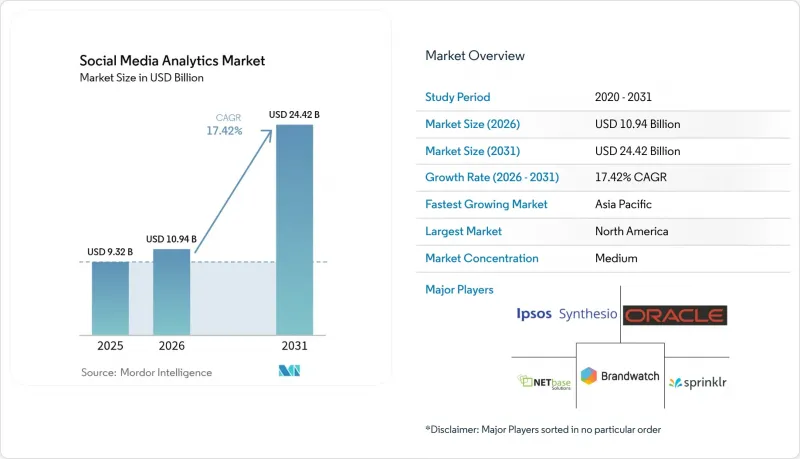
根據 Mordor Intelligence 預測,社群媒體分析市場規模將從 2025 年的 93.2 億美元成長到 2026 年的 109.4 億美元,然後在 2031 年達到 244.2 億美元,2026 年至 2031 年的複合年成長率為 17.42%。
本報告按組件(解決方案、服務)、部署模式(雲端、本地部署)、模組(社交媒體監控與追蹤、社交媒體測量/監控與分析)、最終用戶行業(媒體與娛樂、IT與電信、銀行、金融服務與保險、零售與電子商務等)以及地區進行細分。市場預測以美元計價。
全球社群媒體分析市場趨勢與洞察
社群媒體用戶數量迅速成長
到2025年,將有超過52.4億人使用社群媒體管道。隨著資料量的激增,社群媒體分析市場正朝著可擴展的雲端架構發展,以分析每天數十億次的互動。 TikTok上「影片優先」的互動模式興起,其平均互動率高達2.50%,遠高於Instagram的0.50%,這迫使供應商整合圖像和影片分類功能,取代僅依賴文字的情緒分析工具。醫療保健機構正利用使用者數量的激增來追蹤公共衛生趨勢,90%的美國成年人透過社交平臺獲取健康資訊。數據多樣性加劇了供應商的壟斷,因為專有領域本體和語言模型會隨著時間的推移而提高準確性。然而,消除機器人和虛假互動的需求推高了計算成本,使得持續的演算法改進至關重要。
GenAI 驅動的洞察引擎正在推動北美地區的提升銷售。
北美企業正大力投資基因人工智慧(GenAI),將被動監控轉變為預測性指引。該地區69%的行銷人員認為GenAI在內容個人化上具有突破性意義。先進的變壓器模型如今能夠以99.68%的準確率檢測虛假訊息,從而提高了數據的整體可靠性。先導計畫,將長短期記憶網路(LSTM)應用於136,150條社交媒體帖子,在客戶情緒分類方面實現了91%的準確率,從而能夠進行微細分宣傳活動活動。然而,只有12%的企業表示從GenAI中獲得了明確的投資回報率,這為能夠彌合這一技能差距的供應商創造了諮詢和管理服務的機會。部署低程式碼模型訓練介面和可解釋性儀表板的供應商最有可能從業務規模化中獲利。
嚴格的隱私法規限制了資料的細微度。
GDPR 的實施使歐盟出版商的第三方追蹤能力降低了 14.79%,迫使平台提供者開發諸如聯邦學習等保護隱私的分析方法。 《加州消費者隱私法案》(CCPA) 將類似的限制擴展到了美國。 Meta 的「付費或同意」政策表明,同意框架如何降低數據可用性,並使跨平台用戶資訊的整合變得更加複雜。能夠在保護個人隱私的同時提供匯總的、群體層面的洞察的供應商,可以遵守法規並降低客戶的風險敞口。
細分市場分析
預計到2025年,解決方案將佔總收入的64.32%,凸顯其作為進入社群媒體分析市場入口的地位。雖然訂閱式授權模式能夠提供可預測的利潤率,但企業目前面臨著採用延遲的問題,這使得服務合約更具吸引力。隨著企業尋求模型校準、分類設計和合規性方面的解決方案,服務板塊預計將以22.65%的複合年成長率成長。這一成長表明,社群媒體分析市場在實施和最佳化方面的規模成長速度超過了基礎平台使用費的成長速度,尤其是在GenAI工作流程需要客製化、快速的工程支援時。 Sprinklr預計2025會計年度的營收將從2023會計年度的6.182億美元成長至7.964億美元,這反映了其結合軟體和諮詢服務的雙軌模式。
專業服務的發展動能也得益於各行業合規要求的細微差異。醫療保健產業的客戶要求符合 HIPAA 標準,而銀行業客戶則要求信用風險決策模式具有可解釋性。將領域專家和資料科學家結合的服務提供者正在加快價值實現速度,並擴大客戶支出佔有率。因此,諮詢合作夥伴正在共同開發與轉換率提升和客戶流失降低掛鉤的績效定價機制,從而協調各方獎勵,並增加經常性收入。
預計到2025年,雲端運算將佔據社群媒體分析市場71.25%的佔有率,並在2031年之前維持21.25%的複合年成長率,這主要得益於自動擴展和託管安全等優勢。彈性GPU叢集能夠比大多數本地部署解決方案更經濟高效地處理影片串流和變壓器模型。儘管混合雲方案仍然受到資料居住規則的限制,但超超大規模資料中心業者對區域資料中心的投資正在降低資料主權方面的障礙。因此,隨著即時儀錶板逐漸成為經營團隊層級的維運工具,面向雲端工作負載的社群媒體分析市場將持續成長。
雲端原生供應商利用持續配置技術每週發布新功能,從而改善機器人偵測、支援的語言和合規性範本。與 Snowflake 和 Databricks 等大型資料倉儲生態系統的整合,實現了對行銷、銷售和服務部門的集中式視覺性。同時,傳統的本地部署環境常常面臨模型版本控制和修補程式更新延遲的問題,增加了營運風險。
區域分析
北美地區擁有成熟的數位廣告生態系統,並率先採用生成式人工智慧技術,預計將引領社群媒體分析市場,到2025年將佔據37.55%的市場佔有率。美國超過75%的廣告支出都發生在網路上,因此,社群媒體監聽工具被廣泛用於協調全通路宣傳活動。由於各州隱私法規的增多,企業面臨日益沉重的合規負擔,這也導致對政策驅動型分析框架的需求不斷成長。儘管市場日趨成熟,但隨著品牌將社群媒體分析的應用範圍從行銷擴展到風險管理、投資者關係和職場文化評估等領域,市場成長動能依然強勁。
預計到2031年,亞太地區將以20.85%的複合年成長率成為所有地區中成長最快的地區,這主要得益於其行動優先的用戶群大規模採用社交電商。該地區的社群媒體廣告支出在2024年達到770億美元(年增15%),這為多語言情緒分析和網紅詐騙偵測領域的投資提供了支持。中國生態系統中的創新,例如淘寶的直播帶貨模式,正在向東南亞蔓延,從而催生了對分析技術的新需求。印度的多語言多樣性進一步增加了對高度適應性本體的需求,並促進了以本地語言開發模型的夥伴關係。
在歐洲,隨著GDPR和《數位服務法案》迫使企業尋求符合合規要求的分析替代方案,而非放棄洞察生成,市場呈現穩定成長態勢。整合用戶許可管理、設備端處理和基於差分隱私的報告功能的供應商,正在謹慎的買家群體中拓展訂單管道。同時,在拉丁美洲、中東和非洲,隨著網路普及率的提高,現成的雲端分析工具也開始被廣泛採用。在巴西和海灣國家的都市區,也出現了與已開發市場類似的趨勢,社群媒體分析市場正在加速發展,且無需承擔高昂的在地化成本。
其他好處:
- Excel格式的市場預測(ME)表
- 3個月的分析師支持
目錄
第1章:引言
- 研究假設和市場定義
- 調查範圍
第2章:調查方法
第3章執行摘要
第4章 市場狀況
- 市場概覽
- 市場促進因素
- 社群媒體用戶數量呈指數級成長
- 由 GenAI 提供支援的洞察引擎,可推動北美地區的提升銷售。
- 加速應用內社交電商中的投資報酬率追蹤
- 全球廣告商(美國和歐盟)強制執行的品牌安全指標正在推動市場發展。
- 市場限制因素
- 嚴格的隱私法規限制了資料的細微度。
- 缺乏解讀多模態資料所需的分析技能正在阻礙市場發展。
- 機器人和假流量造成的市場情緒指標扭曲正在阻礙市場發展。
- 價值鏈分析
- 監理展望
- 技術展望
- 波特五力分析
第5章 市場規模與成長預測
- 按組件
- 解決方案
- 服務
- 部署模式
- 雲
- 現場
- 模組特定
- 社群媒體監測與追蹤
- 社群媒體衡量/聆聽與分析
- 按最終用戶行業分類
- 媒體與娛樂
- IT/通訊
- BFSI
- 零售與電子商務
- 旅遊與飯店
- 醫療保健和生命科學
- 其他終端用戶產業
- 按地區
- 北美洲
- 美國
- 加拿大
- 墨西哥
- 歐洲
- 英國
- 德國
- 法國
- 義大利
- 西班牙
- 其他歐洲國家
- 亞太地區
- 中國
- 印度
- 日本
- 韓國
- 其他亞太國家
- 南美洲
- 巴西
- 阿根廷
- 其他南美國家
- 中東和非洲
- 中東
- GCC
- 土耳其
- 以色列
- 其他中東國家
- 非洲
- 南非
- 奈及利亞
- 其他非洲國家
- 中東
- 北美洲
第6章 競爭情勢
- 市場集中度
- 策略趨勢
- 市佔率分析
- 公司簡介
- Sprinklr
- Oracle Corporation
- Synthesio(Crimson Hexagon)
- Brandwatch
- NetBase Solutions Inc.
- Meltwater(Sysomos Inc.)
- Talkwalker
- Sprout Social
- Digimind Social
- Brand24
- Hootsuite Inc.
- Khoros, LLC
- Clarabridge(now Qualtrics)
- Cision Ltd.
- Socialbakers(now Emplifi)
- Mentionlytics
- YouScan
- Pulsar Platform
- Dataminr
- Unmetric
- Awario
- Nuvi
- Adobe Inc.
第7章 市場機會與未來展望
According to Mordor Intelligence, the social media analytics market size is expected to grow from USD 9.32 billion in 2025 to USD 10.94 billion in 2026 and is forecast to reach USD 24.42 billion by 2031 at 17.42% CAGR over 2026-2031.
This report is Segmented by Component (Solutions, Services), Deployment Mode (Cloud, On-Premise), Module (Social Media Monitoring and Tracking, Social Media Measurement/Listening and Analytics), End-User Industry (Media and Entertainment, IT and Telecom, BFSI, Retail and E-Commerce, and More), and Geography. The Market Forecasts are Provided in Terms of Value (USD).
Global Social Media Analytics Market Trends and Insights
Exponential Growth of Number of Social Media Users
More than 5.24 billion individuals engage on social channels in 2025, expanding data volumes and pushing the social media analytics market toward scalable cloud architectures that parse billions of daily interactions. Rising video-first engagement on TikTok, with 2.50% average interaction rates versus 0.50% on Instagram, forces vendors to embed image and video classifiers, displacing text-only sentiment tools. Healthcare providers leverage this user surge to track public health signals, with 90% of US adults sourcing health information on social platforms. Data diversity strengthens vendor lock-in because proprietary domain ontologies and language models improve accuracy over time. However, the need to de-duplicate bots and fake interactions escalates compute costs and necessitates continual algorithmic refinement.
GenAI-Powered Insight Engines Driving Upsell in North America
North American enterprises invest heavily in GenAI to transform passive monitoring into predictive guidance. Sixty-nine percent of regional marketers call GenAI revolutionary for content personalization. Advanced transformer models now detect misinformation with 99.68% accuracy, lifting overall data fidelity. Banking pilots that applied Long Short-Term Memory networks across 136,150 social posts achieved 91% customer-sentiment classification accuracy, enabling micro-segmented campaign offers. Yet only 12% of firms report clear GenAI ROI, creating advisory and managed-service opportunities for providers that can bridge the skills gap. Vendors rolling out low-code model-training interfaces and explainability dashboards are best positioned to capture expansion revenue.
Stringent Privacy Regulations Limiting Data Granularity
GDPR enforcement cut third-party tracking capability by 14.79% for EU publishers, compelling platforms to devise privacy-preserving analytics such as federated learning. The California Consumer Privacy Act extends similar constraints across the United States. Meta's "Pay or Okay" policy illustrates how consent frameworks reduce data availability and complicate cross-platform user stitching. Vendors able to deliver aggregated, cohort-level insights while preserving individual privacy comply with regulation and reduce client risk exposure.
Other drivers and restraints analyzed in the detailed report include:
- Acceleration of In-App Social Commerce ROI Tracking
- Brand-Safety Metric Mandates by Global Advertisers
- Analytics Skill-Set Gap for Multimodal Data Interpretation
For complete list of drivers and restraints, kindly check the Table Of Contents.
Segment Analysis
Solutions contributed 64.32% of 2025 revenue, underlining their role as the entry point to the social media analytics market. Subscription licenses provide predictable margins, yet enterprises now confront implementation backlogs that favor service engagements. Services are forecast to rise at a 22.65% CAGR as firms seek model calibration, taxonomy design, and regulatory mapping. This uptick illustrates how the social media analytics market size for implementation and optimization eclipses basic platform fees, especially when GenAI workflows demand bespoke prompt engineering. Sprinklr's USD 796.4 million FY25 revenue, up from USD 618.2 million in FY23, showcases the dual-stream model of software plus advisory.
The momentum in professional services also stems from vertical compliance nuances. Healthcare clients require HIPAA alignment, while banking customers demand model explainability for credit-risk decisions. Providers that pool domain experts with data scientists reduce time-to-value and deepen wallet share. Consequently, advisory partners co-develop outcome-based pricing tied to conversion uplift or churn reduction, aligning incentives and boosting recurring revenue.
Cloud captured 71.25% of the social media analytics market share in 2025 and is projected to sustain a 21.25% CAGR through 2031 on the strength of auto-scaling and managed security. Elastic GPU clusters process video streams and transformer models more cost-effectively than most on-premise alternatives. Hybrid options persist in sectors bound by data-residency rules, yet hyperscaler investment in regional zones lowers sovereignty barriers. The social media analytics market size for cloud workloads will therefore expand as real-time dashboards become board-level operational tools.
Cloud-native providers leverage continuous deployment to push weekly feature releases that refine bot-detection, language coverage, and compliance templates. Integration with broader data-warehouse ecosystems such as Snowflake and Databricks enables unified marketing, sales, and service visibility. Conversely, legacy on-premise installations struggle with model-versioning and patch latency, increasing operational risk.
Complete Report Scope:
- By Component
- Solutions
- Services
- By Deployment Mode
- Cloud
- On-premise
- By Module
- Social Media Monitoring and Tracking
- Social Media Measurement/Listening and Analytics
- By End-user Industry
- Media and Entertainment
- IT and Telecom
- BFSI
- Retail and e-Commerce
- Travel and Hospitality
- Healthcare and Life-sciences
- Other End-user Industries
- By Geography
- North America
- United States
- Canada
- Mexico
- Europe
- United Kingdom
- Germany
- France
- Italy
- Spain
- Rest of Europe
- Asia-Pacific
- China
- India
- Japan
- South Korea
- Rest of Asia-Pacific
- South America
- Brazil
- Argentina
- Rest of South America
- Middle East and Africa
- Middle East
- GCC
- Turkey
- Israel
- Rest of Middle East
- Africa
- South Africa
- Nigeria
- Rest of Africa
- Middle East
- North America
Geography Analysis
North America led the social media analytics market with 37.55% revenue in 2025, buoyed by sophisticated digital-ad ecosystems and early GenAI rollouts. More than 75% of US ad expenditure is online, driving pervasive use of social listening tools within omnichannel campaign orchestration. Enterprises face rising compliance overhead due to state-level privacy statutes, prompting demand for policy-aware analytics frameworks. Despite maturity, growth continues as brands extend usage from marketing into risk, investor relations, and workplace culture assessment.
Asia-Pacific posts the highest regional CAGR at 20.85% through 2031 as mobile-first populations adopt social commerce at scale. The region's USD 77 billion social-media ad spend in 2024, up 15% year over year, anchors investment in cross-language sentiment and influencer fraud detection. China's ecosystem innovation-such as Taobao's live-stream selling-spills over to Southeast Asia, creating green-field analytics demand. India's multilingual diversity further necessitates adaptable ontologies, spurring local-language model development partnerships.
Europe records steady growth because GDPR and the Digital Services Act force enterprises to seek compliant analytics alternatives rather than abandon insight generation. Vendors that embed consent management, on-device processing, and differential-privacy reporting expand pipeline among cautious buyers. Meanwhile, Latin America, Middle East, and Africa begin adopting off-the-shelf cloud analytics as internet penetration rises. Urban clusters in Brazil and the Gulf states mirror advanced market behaviors, accelerating social media analytics market adoption without incurring heavy localization expenditure.
- Sprinklr
- Oracle Corporation
- Synthesio (Crimson Hexagon)
- Brandwatch
- NetBase Solutions Inc.
- Meltwater (Sysomos Inc.)
- Talkwalker
- Sprout Social
- Digimind Social
- Brand24
- Hootsuite Inc.
- Khoros, LLC
- Clarabridge (now Qualtrics)
- Cision Ltd.
- Socialbakers (now Emplifi)
- Mentionlytics
- YouScan
- Pulsar Platform
- Dataminr
- Unmetric
- Awario
- Nuvi
- Adobe Inc.
Additional Benefits:
- The market estimate (ME) sheet in Excel format
- 3 months of analyst support
TABLE OF CONTENTS
1 INTRODUCTION
- 1.1 Study Assumptions and Market Definition
- 1.2 Scope of the Study
2 RESEARCH METHODOLOGY
3 EXECUTIVE SUMMARY
4 MARKET LANDSCAPE
- 4.1 Market Overview
- 4.2 Market Drivers
- 4.2.1 Exponential Growth of Number of Social Media Users
- 4.2.2 GenAI-powered Insight Engines Driving Upsell in North America
- 4.2.3 Acceleration of In-App Social Commerce ROI Tracking
- 4.2.4 Brand-safety Metric Mandates by Global Advertisers (US and EU) Drives the Market
- 4.3 Market Restraints
- 4.3.1 Stringent Privacy Regulations Limiting Data Granularity
- 4.3.2 Analytics Skill-set Gap for Multimodal Data Interpretation Hinders the Market
- 4.3.3 Bot and Fake-traffic Distortion of Sentiment Metrics Hinders the Market
- 4.4 Value Chain Analysis
- 4.5 Regulatory Outlook
- 4.6 Technological Outlook
- 4.7 Porter's Five Forces Analysis
- 4.7.1 Bargaining Power of Suppliers
- 4.7.2 Bargaining Power of Buyers
- 4.7.3 Threat of New Entrants
- 4.7.4 Threat of Substitutes
- 4.7.5 Intensity of Competitive Rivalry
5 MARKET SIZE AND GROWTH FORECASTS (VALUES)
- 5.1 By Component
- 5.1.1 Solutions
- 5.1.2 Services
- 5.2 By Deployment Mode
- 5.2.1 Cloud
- 5.2.2 On-premise
- 5.3 By Module
- 5.3.1 Social Media Monitoring and Tracking
- 5.3.2 Social Media Measurement/Listening and Analytics
- 5.4 By End-user Industry
- 5.4.1 Media and Entertainment
- 5.4.2 IT and Telecom
- 5.4.3 BFSI
- 5.4.4 Retail and e-Commerce
- 5.4.5 Travel and Hospitality
- 5.4.6 Healthcare and Life-sciences
- 5.4.7 Other End-user Industries
- 5.5 By Geography
- 5.5.1 North America
- 5.5.1.1 United States
- 5.5.1.2 Canada
- 5.5.1.3 Mexico
- 5.5.2 Europe
- 5.5.2.1 United Kingdom
- 5.5.2.2 Germany
- 5.5.2.3 France
- 5.5.2.4 Italy
- 5.5.2.5 Spain
- 5.5.2.6 Rest of Europe
- 5.5.3 Asia-Pacific
- 5.5.3.1 China
- 5.5.3.2 India
- 5.5.3.3 Japan
- 5.5.3.4 South Korea
- 5.5.3.5 Rest of Asia-Pacific
- 5.5.4 South America
- 5.5.4.1 Brazil
- 5.5.4.2 Argentina
- 5.5.4.3 Rest of South America
- 5.5.5 Middle East and Africa
- 5.5.5.1 Middle East
- 5.5.5.1.1 GCC
- 5.5.5.1.2 Turkey
- 5.5.5.1.3 Israel
- 5.5.5.1.4 Rest of Middle East
- 5.5.5.2 Africa
- 5.5.5.2.1 South Africa
- 5.5.5.2.2 Nigeria
- 5.5.5.2.3 Rest of Africa
- 5.5.5.1 Middle East
- 5.5.1 North America
6 COMPETITIVE LANDSCAPE
- 6.1 Market Concentration
- 6.2 Strategic Moves
- 6.3 Market Share Analysis
- 6.4 Company Profiles (includes Global level Overview, Market level overview, Core Segments, Financials as available, Strategic Information, Market Rank/Share for key companies, Products and Services, and Recent Developments)
- 6.4.1 Sprinklr
- 6.4.2 Oracle Corporation
- 6.4.3 Synthesio (Crimson Hexagon)
- 6.4.4 Brandwatch
- 6.4.5 NetBase Solutions Inc.
- 6.4.6 Meltwater (Sysomos Inc.)
- 6.4.7 Talkwalker
- 6.4.8 Sprout Social
- 6.4.9 Digimind Social
- 6.4.10 Brand24
- 6.4.11 Hootsuite Inc.
- 6.4.12 Khoros, LLC
- 6.4.13 Clarabridge (now Qualtrics)
- 6.4.14 Cision Ltd.
- 6.4.15 Socialbakers (now Emplifi)
- 6.4.16 Mentionlytics
- 6.4.17 YouScan
- 6.4.18 Pulsar Platform
- 6.4.19 Dataminr
- 6.4.20 Unmetric
- 6.4.21 Awario
- 6.4.22 Nuvi
- 6.4.23 Adobe Inc.
7 MARKET OPPORTUNITIES AND FUTURE OUTLOOK
- 7.1 White-space and Unmet-need Assessment

 全球社群媒體分析市場規模、佔有率、趨勢和成長分析報告(2026-2034)
 歐洲社群媒體分析:市場佔有率分析、產業趨勢與統計、成長預測(2026-2031)
 社群媒體分析市場機會、成長要素、產業趨勢分析及2026-2035年預測
 社群媒體分析市場:按組件、部署類型、組織規模、產業、應用和分銷管道分類-2026-2032年全球市場預測
 社群媒體分析市場規模、佔有率、趨勢和預測:按組件、部署類型、企業規模、應用、最終用戶和地區分類,2026-2034 年
 全球社群媒體分析市場(至2035年):按產品/服務、功能、方法論、應用、產業和地區分類-產業趨勢和市場預測
 社群媒體分析市場 - 全球產業規模、佔有率、趨勢、機會、預測:按部署方式、公司類型、功能、應用、最終用戶、地區和競爭格局分類,2021-2031 年
 2026-2030年全球社群媒體分析市場
 社群媒體分析市場:按解決方案類型、部署模式、最終用戶和地區分類
 2026年全球社群媒體分析市場報告