


 |
市場調查報告書
商品編碼
2120398
歐洲社群媒體分析:市場佔有率分析、產業趨勢與統計、成長預測(2026-2031)Europe Social Media Analytics - Market Share Analysis, Industry Trends & Statistics, Growth Forecasts (2026 - 2031) |
||||||

※ 本網頁內容可能與最新版本有所差異。詳細情況請與我們聯繫。
根據 Mordor Intelligence 預測,歐洲社群媒體分析市場規模預計將在 2026 年達到 51.2 億美元,並在 2031 年擴大到 103.4 億美元,在整個預測期內以 15.09% 的複合年成長率成長。
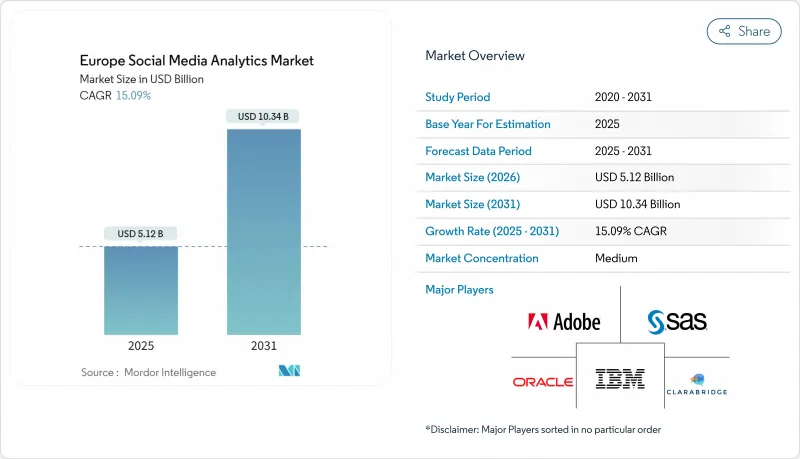
本報告按組件(監控、測量、分析和洞察)、部署模式(本地部署和雲端部署)、最終用戶行業(銀行、金融服務和保險 (BFSI)、IT 和電信、零售、醫療保健等)、組織規模(中小企業和大型企業)以及地區進行細分。市場預測以價值(美元)表示。
歐洲社群媒體分析市場的趨勢與洞察
擴大人工智慧驅動的客戶洞察平台的應用
2025年3月,Adobe將IBM Watsonx整合到Adobe Experience Platform中,使行銷人員能夠使用自然語言而非SQL查詢情緒分析,從而將洞察獲取週期從數週縮短至數小時。同月, 銷售團隊也發布了「行銷智慧」功能,其中包含13個預置連接器,可將付費社交指標和自然情緒分析整合到單一視圖中。這些產品的發布,使得人工智慧正從單純的附加功能轉變為系統的核心組件。由於主要以英語訓練的情緒分類器常常無法準確解讀羅曼語族和日耳曼語族語言的細微差別(歐洲語言平等計畫也強調了這一差距),供應商之間的競爭如今主要集中在語料庫的廣度和多語言準確性上。
歐洲公司增加數位廣告支出
根據 AdEx 基準調查,2024 年社群媒體廣告支出將達到 153.94 億歐元(168.9 億美元),增幅高達 32.8%,超過了展示廣告和搜尋廣告的成長速度。其中,社群影片支出佔比高達 56%,反映出平台演算法優先展示短影片內容。因此,品牌正在尋求能夠將廣告曝光量與後續銷售業績關聯起來的歸因引擎,同時還要滿足《數位服務法案》(DSA) 的資訊揭露要求。由此可見,能夠自動產生合規報告的分析套件正從可選項變為必備工具。
嚴格的GDPR合規性限制
自2018年以來,德國、法國和比利時的監管機構已累計對非法用戶畫像行為處以超過10億歐元(約11億美元)的罰款。儘管平台在處理個人資料之前必須獲得用戶的明確同意,但情緒分析通常會從公開貼文中推斷出人口統計訊息,監管機構正在密切監控這種做法。此外,雲端服務供應商還面臨必須建立本地資料中心的居住要求,這會增加成本,迫使供應商將這些成本轉嫁給客戶。
細分市場分析
2025年,「分析與洞察」將佔總收入的46%,成為歐洲社群媒體分析市場中構成比領域,預計到2031年將維持15.87%的複合年成長率。該領域的成長勢頭強勁,主要得益於企業更傾向於提供指導性輸出而非原始數據面板,Adobe的「Agent Orchestrator」就是一個典型的例子,它能夠自動進行受眾細分和測試。 「監控與衡量」仍能收集關鍵數據,但隨著Kafka等開放原始碼技術的興起,其價值正在下降,預算也正轉向能夠主動偵測使用者情緒轉折點的預測性工具。
《一般資料保護規則》(GDPR) 的壓力進一步推動了向洞察模組的轉變,因為聚合輸出比使用者層級日誌的法律風險更低。供應商正將匿名化功能直接整合到其流程中,以滿足德國和法國監管機構的要求,從而將合規性和決策支援整合到單一工作流程中。
預計到2025年,雲端部署將佔歐洲社群媒體分析市場收入的71%,並以16.12%的複合年成長率持續成長至2031年,超越本地部署解決方案。多語言自然語言處理模型會在宣傳活動高峰期擴展運算能力,並在流量下降時停止運作。這種模式有利於付費使用制。中小企業是成長最快的客戶群,他們傾向於選擇基於銷售費用的訂閱契約,從而避免購買硬體。
由於資料儲存位置的相關法規,銀行和政府機構仍然傾向於選擇本地部署。金融機構遵循歐洲中央銀行的外包指南,該指南規定,即使在雲端合約中,董事會也需對資料安全缺陷負責。混合模式也正在興起,在這種模式下,原始資料保留在公司防火牆內,而只有匿名化的聚合資料才會被遷移到公共雲端用於模型訓練。
其他好處:
- Excel格式的市場預測(ME)表
- 3個月的分析師支持
目錄
第1章:引言
- 研究假設和市場定義
- 調查範圍
第2章:調查方法
第3章執行摘要
第4章 市場狀況
- 市場概覽
- 市場促進因素
- 歐洲社群媒體用戶數量不斷增加
- 擴大人工智慧驅動的客戶洞察平台的應用
- 歐洲公司增加數位廣告支出
- 對即時消費者情緒分析的需求日益成長
- 針對演算法透明度的監管要求的出現,正在推動對分析技術的需求。
- 多語言情感分析模型的在地化要求
- 市場限制因素
- GDPR的嚴格合規要求
- 實施先進分析工具的成本很高
- 消費者對被視為監視的社群媒體監聽的抵制情緒日益高漲。
- 由於平台 API 的限制,資料存取呈現碎片化現象。
- 產業價值鏈分析
- 監理情勢
- 技術展望
- 波特五力分析
- 宏觀經濟因素對市場的影響
第5章 市場規模與成長預測
- 按組件
- 監測
- 測量
- 分析與見解
- 部署模式
- 現場
- 雲
- 按最終用戶行業分類
- 銀行、金融服務和保險(BFSI)
- 資訊科技和通訊
- 零售
- 衛生保健
- 政府服務
- 媒體與娛樂
- 公用事業
- 運輸/物流
- 其他終端用戶產業
- 按組織規模
- 小型企業
- 大公司
- 國家
- 英國
- 德國
- 法國
- 義大利
- 西班牙
- 其他歐洲國家
第6章 競爭情勢
- 市場集中度
- 策略趨勢
- 市佔率分析
- 公司簡介
- Adobe Inc.
- Oracle Corporation
- Salesforce Inc.
- International Business Machines Corporation
- SAP SE
- SAS Institute Inc.
- Talkwalker Sarl
- Brandwatch(part of Cision US Inc.)
- Sprout Social Inc.
- Hootsuite Inc.
- Meltwater BV
- NetBase Solutions Inc.
- Khoros LLC
- Emplifi Czech Republic as
- Qualtrics International Inc.
- Zoho Corporation Private Limited
- Google LLC
- Meta Platforms Inc.
- Ipsos Group SA
- Digimind
- Clarabridge(part of Qualtrics)
第7章 市場機會與未來展望
According to Mordor Intelligence, the Europe social media analytics market size reached USD 5.12 billion in 2026 and is projected to climb to USD 10.34 billion by 2031, advancing at a 15.09% CAGR through the forecast period.
This report is Segmented by Component (Monitoring, Measurement, and Analytics and Insight), Mode of Deployment (On-Premise, and Cloud), End-User Vertical (Banking, Financial Services and Insurance (BFSI), IT and Telecom, Retail, Healthcare, and More), Organization Size (Small and Medium Enterprises, and Large Enterprises), and Geography. The Market Forecasts are Provided in Terms of Value (USD).
Europe Social Media Analytics Market Trends and Insights
Rising Adoption of AI-Powered Customer Insights Platforms
Adobe's March 2025 integration of IBM watsonx into Adobe Experience Platform let marketers query sentiment in plain language rather than SQL, accelerating insight cycles from weeks to hours. Salesforce matched the move the same month, launching Marketing Intelligence with 13 prebuilt connectors that fuse paid-social metrics and organic sentiment in a single view. Such releases reposition artificial intelligence from bolt-on feature to system backbone. Vendors now compete on corpus breadth and multilingual accuracy because sentiment classifiers trained largely on English misread nuance in Romance and Germanic languages, a gap underscored by the European Language Equality project.
Increasing Digital Ad Spending by European Enterprises
The AdEx Benchmark Study logged EUR 15.394 billion (USD 16.89 billion) in 2024 social-media ad spend, a 32.8% jump that eclipsed display and search growth. Social video represented 56% of that outlay, reflecting platform algorithms that elevate short-form clips. As a result, brands insist on attribution engines that align impression delivery with downstream sales, while simultaneously meeting Digital Services Act disclosure requirements. Analytics suites that automate compliance reporting therefore shift from optional to mandatory.
Stringent GDPR Compliance Constraints
National regulators in Germany, France, and Belgium have issued cumulative fines exceeding EUR 1 billion (USD 1.1 billion) for unlawful profiling since 2018. Platforms must secure explicit consent before processing personal data, yet sentiment analysis often infers demographics from public posts, a practice regulators scrutinize. Cloud providers also face residency mandates that compel local data centers, inflating costs that vendors must pass to customers.
Other drivers and restraints analyzed in the detailed report include:
- Growing Demand for Real-Time Consumer Sentiment Analysis
- Emergence of Regulatory Mandates for Algorithmic Transparency Driving Analytics Demand
- Fragmented Data Access Due to Platform API Restrictions
For complete list of drivers and restraints, kindly check the Table Of Contents.
Segment Analysis
Analytics and Insight claimed 46% of 2025 revenue, the top component share of the Europe social media analytics market, and is predicted to post a 15.87% CAGR through 2031. The segment's momentum stems from enterprises that favor prescriptive outputs over raw dashboards, illustrated by Adobe's Agent Orchestrator, which automates audience segmentation and testing. Monitoring and Measurement still capture essential feeds, yet open-source stacks like Kafka shrink their value, shifting budgets toward predictive utilities that flag sentiment inflection points in advance.
General Data Protection Regulation pressure reinforces the tilt toward Insight modules because aggregated outputs carry lower legal exposure than user-level logs. Vendors bake anonymization directly into pipelines to satisfy German and French regulators, thereby combining compliance and decision support in a single workflow.
Cloud deployment generated 71% of 2025 revenue and will expand at a 16.12% CAGR through 2031, eclipsing on-premise alternatives in the Europe social media analytics market. Multilingual natural-language processing models scale compute during campaign surges then idle once traffic recedes, a pattern that favors utility pricing. Small and medium enterprises, the fastest-growing customer group, gravitate toward operating-expense subscriptions that avoid hardware acquisition.
On-premise installations persist in banking and government due to residency mandates. Financial institutions follow European Central Bank outsourcing guidelines that hold boards liable for data-security lapses even in cloud contracts. Hybrid patterns emerge: raw data remain behind corporate firewalls, while sanitized aggregates move to public clouds for model training.
Complete Report Scope:
- By Component
- Monitoring
- Measurement
- Analytics and Insight
- By Mode of Deployment
- On-Premise
- Cloud
- By End-user Vertical
- Banking, Financial Services and Insurance (BFSI)
- Information Technology and Telecommunication
- Retail
- Healthcare
- Government Services
- Media and Entertainment
- Utilities
- Transportation and Logistics
- Other End-user Verticals
- By Organization Size
- Small and Medium Enterprises
- Large Enterprises
- By Country
- United Kingdom
- Germany
- France
- Italy
- Spain
- Rest of Europe
List of Companies Covered in this Report:
- Adobe Inc.
- Oracle Corporation
- Salesforce Inc.
- International Business Machines Corporation
- SAP SE
- SAS Institute Inc.
- Talkwalker Sarl
- Brandwatch (part of Cision US Inc.)
- Sprout Social Inc.
- Hootsuite Inc.
- Meltwater B.V.
- NetBase Solutions Inc.
- Khoros LLC
- Emplifi Czech Republic a.s.
- Qualtrics International Inc.
- Zoho Corporation Private Limited
- Google LLC
- Meta Platforms Inc.
- Ipsos Group S.A.
- Digimind
- Clarabridge (part of Qualtrics)
Additional Benefits:
- The market estimate (ME) sheet in Excel format
- 3 months of analyst support
TABLE OF CONTENTS
1 INTRODUCTION
- 1.1 Study Assumptions and Market Definition
- 1.2 Scope of the Study
2 RESEARCH METHODOLOGY
3 EXECUTIVE SUMMARY
4 MARKET LANDSCAPE
- 4.1 Market Overview
- 4.2 Market Drivers
- 4.2.1 Proliferation of Social Media Users Across Europe
- 4.2.2 Rising Adoption of AI-Powered Customer Insights Platforms
- 4.2.3 Increasing Digital Ad Spending by European Enterprises
- 4.2.4 Growing Demand for Real-Time Consumer Sentiment Analysis
- 4.2.5 Emergence of Regulatory Mandates for Algorithmic Transparency Driving Analytics Demand
- 4.2.6 Localization Requirements for Multilingual Sentiment Models
- 4.3 Market Restraints
- 4.3.1 Stringent GDPR Compliance Constraints
- 4.3.2 High Implementation Costs for Advanced Analytics Tools
- 4.3.3 Growing Consumer Pushback Against Social Listening Perceived as Surveillance
- 4.3.4 Fragmented Data Access Due to Platform API Restrictions
- 4.4 Industry Value Chain Analysis
- 4.5 Regulatory Landscape
- 4.6 Technological Outlook
- 4.7 Porter's Five Forces Analysis
- 4.7.1 Bargaining Power of Buyers
- 4.7.2 Bargaining Power of Suppliers
- 4.7.3 Threat of New Entrants
- 4.7.4 Threat of Substitutes
- 4.7.5 Intensity of Competitive Rivalry
- 4.8 Impact of Macroeconomic Factors on the Market
5 MARKET SIZE AND GROWTH FORECASTS (VALUE)
- 5.1 By Component
- 5.1.1 Monitoring
- 5.1.2 Measurement
- 5.1.3 Analytics and Insight
- 5.2 By Mode of Deployment
- 5.2.1 On-Premise
- 5.2.2 Cloud
- 5.3 By End-user Vertical
- 5.3.1 Banking, Financial Services and Insurance (BFSI)
- 5.3.2 Information Technology and Telecommunication
- 5.3.3 Retail
- 5.3.4 Healthcare
- 5.3.5 Government Services
- 5.3.6 Media and Entertainment
- 5.3.7 Utilities
- 5.3.8 Transportation and Logistics
- 5.3.9 Other End-user Verticals
- 5.4 By Organization Size
- 5.4.1 Small and Medium Enterprises
- 5.4.2 Large Enterprises
- 5.5 By Country
- 5.5.1 United Kingdom
- 5.5.2 Germany
- 5.5.3 France
- 5.5.4 Italy
- 5.5.5 Spain
- 5.5.6 Rest of Europe
6 COMPETITIVE LANDSCAPE
- 6.1 Market Concentration
- 6.2 Strategic Moves
- 6.3 Market Share Analysis
- 6.4 Company Profiles {(includes Global Level Overview, Market Level Overview, Core Segments, Financials as Available, Strategic Information, Market Rank/Share for Key Companies, Products and Services, and Recent Developments)}
- 6.4.1 Adobe Inc.
- 6.4.2 Oracle Corporation
- 6.4.3 Salesforce Inc.
- 6.4.4 International Business Machines Corporation
- 6.4.5 SAP SE
- 6.4.6 SAS Institute Inc.
- 6.4.7 Talkwalker Sarl
- 6.4.8 Brandwatch (part of Cision US Inc.)
- 6.4.9 Sprout Social Inc.
- 6.4.10 Hootsuite Inc.
- 6.4.11 Meltwater B.V.
- 6.4.12 NetBase Solutions Inc.
- 6.4.13 Khoros LLC
- 6.4.14 Emplifi Czech Republic a.s.
- 6.4.15 Qualtrics International Inc.
- 6.4.16 Zoho Corporation Private Limited
- 6.4.17 Google LLC
- 6.4.18 Meta Platforms Inc.
- 6.4.19 Ipsos Group S.A.
- 6.4.20 Digimind
- 6.4.21 Clarabridge (part of Qualtrics)
7 MARKET OPPORTUNITIES AND FUTURE OUTLOOK
- 7.1 White-space and Unmet-Need Assessment

 全球社群媒體分析市場規模、佔有率、趨勢和成長分析報告(2026-2034)
 社群媒體分析:市場佔有率分析、產業趨勢與統計、成長預測(2026-2031)
 社群媒體分析市場機會、成長要素、產業趨勢分析及2026-2035年預測
 社群媒體分析市場:按組件、部署類型、組織規模、產業、應用和分銷管道分類-2026-2032年全球市場預測
 社群媒體分析市場規模、佔有率、趨勢和預測:按組件、部署類型、企業規模、應用、最終用戶和地區分類,2026-2034 年
 全球社群媒體分析市場(至2035年):按產品/服務、功能、方法論、應用、產業和地區分類-產業趨勢和市場預測
 社群媒體分析市場 - 全球產業規模、佔有率、趨勢、機會、預測:按部署方式、公司類型、功能、應用、最終用戶、地區和競爭格局分類,2021-2031 年
 2026-2030年全球社群媒體分析市場
 社群媒體分析市場:按解決方案類型、部署模式、最終用戶和地區分類
 2026年全球社群媒體分析市場報告