


 |
市場調查報告書
商品編碼
2121568
雲端遷移服務:市場佔有率分析、產業趨勢與統計資料、成長預測(2026-2031 年)Cloud Migration Services - Market Share Analysis, Industry Trends & Statistics, Growth Forecasts (2026 - 2031) |
||||||

※ 本網頁內容可能與最新版本有所差異。詳細情況請與我們聯繫。
據 Mordor Intelligence 稱,2025 年雲端遷移服務市場價值為 3000 億美元,預計到 2031 年將達到 12994.8 億美元,而 2026 年為 3830.4 億美元,預測期(2026-2031 年)的複合年成長率為 27.68%。
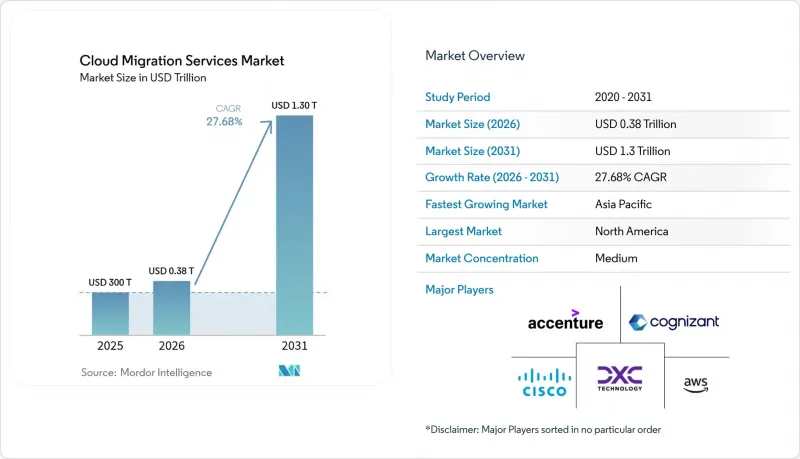
本報告按部署方式(例如,公共雲端)、企業規模(例如,中小企業)、服務類型(IaaS、PaaS、SaaS)、遷移方法(直接遷移、平台重構、重構/重建、替換)、最終用戶行業(例如,銀行、金融服務和保險 (BFSI)、醫療保健、零售)和地區進行細分。市場預測以美元 (USD) 為單位。
全球雲端遷移服務市場趨勢與洞察
透過採用雲端運算實現成本效益和可擴展性的優勢。
即使將工作負載遷移到雲端,企業仍能持續降低 20% 至 30% 的營運成本,這主要得益於消除資本密集的硬體升級週期,並可根據需要靈活擴展資源。 Infomart 將其 B2B 平台遷移到 Oracle 雲端基礎架構後,資料中心成本降低了 38%,同時效能柔軟性也提升了。如今,彈性資源配置使企業能夠應對意外的需求激增,而無需像傳統實體資料中心那樣經歷 6 至 12 個月的採購延遲。從基礎設施維護中節省下來的預算擴大被重新投入到創新工作中,從而增強企業的競爭優勢。這些累積效益意味著成本合理化策略對預期的複合年成長率 (CAGR) 產生了最大的正面影響。
遠距辦公和自備設備辦公(BYOD)的普及
隨著混合辦公模式的普及,企業正將協作套件、身分服務和安全控制遷移到雲端,以確保無論使用者身處何地或使用何種設備,都能獲得一致的使用者體驗。近期調查顯示,89% 的 IT 領導者計劃在 2025 年增加雲端支出,以支援分散式團隊。自帶裝置辦公室 (BYOD) 模式使邊界安全變得更加複雜,並促使企業轉向更容易以雲端原生形式部署的零信任架構。因此,遷移過程中擴大包含安全存取服務邊緣 (SASE)、端點管理和即時分析等多層架構,以確保員工隨時隨地維持高效率工作。這一趨勢對專案進度造成了明顯的短期拖累,尤其是在北美和歐洲地區。
資料安全和監管合規風險
歐洲企業正努力協調《一般資料保護規則》(GDPR) 的要求與公共雲端的服務模式。同時,全球金融機構也在應對重疊的司法管轄區法規,這些法規很少明確定義雲端資料流。在責任共擔模式下,加密、日誌和事件回應的責任歸屬往往不明確。在某些情況下,主權雲端要求迫使企業為本地化容量支付額外費用或維護本地基礎設施,從而拖慢遷移進度。這些因素幾乎阻礙了所有行業的成長,尤其是在醫療保健、銀行和政府部門。
細分市場分析
混合部署是成長最快的部署方式,年複合成長率高達 18.35%,企業需要在滿足低延遲的本地部署需求和利用公共雲端的可擴展性之間取得平衡。儘管超大規模雲端服務供應商的安全態勢已經相當成熟,但公共雲端仍佔據雲端遷移服務市場 54.82% 的佔有率。邊緣雲端整合允許將運算資源部署得更靠近用戶,同時保持後端分析連接的可靠性,這表明未來的架構將在單一工作流程中整合多個執行位置。能夠協調工作負載在這些節點間部署的遷移專家的需求仍然強勁。
企業不再將部署模式視為非此即彼的選擇。金融機構正在將交易引擎部署在私有叢集上,以實現亞毫秒級的延遲,同時將監管報告任務卸載到成本效益更高的公共儲存桶中。醫療機構則在本地處理影像數據,然後將匿名資料傳輸到雲端的AI管道。這些略有不同的部署模式凸顯了混合解決方案為何將在雲端遷移服務市場持續擴大其影響力。
預計到2025年,大型企業將佔據雲端遷移服務市場規模的61.20%,這反映了它們多年期的轉型預算和全球部署。同時,中小企業預計將實現17.65%的複合年成長率,這主要得益於打包式遷移工具鏈的普及,這些工具鏈能夠縮短設定時間並降低專業技術門檻。雲端服務供應商目前正在進行服務細分,例如為財富500強企業提供精細的諮詢服務,為中小企業提供標準化的模板,從而在不影響利潤率的前提下拓展目標市場。
中小企業 (SME) 擴大選擇 SaaS 替代方案和託管服務,以避免組建內部營運團隊的高昂成本。同時,大型企業正在數十個業務部門中分階段推進架構重構,這些重構基於「卓越中心 (CoE)」團隊,這些團隊負責系統化管治和安全藍圖。這種兩極化要求供應商制定差異化的上市時間策略,以適應每個客戶群的預算週期和合規要求。
區域分析
預計到2025年,北美地區的雲端支出將佔全球的37.10%,這主要得益於目前專注於人工智慧最佳化和多重雲端成本管治的早期採用者。美國透過聯邦雲端計畫主導,其中包括83億美元的現代化預算;而加拿大和墨西哥則透過提升網路骨幹網路來加速雲端採用。在全部區域,各組織都在部署預測性工作負載部署引擎,以最佳化消費模式並控制出站費用,這進一步鞏固了北美作為雲端遷移服務市場中心的地位。
亞太地區預計到2031年將實現18.15%的複合年成長率,主要得益於國家級數位轉型基金和超大規模資料中心業者資料中心營運商的投資。微軟已撥款29億美元用於擴建其在日本的資料中心,體現了其對日本雲端市場成長前景的信心。在印度,受銀行、金融服務和保險(BFSI)、零售和政府機構等行業的廣泛現代化推動,預計2028年,印度雲端市場規模將達到255億美元。在中國,在數據本地化法規的支持下,本土雲端服務供應商透過提供針對各國需求的獨特服務,不斷擴大市場佔有率。該地區多元化的監管環境使得混合雲端和多重雲端架構呈現出複雜的局面,企業在遷移過程中必須成功應對這些挑戰。
在歐洲,穩定成長與嚴格的資料主權法規並行。德國和英國仍然是最大的採用者,而法國和西班牙則正在推動主權雲端框架的建設,以支持本國供應商。 GDPR 的實施要求所有專案都必須進行細緻的資料位置映射和加密管治。因此,混合策略正逐漸成為主流,它允許敏感工作負載保留在國內,同時利用可擴展的區域節點執行分析和人工智慧任務。這一趨勢表明,在整個預測期內,歐洲的轉型將與優先考慮合規性的架構緊密相關。
其他好處:
- Excel格式的市場預測(ME)表
- 3個月的分析師支持
目錄
第1章:引言
- 市場分析與定義的前提條件
- 分析範圍
第2章 分析方法
第3章執行摘要
第4章 市場狀況
- 市場概覽
- 市場促進因素
- 採用雲端的成本效益和擴充性優勢
- 遠距辦公和自備設備辦公(BYOD)的普及
- 政府為數位轉型提供資金
- 混合/多重雲端策略的普及
- 利用生成式人工智慧加速重構工作負載
- 範圍 3 報告正在推動一場關注碳排放的轉型。
- 市場限制因素
- 資料安全和監管合規風險
- 舊有應用程式的複雜性和互通性
- 不斷飆升的雲端出口成本正在影響整體擁有成本。
- 強制採用主權雲端引發了對供應商鎖定的擔憂。
- 價值鍊和供應鏈分析
- 監理情勢
- 技術展望
- 宏觀經濟因素的影響
- 投資分析
- 波特五力分析
第5章:預測市場規模與成長率
- 透過部署方法
- 公共雲端
- 私有雲端
- 混合雲端
- 多重雲端
- 按公司規模
- 中小企業
- 大公司
- 按服務類型
- IaaS (Infrastructure-as-a-Service)
- PaaS (Platform-as-a-Service)
- SaaS (Software-as-a-Service)
- 透過過渡方法
- 遷移和重新託管
- 重新平台
- 重構/重建架構
- 替代方案(使用 SaaS 的替代方案)
- 按最終用戶行業分類
- 銀行、金融服務和保險業 (BFSI)
- 醫學與生命科學
- 零售與電子商務
- 政府/公共部門
- 資訊科技/通訊
- 製造業
- 能源公用事業
- 其他
- 按地區
- 北美洲
- 美國
- 加拿大
- 墨西哥
- 南美洲
- 巴西
- 阿根廷
- 歐洲
- 德國
- 英國
- 法國
- 俄羅斯
- 其他歐洲國家
- 亞太地區
- 中國
- 印度
- 日本
- 韓國
- 其他亞太國家
- 中東和非洲
- 中東
- 沙烏地阿拉伯
- UAE
- 土耳其
- 非洲
- 南非
- 奈及利亞
- 中東
- 北美洲
第6章 競爭情勢
- 市場集中度
- 策略趨勢
- 市佔率分析
- 公司簡介
- Accenture plc
- Amazon Web Services Inc.
- Cisco Systems Inc.
- Cognizant Technology Solutions Corporation
- DXC Technology Company
- Evolve IP LLC
- Google LLC
- International Business Machines Corporation(IBM)
- Microsoft Corporation
- Oracle Corporation
- Rackspace Technology Inc.
- Flexera Software LLC(RightScale)
- Tech Mahindra Limited
- VMware Inc.
- WSM International LLC
- Infosys Limited
- HCL Technologies Limited
- Capgemini SE
- Atos SE
- Fujitsu Limited
- Alibaba Cloud(Alibaba Group Holding Limited)
- Kyndryl Holdings Inc.
- Tata Consultancy Services Limited
- NTT Data Corporation
第7章 市場機會與未來展望
According to Mordor Intelligence, the cloud migration services market size was valued at USD 300 billion in 2025 and estimated to grow from USD 383.04 billion in 2026 to reach USD 1299.48 billion by 2031, at a CAGR of 27.68% during the forecast period (2026-2031).
This report is Segmented by Deployment Type (Public Cloud, and More), Enterprise Size (Small and Medium Enterprises, and More), Service Type (IaaS, Paas, Saas), Migration Approach (Lift-And-Shift, Re-Platform, Refactor/Re-architect, Replace), End-User Vertical (BFSI, Healthcare, Retail, and More), and Geography. The Market Forecasts are Provided in Terms of Value (USD).
Global Cloud Migration Services Market Trends and Insights
Cost-efficiency and Scalability Advantages of Cloud Adoption
Enterprises continue to realize 20-30% operational-expenditure savings after moving workloads to the cloud, primarily by eliminating capital-intensive hardware refresh cycles and right-sizing resources on demand. Infomart's business-to-business platform migration to Oracle Cloud Infrastructure cut data-center costs by 38% while boosting performance flexibility. Elastic resource provisioning now allows organizations to handle unexpected demand spikes without the six-to-twelve-month procurement delays common in physical data-center environments. Budget freed from infrastructure upkeep is increasingly redirected toward innovation initiatives that sharpen competitive differentiation. These cumulative benefits give cost-rationalization strategies the highest positive impact on the forecast CAGR.
Rising Remote-work and BYOD Penetration
Hybrid work models have solidified, prompting organizations to migrate collaboration suites, identity services and security controls to the cloud to guarantee consistent user experiences across locations and devices. A recent survey shows 89% of IT leaders intend to raise cloud spending in 2025 to support distributed teams. BYOD complicates perimeter security, steering enterprises toward zero-trust architectures that are easier to enforce in cloud-native form. Consequently, migrations increasingly encompass secure access service edge, endpoint management and real-time analytics layers that maintain workforce productivity from any location. This trend exerts a strong, near-term pull on project pipelines, particularly in North America and Europe.
Data-security and Regulatory-compliance Risks
European firms struggle to reconcile General Data Protection Regulation (GDPR) stipulations with public-cloud service models, while global financial institutions juggle overlapping jurisdictional rules that rarely address cloud data flows explicitly. The shared-responsibility model often blurs accountability for encryption, logging and incident response. In some cases, sovereign-cloud requirements force organizations to pay premiums for localized capacity or retain on-premises infrastructure, extending migration timelines. These factors temper growth across nearly every industry, especially healthcare, banking and government.
Other drivers and restraints analyzed in the detailed report include:
- Government Digital-transformation Funding
- Proliferation of Hybrid / Multi-cloud Strategies
- Legacy-application Complexity and Interoperability
For complete list of drivers and restraints, kindly check the Table Of Contents.
Segment Analysis
Hybrid deployments are the fastest riser, advancing at an 18.35% CAGR as enterprises balance low-latency on-premises demands with public-cloud scale. Public cloud still holds 54.82% cloud migration services market share due to the mature security posture of hyperscale providers. Edge-cloud integrations now push compute closer to the user while maintaining elastic backend analytics connectivity, signaling that future architectures will combine multiple execution venues within a single workflow. Migration specialists able to orchestrate workload placement across these nodes remain in high demand.
Enterprises no longer view deployment as a binary choice. Financial institutions position trading engines on private clusters for sub-millisecond latency while offloading regulatory reporting to cost-efficient public buckets. Healthcare groups process imaging data on-site, then route anonymized sets to AI pipelines in the cloud. These nuanced blueprints underline why hybrid options will keep expanding their footprint within the cloud migration services market.
Large enterprises accounted for 61.20% of cloud migration services market size in 2025, reflecting multi-year transformation budgets and global rollouts. Yet SMEs exhibit an 17.65% CAGR, propelled by packaged migration toolchains that cut setup time and lower expertise thresholds. Cloud providers now segment offerings-white-glove consulting for Fortune 500 clients versus prescriptive templates for smaller firms-thereby widening addressable demand without eroding margins.
SMEs gravitate toward SaaS replacements and managed services to avoid staffing expensive in-house operations teams. Conversely, large entities pursue phased re-architecting across dozens of business units, often underpinned by center-of-excellence teams that codify governance and security blueprints. This bifurcation requires service vendors to maintain differentiated go-to-market motions tailored to each cohort's budget cycles and compliance obligations.
Complete Report Scope:
- By Deployment Type
- Public Cloud
- Private Cloud
- Hybrid Cloud
- Multi-Cloud
- By Enterprise Size
- Small and Medium Enterprises (SMEs)
- Large Enterprises
- By Service Type
- Infrastructure-as-a-Service (IaaS)
- Platform-as-a-Service (PaaS)
- Software-as-a-Service (SaaS)
- By Migration Approach
- Lift-and-Shift (Re-hosting)
- Re-platform
- Refactor / Re-architect
- Replace (SaaS Substitution)
- By End-user Vertical
- Banking, Financial Services and Insurance (BFSI)
- Healthcare and Life Sciences
- Retail and E-commerce
- Government and Public Sector
- IT and Telecommunication
- Manufacturing
- Energy and Utilities
- Others
- By Geography
- North America
- United States
- Canada
- Mexico
- South America
- Brazil
- Argentina
- Europe
- Germany
- United Kingdom
- France
- Russia
- Rest of Europe
- Asia-Pacific
- China
- India
- Japan
- South Korea
- Rest of Asia-Pacific
- Middle East and Africa
- Middle East
- Saudi Arabia
- UAE
- Turkey
- Africa
- South Africa
- Nigeria
- Middle East
- North America
Geography Analysis
North America captured 37.10% of 2025 spend, anchored by early adopters that now focus on AI optimization and multi-cloud cost governance. The United States leads through federal cloud programs such as the USD 8.3 billion modernization budget, while Canada and Mexico leverage improved network backbones to accelerate adoption. Across the region, organizations are integrating predictive workload placement engines to refine consumption models and curb egress charges, reinforcing North America's position at the core of the cloud migration services market.
Asia-Pacific is projected to post an 18.15% CAGR to 2031, propelled by state-level digital-transformation funds and hyperscaler investments. Microsoft earmarked USD 2.9 billion for data-center expansion in Japan, demonstrating confidence in Japan's cloud trajectory. India is on course for a USD 25.5 billion cloud sector by 2028, reflecting widespread modernization across BFSI, retail and government. China's domestic providers, supported by data-localization rules, continue to grow market share via tailored sovereign offerings. The region's diverse regulatory landscape shapes a patchwork of hybrid and multi-cloud designs that migration firms must navigate.
Europe pairs steady growth with stringent data-sovereignty controls. Germany and the United Kingdom remain the largest adopters, yet France and Spain are championing sovereign-cloud frameworks that bolster domestic vendors. GDPR enforcement compels meticulous residency mapping and encryption governance across every project. Consequently, hybrid strategies dominate, allowing sensitive workloads to stay on national soil while analytics and AI tasks harness scalable regional nodes. This dynamic will keep Europe's migration profile firmly tied to compliance-first architectures throughout the forecast period.
- Accenture plc
- Amazon Web Services Inc.
- Cisco Systems Inc.
- Cognizant Technology Solutions Corporation
- DXC Technology Company
- Evolve IP LLC
- Google LLC
- International Business Machines Corporation (IBM)
- Microsoft Corporation
- Oracle Corporation
- Rackspace Technology Inc.
- Flexera Software LLC (RightScale)
- Tech Mahindra Limited
- VMware Inc.
- WSM International LLC
- Infosys Limited
- HCL Technologies Limited
- Capgemini SE
- Atos SE
- Fujitsu Limited
- Alibaba Cloud (Alibaba Group Holding Limited)
- Kyndryl Holdings Inc.
- Tata Consultancy Services Limited
- NTT Data Corporation
Additional Benefits:
- The market estimate (ME) sheet in Excel format
- 3 months of analyst support
TABLE OF CONTENTS
1 INTRODUCTION
- 1.1 Study Assumptions and Market Definition
- 1.2 Scope of the Study
2 RESEARCH METHODOLOGY
3 EXECUTIVE SUMMARY
4 MARKET LANDSCAPE
- 4.1 Market Overview
- 4.2 Market Drivers
- 4.2.1 Cost-efficiency and scalability advantages of cloud adoption
- 4.2.2 Rising remote-work and BYOD penetration
- 4.2.3 Government digital-transformation funding
- 4.2.4 Proliferation of hybrid / multi-cloud strategies
- 4.2.5 Generative-AI workload acceleration of refactoring
- 4.2.6 Scope-3 reporting pushes carbon-aware migrations
- 4.3 Market Restraints
- 4.3.1 Data-security and regulatory-compliance risks
- 4.3.2 Legacy-application complexity and interoperability
- 4.3.3 Escalating cloud-egress fees impact TCO
- 4.3.4 Vendor lock-in fears amid sovereign-cloud mandates
- 4.4 Value / Supply-Chain Analysis
- 4.5 Regulatory Landscape
- 4.6 Technological Outlook
- 4.7 Impact of Macro-Economic Factors
- 4.8 Investment Analysis
- 4.9 Porter's Five Forces
- 4.9.1 Threat of New Entrants
- 4.9.2 Bargaining Power of Buyers
- 4.9.3 Bargaining Power of Suppliers
- 4.9.4 Threat of Substitutes
- 4.9.5 Intensity of Competitive Rivalry
5 MARKET SIZE AND GROWTH FORECASTS (VALUE)
- 5.1 By Deployment Type
- 5.1.1 Public Cloud
- 5.1.2 Private Cloud
- 5.1.3 Hybrid Cloud
- 5.1.4 Multi-Cloud
- 5.2 By Enterprise Size
- 5.2.1 Small and Medium Enterprises (SMEs)
- 5.2.2 Large Enterprises
- 5.3 By Service Type
- 5.3.1 Infrastructure-as-a-Service (IaaS)
- 5.3.2 Platform-as-a-Service (PaaS)
- 5.3.3 Software-as-a-Service (SaaS)
- 5.4 By Migration Approach
- 5.4.1 Lift-and-Shift (Re-hosting)
- 5.4.2 Re-platform
- 5.4.3 Refactor / Re-architect
- 5.4.4 Replace (SaaS Substitution)
- 5.5 By End-user Vertical
- 5.5.1 Banking, Financial Services and Insurance (BFSI)
- 5.5.2 Healthcare and Life Sciences
- 5.5.3 Retail and E-commerce
- 5.5.4 Government and Public Sector
- 5.5.5 IT and Telecommunication
- 5.5.6 Manufacturing
- 5.5.7 Energy and Utilities
- 5.5.8 Others
- 5.6 By Geography
- 5.6.1 North America
- 5.6.1.1 United States
- 5.6.1.2 Canada
- 5.6.1.3 Mexico
- 5.6.2 South America
- 5.6.2.1 Brazil
- 5.6.2.2 Argentina
- 5.6.3 Europe
- 5.6.3.1 Germany
- 5.6.3.2 United Kingdom
- 5.6.3.3 France
- 5.6.3.4 Russia
- 5.6.3.5 Rest of Europe
- 5.6.4 Asia-Pacific
- 5.6.4.1 China
- 5.6.4.2 India
- 5.6.4.3 Japan
- 5.6.4.4 South Korea
- 5.6.4.5 Rest of Asia-Pacific
- 5.6.5 Middle East and Africa
- 5.6.5.1 Middle East
- 5.6.5.1.1 Saudi Arabia
- 5.6.5.1.2 UAE
- 5.6.5.1.3 Turkey
- 5.6.5.2 Africa
- 5.6.5.2.1 South Africa
- 5.6.5.2.2 Nigeria
- 5.6.5.1 Middle East
- 5.6.1 North America
6 COMPETITIVE LANDSCAPE
- 6.1 Market Concentration
- 6.2 Strategic Moves
- 6.3 Market Share Analysis
- 6.4 Company Profiles (includes Global-level Overview, Market-level Overview, Core Segments, Financials as available, Strategic Information, Market Rank/Share for key companies, Products and Services, Recent Developments)
- 6.4.1 Accenture plc
- 6.4.2 Amazon Web Services Inc.
- 6.4.3 Cisco Systems Inc.
- 6.4.4 Cognizant Technology Solutions Corporation
- 6.4.5 DXC Technology Company
- 6.4.6 Evolve IP LLC
- 6.4.7 Google LLC
- 6.4.8 International Business Machines Corporation (IBM)
- 6.4.9 Microsoft Corporation
- 6.4.10 Oracle Corporation
- 6.4.11 Rackspace Technology Inc.
- 6.4.12 Flexera Software LLC (RightScale)
- 6.4.13 Tech Mahindra Limited
- 6.4.14 VMware Inc.
- 6.4.15 WSM International LLC
- 6.4.16 Infosys Limited
- 6.4.17 HCL Technologies Limited
- 6.4.18 Capgemini SE
- 6.4.19 Atos SE
- 6.4.20 Fujitsu Limited
- 6.4.21 Alibaba Cloud (Alibaba Group Holding Limited)
- 6.4.22 Kyndryl Holdings Inc.
- 6.4.23 Tata Consultancy Services Limited
- 6.4.24 NTT Data Corporation
7 MARKET OPPORTUNITIES AND FUTURE OUTLOOK
- 7.1 White-space and Unmet-Need Assessment

 全球雲端遷移軟體市場規模、佔有率、趨勢和成長分析報告(2026-2034)
 雲端原生網路功能遷移服務:市場佔有率分析、產業趨勢和統計數據以及成長預測(2026-2031 年)
 持續智慧市場-2026-2032年全球市場預測
 雲端遷移服務市場機會、成長要素、產業趨勢分析及 2026-2035 年預測。雲端遷移服務市場:依服務類型、服務供應商、遷移策略、資料類型、企業規模、部署模式和產業分類-2026-2032年全球市場預測ERP升級與遷移服務:市場佔有率分析、產業趨勢與統計數據以及成長預測(2026-2031年)
 雲端遷移服務市場規模、佔有率、趨勢和預測:按服務類型、企業規模、部署模式、應用程式、產業和地區分類,2026-2034 年
 雲端遷移服務市場:按元件、部署類型、企業規模、最終用戶產業和地區分類全球雲端辦公室遷移工具市場規模、佔有率、趨勢和成長分析報告(2026-2034年)
 2026年全球雲端遷移服務市場報告